The Toyota Tundra is manufactured exclusively at Toyota Motor Manufacturing Texas (TMMTX), a state of the art production facility located in San Antonio, Texas, USA. Since 2008, every Toyota Tundra sold in North America has been assembled at this plant, making the truck one of Toyota’s most significant American made vehicles.
Covering more than 2,000 acres, the San Antonio facility represents a multi billion dollar investment by Toyota and serves as one of the company’s most important manufacturing hubs outside Japan. The plant employs thousands of workers and produces hundreds of thousands of vehicles annually, including the Toyota Tundra and the Toyota Sequoia SUV.
For many truck buyers, the manufacturing location matters. Full size pickup trucks have traditionally been associated with American brands such as Ford, Chevrolet, and Ram. By building the Tundra in Texas, Toyota demonstrates its commitment to competing directly in the highly competitive North American truck market while supporting local jobs and communities.
The San Antonio plant utilizes Toyota’s renowned production system, which focuses on efficiency, quality control, and continuous improvement. Every stage of production, from stamping and welding to painting and final assembly, follows strict standards designed to ensure durability and reliability.
As a result, the Toyota Tundra benefits from a combination of Japanese engineering and American manufacturing expertise. This blend has helped establish the truck’s reputation for long term dependability and strong resale value.
Why Does Toyota Build the Tundra in Texas?
Toyota chose Texas for several strategic reasons. First and foremost, Texas is one of the largest pickup truck markets in the United States. Truck ownership is deeply ingrained in the state’s culture, making it an ideal location for producing a vehicle designed specifically for American consumers.
Building the Tundra close to its primary customer base allows Toyota to reduce transportation costs, shorten delivery times, and respond more quickly to market demand. Instead of shipping completed trucks from overseas, Toyota can manufacture and distribute vehicles directly from within the United States.
Another advantage is access to a well established supplier network. Numerous automotive parts manufacturers operate throughout Texas and neighboring states, enabling Toyota to source many components domestically. This helps improve supply chain efficiency and supports local economies.
The location also provides excellent logistics infrastructure. Texas offers major highways, rail connections, and access to ports that facilitate the movement of parts and finished vehicles across North America.
In addition, manufacturing in the United States strengthens Toyota’s image among buyers who prefer vehicles built domestically. Many consumers are surprised to learn that the Toyota Tundra is assembled in America and contributes significantly to U.S. manufacturing employment.
Toyota’s investment in Texas reflects a long term commitment to the North American market and reinforces the company’s goal of delivering vehicles that meet the specific needs of American truck owners.
A Brief History of Toyota Tundra Manufacturing
The Toyota Tundra was first introduced for the 2000 model year as Toyota’s entry into the full size pickup truck segment. Unlike smaller pickup trucks sold in other global markets, the Tundra was specifically designed to appeal to North American drivers.
Early production of the first generation Tundra took place at Toyota’s manufacturing facility in Princeton, Indiana. At the time, demand for the truck was still developing, and the Indiana plant provided sufficient production capacity.
As the popularity of the Tundra grew, Toyota recognized the need for a dedicated manufacturing facility capable of supporting future expansion. In response, the company announced plans to build a new truck production plant in San Antonio, Texas.
The Texas facility officially began producing the Tundra in 2006. By 2008, all Tundra production had been consolidated at the San Antonio plant, creating a centralized manufacturing operation focused entirely on Toyota’s full size truck program.
Over the years, Toyota has continued investing in advanced manufacturing technologies, workforce development, and facility upgrades. These improvements have enabled the plant to produce newer generations of the Tundra while maintaining high standards of quality and efficiency.
Today, the San Antonio facility remains the sole production location for the Toyota Tundra, underscoring its importance within Toyota’s global manufacturing network.
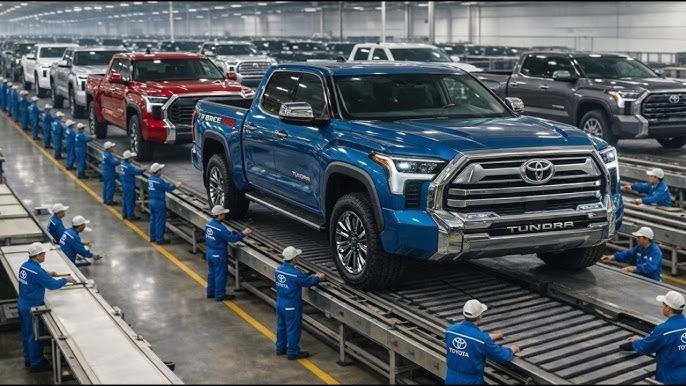
Inside the San Antonio Manufacturing Plant
The Toyota Motor Manufacturing Texas facility in San Antonio is one of the most advanced automotive production plants in North America. Spanning more than 2,000 acres, the complex was specifically designed to support the production of full size trucks and sport utility vehicles for the North American market.
The manufacturing process begins with large steel sheets that are stamped into body panels using powerful presses. These panels are then transferred to highly automated welding stations, where hundreds of robotic systems work alongside skilled technicians to create the truck’s structural framework. Precision is critical during this stage because the integrity of the frame directly affects safety, durability, and overall performance.
After welding, the vehicle body enters the paint shop. Toyota employs sophisticated painting technologies that help protect the truck from corrosion while delivering a durable and attractive finish. Multiple layers of coatings are applied and inspected to ensure consistent quality throughout the production process.
The final assembly stage is where thousands of components come together to create a finished Toyota Tundra. Engines, transmissions, interiors, electrical systems, and exterior components are installed according to strict manufacturing standards. Every vehicle undergoes extensive inspections before leaving the factory.
Quality control remains one of the most important aspects of the facility. Toyota’s manufacturing philosophy emphasizes continuous improvement and defect prevention. Employees are encouraged to identify potential issues early, helping maintain the reliability for which the Toyota brand is known worldwide.
The San Antonio plant also demonstrates Toyota’s commitment to sustainability. The facility incorporates water conservation initiatives, waste reduction programs, and energy efficiency measures designed to minimize environmental impact while maintaining high production output.
Today, the plant produces both the Toyota Tundra and the Toyota Sequoia, making it a vital component of Toyota’s North American operations.
Are Toyota Tundras Made Entirely in the USA?
A common question among truck buyers is whether the Toyota Tundra is completely made in the United States. The answer is somewhat complex.
While every Toyota Tundra is assembled in San Antonio, Texas, not every component originates from the United States. Like most modern vehicles, the Tundra relies on a global supply chain that sources parts and materials from multiple countries.
Many key components are produced by suppliers located throughout the United States, Canada, and Mexico. Certain specialized parts may also come from Japan or other regions where Toyota maintains manufacturing operations. This approach allows Toyota to combine global expertise with local production capabilities.
Despite utilizing an international supply network, the Toyota Tundra consistently ranks among vehicles with significant North American content. The company works closely with domestic suppliers and invests heavily in local manufacturing partnerships to support production.
For consumers who prioritize American manufacturing, it is important to understand the distinction between assembly location and parts origin. The Tundra is built in America by an American workforce, but like virtually every major pickup truck sold today, it contains components sourced from various countries.
This reality is not unique to Toyota. Even trucks produced by traditional American brands often rely on global suppliers for engines, electronics, raw materials, and specialized components. The modern automotive industry operates on an interconnected international manufacturing system.
Ultimately, the Toyota Tundra represents a blend of Japanese engineering, American assembly, and global sourcing. This combination helps deliver the quality, performance, and reliability that many truck owners expect from the vehicle.
How Tundra Manufacturing Compares to Other Full Size Trucks
The Toyota Tundra competes directly against some of the most recognizable trucks in North America, including the Ford F 150, Chevrolet Silverado 1500, and Ram 1500. While these vehicles share the same market segment, their manufacturing strategies differ in several ways.
The Ford F 150 is produced at multiple facilities within the United States. Ford operates major truck assembly plants in Michigan and Missouri, allowing the company to maintain high production volumes and respond quickly to consumer demand. As America’s best selling truck for decades, the F 150 benefits from an extensive domestic manufacturing network.
The Chevrolet Silverado is assembled at several facilities across North America, including plants in the United States, Canada, and Mexico. This multi plant strategy helps General Motors optimize production capacity and supply chain efficiency across different markets.
The Ram 1500 is primarily assembled in Michigan, although various components are sourced from suppliers throughout North America and beyond. Like its competitors, Ram utilizes a combination of domestic production and international sourcing to support manufacturing operations.
What makes the Toyota Tundra unique is its single production location. Every Tundra sold in North America comes from the same San Antonio facility. This centralized manufacturing approach allows Toyota to maintain consistent quality standards and streamlined production processes.
Another notable distinction is Toyota’s production philosophy. The Toyota Production System has long been regarded as one of the most influential manufacturing methodologies in the world. Its emphasis on efficiency, waste reduction, employee involvement, and continuous improvement has inspired manufacturers across numerous industries.
Many buyers who compare the Toyota Tundra with domestic rivals ultimately focus on factors such as reliability, resale value, and long term ownership costs. The truck’s manufacturing location often becomes part of that discussion, especially among consumers who value vehicles assembled in the United States.
Although each manufacturer follows a different production strategy, the Toyota Tundra has successfully established itself as a credible competitor in the highly competitive full size truck segment. Its Texas manufacturing roots have played a significant role in helping the vehicle earn acceptance among American truck buyers.
Does Manufacturing Location Affect Toyota Tundra Quality?
For many truck buyers, the location where a vehicle is manufactured can influence purchasing decisions. Some consumers associate certain countries or factories with higher quality standards, while others prioritize domestic production. When it comes to the Toyota Tundra, the manufacturing location plays an important role, but it is only one part of a much larger quality equation.
Toyota has built its global reputation on consistency, reliability, and strict quality control procedures. Regardless of whether a vehicle is assembled in Japan, the United States, or another country, the company follows standardized production methods designed to ensure every vehicle meets the same performance and safety expectations.
The San Antonio plant operates under the Toyota Production System, a manufacturing philosophy focused on efficiency, continuous improvement, and defect prevention. Employees receive extensive training and are empowered to identify and address potential issues before they become larger problems. This proactive approach helps maintain high quality standards throughout the assembly process.
Another factor contributing to the Tundra’s reputation is Toyota’s commitment to rigorous testing. Components and completed vehicles undergo extensive inspections to verify durability, functionality, and safety. These evaluations help ensure that each truck can withstand demanding real world conditions, whether used for towing, hauling, off road adventures, or everyday driving.
Industry studies and owner surveys consistently rank the Toyota Tundra among the most reliable full size pickup trucks available. Many owners report driving their trucks for hundreds of thousands of miles with relatively few major mechanical issues. This long term dependability is often attributed to Toyota’s engineering standards and disciplined manufacturing practices.
Ultimately, the fact that the Tundra is manufactured in Texas does not diminish its quality. Instead, it demonstrates Toyota’s ability to successfully apply its proven production principles within an American manufacturing environment. Buyers benefit from a truck that combines world class engineering with domestic assembly, resulting in a product known for durability and longevity.
Frequently Asked Questions
Is the Toyota Tundra manufactured in Japan?
No. The Toyota Tundra is not manufactured in Japan. All current Toyota Tundra models are assembled at Toyota Motor Manufacturing Texas in San Antonio, Texas. While some components may originate from international suppliers, final vehicle assembly takes place in the United States.
Where is the Toyota Tundra factory located?
The Toyota Tundra is built at Toyota Motor Manufacturing Texas, located in San Antonio, Texas. This facility serves as the exclusive production site for the Tundra and the Toyota Sequoia.
Are all Toyota Tundras made in Texas?
Yes. Every Toyota Tundra currently sold in North America is assembled at the San Antonio manufacturing plant. Toyota consolidated Tundra production at this facility to improve efficiency and maintain consistent quality standards.
What other vehicles are built at the San Antonio plant?
In addition to the Toyota Tundra, the San Antonio facility also produces the Toyota Sequoia full size SUV. Both vehicles share certain components and manufacturing resources within the plant.
Does the Toyota Tundra qualify as an American made truck?
The Toyota Tundra is assembled in the United States by American workers and includes a significant amount of North American sourced content. However, like most modern vehicles, some components come from international suppliers. Many buyers still consider the Tundra an American built truck because of its domestic assembly and substantial economic contribution to U.S. manufacturing.
Why did Toyota choose Texas for Tundra production?
Toyota selected Texas because of its strong truck culture, strategic location, extensive transportation infrastructure, and access to a skilled workforce. Building the Tundra in Texas also allows Toyota to stay closer to one of its largest customer markets.
Is the Toyota Tundra more reliable because it is built in Texas?
Reliability is primarily the result of engineering design, manufacturing processes, and quality control standards rather than geographic location alone. Toyota applies the same rigorous production principles at its Texas facility that have helped establish the company’s reputation worldwide.
Conclusion
So, where is the Toyota Tundra manufactured? The answer is straightforward. Every Toyota Tundra is assembled at Toyota Motor Manufacturing Texas in San Antonio, Texas. This state of the art facility has served as the truck’s exclusive production home for many years and remains one of Toyota’s most important manufacturing operations in North America.
Toyota’s decision to build the Tundra in Texas reflects a strategic commitment to the American truck market. By producing the vehicle close to its primary customer base, the company can improve logistics, support local economies, and deliver a truck tailored specifically to the needs of North American drivers.
Although the Tundra incorporates components sourced from a global supply chain, its final assembly takes place in the United States under Toyota’s renowned quality standards. The result is a full size pickup truck that combines advanced engineering, dependable performance, and strong manufacturing expertise.
Whether you are researching your next truck purchase, comparing full size pickups, or simply curious about Toyota’s production operations, understanding where the Toyota Tundra is manufactured provides valuable insight into one of the most respected trucks on the road today. Its Texas roots continue to play a major role in its identity, helping the Tundra stand out in one of the most competitive segments of the automotive industry.