The Hyundai P1326 code is one of the most alarming engine trouble codes that Hyundai owners can experience. In many cases, this warning appears suddenly along with a flashing check engine light, reduced engine power, and limp mode activation. For some drivers, the issue begins with a strange knocking sound from the engine. Others notice sluggish acceleration or rough idling before the vehicle becomes difficult to drive safely.
What makes the Hyundai P1326 code especially concerning is its connection to potential engine damage. This trouble code is commonly associated with the Knock Sensor Detection System, also known as KSDS, which Hyundai designed to detect abnormal engine vibrations linked to rod bearing wear. If the system detects unusual knocking patterns, the vehicle may enter a protective driving mode to prevent catastrophic engine failure.
Many Hyundai owners become frustrated after discovering that repair costs can quickly rise into the thousands of dollars. In severe cases, the problem may require a complete engine replacement. The situation becomes even more stressful when drivers are unsure whether their vehicle qualifies for Hyundai warranty extensions or recall related repairs.
Understanding the Hyundai P1326 code early can help prevent further damage and reduce repair expenses. This guide explains the meaning of the code, the most common symptoms, possible causes, repair costs, and proven solutions. You will also learn which Hyundai models are most affected and whether it is safe to continue driving with this warning active.
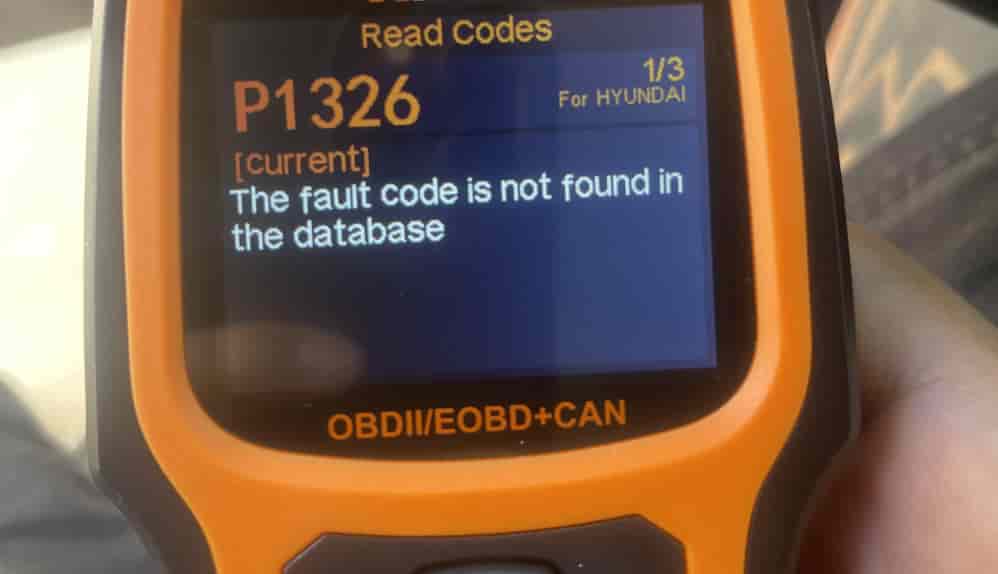
What Does the Hyundai P1326 Code Mean?
The Hyundai P1326 code indicates that the vehicle’s Knock Sensor Detection System has detected abnormal engine vibrations that may point to internal engine damage. In most situations, the code appears when the engine control module identifies knocking patterns associated with worn rod bearings or excessive engine stress.
Modern Hyundai engines rely on knock sensors to monitor combustion vibrations inside the engine block. These sensors help the engine control module adjust ignition timing and maintain smooth performance. However, when the vibrations exceed safe operating limits, the system interprets the condition as a possible engine failure risk. As a result, the vehicle stores the P1326 trouble code and may activate limp mode to protect the engine from additional damage.
Limp mode significantly reduces engine power and limits acceleration. This protective function is designed to help drivers avoid complete engine seizure while still allowing the vehicle to reach a repair facility safely. Although the car may still operate, performance becomes severely restricted, especially during highway driving or uphill acceleration.
In many Hyundai vehicles, the P1326 code has become closely linked to Theta II engine problems. These engines have faced widespread complaints involving rod bearing wear, oil flow issues, and engine knocking. Because of this history, Hyundai introduced software updates, warranty extensions, and inspection programs for affected vehicles.
Drivers often misunderstand the Hyundai P1326 code as a simple sensor problem. In reality, the warning can indicate deeper mechanical damage inside the engine. Ignoring the issue may lead to severe consequences, including complete engine failure and extremely expensive repairs.
Common Symptoms of the Hyundai P1326 Code
When the Hyundai P1326 code appears, the vehicle usually does not fail silently. Instead, it sends several clear warning signals that indicate something is wrong inside the engine. One of the most noticeable symptoms is a flashing check engine light, which often appears suddenly while driving or starting the car. This flashing light is a serious warning and should not be ignored because it typically indicates potential engine damage rather than a minor sensor issue.
Another common symptom is a significant loss of engine power. Many drivers report that the vehicle feels unusually weak, especially during acceleration. This happens because the engine control module restricts performance to protect internal components from further damage. In many cases, the car enters limp mode, a safety function that limits speed and reduces engine output to prevent catastrophic failure.
Engine knocking noises are also frequently associated with the P1326 code. These sounds may resemble metallic tapping or knocking coming from the engine block. This symptom is often linked to rod bearing wear or internal friction issues, which are serious mechanical concerns.
Drivers may also experience rough idling, where the engine vibrates more than normal when the vehicle is stopped. In some cases, acceleration becomes inconsistent, and the vehicle may struggle to maintain steady speed. These symptoms often worsen over time if the underlying issue is not addressed.
Overall, these warning signs should be treated as early indicators of possible engine failure. Continuing to drive under these conditions increases the risk of severe damage and significantly higher repair costs.
What Causes the Hyundai P1326 Code?
The Hyundai P1326 code is triggered when the engine control system detects abnormal vibration patterns that suggest potential engine knock or internal mechanical stress. In many cases, the knock sensor detection system plays a central role in identifying these irregular signals and sending warnings to the ECU. However, the root cause can vary from minor electrical issues to serious engine damage.
A common cause is a malfunctioning knock sensor or inaccurate readings from the knock sensor detection system. When the sensor becomes overly sensitive or degraded, it may incorrectly detect normal engine vibrations as dangerous knocking. In this situation, the ECU may activate limp mode even though the engine is still mechanically stable.
More serious cases involve rod bearing wear inside the engine. When rod bearings deteriorate, the engine produces excessive clearance and abnormal knocking noises. These vibrations are then picked up by the knock sensor, which leads the system to trigger the P1326 code as a protective measure. This issue is often associated with long-term engine wear or manufacturing-related defects in certain engine families.
Low engine oil pressure can also contribute to this condition. When oil circulation becomes insufficient, metal components begin to experience increased friction. This accelerates wear and produces irregular vibration patterns that the system detects as engine knock.
In some cases, wiring harness damage or poor electrical connections interfere with sensor communication. Faulty signals may be sent to the ECU, which can lead to incorrect fault detection.
Finally, outdated ECU software can misinterpret engine vibration data. Hyundai has released software updates in some models to improve detection accuracy, but mechanical inspection is still required when the code appears.
Can You Drive With a Hyundai P1326 Code?
When the Hyundai P1326 code appears, many drivers immediately wonder whether it is still safe to continue driving. In most cases, the vehicle may still operate, but it does so under restricted conditions due to limp mode activation. This mode reduces engine power and limits acceleration to protect internal components from further damage.
Although the car can move, driving with an active P1326 code is generally not recommended. The system activates this warning because it has detected abnormal engine vibrations that may indicate serious internal wear. In some situations, the issue is linked to rod bearing degradation, which can quickly escalate into severe engine failure if the vehicle continues to operate under load.
If the engine enters limp mode, performance becomes noticeably weak, especially during highway driving or uphill acceleration. This can create unsafe driving conditions, particularly when merging into traffic or overtaking other vehicles. The reduced power output is a protective response from the ECU, not a normal operating state.
In some cases, the code may appear due to a faulty sensor or wiring issue. Even then, it is still important to diagnose the vehicle as soon as possible because distinguishing between a false alarm and real engine damage requires professional inspection.
Continuing to drive without checking the cause increases the risk of permanent engine damage and significantly higher repair costs. In severe cases, the engine may fail completely while driving, leaving the vehicle inoperable.
For safety reasons, the best approach is to limit driving and have the vehicle inspected by a qualified technician or Hyundai service center as soon as the P1326 code is detected.
How to Diagnose the Hyundai P1326 Code
Diagnosing the Hyundai P1326 code requires a structured approach because the issue can range from simple sensor faults to serious internal engine damage. The first step is to read the diagnostic trouble code using an OBD2 scanner. This confirms that P1326 is present and helps identify whether any additional related codes are stored in the ECU.
After confirming the code, a visual inspection of the engine bay should be performed. Mechanics typically check the knock sensor wiring harness for damage, corrosion, or loose connections. Faulty wiring can interrupt communication between the sensor and the engine control module, which may lead to incorrect detection of engine knock.
Engine oil condition is another critical factor during diagnosis. Low oil levels or contaminated oil can increase internal friction and create abnormal vibrations. Technicians often inspect both oil level and oil quality to determine whether lubrication issues are contributing to the problem.
The knock sensor itself is also tested for proper operation. In some cases, the sensor becomes overly sensitive or fails to accurately detect engine vibration patterns. When this happens, it may send incorrect signals that trigger limp mode even if the engine is mechanically sound.
If no external issues are found, deeper mechanical inspection may be required. This can include checking for rod bearing wear or internal engine noise using specialized diagnostic tools. In some Hyundai service procedures, technicians perform test drives while monitoring live engine data to observe abnormal vibration patterns.
Finally, ECU software should also be checked. In certain models, outdated calibration can cause false P1326 triggers. Updating the software may resolve the issue if no mechanical damage is detected.
How to Fix the Hyundai P1326 Code
Fixing the Hyundai P1326 code depends entirely on the root cause, which can range from a simple sensor issue to major engine repair. The first and most common repair involves replacing the knock sensor if testing confirms it is faulty or providing inaccurate readings. In many cases, a damaged or overly sensitive sensor is identified during diagnosis and is replaced to restore correct communication with the ECU.
Another possible solution is repairing or replacing the knock sensor wiring harness. If the wiring is damaged, corroded, or loose, the ECU may receive incorrect vibration signals. Once the wiring is restored, the system can accurately monitor engine conditions again, which may clear the code.
In some Hyundai models, a software update for the ECU is required. Hyundai has released updated calibration files that improve knock detection logic and reduce false limp mode activation. When no mechanical damage is found, updating the ECU software often resolves the issue.
However, if inspection reveals rod bearing wear or internal engine damage, more serious repairs are needed. In mild cases, technicians may perform partial engine repairs, but in severe situations, a complete engine replacement becomes necessary. This is especially common when metal debris is found in the engine oil, indicating advanced internal wear.
After repairs are completed, the diagnostic trouble code must be cleared using an OBD2 scanner. A road test is usually performed to confirm that the engine operates normally and no abnormal vibration signals return.
It is important to understand that simply clearing the code without fixing the underlying issue will not solve the problem. The P1326 code is a protective warning, and ignoring it may lead to repeated limp mode activation or complete engine failure.
Hyundai P1326 Repair Cost
The repair cost for the Hyundai P1326 code varies widely depending on the actual cause of the problem. In some cases, the issue is minor and relatively inexpensive to fix, while in other situations it can become one of the most costly engine-related repairs a Hyundai owner may face.
If the problem is related to a faulty knock sensor, the repair cost is usually on the lower end. Replacing the sensor and performing a basic diagnostic reset typically costs between 100 and 300 dollars at independent repair shops. Dealer pricing is often higher due to labor rates and OEM parts usage.
When the issue involves wiring harness repair or replacement, the cost may increase slightly depending on the level of damage. Most repairs in this category range from 200 to 600 dollars. Labor time increases if the wiring damage is difficult to access or requires partial engine disassembly.
If an ECU software update is the solution, the cost is often minimal or even free if performed under warranty or recall programs. In many cases, Hyundai dealers provide software updates at no charge when related to known issues.
However, the most serious and expensive scenario occurs when internal engine damage is detected. Rod bearing wear or engine knock issues can lead to partial engine rebuilds or full engine replacement. In these cases, repair costs can range from 3,000 to over 8,000 dollars depending on the model, engine type, and labor charges. Some owners may receive coverage under Hyundai’s warranty extension or settlement programs, which can significantly reduce or eliminate out-of-pocket expenses.
Overall, the Hyundai P1326 repair cost depends heavily on early diagnosis. The longer the issue is ignored, the higher the risk of severe engine damage and expensive replacement.
Hyundai P1326 Recall and Warranty Extension
The Hyundai P1326 code has been closely linked to broader engine reliability concerns, especially in vehicles equipped with Theta II engines. Because of this, Hyundai has introduced warranty extensions and service programs in several markets to address potential engine defects that may trigger this code.
In many cases, Hyundai offers an extended warranty specifically for engine-related failures connected to rod bearing wear or abnormal knocking conditions. This warranty extension can significantly reduce repair costs or fully cover engine replacement if the vehicle meets eligibility requirements. However, coverage is not automatic for all vehicles, and it depends on factors such as model year, mileage, maintenance history, and VIN verification.
Some affected vehicles may also be included in service campaigns or recall-related inspections. During these programs, Hyundai dealerships inspect the engine for early signs of wear and may perform software updates to improve the Knock Sensor Detection System. In certain cases, engines that show early failure symptoms are replaced at no cost to the owner.
To check eligibility, owners are usually required to enter their Vehicle Identification Number (VIN) on official Hyundai service portals or contact a local dealership. This step helps determine whether the vehicle is covered under warranty extension, recall actions, or goodwill repair programs.
It is important to note that not every P1326 code qualifies for recall coverage. If the issue is caused by external factors such as sensor failure or wiring damage, warranty approval may be limited. However, when internal engine damage is confirmed, Hyundai has been more likely to provide financial support under extended coverage programs.
Understanding recall and warranty options is critical because it can dramatically reduce repair expenses and prevent unnecessary engine replacement costs.
How to Prevent the P1326 Code in the Future
Preventing the Hyundai P1326 code is not always fully within the driver’s control, especially when internal engine wear or manufacturing issues are involved. However, proper maintenance and driving habits can significantly reduce the risk of triggering this fault.
One of the most important preventive steps is maintaining regular oil changes. Engine oil plays a critical role in lubricating internal components and reducing friction. When oil becomes old or contaminated, it loses its ability to protect the engine, which can increase wear on rod bearings and other moving parts. Using the correct oil grade recommended by Hyundai is also essential because incorrect viscosity can affect oil pressure and engine performance.
It is also important to monitor engine behavior closely. Early warning signs such as unusual knocking sounds, reduced acceleration, or rough idling should never be ignored. Addressing these symptoms early can prevent the Knock Sensor Detection System from detecting severe abnormal vibrations that lead to limp mode activation.
Keeping the knock sensor system and wiring in good condition is another key factor. During routine maintenance, technicians should inspect wiring connections to ensure they are secure and free from corrosion or damage. A stable electrical connection helps prevent false readings that may trigger the P1326 code.
Avoiding aggressive driving habits can also reduce engine stress. Frequent hard acceleration, high RPM driving, and heavy load conditions can increase internal wear over time, especially in engines already prone to bearing issues.
Conclusion
The Hyundai P1326 code is more than just a simple diagnostic trouble code, it is a critical warning that the engine’s knock detection system has identified abnormal vibration patterns that may be linked to serious internal wear. In many cases, the issue begins with noticeable symptoms such as reduced engine power, rough performance, or limp mode activation. However, behind these early signs, the root cause can range from a minor sensor malfunction to significant mechanical damage inside the engine.
Understanding this code early is extremely important because it directly affects both safety and repair costs. When drivers continue operating the vehicle without proper diagnosis, small issues can quickly escalate into major engine failure. This is especially true for Hyundai models equipped with Theta II engines, where rod bearing wear and lubrication issues have been widely reported.
The good news is that not every case leads to expensive repairs. Some vehicles only require a knock sensor replacement, wiring repair, or a simple ECU software update. In other situations, Hyundai warranty extensions or recall programs may cover part or even all of the repair costs if the vehicle qualifies.
For this reason, the best approach is always early inspection and proper diagnosis. Checking the vehicle as soon as the P1326 code appears can significantly reduce financial risk and prevent unexpected breakdowns. Maintaining regular engine service, especially oil changes and system checks, also helps reduce the likelihood of this issue occurring again.
Ultimately, the Hyundai P1326 code should be treated as a serious warning, not a temporary inconvenience, because acting quickly is the key to protecting both your engine and your budget.