When a Volvo displays the warning message “Reduced Engine Performance,” most drivers immediately feel concerned because the vehicle suddenly loses power and no longer responds normally to acceleration. In many cases, the car may feel sluggish, struggle to speed up, or become limited in maximum performance. This situation is commonly associated with what is known as limp mode, a protective function activated by the Engine Control Unit, also called ECU, to prevent further damage to critical engine components.
This condition is not a random failure but a controlled response from the vehicle’s onboard diagnostic system. When the ECU detects abnormal readings from essential systems such as air intake, fuel delivery, turbo pressure, or sensor feedback, it reduces engine output intentionally. The goal is to protect components like the turbocharger, throttle body, or fuel system from severe damage.
For many Volvo drivers, especially those driving models such as XC60, XC90, or S60, this warning often appears unexpectedly, creating confusion and concern. Some drivers worry about expensive engine damage, while others are unsure whether it is safe to continue driving.
Understanding what “Reduced Engine Performance” actually means is the first step toward solving the issue correctly. In most cases, the problem is not catastrophic engine failure but rather a signal indicating that one or more systems are not operating within expected parameters. These may include airflow sensors, boost pressure regulation, or software related faults inside the ECU.
This article will explain the real causes behind Volvo Reduced Engine Performance, how to recognize limp mode symptoms, and most importantly how to fix the issue properly instead of simply resetting the warning without solving the root cause.
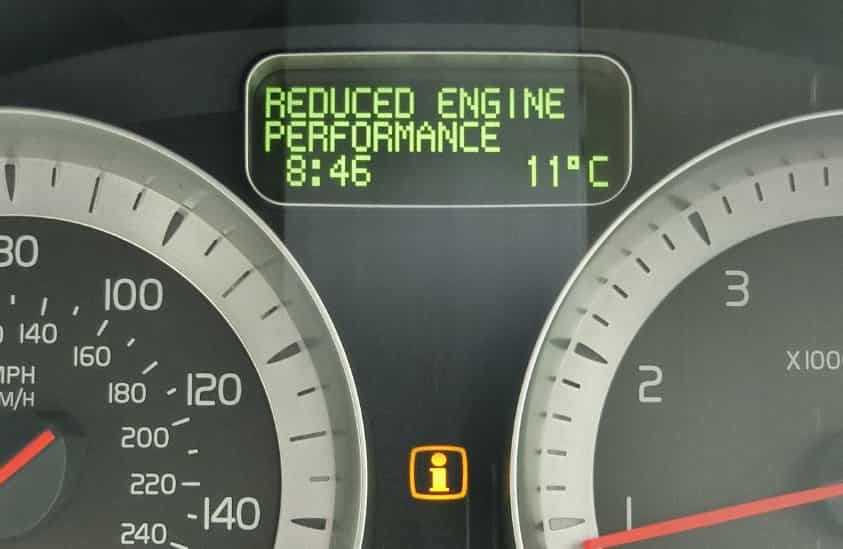
WHAT IS VOLVO REDUCED ENGINE PERFORMANCE
The “Volvo Reduced Engine Performance” message describes a protective mode in Volvo vehicles. The Engine Control Unit, or ECU, activates this mode when it detects abnormal engine behavior. The system then limits engine power to protect key components.
This mode is commonly called limp mode. Volvo uses it to prevent serious damage when something is not working correctly. The ECU constantly monitors signals from sensors that control air intake, fuel delivery, and turbo pressure.
When one of these signals becomes unstable or incorrect, the ECU reacts immediately. It reduces engine torque and limits acceleration. This helps protect parts such as the turbocharger, throttle body, and fuel system.
Modern Volvo engines depend heavily on sensor data. Key components like the Mass Air Flow sensor, turbo boost system, and throttle control send continuous information to the ECU. If any reading falls outside the normal range, the system assumes a risk is present.
The ECU then reduces performance instead of allowing full engine power. This prevents overheating, incorrect air fuel ratios, and pressure damage inside the engine.
This warning does not always point to a major engine failure. In most cases, it indicates a fault in a sensor, airflow system, or electronic control signal. The ECU stores these faults as diagnostic trouble codes. A proper scan tool is needed to read them.
Volvo models such as XC60, XC90, S60, and V60 often show this warning when the system detects inconsistent readings. These vehicles use advanced engine management systems that prioritize protection and emissions control.
The reduced engine performance message is not the root problem. It is a signal that something inside the system needs attention. The real cause always comes from a deeper mechanical or electronic issue.
A correct diagnosis is important before any repair. If the root cause is not fixed, the warning will return even after resetting the system.
MAIN CAUSES OF VOLVO REDUCED ENGINE PERFORMANCE
The “Volvo Reduced Engine Performance” warning appears when the Engine Control Unit detects that one or more engine systems are not operating within safe limits. The ECU reduces engine power to protect key components and maintain safe driving conditions. Several common issues can trigger this condition, and most of them relate to air intake, fuel delivery, or turbo system performance.
One of the most frequent causes is a throttle body problem. The throttle body controls airflow into the engine, and when it becomes dirty or fails electronically, the ECU receives incorrect airflow data. This leads to poor acceleration and reduced engine response. Another common cause is a faulty Mass Air Flow sensor. This sensor measures incoming air and helps the ECU balance fuel injection. When it sends inaccurate readings, the air fuel mixture becomes unstable, which forces the ECU to limit power to avoid damage.
Turbocharger issues also play an important role in Volvo vehicles, especially in turbocharged models. A leak in the intake system or a malfunctioning wastegate can cause unstable boost pressure. When this happens, the ECU immediately reduces engine output to protect the turbo system. Fuel system problems such as a weak fuel pump or clogged injectors can also trigger reduced performance because the engine does not receive enough fuel for proper combustion.
In some cases, intake air leaks allow unmetered air to enter the engine, which disrupts the balance between air and fuel. Finally, ECU or software errors may also cause the system to activate limp mode even when no physical damage is present. These issues usually require diagnostic scanning or software updates to resolve properly.
LIMP MODE SYMPTOMS YOU CAN EASILY RECOGNIZE
When a Volvo enters limp mode and displays the “Reduced Engine Performance” message, the vehicle shows several clear symptoms that affect normal driving behavior. These signs appear because the Engine Control Unit actively limits engine power to protect internal systems from further damage. Understanding these symptoms helps drivers identify the issue early and respond correctly.
One of the most common symptoms is a sudden loss of acceleration. The car still moves, but it responds slowly even when the accelerator pedal is pressed firmly. This happens because the ECU restricts engine torque to keep performance within a safe range. In many cases, the vehicle also struggles to maintain speed on highways or uphill roads, which makes driving feel heavy and restricted.
Another clear sign is the activation of the check engine light on the dashboard. This light often appears together with the reduced engine performance message. The ECU stores diagnostic trouble codes that indicate which system has triggered the protection mode. Drivers may also notice that engine sound becomes less responsive or uneven under load.
Some Volvo models may also show limited transmission behavior. The automatic gearbox may shift more slowly or stay in lower gears to reduce stress on the engine. In addition, the vehicle may not allow high RPM operation, which prevents full power output.
In certain cases, fuel efficiency may drop or idle may become unstable. The engine can feel slightly rough when stopped at traffic lights. These symptoms vary depending on the root cause, but they all indicate that the ECU has detected a problem and is actively protecting the engine system.
Recognizing these symptoms early is important because continued driving without proper diagnosis can increase wear on components such as the turbocharger, throttle body, or fuel system.
IS IT SAFE TO DRIVE IN REDUCED ENGINE PERFORMANCE MODE?
When a Volvo enters Reduced Engine Performance mode, the vehicle remains drivable, but the Engine Control Unit has already limited engine power to protect critical systems. This means the car is not operating under normal conditions, and performance is intentionally restricted. In most cases, the engine reduces torque and acceleration, which allows the driver to continue moving but with clear limitations.
Driving in this condition is generally safe for a short distance, especially if you need to reach a nearby workshop or a safe stopping point. The ECU activates this mode to prevent further damage to components such as the turbocharger, throttle body, or fuel system. By reducing engine output, the system helps avoid overheating, pressure imbalance, or severe mechanical failure.
However, continuing to drive for long distances in limp mode is not recommended. Although the vehicle still functions, the underlying issue remains active. If the problem involves air intake leaks, sensor failure, or turbocharger malfunction, extended driving can increase wear and lead to more expensive repairs. In some cases, performance may drop further, and the vehicle may enter a stricter limitation mode.
It is also important to understand that Reduced Engine Performance does not indicate a minor warning. It is a protective response triggered by the ECU after detecting abnormal data. Even if the car feels stable at low speeds, the system has already identified a risk condition that requires attention.
The safest approach is to drive gently, avoid high RPM, and prevent sudden acceleration. The driver should prioritize visiting a qualified technician as soon as possible for a full diagnostic scan. This ensures the root cause is identified and resolved before additional damage occurs.
HOW TO FIX VOLVO REDUCED ENGINE PERFORMANCE PROPERLY
Fixing Volvo Reduced Engine Performance requires a correct diagnosis first because this warning is not a single fault but a system response from the Engine Control Unit. The ECU activates limp mode when it detects abnormal data from sensors, airflow systems, fuel delivery, or turbo pressure. For this reason, the repair process must focus on identifying the root cause instead of only clearing the warning.
The first step is a basic reset. In some cases, restarting the engine or disconnecting the battery for a short time can temporarily clear the warning. However, this does not solve the underlying issue, and the problem often returns if the faulty component is still present.
The most important step is performing an OBD2 diagnostic scan. This scan reads error codes stored in the ECU and identifies which system triggered limp mode. Common codes often relate to the Mass Air Flow sensor, throttle body, turbocharger system, or fuel pressure regulation. Without this step, repairs become guesswork and may not resolve the issue.
Once the fault is identified, cleaning or replacing components may be necessary. A dirty throttle body or contaminated MAF sensor can often cause incorrect airflow readings, and cleaning these parts can restore proper function. If the turbo system has leaks or pressure issues, repairs to hoses or wastegate components may be required. Fuel system problems may involve replacing the fuel pump or cleaning injectors.
In some cases, the issue comes from software rather than hardware. Volvo ECU systems may require a software update or recalibration from an authorized service center. This step ensures that engine control logic is properly aligned with current system conditions.
Proper repair always depends on accurate diagnosis. Fixing symptoms without addressing the root cause will only lead to repeated limp mode activation.
COMMON VOLVO MODELS AFFECTED
The Reduced Engine Performance warning can appear across many Volvo models because the engine management system is similar throughout the lineup. Volvo uses advanced Engine Control Unit technology in most modern vehicles, which means the same protective limp mode logic is applied when abnormal conditions are detected.
One of the most commonly affected models is the Volvo XC60. This SUV often experiences reduced engine performance due to issues with the turbo system, throttle body, or airflow sensors. Because it is widely used in both city and highway driving, sensor contamination and intake system wear can develop over time.
The Volvo XC90 also frequently shows this warning, especially in versions equipped with turbocharged engines. In many cases, the ECU limits power when it detects unstable boost pressure or inconsistent fuel delivery. This helps protect the engine but results in noticeable power loss during acceleration or uphill driving.
The Volvo S60 and V60 sedans can also experience reduced engine performance. These models rely heavily on precise sensor input, and even small deviations in airflow or fuel ratio can trigger limp mode. Drivers may notice hesitation, reduced acceleration, or warning messages on the dashboard.
Although these models are commonly affected, the root causes are usually similar across the entire Volvo range. Problems often involve the Mass Air Flow sensor, throttle body contamination, turbocharger leaks, or fuel system irregularities. In some cases, ECU software calibration issues can also contribute to the warning appearing unexpectedly.
Understanding which models are more prone to this issue helps drivers identify patterns and respond faster when symptoms appear. However, the warning itself does not indicate a design flaw in a specific model. It reflects the sensitivity of Volvo’s engine protection system, which prioritizes long term engine safety over short term performance.
HOW TO PREVENT REDUCED ENGINE PERFORMANCE IN VOLVO
Preventing Volvo Reduced Engine Performance requires consistent maintenance and attention to key engine systems. This warning usually appears when the Engine Control Unit detects irregular data from airflow, fuel, or turbo components. By keeping these systems in good condition, drivers can significantly reduce the risk of limp mode activation.
One of the most important prevention steps is regular air system maintenance. The throttle body should be cleaned periodically to ensure smooth airflow into the engine. A dirty throttle body can disrupt air intake and trigger incorrect readings. The Mass Air Flow sensor also needs to stay clean because it directly affects how the ECU calculates fuel injection.
Fuel system maintenance is equally important. Using high quality fuel helps prevent injector clogging and fuel pump strain. Over time, poor fuel quality can reduce combustion efficiency and increase the risk of engine imbalance. Regular inspection of fuel injectors helps maintain stable engine performance.
Turbocharged Volvo engines require special attention to boost pressure stability. Checking hoses, seals, and intercooler connections helps prevent air leaks that can cause pressure loss. Even small leaks can confuse the ECU and activate reduced engine performance mode.
Software updates from Volvo service centers also play an important role. The ECU relies on calibrated data to manage engine behavior. Outdated software can sometimes cause false triggers or inefficient responses. Keeping the system updated ensures accurate engine control.
Regular diagnostic checks using OBD2 tools can also help detect early warning signs before the problem becomes serious. Identifying sensor irregularities early allows quick correction and prevents limp mode activation.
Good driving habits also matter. Avoiding harsh acceleration, allowing proper engine warm up, and maintaining steady driving conditions can reduce stress on engine components and improve long term reliability.
COST OF FIXING VOLVO REDUCED ENGINE PERFORMANCE
The cost of fixing Volvo Reduced Engine Performance varies widely because this issue does not come from a single faulty part. The Engine Control Unit activates limp mode based on different system failures, including airflow sensors, fuel delivery, turbo pressure, or software errors. The final repair cost depends on the exact root cause identified through diagnosis.
In many cases, the first expense is a diagnostic scan using an OBD2 tool. This step helps identify error codes stored in the ECU and usually represents the lowest cost in the repair process. Once the issue is identified, simple problems such as a dirty throttle body or a contaminated Mass Air Flow sensor are relatively inexpensive to fix. Cleaning or minor servicing of these components often restores normal performance without major replacement costs.
However, costs increase when the problem involves more complex systems. Turbocharger issues, for example, can become expensive because they may require repairing or replacing boost components, hoses, or the turbo unit itself. Fuel system problems such as a failing fuel pump or clogged injectors also raise repair expenses due to part replacement and labor time.
If the issue comes from ECU software, the cost is usually lower compared to mechanical repairs. A software update or recalibration at an authorized Volvo service center can resolve the problem without replacing physical components. However, dealer level services may still charge higher fees due to specialized equipment and programming requirements.
Overall, the cost can range from minor maintenance level expenses to significant repairs depending on severity. The most important factor is early diagnosis. Identifying the problem early helps avoid damage escalation and reduces total repair cost significantly.
CONCLUSION
The Volvo Reduced Engine Performance warning is not a random failure but a protective response from the Engine Control Unit. When the ECU detects abnormal signals from key systems such as air intake, fuel delivery, turbo pressure, or engine sensors, it activates limp mode to protect the engine from further damage. This results in reduced power, limited acceleration, and a noticeable change in driving behavior.
Understanding this condition is important because the warning itself is not the real problem. It is only a signal that something inside the system is not working correctly. The true cause usually comes from components such as the Mass Air Flow sensor, throttle body, turbocharger system, or fuel delivery system. In some cases, ECU software issues can also trigger this warning without any major mechanical failure.
Most drivers experience confusion when this message appears, especially when the vehicle suddenly loses power. However, the ECU is designed to prioritize engine safety over performance. This means the car is still drivable, but only in a limited mode until the issue is resolved.
Proper diagnosis is always the key to fixing this problem. Reading ECU error codes with an OBD2 scan tool helps identify the exact cause instead of relying on guesswork. Once the root issue is found, targeted repairs such as cleaning sensors, fixing air leaks, or replacing faulty components can restore normal engine performance.
If the problem is handled early, repair costs remain low and engine damage can be avoided. Ignoring the warning or continuing to drive without inspection can lead to more serious issues, especially in turbocharged engines.
For Volvo owners, regular maintenance and timely diagnostics are the best way to prevent Reduced Engine Performance from returning and to keep the engine operating safely and efficiently.