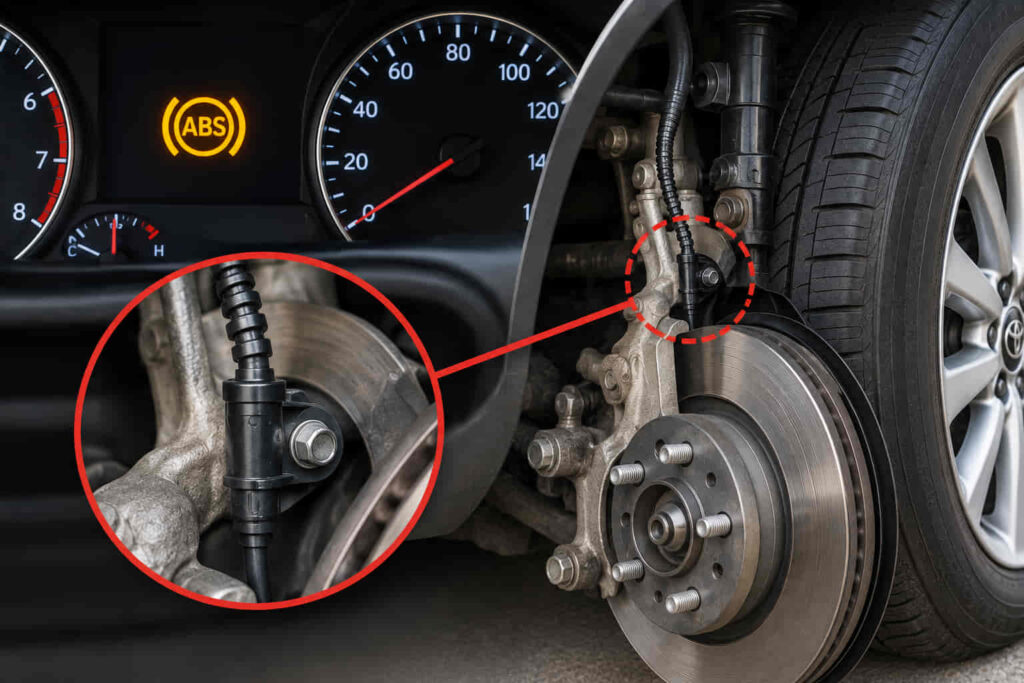
The Toyota C0210 code indicates a fault associated with the right rear wheel speed sensor circuit, which supplies wheel-speed information to the skid control ECU for ABS and related vehicle stability functions. Toyota service information identifies C0210/33 as “Rear Speed Sensor RH Circuit” on applicable models. The fault does not automatically mean the right rear wheel speed sensor itself has failed because damaged wiring, poor electrical connections, incorrect sensor installation, a problem with the sensor rotor, or a fault within the skid control system can produce an abnormal wheel-speed signal.
A Toyota with C0210 may illuminate the ABS warning light and may also experience changes in stability or traction-control operation, depending on the model and other stored diagnostic trouble codes. Accurate diagnosis therefore requires more than replacing the right rear sensor immediately. The diagnostic process should identify whether the ECU is receiving an incorrect or missing wheel-speed signal and then trace the problem through the sensor, connector, wiring circuit, rotor, and associated control components.
This guide explains what Toyota C0210 means, the conditions that can cause it, the symptoms associated with the fault, how to diagnose the affected circuit, and which repair should be performed after the failed component or connection has been identified.
What Does the Toyota C0210 Code Mean?
The Toyota C0210 code means the skid control ECU has detected a fault associated with the right rear wheel speed sensor circuit. Toyota identifies C0210/33 as “Rear Speed Sensor RH Circuit” on applicable models, with “RH” referring to the right-hand side of the vehicle. The right rear wheel speed sensor monitors the rotational speed of that wheel and provides the information required by the brake control system to determine how fast the wheel is rotating relative to the other wheels.
The right rear wheel speed sensor is part of a larger signal path rather than an isolated component. Wheel rotation produces a signal through the interaction between the speed sensor and its associated rotor. That signal reaches the skid control ECU through the sensor wiring and electrical connectors. The ECU compares wheel-speed information from the right rear wheel with information from the other wheels and vehicle operating conditions. An absent or abnormal signal can therefore indicate a problem anywhere along this path, not only a failed sensor.
This distinction is important when diagnosing C0210 because C0210 does not by itself prove that the right rear wheel speed sensor needs replacement. The fault can originate from the sensor, its installation, an electrical connector, damaged wiring, the speed sensor rotor, or the skid control ECU/brake actuator assembly on applicable Toyota models. For example, an open circuit can prevent the sensor signal from reaching the ECU even when the sensor itself remains functional. A damaged or contaminated rotor can also produce an abnormal wheel-speed signal without an electrical failure inside the sensor.
The wheel-speed signal is particularly important to the Anti-lock Braking System (ABS). ABS uses individual wheel-speed information to identify when a wheel is approaching lockup during braking and adjusts braking pressure accordingly. On Toyota vehicles equipped with additional brake and stability functions, the same wheel-speed information can also contribute to Vehicle Stability Control (VSC), Traction Control (TRAC), Electronic Brake-force Distribution (EBD), and related systems. A C0210 fault can therefore affect more than the monitoring of one wheel even though the diagnostic code points toward the right rear wheel-speed circuit.
The exact detection conditions for C0210 should be checked against the repair information for the specific Toyota model, model year, drivetrain, and brake-control system being diagnosed. Toyota has used C0210 across multiple vehicle applications, but diagnostic thresholds, connector configurations, sensor designs, and inspection procedures are not necessarily identical between them. For this reason, the code should first be interpreted as identifying the right rear wheel speed sensor circuit as the diagnostic area, after which model-specific testing determines the actual failed component.
What Are the Symptoms of the Toyota C0210 Code?
The primary symptom of Toyota C0210 is an ABS-related warning accompanied by a stored fault for the right rear wheel speed sensor circuit. Additional warning indicators and changes in stability or traction-control functions depend on the Toyota model, its equipment, and whether other DTCs are stored at the same time. The physical driving symptoms can also differ because C0210 identifies an abnormal wheel-speed input rather than a single mechanical failure with one fixed symptom.
The ABS warning light is an important visible indication because the skid control ECU depends on accurate wheel-speed information to control anti-lock braking. When the right rear wheel-speed signal cannot be trusted, the control system can store C0210 and restrict functions that depend on that information. The driver may still have conventional mechanical braking, but this should not be interpreted as confirmation that ABS and related electronic brake-control functions are operating normally. A warning light should therefore be treated as evidence that the system requires diagnosis rather than simply cleared with a scan tool.
VSC and traction-control warnings can also appear on Toyota models where these systems share wheel-speed data with ABS. Stability control determines whether the vehicle is following the driver’s intended path using several inputs, including individual wheel speeds. Traction control similarly uses wheel-speed differences to recognize excessive drive-wheel slip. An unreliable right rear wheel-speed signal can consequently interfere with the data these systems require, which explains why an ABS sensor-circuit problem can produce warning indicators beyond the ABS light itself.
Scan-tool data can provide a more specific symptom than dashboard warning lights. The right rear wheel-speed reading may disappear, remain implausible, fluctuate, or differ abnormally from the other wheel-speed readings when the fault is present. Comparing RR Wheel Speed with the other wheels is therefore useful because all four wheels should show logically related speeds while the vehicle travels straight at a steady speed. A right rear reading that repeatedly drops while the other three remain stable directs the diagnosis toward the right rear signal path, although further testing is still required to distinguish the sensor from wiring, connector, installation, or rotor faults.
C0210 should not be blamed for every braking or handling symptom that occurs at the same time. Grinding noises, wheel-bearing play, brake-pedal abnormalities, or additional warning lights can indicate separate or related faults that require their own diagnosis. The correct diagnostic approach is to combine the stored DTC, warning indicators, freeze-frame or related diagnostic information when available, live wheel-speed data, and physical inspection rather than identifying the failed part from the code alone.
Read more: Toyota P2118
What Causes the Toyota C0210 Code?
The Toyota C0210 code can be caused by a faulty right rear wheel speed sensor, incorrect sensor installation, damaged wiring or connectors, a problem with the speed sensor rotor, or a fault in the skid control ECU/brake actuator assembly. These causes affect different points in the same signal path between the rotating wheel and the skid control ECU. The correct repair therefore depends on identifying where the right rear wheel-speed signal becomes missing, interrupted, or abnormal.
A faulty right rear wheel speed sensor is one possible cause of C0210 because the sensor provides the wheel-speed information monitored by the skid control ECU. A sensor that cannot generate or transmit the expected signal prevents the ECU from accurately determining right rear wheel speed. Physical damage, internal sensor failure, or deterioration of the sensor can produce this condition. However, the presence of C0210 alone does not confirm sensor failure because the ECU monitors the resulting circuit and signal rather than physically identifying which component has failed.
Incorrect installation can also interfere with the right rear wheel-speed signal even when the sensor remains electrically functional. The sensor must be positioned correctly relative to the component used to detect wheel rotation. Improper mounting, foreign material around the installation area, or an abnormal relationship between the sensor and rotor can prevent a consistent signal from reaching the skid control ECU. This is why physical inspection of the sensor and its mounting position should occur before a replacement sensor is assumed to be necessary.
Damaged wiring and electrical connectors are another important cause because the sensor signal must travel through the circuit before reaching the control unit. An open circuit can stop the signal completely, while damaged wiring or poor terminal contact can cause intermittent signal loss. Connector damage, loose terminals, corrosion, contamination, or wiring damage near the wheel can therefore create symptoms similar to those of a defective sensor. For example, a circuit that loses continuity when the suspension or harness moves can produce an intermittent wheel-speed reading even though the sensor itself still operates.
The speed sensor rotor can cause C0210 when its condition prevents the sensor from producing a valid representation of wheel rotation. The sensor and rotor operate as related components, so diagnosis must consider both sides of that relationship. Damage, contamination, improper installation, or another rotor-related abnormality can distort the signal detected at the right rear wheel. This type of failure is particularly important because replacing the sensor without inspecting the rotor leaves the actual source of the abnormal signal unresolved.
A problem with the skid control ECU or brake actuator assembly is also included among the possible trouble areas on applicable Toyota diagnostic procedures. The control unit should not be the first component replaced when C0210 is stored. Sensor condition, installation, connectors, wiring, and the rotor provide more direct points for testing and should be evaluated according to the repair procedure for the specific vehicle. Suspecting the ECU becomes more reasonable when the external circuit and related components meet their specified test conditions but C0210 continues to return.
The cause can also differ according to Toyota model, year, drivetrain, and ABS configuration. Connector pinouts, sensor construction, diagnostic thresholds, and component integration are not identical across every vehicle carrying a Toyota badge. A diagnostic procedure for one Toyota should therefore not be transferred to another model solely because both vehicles store C0210. The code identifies the right rear wheel speed sensor circuit as the fault area, while vehicle-specific testing identifies whether the sensor, installation, circuit, rotor, or control unit is responsible.
How Do You Diagnose the Toyota C0210 Code?
Diagnosing Toyota C0210 requires confirming the code, comparing right rear wheel-speed data with the other wheels, and then testing the sensor, installation, wiring, connectors, and speed sensor rotor before suspecting the skid control ECU. This sequence is important because C0210 identifies a fault area rather than automatically identifying a failed component. Replacing the right rear wheel speed sensor without testing the circuit can leave the original problem unresolved when damaged wiring, a poor connector connection, or a rotor-related fault is responsible.
Start the diagnosis by scanning the ABS or skid control system and confirming that C0210 is stored. Record other DTCs before clearing anything because related codes can change the direction of the diagnosis. A code affecting another wheel-speed sensor, power supply, brake actuator, or communication circuit can indicate a broader problem than an isolated right rear sensor fault. The vehicle’s model, year, drivetrain, and brake-control configuration should also be identified before electrical testing because Toyota diagnostic procedures, connector terminals, and specifications differ between applications.
Live wheel-speed data provides a direct way to determine whether the right rear signal behaves differently from the other wheels. Monitor the RR Wheel Speed parameter together with the left rear and front wheel-speed values while the vehicle is operated under appropriate test conditions. A right rear value that remains at zero, drops out intermittently, fluctuates abnormally, or differs significantly from the other wheels provides evidence of a problem in the right rear wheel-speed signal path. When all four readings remain logically consistent, an intermittent fault or a condition that is not active during the test should be considered rather than immediately condemning the sensor.
The right rear wheel speed sensor and its installation should be physically inspected after an abnormal signal has been identified. Check whether the sensor is securely and correctly mounted and whether its surrounding area shows physical damage, contamination, or evidence of improper installation. The relationship between the sensor and rotor matters because the ECU depends on a consistent signal created as the wheel rotates. A functional sensor can still produce unusable data when its installation prevents it from detecting the rotor correctly.
Inspect the electrical connector and wiring harness next because an intact sensor cannot communicate with the skid control ECU through a defective circuit. Examine the connector for poor engagement, damaged terminals, contamination, corrosion, or other conditions that can compromise electrical contact. Inspect the harness along the accessible route for cuts, abrasion, stretching, previous repairs, or damage in areas exposed to wheel and suspension movement. An intermittent wiring fault deserves particular attention when the wheel-speed value appears normally at one moment and drops out when the vehicle moves.
Circuit testing should follow the wiring diagram and specifications for the exact Toyota being repaired. Continuity, open-circuit, short-circuit, and related electrical checks can determine whether the signal path between the right rear sensor and the control system is intact. Do not apply a resistance value, connector pin number, or voltage specification from a different Toyota model simply because both vehicles have C0210. Sensor technologies and circuit layouts vary, so model-specific service information must determine the test points and acceptable measurements.
The speed sensor rotor should be inspected when the sensor installation and electrical circuit do not explain the abnormal wheel-speed signal. Damage, contamination, deformation, or another condition affecting the rotor can prevent the sensor from detecting wheel rotation consistently. Rotor-related faults can be especially misleading because the sensor and wiring may pass electrical tests while live data still shows an irregular wheel-speed value. Comparing the right rear signal with the other wheels while the vehicle moves can help connect this type of physical problem with the abnormal data seen by the ECU.
The skid control ECU or brake actuator assembly should be considered only after the right rear sensor, installation, circuit, connectors, and rotor have been evaluated according to the applicable Toyota diagnostic procedure. This order prevents an expensive control component from being replaced before simpler external causes have been eliminated. If the required sensor and circuit measurements meet specification but C0210 repeatedly returns, diagnosis can then progress toward the control unit using the model-specific Toyota repair information.
The diagnosis is complete only when the repair is verified and C0210 does not return. Clear the stored DTC after repairing the confirmed fault, operate the vehicle under the conditions specified for that Toyota, monitor the wheel-speed data again, and rescan the brake control system. The RR Wheel Speed value should remain logically consistent with the other wheels during comparable driving conditions, and the fault should not reset. This final verification distinguishes a confirmed repair from a temporary disappearance of the warning light.
How Do You Fix the Toyota C0210 Code?
Fixing the Toyota C0210 code requires repairing the specific fault that is disrupting the right rear wheel-speed signal. Depending on the diagnostic result, the repair may involve correcting the sensor installation, repairing the wiring or connector, replacing the right rear wheel speed sensor, addressing a damaged speed sensor rotor or related hub component, or diagnosing the skid control ECU. The wheel speed sensor should not be replaced solely because C0210 is present because the code identifies the affected circuit rather than confirming which component has failed.
Correct the sensor installation first when inspection shows that the right rear wheel speed sensor is improperly mounted but remains functional. The sensor must maintain the correct physical relationship with the rotor to produce a usable wheel-speed signal. Dirt, foreign material, improper seating, or installation damage can interfere with this relationship. Cleaning the relevant mounting area and reinstalling the sensor correctly can restore the signal when the sensor and electrical circuit pass their required tests. A damaged sensor should be replaced rather than reinstalled.
Repair the wiring or connector when electrical testing identifies an open circuit, short circuit, damaged conductor, poor terminal contact, or another connection problem between the sensor and control system. The repair must restore a stable electrical path rather than simply make the warning light disappear temporarily. For example, a partially damaged harness near a moving suspension component may maintain continuity while the vehicle is stationary but interrupt the wheel-speed signal as the suspension moves. Repairing the damaged section and securing the harness correctly addresses the underlying cause instead of masking an intermittent C0210 fault.
Replace the right rear wheel speed sensor when diagnosis confirms that the sensor cannot provide the required signal while its wiring, connector, installation, and related components are in acceptable condition. Sensor replacement should be the result of diagnosis, not the first diagnostic step. After installation, the connector must be fully engaged and the harness must follow its intended routing so it is not stretched, pinched, or exposed to unnecessary contact with moving components. The exact installation procedure and any required specifications should come from service information for the Toyota model being repaired.
Repair or replace the affected rotor or related hub component when physical inspection and signal analysis identify the wheel-speed detection surface as the source of the fault. A damaged or contaminated rotor can create an irregular signal even when the sensor and electrical circuit operate correctly. This explains why installing a new sensor does not necessarily resolve C0210 when the underlying problem exists at the rotor. The required repair depends on the vehicle design because the relevant wheel-speed components can be integrated differently across Toyota models.
The skid control ECU or brake actuator assembly should only become a primary repair candidate after the external components and circuit have passed the specified diagnostic checks. Replacing a control module before verifying the sensor circuit creates unnecessary cost and may leave C0210 unchanged. When sensor operation, installation, wiring, connectors, and the rotor satisfy the applicable specifications but the ECU still fails to process the right rear wheel-speed input correctly, model-specific diagnostic procedures should be used to determine whether control-unit repair or replacement is justified.
Clearing C0210 is not the same as fixing C0210. A successful repair must restore a stable right rear wheel-speed signal and prevent the code from returning under the appropriate operating conditions. After completing the repair, clear the DTC with a compatible scan tool, operate the vehicle according to the applicable verification procedure, and monitor RR Wheel Speed against the other wheel-speed values. The right rear reading should respond consistently as vehicle speed changes rather than remaining at zero, dropping out, or fluctuating abnormally.
Perform a final scan after the verification drive to determine whether C0210 or another ABS-related DTC has returned. A warning light that remains off while the diagnostic system continues to store or reset a fault should not be treated as a completed repair. The repair is confirmed when the right rear wheel-speed data is operating correctly, C0210 does not reset under its detection conditions, and the brake control system no longer identifies the original circuit fault.
Is the Toyota C0210 Code Serious?
The Toyota C0210 code is a serious fault because it can interfere with the wheel-speed information required by the ABS and related brake or stability-control systems. C0210 does not automatically mean that the vehicle has lost conventional braking, but it indicates that the skid control ECU has detected a problem associated with the right rear wheel speed sensor circuit. The severity comes from the possibility that electronic functions designed to maintain braking stability may not operate normally when accurate wheel-speed data is unavailable.
ABS relies on individual wheel-speed signals to determine whether a wheel is approaching lockup during braking. When the right rear signal is missing or unreliable, the control system cannot use that input with the same confidence as a valid wheel-speed signal. On Toyota models equipped with VSC, TRAC, EBD, or related functions, the effect can extend beyond ABS because these systems also use wheel-speed information as part of their control strategies. The exact functions affected depend on the model and brake-control configuration.
C0210 should therefore be diagnosed promptly even when the vehicle appears to brake normally during routine driving. Normal pedal feel during one stop does not confirm that ABS will function correctly during an emergency braking event or on a low-traction surface. The appropriate response is to inspect the warning indicators, retrieve all stored DTCs, evaluate wheel-speed data, and repair the confirmed fault rather than repeatedly clearing the code.
The urgency increases when C0210 appears with additional brake-system warning lights, other ABS DTCs, abnormal braking behavior, or mechanical symptoms from the affected wheel area. These conditions can indicate that the vehicle has more than an isolated wheel-speed signal problem. C0210 should consequently be evaluated as part of the complete brake-control condition rather than used as the sole measure of whether the vehicle is safe.
Can You Drive a Toyota With the C0210 Code?
A Toyota with C0210 may retain conventional braking, but it should not be assumed to have fully functional ABS, stability control, or traction-control assistance until the fault has been diagnosed. Whether the vehicle should continue to be driven depends on the warning lights, braking behavior, additional DTCs, road conditions, and the actual cause of the right rear wheel-speed circuit fault.
The distinction between mechanical braking and electronic brake assistance is important. The wheel speed sensor does not create the hydraulic braking force that slows the vehicle. Instead, its signal helps the control system determine how the wheels are behaving. A driver can therefore encounter a vehicle that appears to stop normally while an ABS-related warning remains active. This does not establish that the vehicle will respond normally when wheel lockup or instability requires electronic intervention.
Driving becomes a greater concern in rain, snow, ice, gravel, or other low-traction conditions because these environments increase the value of accurate wheel-speed information. Emergency braking also places greater demands on ABS than gradual braking during normal traffic. A C0210 fault that appears insignificant during a short drive on dry pavement can therefore become more relevant when traction decreases or hard braking is required.
Do not continue driving solely on the assumption that C0210 is “just a sensor code” when the red brake warning light is illuminated, braking performance has changed, unusual wheel or brake noises are present, or additional serious brake-system faults are stored. Those symptoms require evaluation of the complete braking system. When C0210 is the only identified ABS-related fault and conventional braking appears normal, the vehicle still requires timely diagnosis to restore the affected electronic safety functions.
How Much Does It Cost to Fix Toyota Code C0210?
The cost to fix Toyota C0210 depends on whether diagnosis identifies the right rear wheel speed sensor, wiring or connector, sensor rotor or hub-related component, or skid control ECU as the actual cause. There is no single accurate repair price for C0210 because the diagnostic code identifies a circuit fault area rather than one component that must always be replaced.
A sensor-related repair is generally different in scope from a wiring repair. Replacing a confirmed faulty wheel speed sensor involves the part itself plus diagnosis and installation labor, while damaged wiring may require locating an intermittent open or short before any repair can begin. A simple connector or harness defect can involve relatively little replacement hardware but require additional diagnostic time if the signal fails only while the vehicle is moving.
Rotor or hub-related faults change the repair scope further because the wheel-speed detection components are not configured identically across Toyota models. On some applications, correcting the fault may require work beyond replacing an external sensor. Labor time and parts cost consequently depend on the specific model, model year, component design, local labor rate, and whether original-equipment or aftermarket parts are selected.
A skid control ECU or brake actuator-related repair can be substantially more involved than correcting a sensor or wiring fault. This is another reason the control unit should not be replaced based on C0210 alone. The sensor, installation, wiring, connectors, and rotor should first be tested according to the applicable diagnostic procedure. Paying for accurate diagnosis can prevent the cost of replacing an expensive component that was not responsible for the code.
An exact C0210 repair estimate should therefore be calculated only after the failed part or circuit has been identified. A useful estimate should separate diagnostic labor, replacement parts, installation labor, and any additional procedures required for the specific Toyota. Quoting one universal price before diagnosis would imply a level of certainty that the C0210 code itself does not provide.
What Is the Difference Between Toyota C0210 and C0215?
The main difference between Toyota C0210 and C0215 is the rear wheel speed sensor circuit identified by each code: C0210/33 refers to the right rear speed sensor circuit, while C0215/34 refers to the left rear speed sensor circuit on applicable Toyota models. Both codes belong to the same diagnostic context because they concern rear wheel-speed information used by the skid control ECU, but they direct diagnosis toward opposite sides of the vehicle.
Toyota C0210 directs attention to the right rear wheel-speed signal path. Diagnosis therefore focuses on the right rear speed sensor, its installation, electrical connector and wiring, the associated speed sensor rotor, and ultimately the skid control ECU when the external components pass their required tests. Toyota C0215 follows the corresponding logic on the left rear side. This distinction prevents a technician from inspecting or replacing a sensor on the wrong side simply because both codes relate to rear wheel-speed sensing.
The two codes can also provide useful diagnostic context when they appear together. A single C0210 fault places greater diagnostic emphasis on the right rear circuit, while simultaneous faults involving multiple wheel-speed circuits can justify investigating components or conditions shared by those circuits. The additional codes do not prove that a shared component has failed, but they change the diagnostic context and should be evaluated before parts are replaced.
C0210 and C0215 should therefore be treated as related but separate diagnostic trouble codes. C0210 identifies the right rear wheel speed sensor circuit, whereas C0215 identifies the left rear wheel speed sensor circuit. In either case, the DTC identifies the circuit that requires diagnosis rather than proving that the wheel speed sensor itself has failed. The sensor, installation, connector, wiring, rotor, and applicable control components must still be tested to determine the actual cause.