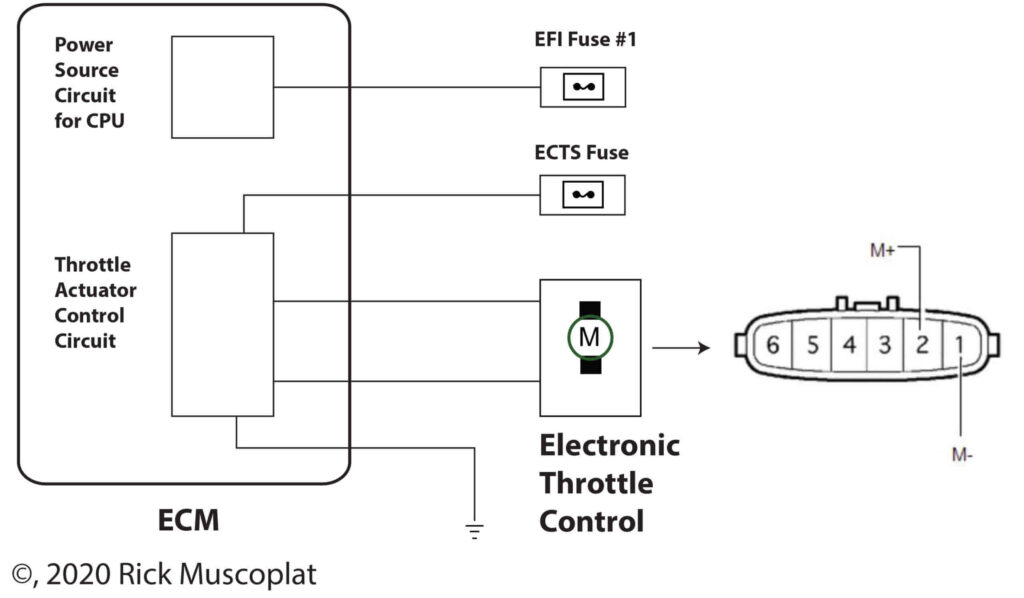
Toyota P2118 is a diagnostic trouble code associated with the electronic throttle control system, specifically the throttle actuator control motor current or performance. When the engine control module detects that the throttle actuator motor is operating outside the expected electrical or performance range, it can store P2118 and illuminate the Check Engine Light. Because the throttle actuator controls how far the throttle plate opens, this fault can directly affect engine speed, acceleration, and throttle response.
A Toyota with P2118 may experience reduced engine power, delayed acceleration, abnormal throttle response, or fail-safe operation. However, the code does not automatically mean the throttle body has failed. The fault can originate from the throttle actuator motor, its electrical circuit, damaged wiring or connectors, an abnormal power supply, or, less commonly, the engine control module. Replacing the throttle body without testing these components can therefore result in an unnecessary repair.
Diagnosing Toyota P2118 requires identifying where the electronic throttle control system is failing before replacing parts. This guide explains what P2118 means, how serious it is, which symptoms and causes are associated with it, how to diagnose the fault systematically, and which repair should be performed after the failed component or circuit has been confirmed.
What Does the P2118 Code Mean on a Toyota?
Toyota P2118 means the engine control module has detected a problem involving the throttle actuator control motor current or performance within the electronic throttle control system. The throttle actuator motor is integrated with the electronic throttle body and moves the throttle plate according to commands from the engine control module. When motor operation or the associated electrical circuit falls outside the expected operating conditions, the ECM can store diagnostic trouble code P2118.
Toyota’s electronic throttle control system replaces the direct mechanical relationship between accelerator pedal movement and throttle plate opening with electronically controlled operation. The accelerator pedal provides an input representing the driver’s demand, the ECM processes that input together with other engine operating data, and the throttle actuator motor moves the throttle plate to the commanded position. Position feedback then allows the ECM to monitor whether actual throttle operation corresponds with the requested operation. This closed-loop control allows precise regulation of engine airflow rather than relying solely on a mechanical throttle cable.
P2118 therefore identifies a fault within this control process rather than proving that the throttle body itself must be replaced. The ECM must supply and control the throttle actuator motor electrically, while the wiring harness and connectors must maintain a reliable circuit between the relevant components. A fault affecting motor operation, electrical continuity, power delivery, or the actuator itself can interfere with throttle control and create the conditions associated with P2118. This distinction is important because a stored code identifies the affected system and fault condition; it does not independently identify the failed part.
The relationship between P2118 and throttle operation also explains why the code can affect vehicle performance. The throttle plate regulates the amount of air entering the engine. If the ECM cannot control the throttle actuator as expected, normal accelerator input may no longer produce the intended throttle opening. The control system may then restrict throttle operation to protect against uncontrolled or unreliable engine response. Diagnosis must therefore determine whether the problem originates in the actuator, its electrical circuit, its power supply, or another part of the electronic throttle control system before a repair is selected.
How Serious Is the P2118 Code on a Toyota?
Toyota P2118 should be treated as a significant fault because it can interfere directly with electronic throttle control and the driver’s ability to command engine power. Its practical severity depends on how the vehicle behaves after the code is stored. A Toyota that retains predictable throttle response presents a different immediate situation from one that has severely limited acceleration, unstable operation, or fail-safe behavior, but the underlying throttle-control fault still requires diagnosis.
The main concern is loss or restriction of throttle control rather than the Check Engine Light itself. The ECM relies on the electronic throttle system to regulate engine airflow according to accelerator demand and operating conditions. When the system cannot reliably perform that function, protective control strategies may limit throttle opening or engine output. The driver can consequently press the accelerator and receive less acceleration than expected. That behavior becomes particularly important when entering traffic, crossing an intersection, climbing a grade, or performing any maneuver that depends on predictable engine response.
Driving should not continue normally when P2118 is accompanied by severe power loss, highly abnormal throttle response, repeated stalling, or an inability to accelerate predictably. Continuing to operate the vehicle under those conditions creates a practical driving risk because available engine response may not match the driver’s demand. The appropriate action is to move the vehicle to a safe location when possible and have the electronic throttle control system diagnosed rather than repeatedly clearing the code and attempting to continue driving.
A Toyota that appears to drive normally after P2118 is recorded still requires inspection. An intermittent electrical connection, damaged connector, wiring fault, or developing actuator problem can disappear temporarily and return when vibration, temperature, electrical load, or other operating conditions change. Clearing P2118 without finding its cause only removes the stored diagnostic information; it does not repair the condition that caused the ECM to detect the fault.
The severity of P2118 also makes accurate diagnosis more important than immediate parts replacement. A throttle body can be associated with the code, but so can faults elsewhere in the actuator circuit. Replacing the throttle body before checking the electrical path can leave the original problem unresolved. The correct diagnostic objective is to identify the failed component or circuit first and then perform the repair that addresses that confirmed failure.
Read more: Toyota C0205
What Are the Symptoms of Toyota Code P2118?
The main symptoms of Toyota P2118 are an illuminated Check Engine Light, reduced engine power, limited acceleration, delayed or abnormal throttle response, unstable engine operation, and fail-safe operation. The exact symptoms depend on the type and severity of the throttle actuator control fault. An intermittent electrical problem may initially produce little more than a stored DTC, while a failure that prevents reliable throttle actuator operation can noticeably restrict engine response.
The Check Engine Light is one of the first observable symptoms because the ECM stores P2118 after detecting an abnormal condition in the throttle actuator control system. The warning light confirms that the vehicle has detected a fault, but it does not identify which component should be replaced. Reading P2118 together with freeze-frame data and any additional stored DTCs provides more diagnostic value than treating the warning light as evidence of a failed throttle body.
Reduced engine power and limited acceleration occur when the electronic throttle system cannot provide normal throttle operation. The throttle plate regulates airflow into the engine, so restricted throttle movement limits the amount of air available as the driver requests more power. A driver may notice that accelerator pedal movement produces weaker acceleration than expected or that engine speed does not increase normally. These symptoms indicate a functional throttle-control problem rather than a simple warning-light condition.
Delayed or inconsistent throttle response can occur when commanded throttle operation and actual throttle behavior no longer correspond correctly. The ECM uses electronic inputs and feedback to regulate the throttle actuator, so a problem with actuator operation or its electrical circuit can prevent the system from responding normally to accelerator demand. The vehicle may respond slowly, restrict throttle opening, or behave differently from one drive cycle to another when the underlying fault is intermittent.
Fail-safe operation is one of the more important manifestations of an electronic throttle control fault. The purpose of a protective strategy is to prevent unreliable throttle operation from producing unrestricted engine output. As a result, available engine power can be intentionally limited when the ECM determines that normal throttle control cannot be maintained. This protection explains why severe power loss associated with P2118 does not necessarily mean the engine itself has suffered mechanical failure.
Not every Toyota with P2118 will display all of these symptoms. The code should therefore remain the starting point for diagnosis rather than using the presence or absence of one symptom to select a replacement part. The combination of stored codes, vehicle behavior, electrical inspection, and component testing provides the evidence needed to locate the actual failure.
What Causes the P2118 Code on a Toyota?
Toyota P2118 can be caused by a faulty throttle actuator or throttle body assembly, an open or shorted actuator circuit, damaged wiring or electrical connectors, a problem with the actuator’s electrical supply, or a control-side fault. These causes belong to the same electronic throttle control path, which is why diagnosis should follow the circuit systematically instead of assuming that P2118 automatically requires throttle body replacement.
A fault in the throttle actuator motor or throttle body assembly is a direct possible cause because the actuator physically controls throttle plate movement. The ECM commands the motor to change throttle opening and expects the system to operate within defined electrical and functional conditions. An internal actuator failure can prevent the commanded movement or create abnormal electrical behavior. Replacement becomes justified when diagnostic testing confirms the actuator or integrated throttle body assembly is defective, not merely because P2118 appears on an OBD-II scanner.
Damaged wiring can produce the same DTC without a mechanically defective throttle body. The actuator depends on an electrical circuit between the control system and throttle body, so an open circuit, short circuit, damaged conductor, or excessive resistance can disrupt motor operation. Wiring faults may also be intermittent. Engine vibration, movement of the harness, heat, moisture, or deterioration around a connector can change electrical continuity and cause a fault to appear during one drive cycle but not another.
Electrical connectors and terminals require separate attention because a harness can appear visually intact while the connection itself is unreliable. A loose terminal, poor pin contact, corrosion, contamination, or physical connector damage can interrupt the electrical path needed to operate the throttle actuator. This is why connector inspection belongs early in the diagnostic process. Replacing an electronic throttle body cannot correct a poor connection elsewhere in the circuit.
The electrical supply to the throttle actuator system must also be verified. A motor requires adequate electrical power to operate according to the ECM command, and a supply-side fault can alter actuator performance even when the motor itself remains functional. Diagnosis should therefore establish that the relevant circuit receives the specified supply and has the required continuity before condemning the throttle body. Model-specific wiring diagrams and Toyota service information are important at this stage because circuit layouts, connector terminals, and test specifications can differ between vehicles.
A control-side or ECM-related problem belongs later in the diagnostic hierarchy. The ECM participates directly in commanding and monitoring electronic throttle operation, but it should not be treated as the first suspected component when P2118 is stored. The actuator, wiring, connectors, electrical supply, and relevant circuit conditions should be verified first. Suspecting the ECM before excluding these more direct parts of the circuit can turn a systematic diagnosis into expensive parts swapping.
Throttle-body contamination should also be distinguished from a confirmed electrical actuator fault. Deposits around the throttle plate can affect throttle operation in certain circumstances, but cleaning the throttle body is not a universal repair for P2118. P2118 concerns throttle actuator control operation, so cleaning only makes sense when inspection establishes a relevant mechanical restriction or contamination issue. An open wire, damaged connector, supply problem, or failed actuator motor will not be repaired by removing deposits from the throttle plate.
The most effective way to identify the cause is therefore to follow the system in diagnostic order. Stored and related DTCs establish the fault context, physical inspection can reveal obvious connector or harness problems, electrical testing evaluates the actuator circuit, and component testing determines whether the throttle actuator itself has failed. This evidence-based sequence prevents P2118 from being misinterpreted as a command to replace the most obvious component.
How Do You Diagnose Toyota Code P2118?
Diagnosing Toyota P2118 requires checking the stored trouble codes, inspecting the throttle actuator circuit, verifying its wiring and electrical connections, testing the circuit against Toyota specifications, and confirming throttle actuator operation before replacing the throttle body or ECM. The diagnostic sequence matters because P2118 identifies an abnormal condition in the electronic throttle control system but does not independently prove which component has failed. A systematic test separates an actuator failure from a wiring, connector, power-supply, or control problem.
Start by scanning the vehicle for all stored and pending diagnostic trouble codes rather than reading P2118 in isolation. Record freeze-frame information before clearing anything because it shows the operating conditions present when the ECM detected the fault. Engine speed, vehicle operating state, voltage-related information available through the scan tool, and accompanying throttle-control codes can provide context for determining whether the problem is persistent or intermittent. Related codes such as P2102, P2103, P2111, or P2112 should not automatically be treated as separate failures because multiple DTCs can originate from the same electronic throttle control problem.
Inspect the throttle body, wiring harness, and electrical connectors before replacing components. The inspection should focus on physical damage, loose connections, damaged terminals, corrosion, contamination, pin-contact problems, and sections of the harness that have been rubbed, pinched, overheated, or otherwise compromised. An intermittent connection is especially important when P2118 disappears after clearing but later returns. Movement, vibration, temperature changes, and connector contact can allow an electrical fault to appear only under particular operating conditions.
The throttle actuator circuit should then be tested using the wiring diagram and specifications for the exact Toyota model, engine, and model year. Electrical diagnosis should establish whether the actuator has the required circuit integrity and whether an open, short, excessive resistance, or supply problem exists. Generic resistance or voltage values should not be substituted for Toyota specifications because electronic throttle circuit design and connector assignments can vary by application. Measurements should be compared with the applicable service information rather than with an assumed universal value.
Throttle actuator operation should be evaluated only after basic circuit integrity has been established. A capable scan tool can provide relevant throttle-control data on supported Toyota vehicles, allowing the technician to compare commanded behavior with system feedback and determine whether the throttle system responds as expected. The diagnostic value comes from the relationship between the ECM command and actual system behavior. A throttle actuator that fails to operate correctly despite a verified electrical path points diagnosis toward the actuator or throttle body assembly, while abnormal electrical measurements direct attention back toward the circuit.
The throttle body itself also requires physical inspection, but contamination should not automatically be diagnosed as the cause of P2118. Deposits around the throttle plate and an electrical failure of the throttle actuator are different fault mechanisms. Cleaning is appropriate only when inspection establishes a relevant contamination or movement problem and the applicable service procedure supports cleaning. It cannot restore an open circuit, repair a damaged terminal, correct a shorted wire, or restore a failed actuator motor.
Battery and system voltage should also be considered when the diagnostic evidence indicates an electrical supply problem or when multiple voltage-related DTCs are present. Electronic control systems depend on a stable electrical environment, so an abnormal supply condition can complicate diagnosis. The objective is not to blame the battery for every P2118 code, but to avoid condemning an electronic component while the circuit supplying or controlling it has not been verified.
The ECM belongs near the end of the diagnostic sequence. Before considering an ECM fault, the technician should have evidence that the relevant wiring, connectors, power conditions, and throttle actuator circuit meet the specifications for that Toyota application. Replacing or programming a control module without first proving these external circuits are functional introduces substantial cost without establishing that the module caused the fault.
After a repair or circuit correction, clear the stored DTC with an appropriate scan tool and operate the vehicle under suitable conditions while monitoring throttle behavior. Scan the system again to determine whether P2118 or related codes return. A successful repair is confirmed by normal throttle operation and the absence of the fault after verification; the fact that a code can be erased is not evidence that its underlying cause has been corrected.
The central rule for P2118 diagnosis is therefore test the system before replacing the part. A throttle body should be replaced when testing supports a throttle actuator or integrated assembly failure. Wiring should be repaired when circuit testing identifies an open, short, excessive resistance, terminal problem, or damaged connection. ECM diagnosis should proceed only after the external circuit and actuator have been appropriately verified. This sequence converts P2118 from a generic fault code into a testable diagnostic path and reduces unnecessary parts replacement.
How Do You Fix the P2118 Code on a Toyota?
Fixing Toyota P2118 requires repairing the specific fault found in the throttle actuator control system rather than automatically replacing the throttle body. The correct repair can involve restoring damaged wiring or electrical connections, correcting a power-supply problem, servicing or replacing the throttle body when its actuator is confirmed faulty, or investigating the ECM after the external circuit has passed the required tests. The repair decision should therefore follow the diagnostic evidence established before parts are replaced.
Repair the wiring or electrical connector when testing identifies an open circuit, short circuit, excessive resistance, damaged conductor, loose terminal, corrosion, or another connection problem affecting throttle actuator operation. The repaired circuit must restore reliable electrical continuity under normal engine vibration and temperature conditions. Simply reconnecting a loose connector and clearing P2118 is insufficient when damaged terminals or wiring remain capable of interrupting the circuit again.
The throttle body should be serviced only when inspection identifies a condition that servicing can actually correct. Deposits around the throttle plate, for example, represent a different problem from an internally failed throttle actuator motor. Cleaning may address relevant contamination or restricted movement when the applicable Toyota service procedure allows it, but cleaning cannot repair an electrical open, shorted circuit, damaged connector, failed motor winding, or other internal electrical failure. Treating throttle-body cleaner as a universal P2118 repair can therefore leave the actual fault unchanged.
Replace the throttle body or applicable actuator assembly when diagnostic testing confirms that the actuator cannot operate correctly despite the associated circuit and electrical connections meeting the specifications for that Toyota application. This distinction prevents unnecessary replacement because P2118 describes a throttle actuator control fault condition rather than issuing a direct instruction to install a new throttle body. The replacement component should also match the exact Toyota model, model year, engine, and applicable part specification because electronic throttle assemblies are not universally interchangeable.
An electrical supply problem must be corrected before a new throttle-control component is installed. When testing identifies inadequate supply, a circuit fault, or another abnormal electrical condition, installing a replacement throttle body without correcting that condition can leave P2118 unresolved. The same principle applies when several electrical DTCs occur together: the common electrical condition should be investigated before each code is treated as evidence of an independent component failure.
ECM replacement should remain one of the final repair considerations. A suspected ECM fault becomes meaningful only after the throttle actuator, wiring, connectors, and relevant electrical circuits have been tested according to the service information for the vehicle. If ECM replacement or programming is ultimately required, the procedure should follow Toyota-specific service requirements because control-module installation can involve programming, initialization, or other vehicle-specific operations.
A successful P2118 repair must correct both the stored fault and the vehicle behavior that accompanied it. Normal acceleration and throttle response should return when the underlying throttle-control problem has been eliminated. If P2118 returns after the repair, the diagnostic process should resume rather than repeatedly clearing the code or replacing additional components without test evidence.
How Do You Clear Toyota P2118 After the Repair?
Clear Toyota P2118 with a compatible diagnostic scan tool only after the fault that triggered the code has been repaired. Erasing the DTC removes stored diagnostic information from the ECM, but it does not repair a throttle actuator, wiring, connector, or electrical problem. Clearing the code should therefore be treated as part of repair verification rather than as the repair itself.
Before clearing P2118, preserve any diagnostic information still needed for troubleshooting, including accompanying DTCs and relevant freeze-frame data. Once the repair has been completed, erase the applicable trouble codes with the scan tool, restart the vehicle, and confirm that the electronic throttle system operates normally. Accelerator input should produce predictable engine response without the reduced-power or abnormal throttle behavior that was present before the repair.
The vehicle should then be rescanned after an appropriate operating or verification procedure. If P2118 remains absent and throttle operation is normal, the repair has stronger evidence of being successful. If P2118 immediately returns, the fault is still present or the original diagnosis did not identify the complete problem. An intermittent code that returns later also warrants renewed inspection of connections, wiring, and other conditions capable of changing with vibration or temperature.
Throttle initialization or relearn requirements should be determined from the service information for the exact Toyota model and repair performed. A single relearn procedure should not be assumed to apply to every Toyota vehicle because electronic throttle system procedures can vary by application. Follow the model-specific procedure when replacement, disconnection, or another service operation requires initialization.
Disconnecting the battery should likewise not be used as the primary method for fixing P2118. Removing power may erase or reset certain stored information on some vehicles, but it does not restore a failed actuator motor or repair an electrical circuit. It can also remove diagnostic information that would otherwise help locate an intermittent fault. Using a scan tool after completing the actual repair provides a more controlled method for clearing the DTC and verifying whether the ECM detects the problem again.
The final verification is not simply “P2118 has been cleared.” The correct standard is that the underlying fault has been repaired, throttle operation has returned to normal, and the code does not return during the appropriate post-repair check. This distinction prevents code deletion from being mistaken for fault correction.
How Much Does It Cost to Fix Toyota Code P2118?
The cost to fix Toyota P2118 depends on whether diagnosis identifies a wiring or connector fault, an electrical supply problem, a failed throttle body or actuator, or a less common control-side problem. P2118 does not identify a single failed component, so there is no technically reliable fixed repair price based on the code alone. The final cost is determined by the failed part, diagnostic labor, the Toyota model and model year, local labor rates, and whether the repair requires component replacement or only circuit restoration.
A wiring or connector fault can require substantially less parts cost than replacing an electronic throttle body, although labor can increase when the damaged section of the circuit is difficult to locate. Intermittent faults are particularly important because a loose terminal, damaged conductor, or poor connection may test normally until vibration, temperature, or harness movement recreates the condition. Diagnostic time is therefore part of the repair cost and should not be treated as unnecessary expense when the alternative is replacing functional components.
Throttle body replacement represents a different repair scenario because the electronic throttle actuator is associated with the throttle body assembly on applicable systems. Replacement is justified when testing confirms that the actuator or assembly has failed while the external wiring, connectors, and relevant electrical conditions are correct. The total price then depends on the exact vehicle application, replacement-part choice, labor requirements, and any model-specific post-installation procedure.
An ECM-related repair can increase the total cost further because control-module work may involve more than installing a replacement component. Diagnosis must first establish that the external throttle actuator circuit and related components are functioning correctly. Programming, initialization, or vehicle-specific procedures may also apply when a control module is replaced. For this reason, the ECM should not be selected as the repair target simply because previous attempts to clear P2118 were unsuccessful.
The most useful estimate is therefore one based on a confirmed diagnosis rather than a generic P2118 price. A repair shop should first determine whether the failure is located in the circuit, connector, actuator assembly, electrical supply, or control side of the system and then estimate the corresponding repair. This approach links cost to evidence and prevents an inexpensive wiring problem from turning into an unnecessary throttle body or ECM replacement.
Which Toyota Models Can Have the P2118 Code?
P2118 can appear on Toyota vehicles equipped with an electronic throttle control system when the ECM detects the fault condition associated with throttle actuator motor current or performance. The presence of the code depends on the vehicle’s engine-management and throttle-control configuration rather than the Toyota badge alone. For that reason, the exact model, model year, engine, and applicable service information must be identified before using a wiring diagram or diagnostic specification.
The diagnostic meaning of P2118 provides a common starting point, but the repair procedure should not be assumed to be identical across Toyota applications. Connector layouts, circuit routing, component configuration, test specifications, and service procedures can differ between vehicle generations and powertrains. A diagnostic value or connector terminal that applies to one Toyota application should not automatically be transferred to another.
This distinction becomes important when searching for a repair procedure using only terms such as “Toyota P2118.” The DTC identifies the fault context, while the vehicle identification determines the correct technical procedure. A useful diagnostic search therefore combines P2118 with the Toyota model, model year, engine, and, when necessary, additional vehicle information. For example, a technician diagnosing P2118 should use the service information for the vehicle being repaired rather than relying on a procedure written for a different Toyota application simply because both vehicles store the same DTC.
The supplied reference materials establish the semantic writing framework rather than a verified model-by-model Toyota application list, so specific Toyota models should not be presented here as confirmed P2118 applications without additional technical evidence. This preserves the distinction between broad DTC relevance and model-specific diagnostic information.
What Is the Difference Between P2118 and Other Toyota Throttle Control Codes?
P2118 differs from other electronic throttle control DTCs because each code identifies a different detected fault condition within the throttle-control system. Codes can occur together because the throttle actuator, throttle plate, electrical circuit, ECM commands, and system feedback participate in the same control process. The presence of several throttle-related DTCs therefore does not automatically mean that several components failed independently.
P2118 centers on the throttle actuator control motor current or performance fault context. P2102 and P2103 are also associated with the throttle actuator control motor circuit, but they represent different electrical fault descriptions. Their diagnostic relationship is useful because the combination of codes can provide more information about the electrical side of the throttle-control problem than P2118 provides by itself. The technician should preserve and evaluate all stored DTCs before clearing them.
P2111 and P2112 shift the diagnostic context toward throttle actuator or throttle plate position behavior. P2111 is associated with a throttle actuator control system condition in which the throttle is stuck open, while P2112 is associated with a stuck-closed condition. These codes therefore should not be treated as synonyms for P2118 even though all three can direct diagnosis toward the electronic throttle control system.
The distinction matters because DTC terminology changes the diagnostic path. A circuit-related code directs attention toward electrical control and circuit integrity, while a stuck-open or stuck-closed condition introduces questions about actual throttle movement and whether commanded and observed operation correspond. When P2118 appears with another throttle-control code, the codes should be interpreted as related diagnostic evidence rather than processed independently in arbitrary order.
Related codes also create a useful semantic structure for Toyota diagnostic content. A dedicated P2102 page can explain its specific circuit condition, while separate P2103, P2111, and P2112 pages can address their own definitions, causes, diagnostic procedures, and repairs. The Toyota P2118 page can then connect to those resources when a related DTC appears during diagnosis. This internal-link structure keeps each page focused on one central fault entity while strengthening the broader electronic throttle control topic cluster.