Fix-a-Flat is a good temporary solution for small tire punctures, especially when you need to get back on the road without immediately changing a tire. The aerosol tire sealant works by injecting a sealing compound and propellant into the tire, helping close minor leaks and restore some air pressure. However, Fix-a-Flat is not a permanent tire repair and cannot fix severe damage, such as sidewall cuts, large punctures, or tire blowouts.
The effectiveness of Fix-a-Flat depends on three main factors: the size and location of the puncture, the condition of the tire, and whether the product is used correctly. It works best on small punctures in the tire’s tread area, where the sealant can reach the leak and form a temporary seal. Drivers must still check tire pressure and arrange a professional inspection because the sealant does not repair internal structural damage.
Fix-a-Flat also has limitations involving tire pressure monitoring systems (TPMS), sealant residue, and driving distance after application. Understanding these limitations helps drivers determine when the product is useful and when a spare tire or professional repair is the safer choice.
This article explains how well Fix-a-Flat works, which tire punctures it can seal, its safety and disadvantages, how long it lasts, and whether it is worth keeping in your vehicle for emergencies.
Is Fix-a-Flat Good for Fixing a Flat Tire?
Fix-a-Flat is effective for temporarily sealing small punctures in the tire’s tread area, making it a useful emergency repair option for drivers who cannot immediately reach a tire shop. The product combines a liquid sealant with a propellant to reduce air leakage and restore some tire pressure. However, its effectiveness depends on the puncture’s location, the extent of tire damage, and the tire’s condition before application.
Fix-a-Flat works best when a tire loses air through a small puncture caused by a nail, screw, or similar sharp object. The sealant spreads along the tire’s inner surface as the wheel rotates and can accumulate around the puncture to restrict air loss. For example, a small nail hole in an otherwise undamaged tire tread is a more suitable application than a long cut or a puncture near the sidewall. The product cannot restore damaged tire cords, repair a separated bead, or make a structurally compromised tire safe to drive.
The main advantage of Fix-a-Flat is convenience during roadside emergencies. Drivers can apply the product through the tire valve without removing the wheel or using specialized tire repair equipment. This makes it useful when a tire develops a minor leak away from a repair facility. However, the tire must still be capable of holding sufficient pressure to support the vehicle safely. A tire that has been driven while severely underinflated may have internal damage that sealant cannot correct.
Fix-a-Flat is best used to reach a nearby tire repair facility, not to avoid professional repair. A qualified technician must inspect the tire to determine whether it can be repaired or needs replacement. Even when the sealant stops visible air loss, the original puncture and any hidden structural damage remain important safety concerns.
How Does Fix-a-Flat Work Inside a Tire?
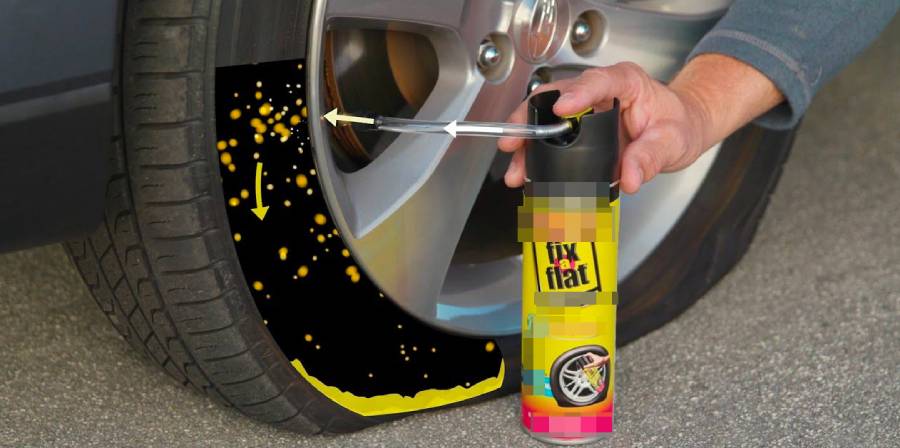
Fix-a-Flat works by delivering a liquid tire sealant and pressurized propellant through the tire valve to temporarily seal small air leaks. The propellant helps move the sealing compound into the tire and provides some inflation, while the liquid sealant is distributed across the inner surface as the wheel rotates. When the sealant reaches a suitable puncture, it can collect around the opening and reduce the escape of pressurized air.
The sealing process involves three main stages: sealant injection, sealant distribution, and puncture sealing. First, the aerosol can releases its contents through the valve stem into the tire cavity. Next, wheel rotation helps spread the compound along the inner liner. Finally, escaping air carries sealant toward the puncture, where the material accumulates and forms a temporary barrier. For example, a small hole left by a nail in the tread area may stop leaking once enough sealant reaches the opening.
Fix-a-Flat also provides limited tire inflation, but it does not necessarily restore a completely flat tire to the vehicle manufacturer’s recommended pressure. The pressure achieved depends on factors such as tire size, the amount of air already inside, the severity of the leak, and the product’s specified capacity. Larger tires may require additional inflation from an air compressor. Drivers should verify the pressure with a tire gauge rather than assuming the aerosol can has fully inflated the tire.
The sealant does not bond damaged rubber or reinforce the tire’s internal structure in the same way as a properly performed tire repair. Its purpose is to reduce air loss long enough for the driver to obtain professional assistance. After using Fix-a-Flat, drivers should follow the product’s driving instructions, monitor tire pressure, and have the tire inspected as soon as possible.
What Types of Tire Damage Can Fix-a-Flat Repair?
Fix-a-Flat can temporarily seal small punctures in the tire’s tread area, but it cannot repair sidewall damage, large cuts, tire blowouts, or structural failures. Its effectiveness depends on the puncture’s size, location, and the condition of the surrounding rubber. The sealant works by filling small openings where air escapes, rather than restoring the tire’s original structural strength.
The most suitable damage involves small punctures caused by nails, screws, or other sharp objects that penetrate the tread. Many passenger tire sealant products are designed for tread punctures up to approximately 1/4 inch (6 mm), although the exact sealing capacity must be confirmed on the specific Fix-a-Flat product label. Punctures outside the repairable tread area require a different approach because the tire’s shoulder and sidewall experience substantial flexing during driving.
Fix-a-Flat also cannot correct damage caused by driving on a severely underinflated tire. When tire pressure drops significantly, the sidewalls bend excessively and generate heat, potentially damaging internal cords and rubber layers. Even when sealant stops the original leak, these structural problems remain. A tire with exposed cords, visible bulges, deep cuts, or evidence of internal separation should not be driven on using sealant.
Can Fix-a-Flat Repair a Nail Puncture?
Fix-a-Flat can temporarily seal a small nail puncture located in the tire’s repairable tread area, provided the tire has no additional structural damage. Nail punctures create relatively narrow openings that allow the sealing compound to accumulate around the leak and reduce air loss. The result depends on the hole’s diameter, its location, and whether the sealant reaches the puncture effectively.
For example, a small finishing nail embedded near the center of the tread may create a slow leak that Fix-a-Flat can temporarily control. A larger puncture near the shoulder presents a greater risk because the surrounding area experiences more flexing and may fall outside the repairable region. Drivers should not remove an embedded nail before applying the product unless the manufacturer’s instructions specifically require it, because removing the object can increase air loss.
A sealed nail puncture still requires professional inspection. A tire technician must remove the tire from the wheel, examine its internal condition, and determine whether the puncture qualifies for a permanent repair.
Can Fix-a-Flat Repair a Tire Sidewall?
Fix-a-Flat cannot safely repair tire sidewall damage. The sidewall supports the vehicle’s load while repeatedly flexing as the tire rotates. Cuts, punctures, or bulges in this area can damage the reinforcing cords that maintain the tire’s shape and strength. A liquid sealant cannot restore those structural components.
For example, a sidewall cut caused by striking a sharp curb may expose or sever reinforcing cords beneath the rubber. Even if sealant temporarily reduces air leakage, the damaged sidewall remains vulnerable to sudden failure. Sidewall bulges are particularly concerning because they can indicate internal cord damage or separation.
Drivers should replace a tire with significant sidewall damage rather than attempt to repair it using Fix-a-Flat, a tire plug, or a conventional patch. A spare tire or roadside assistance is the safer option when the tire’s structural integrity is compromised.
Is Fix-a-Flat Safe for Your Tires?
Fix-a-Flat is generally safe for use in compatible tires when applied according to the manufacturer’s instructions, but it does not make a damaged tire safe for continued normal driving. Modern tire sealants are designed to provide temporary puncture sealing without requiring wheel removal. However, compatibility depends on the specific product formulation, tire construction, and condition of the tire.
One concern is the sealant residue left inside the tire after application. As the wheel rotates, the liquid compound spreads across portions of the inner liner and may remain around the puncture, valve area, or other internal surfaces. This residue does not automatically mean the tire is permanently damaged, but it can complicate inspection and repair. A technician may need to remove the sealant before evaluating the puncture and preparing the inner liner for a permanent repair.
The tire valve is another component that requires attention. Fix-a-Flat enters through the valve stem, and residual sealing compound may collect near the valve core. Depending on the product formulation and how it is used, residue can interfere with valve operation or contribute to air leakage. For example, sealant that prevents the valve core from closing properly may cause the tire to lose pressure after the application. A technician should inspect the valve if pressure loss continues.
The greatest safety concern is driving on a tire that has already suffered structural damage. Fix-a-Flat cannot reverse damage caused by overheating, excessive sidewall flexing, or prolonged operation at low pressure. A tire may appear inflated after treatment while still having damaged internal cords or separated rubber layers. These defects are not reliably visible from the outside.
Professional tire inspection is necessary after using Fix-a-Flat, even when the tire maintains pressure. The technician should be informed that aerosol sealant was used so the tire can be handled, cleaned, and evaluated appropriately. If the puncture falls within the repairable tread area and the tire passes inspection, a proper repair may be possible. Otherwise, tire replacement is necessary to restore safe driving conditions.
Is Fix-a-Flat Safe for TPMS Sensors?
Fix-a-Flat products labeled TPMS-safe are designed to be compatible with tire pressure monitoring systems (TPMS) when used according to the manufacturer’s instructions. However, compatibility does not guarantee that every sensor will remain unaffected. The risk depends on the sealant formulation, sensor design, and whether residue accumulates around the sensor or valve assembly.
Most modern passenger vehicles use either direct or indirect TPMS. Direct TPMS measures tire pressure through electronic sensors mounted inside the wheels, often near the valve stems. Indirect TPMS estimates pressure changes using wheel-speed data rather than sensors inside the tires. Aerosol sealants are primarily a concern for direct TPMS because the sealing compound enters the same tire cavity that contains the pressure sensor.
Sealant residue can collect around a direct TPMS sensor’s pressure port or valve assembly. If the material obstructs the pressure-sensing opening, the sensor may report inaccurate readings or trigger a dashboard warning. For example, a sensor exposed to accumulated sealant may continue displaying a low-pressure warning even after the tire has been reinflated. However, a warning light can also indicate genuinely low pressure, so drivers should verify tire pressure with a reliable gauge before assuming the sensor is malfunctioning.
Drivers should check the Fix-a-Flat product label for TPMS compatibility before application. After using the sealant, inform the tire technician so the sensor and valve assembly can be inspected during tire servicing. Cleaning may resolve residue-related problems, while a damaged or malfunctioning sensor may require replacement. The TPMS warning light should not be ignored simply because the tire appears properly inflated.
How Long Does Fix-a-Flat Last in a Tire?
Fix-a-Flat is intended to provide temporary puncture sealing until the tire can be professionally inspected and repaired or replaced. There is no universal number of days or miles that applies to every application. The duration depends on the puncture’s size, the tire’s condition, the effectiveness of the seal, and the instructions provided for the specific Fix-a-Flat product.
A successfully sealed puncture may retain air pressure for a period of time, but maintaining pressure does not mean the tire has been permanently repaired. Tire pressure changes with temperature, driving conditions, and the quality of the temporary seal. For example, a small tread puncture may stop leaking immediately after treatment, while another puncture may continue losing air because the sealing compound cannot completely close the opening.
The condition of the tire before treatment also affects how long the temporary repair remains usable. A tire that has lost substantial pressure may have experienced excessive sidewall flexing or internal heat damage. Fix-a-Flat cannot reverse these problems, even if it restores enough pressure to make the tire appear inflated. Drivers should arrange professional tire inspection promptly rather than using pressure retention as proof that the tire is safe.
How Far Can You Drive After Using Fix-a-Flat?
You should drive only as far as permitted by the specific Fix-a-Flat product instructions and only when the tire is adequately inflated and safe to move. The product is intended to help drivers reach a nearby repair facility, not continue normal driving for an extended period. Driving limits vary by formulation, tire condition, and the manufacturer’s directions.
Some Fix-a-Flat instructions call for driving a short distance immediately after application to distribute the sealant throughout the tire. This initial driving step helps the liquid compound reach the puncture and form a temporary seal. However, the distance required for sealant distribution should not be confused with the maximum distance permitted before professional repair.
For example, a driver who experiences a slow tread leak several miles from a tire shop may be able to use Fix-a-Flat to reach that facility, provided the tire holds sufficient pressure and the product instructions allow continued driving. A tire that remains visibly flat, loses pressure rapidly, or shows sidewall damage should not be driven on. Drivers should stop in a safe location and arrange roadside assistance when the tire cannot support the vehicle safely.
Can You Leave Fix-a-Flat in a Tire Permanently?
Fix-a-Flat should not be treated as a permanent tire repair, even when the tire continues holding air. The sealant temporarily restricts leakage but does not provide the structural inspection or repair required to determine whether the tire is suitable for continued service.
A proper tire repair requires a technician to remove the tire from the wheel and inspect its internal condition. For an eligible tread puncture, an industry-accepted repair generally combines a rubber stem that fills the injury channel with an internal patch that seals the inner liner. This process addresses the puncture more comprehensively than aerosol sealant alone.
Leaving Fix-a-Flat inside a tire without professional inspection also allows hidden damage to remain undetected. For example, a tire driven while severely underinflated may develop internal sidewall damage that is not visible after reinflation. The sealant may stop air loss without resolving that underlying problem.
The appropriate next step is to have the tire inspected as soon as possible and tell the technician which sealant was used. The technician can determine whether the tire is repairable, whether the sealant needs to be removed, and whether the valve or TPMS components require attention. A tire that cannot meet professional repair criteria must be replaced rather than kept in service with sealant.
What Are the Disadvantages of Using Fix-a-Flat?
The five main disadvantages of Fix-a-Flat are limited puncture coverage, temporary sealing, potential sealant residue, additional tire servicing, and incomplete tire inflation. These limitations make the product useful for certain roadside emergencies but unsuitable as a replacement for professional tire repair.
The first disadvantage is its inability to repair major tire damage. Fix-a-Flat is designed for small punctures in the tread area, not sidewall cuts, large holes, damaged tire beads, or blowouts. Its sealing compound works by restricting air leakage through a small opening rather than restoring damaged rubber or reinforcing cords. For example, a nail puncture near the center of the tread may respond to the sealant, while a sidewall tear caused by hitting a curb remains structurally unsafe.
The second limitation is that the repair is temporary. Even when Fix-a-Flat successfully stops air loss, it does not establish whether the tire has suffered internal damage. A tire driven at very low pressure can develop excessive heat and sidewall deterioration that remain hidden after reinflation. This means drivers must still arrange a professional inspection rather than assuming that a tire holding air is permanently repaired.
The third disadvantage involves sealant residue inside the tire. The liquid compound can coat portions of the inner liner, valve assembly, and nearby components as it spreads during rotation. This material may need to be removed before a technician can inspect the puncture or prepare the tire for a permanent repair. Residue can also interfere with certain valve or TPMS components, although the risk depends on the product formulation and sensor design.
The fourth disadvantage is the additional servicing required after application. A technician must inspect the tire, determine whether the puncture meets repair criteria, and address any remaining sealant. Some repair facilities have specific procedures or restrictions for handling tires containing aerosol sealants. For example, a shop may require additional cleaning before completing an internal patch-and-plug repair. Drivers should inform the technician that Fix-a-Flat was used before tire removal.
The fifth limitation is incomplete inflation. Fix-a-Flat contains propellant that adds pressure to the tire, but the amount delivered may not restore the recommended pressure, especially in larger tires or those with substantial air loss. A portable air compressor may still be necessary. Drivers should never assume that using Fix-a-Flat makes a tire safe to drive without checking its pressure and physical condition.
How Do You Use Fix-a-Flat Correctly?
To use Fix-a-Flat correctly, park safely, inspect the tire, check the product instructions, attach the can to the valve stem, dispense the sealant, and verify tire pressure before continuing. The exact procedure depends on the Fix-a-Flat formulation, tire size, and instructions printed on the container. Correct application improves the chance of temporarily sealing a suitable puncture while reducing the risk of driving on an unsafe tire.
First, move the vehicle to a safe, level location away from moving traffic whenever possible. Turn on the hazard lights, engage the parking brake, and inspect the damaged tire without placing yourself in danger. Look for visible sidewall cuts, bulges, separated rubber, or other signs of severe damage. Fix-a-Flat should not be used to justify driving on a tire with structural damage. If the vehicle cannot be moved or the tire is visibly unsafe, contact roadside assistance.
Next, confirm that the product is appropriate for the vehicle and tire. Read the instructions on the can, including tire-size compatibility, temperature restrictions, required application position, and any TPMS-related guidance. Different Fix-a-Flat formulations may have different operating requirements. For example, a can intended for a passenger car tire may not contain enough sealant or propellant for a larger truck tire. Use the correct product size and follow the manufacturer’s directions rather than assuming every aerosol tire sealant works identically.
Remove the valve cap and connect the product’s hose or nozzle securely to the valve stem according to the container instructions. Dispense the contents as directed, keeping the can in the required position. A secure connection helps deliver the sealing compound into the tire instead of allowing it to escape around the valve. Avoid placing your face directly over the connection, and follow the product’s handling precautions.
After application, follow the manufacturer’s instructions for distributing the sealant. Some formulations require driving a short distance so the compound can spread across the tire’s inner surface and reach the puncture. This movement helps the sealant accumulate around the leak and restrict escaping air. However, do not drive if the tire remains visibly flat, cannot support the vehicle, or shows signs of structural damage.
Check the tire pressure using a reliable gauge at the point specified in the product instructions. Compare the reading with the vehicle manufacturer’s recommended cold tire pressure, usually found on the driver’s door-jamb placard. Add air with a compressor when necessary and permitted by the product instructions. Do not use the maximum pressure printed on the tire sidewall as the vehicle’s normal inflation target.
Finally, arrange a professional tire inspection as soon as possible. Tell the technician that Fix-a-Flat was used and identify the product when possible. The technician can inspect the puncture, remove sealant residue as necessary, check the valve and TPMS components, and determine whether the tire can be repaired. Fix-a-Flat should be treated as an emergency measure to reach appropriate tire service, not as a completed repair.
Read more: VEVOR Diesel Heater Review: Is It Worth Buying?
Is Fix-a-Flat Better Than a Tire Plug or Patch?
Fix-a-Flat is more convenient for temporary roadside tire sealing, but a properly installed combination plug-and-patch repair provides a more reliable long-term solution for eligible punctures. The main differences involve repair durability, installation requirements, tire inspection, and the types of damage each method can address. Fix-a-Flat requires no wheel removal, while a professional repair involves examining the tire’s internal structure before restoring its airtight seal.
Fix-a-Flat is particularly useful when a driver encounters a small tread puncture and does not have access to tire repair equipment. The aerosol sealant enters through the valve stem and can temporarily restrict air leakage without removing the tire. However, this convenience comes with a limitation: the product cannot determine whether the tire has internal damage or whether the puncture meets professional repair standards.
A professional tire repair addresses both the puncture channel and the inner liner when the damage is repairable. The tire must be removed from the wheel so a technician can inspect its internal condition, identify hidden damage, and prepare the puncture for repair. For example, a small nail puncture within the repairable tread area may qualify for a combination repair, while a puncture in the shoulder or sidewall generally requires tire replacement.
Is Fix-a-Flat Better Than a Tire Plug?
Fix-a-Flat is easier to apply than a tire plug during an emergency, but neither aerosol sealant nor an externally installed plug alone is considered an equivalent substitute for a complete professional tire repair. The two methods address air leakage differently and require different levels of equipment and physical access to the puncture.
Fix-a-Flat uses a liquid sealing compound that travels through the tire cavity and accumulates around a suitable leak. A tire plug, by comparison, is inserted directly into the puncture channel to restrict air loss. Installing an external plug typically requires locating the puncture, preparing the opening with a repair tool, and inserting a rubber repair strip. This process is more hands-on than connecting an aerosol can to a valve stem.
An external plug may stop a small tread puncture from leaking, but it does not provide an internal inspection or necessarily restore the inner liner’s airtight seal. Industry repair guidance favors a combination repair that fills the puncture channel and seals the inner liner after the tire has been removed and inspected.
For drivers without tire repair tools, Fix-a-Flat offers a simpler emergency option. However, both temporary sealant applications and external plug-only repairs should be followed by professional inspection to determine whether the tire can safely remain in service.
Is Fix-a-Flat Better Than a Tire Patch?
A properly installed internal patch used with a puncture-filling stem is better suited for permanent repair than Fix-a-Flat, while Fix-a-Flat is more convenient for immediate roadside use. The difference is that sealant temporarily reduces air loss, whereas a professional combination repair addresses both the inner liner and the puncture channel.
An internal patch seals the damaged inner liner, which helps maintain tire pressure. However, a patch alone does not fill the puncture channel through the tread. An unfilled injury channel can allow moisture and contaminants to enter the tire structure. For this reason, professional passenger tire repair standards generally require both an internal patch and a puncture-filling stem rather than a patch-only repair.
For example, a tire with a small puncture in the central tread area may be repaired using a combination patch-and-plug unit after a technician confirms that the tire has no disqualifying internal damage. Fix-a-Flat may temporarily control the same leak, but it does not provide the same inspection or structural assessment.
The best choice depends on the situation. Fix-a-Flat is useful when immediate roadside assistance is needed for a suitable minor puncture. A professional combination repair is the preferred long-term option when the tire meets established repair criteria. Tires with nonrepairable damage must be replaced regardless of which temporary method was initially used.
Is Fix-a-Flat Worth Buying for Emergencies?
Fix-a-Flat is worth buying as a backup emergency tire sealant for drivers who want a convenient way to temporarily manage small tread punctures. It is particularly useful for vehicles without a spare tire or for drivers who lack the tools and experience required to change a wheel. However, its value depends on understanding that it cannot handle every flat tire and does not eliminate the need for professional repair.
The main purchasing advantage is convenience. A compatible Fix-a-Flat can is compact, requires no jack or wheel removal, and can be stored with other emergency vehicle supplies. For example, a driver who discovers a slow leak caused by a small nail puncture may be able to use the sealant to reach a nearby tire shop instead of waiting for roadside assistance. This advantage applies only when the tire is otherwise safe to drive and the sealant successfully maintains adequate pressure.
Fix-a-Flat also has limitations that affect its value. It cannot repair sidewall cuts, blowouts, large punctures, or tires damaged by prolonged underinflation. The product has a limited shelf life, and drivers must check its expiration date, storage requirements, and compatibility with their tire size. A can that is expired, improperly stored, or too small for the tire may not perform as intended during an emergency.
A portable air compressor is another useful emergency tool because it can restore pressure when a tire has a slow leak or when aerosol sealant does not provide sufficient inflation. However, an air compressor does not seal a puncture. A spare tire offers a different solution by replacing the damaged wheel temporarily, while roadside assistance provides access to professional help when the vehicle cannot be driven safely.
The most practical approach is to keep Fix-a-Flat as one component of a broader roadside emergency kit rather than relying on it as the only flat tire solution. Drivers should also carry a tire pressure gauge, maintain access to an appropriate inflation method, and know how to obtain roadside assistance. Fix-a-Flat provides its greatest value when it successfully controls a minor tread leak long enough to reach a repair facility without compromising tire safety.