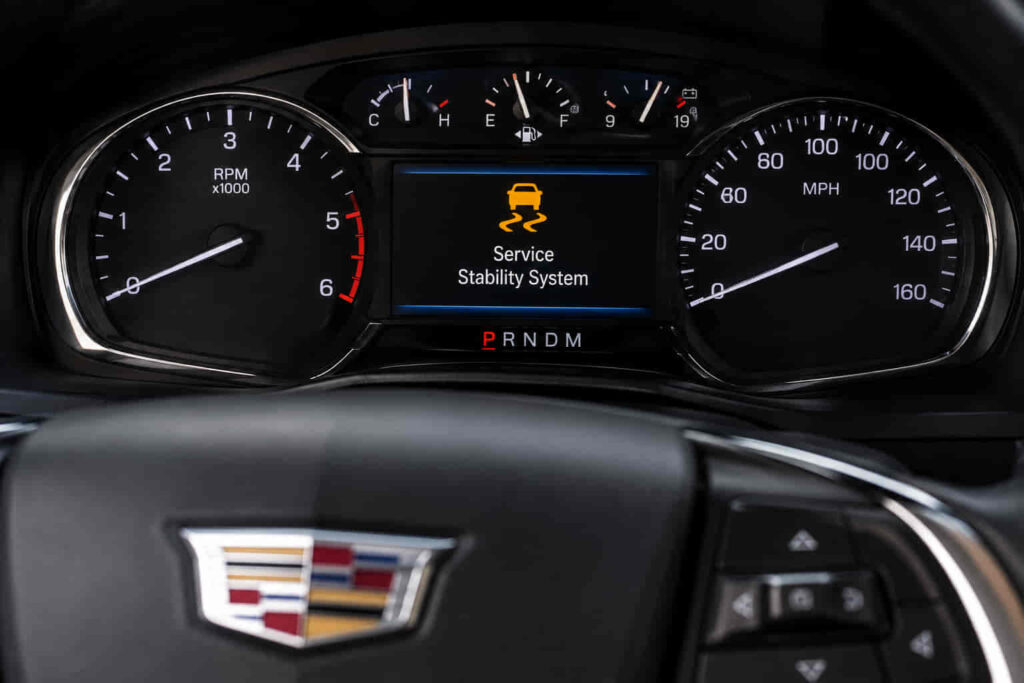
A Cadillac Escalade Service Stability System message usually appears when the vehicle detects a problem with the electronic stability control system, ABS system, sensors, or communication between safety-related control modules. The stability system is designed to help maintain vehicle control by monitoring wheel speed, steering direction, vehicle movement, and braking conditions. When the system detects inaccurate information or a component failure, it may temporarily disable stability control functions and display a warning message.
The Cadillac Escalade uses multiple connected systems to maintain stability, including StabiliTrak, Electronic Stability Control (ESC), traction control, and the anti-lock braking system (ABS). These systems depend on accurate data from sensors and reliable communication between electronic modules. A failure in one component can affect the entire stability control network.
Common causes of a Service Stability System warning include faulty wheel speed sensors, ABS module problems, steering angle sensor issues, low battery voltage, damaged wiring, tire-related problems, or control module communication failures. The warning does not always indicate a major mechanical failure, but it should not be ignored because stability systems play an important role in vehicle safety.
This guide explains the most common causes of Cadillac Escalade Service Stability System messages, how each problem affects the stability control system, and what diagnostic steps can help identify the correct repair.
Can a Faulty Wheel Speed Sensor Cause Cadillac Escalade Stability System Problems?
A faulty wheel speed sensor can cause Cadillac Escalade Service Stability System problems because the stability control system depends on accurate wheel speed information to determine whether the vehicle is losing traction or becoming unstable. Each wheel speed sensor monitors the rotation of an individual wheel and sends this information to the ABS and stability control modules.
The Cadillac Escalade stability system compares wheel speed data with steering input and vehicle movement information to determine when corrective action is needed. If one sensor sends an incorrect signal or stops communicating, the system may not be able to accurately detect wheel slip, uneven rotation, or changes in vehicle movement. As a safety response, the vehicle may disable stability control functions and display the Service Stability System warning.
Wheel speed sensor failures can occur because of damaged sensors, wiring problems, connector corrosion, or contamination around the sensor area. These problems are more common in vehicles exposed to harsh weather conditions, road debris, or long-term use because the sensors operate close to the wheels and braking components.
Drivers may notice additional symptoms such as ABS warning lights, traction control warnings, inconsistent speed readings, or stability control activation problems. For example, if a Cadillac Escalade shows a Service Stability System message after a wheel bearing replacement, a damaged or incorrectly positioned wheel speed sensor may be the actual cause.
Proper diagnosis requires scanning ABS and stability control fault codes and checking sensor data from each wheel. Replacing a wheel speed sensor without confirming the failure source can lead to unnecessary repairs if the real problem exists in the wiring or control module.
Can ABS System Problems Trigger Cadillac Escalade Service Stability System?
ABS system problems can trigger a Cadillac Escalade Service Stability System message because the stability control system relies on ABS components to apply individual braking force when the vehicle begins to lose control. The ABS system and stability control system share important sensors, hydraulic components, and electronic communication pathways.
The ABS module processes information from wheel speed sensors and controls brake pressure during emergency braking or stability corrections. When the module detects internal faults, communication errors, or abnormal sensor readings, it may prevent the stability system from operating correctly and activate the warning message.
Common ABS-related causes include ABS module failure, hydraulic control problems, damaged wiring, and communication issues between the ABS module and other vehicle control systems. Because the ABS module acts as a central controller for several safety functions, a single failure can affect multiple warning systems at the same time.
A Cadillac Escalade with ABS-related stability problems may display multiple warnings, including ABS light, traction control warning, and Service Stability System message. For example, if the ABS module cannot process wheel speed information correctly, the stability control system may disable itself because it cannot safely control braking intervention.
Diagnosing ABS-related problems requires reading specific ABS fault codes rather than relying only on dashboard warnings. A proper scan can identify whether the issue comes from the ABS module, sensor input, wiring connection, or another connected stability system component.
Can a Steering Angle Sensor Problem Disable Stability Control?
A steering angle sensor problem can disable Cadillac Escalade stability control because the system needs accurate steering direction information to compare the driver’s intended path with the vehicle’s actual movement. The steering angle sensor measures how much and in which direction the steering wheel is turned, allowing the stability control module to determine whether corrective action is needed.
The Cadillac Escalade stability system uses steering angle data together with wheel speed information, yaw rate data, and brake system information. When the sensor provides incorrect readings or loses calibration, the system may misunderstand the vehicle’s direction and disable stability control functions as a protective measure.
Steering angle sensor problems can occur after wheel alignment changes, steering component repairs, battery disconnection, electrical faults, or sensor internal failure. In some cases, the sensor itself is working correctly but requires recalibration because the system no longer recognizes the correct steering center position.
Drivers may experience symptoms such as a Service Stability System warning, traction control messages, steering-related warnings, or stability control activation at incorrect times. For example, after replacing suspension components on a Cadillac Escalade, the stability system may require calibration because the steering angle data no longer matches the actual wheel position.
Proper diagnosis requires checking stability system fault codes and verifying steering angle sensor readings with a diagnostic scanner. Replacing the sensor without confirming calibration or signal problems can result in unnecessary repairs because the issue may only require system relearning.
Can Low Battery Voltage Cause Cadillac Escalade Stability System Warning?
Low battery voltage can cause a Cadillac Escalade Service Stability System warning because electronic stability systems require stable electrical power to communicate and operate correctly. The stability control system depends on multiple electronic modules, sensors, and communication networks that can malfunction when voltage drops below normal operating levels.
The Cadillac Escalade uses electrical power from the battery and charging system to operate modules such as the ABS control module, stability control module, and other vehicle computers. When battery voltage becomes unstable due to a weak battery, alternator problems, or poor electrical connections, these modules may generate incorrect signals or lose communication temporarily.
Voltage-related problems can create multiple warning messages at the same time because modern vehicle systems are interconnected. A weak battery may cause stability warnings, ABS lights, traction control messages, or other electronic alerts even when the mechanical braking and suspension components are functioning normally.
Common causes include an aging battery, charging system failure, loose battery terminals, or poor grounding connections. For example, a Cadillac Escalade that displays a Service Stability System warning immediately after starting in cold weather may have a battery voltage issue rather than a failure of the stability control components.
Checking battery voltage and charging system performance is an important diagnostic step before replacing expensive stability system parts. Restoring proper electrical supply can resolve warning messages when the underlying cause is voltage instability.
Read more: Cadillac Engine Power Reduced
Can Wiring or Connector Problems Affect Cadillac Stability System?
Wiring or connector problems can affect the Cadillac Escalade stability system because electronic control modules require uninterrupted communication with sensors and other components to maintain vehicle stability. The stability control system depends on accurate electrical signals from wheel speed sensors, steering sensors, ABS components, and control modules. Any interruption in these signals can cause the system to disable stability functions and display a warning message.
Electrical connection problems often develop because of corrosion, damaged wiring insulation, loose connectors, or poor grounding points. Since many stability system components are located near the wheels and under the vehicle, they are exposed to moisture, road salt, dirt, and vibration that can affect electrical reliability over time.
A damaged connector may create intermittent failures where the Cadillac Escalade operates normally at one moment but displays the Service Stability System warning under certain conditions. Temperature changes, vehicle movement, or moisture exposure can temporarily affect the connection quality and cause communication errors between modules.
Diagnosing wiring-related problems requires more than checking dashboard warnings. Technicians need to inspect connectors, test electrical continuity, verify sensor signals, and check communication between stability control modules. For example, replacing a wheel speed sensor will not solve the problem if the actual failure is a damaged wire between the sensor and the ABS module.
Repairing electrical connection issues can restore normal stability system operation without replacing expensive electronic components. A complete inspection ensures that the actual communication failure is corrected rather than treating only the warning message.
Can Tire Problems Trigger Cadillac Escalade Stability System Errors?
Tire problems can trigger Cadillac Escalade stability system errors because the stability control system relies on consistent wheel rotation information to determine vehicle movement and traction conditions. The system compares data from multiple wheels to detect differences that may indicate slipping, loss of control, or changes in driving conditions.
Incorrect tire size, uneven tire pressure, excessive tire wear, or mismatched tires can create different wheel rotation speeds. Since wheel speed sensors measure how fast each wheel rotates, these differences may be interpreted by the stability control module as abnormal vehicle behavior.
Tire-related stability warnings are especially possible when tires on the same vehicle have different diameters or significantly different tread conditions. The stability system expects predictable wheel speed relationships, and large differences can interfere with the calculations used by traction control and stability control functions.
Drivers may notice symptoms such as traction control activation, stability warnings, unusual handling behavior, or inconsistent system operation after changing tires. For example, installing a tire with a different size than the manufacturer specification on one axle of a Cadillac Escalade may create wheel speed differences that confuse the stability control system.
Checking tire condition, tire pressure, and tire specifications should be part of the diagnostic process before replacing electronic components. Correcting tire-related issues can resolve stability warnings when the system itself is functioning properly.
Can Stability Control Module Problems Cause Service Stability System Message?
A stability control module problem can cause a Cadillac Escalade Service Stability System message because the module acts as the central processor that receives sensor information and controls stability-related functions. The stability control module communicates with components such as wheel speed sensors, steering angle sensors, ABS systems, and other vehicle control modules to determine how the vehicle is moving and when corrective action is required.
When the module develops an internal fault or loses communication with connected systems, the stability control system may become unavailable. These failures can occur because of internal electronic damage, software-related issues, communication errors, or unstable electrical conditions affecting module operation.
Module-related problems are usually more complex than individual sensor failures because the module manages information from multiple systems. A faulty module may create several warning messages at the same time, including stability control warnings, traction control alerts, and ABS-related notifications.
Diagnosing a stability control module problem requires proper scanning equipment that can access ABS and stability system data. Technicians need to verify whether the module is receiving correct sensor information before deciding that the module itself has failed. For example, a Cadillac Escalade may show a stability warning because the module is receiving incorrect wheel speed data rather than because the module is damaged.
Replacing a stability control module should only be considered after confirming that sensors, wiring, voltage supply, and communication networks are operating correctly. Accurate diagnosis prevents unnecessary replacement of expensive electronic components.
How Do You Diagnose Cadillac Escalade Service Stability System Warning?
Diagnosing a Cadillac Escalade Service Stability System warning requires identifying the exact component or communication problem that prevents the stability control system from operating correctly. Because the system depends on multiple sensors and modules, replacing parts based only on the warning message can lead to incorrect repairs.
The first diagnostic step is scanning the vehicle with an OBD-II tool that can access ABS and stability control fault codes. Standard engine codes may not provide enough information because stability system problems are often stored in specialized control modules. Reading these codes helps identify whether the issue involves a wheel speed sensor, steering angle sensor, ABS module, electrical system, or communication failure.
After retrieving fault information, the next step is verifying the affected component. This may include checking sensor readings, inspecting wiring connections, testing battery voltage, confirming module communication, and verifying that tire conditions match manufacturer specifications.
A complete diagnostic process focuses on finding the root cause rather than removing the warning temporarily. For example, clearing a Service Stability System message may turn off the warning briefly, but it will return if the failed sensor, damaged wiring, or communication problem remains unresolved.
Accurate diagnosis helps restore the Cadillac Escalade stability system safely while avoiding unnecessary repairs. Since stability control directly affects vehicle handling and safety, persistent warning messages should be investigated before continuing normal driving conditions.
How Can You Restore Cadillac Escalade Stability System Performance?
You can restore Cadillac Escalade stability system performance by identifying and repairing the specific cause of the warning instead of treating the Service Stability System message as a single component failure. The stability control system depends on accurate information from multiple sensors, electronic modules, braking components, and electrical connections to maintain vehicle control.
A Service Stability System warning can result from different sources, including wheel speed sensor failures, ABS system problems, steering angle sensor issues, low battery voltage, wiring faults, tire-related conditions, or stability control module problems. Because these components work together, a complete diagnostic process is necessary to determine the actual failure point.
The most effective repair approach begins with reading stability system fault codes and checking the related components systematically. Testing sensors, inspecting electrical connections, verifying voltage supply, and confirming module communication help prevent unnecessary replacement of expensive parts.
Regular maintenance also reduces the chance of stability system failures. Maintaining proper battery condition, checking tire specifications and pressure, addressing warning lights early, and repairing electrical issues before they affect communication can improve long-term system reliability.
A Cadillac Escalade Service Stability System message should not be ignored because the system plays an important role in vehicle safety. With accurate diagnosis and proper repairs, the stability control system can return to normal operation and continue supporting safe handling in different driving conditions.