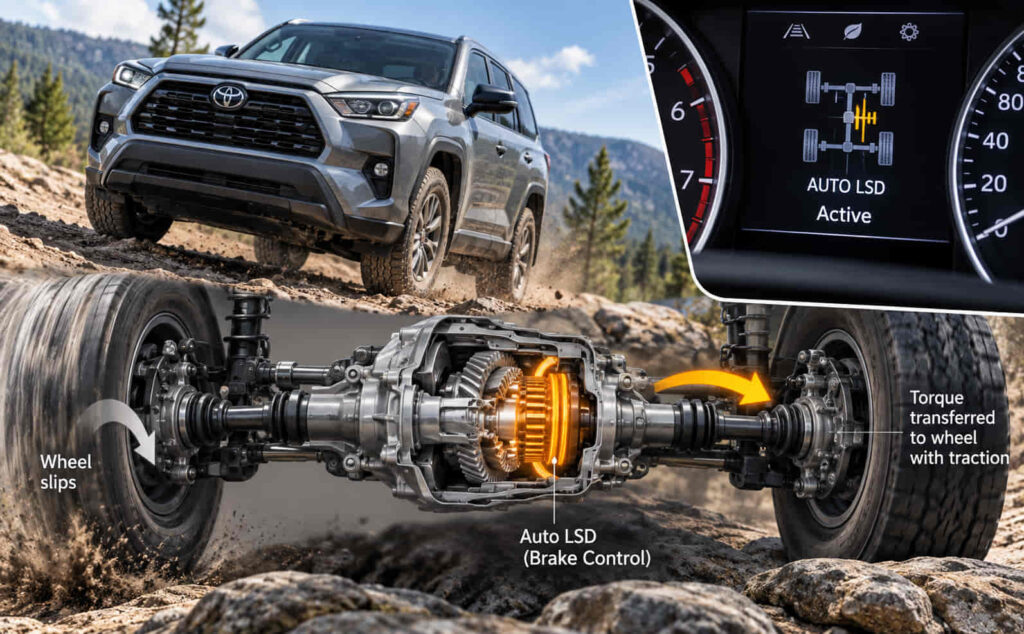
Auto LSD Toyota is a traction-assistance system that helps a vehicle regain traction when one of its drive wheels begins to spin on a slippery or low-grip surface. Instead of relying on a conventional mechanical limited-slip differential to restrict wheel-speed differences, the system uses the vehicle’s braking and traction-control functions to reduce excessive wheel spin. This intervention allows the open differential to direct more usable torque toward the drive wheel that still has traction.
Toyota designed Auto LSD for situations where normal traction control may restrict wheel spin more aggressively than the driver needs. When Auto LSD is activated and the system detects excessive wheel spin, it applies braking force to the spinning wheel while allowing controlled power delivery from the engine. This function can help the vehicle move through surfaces such as loose gravel, mud, sand, snow, or uneven terrain where one drive wheel has substantially less grip than the other.
Auto LSD should not be confused with a mechanical limited-slip differential or a locking differential. Although these systems share the objective of improving traction, they achieve it through different mechanisms. Understanding how Toyota Auto LSD detects wheel slip, controls the spinning wheel, and interacts with the differential explains when the system is useful and when another traction or drivetrain function is more appropriate.
What Is Auto LSD on a Toyota?
Auto LSD on a Toyota is an electronic traction-assistance function that helps reduce drive-wheel spin when the vehicle encounters a low-traction surface. The term “Auto LSD” refers to Automatic Limited-Slip Differential, but the function should not automatically be interpreted as a conventional mechanical limited-slip differential. Its purpose is to create a limited-slip effect by controlling excessive wheel spin so that the vehicle can use available traction more effectively.
Wheel spin becomes a problem when the drive wheels encounter surfaces with different levels of grip. With an open differential, the left and right drive wheels can rotate at different speeds, which is necessary when the vehicle turns. However, this characteristic can become a disadvantage when one drive wheel loses traction. The low-grip wheel can spin rapidly while the wheel with better traction receives insufficient usable torque to move the vehicle effectively.
Toyota Auto LSD addresses this condition by using braking intervention to control the spinning drive wheel. When excessive wheel spin is detected, the system can apply braking force to that wheel. The added resistance changes how torque passes through the differential, helping the drive wheel with better grip receive more usable driving force. The result resembles one of the functions associated with a limited-slip differential even though the underlying mechanism is different.
This distinction is important because Auto LSD, a mechanical limited-slip differential, and a locking differential do not achieve traction in the same way. A mechanical LSD uses components inside the differential to limit the speed difference between the drive wheels. A differential lock mechanically links the two sides so that both wheels are driven together under its operating conditions. Auto LSD instead relies on electronic control and braking intervention to manage wheel spin. The shared objective is improved traction, but the method used to achieve that objective differs.
For example, consider a Toyota equipped with Auto LSD when one drive wheel is positioned on loose gravel while the other remains on a firmer surface. Pressing the accelerator can cause the wheel on loose gravel to spin because it has less available grip. Auto LSD can control that spinning wheel with braking force, allowing more usable torque to reach the wheel on the firmer surface and helping the vehicle move forward.
How Does Toyota Auto LSD Work?
Toyota Auto LSD works by detecting excessive drive-wheel spin and applying braking force to the spinning wheel, which helps transfer usable driving force through the differential to the wheel with better traction. The process combines wheel-speed monitoring, electronic control and brake intervention rather than mechanically locking the differential.
The process begins when the vehicle monitors wheel rotation. A drive wheel that suddenly rotates substantially faster than the other wheels can indicate that its tire has exceeded the available traction at the road surface. This situation can occur on mud, loose gravel, sand, snow or another surface where the coefficient of friction is lower under one drive wheel than under the other.
Once excessive wheel spin is identified under the appropriate operating conditions, Auto LSD can command braking force at the spinning wheel. Applying the brake creates resistance on the low-traction side of the open differential. That resistance is important because an open differential does not independently guarantee that the wheel with better grip receives enough usable torque when the opposite wheel is spinning freely.
The braking intervention therefore changes the torque condition across the differential. Resistance at the spinning wheel allows usable driving force to be delivered to the opposite drive wheel, where more traction may be available. The system does not need to physically lock both axle shafts together to produce this effect. It manages the behavior of the open differential by controlling the wheel that is losing traction.
For example, if one drive wheel enters a muddy patch while the opposite drive wheel remains on a firmer section of ground, the muddy-side wheel can begin spinning as the driver applies the accelerator. Auto LSD can brake the spinning wheel rather than allowing uncontrolled wheel speed to continue. The resulting resistance helps the wheel on firmer ground produce useful tractive force, increasing the vehicle’s ability to move out of the low-grip area.
This mechanism also explains why Auto LSD and conventional traction control should not be treated as interchangeable terms. Both respond to wheel slip, and both can use the braking system as part of their control strategy, but their operating objectives can differ. Auto LSD is intended to permit a degree of controlled wheel spin while helping the vehicle generate traction in conditions where additional wheel slip may be useful. Conventional traction control generally focuses on suppressing excessive wheel spin to maintain vehicle stability and grip. The exact operating logic, activation requirements and limitations depend on the Toyota model, drivetrain and model year, so the owner’s manual for the specific vehicle remains the authoritative reference for vehicle-specific instructions.
Read more: Toyota P0430
In What Situations Does Toyota Auto LSD Work?
Toyota Auto LSD is designed to assist when a drive wheel spins because the vehicle is traveling over a loose, slippery, or uneven surface with insufficient traction. The system is most relevant when there is a significant difference in available grip between the drive wheels and normal power delivery through the differential is not producing enough tractive force to move the vehicle effectively.
Loose surfaces are a common condition in which Auto LSD can be useful. Gravel, sand, mud, and similar terrain can allow a tire to rotate faster than the vehicle is actually moving because the surface cannot provide enough friction to convert the applied torque into forward motion. Once a drive wheel begins spinning excessively, increasing accelerator input alone may produce more wheel spin rather than more vehicle movement. Auto LSD controls this condition by adding braking resistance to the spinning wheel and helping the drivetrain use the traction available at the opposite wheel.
Uneven traction between the drive wheels creates another relevant operating condition. One tire may remain on a relatively firm surface while the other encounters mud, loose material, or another low-grip section. The wheel on the slippery side can begin spinning because an open differential allows the drive wheels to rotate at different speeds. Braking the spinning wheel creates resistance on that side of the differential, which helps the wheel with greater surface grip generate usable tractive force.
Snow and other slippery surfaces can create a similar wheel-slip condition. Auto LSD can assist when one drive wheel loses grip while another retains enough traction to help move the vehicle. However, the system does not create traction where none exists. Tire condition, tire type, surface friction, vehicle load, gradient, and available grip still determine how much force the tires can transfer to the ground. Auto LSD manages the available traction; it cannot overcome the physical traction limit between the tires and the surface.
The same principle explains the system’s limitations in severe conditions. If both drive wheels have extremely little grip, applying the brake to one spinning wheel cannot create a high-friction surface beneath the other. A vehicle that is deeply stuck in mud or sand may therefore remain immobilized despite Auto LSD intervention. The system should be understood as traction assistance rather than a substitute for suitable tires, appropriate driving technique, four-wheel-drive capability, or recovery equipment where those measures are required.
When Should You Turn On Auto LSD on a Toyota?
You should use Toyota Auto LSD when a drive wheel is spinning on a low-traction surface and the vehicle is having difficulty moving because usable driving force is not reaching the wheel with better grip. Its purpose is situational rather than continuous, so Auto LSD should be activated when the driving condition matches the traction problem the system is designed to address.
A typical use case occurs when a vehicle needs to move across loose gravel, mud, sand, or another surface where wheel spin prevents effective forward movement. In this situation, controlled wheel spin can be useful because completely suppressing wheel rotation may prevent the vehicle from developing enough momentum to move through the loose material. Auto LSD allows the drivetrain and braking system to manage this wheel spin while helping the drive wheel with greater grip contribute more tractive force.
Auto LSD can also be useful when the two drive wheels encounter different surfaces. For example, one wheel may be positioned on a slippery shoulder while the opposite wheel remains on a firmer road surface. If the low-traction wheel spins and the vehicle struggles to move, activating Auto LSD can help control that wheel and make better use of the traction available at the other tire. The benefit comes from managing the difference in available grip rather than simply increasing engine power.
The driver should therefore base Auto LSD use on wheel-slip conditions rather than treating the function as a general performance mode. On a normal paved road where both drive wheels maintain adequate traction, the system does not provide the same practical benefit because there is no significant traction imbalance for it to manage. Normal vehicle stability and traction-control functions are intended to handle ordinary driving conditions.
Auto LSD should also be used according to the operating procedure specified for the individual Toyota vehicle. Activation conditions and system behavior can differ by model, drivetrain, market, and model year. The source materials provided for this project do not contain model-specific Toyota operating limits, so a universal activation speed, button procedure, or operating threshold should not be stated as applicable to every Toyota. Those specifications should be taken from the owner’s manual for the exact vehicle before model-specific instructions are added.
When Should You Not Use Toyota Auto LSD?
Toyota Auto LSD should not be used as a default driving mode when the drive wheels already have adequate traction. The function is intended to address a specific traction problem in which excessive wheel spin prevents the vehicle from using available grip effectively. When the vehicle is traveling normally on a stable paved surface, there is generally no traction imbalance that requires Auto LSD intervention.
The reason is connected directly to the function of the system. Auto LSD manages wheel slip by allowing controlled wheel spin and using braking intervention to increase resistance at a spinning drive wheel. This strategy is useful when a vehicle needs additional traction on a loose or slippery surface, but normal road driving requires different priorities, including predictable traction control and vehicle stability. Activating a specialized traction-assistance function without the conditions it is designed to address does not create additional tire grip.
Auto LSD should also not be treated as a solution for every situation in which a Toyota becomes stuck. The system can redistribute usable driving force only when sufficient traction remains available at another drive wheel. If the tires cannot generate adequate friction because both drive wheels are on extremely slippery ground, the vehicle is deeply embedded in loose material, or the tires are unsuitable for the surface, Auto LSD cannot independently overcome those physical limitations.
Drivers should also avoid assuming that one Toyota model has the same Auto LSD operating restrictions as another. Activation requirements and operating limits can vary according to the vehicle, drivetrain, model year, and market specification. The source materials supplied for this article do not provide model-specific Toyota limits, so a single maximum operating speed or universal deactivation procedure cannot be stated reliably for every Toyota. The owner’s manual for the specific vehicle should determine those operating requirements.
What Is the Difference Between Toyota Auto LSD and Traction Control?
Toyota Auto LSD and traction control both manage drive-wheel slip, but they use wheel-slip control for different operating objectives. Conventional traction control is primarily intended to suppress excessive wheel spin and maintain controlled traction during normal driving, while Auto LSD is intended to help a vehicle continue moving in low-traction conditions where a degree of controlled wheel spin may be useful.
Traction control responds when engine torque exceeds the amount of force the tire can transfer through the available road friction. A drive wheel can then rotate faster without producing a corresponding increase in vehicle speed. The control system responds to this loss of traction and can use available vehicle-control functions to reduce excessive wheel spin. The objective is to restore a more controlled relationship between tire rotation and the road surface.
Auto LSD addresses the same basic physical event from a different functional context. When a wheel spins on loose or uneven terrain, eliminating wheel spin as aggressively as possible is not always the desired response. The vehicle may need controlled wheel rotation to move through gravel, sand, mud, or another low-grip surface. Auto LSD manages the spinning wheel with braking intervention while allowing the drivetrain to continue producing useful driving force.
For example, a Toyota accelerating on a paved but slippery road and a Toyota attempting to move with one drive wheel in loose mud can both experience wheel slip. The first condition calls for controlled traction and stability during ordinary driving. The second creates a traction imbalance in which the vehicle may benefit from resistance being applied to the freely spinning wheel so that the opposite wheel can use its available grip. The presence of wheel slip is similar, but the driving objective is different.
Auto LSD and traction control should therefore not be described simply as two names for the same feature. They are related through wheel-speed monitoring, braking control, traction, and drivetrain management, but the appropriate operating strategy depends on the driving condition. Vehicle-specific implementation can also vary, so the exact relationship between Auto LSD and other traction-control functions should be confirmed for the individual Toyota model.
What Is the Difference Between Toyota Auto LSD and a Differential Lock?
Toyota Auto LSD uses electronic braking intervention to create a limited-slip effect, while a differential lock mechanically restricts the speed difference between the connected drive wheels. Both systems can improve traction when wheel grip is uneven, but they act on the drivetrain through fundamentally different mechanisms.
A differential normally allows the left and right wheels on an axle to rotate at different speeds. This speed difference is necessary because the outside wheel travels farther than the inside wheel when a vehicle turns. An open differential handles this difference efficiently during normal driving, but it can become a limitation when one drive wheel loses traction and spins with little resistance.
Auto LSD does not mechanically join the two axle shafts to eliminate that speed difference. Instead, it applies braking resistance to a drive wheel that is spinning excessively. The added resistance changes the torque condition across the open differential and helps the opposite wheel use more of the available driving force. The system therefore produces a limited-slip effect through brake control rather than through a mechanical locking connection inside the drivetrain.
A differential lock uses a different principle. When engaged under its intended operating conditions, the locking mechanism restricts differential action so that the connected wheels cannot behave as independently as they do with an open differential. This mechanical relationship can provide strong traction benefits when one wheel has very little grip, but it also changes how the axle behaves when the vehicle turns because the wheels naturally need to cover different distances.
Consider a vehicle with its left drive wheel on a low-grip surface and its right drive wheel on firm ground. Auto LSD can brake the spinning left wheel and use the resulting resistance to help the right wheel generate useful tractive force. A locking differential addresses the traction imbalance mechanically by restricting relative wheel-speed behavior. Both approaches are intended to help the vehicle move, but one manages wheel slip through braking intervention while the other changes the mechanical behavior of the differential.
This distinction explains why Auto LSD should not be called an electronic differential lock without qualification. The driver may experience a similar practical outcome—improved ability to move when traction differs between the drive wheels—but the mechanism, operating behavior, and limitations are not identical. Auto LSD, mechanical limited-slip differentials, and differential locks belong to the same broader traction and drivetrain context while remaining separate systems.
Which Toyota Vehicles Have Auto LSD?
Auto LSD is available on selected Toyota vehicles rather than being a standard feature across the entire Toyota lineup. Availability depends on factors such as the model, drivetrain configuration, model year, trim level, and market. For this reason, the presence of an Auto LSD function on one Toyota vehicle does not establish that another vehicle with a similar drivetrain has the same system.
Auto LSD is most relevant to Toyota vehicles designed for driving conditions in which a drive wheel may encounter loose or uneven surfaces. The function addresses a drivetrain problem created when one drive wheel loses traction and begins spinning while another wheel retains usable grip. Its practical value therefore depends partly on the vehicle’s drivetrain architecture and intended operating conditions rather than simply on the Toyota badge.
The most reliable way to determine whether a specific Toyota has Auto LSD is to check the owner’s manual and the vehicle’s physical controls. A dedicated AUTO LSD switch or a corresponding indicator described in the owner’s manual provides vehicle-specific evidence that the function is present. This approach is more reliable than assuming availability from the model name alone because Toyota can change equipment and control strategies between generations, trims, drivetrains, and regional specifications.
Model-specific information becomes especially important when comparing two versions of the same Toyota. A feature offered with one drivetrain or during one production period may not necessarily appear with another configuration. The source materials provided for this article do not contain a verified Toyota model-and-year compatibility table, so listing specific vehicles as universally equipped with Auto LSD would introduce information that those sources do not establish.
Where Is the Auto LSD Button on a Toyota?
The Auto LSD button is located among the vehicle’s driver-operated controls on Toyota models equipped with a manually selectable Auto LSD function, but its exact position varies by model and model year. Drivers should identify the control by its AUTO LSD marking rather than assume that every Toyota places the switch in the same dashboard or console position.
Pressing the Auto LSD control requests the operating mode designed for low-traction situations. The button itself does not mechanically lock the differential. Instead, it changes how the vehicle’s electronic traction functions respond to drive-wheel slip under the conditions defined for that vehicle. This distinction connects the physical AUTO LSD switch directly to the electronic braking-based mechanism described earlier in the article.
The control should therefore be understood as a mode-selection interface rather than a mechanical drivetrain lever. When the driver selects Auto LSD, the vehicle can permit and manage wheel-slip behavior appropriate to the system’s traction objective. If a low-grip wheel begins spinning, braking intervention can then help create resistance at that wheel so that usable driving force reaches the wheel with better traction.
The owner’s manual should be used when identifying the button and following the activation procedure for a specific Toyota. This is particularly important because the source materials supplied for this article do not establish a universal button location or activation sequence for all Toyota vehicles. Using vehicle-specific instructions prevents a control arrangement from one Toyota model from being incorrectly applied to another.
What Does the Auto LSD Light Mean on a Toyota?
The Auto LSD indicator communicates the status of the Auto LSD function, but its exact meaning must be interpreted according to the indicator behavior and the instructions for the specific Toyota model. Seeing the AUTO LSD symbol after selecting the function should therefore not automatically be interpreted as evidence that the vehicle has a mechanical problem.
The indicator is connected to system status rather than to the physical differential alone. Auto LSD depends on electronic control, wheel-speed information, and braking intervention, so the dashboard indication helps the driver understand whether the selected traction function is available or operating according to the vehicle’s control logic. The precise distinction between a continuously illuminated indicator, a flashing indicator, and a warning condition can vary by vehicle implementation.
An Auto LSD indication also needs to be interpreted alongside other dashboard warnings. Because the function depends on systems involved in wheel-speed detection and brake control, a problem affecting related vehicle-control functions may also affect Auto LSD availability. A driver should therefore consider whether ABS, traction-control, stability-control, or other warning indicators are present instead of diagnosing the Auto LSD system from one dashboard symbol in isolation.
A persistent or unexpected Auto LSD indication should be checked against the owner’s manual for the exact vehicle. If the displayed behavior does not match normal operation described by Toyota, diagnostic inspection may be required to identify the underlying condition. The source materials provided for this article do not define Toyota-specific indicator patterns or diagnostic trouble codes, so assigning one universal fault meaning to a flashing or continuously illuminated AUTO LSD light would not be sufficiently supported.
This distinction is important for troubleshooting because an Auto LSD indicator and an Auto LSD fault are not necessarily the same thing. The indicator can communicate a selected or operating state, while an abnormal warning condition can point to a problem that requires further diagnosis. Correct interpretation begins with the specific vehicle’s documented indicator behavior before individual components are suspected or replaced.