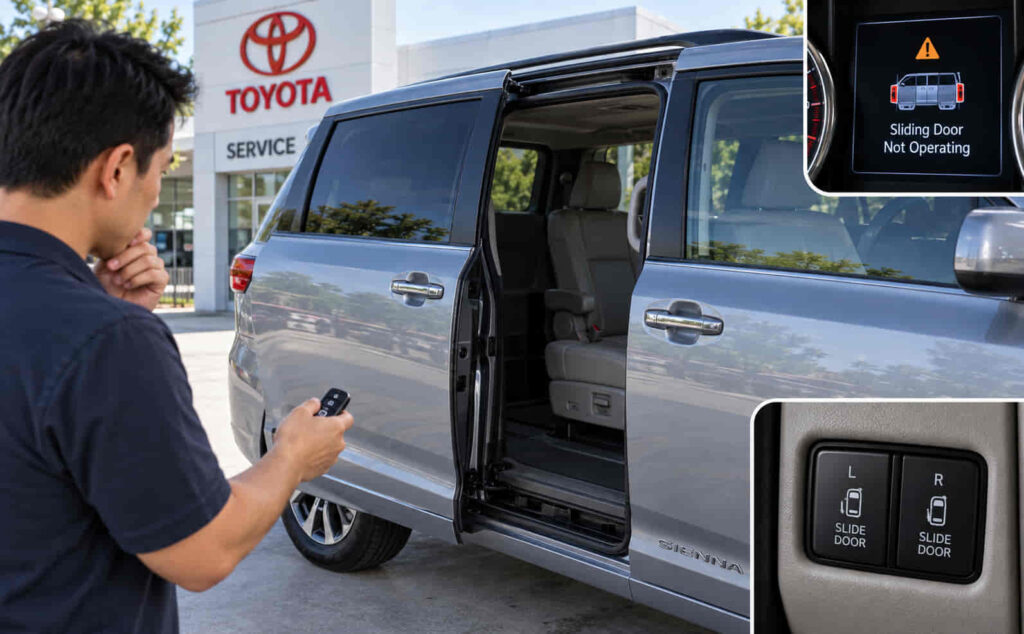
Toyota Sienna automatic doors can stop working because the power sliding door system is disabled, electrical power is interrupted, or a mechanical component has failed. The most relevant causes include an incorrectly positioned power door switch, a blown fuse, a weak or disconnected 12-volt battery, a faulty sliding door motor, a damaged drive cable, a malfunctioning latch or sensor, and resistance in the door track or roller mechanism. The correct diagnosis depends on whether one door or both doors have stopped working and whether the affected door still operates manually.
When both Toyota Sienna power sliding doors stop working at the same time, the shared electrical supply and system controls should be checked before individual door components. When only one sliding door fails, the fault is more likely to involve components associated with that door, such as its motor, cable, latch, sensor, wiring, or mechanical movement. A door that beeps but does not move also provides a different diagnostic clue from a door that produces no response at all.
This guide explains why Toyota Sienna automatic doors stop working, how to narrow down the cause from the symptoms, how to check the main electrical and mechanical components, when a reset is appropriate, and which problems require professional repair.
Why Are the Toyota Sienna Automatic Doors Not Working?
Toyota Sienna automatic doors stop working when the power sliding door system loses electrical power, receives a command that prevents automatic operation, or encounters a mechanical problem that prevents the door from moving correctly. The main causes include a disabled power door switch, a blown fuse, low 12-volt battery voltage, a faulty motor, a damaged drive cable, a malfunctioning latch or sensor, and excessive resistance in the sliding door track or roller assembly. The symptoms produced by the door help distinguish these causes before parts are removed or replaced.
The power sliding door switch is one of the first components to check because the doors can remain mechanically functional while automatic operation is disabled. When the system is switched off, the sliding doors can behave like manual doors even though the motors, cables, and other mechanical components have not failed. This condition is especially relevant when automatic operation suddenly disappears without grinding noises, irregular door movement, or other mechanical symptoms.
Electrical supply problems can produce similar symptoms. The Toyota Sienna power sliding door system depends on the vehicle’s 12-volt electrical system, so a discharged or disconnected battery can interrupt normal power-door operation. A blown fuse or circuit problem can also prevent electrical power from reaching the system. Electrical causes deserve greater attention when both doors stop responding at approximately the same time because two independent door mechanisms are less likely to develop separate mechanical faults simultaneously.
A malfunction becomes more localized when only one Toyota Sienna sliding door stops working. The affected door has its own mechanical and electrical components that can fail while the opposite door continues operating. A worn motor can lose the ability to move the door through its full travel, while a damaged drive cable can prevent the motor from transferring movement correctly. These failures can produce slow movement, incomplete opening or closing, unusual mechanical noises, or no powered movement despite other parts of the power-door system remaining operational.
The latch, sensors, track, and rollers also influence whether the automatic door can complete an opening or closing cycle. The control system relies on the door being in an acceptable operating state, while the mechanical assembly must allow the door to travel without excessive resistance. A latch that does not release correctly, an incorrect door-position input, debris in the track, or a damaged roller can therefore interrupt automatic operation even when electrical power is available. The symptom pattern should be identified before replacing the motor because a motor replacement does not correct a restricted track, damaged cable, defective latch, or unrelated electrical fault.
Why Are Both Toyota Sienna Sliding Doors Not Working?
Both Toyota Sienna sliding doors can stop working when a shared system condition prevents power operation, so the diagnosis should begin with components and controls that can affect both doors. The power sliding door main switch, 12-volt electrical supply, relevant power circuit, and system state should be checked before assuming that both door motors or both drive mechanisms have failed independently.
The main power door switch is the simplest distinction between a disabled system and a component failure. When the switch is set to a position that disables powered operation, both sliding doors can lose their automatic function while remaining capable of manual movement. Checking the switch first prevents unnecessary diagnosis of motors, cables, latches, and door assemblies when the system has simply been disabled.
The vehicle’s electrical condition becomes the next diagnostic area when the switch is correctly positioned. Both automatic doors require a stable electrical supply to operate their motors and control functions. A weak 12-volt battery, a recently disconnected battery, a blown fuse, or another interruption in the shared electrical path can therefore affect both doors. The timing of the failure provides useful context: if both doors stopped operating after the battery discharged, was replaced, or was disconnected, the electrical event should be considered before investigating two separate mechanical failures.
A simultaneous failure of both doors should not automatically be treated as proof of a fuse or battery problem. The diagnosis still depends on the complete symptom pattern. Interior switches, exterior handles, remote commands, manual door movement, warning sounds, and other power functions can help establish whether the problem affects the entire system or only specific methods of activating it. This distinction reduces unnecessary parts replacement because a shared control or power problem requires a different repair path from a failed motor or cable on an individual sliding door.
When basic shared-system checks do not restore operation, the next step is systematic electrical diagnosis rather than replacing parts by assumption. The relevant power supply, fuse condition, wiring, control inputs, and individual door response need to be evaluated in sequence. This approach isolates the failed circuit or component while preserving the central diagnostic distinction: two doors failing together points the investigation toward shared conditions first, whereas a single failed door shifts attention toward components specific to that door.
Read more: Toyota C1201
Why Is Only One Toyota Sienna Power Sliding Door Not Working?
Only one Toyota Sienna power sliding door stops working when the fault is isolated to components, wiring, or mechanical movement associated with that specific door. A single-door failure shifts the diagnostic focus away from shared system conditions and toward the affected door’s motor, drive cable, latch, position inputs, wiring, track, and roller mechanism. The working door provides an important comparison because it confirms that at least part of the vehicle’s power sliding door system remains operational.
The exact behavior of the faulty door helps narrow the diagnosis. A door that makes motor or mechanical noise without completing its travel indicates a different problem from a door that remains completely silent. Noise accompanied by little or irregular movement directs attention toward the drive mechanism, cable, rollers, track, or another source of mechanical resistance. A completely unresponsive door requires greater attention to its electrical supply, switches, wiring, motor, and control inputs. These symptoms should be evaluated before a motor is replaced because the motor is only one component in the complete sliding door system.
The door’s manual operation provides another diagnostic distinction. A Toyota Sienna sliding door that moves through its full range manually but does not operate automatically still has a functional basic sliding path, but manual movement does not prove that every mechanical component is in good condition. The powered mechanism places different loads on the cable, motor, latch, and rollers. Resistance or component wear that is manageable by hand can still interfere with automatic operation.
A door that is difficult to move manually requires inspection of its mechanical path before repeated power operation. Dirt or foreign material in the track can restrict movement, while damaged or worn rollers can prevent the door from traveling smoothly. Problems with the drive cable or related mechanism can also create resistance or abnormal movement. Continuing to command a mechanically restricted door to open or close places additional load on the powered system instead of correcting the original restriction.
The latch and door-state inputs also need to correspond with the commanded movement. Automatic operation requires more than simply supplying voltage to the motor; the system must receive the conditions necessary to initiate and complete door movement. A problem involving the latch, wiring, or a door-specific input can therefore prevent one door from operating while the opposite sliding door continues to work normally.
Driver-side and passenger-side failures should follow the same diagnostic principle rather than being treated as entirely separate problems. First determine whether the affected door responds to any power command, then compare automatic and manual operation, listen for abnormal mechanical sounds, and inspect the movement of the door. The resulting symptom pattern determines whether electrical diagnosis or mechanical inspection should receive priority.
Why Does the Toyota Sienna Sliding Door Beep but Not Open?
A Toyota Sienna sliding door that beeps but does not open is receiving or acknowledging an operating condition without successfully completing the requested door movement. The beep is therefore diagnostically different from complete silence. Instead of assuming that the entire power door system has lost electrical power, the investigation should focus on why the commanded opening sequence cannot proceed or finish.
Mechanical resistance is one condition that can interrupt powered movement. The sliding door must move along its track through a defined path, and resistance from the track, roller assembly, or another mechanical component can prevent normal travel. An obstruction should be removed before the door is operated again because repeatedly commanding a restricted door does not eliminate the cause of the resistance.
The latch mechanism can create a similar symptom when the door receives an opening command but does not release or transition correctly into movement. The power sliding door system depends on coordinated operation between the latch and the mechanism that moves the door. If that sequence is interrupted, the vehicle can respond to the command without producing normal opening movement. Observing whether the latch releases and whether the door begins to move helps distinguish this condition from a door that never attempts to operate.
A motor or drive mechanism problem can also produce an audible response without successful door travel. A weakened or failed motor may be unable to generate the movement required under load, while a damaged cable can prevent motor output from being transferred correctly to the sliding door. Grinding, irregular movement, partial travel, or mechanical noise increases the relevance of these components during diagnosis.
The location at which the door stops is also useful. A door that starts moving and then reverses or stops has progressed further through the operating sequence than a door that remains closed after the command. That difference helps separate problems related to initial release from problems that emerge during travel. Diagnosis should therefore record what the door actually does after the beep instead of treating the beep itself as the failure.
A Toyota Sienna sliding door that repeatedly beeps without opening should not be forced through repeated automatic cycles when the door is visibly restricted or making abnormal mechanical noises. The appropriate next step is to identify whether the failure occurs at the latch, during initial powered movement, or while the door travels along the track. This symptom-based approach narrows the failed system before repair and reduces unnecessary replacement of unrelated components.
Why Does the Toyota Sienna Sliding Door Work Manually but Not Automatically?
A Toyota Sienna sliding door that works manually but not automatically has retained basic mechanical movement while the powered opening and closing function is unavailable or unable to complete its operation. This symptom shifts the diagnosis toward the power sliding door switch, electrical supply, motorized drive mechanism, cable, wiring, latch operation, and control inputs. Manual movement confirms that the door can physically travel along its track, but it does not prove that every component required for automatic operation is working correctly.
The distinction exists because manual and automatic operation do not use the sliding door system in exactly the same way. When the door is moved by hand, the person supplies the force required to move it. During automatic operation, the power sliding door system must receive the correct command, release the door appropriately, activate the powered drive mechanism, move the door through its travel, monitor its operating state, and complete the opening or closing sequence. A failure at one of these stages can disable automatic operation without making manual movement impossible.
The power sliding door switch should be considered early when both doors work manually but neither operates automatically. A disabled power function can make otherwise functional sliding doors behave as manual doors. This differs from a localized motor or drive mechanism failure, which is more relevant when one door loses automatic operation while the other continues to work. The number of affected doors therefore changes the diagnostic priority.
A door that moves smoothly by hand but remains completely unresponsive to power commands requires greater attention to the electrical and control side of the system. The relevant switch condition, electrical supply, fuse, wiring, and door-specific power components need to be evaluated before assuming that the track itself is responsible. In contrast, a door that attempts to move automatically but stops, reverses, or makes abnormal mechanical noises points more strongly toward resistance or a problem in the powered drive mechanism.
Manual movement must also be evaluated for resistance rather than classified simply as working or not working. A person can apply more or less force while moving the door and may compensate for resistance that affects powered operation. A worn roller, contaminated track, damaged cable mechanism, or another source of mechanical drag can therefore exist even when the door can still be opened manually. Smooth, consistent manual travel provides more diagnostic information than the fact that the door moves at all.
For this reason, a Toyota Sienna sliding door that works manually but not automatically should not immediately be diagnosed as having a bad motor. The symptom first establishes that the basic door path remains usable. The next distinction is whether the system responds to a power command and fails during movement or produces no powered response. That distinction determines whether diagnosis should prioritize the motorized mechanism and mechanical load or the electrical supply and control path.
How Do You Diagnose a Toyota Sienna Automatic Door That Is Not Working?
To diagnose a Toyota Sienna automatic door that is not working, identify the failure pattern first and then inspect the system from shared operating conditions to door-specific electrical and mechanical components. The diagnosis should establish whether one or both sliding doors are affected, whether the doors work manually, whether the system responds to a power command, and whether abnormal movement or noise occurs. These observations narrow the fault before individual components are tested or replaced.
Start by determining whether the problem affects both sliding doors. When both doors fail simultaneously, check the power sliding door operating condition and shared electrical supply before investigating two individual door mechanisms. Confirm that the power door function has not been disabled and consider whether the problem began after the 12-volt battery discharged, was disconnected, or was replaced. A simultaneous failure creates a different diagnostic context from a single-door malfunction because both doors depend on shared vehicle electrical and control conditions.
The electrical power path should be examined next when the system remains unresponsive. A fuse must be inspected according to the fuse identification and procedure specified for the applicable Toyota Sienna model year because fuse locations and circuit arrangements are not identical across every Sienna generation. A fuse that has opened should not simply be replaced repeatedly without investigating why it failed. Recurrent fuse failure indicates an electrical problem that requires diagnosis rather than a permanent repair through repeated fuse replacement.
Battery condition also matters because the automatic doors rely on the vehicle’s 12-volt electrical system. A battery-related event that occurs immediately before the doors stop operating provides relevant diagnostic context. However, temporal association alone does not establish the failed component. The electrical supply and door response still need to be checked before concluding that the battery itself is responsible.
Mechanical inspection becomes more important when the affected door responds to commands but cannot move normally. Observe the door through the portion of travel it can complete and identify hesitation, reversal, binding, grinding, uneven movement, or excessive resistance. The track and roller mechanism should allow controlled movement without an obstruction interfering with the door path. Visible debris can be removed, but damaged rollers, drive components, or other mechanical faults require repair rather than repeated operation.
The drive cable and motor become higher-priority diagnostic targets when power is available and the door attempts to operate but movement is absent, incomplete, or mechanically abnormal. These components work together to produce powered travel, so the symptom must distinguish a motor that cannot produce the required movement from a mechanism that cannot transfer or accept that movement correctly. Replacing a motor without identifying cable damage or mechanical resistance can leave the original failure unresolved.
Latch operation and door-state inputs should be evaluated when the system acknowledges a command but cannot begin or complete the expected sequence. The powered door must transition from a secured position into controlled movement and then recognize the appropriate state as it opens or closes. A malfunction in this sequence can resemble a motor problem because the visible result is still a door that does not travel normally.
The final diagnosis should connect the symptom to the failed function before a repair decision is made. No response from either door directs attention toward shared controls and electrical supply. Failure isolated to one door increases the relevance of door-specific wiring and components. A beep or attempted movement confirms a different stage of operation from complete silence, while grinding, binding, or partial travel increases the relevance of mechanical components. This symptom-to-system approach is more reliable than replacing the most commonly blamed component without testing the conditions surrounding the failure.
How Do You Reset a Toyota Sienna Power Sliding Door?
A Toyota Sienna power sliding door should be reset or reinitialized when the automatic function has lost its normal operating state rather than when a mechanical component is physically damaged. Resetting is most relevant after an interruption to the vehicle’s electrical system or when the power door system stops operating normally without clear evidence of a broken cable, damaged roller, failed motor, or obstructed track. The exact procedure must match the Toyota Sienna model year because the power sliding door system and its initialization requirements differ across Sienna generations.
Before attempting a reset, confirm that the door can close correctly and that its path is not physically restricted. A reset cannot repair a damaged drive cable, restore a failed motor, straighten a damaged track, or eliminate resistance from a defective roller. Trying to reinitialize a door with a mechanical problem can therefore leave the same symptom unchanged because the reset addresses system operation rather than physical damage.
The power sliding door switch and 12-volt electrical condition should also be checked before treating the malfunction as a reset problem. A disabled power door function can make a working system appear defective, while inadequate electrical power can prevent normal automatic operation. Restoring the correct operating condition should come before reinitialization because resetting a system that is still disabled or inadequately powered does not address the underlying cause.
The appropriate reset sequence should be taken from the owner’s manual or repair information for the specific Toyota Sienna model year. This model-specific approach is important because a procedure applicable to one generation should not be assumed to apply unchanged to another. The objective is to restore the operating state expected by that vehicle’s power sliding door system and then test the door through normal opening and closing operation.
A successful reset should restore consistent automatic operation rather than temporarily make the door move once. Test the affected door using its normal power controls and observe whether it opens, travels, closes, and latches without hesitation, reversal, abnormal noise, or excessive resistance. When both doors were affected, test both sides independently so that a remaining door-specific problem is not mistaken for a successful system-wide repair.
A Toyota Sienna sliding door that still does not work after the correct reset procedure requires further diagnosis. Complete silence keeps electrical supply, wiring, switches, control inputs, and the motor relevant to the investigation. A door that attempts to move but binds, reverses, stops, or makes abnormal noises shifts attention toward the motorized drive mechanism, cable, latch, track, and rollers. Repeating the reset does not repair these failures.
How Do You Fix a Toyota Sienna Automatic Door That Is Not Working?
You fix a Toyota Sienna automatic door by repairing the specific electrical, control, or mechanical condition identified during diagnosis. A disabled power door system requires restoration of the correct operating setting, an electrical interruption requires correction of the affected power circuit, and a mechanically restricted door requires the source of resistance to be removed or repaired. A faulty motor, cable, latch, roller, wiring circuit, or related component requires component-specific repair rather than repeated resetting.
When the power sliding door function has simply been disabled, restoring the correct switch condition can return automatic operation without replacing any components. The door should then be tested through a complete opening and closing cycle. If normal operation returns consistently and no abnormal movement or noise is present, additional mechanical repair is not justified solely because the door previously operated manually.
An electrical fault requires a different repair path. A blown fuse can interrupt power to a circuit, but replacing the fuse is only a complete repair when the condition that caused it to open is no longer present. A replacement fuse that fails again indicates an unresolved electrical problem. Wiring damage, connector problems, or another circuit fault should be diagnosed before additional fuses or expensive door components are installed.
Battery-related problems should be handled according to the condition of the 12-volt electrical system. If door operation was disrupted by a discharged or disconnected battery, the electrical system must first be restored to a normal operating condition. The power door system can then be evaluated for any required model-specific reinitialization. Continued failure after stable electrical power has been restored indicates that the diagnosis must move beyond the battery event.
Mechanical resistance requires correction at the component producing the restriction. Debris in the door path should be removed, while a damaged track or worn roller requires appropriate mechanical service. A door that binds should not be repeatedly operated with the power system because the motorized mechanism must work against the additional resistance. Restoring smooth mechanical travel reduces the load on the drive system and allows the remaining components to be evaluated under normal conditions.
A damaged drive cable or defective motor requires repair of the powered movement mechanism. These components should be distinguished before replacement because they participate in the same visible function but fail in different ways. A motor can receive a command without producing adequate movement, while a damaged cable or drive mechanism can prevent motor output from moving the door correctly. Mechanical noise, irregular travel, visible cable damage, and the response of the motor during activation help separate these failure paths.
Latch and control-related faults require the same cause-specific approach. The sliding door must release, move, and secure itself in the expected sequence. Repair should target the stage that fails rather than the final symptom of “door not working.” A door that cannot release from the closed position presents a different fault from a door that releases normally but stops halfway through its travel.
DIY repair is most appropriate when the cause can be identified and corrected without dismantling complex door mechanisms or diagnosing an uncertain electrical fault. Basic operating checks, removal of obvious track obstructions, and procedures explicitly described for the applicable vehicle can be completed without treating the entire sliding door assembly as defective. Repairs involving damaged cables, internal drive components, persistent electrical faults, significant mechanical resistance, or uncertain latch and control problems require greater technical diagnosis.
Professional repair becomes the appropriate path when the sliding door cannot close or latch securely, repeatedly reverses or binds, produces grinding or other abnormal mechanical noises, has visible drive-mechanism damage, repeatedly blows a replacement fuse, or remains inoperative after the basic operating and electrical conditions have been verified. These symptoms indicate that continued trial-and-error operation is less useful than identifying the failed component through a complete mechanical or electrical diagnosis.
How Much Does It Cost to Fix a Toyota Sienna Power Sliding Door?
The cost to fix a Toyota Sienna power sliding door depends primarily on the failed component, the model year, the amount of diagnostic labor required, and whether the repair is completed by the owner, an independent repair shop, or a Toyota dealer. A door that only requires correction of an operating condition costs substantially less to restore than a door with a damaged cable, motor, latch mechanism, roller assembly, wiring fault, or multiple worn components. For this reason, an accurate repair estimate should follow diagnosis rather than precede it.
Minor problems are generally the least complex because they may not require replacement of the power sliding door mechanism. A disabled power door function, an obvious obstruction in the track, or another basic operating issue can sometimes be corrected without replacing major components. The repair becomes more involved when diagnosis identifies an electrical circuit problem because the technician must locate the point at which power, wiring continuity, or a required control input is lost.
Mechanical failures can increase both parts and labor requirements. The Toyota Sienna sliding door is not operated by the motor alone; powered movement depends on the interaction between the motorized mechanism, cable or drive components, rollers, track, latch, and door structure. Reaching and replacing an internal component can therefore require more labor than the price of the individual part suggests. A repair estimate should identify both the failed component and the work required to access, replace, adjust, and test it.
The model year also matters when comparing Toyota Sienna sliding door repair costs. Sienna generations do not use an identical power sliding door arrangement, and replacement parts, procedures, labor time, and component availability can differ. A repair price reported for one model year should therefore not be treated as the standard cost for every Toyota Sienna.
The most useful estimate is one tied to a confirmed failure. If a repair shop recommends a major power sliding door component, the diagnosis should explain which function has failed and how that failure corresponds with the symptoms. This prevents the broad symptom “automatic door not working” from being converted directly into an expensive parts replacement without establishing the cause.
How Can You Prevent Toyota Sienna Power Sliding Door Problems?
Toyota Sienna power sliding door problems can be reduced by keeping the door’s mechanical path unobstructed, responding to abnormal movement early, and avoiding repeated powered operation when the door is binding or making unusual noises. Preventive attention is most useful for components affected by movement and mechanical resistance because the motorized system must repeatedly move a large sliding door through the same track and roller path.
The track should remain free of objects and accumulated material that interfere with door travel. The objective is not simply cosmetic cleanliness; the door needs an unobstructed path to move consistently. When the door begins hesitating at the same position, requires noticeably more manual force, or stops and reverses during powered operation, the cause should be inspected instead of repeatedly cycling the door.
Changes in sound are also useful early indicators. New grinding, scraping, clicking, or other abnormal mechanical noises should be associated with the stage of door movement at which they occur. A sound that appears while the door begins moving provides different diagnostic information from one that occurs near the fully open or fully closed position. Recording when the symptom occurs helps isolate the mechanism involved before the condition develops into complete loss of automatic operation.
The cable, rollers, latch, and related moving components should also be evaluated when door movement becomes irregular. Preventive maintenance does not mean replacing these components on an arbitrary schedule without evidence of wear. It means identifying changes in movement, alignment, resistance, or sound and correcting the underlying mechanical condition before continued powered operation places additional stress on the system.
Electrical symptoms deserve the same early attention. Intermittent automatic operation, inconsistent response to commands, or problems that appear after a battery or electrical event should be diagnosed while the symptom can still be reproduced. Intermittent faults can become more difficult to isolate when the door is repeatedly reset or operated without recording the circumstances in which the malfunction occurs.
When Should You Take a Toyota Sienna With a Faulty Sliding Door to a Dealer or Repair Shop?
A Toyota Sienna with a faulty sliding door should be taken to a qualified repair facility when the door cannot close or latch securely, has damaged drive components, develops significant mechanical resistance, repeatedly experiences an electrical failure, or remains inoperative after the basic operating conditions have been checked. Professional diagnosis is also appropriate when identifying the fault requires removal of door components or electrical testing beyond the owner’s available tools and repair information.
A door that cannot close or latch securely deserves priority because the problem has progressed beyond loss of convenience. The sliding door must remain mechanically secure when the vehicle is used. If the door does not reach or maintain its correctly closed position, the underlying latch, alignment, drive, or mechanical problem should be repaired before normal operation is resumed.
Grinding, binding, visible cable damage, or severe irregular movement also indicates that continued automatic operation is inappropriate. These symptoms point toward a mechanical problem that repeated opening and closing cycles will not correct. Continuing to operate the powered mechanism against resistance can add load to components that are still functioning and complicate the original failure.
Repeated electrical failure requires diagnosis rather than repeated component substitution. A fuse that opens again after replacement, an intermittent loss of power, or a door that remains electrically unresponsive after the basic power conditions have been verified indicates that the circuit needs to be tested. The purpose of professional diagnosis is to identify the failed electrical path or component before replacement parts are selected.
A Toyota dealer can be particularly relevant when diagnosis depends on model-specific service information, control-system testing, or a procedure tied to the exact vehicle configuration. An independent repair shop with appropriate Toyota experience can also diagnose mechanical and electrical sliding door faults. The important distinction is not dealer versus independent repair alone, but whether the technician can identify the failed function and verify the repair through complete door operation.
The repair is complete when the Toyota Sienna power sliding door responds consistently to its intended controls, moves through its full travel without abnormal resistance or noise, and closes and latches correctly. If the door still requires repeated resets, intermittent retries, or physical assistance after repair, the original malfunction has not been fully resolved.