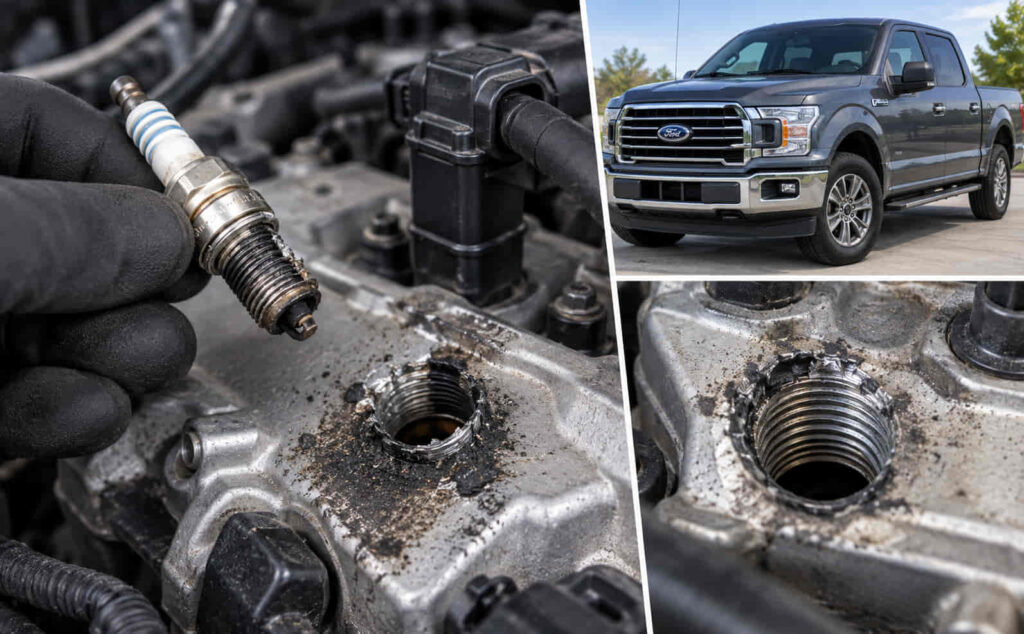
A Ford F150 spark plug blowout occurs when combustion pressure forces a spark plug out of the cylinder head after the threads can no longer hold it securely in place. The failure can produce a loud popping or tapping sound, an immediate engine misfire, reduced power, and damage to the spark plug threads. In affected engines, the repair may involve restoring the damaged threads with an insert, repairing the spark plug hole, or replacing the cylinder head when the damage is too extensive for a thread repair.
Spark plug blowout should not be confused with every spark plug problem reported on Ford F-150 engines. A plug that wears out, fouls, breaks during removal, or causes a normal ignition misfire represents a different failure mechanism. A true blowout involves the spark plug losing its mechanical retention in the cylinder head and being pushed outward by pressure generated during combustion.
The severity of the problem depends on the condition of the spark plug threads, cylinder head, ignition components, and affected cylinder. This guide explains the symptoms and causes of Ford F150 spark plug blowout, the engines associated with the problem, the damage it can cause, how the failure is diagnosed and repaired, expected repair costs, and the steps that help prevent another blowout.
What Is a Ford F150 Spark Plug Blowout?
A Ford F150 spark plug blowout is a mechanical failure in which a spark plug is expelled from its threaded hole in the cylinder head while the engine is operating. Combustion generates pressure inside each cylinder, and the spark plug threads must withstand that pressure while maintaining a sealed combustion chamber. When the threads no longer provide sufficient retention, cylinder pressure can force the plug outward and damage the threaded spark plug hole.
The failure centers on the connection between the spark plug and the cylinder head rather than the ignition function of the plug itself. A properly installed spark plug is threaded into the cylinder head and seated tightly enough to maintain both mechanical retention and a combustion seal. If the thread engagement becomes inadequate because the threads are damaged, weakened, or unable to hold the plug securely, repeated combustion cycles place force against an already compromised connection. The spark plug can eventually loosen and be expelled from the head.
A spark plug blowout is therefore different from an ordinary spark plug misfire. A worn, fouled, or defective spark plug can fail to ignite the air-fuel mixture while remaining securely installed in the cylinder head. During a blowout, the mechanical connection between the spark plug and cylinder head fails. A misfire can then occur as a consequence because the displaced plug can no longer perform its normal ignition function inside the combustion chamber.
Ford F-150 spark plug blowout should also be distinguished from the separate problem of a spark plug breaking during removal. Although both problems involve spark plugs and can lead to cylinder-head repair, their failure mechanisms are different. A blowout occurs while the engine is operating and involves loss of thread retention, whereas a plug that breaks or becomes stuck during service creates a removal problem. Separating these failures is important because the diagnosis, affected engine configurations, and repair procedures are not necessarily the same.
What Are the Symptoms of a Ford F150 Spark Plug Blowout?
The main symptoms of a Ford F150 spark plug blowout are a sudden popping or tapping noise from the engine, an immediate misfire, rough engine operation, reduced power, and physical displacement of the spark plug from its normal position. Several symptoms can appear at the same time because one mechanical failure disrupts both combustion sealing and ignition in the affected cylinder.
A loud repetitive popping or tapping sound is one of the most recognizable signs. Once the spark plug is loose or has been expelled, the spark plug hole can no longer maintain its normal combustion seal. Pressure can escape through the opening each time the affected cylinder reaches its combustion cycle. The resulting sound follows engine speed, so the frequency generally changes as engine RPM rises or falls. This characteristic can help distinguish a spark plug blowout from noises that do not follow individual combustion events.
An engine misfire and rough running can begin immediately after the plug leaves its installed position. The spark plug must extend into the combustion chamber in the correct position to ignite the compressed air-fuel mixture. Once it is displaced, normal ignition in that cylinder is interrupted. The engine is then operating without effective combustion from the affected cylinder, which can produce noticeable vibration, uneven idle, hesitation, and reduced engine power.
The Check Engine Light can also illuminate when the powertrain control system detects abnormal combustion or a persistent misfire. A diagnostic trouble code may help identify which cylinder is affected, but a misfire code alone does not prove that a spark plug has blown out. Ignition coil faults, injector problems, compression loss, and conventional spark plug failures can produce similar misfire codes. Physical inspection of the affected cylinder is therefore necessary to distinguish a mechanical spark plug blowout from other causes of misfire.
Physical displacement around the spark plug and ignition coil provides stronger evidence of a blowout. On an engine using a coil-on-plug ignition system, the spark plug sits beneath the ignition coil. A plug forced upward from the cylinder head can disturb or damage components above the spark plug hole. Inspection may reveal a loose or displaced plug, damaged threads, or visible damage around the spark plug and ignition coil area.
These symptoms should be evaluated together rather than individually. A Ford F-150 that only has a Check Engine Light or rough idle does not automatically have a spark plug blowout. The combination of a sudden combustion-related popping sound, immediate misfire, loss of power, and evidence that the spark plug has moved out of the cylinder head provides a much stronger diagnostic pattern.
Read more: Toyota C0215
What Causes a Spark Plug to Blow Out of a Ford F150?
A Ford F150 spark plug blows out when the threaded connection between the spark plug and cylinder head can no longer withstand combustion pressure. The failure develops around spark plug retention rather than the electrical operation of the plug. Damaged cylinder head threads, inadequate thread engagement, incorrect installation, improper tightening, or damage from previous spark plug service can weaken this connection until the plug is no longer held securely in the cylinder head.
Combustion pressure provides the force that ultimately pushes the spark plug outward. During normal engine operation, the air-fuel mixture is compressed and ignited inside the cylinder while the spark plug remains mechanically secured in its threaded hole. The cylinder head threads resist the outward force acting on the plug during repeated combustion cycles. A correctly installed plug and intact threads maintain this connection, while compromised threads reduce the amount of force the connection can withstand. Once retention becomes insufficient, repeated pressure cycles can loosen the plug further until it is expelled from the spark plug hole.
Insufficient thread engagement increases the risk because the combustion load must be carried by the threads connecting the spark plug to the cylinder head. The strength of this connection depends on the design of the cylinder head, the amount of usable thread engagement, and the condition of those threads. This is particularly relevant when evaluating Ford F-150 engines associated with spark plug ejection because cylinder-head design and engine generation determine how the plug is retained. For this reason, spark plug blowout should not be attributed to every Ford F-150 engine simply because the vehicle uses an aluminum cylinder head.
Damaged or stripped cylinder head threads can directly reduce spark plug retention. The spark plug threads must engage correctly with the corresponding threads in the spark plug hole. Cross-threading during installation, deterioration of previously damaged threads, or an unsuccessful earlier repair can remove or deform part of this threaded surface. The remaining threads then carry a greater portion of the combustion load. Continued operation can progressively weaken the connection until the spark plug loosens or is forced completely out.
Incorrect spark plug tightening can also contribute to the conditions that allow a blowout. A spark plug that is not seated and tightened according to the correct service specification may fail to maintain the intended mechanical connection and combustion seal. However, there is no single Ford F-150 spark plug torque specification that applies to every model year and engine. The correct specification depends on the specific engine, cylinder head, spark plug application, and service procedure, so a generic torque value should not be applied across the entire F-150 range.
Overtightening creates a different problem because additional tightening force is not automatically equivalent to greater spark plug retention. Excessive torque can place unnecessary stress on the threads or spark plug and can contribute to thread damage during installation or later removal. The objective is therefore not to make the spark plug as tight as possible, but to install it according to the specification and procedure for the particular engine.
Previous spark plug service is another factor that should be considered when diagnosing a blowout. A spark plug hole that has already been cross-threaded, repaired, or partially stripped does not have the same condition as an undamaged threaded hole. Installing a new spark plug may restore ignition operation without correcting an underlying retention problem if the cylinder head threads are already compromised. A later blowout can therefore be the final stage of earlier thread damage rather than a failure that developed during a single drive.
These causes are connected by one mechanical principle: the spark plug must remain securely retained against cylinder pressure. Combustion pressure alone does not indicate a defect because every functioning cylinder subjects its spark plug to repeated pressure. A Ford F150 spark plug blowout occurs when the retention provided by the spark plug-to-cylinder-head connection becomes insufficient for those normal operating forces. Identifying why that connection failed is essential because the cause determines whether installing another plug is sufficient, the threads require repair, or the cylinder head needs more extensive work.
Which Ford F150 Years and Engines Have Spark Plug Blowout Problems?
Ford F150 spark plug blowout is primarily associated with certain earlier Ford modular engines rather than every F-150 model year or every Triton engine. The problem is commonly linked to applications using earlier aluminum cylinder-head designs in which the spark plug had relatively limited thread engagement. The engine family, cylinder-head design, and production period are therefore more useful for identifying risk than treating “Ford F-150” as a single mechanical configuration.
The 5.4L Triton V8 is one of the engines frequently associated with spark plug ejection, particularly earlier versions of Ford’s modular engine design. The underlying concern involves the threaded connection between the spark plug and aluminum cylinder head. When that connection becomes inadequate, the threads may no longer retain the spark plug against repeated combustion pressure. The plug can loosen progressively and eventually be expelled from the cylinder head, often damaging the spark plug hole in the process.
Certain 4.6L V8 applications are also associated with spark plug thread and ejection problems. This does not mean that every Ford F-150 equipped with a 4.6L or 5.4L engine will experience a blowout. Ford used different engine and cylinder-head configurations across F-150 production, and changes in cylinder-head and spark plug design affect the type of spark plug problem that may occur. Diagnosis should therefore begin with the exact model year, engine, and cylinder-head configuration rather than with engine displacement alone.
Model year also requires careful interpretation because a vehicle’s year is only a practical way of narrowing down the hardware installed in it. Two F-150 trucks from different production periods can carry engines with substantially different spark plug designs even when both engines belong to Ford’s modular family. Replacement engines or previously replaced cylinder heads can further complicate identification. Confirming the engine configuration is consequently more reliable than assuming a particular failure solely from the age of the truck.
Another important distinction is the difference between spark plug blowout and spark plug breakage during removal. These are separate mechanical problems even though both are widely described as Ford F-150 spark plug problems. A blowout occurs when the running engine forces a spark plug out because its threaded connection to the cylinder head can no longer retain it. Spark plug breakage during removal occurs during service when part of the plug becomes stuck or separates while a technician is attempting to remove it.
The distinction matters because the two failures require different repair decisions. A blown-out spark plug directs the diagnosis toward the condition of the spark plug hole, remaining cylinder-head threads, and components around the affected cylinder. A broken plug directs the service procedure toward extracting the remaining portion without damaging the cylinder head. Searching for a repair procedure without first distinguishing these two problems can therefore lead an owner toward the wrong tools, parts, or service method.
The most accurate way to determine whether a specific Ford F-150 belongs to an affected configuration is to identify its model year and exact engine before selecting a repair procedure. The spark plug design and cylinder-head configuration should then be matched to the appropriate service information. This approach prevents a problem associated with one generation of Ford engine from being incorrectly applied to another generation that has a different spark plug failure mode.
What Damage Can a Ford F150 Spark Plug Blowout Cause?
A Ford F150 spark plug blowout can damage the cylinder head threads, spark plug hole, spark plug, and ignition components around the affected cylinder. The most important damage is usually found at the threaded connection that previously held the spark plug because this connection must be restored before another plug can remain securely installed. The extent of thread damage also determines whether the cylinder head can be repaired in place or requires more extensive service.
Thread damage occurs because the spark plug does not simply stop firing when a blowout happens. The plug physically moves through or out of the threaded hole while combustion pressure is acting against it. If the cylinder head threads were already weakened, the final ejection can remove or deform additional thread material. Installing another spark plug into the same damaged hole without first evaluating the threads can leave the replacement plug with inadequate retention and allow the failure to happen again.
The spark plug hole must therefore be evaluated as a mechanical mounting point rather than only as an opening into the combustion chamber. A repairable hole may still have localized thread damage that can be restored with an appropriate thread-repair method. More extensive damage can affect the ability to establish correct thread alignment, spark plug seating, and a reliable combustion seal. The condition of the cylinder head around the hole determines which repair method is appropriate.
Components above the spark plug can also be affected when the plug is forced outward. On a coil-on-plug configuration, the ignition coil and its boot occupy the area directly above the installed spark plug. Upward movement of the plug can disturb these components, while heat and escaping combustion gases can expose nearby parts to conditions they do not encounter during normal operation. The ignition coil, boot, electrical connector, and surrounding area should consequently be inspected rather than assuming that repairing the threads resolves every part of the failure.
The severity of a blowout cannot be determined from the engine noise alone. Two Ford F-150 engines can produce similar popping and misfire symptoms while having different levels of thread damage. One may have a spark plug hole suitable for a thread repair, while another may have damage that requires more extensive cylinder-head work. The repair decision should therefore follow inspection of the affected cylinder instead of being based only on the fact that the spark plug was expelled.
How Do You Diagnose a Ford F150 Spark Plug Blowout?
A Ford F150 spark plug blowout is diagnosed by identifying the affected cylinder, inspecting the spark plug and ignition components, and determining whether the threads inside the spark plug hole are damaged. The diagnostic objective is not merely to confirm that the engine is misfiring. It is to establish whether the spark plug has lost its mechanical connection to the cylinder head and determine how much damage occurred when that connection failed.
Diagnosis begins with the symptoms produced when the failure occurs. A sudden repetitive popping or tapping noise combined with rough running and an immediate loss of power provides a stronger indication of a blowout than a misfire by itself. Engine management data and diagnostic trouble codes can help identify the cylinder experiencing abnormal combustion, but they should be treated as a way to locate the problem rather than proof of damaged spark plug threads.
Physical inspection provides the critical confirmation. The affected spark plug area should be examined for a displaced or loose spark plug, a disturbed ignition coil or boot, and evidence that combustion gases have escaped around the spark plug hole. Once the plug is removed or its position is confirmed, the condition of the threaded hole becomes central to the diagnosis. Damaged, stripped, or missing threads indicate that installing a replacement plug alone will not restore the mechanical connection required to resist combustion pressure.
Thread condition must also be evaluated before selecting a repair. The relevant questions are whether sufficient original thread material remains, whether the hole maintains proper alignment, whether it has been repaired previously, and whether damage extends beyond the threaded area. These observations determine whether thread restoration is practical or whether the cylinder head requires a different repair approach.
The surrounding ignition components should be inspected during the same diagnostic process. A replacement spark plug still requires a functioning ignition coil and boot to produce reliable combustion in the repaired cylinder. Damage caused during the ejection event can therefore create a second fault even after the spark plug hole itself has been restored. Confirming the condition of both the mechanical connection and ignition components reduces the risk of mistaking a remaining ignition fault for an unsuccessful thread repair.
A complete diagnosis ends with classification of the damage rather than simply confirmation of the blowout. Minor or localized thread damage can lead to one repair path, substantial spark plug hole damage can require a more involved thread restoration, and cylinder-head damage outside the repairable area can change the decision entirely. This classification provides the basis for choosing between thread repair and more extensive cylinder-head work in the next stage.
How Do You Fix a Ford F150 Spark Plug Blowout?
A Ford F150 spark plug blowout is fixed by restoring a secure threaded connection between the spark plug and cylinder head, then replacing or repairing any components damaged during the failure. The correct repair depends on the condition of the spark plug hole and cylinder head. A replacement spark plug alone does not correct the problem when the threads responsible for retaining the plug have been stripped or otherwise damaged.
Thread repair is a practical repair path when the damage is concentrated in the spark plug hole and the surrounding cylinder head remains suitable for restoration. The objective is to create a correctly positioned threaded surface that can retain the spark plug against combustion pressure. This addresses the mechanical cause of the failure rather than simply restoring ignition temporarily. The repaired hole must also allow the spark plug to seat in the intended position and maintain an effective combustion seal.
A thread insert can be used when the original cylinder head threads no longer provide sufficient retention and the specific engine and damage condition allow an insert repair. The damaged hole is restored so that an insert provides new internal threads for the spark plug. The insert becomes part of the repaired threaded connection, allowing the plug to be installed and retained without depending on the stripped original threads. The suitability of this repair depends on correct alignment, adequate material around the spark plug hole, and compatibility between the repair system and the cylinder head.
The quality of the thread repair matters because the spark plug must occupy a specific position relative to the combustion chamber. A repair that merely allows a plug to be screwed into the hole is not necessarily equivalent to a correctly restored spark plug mounting point. Thread alignment, seating position, insert security, and the condition of the surrounding cylinder-head material all influence whether the repaired connection can tolerate repeated combustion cycles without loosening.
Cylinder-head removal is not automatically required for every Ford F150 spark plug blowout. Some spark plug thread repairs are designed to address localized damage without replacing the entire cylinder head. Whether an in-place repair is appropriate depends on the engine configuration, access to the affected spark plug hole, severity of thread damage, previous repairs, and the repair procedure being used. The repair method must also control contamination because work performed around an open spark plug hole can introduce unwanted material toward the combustion chamber.
More extensive cylinder-head work becomes necessary when the damage cannot be reliably corrected at the spark plug hole. A cylinder head with severe material loss, unsuitable previous repairs, damage that prevents correct spark plug alignment, or another structural problem may not provide an adequate foundation for a normal thread repair. In that situation, cylinder-head repair or replacement addresses the damaged component rather than repeatedly attempting to retain a spark plug in an unreliable mounting point.
The ignition components should be addressed as part of the same repair. A spark plug ejected from a coil-on-plug engine can disturb the ignition coil, boot, connector, or nearby components. Restoring the cylinder head threads while leaving a damaged ignition component in place can result in a continuing misfire even though the spark plug itself is once again mechanically secure. The repaired cylinder should therefore have both a reliable spark plug mounting point and a functioning ignition path.
Repair verification is the final part of correcting the blowout. The spark plug must remain properly seated, the affected cylinder must return to normal combustion, and the previous popping noise and misfire should no longer be present. Any remaining abnormal engine operation requires further diagnosis rather than assuming that every symptom originated solely from the damaged threads.
The key distinction between the available repair paths is therefore the amount and location of damage. Repairable thread damage can be addressed by restoring the spark plug threads, while damage that prevents a reliable threaded repair can require cylinder-head repair or replacement. Making that distinction before installing parts reduces the chance of a temporary repair followed by another spark plug blowout.
How Much Does It Cost to Repair a Ford F150 Spark Plug Blowout?
The cost to repair a Ford F150 spark plug blowout depends primarily on whether the damage can be corrected with a spark plug thread repair or requires more extensive cylinder-head work. A localized repair to the spark plug hole represents a different level of labor and parts cost from removing, repairing, or replacing a cylinder head. Additional damage to the spark plug, ignition coil, or related components can increase the final repair bill.
A thread repair is generally the less extensive repair path when the spark plug hole is damaged but the surrounding cylinder head remains suitable for restoration. In this situation, the repair focuses on creating a secure threaded connection for the replacement spark plug. Labor includes accessing the affected cylinder, evaluating the damaged hole, performing the thread repair, installing the spark plug correctly, and confirming that the cylinder operates normally afterward. The repair becomes more involved when access to the affected spark plug hole is restricted by the engine layout.
The condition of the cylinder head is one of the largest factors affecting cost. A spark plug blowout that strips the threads does not automatically mean the entire cylinder head must be replaced. If the damaged area can accept an appropriate thread repair, much of the labor associated with cylinder-head removal may be avoided. When the spark plug hole cannot be restored reliably, however, cylinder-head repair or replacement can require substantially more labor because additional engine components may need to be removed and reinstalled.
Previous repairs can also change the price. A spark plug hole that has already received a thread insert or another repair must be evaluated differently from an undamaged original hole. If an earlier repair has failed or removed additional cylinder-head material, the technician may have fewer repair options available. The amount of usable material, alignment of the existing hole, and condition of the previous repair can determine whether another localized repair is practical.
Ignition-system damage adds another potential expense. Because the ignition coil and boot are positioned around the spark plug on coil-on-plug applications, a plug that is forced out of the cylinder head can disturb or damage these components. A damaged coil, boot, connector, or spark plug must be considered separately from the thread repair. This explains why two Ford F-150 trucks with the same basic spark plug blowout can receive different repair estimates.
Labor rates create another source of variation. Repair cost differs by geographic location, shop type, engine configuration, accessibility of the affected cylinder, and the amount of diagnostic work required before the repair begins. An estimate should therefore identify what work is actually included instead of being evaluated only by its total price. A quote for repairing one damaged spark plug hole is not directly comparable with a quote that includes cylinder-head removal, additional ignition parts, or repair of an unsuccessful previous insert.
The most useful repair estimate separates the spark plug blowout into its actual damage and required work. The technician should determine the condition of the cylinder-head threads, whether a thread insert or another approved repair method is appropriate, whether the cylinder head must be removed or replaced, and whether the ignition components were damaged. The severity of the cylinder-head and thread damage, rather than the blown-out spark plug itself, is what primarily determines the final repair cost.
Can You Drive a Ford F150 After a Spark Plug Blowout?
A Ford F150 should not continue to be driven normally after a spark plug blowout because the affected cylinder has lost the spark plug connection required for normal ignition and combustion sealing. The engine may remain capable of running, but the ability to run does not mean the underlying mechanical failure has become safe to ignore. The damaged spark plug hole and surrounding components should be inspected before the truck returns to normal operation.
The immediate problem extends beyond a conventional engine misfire. Once the spark plug has been expelled from the cylinder head, the affected cylinder no longer has a properly positioned plug or a normal seal at the spark plug hole. Combustion pressure can escape through that opening, producing the repetitive popping or tapping noise associated with the failure. The cylinder may also stop contributing normal power, which explains the sudden rough running and loss of performance that can accompany a blowout.
Continuing to operate the engine does not restore the damaged threads and can expose the affected area to repeated combustion events. The spark plug hole may already contain stripped or weakened threads, while the ignition coil, boot, connector, or nearby components may have been disturbed when the plug moved outward. Driving without first determining the extent of this damage leaves the original mechanical failure unresolved.
A misfiring engine can also create problems beyond the spark plug mounting point. When combustion in a cylinder is disrupted, engine operation and exhaust conditions differ from normal operation. The correct response is therefore to diagnose the failed cylinder and repair the spark plug retention problem rather than treating the symptoms as an ordinary ignition fault and continuing to drive.
The practical distinction is between moving a vehicle under exceptional circumstances and considering it repaired enough for continued use. A Ford F-150 that still starts after a spark plug blowout has not corrected the damaged cylinder-head threads simply because the engine runs. Normal driving should resume only after the spark plug hole, cylinder-head threads, spark plug, and affected ignition components have been inspected and the failed connection has been repaired.
How Can You Prevent a Ford F150 Spark Plug Blowout?
A Ford F150 spark plug blowout is best prevented by protecting the threaded connection between the spark plug and cylinder head during installation, maintenance, and subsequent spark plug service. Correct installation matters because the threads must retain the spark plug through repeated combustion cycles without being damaged during installation or removal.
The spark plug should be installed in correct alignment with the cylinder-head threads. Cross-threading damages the surfaces that provide mechanical retention and can leave the plug apparently installed even though the threaded connection has already been compromised. Beginning installation with the plug correctly aligned reduces the risk of forcing it through the threads at an incorrect angle and damaging the spark plug hole.
Correct tightening is equally important. The objective is to achieve the installation condition specified for the particular engine and spark plug application, not to maximize tightening force. Insufficient tightening can prevent the plug from being seated as intended, while excessive tightening can place unnecessary stress on the spark plug or cylinder-head threads. Because Ford F-150 engines and cylinder-head configurations differ across model years, the applicable service specification should be identified for the exact engine rather than replaced with one universal torque value.
Existing thread condition should also be considered whenever spark plugs are serviced. A plug that feels abnormal during removal or installation can indicate damaged, contaminated, or previously repaired threads. Forcing a replacement plug into a compromised hole does not restore the original thread strength. Identifying the problem during service allows the spark plug hole to be evaluated before normal combustion pressure tests the weakened connection again.
Previous thread repairs deserve the same attention. An F-150 with an existing insert or documented spark plug hole repair should be evaluated according to the condition and type of that repair rather than treated as though the cylinder head still has untouched original threads. A secure previous repair may continue to function correctly, while a loose, damaged, or misaligned repair can require further attention before another spark plug is installed.
The remaining spark plug locations can also be inspected when one cylinder has experienced a blowout, particularly when there is reason to suspect a shared installation history or previous spark plug service. A blowout in one cylinder does not prove that the other spark plug holes are damaged, but evidence of incorrect installation or earlier thread damage provides a reason to evaluate related locations rather than waiting for another failure to reveal them.
Prevention ultimately depends on maintaining the mechanical integrity of the spark plug-to-cylinder-head connection. Correct alignment, engine-specific installation specifications, intact threads, and proper evaluation of previous thread damage directly address the conditions that allow a spark plug to lose retention. These measures are more relevant to preventing another Ford F150 spark plug blowout than simply replacing spark plugs more frequently without considering the condition of the cylinder-head threads.