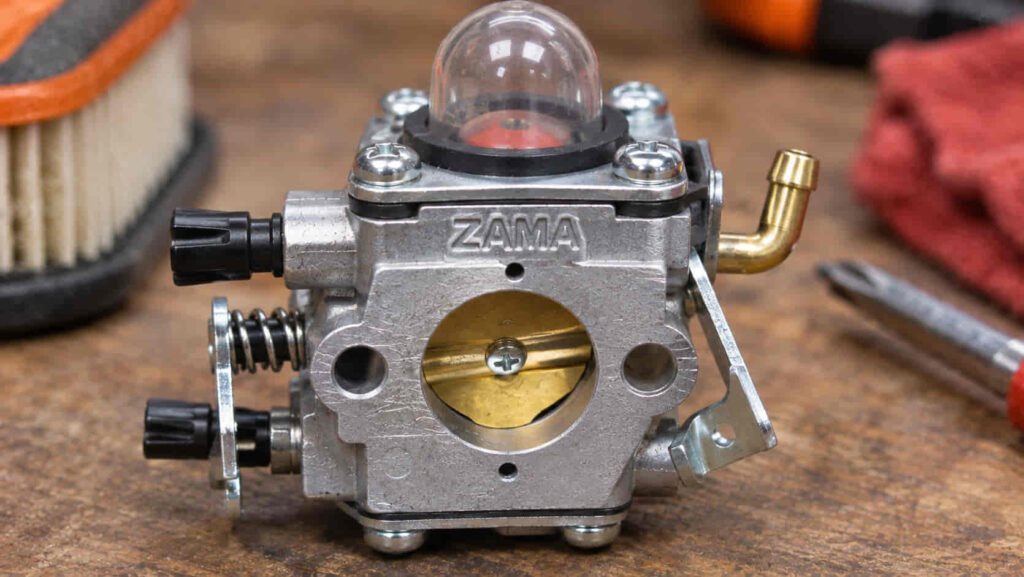
Zama carburetor identification requires locating the carburetor body type and model number, then matching these markings with the manufacturer’s parts catalog. The body type identifies the carburetor family, such as C1Q, C1U, C1M, C3M, or RB, while the model number identifies the specific carburetor within that family. Both identifiers are essential for selecting compatible replacement carburetors, rebuild kits, and service components.
Zama carburetors use different identification systems depending on their production generation. Older models feature alphanumeric identifiers, such as K54A, while newer models use abbreviated markings that correspond to longer catalog numbers. For example, Z026/12A represents the model number Z026-120-0612-A, according to ZAMA’s technical documentation. Manufacturing codes and cast-in body markings serve different purposes and should not be confused with specific model numbers. ZAMA Group+1
Accurate carburetor identification prevents compatibility problems during small engine repair and maintenance. Two Zama carburetors with identical body types and similar external appearances are not necessarily interchangeable because their fuel metering characteristics, internal components, and linkage configurations can differ according to engine requirements.
This guide explains how to identify Zama carburetors, locate identification markings, interpret model numbers, distinguish carburetor types, and use an identification chart. It also covers OEM part number cross-referencing, carburetor identification without visible model numbers, and compatible replacement carburetor and rebuild kit selection.
How Do You Identify a Zama Carburetor?
To identify a Zama carburetor, locate the ZAMA brand name, determine the carburetor body type, record the model number, and verify the identification against the official ZAMA parts catalog. These four steps establish the manufacturer, carburetor family, specific model, and corresponding service parts.
The ZAMA brand name provides the initial manufacturer identification. According to ZAMA’s technical newsletter published in November 2020, genuine Zama carburetors carry the manufacturer’s name on their exterior. Carburetors manufactured by aftermarket suppliers may resemble original Zama products in their housing design, mounting configuration, and external components. However, physical resemblance alone does not establish authenticity or compatibility.
The carburetor body type identifies the product family through markings such as C1Q, C1U, C1M, and C3M. These designations distinguish carburetor families with different construction characteristics. The model number provides a more specific identification within each family. For example, C1S-E1 and C1S-S1B belong to the same C1S carburetor family but have different pump gaskets, mixture adjustment screws, and other service components. ZAMA Group+1
Recording the complete identification code, including its letter suffix, ensures a more accurate parts lookup. Missing a character or using only the body type can result in selecting an incorrect carburetor assembly or rebuild kit.
The final identification step involves matching the recorded code with the official ZAMA parts catalog. The catalog provides model-specific component information, exploded parts diagrams, rebuild kit numbers, and gasket and diaphragm kit numbers. Equipment manufacturer documentation provides an additional reference for verifying compatibility with the engine or power equipment.
Where Is the Model Number on a Zama Carburetor?
The model number on a Zama carburetor is located on the metering cover, above the choke valve, or near the fuel line connections, depending on the carburetor’s production generation. ZAMA uses engraving, laser marking, and black ink printing to identify specific carburetor models.
Zama carburetors manufactured during the late 1970s and some from the early 1980s feature engraved identification numbers on the metering cover or above the choke valve. On certain older carburetors carrying longer identification sequences, the initial four digits indicate the model. For example, a C2S carburetor engraved with 19010803L corresponds to the C2S-1901 model, as documented in ZAMA’s technical newsletter.
Later-generation Zama carburetors carry laser-etched or ink-printed identifiers near their fuel line connections. A marking such as K54A identifies the specific model, while a separate marking such as 645A contains manufacturing information. More recent models use shortened identification codes that correspond to longer catalog numbers. ZAMA Group
The body type marking is distinct from the model number. On carburetors with high-speed and low-speed mixture adjustment needles, the body designation is often cast into the surrounding housing. A marking such as C1Q identifies the carburetor family rather than the individual model.
Dirt, fuel residue, oxidation, and prolonged equipment use can obscure carburetor identification markings. Cleaning the exterior with a soft brush and a clean cloth improves visibility without damaging the identification surface. Avoid abrasive cleaning methods, particularly on ink-printed markings, because removing the original identifier makes subsequent model identification more difficult.
When inspecting a Zama carburetor, record both the body designation and the model marking before ordering replacement components. Photographing the original markings also provides a permanent reference for future maintenance, repair, and parts identification.
What Do Zama Carburetor Model Numbers Mean?
Zama carburetor model numbers identify the carburetor body type, specific product design, and model variation. ZAMA has used different numbering systems throughout its manufacturing history, including traditional alphanumeric model numbers and newer numerical identification codes. Understanding these numbering systems allows equipment owners and repair technicians to distinguish individual carburetor models and locate the corresponding replacement components.
Traditional Zama carburetor model numbers combine a body designation with an alphanumeric identifier. For example, C1U-K54A consists of the body type C1U and the model identifier K54A. The initial letter K indicates that the carburetor was designed for Echo equipment, while the remaining characters distinguish the specific model. The complete designation C1U-K54A corresponds to an individual entry in the ZAMA parts catalog, which contains part numbers for components such as pump diaphragms, throttle shafts, and mixture adjustment screws. ZAMA Group+1
The letter suffix at the end of a traditional Zama model number forms part of the product identifier. Retaining this suffix during a model lookup is essential because carburetors with similar identification numbers may have different component configurations or calibration specifications. A matching numerical sequence without the correct suffix does not establish replacement compatibility.
Newer Zama carburetors use an expanded numbering system with abbreviated identification markings. According to ZAMA’s November 2020 technical newsletter, a carburetor marked Z011/02A corresponds to the complete model number Z011-120-0602-A, while Z026/12A corresponds to Z026-120-0612-A. The shortened marking identifies the product externally, whereas the complete model number provides the reference for accessing detailed technical documentation and replacement component information. ZAMA Group+1
The manufacturing code serves a different purpose from the model number. A separate marking such as 645A contains factory information, including the production year and week. This information supports manufacturing traceability rather than model identification. Using the manufacturing code for a replacement parts search does not reliably identify the required carburetor assembly.
The body type, model number, and manufacturing code therefore represent three distinct levels of carburetor information. The complete model number is the primary reference for replacement parts identification. For example, ZAMA lists rebuild kit Z000 001 K038 for model Z026-120-0612-A. This model-specific relationship allows technicians to identify compatible service components without relying solely on external dimensions or carburetor appearance.
Read more: carburetor cleaner vs brake cleaner
What Are the Different Types of Zama Carburetors?
Zama carburetors are classified into different body types, including C1Q, C1U, C1M, C1T, C1S, C2, C3, C3A, C3M, and RB. These carburetor types differ in body construction, throttle mechanisms, fuel metering systems, and component configurations. ZAMA’s technical documentation distinguishes conventional cube-style diaphragm carburetors from rotary-style RB carburetors, providing separate servicing instructions for these designs. ZAMA Group+2
Zama C1Q carburetors use a compact diaphragm-based design suitable for small engine applications. Their construction incorporates fuel pumping and metering components that regulate fuel delivery according to engine demand. Models within the C1Q family have different internal component configurations. For example, the C1Q-S257A uses the RB-69 rebuild kit, whereas the C1Q-S270C requires the RB-150 rebuild kit. This difference demonstrates why the C1Q body designation alone is insufficient for replacement parts identification. ZAMA Group+1
The C1U, C1M, C1T, and C1S families represent additional Zama carburetor body configurations. Their differences include fuel passage arrangements, throttle and choke assemblies, metering components, and external connection positions. For example, the C1T-200053A features an 8 mm bore specification and uses the RB-149 rebuild kit, while the C1S-K3A uses the RB-3 rebuild kit. These model-specific characteristics reflect different engine design and servicing requirements. ZAMA Group+1
Zama C3, C3A, and C3M carburetors are cube-style diaphragm carburetors available in different bore sizes and component configurations. The bore diameter influences airflow capacity, while the metering system regulates the fuel supplied to the engine. For example, the C3A-G1A and C3A-H15 both feature a 13.5 mm bore but use different rebuild kits, RB-30 and RB-34, respectively. These differences demonstrate that matching bore diameters do not guarantee component interchangeability. ZAMA Group+1
Zama RB carburetors differ from conventional cube-style carburetors through their rotary throttle mechanism. Instead of using a conventional butterfly throttle plate, the rotary design regulates airflow through a rotating valve within the carburetor housing. This mechanism changes the effective air passage opening as the throttle position changes, allowing the carburetor to control engine speed and fuel delivery. ZAMA provides dedicated disassembly and servicing instructions for RB carburetors because their internal construction differs from conventional diaphragm carburetor designs. ZAMA Group+1
The most reliable method for distinguishing Zama carburetor types is to match the body designation with the complete model number in the manufacturer’s parts catalog. External characteristics support preliminary identification, but model-specific documentation determines the correct carburetor assembly, internal components, and service parts.
What Is the Zama Carburetor Identification Chart?
A Zama carburetor identification chart is a reference table that connects carburetor body types, complete model numbers, and external identification markings. It simplifies the identification process by allowing equipment owners and repair technicians to compare the markings on a carburetor with corresponding model designations.
The identification chart is particularly useful for newer Zama carburetors because their external markings contain abbreviated model numbers rather than the complete identifiers used in the manufacturer’s parts catalog. Traditional Zama carburetors use alphanumeric model designations, while newer models require the conversion of shortened markings into their corresponding catalog numbers.
The following Zama carburetor identification chart provides seven model examples verified against the manufacturer’s official parts catalog.
| Body type | Carburetor marking | Complete model number | Rebuild kit |
|---|---|---|---|
| C1Q | K120A | C1Q-K120A | RB-234 |
| C1Q | S270C | C1Q-S270C | RB-150 |
| C1Q | S259A | C1Q-S259A | RB-69 |
| C1U | 110146A | C1U-110146A | RB-196 |
| C1U | Z020/03A | C1U-Z020-120-0603-A | RB-117 |
| RB | Z011/21B | RB-Z011-120-0621-B | RB-182 |
| RB | Z011/28A | RB-Z011-120-0628-A | RB-188 |
Source: ZAMA official parts catalog. ZAMA Group+6
The chart establishes the relationship between carburetor markings and compatible service components. For example, a carburetor with the C1U body designation and the Z020/03A marking corresponds to the C1U-Z020-120-0603-A model, which uses the RB-117 rebuild kit and the GND-64 gasket and diaphragm kit.
A Zama carburetor identification chart serves as a preliminary reference rather than a universal compatibility chart. Equipment compatibility requires additional verification against the original equipment manufacturer’s documentation because carburetor identification and engine compatibility are separate technical considerations.
How Do You Look Up a Zama Carburetor Model Number?
To look up a Zama carburetor model number, enter the complete model designation into the official ZAMA Parts & Services database and match the search result with the original carburetor markings. The database provides model-specific technical information, component part numbers, exploded assembly diagrams, and compatible service kits.
The lookup process begins by combining the body type with the specific model marking. For example, a carburetor with a C1Q body designation and an S270C marking corresponds to C1Q-S270C. Searching for the complete designation through the ZAMA Parts & Services database provides more precise results than searching for the C1Q body type alone, which represents an entire carburetor family.
The model-specific catalog organizes replacement components by reference number, component name, and individual part number. For example, the C1Q-S270C catalog identifies the pump diaphragm as part number 0015050, the metering diaphragm assembly as A015045, and the inlet needle valve as 0018004. These individual part numbers allow technicians to replace specific components without purchasing an entire carburetor assembly. ZAMA Group
The lookup also identifies compatible service kits. ZAMA lists RB-150 as the rebuild kit and GND-56 as the gasket and diaphragm kit for the C1Q-S270C carburetor. Matching the kit number with the exact carburetor model prevents the selection of diaphragms, gaskets, and metering components intended for different carburetor configurations.
When a model number does not produce a matching result, recheck the body designation, numerical sequence, letter suffix, and abbreviated markings. Equipment model numbers and OEM parts diagrams provide alternative identification references when the original carburetor markings are incomplete or illegible.
How Do You Identify a Zama Carburetor Without a Model Number?
To identify a Zama carburetor without a model number, use the equipment model, serial number, carburetor body designation, physical characteristics, and OEM parts documentation. These five identification references help narrow down potential carburetor models when the original identification markings are missing, damaged, or illegible.
The equipment model and serial number provide the most reliable alternative identification references. Equipment manufacturers assign specific carburetor assemblies to their engine and equipment configurations. Products sold under the same equipment model name may use different carburetors depending on their production period or serial number range. Checking both identifiers against the manufacturer’s parts catalog reduces the risk of incorrect identification.
The carburetor body designation narrows the search to a specific product family. For example, a visible C1Q marking identifies the carburetor as part of the C1Q family, even when the specific model number has disappeared. However, additional information is necessary because carburetors within this family have different fuel metering components and calibration specifications.
Physical characteristics provide supplementary identification references. Mounting hole spacing, throttle bore diameter, fuel inlet position, primer bulb configuration, and throttle linkage design help distinguish potential models. Comparing these characteristics with technical drawings and product photographs eliminates visibly incompatible assemblies.
The original equipment parts diagram provides a reference for confirming the carburetor assembly number. When multiple carburetors share similar external characteristics, the OEM part number offers a more reliable identification method than visual comparison. Physical similarity alone does not confirm internal calibration or engine compatibility.
For example, STIHL identifies the equipment serial number as an essential reference for finding appropriate replacement parts. When the original carburetor markings are completely missing, providing the equipment model and serial number to an authorized dealer helps establish the correct replacement assembly. STIHL Support
How Do You Cross-Reference a Zama Carburetor Part Number?
To cross-reference a Zama carburetor part number, match the Zama model number with the OEM carburetor part number and verify the corresponding equipment application. Cross-referencing connects different product identification systems used by carburetor manufacturers, equipment manufacturers, and replacement parts suppliers.
The Zama model number identifies the specific carburetor design within ZAMA’s product catalog, whereas the OEM part number identifies the carburetor assembly within the equipment manufacturer’s inventory system. Both numbers can refer to the same physical carburetor despite having different numbering formats.
The cross-reference process requires comparing the original carburetor identification with the equipment manufacturer’s parts catalog and the ZAMA Parts & Services database. The equipment catalog establishes the required carburetor assembly, while the ZAMA catalog identifies model-specific components and service kits. ZAMA Group
Superseded part numbers require additional verification during cross-referencing. Manufacturers may introduce replacement assemblies under new part numbers following design revisions, component changes, or product discontinuation. A manufacturer-confirmed supersession establishes a replacement relationship between the original and updated part numbers.
Accurate cross-referencing reduces incorrect parts selection, unnecessary returns, and repair delays. When a replacement carburetor carries a different identification number from the original assembly, verify the documented interchangeability before installation rather than relying on visual similarity or matching mounting dimensions.
How Do You Find a Compatible Zama Replacement Carburetor?
To find a compatible Zama replacement carburetor, match the complete carburetor model number, OEM part number, equipment model, mounting configuration, linkage design, and fuel metering specifications. These six identification criteria establish whether the replacement carburetor meets the mechanical and operational requirements of the original engine.
The complete Zama model number and OEM part number provide the primary references for replacement compatibility. When an original carburetor has been discontinued, a manufacturer-approved replacement or superseded part number provides an alternative. The replacement relationship must be documented because a newer model number does not automatically indicate compatibility with an older carburetor.
Mechanical compatibility depends on mounting hole spacing, throttle bore diameter, fuel inlet orientation, and throttle and choke linkage configurations. Differences in these characteristics can prevent proper installation or interfere with throttle operation. For example, a replacement carburetor with matching mounting dimensions but a different throttle linkage design may not connect correctly to the equipment’s throttle control mechanism.
Operational compatibility depends on the carburetor’s fuel metering characteristics and calibration. Carburetors with identical external dimensions can contain different fuel passages, inlet needle valves, and metering components designed for specific engine requirements. Installing an incorrectly calibrated carburetor can cause difficult starting, unstable idling, excessive fuel consumption, or insufficient fuel delivery.
The correct replacement Zama carburetor must satisfy both mechanical and operational compatibility requirements. Verify the replacement assembly through the equipment manufacturer’s parts catalog or an authorized parts supplier before purchasing.
How Do You Identify the Correct Zama Carburetor Rebuild Kit?
To identify the correct Zama carburetor rebuild kit, match the complete carburetor model number with the rebuild kit part number listed in the official ZAMA parts catalog. The rebuild kit must correspond to the specific carburetor model because diaphragm dimensions, gasket configurations, inlet needle valves, and metering components differ between designs.
ZAMA offers two primary types of carburetor service kits: rebuild kits and gasket and diaphragm kits. A rebuild kit contains components intended for more extensive carburetor restoration, including diaphragms, gaskets, and selected fuel metering components. A gasket and diaphragm kit primarily contains flexible diaphragms and sealing components used to restore fuel pumping, fuel metering, and chamber sealing. The exact contents depend on the individual kit number.
The distinction between these two service kits determines the scope of the repair. For example, ZAMA specifies the RB-150 rebuild kit and the GND-56 gasket and diaphragm kit for the C1Q-S270C carburetor. The two kits serve the same carburetor model but address different component replacement requirements. ZAMA Group
Carburetors belonging to the same body family do not necessarily use identical rebuild kits. For example, the C1Q-S270C requires the RB-150 rebuild kit, whereas the C1Q-S70 requires the RB-100 rebuild kit. Both models use the GND-56 gasket and diaphragm kit, demonstrating that shared diaphragm and gasket configurations do not establish compatibility between complete rebuild kits. ZAMA Group+1
Selecting the appropriate Zama carburetor rebuild kit also requires assessing the condition of the internal components. Hardened diaphragms and deteriorated gaskets may require only a gasket and diaphragm kit, while damaged inlet needle valves or worn metering components may require a more comprehensive rebuild kit.
Before purchasing a Zama carburetor service kit, compare its part number and component contents with the model-specific parts diagram. This verification ensures that the selected kit contains the components required for the intended repair.
What Are the Most Common Zama Carburetor Identification Mistakes?
The six most common Zama carburetor identification mistakes are confusing the body type with the model number, misinterpreting manufacturing codes, ignoring model suffixes, relying on physical appearance, assuming interchangeability within the same carburetor family, and overlooking OEM part numbers. These mistakes increase the risk of purchasing incompatible replacement carburetors and service components.
Confusing identification markings leads to inaccurate parts searches. A body designation such as C1Q represents an entire carburetor family rather than a specific product model, while manufacturing codes provide production traceability information. Ignoring the letter suffix also produces an incomplete model designation, potentially directing users to a carburetor with different component configurations.
Relying on physical appearance and assuming interchangeability within the same carburetor family creates mechanical and operational compatibility risks. Two visually identical Zama carburetors can have different fuel passages, metering components, and calibration specifications. Installing an incompatible carburetor can result in starting difficulties, irregular engine performance, and incorrect air-fuel mixtures.
Overlooking OEM part numbers prevents accurate verification of equipment compatibility, particularly when manufacturers change carburetor assemblies during a product’s production lifecycle. The equipment model and serial number provide additional references for identifying the appropriate assembly.
Accurate Zama carburetor identification requires verifying the complete model designation against the ZAMA parts catalog and the original equipment manufacturer’s documentation. This approach minimizes replacement errors, unnecessary repair costs, and equipment downtime while ensuring the selected carburetor or service kit meets the engine’s requirements.