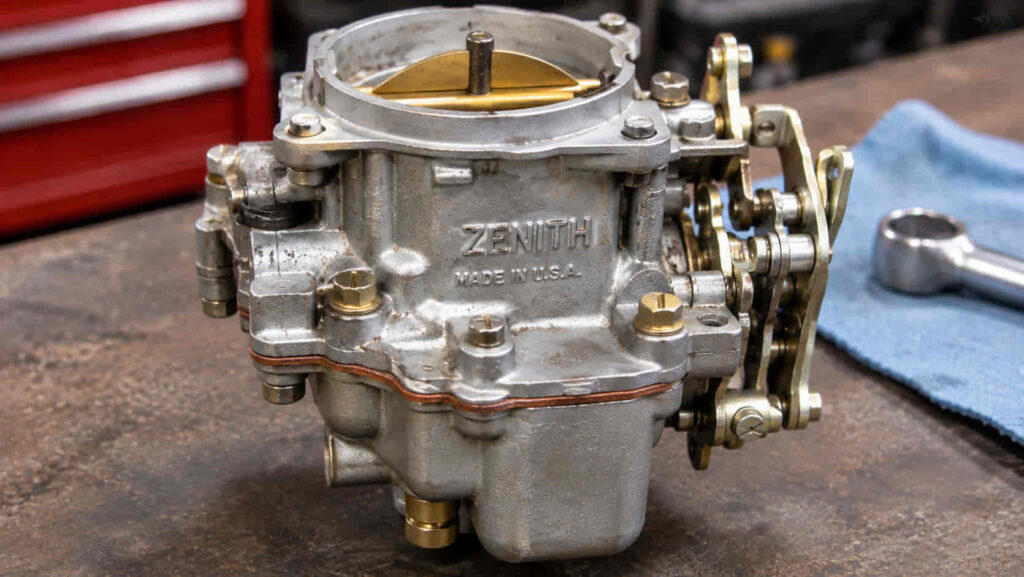
Zenith carburetor identification involves locating the assembly number, determining the model series, and examining the physical characteristics of the carburetor. The Zenith assembly number is the most reliable identifier for finding compatible replacement parts, rebuild kits, and complete carburetor assemblies. On most older American-made Zenith carburetors, this number appears on a round metal identification tag riveted to the float bowl cover. Later designs use identification numbers stamped directly into the carburetor body. thecarburetorshop.com+2
Zenith carburetors include several model series, such as the 61, 68, 161, 267, and 228, with different body designs, mounting dimensions, and fuel metering configurations. Carburetors within the same model series do not necessarily use identical internal components or calibration settings. Identifying the model series alone is therefore insufficient to guarantee replacement part compatibility.
Identifying a Zenith carburetor without an identification tag requires examining its airflow direction, body construction, mounting bolt spacing, throttle bore diameter, and linkage configuration. These characteristics help narrow down the model series and potential engine applications, although they do not always establish the exact assembly number.
This Zenith carburetor identification guide explains how to locate and interpret identification numbers, distinguish common model series, recognize different carburetor types, and verify compatibility with rebuild kits and replacement assemblies. The guide focuses primarily on American-made Zenith carburetors used in agricultural tractors, industrial equipment, and vintage gasoline engines.
How Do You Identify a Zenith Carburetor?
To identify a Zenith carburetor, locate the assembly number, determine the model series, examine the physical characteristics, and verify the information against a Zenith parts catalog. The assembly number provides the most accurate identification because it distinguishes individual carburetor configurations within the same model series.
Begin by inspecting the carburetor for a metal identification tag or a number stamped directly into its housing. Record the complete identification number, including any letter suffix. For example, a Zenith carburetor marked 8714A has an assembly number of 8714A and an OEM part number of 4669AB. These numbers provide separate references for identifying the carburetor and its original equipment application. carbdoc.com+1
Determine the model series by examining the carburetor’s body construction, airflow direction, and float bowl configuration. Model series such as the Zenith 61, 68, and 161 represent different carburetor design families. Identifying the design family narrows the search but does not establish the exact fuel metering specifications or internal component configuration.
Physical measurements provide additional identification information when the original markings are missing or illegible. The mounting bolt spacing, throttle bore diameter, fuel inlet position, and throttle linkage arrangement help distinguish carburetors with similar external designs. These measurements also help determine whether a replacement assembly fits the existing intake manifold.
Complete the identification process by cross-referencing the assembly number and physical specifications with a Zenith carburetor parts catalog or application guide. The equipment manufacturer, engine model, and original OEM part number provide additional verification, particularly when identifying carburetors installed on older tractors and industrial engines. Accurate identification reduces the risk of purchasing incompatible gaskets, fuel metering components, rebuild kits, or replacement carburetors.
Where Are the Identification Numbers on a Zenith Carburetor?
Zenith carburetor identification numbers are primarily located on a round metal identification tag, the float bowl cover, or the carburetor housing. The exact location depends on the model series, manufacturing period, and identification method used during production.
American Zenith carburetors manufactured between approximately 1932 and the early 1980s generally feature a circular identification tag secured by a central rivet. The tag is approximately the size of a US dime, measuring around 18 mm in diameter, and is made from brass or aluminum. On models such as the Zenith 161 and 228, the identification tag is typically positioned on top of the float bowl cover. thecarburetorshop.com+2
Original equipment identification tags generally contain two concentric sets of numbers. The inner number, positioned closest to the central rivet, represents the Zenith assembly number. The outer number represents the original equipment manufacturer’s part number. Aftermarket Zenith carburetors from the same period may display only the Zenith identification number.
Later Zenith carburetors use numbers stamped directly into the metal housing or attached rectangular identification tags. Stamped identification numbers appear as recessed characters rather than raised markings. Depending on the carburetor design, these numbers are located on the upper surface of the float bowl cover or along the side of the housing. Early models, including certain Zenith 33 carburetors, also use identification tags secured beneath a float bowl screw. carbdoc.com+1
Paint, grease, dirt, corrosion, and oxidation frequently obscure identification numbers on older carburetors. Clean the identification surface carefully with a soft nylon brush and a suitable cleaning agent to expose the markings without damaging the metal. Avoid aggressive sanding, grinding, or scraping because these methods can permanently erase shallow identification stamps.
Raised numbers formed during the casting process should not be confused with stamped identification numbers. Casting numbers generally identify individual housing components rather than the complete carburetor assembly, making them insufficient for definitive parts identification.
What Do Zenith Carburetor Identification Numbers Mean?
Zenith carburetors have four primary types of identification numbers: assembly numbers, OEM part numbers, model numbers, and casting numbers. Each number identifies a different aspect of the carburetor, ranging from its complete assembly configuration to individual housing components. Understanding these differences is essential for accurate parts identification and compatibility verification.
The Zenith assembly number identifies a specific carburetor configuration and serves as the primary reference for parts lookup. It commonly consists of four or five digits, sometimes followed by a letter suffix. Zenith carburetor specification catalogs associate assembly numbers with engine applications, venturi sizes, main jets, idle jets, fuel inlet valves, and repair kits. Preserve the complete number, including its suffix, when consulting technical documentation to avoid overlooking configuration differences. Notion+2
The OEM part number (Original Equipment Manufacturer part number) identifies the carburetor within the equipment manufacturer’s parts system. Manufacturers such as Continental, Wisconsin, and Allis-Chalmers assigned their own part numbers to Zenith carburetors installed on their engines. An OEM part number can be cross-referenced with the corresponding Zenith assembly number through an equipment parts catalog. This identification method is particularly useful when the Zenith number is illegible but the original equipment documentation remains available.
The Zenith model number identifies the carburetor’s design family and, depending on the series, its structural or functional configuration. For example, the designation 68JU8 identifies a Series 68 carburetor with a back-suction economizer, a universal replacement configuration, and a size 8 designation. Model numbers help determine the general carburetor design, but they do not independently specify every internal component or fuel calibration setting. Durant Motors Automobile Club+1
The casting number identifies an individual cast component, such as the throttle body or float bowl housing. Unlike an assembly number, a casting number does not necessarily represent the complete carburetor configuration. Different Zenith assemblies can share identical castings while using different jets, venturis, or fuel metering components. Casting numbers are therefore useful for narrowing down potential model families but are insufficient on their own for selecting a complete rebuild kit.
When performing a Zenith carburetor number lookup, prioritize the assembly number, use the OEM part number to verify the original application, and use model and casting numbers as supplementary identification references. This distinction prevents purchasing components that physically fit the carburetor but fail to meet the engine’s fuel metering requirements.
Read more: chainsaw carburetor cleaning
What Are the Common Zenith Carburetor Models?
Common Zenith carburetor models include the 61, 62, 67, 68, 161, 267, 28, 228, 33, and 1408 series. These models differ in body construction, airflow direction, throttle bore dimensions, fuel metering systems, and engine applications. Recognizing these differences helps narrow down carburetor identification before performing an assembly number lookup. carbdoc.com+1
The Zenith 61, 62, and 161 series are commonly associated with cast-iron construction and updraft configurations. These carburetors were used extensively in agricultural tractors and industrial engines. Their durable housings make them suitable for demanding operating environments. The Zenith 161, for example, was installed on International Harvester tractors. Distinguishing between these series requires examining the mounting flange, throttle bore, and assembly number. Durant Motors Automobile Club+2
The Zenith 67, 68, and 267 series feature single-barrel updraft configurations with twin floats and semi-concentric fuel bowls. This fuel bowl design helps maintain fuel delivery when equipment operates on uneven terrain or at inclined angles. The Zenith 267 incorporates an economizer system that regulates fuel delivery according to engine operating conditions. Differences in venturi dimensions, mounting configurations, and fuel calibration distinguish individual assemblies within these series. Notion+1
The Zenith 28 and 228 series are single-barrel downdraft carburetors with primary and secondary venturis and an accelerator pump system. The principal difference between these models is their idle circuit configuration. The Zenith 28 uses a single idle discharge opening, whereas the Zenith 228 incorporates two discharge openings positioned around the closed throttle plate. The orientation of the throttle and choke shafts provides an additional identification reference for distinguishing model variations. Carburetor Doctor+1
The Zenith 33 series is a single-barrel downdraft carburetor used in industrial engine applications. Its identification characteristics include two-piece aluminum construction and a vacuum-operated accelerator pump. Model variations feature different choke controls, fuel shut-off solenoids, and external control mechanisms, making these components useful supplementary identification references. Manualzz+1
The Zenith 1408 series is a separate carburetor family documented in Zenith specification catalogs and model-specific parts references. Identifying this series requires comparing its housing configuration, identification markings, and component arrangement with the corresponding technical diagrams. Its service components should be selected using the assembly number rather than visual similarities to other Zenith models. Classic Car Library+2
A Zenith carburetor identification chart provides an initial model reference, while the assembly number establishes the specific configuration. Comparing both references prevents incorrect identification when different carburetor series share similar external characteristics.
How Can You Identify Different Types of Zenith Carburetors?
Zenith carburetors are classified into three primary types based on airflow direction: updraft, downdraft, and sidedraft carburetors. Each type has a distinct air inlet orientation and mounting configuration that determines how the air-fuel mixture enters the engine’s intake manifold. Identifying the airflow direction helps narrow down the carburetor model family and establish its general installation requirements.
A Zenith updraft carburetor is identified by its upward airflow through the venturi toward the intake manifold. The engine mounting flange sits above the main carburetor body, while the air inlet is positioned beneath the throttle section or extends horizontally from the lower housing. Common Zenith updraft models include the 61, 62, 68, 161, and 267 series. These carburetors are widely used in agricultural tractors and industrial engines. The Zenith 61 and 161, for example, feature a single-barrel, single-venturi updraft design. carbdoc.com+2
A Zenith downdraft carburetor directs airflow downward from the upper air inlet through the venturi and throttle bore into the intake manifold. The air cleaner connects to the upper intake opening, while the engine mounting flange is positioned at the bottom of the carburetor. The Zenith 28 and 228 series are examples of downdraft carburetors. The downward airflow orientation distinguishes these models from updraft designs, regardless of their external housing dimensions. carburetor-parts.com+1
A Zenith sidedraft carburetor directs airflow horizontally through the carburetor body toward the intake manifold. The air inlet and engine mounting flange are positioned on opposite sides of the assembly. British Zenith-Stromberg 150 CD and 175 CD carburetors are examples of horizontal or inclined-flow designs that use a variable venturi and a diaphragm-controlled air valve. These models require different identification and parts references from American Zenith carburetors. Operation & Setup+2
Airflow direction determines the carburetor type but does not establish its exact assembly configuration. Verify the mounting dimensions, identification numbers, and engine application before selecting replacement components.
How Do You Identify a Zenith Carburetor Without an Identification Tag?
To identify a Zenith carburetor without an identification tag, examine its physical characteristics, measure its mounting dimensions, and compare its configuration with Zenith technical diagrams and engine application records. These identification methods help establish the model series when the original assembly number is missing, damaged, or illegible. However, they do not always determine the exact fuel metering configuration of the carburetor.
The external construction of a Zenith carburetor provides several visual identification references. Examine the float bowl shape, housing material, fuel inlet location, throttle shaft orientation, and choke linkage arrangement. These features help distinguish model families because each series incorporates specific structural characteristics. The shape of the float bowl gasket is particularly useful when identifying carburetors with similar external housings, as it reflects the arrangement of fuel passages and assembly screw holes. carbdoc.com+1
Mounting bolt spacing and throttle bore diameter are two essential measurements for narrowing down potential Zenith carburetor models. Use a vernier caliper to measure the center-to-center distance between the mounting bolt holes and the internal diameter of the throttle bore. For example, certain Zenith 28 and 228 configurations have mounting bolt spacings ranging from 2⅜ to 2¹⁵⁄₁₆ inches (60.3–74.6 mm) and throttle bore diameters ranging from 1⁵⁄₁₆ to 1¹¹⁄₁₆ inches (33.3–42.9 mm). These measurements provide dimensional references for comparison with technical specifications. Carburetor Doctor
Internal component inspection provides additional identification evidence when external characteristics are insufficient. The venturi diameter, float design, bowl gasket profile, and fuel inlet valve configuration help distinguish assembly variations. For example, identifying a Zenith Model 33 rebuild kit without an assembly number requires comparing the original components with those included in the replacement kit. This comparison reduces the risk of purchasing incompatible service parts. carburetor-parts.com
Photographs also support Zenith carburetor identification without a tag. Capture clear images of the upper housing, lower housing, both sides, mounting flange, and throttle and choke linkages. Include a ruler or caliper in the photographs to establish component dimensions. Detailed images allow carburetor specialists to compare the assembly with model-specific diagrams and identify potential replacement parts.
The engine manufacturer, engine model, serial number, and equipment application provide supplementary identification references. Cross-reference this information with original equipment parts catalogs to establish potential assembly numbers. However, engine application records do not guarantee positive identification because the original carburetor may have been replaced during previous repairs. When the exact assembly number remains unknown, confirm individual component specifications before ordering replacement parts.
Which Engines Use Zenith Carburetors?
Zenith carburetors are used in agricultural tractor engines, industrial gasoline engines, vintage automobile engines, and marine engines. Their applications include equipment manufactured by Ford, International Harvester, Allis-Chalmers, Wisconsin, Continental, and Hercules. The carburetor configuration varies according to engine displacement, operating speed, fuel requirements, and equipment design.
Agricultural tractors equipped with Zenith carburetors include the Ford Model A-based agricultural conversions and Allis-Chalmers B, C, WC, and WD models. Updraft carburetors are common in agricultural applications because their mounting orientation accommodates intake manifolds positioned above the carburetor assembly. Different production years and engine configurations require specific Zenith assembly numbers, even within the same tractor model. waltstractors.com+1
Industrial engines equipped with Zenith carburetors include the Continental F163, Wisconsin gasoline engines, and various Hercules engine configurations. These engines power equipment such as forklifts, generators, agricultural machinery, and stationary industrial equipment. Zenith application catalogs associate carburetor assembly numbers with specific engine models, equipment manufacturers, and fuel metering specifications. Classic Car Library+2
Vintage automobiles also use Zenith carburetors, with the Ford Model A and Model B being notable examples. Marine applications require additional attention to application-specific fuel system and safety requirements because automotive and industrial carburetors are not automatically suitable for marine engines.
Engine identification provides a starting point for locating the original carburetor specification. However, the carburetor currently installed on an engine may differ from its factory configuration due to previous repairs or aftermarket replacements. Verify the actual Zenith assembly number against the engine application catalog before purchasing replacement parts.
How Do You Find the Correct Rebuild Kit for a Zenith Carburetor?
To find the correct Zenith carburetor rebuild kit, match the complete Zenith assembly number with the compatible carburetor numbers specified in the rebuild kit catalog. The assembly number identifies the original carburetor configuration, allowing the supplier to determine which gaskets, fuel inlet valves, seals, and other service components are compatible.
A typical Zenith carburetor rebuild kit contains a float bowl gasket, mounting flange gasket, needle and seat assembly, seals, and other service components. More comprehensive kits may include throttle shafts, mixture adjustment screws, float pins, and accelerator pump components. The contents depend on the carburetor model and the intended scope of the rebuild. Floats and calibrated jets are not necessarily included and may require separate purchases. The Brillman Company+2
Carburetors within the same model series do not necessarily use interchangeable rebuild kits. For example, Zenith Model 33 rebuild kits K7065 and K7096 differ in their needle and seat assemblies, diaphragm requirements, and component configurations. Selecting a kit based solely on the Model 33 designation can therefore result in incompatible replacement parts. carburetor-parts.com
When the assembly number is unavailable, compare the original float bowl gasket, fuel inlet valve, needle and seat dimensions, and diaphragm configuration with the components shown in the rebuild kit documentation. This method helps establish service part compatibility without relying exclusively on external housing characteristics.
Before ordering Zenith carburetor rebuild kits, confirm both the assembly number compatibility and the kit contents. Correct component selection preserves the carburetor’s intended fuel metering characteristics, prevents sealing problems, and reduces the risk of fuel leakage following reassembly.
How Do You Find a Compatible Zenith Replacement Carburetor?
To find a compatible Zenith replacement carburetor, match the original assembly number, engine specifications, mounting dimensions, linkage configuration, and fuel metering requirements. A compatible replacement must satisfy both the mechanical installation requirements and the operating characteristics of the engine.
The original Zenith assembly number provides the primary reference for replacement carburetor selection. Cross-reference this number with a replacement carburetor catalog to identify direct replacements or approved alternative assemblies. When the original model is discontinued, a documented universal replacement designed for the corresponding engine application provides an alternative.
Mechanical compatibility depends on airflow direction, mounting bolt spacing, throttle bore diameter, and the available installation space. For example, the Zenith 14997 universal updraft carburetor features reversible linkage, a 2-inch (50.8 mm) air inlet, and mounting bolt spacing of 2¹¹⁄₁₆ inches (68.3 mm). These specifications establish whether the replacement carburetor can accommodate the existing intake manifold and control mechanisms. New Zenith Carburetor Universal+1
Fuel metering compatibility depends on engine displacement, operating speed, venturi diameter, and carburetor calibration. An incorrectly sized or calibrated carburetor can cause poor acceleration, excessive fuel consumption, unstable idling, or insufficient engine power. Matching mounting dimensions alone does not guarantee correct engine performance because carburetors with similar housings can incorporate different fuel metering systems.
Before purchasing a replacement Zenith carburetor, verify its documented engine applications, fuel inlet connection, throttle linkage, and choke control configuration. Confirming these specifications reduces installation complications and preserves the engine’s intended operating characteristics.
What Are the Common Mistakes When Identifying a Zenith Carburetor?
The six most common Zenith carburetor identification mistakes are confusing casting numbers with assembly numbers, misinterpreting OEM part numbers, relying solely on external appearance, assuming model-series interchangeability, depending exclusively on engine information, and applying incorrect identification conventions.
Confusing casting numbers with assembly numbers leads to inaccurate parts lookup because raised casting marks identify housing components rather than complete carburetor configurations. Similarly, treating an OEM part number as a Zenith assembly number can produce incorrect search results in catalogs organized according to Zenith’s numbering system. Use the appropriate numerical index or OEM cross-reference to distinguish these identifiers. thecarburetorshop.com+2
Identifying a carburetor solely by its external appearance overlooks differences in internal components and fuel calibration. Two carburetors belonging to the Zenith 68 series, for example, can have similar housings but different venturi sizes, jets, and fuel inlet valves. Shared model designations do not guarantee component interchangeability.
Relying exclusively on the engine model creates identification errors when the original carburetor has been replaced with an aftermarket assembly. Equipment documentation establishes the factory configuration but does not necessarily identify the carburetor currently installed on the engine.
Applying American Zenith identification conventions to British or French Zenith carburetors also increases the risk of incorrect identification. These carburetors require technical documentation appropriate to their respective manufacturers and model families.
Accurate Zenith carburetor identification requires verification of the assembly number against reliable technical documentation. When identification markings are unavailable, combine physical measurements, component inspection, and engine application records before selecting replacement parts.