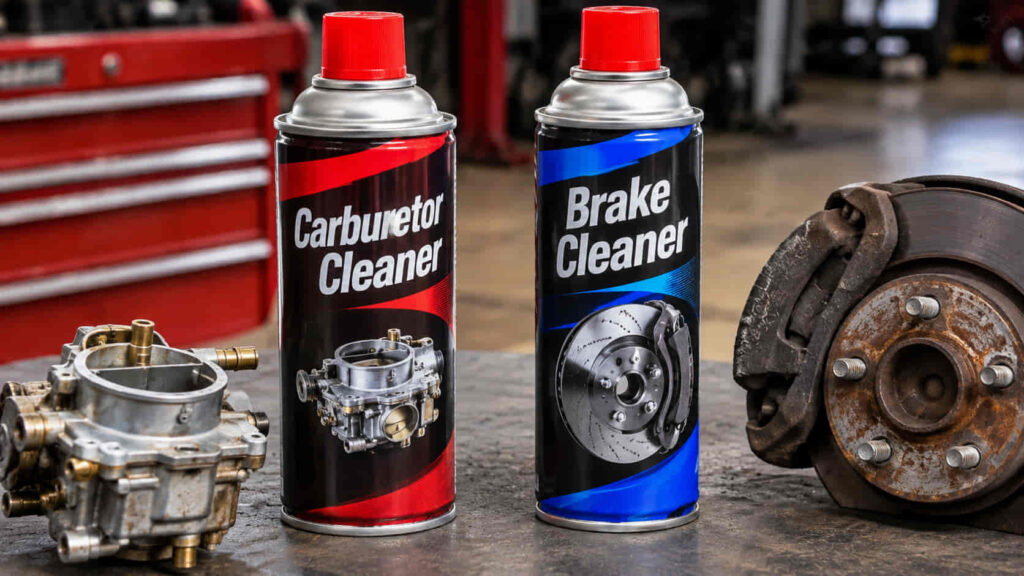
The main difference between carburetor cleaner and brake cleaner is their intended cleaning application. Carburetor cleaner dissolves gum, varnish, and fuel deposits that accumulate inside carburetors, while brake cleaner removes oil, grease, brake dust, and other contaminants from brake components. Although both products contain powerful chemical solvents, their formulations are designed to address different types of contamination and component requirements.
Carburetor cleaner and brake cleaner differ in chemical composition, cleaning effectiveness, evaporation rate, residue formation, material compatibility, and safety characteristics. Brake cleaners are typically formulated to dry quickly without leaving residue on approved surfaces, whereas carburetor cleaners prioritize the removal of stubborn fuel-related deposits. These characteristics vary depending on the specific solvent formulation and manufacturer.
Carburetor cleaner and brake cleaner are not universally interchangeable. For example, CRC Carb & Choke Cleaner is formulated to dissolve fuel-related deposits, while CRC Brakleen Platinum is designed to remove contaminants without leaving residue. Both products are classified as unsuitable for plastic surfaces, demonstrating that effective solvent cleaning does not guarantee material compatibility. CRC Industries+1
Choosing the appropriate automotive cleaner requires considering the type of contamination, component material, and operating requirements. Using an incompatible solvent can damage rubber seals, deteriorate plastic components, or contaminate braking surfaces. Understanding the differences between carburetor cleaner and brake cleaner helps prevent component damage, improve cleaning effectiveness, and reduce chemical exposure during automotive maintenance.
What Is the Difference Between Carburetor Cleaner and Brake Cleaner?
Carburetor cleaner removes fuel-related deposits from carburetors, whereas brake cleaner removes oil, grease, brake dust, and other contaminants from brake components. The two automotive cleaning products differ in six primary characteristics: intended application, chemical composition, target contaminants, evaporation rate, residue formation, and material compatibility.
Carburetor cleaner is formulated to dissolve stubborn deposits that develop as gasoline evaporates, oxidizes, and deteriorates. These deposits, including gum and varnish, accumulate inside carburetor jets, fuel passages, and float bowls, restricting fuel delivery and disrupting the air-fuel mixture. Carburetor cleaning solvents help dissolve these deposits, allowing contaminated components to be cleaned without damaging compatible metal surfaces when used as directed.
Brake cleaner is formulated to remove contaminants that interfere with the operation of braking components. Oil, grease, brake fluid, and accumulated road grime can contaminate brake rotors and other braking surfaces. Many brake cleaner formulations combine strong degreasing properties with rapid evaporation and residue-free drying, making them suitable for approved brake components where cleanliness is particularly important.
Another difference between carburetor cleaner and brake cleaner is their compatibility with automotive materials. Both products contain solvents that can damage certain plastics, rubber compounds, painted surfaces, and protective coatings. Carburetor cleaner is not automatically safe for carburetor seals and gaskets, just as brake cleaner is not automatically safe for every component within a braking system.
The functional difference between these cleaners is therefore determined by their formulation and intended application rather than solvent strength alone. A product that effectively dissolves grease does not necessarily provide suitable cleaning performance against hardened fuel deposits or meet the material compatibility requirements of a carburetor.
What Are Carburetor Cleaner and Brake Cleaner Made Of?
Carburetor cleaner and brake cleaner contain organic solvents, such as acetone, toluene, heptane, and petroleum-derived hydrocarbons. Certain brake cleaner formulations also contain chlorinated solvents, such as tetrachloroethylene. The chemical composition of each cleaner determines its solvency, evaporation rate, flammability, toxicity, and material compatibility.
Carburetor cleaners combine solvents capable of dissolving fuel-related deposits and removing accumulated oil and grime. Acetone dissolves various organic substances and evaporates rapidly, while hydrocarbon solvents, such as heptane, help dissolve oily contaminants. For example, the Safety Data Sheet (SDS) for CRC Carb & Choke Cleaner lists acetone and heptane among its ingredients, demonstrating how manufacturers combine different solvents to achieve the required cleaning properties. archpdfs.lps.org+1
Brake cleaners are available in two principal chemical categories: chlorinated and non-chlorinated formulations. Chlorinated brake cleaners traditionally contain solvents such as tetrachloroethylene, which provides effective degreasing properties and low flammability. However, chlorinated solvents present significant health hazards that require appropriate handling and ventilation.
Non-chlorinated brake cleaners use alternative solvents, including acetone, heptane, methanol, and toluene. For example, the Safety Data Sheet for CRC Brakleen Non-Chlorinated Brake Parts Cleaner identifies several of these compounds in its formulation. These solvents dissolve oil and grease but introduce different safety considerations, particularly regarding flammability and vapor exposure. Non-Chlorinated, 5 Gal
The presence of similar chemical ingredients does not make carburetor cleaner and brake cleaner interchangeable. Differences in solvent concentration, formulation, additives, and intended applications influence how each product interacts with contaminants and automotive materials. Manufacturers’ product labels and Safety Data Sheets provide the most reliable information for evaluating the chemical properties and safety requirements of a specific cleaner.
Read more: briggs and stratton model number
What Is Carburetor Cleaner Used For?
Carburetor cleaner is used to remove gum, varnish, carbon buildup, and other fuel-related deposits from carburetor components. Its solvent formulation dissolves accumulated contaminants that restrict fuel flow, interfere with air-fuel mixture regulation, and reduce engine performance.
Gasoline undergoes oxidation and evaporation during extended storage, leaving behind sticky residues that accumulate inside carburetors. These deposits are particularly common in seasonal equipment, such as lawn mowers, motorcycles, generators, and classic cars that remain unused for extended periods.
Carburetor cleaner helps restore unobstructed fuel flow by dissolving deposits inside carburetor jets and fuel passages. Even a small accumulation of varnish inside an idle jet restricts fuel delivery, resulting in rough idling, hesitation, or engine stalling. Removing these deposits helps restore normal engine operation when contamination is the underlying cause.
Carburetor cleaner also removes deposits around choke valves, throttle plates, and float bowls. Contamination around moving components increases resistance and interferes with their movement, affecting engine starting and fuel delivery. Cleaning these components helps maintain proper carburetor operation.
Certain carburetor cleaners are also suitable for cleaning other automotive metal components when explicitly approved by the manufacturer. However, their ability to dissolve fuel deposits does not make them suitable for every fuel system component. Rubber diaphragms, plastic floats, seals, and gaskets require compatible cleaning products to prevent material deterioration.
Carburetor cleaning addresses contamination rather than mechanical damage. Worn needle valves, damaged floats, and defective gaskets require repair or replacement rather than solvent cleaning.
What Is Brake Cleaner Used For?
Brake cleaner is used to remove oil, grease, brake fluid, brake dust, and other contaminants from compatible braking components. Its formulation combines effective degreasing properties with rapid evaporation to clean designated surfaces without leaving unwanted chemical residue. For example, CRC Brakleen is specifically formulated to remove contaminants from brake assemblies and dry without leaving residue. CRC+1
Brake cleaner is commonly used on brake rotors, brake drums, and compatible metal surfaces of brake calipers during maintenance and component replacement. New brake rotors may contain protective oil coatings that prevent corrosion during storage and transportation. When the rotor manufacturer requires their removal, brake cleaner dissolves these coatings before installation.
Removing contaminants from braking surfaces is important because braking performance depends on friction between brake pads and rotors or brake shoes and drums. Oil and grease interfere with this friction, potentially reducing braking effectiveness and causing inconsistent braking behavior.
Brake cleaner also helps remove accumulated brake dust generated by the gradual wear of friction materials during braking. Wet cleaning methods help prevent brake dust from becoming airborne, reducing the risk of inhalation during maintenance. Compressed air should not be used to disperse brake dust.
However, brake cleaner cannot reliably restore brake pads or shoes that have absorbed oil or brake fluid. Porous friction materials retain contaminants beneath their surfaces, making complete removal difficult. Severely contaminated friction components generally require replacement according to the manufacturer’s service instructions.
Which Cleaner Is Better at Removing Grease and Deposits?
Brake cleaner is generally better suited for removing oil and grease from brake components, while carburetor cleaner is better suited for dissolving gum, varnish, and fuel-related deposits inside carburetors. Neither product is universally stronger because cleaning effectiveness depends on the chemical properties of the solvent and the composition of the contaminant.
Brake cleaner dissolves petroleum-based contaminants by breaking down and dispersing oily substances, allowing them to be removed from metal surfaces. Its degreasing properties are particularly useful for cleaning brake rotors, drums, and other approved automotive components. Rapid evaporation also minimizes the likelihood of solvent residue remaining on the cleaned surface.
Carburetor cleaner targets more complex deposits that develop when gasoline deteriorates through oxidation and evaporation. Unlike fresh oil and grease, aged fuel deposits form sticky or hardened layers that adhere to metal surfaces. Carburetor cleaner contains solvents selected to dissolve these deposits and facilitate their removal from restricted areas, such as carburetor jets and fuel passages.
Cleaning effectiveness also depends on solvent contact time. Fresh grease generally requires less contact time to dissolve than hardened fuel varnish. Heavily contaminated carburetor components may require repeated cleaning or an approved soaking procedure to remove persistent deposits. Aerosol carburetor cleaners and immersion-type cleaning solutions have different formulations and application requirements.
The appropriate cleaner should therefore be selected according to the contaminant and the component being cleaned. Strong degreasing performance alone does not establish that a solvent is suitable for a particular automotive application, especially when sensitive materials or safety-critical components are involved.
Does Brake Cleaner Evaporate Faster Than Carburetor Cleaner?
Brake cleaner is often formulated for rapid evaporation, but it does not always evaporate faster than carburetor cleaner. The evaporation rate of both products depends on solvent volatility, chemical composition, ambient temperature, and airflow around the cleaned surface.
Brake cleaner manufacturers prioritize rapid drying and residue-free cleaning because braking surfaces must remain free from contaminants that interfere with friction. Rapid solvent evaporation also reduces drying time during brake maintenance and component installation.
Carburetor cleaners balance solvent evaporation with the contact time required to dissolve fuel-related deposits. However, aerosol carburetor cleaners can also evaporate rapidly. For example, CRC Industries classifies both its Carb & Choke Cleaner and its Brakleen Non-Chlorinated Brake Cleaner as fast-evaporating products, while certain non-flammable Brakleen formulations are classified as very fast-evaporating. CRC Industries+2
Evaporation rate and residue formation are separate chemical properties. A fast-evaporating solvent does not necessarily guarantee residue-free cleaning because nonvolatile additives and dissolved contaminants can remain on the surface. Similarly, carburetor cleaner does not inherently leave an oily residue.
Checking the manufacturer’s technical specifications provides a more reliable comparison of drying time and residue characteristics than selecting a cleaner based solely on its product category. Allow cleaned components to dry completely according to the manufacturer’s instructions before reassembly or operation.
Are Carburetor Cleaner and Brake Cleaner Safe on Rubber and Plastic?
Carburetor cleaner and brake cleaner are not universally safe on rubber and plastic. Their material compatibility depends on the chemical composition of the cleaning solvent, the type of polymer being cleaned, and the duration of exposure. Both cleaners can damage incompatible rubber seals, plastic components, gaskets, and protective coatings.
Rubber components are particularly susceptible to solvent exposure because certain organic solvents penetrate the polymer structure and extract chemical additives that maintain flexibility. This interaction causes swelling, softening, shrinkage, or cracking, depending on the rubber compound and solvent formulation. For example, a carburetor O-ring exposed to an incompatible cleaner may lose its original dimensions and sealing properties, resulting in fuel leakage after reassembly.
Plastic components experience similar deterioration when exposed to incompatible cleaning solvents. Acetone and certain aromatic hydrocarbons can soften, discolor, or damage specific plastics. Carburetor floats, plastic connectors, and electrical component housings therefore require cleaning products approved for their particular materials.
Carburetor cleaner and brake cleaner are generally suitable for designated bare metal surfaces, such as steel and aluminum, when permitted by the manufacturer. However, compatibility with bare metal does not guarantee compatibility with painted surfaces, plated finishes, or protective coatings. Strong solvents can dissolve surface coatings and expose the underlying material to corrosion.
Material compatibility is especially important when cleaning assembled automotive components that contain both metallic and nonmetallic materials. A metal brake caliper, for example, also contains rubber dust boots and hydraulic seals that may require different cleaning precautions.
Check the product label, technical data sheet, and component manufacturer’s cleaning instructions before applying either cleaner. A product specifically identified as safe for the intended material provides a more reliable basis for selection than assumptions about carburetor cleaner or brake cleaner as a product category.
Can You Use Brake Cleaner Instead of Carburetor Cleaner?
Brake cleaner should not be used as a direct substitute for carburetor cleaner unless the product and component manufacturers explicitly approve the application. Although both products dissolve organic contaminants, brake cleaner is formulated primarily for removing oil and grease from brake components rather than addressing fuel-related deposits inside carburetors.
CRC Industries advises against using brake cleaner as carburetor cleaner because it may be less effective at removing certain carburetor deposits and can damage sensitive rubber seals and gaskets. CRC These material compatibility concerns are particularly important in assembled carburetors, where cleaning solvents can come into contact with multiple materials simultaneously.
Brake cleaner may remove surface grease and oil from compatible, unpainted metal components. However, removing external contamination differs from dissolving hardened fuel varnish inside narrow carburetor passages. A dedicated carburetor cleaner provides cleaning properties specifically formulated for these fuel-related contaminants.
Using an incompatible brake cleaner on a carburetor can also compromise the integrity of its sealing components. Damaged O-rings, gaskets, and rubber-tipped needle valves can cause fuel leakage, incorrect fuel delivery, and unstable air-fuel mixtures. These problems may require carburetor rebuilding or component replacement rather than additional cleaning.
Carburetor cleaner is therefore the preferred product for routine carburetor maintenance. Selecting a dedicated cleaning solvent based on the manufacturer’s instructions reduces the risk of incomplete deposit removal, material deterioration, and unnecessary repair expenses.
Can You Use Carburetor Cleaner Instead of Brake Cleaner?
Carburetor cleaner should not be used as a substitute for brake cleaner on braking surfaces unless the manufacturer explicitly approves the application. Carburetor cleaner is formulated to dissolve fuel-related deposits rather than meet the specific cleaning requirements of braking components. Differences in chemical composition, residue formation, and material compatibility make these products unsuitable for unrestricted substitution.
Brake rotors and drums require clean friction surfaces to maintain effective braking performance. Depending on its formulation, carburetor cleaner may leave chemical residue or redistribute dissolved contaminants across these surfaces. Such contamination can reduce friction between brake pads and rotors, potentially compromising braking effectiveness.
Carburetor cleaner can also damage rubber seals, caliper dust boots, painted surfaces, and other sensitive braking system materials. Although the metallic portions of brake components may tolerate certain solvents, surrounding materials require specific chemical compatibility to maintain their structural integrity and functionality.
If carburetor cleaner has already been applied to brake rotors, follow the brake component manufacturer’s cleaning instructions and use an approved brake cleaner where appropriate. Contaminated brake pads and shoes may require replacement because porous friction materials can absorb chemical substances that surface cleaning cannot reliably remove. Avoid operating the vehicle until the affected braking components have been inspected and restored to a safe condition.
Dedicated brake cleaner remains the preferred product for brake maintenance because its formulation addresses the specific cleanliness and material compatibility requirements of braking components.
What Are the Safety Risks of Carburetor Cleaner and Brake Cleaner?
Carburetor cleaner and brake cleaner present five primary safety risks: flammability, inhalation toxicity, skin irritation, eye irritation, and hazardous thermal decomposition. The relative safety of these automotive cleaners depends on their chemical formulation, exposure conditions, and handling procedures rather than their intended cleaning application.
Flammability is a significant concern with many carburetor cleaners and non-chlorinated brake cleaners. Organic solvents, such as acetone and heptane, release flammable vapors that can ignite near sparks, open flames, and hot engine components. For example, CRC classifies both its Carb & Choke Cleaner and Brakleen Platinum Brake & Parts Cleaner as extremely flammable products. CRC Industries+1
Inhalation exposure occurs when volatile solvents evaporate and accumulate in the surrounding air. Breathing concentrated solvent vapors can cause headaches, dizziness, drowsiness, and respiratory irritation. Certain chlorinated solvent formulations also present serious long-term health risks, including potential carcinogenic effects. Adequate ventilation reduces airborne solvent concentrations and limits inhalation exposure. avondalecity-az.safepersonnelsds.com+1
Direct contact with carburetor cleaner or brake cleaner can irritate the skin and eyes. Organic solvents remove protective oils from the skin, resulting in dryness, irritation, and potentially dermatitis following repeated exposure. Chemical-resistant gloves selected according to the product’s Safety Data Sheet (SDS) and protective eyewear help prevent direct chemical exposure.
Hazardous thermal decomposition is another serious concern associated with certain chlorinated brake cleaners. Exposure to intense heat can produce highly toxic decomposition gases. Chlorinated cleaning solvents must therefore be kept away from welding operations, flames, and high-temperature surfaces.
Neither non-chlorinated nor non-flammable labeling guarantees that an automotive cleaner is safe. Use both products in adequately ventilated environments, wear appropriate personal protective equipment, and store containers away from heat and ignition sources. Always follow the product-specific Safety Data Sheet to identify chemical hazards, exposure precautions, and safe handling requirements.
What Is the Difference Between Chlorinated and Non-Chlorinated Brake Cleaner?
Chlorinated brake cleaner contains chlorine-based solvents, whereas non-chlorinated brake cleaner uses solvents that do not contain chlorine. These two formulations differ in chemical composition, flammability, toxicity, evaporation rate, and material compatibility.
Chlorinated brake cleaners commonly contain tetrachloroethylene, also known as perchloroethylene, which effectively dissolves oil and grease. Many chlorinated formulations are non-flammable, reducing the risk of solvent ignition during automotive maintenance. However, exposure to chlorinated solvent vapors presents significant health risks, and thermal decomposition can produce highly toxic gases.
Non-chlorinated brake cleaners use alternative organic solvents, such as acetone, heptane, and other hydrocarbons. These formulations provide effective degreasing performance without relying on chlorinated solvents. However, many non-chlorinated brake cleaners are highly flammable and require strict precautions around ignition sources.
The evaporation rate of chlorinated and non-chlorinated brake cleaners depends on their specific chemical formulations rather than the presence or absence of chlorine alone. Manufacturers offer different formulations to accommodate varying cleaning requirements, drying times, and working conditions.
Neither formulation is inherently safer or more effective for every automotive application. Selecting the appropriate brake cleaner requires evaluating the component manufacturer’s recommendations, material compatibility, workplace conditions, and product-specific Safety Data Sheet (SDS).
For example, CRC Brakleen Non-Chlorinated Brake Parts Cleaner is formulated for applications requiring chlorine-free solvents. However, its non-chlorinated formulation does not eliminate flammability or material compatibility concerns. CRC+1
When Should You Use Carburetor Cleaner or Brake Cleaner?
Use carburetor cleaner to remove fuel-related deposits from compatible carburetor components and brake cleaner to remove oil, grease, and other contaminants from approved braking surfaces. Product selection should prioritize the component’s function, contaminant type, material composition, and safety requirements.
Carburetor cleaner is appropriate when gum and varnish restrict fuel passages or interfere with carburetor operation. Brake cleaner is appropriate when brake rotors, drums, or other compatible braking components require degreasing and residue-free cleaning.
Other automotive components require cleaning products formulated for their specific operating conditions. Throttle body cleaner removes deposits from compatible throttle body surfaces while addressing the material requirements of modern air intake systems. Electrical contact cleaner is designed for compatible electrical connections, while automotive degreaser removes accumulated oil and grease from designated engine and mechanical surfaces. CRC
Certain multipurpose products support both carburetor and brake cleaning applications. For example, CRC Brakleen Platinum lists both carburetors and braking components among its intended applications. However, the manufacturer also identifies the product as unsuitable for plastics and warns that it may cause rubber swelling. CRC
The appropriate automotive cleaner is therefore determined by its approved applications and material compatibility rather than its product name, solvent strength, or price alone.