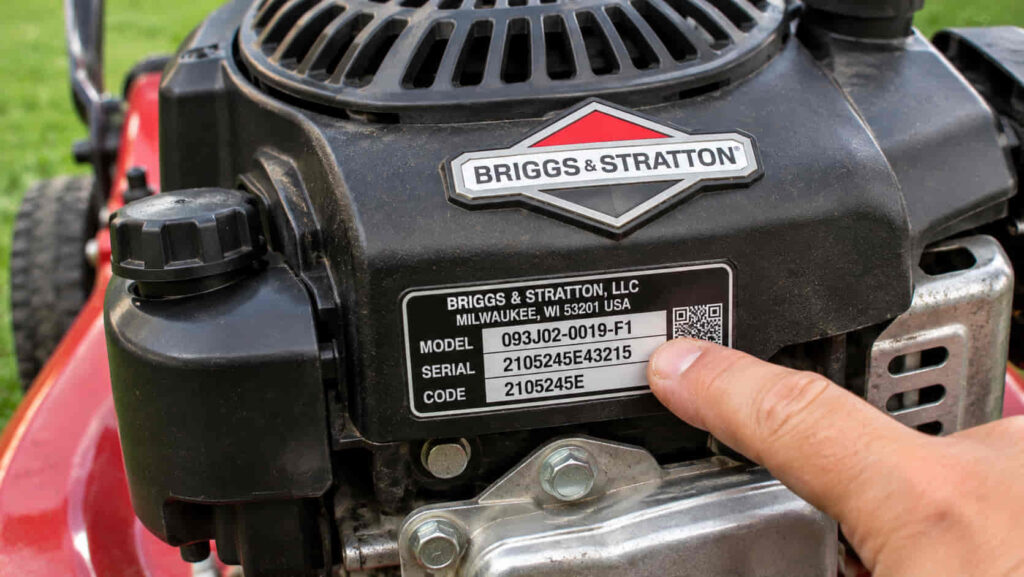
A Briggs and Stratton model number is a numerical or alphanumeric identifier that specifies the engine’s basic design and mechanical characteristics, including displacement, design series, crankshaft orientation, bearing configuration, and starting system. This identifier allows equipment owners and repair technicians to identify engines, retrieve technical documentation, and select compatible replacement parts.
Briggs & Stratton uses three primary identification numbers: the Model Number, Type Number, and Code Number. The Model Number identifies the basic engine design, the Type Number specifies mechanical variations and original equipment manufacturer (OEM) configurations, and the Code Number indicates the manufacturing date and production information. Together, these numbers provide the information necessary for accurate engine identification.
The Briggs and Stratton model number is typically stamped into the blower housing, overhead valve (OHV) cover, or metal surface near the spark plug. Its location varies depending on the engine design and equipment application, such as lawn mowers, generators, pressure washers, and snow blowers.
Accurate engine identification prevents compatibility errors when purchasing replacement components such as carburetors, air filters, ignition coils, and starter motors. Engines with identical horsepower ratings or similar external appearances may require different service parts due to mechanical and production variations.
This guide explains where to find your Briggs and Stratton model number, how to decode its characters, and how to use engine identification numbers to retrieve specifications, access manuals, determine manufacturing dates, and find compatible replacement parts.
What Is a Briggs and Stratton Model Number?
A Briggs and Stratton model number is an engine identification code that describes the basic design and mechanical characteristics of a Briggs & Stratton engine. Under the manufacturer’s numerical designation system, the model number encodes five primary characteristics: approximate engine displacement, basic design series, crankshaft orientation, bearing and lubrication configuration, and starter type.
The model number serves as a technical reference for engine maintenance, troubleshooting, repair, and replacement part selection. For example, two Briggs & Stratton engines with the same horsepower rating may have different crankshaft configurations, lubrication systems, or starting mechanisms. These mechanical differences affect the compatibility of replacement components, such as crankshafts, starter motors, and internal engine bearings.
A Briggs and Stratton engine model number is different from an equipment model number. The engine model number identifies the power-producing unit, whereas the equipment model number identifies the complete machine, such as a lawn mower, generator, or pressure washer. A lawn mower manufactured by another brand may contain a Briggs & Stratton engine with its own identification numbers. Owners should use the engine identification numbers when purchasing engine components and the equipment model number when purchasing machine-specific components, such as mower decks, wheels, and cutting blades. briggsandstratton.com+2
What Is the Difference Between Briggs and Stratton Model, Type, and Code Numbers?
The difference between Briggs and Stratton Model, Type, and Code numbers lies in the level of engine identification each number provides. The Model Number identifies the basic engine design, the Type Number distinguishes specific engine configurations, and the Code Number records manufacturing information. Briggs & Stratton collectively uses these identifiers to distinguish engines and their production variations.
The Model Number describes the fundamental mechanical characteristics of an engine. For example, model 303447 identifies an engine with an approximate displacement of 30 cubic inches, design series 3, a horizontal crankshaft, a ball-bearing configuration with pressure lubrication, and an electric starting system with an alternator. These characteristics establish the basic engine configuration without identifying every individual component installed during production. briggsandstratton.com
The Type Number identifies variations within the same engine model, including component specifications, paint color, decals, governed engine speed, and original equipment manufacturer (OEM) requirements. Two engines sharing the same model number may have different type numbers because they are configured for different equipment applications. These variations explain why identifying the model alone does not always guarantee replacement part compatibility.
The Code Number identifies when the engine was manufactured. In the standard eight-digit date code system, the first six digits represent the year, month, and day of manufacture, while the remaining two digits identify production-related information. For example, code 01061201 indicates an engine manufactured on June 12, 2001. briggsandstratton.com+1
Recording all three identification numbers reduces errors when retrieving illustrated parts lists, verifying component compatibility, and ordering replacement parts. The complete identification information is particularly useful when manufacturers introduce component changes within the same engine model during its production lifecycle.
Read more: does autozone check engine light
Where Is the Model Number on a Briggs and Stratton Engine?
The model number on a Briggs and Stratton engine is typically stamped into the blower housing, overhead valve (OHV) cover, muffler heat shield, or a metal surface above the spark plug. Depending on the engine design and manufacturing period, the identification numbers may also appear on a metal tag or fuel tank label. The exact location varies according to the equipment application and engine configuration. briggsandstratton.com+1
On Briggs & Stratton push lawn mower engines, the model number is found in three primary locations: immediately above the spark plug, between the overhead valve cover and the air filter, or on the sheet metal above the muffler. Engines equipped with decorative plastic shrouds may have identification numbers concealed beneath these covers. Removing the decorative cover according to the manufacturer’s instructions exposes the stamped numbers for inspection. Briggs & Stratton
On riding lawn mower engines, the model number is located in two primary areas: the metal valve cover or an aluminum identification tag positioned on the upper blower housing near the rotating screen. These locations apply to different engine configurations, including single-cylinder and V-twin engines. A flashlight helps reveal stamped characters in areas where the equipment frame restricts visibility. Briggs & Stratton
On Briggs & Stratton generator and pressure washer engines, the model number is commonly stamped into the OHV rocker cover. Other identification locations include the fuel tank label, the metal surface near the spark plug, and an identification tag above the recoil starter. Certain generator manufacturers install decorative chrome covers over the original rocker cover, concealing the engine identification numbers underneath. The generator or pressure washer product number should not be confused with the engine model number when ordering internal engine components. briggsandstratton.com+1
On Briggs & Stratton snow blower engines, the model number appears in four possible locations: the identification label beside the recoil starter, the cylinder shield, the metal shield beneath the muffler, or the left side of the OHV cover. Snow blower engines feature protective covers that shield engine components from snow and moisture, making identification markings less visible than those on conventional lawn mower engines. Briggs & Stratton+1
Before inspecting the identification numbers, switch off the engine, allow it to cool, and disconnect the spark plug wire to prevent accidental starting. Clean the identification surface with a soft cloth to reveal obscured characters. Photograph or record the complete Model, Type, and Code numbers for subsequent reference. Avoid using the numbers printed on the engine emissions label, as these identify emissions-related characteristics rather than the specific engine configuration required for replacement parts lookup.
What Does a Briggs and Stratton Model Number Look Like?
A Briggs and Stratton model number consists of five or six numerical or alphanumeric characters, depending on the engine series and identification system. These characters follow a structured sequence that represents the engine’s mechanical characteristics. The model number appears alongside additional identification information that distinguishes specific engine configurations and manufacturing details.
For example, Briggs & Stratton uses the identifier 12H702-0505-E1 in its official replacement parts documentation. The first six characters, 12H702, represent the basic engine model, while the remaining characters provide type and configuration information. The separate eight-digit manufacturing code records production information rather than the basic engine design. briggsandstratton.com
Five-character model numbers require a leading zero when entered into the manufacturer’s online lookup system. For example, an engine model stamped as 92902 should be entered as 092902 when the search tool requires six characters. This formatting requirement standardizes engine identifiers without changing their original mechanical meaning. Briggs & Stratton+1
Letters within an alphanumeric model number are part of the engine identification system and must be recorded accurately. Omitting a letter or entering an incorrect digit can return documentation for a different engine configuration or prevent the lookup system from locating the engine altogether.
How Do You Decode a Briggs and Stratton Model Number?
To decode a Briggs and Stratton model number, separate its characters into five identification groups: engine displacement, basic design series, crankshaft orientation, bearing and lubrication configuration, and starter type. Each group represents a mechanical attribute that helps identify the engine’s construction and operating characteristics.
The first one or two digits represent the approximate engine displacement in cubic inches (CID). Engine displacement measures the volume swept by the pistons inside the cylinders during their movement from bottom dead center to top dead center. For example, a model number beginning with 12 indicates approximately 12 cubic inches of displacement, equivalent to 197 cubic centimeters (cc). A model beginning with 30 represents approximately 492 cc. These values represent nominal displacement classifications rather than exact measurements.
The first character after the displacement identifies the basic design series. Briggs & Stratton assigns numerical and alphabetical characters to distinguish engine designs according to characteristics such as cylinder construction, ignition systems, and mechanical configuration. For example, the letter H in model 12H702 identifies its design series. Engines with similar displacement but different design series may require different internal components because displacement alone does not determine engine construction.
The second character after the displacement identifies the crankshaft orientation. Under the manufacturer’s designation system, numbers 0 through 4 and letters A through G represent horizontal crankshafts, while numbers 5 through 9 and letters H through Z represent vertical crankshafts. Horizontal-shaft engines are commonly installed in generators, pressure washers, and tillers, whereas vertical-shaft engines are widely used in rotary lawn mowers. This distinction affects engine mounting, power transmission, and equipment compatibility.
The third character after the displacement identifies the bearing arrangement and associated mechanical features, including lubrication, gear reduction, and auxiliary power transmission. For example, designation 0 represents a plain bearing arrangement, designation 4 indicates ball bearings with pressure-fed lubrication, and designation 7 identifies plain bearings with pressure-fed lubrication. These configurations influence how the crankshaft is supported and how oil reaches internal engine components. briggsandstratton.com+1
The final character identifies the starting configuration. Common designations include 0 for engines without a starter, 2 for recoil-start engines, 5 for electrically started engines, and 7 for engines equipped with both an electric starter and an alternator. Identifying this character helps narrow the selection of starting components, such as recoil starter assemblies, starter motors, and charging system components.
Applying this decoding system to model 12H702 identifies an engine with approximately 197 cc of displacement, design series H, a vertical crankshaft, a plain bearing arrangement, and a recoil starter. This information establishes the engine’s fundamental mechanical characteristics before consulting its model-specific documentation.
The official Briggs & Stratton model numbering chart provides reference information for interpreting these characters, including historical designations that are no longer in use. However, decoding the model number does not establish the engine’s exact horsepower, crankshaft dimensions, or individual service part numbers. These specifications require the corresponding engine documentation and complete identification information.
How Do You Look Up a Briggs and Stratton Model Number?
To look up a Briggs and Stratton model number, enter the engine’s Model and Type numbers into the official Briggs & Stratton manuals and parts lookup tool. The search system retrieves technical documents associated with the engine configuration, including operator’s manuals and illustrated parts lists (IPLs).
Before performing a lookup, record the complete Model, Type, and Code numbers stamped on the engine. Preserve all numerical and alphabetical characters, including leading zeros where required. For example, an engine identified as 12H702-0505-E1 contains the basic model number 12H702, the type number 0505, and the trim designation E1. These additional identifiers distinguish specific configurations within the same engine model.
Visit the official Briggs & Stratton manual lookup page and enter the engine identification number using the required format. The search system accepts a six-character model number followed by a four-character type number, with an additional two-character suffix where applicable. Insert a hyphen after the first six characters and add a leading zero to five-character model numbers to meet the search format requirements.
The lookup results provide two primary technical documents: the Operator’s Manual and the Illustrated Parts List. The Operator’s Manual contains operating instructions, safety requirements, maintenance schedules, and model-specific service information. The Illustrated Parts List contains exploded engine diagrams, component reference numbers, and corresponding service part numbers required for repairs.
An unsuccessful model number lookup generally requires checking the accuracy of the recorded characters, leading zeros, hyphens, and type information. Engines manufactured before 1965 may require the model number and the first four digits of the serial number to identify the correct parts documentation. Contact an authorized Briggs & Stratton dealer when the online database does not return the required engine documents. Briggs & Stratton+2
How Do You Find Briggs and Stratton Replacement Parts by Model Number?
To find Briggs and Stratton replacement parts by model number, retrieve the engine’s Illustrated Parts List, identify the required component, and verify its service part number against the engine’s Type and Code numbers. This process establishes component compatibility based on the manufacturer’s technical documentation rather than engine appearance or horsepower ratings.
The Illustrated Parts List organizes engine components into mechanical assemblies, such as the fuel system, ignition system, cylinder assembly, lubrication system, and starting system. Each exploded diagram illustrates the position and relationship of individual components within an assembly. For example, locating a carburetor in the fuel system diagram helps distinguish the complete carburetor assembly from individual components such as the float, inlet needle, and mounting gasket.
Briggs & Stratton distinguishes between diagram reference numbers and service part numbers. Reference numbers contain one to four digits and identify components within an exploded diagram, whereas service part numbers generally contain six or eight digits and identify the replacement components required for ordering. A reference number is therefore a navigation identifier within the parts document, not the actual number used to purchase a replacement component. briggsandstratton.com
Replacement part compatibility also depends on engine configuration and production changes. Briggs & Stratton may specify different service part numbers for the same component according to the engine’s Type Number or manufacturing Code Number. For example, two engines sharing the same basic model number may require different carburetors because of variations in fuel delivery, governor linkages, or equipment manufacturer specifications.
Check whether the original service part number has been superseded before purchasing a replacement. A superseded part number indicates that the manufacturer has assigned a newer identifier to an approved replacement component. Verifying the supersession and applicable engine configuration prevents ordering discontinued or incompatible parts.
Once the correct service part number has been confirmed, use it to search for compatible Briggs and Stratton replacement parts, including carburetors, spark plugs, air filters, ignition coils, and starter motors. Matching replacement components against the manufacturer’s parts documentation reduces purchasing errors, unnecessary repair costs, and equipment downtime.
How Can You Tell the Age of a Briggs and Stratton Engine?
To determine the age of a Briggs and Stratton engine, decode the first six digits of the eight-digit Code Number to identify the year, month, and day of manufacture. Briggs & Stratton introduced this manufacturing date identification system in 1965, allowing equipment owners and repair technicians to determine when an engine was produced.
The first two digits represent the manufacturing year, the third and fourth digits represent the month, and the fifth and sixth digits represent the day. The remaining two digits provide manufacturing-related information, such as the production plant or assembly line.
For example, an engine with the Code Number 99011556 was manufactured on January 15, 1999. The digits 99 represent 1999, 01 represents January, 15 identifies the day, and 56 identifies the manufacturing plant and assembly line. briggsandstratton.com
Determining the manufacturing date of Briggs & Stratton engines produced before 1965 requires a different approach because these engines predate the standardized Code Number system. Owners must cross-reference the engine model and serial number with historical production records or antique engine dating charts to establish the manufacturing period.
The manufacturing date also helps identify replacement parts affected by production changes. Briggs & Stratton may introduce revised components during the production lifecycle of an engine without changing its basic model number. Consequently, the manufacturing Code Number helps distinguish between earlier and later component configurations when the Illustrated Parts List specifies a production date restriction.
Can You Find Briggs and Stratton Engine Specifications by Model Number?
Yes, a Briggs and Stratton model number provides access to engine specifications, including displacement, cylinder bore, piston stroke, crankshaft orientation, valve clearances, and starting configuration. Some mechanical characteristics are encoded directly within the model number, while precise measurements and service specifications require model-specific technical documentation.
The model number provides a starting point for identifying specifications, but its numerical designations do not represent exact engine measurements. For example, a model number beginning with 12 indicates a nominal displacement of approximately 12 cubic inches, or 197 cc. It does not establish the exact cylinder bore, piston stroke, or horsepower rating.
Briggs & Stratton provides engine specification charts and technical documentation containing measurements required for maintenance and mechanical repairs. These specifications include valve clearances, spark plug gaps, cylinder bore dimensions, and piston stroke measurements. Using the correct specifications ensures that adjustments and replacement components meet the manufacturer’s requirements. briggsandstratton.com
Horsepower, gross torque, and crankshaft dimensions cannot be determined reliably from the model number alone. Engines belonging to the same basic design series may have different power ratings or equipment-specific configurations. Consult the manufacturer’s engine specifications, original power rating label, or an authorized Briggs & Stratton dealer using the complete Model, Type, and Code numbers to confirm these values before performing major repairs or selecting a replacement engine.
How Do You Identify a Briggs and Stratton Engine Without a Model Number?
To identify a Briggs and Stratton engine without a visible model number, inspect alternative identification locations, examine the original equipment documentation, and cross-reference the engine’s physical characteristics. These methods help narrow down the engine model when identification markings are damaged, obscured, or missing.
Inspect the blower housing, valve cover, muffler heat shield, and metal surfaces near the spark plug for stamped identification numbers. Dirt, grease, corrosion, and accumulated paint can conceal these markings. Clean the suspected identification surface with a soft cloth and a suitable degreaser while the engine is off and cool. Avoid abrasive cleaning methods that may permanently damage shallow stamped characters.
The original equipment documentation provides another reference for engine identification. Equipment manufacturers maintain product records, owner’s manuals, and parts catalogs that sometimes specify the installed Briggs & Stratton engine model. Searching the equipment model and serial numbers helps establish the original engine configuration, provided the engine has not been replaced.
Physical characteristics also help narrow down possible engine models. These characteristics include crankshaft orientation, cylinder configuration, valve design, starter type, carburetor configuration, and air filter housing. For example, a single-cylinder, vertical-shaft OHV engine with a recoil starter belongs to a different mechanical configuration from a horizontal-shaft engine equipped with an electric starter.
Contact an authorized Briggs & Stratton dealer when the available information is insufficient to establish the exact model. Provide photographs of the engine, visible identification markings, and original equipment information. Physical resemblance alone does not guarantee replacement part compatibility because different engine models may share similar external components.
Can You Replace a Briggs and Stratton Engine With a Different Model Number?
Yes, a Briggs and Stratton engine can be replaced with a different model number, provided the replacement engine meets the original equipment’s mechanical, dimensional, electrical, and operating requirements. An identical model number simplifies engine replacement, but a different model with compatible specifications can also serve as a suitable replacement.
Crankshaft orientation and dimensions determine whether the replacement engine connects correctly to the equipment’s power transmission system. The replacement crankshaft must match the required diameter, length, and connection type. For example, replacing a vertical-shaft lawn mower engine requires compatibility between the crankshaft and the existing blade adapter or drive pulley.
Engine mounting dimensions determine whether the replacement engine fits the equipment frame. The mounting hole pattern, bolt spacing, and overall engine dimensions must accommodate the existing installation without interfering with surrounding components. Differences in engine size, fuel tank position, or exhaust configuration can prevent installation even when two engines have similar displacement and power ratings. shop.briggsandstratton.com+1
Power output, governed operating speed, starting configuration, throttle controls, and electrical connections must also satisfy the equipment manufacturer’s requirements. For example, replacing an electric-start riding mower engine requires compatibility with the existing battery, charging system, ignition switch, and safety interlock system.
Consult the Briggs & Stratton engine replacement guide or an authorized dealer using the original engine’s Model, Type, and Code numbers before purchasing a replacement engine. Confirming mechanical and electrical compatibility reduces installation problems, equipment damage, and operational safety risks.
What Are the Common Mistakes When Identifying a Briggs and Stratton Engine?
The six most common mistakes when identifying a Briggs and Stratton engine are confusing engine and equipment model numbers, misreading emissions labels, omitting leading zeros, ignoring type and trim information, confusing diagram reference numbers with service part numbers, and relying solely on horsepower ratings. These errors result in incorrect technical documentation, incompatible replacement parts, and unnecessary repair costs.
Confusing the equipment model number with the engine model number leads to incorrect parts searches because each identifier refers to a different assembly. Similarly, emissions labels contain regulatory information, such as engine family designations, rather than the complete identification numbers required for engine parts lookup.
Omitting leading zeros or ignoring alphabetical characters prevents accurate identification in online lookup systems. Incomplete Type and Code numbers also make it difficult to distinguish mechanical variations and production changes within the same engine model.
Using diagram reference numbers instead of service part numbers results in incorrect component searches. The reference number identifies a component’s position within an exploded diagram, whereas the service part number identifies the component for ordering.
Horsepower ratings and commercial engine series names, such as Intek, Vanguard, and Quantum, are insufficient for confirming parts compatibility. Engines with identical power ratings can have different carburetors, crankshafts, and starting systems. Verify the complete Model, Type, and Code numbers against the manufacturer’s illustrated parts list before purchasing replacement components.