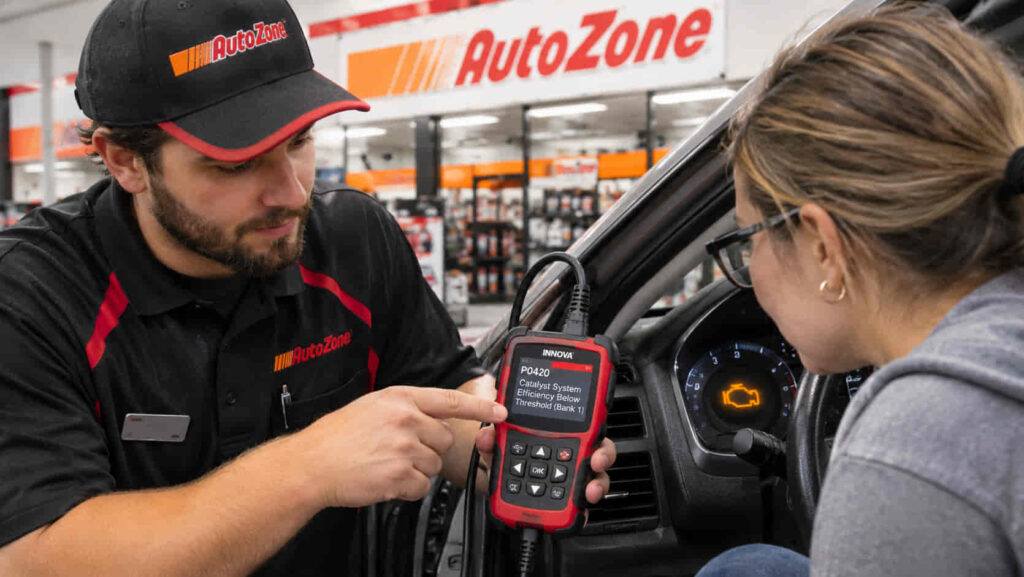
Yes, AutoZone checks engine lights for free through its Fix Finder service at its stores across the United States. The service uses an onboard diagnostic (OBD-II) scan tool to retrieve diagnostic trouble codes (DTCs) from a vehicle’s computer and generate a report containing detected fault conditions and recommended repair solutions. According to AutoZone, the scan typically takes less than one minute once the diagnostic tool is connected, and customers receive both printed and digital copies of their reports. AutoZone+1
AutoZone Fix Finder also retrieves diagnostic information related to the anti-lock braking system (ABS), maintenance warning lights, emissions readiness, and battery voltage on compatible vehicles. The available diagnostic information varies depending on the vehicle’s make, model, model year, and onboard computer capabilities.
However, AutoZone’s free check engine light scan is not equivalent to a comprehensive mechanical diagnosis. A diagnostic trouble code identifies a fault detected by the vehicle’s computer but does not necessarily establish its underlying cause. For example, code P0300 indicates random or multiple cylinder misfires, which may result from ignition faults, fuel delivery problems, or mechanical issues.
Understanding how AutoZone Fix Finder works, what its diagnostic report includes, and where its limitations begin helps vehicle owners make informed repair decisions. Using the free scan as an initial diagnostic step can reduce unnecessary replacement parts purchases and help determine when professional mechanical testing is necessary.
Does AutoZone Check Engine Lights for Free?
Yes, AutoZone checks engine lights for free through its Fix Finder service. Vehicle owners can visit an AutoZone store to have diagnostic trouble codes retrieved from their vehicle’s onboard computer without paying a diagnostic scanning fee or purchasing a personal OBD-II scanner.
According to AutoZone, Fix Finder is available at all its U.S. stores during regular business hours. Customers can receive a printed diagnostic report and request a digital copy by providing an email address. The service requires a direct connection to the vehicle’s computer, meaning the diagnostic scan cannot be performed online. Free Car Diagnostic Tool
The free service covers diagnostic code retrieval and potential repair recommendations, but it does not cover replacement parts, repair labor, or comprehensive mechanical testing. For example, if a scan reveals an evaporative emission control (EVAP) system fault, the vehicle owner receives information about the detected condition and possible solutions. Any replacement components or additional testing remain separate expenses.
AutoZone’s free check engine light service is particularly useful for vehicle owners who want to investigate a dashboard warning light before paying for professional diagnostic services. It provides an initial understanding of the detected problem, allowing drivers to assess their repair options and determine whether further mechanical inspection is necessary.
What Is AutoZone Fix Finder?
AutoZone Fix Finder is a free vehicle diagnostic service that retrieves fault information from a vehicle’s onboard computer and converts it into an accessible report containing diagnostic trouble codes and potential repair solutions. The service connects electronic fault detection with practical repair recommendations, helping vehicle owners understand why their dashboard warning lights have appeared.
Modern vehicles use electronic control modules, sensors, and actuators to monitor engine performance, emissions control, and other operating conditions. When the engine control module (ECM) or powertrain control module (PCM) detects an abnormal condition that meets specific diagnostic criteria, it records a diagnostic trouble code and may activate the check engine light, also known as the malfunction indicator lamp (MIL).
Fix Finder retrieves available diagnostic information through the vehicle’s onboard diagnostics (OBD-II) interface. AutoZone processes the retrieved information using its diagnostic resources to generate a vehicle-specific report supported by previously verified repair solutions. Vehicle details, including the make, model, model year, engine configuration, and mileage, help contextualize the diagnostic findings. Free Car Diagnostic Tool+1
For example, when a vehicle records diagnostic trouble code P0171, Fix Finder identifies a lean fuel mixture condition affecting Bank 1. Potential repair recommendations may involve investigating intake air leaks, fuel delivery problems, or airflow measurement faults. However, confirming the actual cause requires additional testing when several underlying problems produce the same trouble code.
Fix Finder therefore serves as an initial troubleshooting resource rather than a complete vehicle inspection. Its primary value lies in translating electronic diagnostic information into actionable repair guidance without requiring vehicle owners to purchase specialized scanning equipment.
Read more: is autel mk808 good
How Does AutoZone Check Your Engine Light?
AutoZone checks your engine light by connecting a Fix Finder scan tool to your vehicle’s onboard diagnostic (OBD-II) port, retrieving diagnostic trouble codes, and processing the recorded information into a vehicle-specific diagnostic report. The process examines electronic fault information without disassembling engine components or performing invasive mechanical tests.
The diagnostic process begins when the vehicle owner arrives at an AutoZone store and requests the free Fix Finder service. Information about the vehicle, including its make, model, model year, and symptoms, provides context for interpreting the diagnostic results. Drivers should mention unusual operating conditions, such as rough idling, reduced acceleration, or increased fuel consumption, because these symptoms may help guide further troubleshooting.
An AutoZone employee locates the vehicle’s Data Link Connector (DLC), commonly known as the OBD-II port. On most passenger vehicles, this connector is located beneath the driver’s side dashboard near the steering column. It provides a standardized communication interface between the vehicle’s electronic control modules and external diagnostic equipment.
The Fix Finder scan tool connects to the diagnostic port to establish communication with the vehicle’s computer. For the standard self-service procedure, the ignition is switched on without starting the engine. This supplies power to the relevant electronic systems and allows the scanner to retrieve available diagnostic information. The scanner reads recorded trouble codes without requiring the removal of engine components. AutoZone
AutoZone also provides a Fix Finder self-service option for customers who prefer to perform the scan themselves. Vehicle owners can request a scanning device from an AutoZone employee, connect it to their vehicle, follow the provided instructions, and return the device to the store once the scan is complete. AutoZone
The retrieved diagnostic information is processed alongside vehicle-specific details to generate a Fix Finder report. An AutoZone employee reviews the results with the customer, explains potential repair solutions, and helps identify relevant replacement parts. When additional diagnostic testing or professional repairs are necessary, AutoZone can recommend a local repair shop.
What Does AutoZone Fix Finder Check?
AutoZone Fix Finder checks three primary categories of dashboard warning lights: the check engine light, the anti-lock braking system (ABS) light, and maintenance warning lights. On compatible vehicles, the service also retrieves supplementary information about emissions readiness, battery voltage, tire pressure monitoring, oil condition indicators, and brake pad life. AutoZone+1
Check engine light scanning retrieves diagnostic trouble codes associated with engine management and emissions control systems. These codes identify abnormal operating conditions involving components such as oxygen sensors, ignition coils, fuel injectors, and evaporative emission control systems. For example, code P0455 indicates a large leak detected within the EVAP system, providing a starting point for investigating fuel vapor containment problems.
ABS scanning retrieves available fault information from the anti-lock braking system. A recorded fault may relate to wheel speed sensors, electrical connections, or the ABS control module. However, retrieving an ABS trouble code does not constitute a physical inspection of brake pads, rotors, brake fluid, or hydraulic components.
Maintenance-related scanning provides access to electronically recorded service information. Depending on the vehicle, Fix Finder can retrieve oil life estimates, oil level status, brake pad life indicators, and upcoming maintenance recommendations. These readings reflect information available through the vehicle’s electronic systems rather than independently measured component conditions.
Emissions readiness information indicates whether the vehicle’s onboard diagnostic monitors have completed their required self-tests. This information helps drivers assess readiness for an emissions inspection, particularly after recent repairs or diagnostic code clearing. Completed readiness monitors do not independently guarantee that a vehicle will pass every applicable inspection requirement.
Fix Finder can also retrieve battery voltage and supported tire pressure monitoring system (TPMS) information. A voltage reading provides an initial indication of electrical system conditions, but it does not replace dedicated battery load testing or charging system evaluation.
The diagnostic coverage of AutoZone Fix Finder ultimately depends on the vehicle’s make, model, model year, electronic control modules, and supported communication protocols. A successful OBD-II connection does not guarantee access to every electronic system or mechanical condition within the vehicle.
What Vehicles Can AutoZone Check for Engine Light Problems?
AutoZone Fix Finder can check engine lights on most OBD-II-compatible passenger vehicles, including gasoline-powered cars, SUVs, and light-duty pickup trucks. Vehicle compatibility depends on the model year, diagnostic communication protocol, vehicle classification, and electronic systems supported by the Fix Finder scan tool.
Most gasoline-powered passenger cars and light-duty trucks sold in the United States from the 1996 model year onward use standardized OBD-II systems. These systems allow external diagnostic tools to retrieve standardized engine and emissions-related trouble codes through a diagnostic connector. Vehicles manufactured before 1996 may use OBD-I or manufacturer-specific diagnostic systems that require different scanning equipment.
According to the U.S. Environmental Protection Agency (EPA), full federal OBD compliance became mandatory for light-duty gasoline vehicles below 8,500 pounds in gross vehicle weight rating (GVWR) beginning with the 1996 model year. Full compliance for light-duty diesel vehicles within the same weight classification followed in the 1997 model year. However, these regulatory requirements do not guarantee compatibility with every diagnostic function offered by AutoZone Fix Finder. nepis.epa.gov
Hybrid vehicles equipped with internal combustion engines generally support standardized OBD-II powertrain diagnostics. However, specialized systems, such as high-voltage battery management, regenerative braking, and electric motor control, may require manufacturer-specific diagnostic equipment. Fully electric vehicles have different diagnostic requirements and should be evaluated for compatibility before visiting AutoZone.
Heavy-duty commercial trucks, older diesel vehicles, and vehicles with proprietary diagnostic systems may require specialized scan tools. Differences in diagnostic connectors, communication protocols, and electronic control modules can prevent standard scanning equipment from retrieving the necessary fault information.
Vehicle owners should confirm compatibility with their local AutoZone store when driving an older, imported, diesel-powered, hybrid, or specialized vehicle. Providing the vehicle’s make, model, model year, and engine type helps determine whether Fix Finder can retrieve the required diagnostic information.
How Long Does an AutoZone Check Engine Light Test Take?
An AutoZone check engine light test typically takes less than one minute to retrieve diagnostic information once the Fix Finder scan tool is connected to a compatible vehicle. According to AutoZone, customers receive a diagnostic report in printed and emailed formats after completing the free test. Free Car Diagnostic Tool
The scanning duration represents only one part of the complete service. The total time spent at AutoZone depends on employee availability, customer waiting times, diagnostic connector accessibility, report preparation, and the time required to explain the results.
Vehicles with multiple recorded trouble codes or communication difficulties may require additional time to retrieve and review diagnostic information. For example, a vehicle displaying both check engine and ABS warning lights may require a more detailed discussion of the affected systems and potential repair options.
AutoZone offers Fix Finder during regular store business hours. Its official service description encourages customers to visit a local store when a dashboard warning light appears. Drivers who have limited time or questions about vehicle compatibility should contact their preferred location before visiting.
Although the diagnostic scan takes less than one minute under normal conditions, identifying and repairing the underlying problem may require significantly more time. The duration of a code scan should therefore not be confused with the time required for a complete mechanical diagnosis.
What Information Does an AutoZone Diagnostic Report Provide?
An AutoZone Fix Finder diagnostic report provides information about detected vehicle faults, diagnostic trouble code descriptions, potential repair solutions, and relevant replacement parts. The report helps vehicle owners understand which operating conditions triggered their dashboard warning lights and determine the appropriate next steps.
Diagnostic trouble codes (DTCs) represent the primary information retrieved during the scan. Each code corresponds to a specific fault condition detected by the vehicle’s onboard computer. For example, P0171 indicates that the air-fuel mixture is too lean in Bank 1, while P0455 indicates a large leak detected within the evaporative emission control (EVAP) system.
The diagnostic report also explains recorded trouble codes in accessible language and provides potential repair recommendations. According to AutoZone, Fix Finder uses information from millions of technician-verified repairs to identify relevant solutions and suggest replacement parts. These recommendations provide a starting point for troubleshooting rather than confirmation that a specific component has failed. Free Car Diagnostic Tool
Understanding diagnostic results also requires distinguishing between stored, pending, and permanent trouble codes. Stored codes record faults recognized by the vehicle’s diagnostic system, while pending codes indicate detected conditions that have not necessarily met the criteria for a confirmed fault. Permanent codes document certain emissions-related faults and remain recorded until the vehicle verifies that the underlying problem has been resolved through its diagnostic monitoring process.
Depending on vehicle compatibility, Fix Finder may provide additional information about emissions readiness, battery voltage, and maintenance requirements. Customers can retain printed and emailed copies of the report for future reference or share the information with a professional mechanic. AutoZone also allows customers to request a reprint of a report from the previous 30 days. Free Car Diagnostic Tool
How Accurate Is AutoZone’s Check Engine Light Diagnostic?
AutoZone’s check engine light diagnostic is useful for retrieving recorded diagnostic trouble codes and identifying potential repair solutions on compatible vehicles. However, accurately reading a diagnostic trouble code does not guarantee accurate identification of the underlying mechanical or electrical problem. These represent two distinct levels of automotive diagnosis.
The Fix Finder scan tool communicates directly with the vehicle’s onboard diagnostic system to retrieve available fault information. When the vehicle records a diagnostic trouble code, the scanner identifies the reported condition rather than independently inspecting the component associated with that code. Consequently, the accuracy of the repair recommendation depends on how closely the suggested solution matches the vehicle’s actual mechanical condition.
For example, diagnostic trouble code P0420 indicates that catalytic converter efficiency in Bank 1 has fallen below the required threshold. Although a deteriorated catalytic converter represents a potential cause, exhaust leaks, sensor-related problems, and underlying engine performance issues can also contribute to the detected condition. Replacing the catalytic converter without further investigation may therefore result in unnecessary repair expenses. AutoZone+1
Similarly, diagnostic trouble code P0300 indicates random or multiple cylinder misfires. Potential causes include worn spark plugs, malfunctioning ignition coils, insufficient fuel delivery, intake air leaks, and internal engine compression problems. The trouble code identifies the abnormal combustion condition but does not establish which component caused it.
Professional diagnostic testing improves root cause identification by combining trouble codes with live sensor data, electrical measurements, physical inspections, and manufacturer-specific testing procedures. For example, a mechanic investigating an engine misfire may examine fuel pressure, ignition performance, and cylinder compression before recommending replacement components.
AutoZone Fix Finder is most valuable as an initial diagnostic resource. Its recommendations help narrow the range of potential problems, but complex, recurring, or safety-related faults require additional investigation. Vehicle owners should verify the underlying cause before purchasing expensive replacement parts or authorizing major repairs.
What Are the Common Check Engine Light Codes AutoZone Can Read?
AutoZone Fix Finder can read standard OBD-II diagnostic trouble codes associated with engine performance and emissions control systems on compatible vehicles. Five frequently encountered examples are P0300, P0420, P0171, P0455, and P0128. Each code identifies a particular fault condition that helps vehicle owners narrow the scope of diagnostic testing.
The P0300 trouble code indicates random or multiple cylinder misfires. This condition occurs when combustion fails to proceed correctly across multiple cylinders or when the vehicle’s computer cannot consistently attribute misfires to a single cylinder. Potential causes include worn spark plugs, faulty ignition coils, insufficient fuel delivery, and cylinder compression problems. Drivers experiencing severe engine shaking or a flashing check engine light should stop driving as soon as it is safe to do so.
The P0420 trouble code indicates catalyst system efficiency below the required threshold in Bank 1. The vehicle’s computer evaluates catalytic converter performance using information from oxygen sensors. Catalytic converter deterioration, exhaust leaks, and underlying engine performance problems can contribute to this fault condition.
The P0171 trouble code indicates that the engine is operating with an excessively lean air-fuel mixture in Bank 1. This condition develops when the engine receives too much air relative to the amount of fuel supplied. Potential causes include intake manifold leaks, insufficient fuel pressure, and inaccurate mass airflow sensor readings.
The P0455 trouble code indicates a large leak detected within the evaporative emission control (EVAP) system. This system prevents gasoline vapors from escaping into the atmosphere. A loose or damaged fuel cap, disconnected vapor hose, or malfunctioning EVAP valve can prevent the system from maintaining the required pressure or vacuum.
The P0128 trouble code indicates that the engine coolant temperature remains below the expected thermostat regulating temperature. A thermostat stuck in the open position, inaccurate coolant temperature sensor readings, or cooling system problems can contribute to this condition.
Although these diagnostic trouble codes identify different operating abnormalities, none independently confirms that a particular replacement component is necessary. Vehicle owners should interpret each code alongside vehicle symptoms, maintenance history, and additional diagnostic findings.
Can AutoZone Clear or Reset Your Check Engine Light?
AutoZone’s free Fix Finder service primarily reads diagnostic trouble codes and provides repair recommendations. Clearing the check engine light is not an explicitly guaranteed feature of the free service. Although compatible OBD-II scanners can erase certain trouble codes, vehicle owners should confirm whether their local AutoZone store provides code-clearing assistance. Free Car Diagnostic Tool+1
Reading diagnostic trouble codes, clearing diagnostic trouble codes, and repairing the underlying problem represent three different procedures. Reading codes retrieves recorded fault information, while clearing codes removes certain diagnostic records from the vehicle’s computer. Repairing the underlying problem corrects the mechanical or electrical condition responsible for activating the warning light.
Clearing diagnostic trouble codes without completing the necessary repairs provides only temporary relief from the warning light. For example, erasing a P0455 code does not repair a damaged EVAP hose. Once the vehicle’s computer performs another evaporative emissions system test and detects the same leak, the check engine light may illuminate again.
Premature code clearing also removes valuable diagnostic information, such as stored fault codes and associated freeze-frame data. Additionally, clearing codes can reset emissions readiness monitors to an incomplete status. Vehicles with insufficient completed readiness monitors may be unable to complete an emissions inspection successfully. nepis.epa.gov
Permanent diagnostic trouble codes differ from conventional stored codes because they cannot normally be erased using a standard OBD-II scanner. The vehicle’s onboard diagnostic system must verify that the underlying fault has been corrected before removing these records.
After a successful repair, the check engine light may turn off automatically once the vehicle completes the required diagnostic monitoring cycles. AutoZone also recommends identifying and correcting the underlying issue before resetting the warning light with a compatible scan tool. AutoZone.com
Vehicle owners should therefore prioritize resolving the detected fault rather than simply turning off the check engine light. A dashboard without an illuminated warning light does not necessarily indicate that all mechanical problems have been corrected.
What Is the Difference Between AutoZone Fix Finder and a Mechanic Diagnostic?
The main difference between AutoZone Fix Finder and a professional mechanic diagnostic is the depth of testing performed to identify the underlying vehicle problem. AutoZone provides free diagnostic code reading and potential repair recommendations, while a professional mechanic performs additional testing to verify the cause of the detected fault.
AutoZone Fix Finder retrieves electronic information recorded by the vehicle’s onboard computer. The service helps identify affected vehicle systems, interpret diagnostic trouble codes, and suggest potential replacement components. This approach is particularly useful for initial troubleshooting because vehicle owners can obtain diagnostic information without paying an upfront diagnostic fee.
A professional mechanic diagnostic involves a more comprehensive evaluation of the vehicle’s operating condition. Technicians combine electronic fault information with live sensor data analysis, physical inspections, electrical measurements, and mechanical testing. These procedures help determine whether the detected fault originates from a malfunctioning component, damaged wiring, mechanical deterioration, or another related system.
For example, when AutoZone Fix Finder retrieves diagnostic trouble code P0171, the report identifies a lean air-fuel mixture condition in Bank 1. A professional mechanic may perform an intake system smoke test to identify vacuum leaks, measure fuel pressure to evaluate fuel delivery, and analyze fuel trim data to assess engine operating conditions. These additional procedures help distinguish between potential causes without replacing functional components unnecessarily.
Professional diagnostic services generally involve a fee because repair facilities allocate technician labor, specialized equipment, and manufacturer-specific technical resources to identify the underlying problem. The total diagnostic cost depends on the complexity of the fault, vehicle design, and labor rates of the repair facility.
AutoZone Fix Finder is an effective starting point for investigating dashboard warning lights, particularly when the vehicle operates normally. Professional diagnosis becomes necessary when trouble codes persist, multiple systems report faults, drivability problems develop, or expensive component replacements require confirmation.
Is It Safe to Drive to AutoZone With the Check Engine Light On?
Driving to AutoZone with the check engine light on may be safe when the warning light remains steady, the vehicle operates normally, and the manufacturer’s instructions permit continued driving. If the check engine light is flashing or the vehicle exhibits severe performance problems, pull over safely and arrange professional assistance instead of continuing to AutoZone.
A steady check engine light indicates that the vehicle’s onboard computer has detected a malfunction affecting engine operation or emissions control. Common causes include a loose gas cap, oxygen sensor problems, and evaporative emission control system faults. Although these conditions do not always require an immediate stop, drivers should arrange diagnostic testing promptly to prevent potential mechanical damage and increased fuel consumption.
A flashing check engine light indicates a potentially serious engine malfunction, particularly a severe engine misfire. According to the U.S. Environmental Protection Agency (EPA), severe misfires can damage emissions control components, especially the catalytic converter, within a relatively short period. nepis.epa.gov+1
During a severe engine misfire, unburned fuel can enter the exhaust system and generate excessive heat inside the catalytic converter. Continued vehicle operation under these conditions increases the risk of catalytic converter deterioration, reduced engine performance, and expensive repairs.
Vehicle symptoms also determine whether continued driving is appropriate. Excessive engine vibration, significant power loss, overheating, unusual mechanical noises, smoke, or an illuminated oil pressure warning light indicate conditions that require immediate attention, even when the check engine light remains steady.
Drivers experiencing these symptoms should stop the vehicle in a safe location, switch off the engine, and arrange roadside assistance or towing to a qualified repair facility.
AutoZone’s free Fix Finder service provides a convenient diagnostic option for vehicles that can be operated safely. However, obtaining a free diagnostic scan should never take priority over preventing mechanical damage or protecting vehicle occupants.
Where Else Can You Get a Free Check Engine Light Diagnostic?
Besides AutoZone, vehicle owners can obtain free check engine light scans from automotive parts retailers such as O’Reilly Auto Parts and Advance Auto Parts, as well as participating independent repair shops. These services provide access to diagnostic trouble codes without the initial expense of purchasing a scan tool or paying for a comprehensive mechanical diagnosis.
O’Reilly Auto Parts offers free check engine light testing through its VeriScan service. Customers can visit a store without an appointment to have available diagnostic trouble codes retrieved and receive information about potential repair solutions. Like AutoZone Fix Finder, VeriScan provides an initial troubleshooting resource rather than a comprehensive mechanical inspection. O’Reilly Auto Parts
Advance Auto Parts provides free check engine light scanning through its ReliaScan service at most store locations. Employees connect an OBD-II scanner to the vehicle’s diagnostic port, retrieve stored trouble codes, and explain the detected fault conditions. Service availability and diagnostic coverage depend on the store and vehicle compatibility. Advance Auto Parts+1
Independent automotive repair shops may also offer complimentary diagnostic scans or promotional vehicle inspections. However, these services sometimes involve conditions, such as authorizing subsequent repairs at the same facility. Vehicle owners should confirm whether the free service includes only code retrieval or additional mechanical and electrical testing.
When selecting a free diagnostic service, consider vehicle compatibility, report comprehensiveness, store accessibility, and available technical assistance. Regardless of the provider, a free code scan does not eliminate the need for professional diagnostic testing when the underlying fault remains uncertain.
What Should You Do After AutoZone Checks Your Engine Light?
After AutoZone checks your engine light, review the diagnostic report, assess the severity of the detected fault, verify its underlying cause, and determine the appropriate repair strategy. The Fix Finder report provides an initial troubleshooting direction, but subsequent decisions should reflect the vehicle’s actual mechanical condition.
Begin by reviewing the diagnostic trouble codes and their descriptions. Retain a copy of the report and document accompanying symptoms, such as rough idling, reduced acceleration, unusual fuel consumption, or difficulty starting the engine. This information helps establish relationships between electronically detected faults and observable vehicle performance problems.
Simple faults may require only a basic inspection. For example, a P0455 trouble code on a vehicle equipped with a conventional fuel cap may justify checking whether the cap is loose, damaged, or improperly installed. However, a persistent EVAP system fault after securing the fuel cap requires further investigation.
More complex problems require professional diagnostic testing. Engine misfires, recurring electrical faults, and catalytic converter efficiency problems can originate from multiple interconnected components. Purchasing every replacement part suggested in a diagnostic report without confirming the underlying cause increases repair expenses and may leave the original problem unresolved.
AutoZone also offers repair resources and referrals to automotive repair facilities for customers who require professional assistance. Vehicle owners can share their Fix Finder report with a mechanic to provide additional diagnostic context. Free Car Diagnostic Tool+1
When the estimated repair cost is substantial, evaluate the vehicle’s current market value, overall mechanical condition, maintenance history, and expected remaining service life. For an older vehicle requiring extensive engine or emissions system repairs, selling or replacing the vehicle may represent a more economical alternative to continued repair expenses.
After completing the appropriate repairs, verify that the original fault has been resolved and that the check engine light does not return under normal operating conditions. Successful repair requires correcting the underlying malfunction rather than simply clearing the recorded trouble codes.
Using AutoZone Fix Finder as the first stage of a structured diagnostic process helps vehicle owners minimize unnecessary expenses, prioritize necessary repairs, and make informed decisions about long-term vehicle ownership.