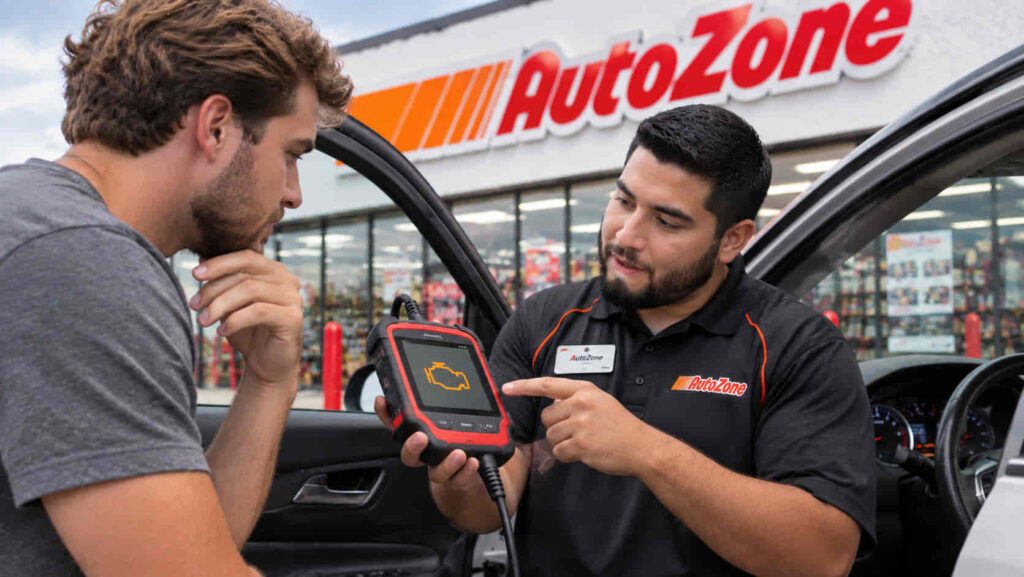
Yes, AutoZone offers free vehicle diagnostics through its Fix Finder service and free parts testing program. These services help drivers retrieve diagnostic trouble codes (DTCs), identify potential vehicle problems, and evaluate essential electrical components without paying a diagnostic fee.
AutoZone’s Fix Finder service retrieves diagnostic information associated with the check engine light, anti-lock braking system (ABS), and maintenance warning lights. The service provides customers with a diagnostic report containing vehicle fault codes and potential repair solutions based on technician-verified fixes. According to AutoZone, the scanning process often takes less than one minute once the diagnostic reader is connected. Free Car Diagnostic Tool
In addition to electronic code reading, AutoZone provides complimentary testing for batteries, alternators, and starter motors. These tests help identify component failures associated with starting difficulties, electrical malfunctions, and charging system problems. Service availability depends on store location, testing equipment, and vehicle compatibility. AutoZone
However, AutoZone’s free diagnostics do not replace a comprehensive vehicle diagnosis performed by a professional mechanic. Diagnostic trouble codes identify detected faults rather than conclusively establishing their underlying causes. Understanding AutoZone’s diagnostic capabilities, testing procedures, accuracy, and service limitations helps vehicle owners determine whether free diagnostic testing is sufficient or additional mechanical inspection is necessary.
What Does AutoZone’s Free Diagnostic Test Check?
AutoZone’s free diagnostic services cover two main areas: electronic fault code reading and electrical component testing. The Fix Finder service retrieves diagnostic information from vehicle computer systems, while the free parts testing program evaluates the operating condition of batteries, alternators, and starter motors.
Fix Finder reads diagnostic information associated with the check engine light, anti-lock braking system (ABS), and maintenance lights on compatible vehicles. The diagnostic scanner communicates with onboard control modules to retrieve stored trouble codes and generate a report containing potential repair solutions. For example, an ABS trouble code associated with a wheel speed sensor helps narrow the investigation to the sensor, its wiring, or related components.
AutoZone also offers free battery testing to determine whether a battery has sufficient power and remains suitable for continued use. A battery tester evaluates the battery’s electrical condition, helping distinguish a discharged battery from one that requires replacement. AutoZone also provides complimentary charging for functional batteries with insufficient charge.
Alternator testing evaluates the charging system’s ability to generate electrical power while the engine operates. A malfunctioning alternator prevents the battery from maintaining sufficient charge and contributes to symptoms such as dim headlights, recurring battery discharge, and electrical malfunctions. AutoZone offers in-vehicle alternator testing to help determine whether the charging problem originates from the alternator.
Starter motor testing evaluates the component responsible for cranking the engine during startup. A defective starter contributes to symptoms such as clicking noises, intermittent starting difficulties, or failure to crank. Unlike battery and alternator testing, AutoZone’s published starter testing procedure requires customers to remove the starter motor and bring it to the store. AutoZone
The availability of these complimentary tests depends on vehicle compatibility, store equipment, and location-specific restrictions. Electronic code reading identifies recorded system faults, whereas component testing evaluates the condition of individual electrical parts.
Does AutoZone Check Engine Lights for Free?
Yes, AutoZone checks engine light codes for free through its Fix Finder service without requiring customers to purchase replacement parts. The service retrieves diagnostic trouble codes from the vehicle’s onboard computer and provides a report describing detected faults and potential repair solutions. Free Car Diagnostic Tool
The check engine light activates when the engine control module (ECM) detects an abnormal operating condition within a monitored system. The ECM monitors information from sensors associated with fuel delivery, ignition timing, airflow, and exhaust emissions. When the system detects a fault that meets its diagnostic criteria, it records a corresponding diagnostic trouble code.
For example, diagnostic trouble code P0300 indicates random or multiple-cylinder engine misfires. Potential causes include worn spark plugs, faulty ignition coils, malfunctioning fuel injectors, and insufficient cylinder compression. Reading the code identifies the detected combustion problem but does not establish which component caused it.
The behavior of the check engine light also indicates the urgency of the problem. A continuously illuminated check engine light requires prompt investigation, while a flashing check engine light typically indicates a severe engine misfire that risks catalytic converter damage. Drivers experiencing a flashing warning light should stop driving as soon as it is safe and arrange professional inspection or towing rather than continuing to an AutoZone store. AutoZone.com+1
AutoZone’s free check engine light service provides a starting point for troubleshooting engine and emissions-related problems before committing to replacement parts or professional repairs.
Read more: does autozone install wiper blades
How Does AutoZone’s Free Fix Finder Service Work?
AutoZone’s free Fix Finder service works by retrieving diagnostic trouble codes from a vehicle’s onboard computer and matching the recorded faults with potential repair solutions. The service uses an onboard diagnostics (OBD-II) scanner and a database of technician-verified fixes to help customers identify the next steps in the troubleshooting process.
The diagnostic process begins by connecting the Fix Finder reader to the vehicle’s OBD-II diagnostic port, which is typically located beneath the dashboard near the steering column. This port provides access to diagnostic information stored in compatible electronic control modules. When connected, the scanner communicates with the vehicle’s computer to retrieve available fault codes and other supported diagnostic information.
Customers can also borrow a Fix Finder scan tool from AutoZone and perform the scan themselves using the retailer’s instructions. After the scan is complete, the device is returned to the store, where the collected diagnostic information is processed through AutoZone’s computer system. The software analyzes fault codes, vehicle specifications, and mileage to identify relevant repair recommendations. AutoZone+1
AutoZone provides a complimentary diagnostic report in printed and digital formats. The report contains retrieved trouble codes, recommended repair solutions, and suggested replacement parts. Depending on vehicle compatibility, it also provides information about emissions readiness, battery voltage, oil life, tire pressure monitoring, and upcoming maintenance requirements.
An AutoZone associate reviews the report with the customer and assists with identifying suitable replacement parts. When the recommended repair requires specialized equipment or advanced mechanical knowledge, AutoZone can recommend a local repair shop for further diagnosis and repair. Free Car Diagnostic Tool
How Accurate Is AutoZone’s Free Diagnostic Test?
AutoZone’s free diagnostic test is useful for retrieving stored trouble codes and identifying potential repair solutions, but it cannot guarantee an accurate diagnosis of the underlying mechanical or electrical fault. Its diagnostic reliability depends on three factors: code retrieval accuracy, fault code interpretation, and verification of the underlying cause.
Code retrieval reflects information recorded by the vehicle’s onboard diagnostic system. The Fix Finder scanner retrieves this information directly from compatible control modules rather than independently inspecting the physical condition of individual components. A correctly retrieved trouble code therefore confirms that the vehicle’s computer has detected a particular abnormal condition, not necessarily that a specific component has failed.
Diagnostic trouble code P0171, for example, indicates that the air-fuel mixture is too lean on Bank 1 of the engine. Potential causes include vacuum leaks, insufficient fuel pressure, contaminated mass airflow sensors, and malfunctioning fuel injectors. Replacing the oxygen sensor solely because the engine control module detected a lean condition risks leaving the underlying problem unresolved.
AutoZone improves the relevance of its repair recommendations by comparing diagnostic information with millions of technician-verified repair records. This approach helps identify likely solutions based on previous repairs involving similar vehicles and fault codes. However, historical repair data does not confirm that an individual vehicle has the same underlying defect. AutoZone+1
Confirming the root cause requires additional testing when several faults produce the same diagnostic code. For instance, a technician investigating P0171 may perform an intake smoke test, measure fuel pressure, and analyze live fuel trim data before recommending replacement parts.
AutoZone’s Fix Finder report is therefore most reliable as an initial troubleshooting resource rather than a definitive diagnosis. Drivers should verify recommended repairs through appropriate component testing before purchasing replacement parts.
What Problems Can AutoZone’s Free Diagnostics Not Detect?
AutoZone’s free diagnostics cannot reliably identify problems that require physical inspection, advanced mechanical testing, or detailed electrical circuit analysis. Fix Finder retrieves information from monitored electronic systems, but its diagnostic capabilities do not extend to every mechanical component within a vehicle.
Internal engine damage is one of the primary limitations of electronic code reading. Problems such as worn piston rings, damaged valves, and leaking head gaskets require additional mechanical testing to determine their severity and location. For example, a cylinder misfire code indicates abnormal combustion but cannot distinguish between an ignition failure and insufficient cylinder compression. A compression test or cylinder leak-down test helps identify the underlying mechanical fault.
Transmission problems also require specialized diagnostic procedures when electronic fault codes provide insufficient information. Although a diagnostic scanner can retrieve supported transmission-related codes, it cannot directly measure clutch wear, inspect internal gears, or confirm hydraulic pressure problems. These conditions require additional testing to determine whether the transmission needs servicing or mechanical repair.
Physical wear within braking and suspension systems is another limitation. An ABS trouble code identifies a detected fault within the anti-lock braking system but does not measure brake pad thickness, rotor wear, or brake fluid contamination. Similarly, worn shock absorbers, damaged ball joints, and deteriorated suspension bushings require physical inspection to assess their condition.
Intermittent electrical faults present additional diagnostic challenges because loose connections, damaged wiring, and poor grounding can produce symptoms without consistently triggering fault codes. Identifying these problems requires voltage measurements, continuity testing, and circuit inspection.
A diagnostic report containing no trouble codes does not establish that a vehicle is mechanically sound. Drivers experiencing unusual noises, fluid leaks, vibrations, or reduced braking performance should arrange a professional inspection even when AutoZone’s diagnostic scan reveals no recorded faults.
What Vehicles Are Compatible With AutoZone’s Free Diagnostic Test?
AutoZone’s free Fix Finder service is compatible with most passenger cars and light-duty trucks manufactured for the U.S. market from the 1996 model year onward that support OBD-II diagnostics. The Environmental Protection Agency (EPA) established standardized onboard diagnostic requirements for 1996 and newer passenger vehicles to improve emissions monitoring and fault detection. US EPA+1
Vehicles manufactured before 1996 generally use earlier diagnostic systems, commonly referred to as OBD-I. These systems feature manufacturer-specific communication protocols and diagnostic connectors, which limit compatibility with standardized OBD-II scanning equipment.
Diagnostic coverage also varies among OBD-II-compatible vehicles. Standard powertrain codes are more widely accessible than manufacturer-specific codes associated with braking, transmission, and other electronic systems. Hybrid and electric vehicles introduce additional diagnostic requirements involving high-voltage batteries, electric motors, and specialized control modules.
Drivers with older vehicles, imported models, hybrid vehicles, or fully electric vehicles should confirm compatibility with their local AutoZone store before requesting diagnostic testing. The presence of a diagnostic port does not guarantee access to every electronic control module or vehicle system.
How Long Does AutoZone’s Free Diagnostic Test Take?
AutoZone’s free Fix Finder diagnostic scan takes less than one minute, according to the company’s published service information. The diagnostic reader communicates with the vehicle’s onboard computer to retrieve available trouble codes, which are subsequently processed to generate a diagnostic report.
The total time spent at AutoZone depends on store traffic, employee availability, vehicle communication, and report interpretation. Although code retrieval takes less than one minute, connecting the scanner, generating the report, and discussing recommended repairs require additional time.
Electrical component testing follows a separate procedure. Battery, alternator, and starter motor tests require different equipment and testing conditions. For example, a discharged battery requires sufficient charging before its condition can be accurately evaluated, extending the overall testing duration.
AutoZone does not guarantee a fixed completion time for the entire diagnostic visit.
AutoZone’s Free Parts Testing program specifies that testing a removed starter motor takes approximately five minutes. Its fast battery charger can recharge most automotive batteries in about 30 minutes. These additional services increase the total visit duration when customers require more than a standard Fix Finder scan. AutoZone+2
Do You Need an Appointment for AutoZone’s Free Diagnostics?
No appointment is generally required for AutoZone’s free diagnostic services. Customers can visit an AutoZone store during regular business hours and request Fix Finder assistance or electrical component testing. The company’s published service instructions direct customers to visit a nearby store without specifying an advance booking requirement.
AutoZone provides free diagnostic testing without requiring customers to purchase replacement parts. Drivers can obtain a Fix Finder report, review potential repair recommendations, and decide whether to perform the repairs themselves or seek professional mechanical assistance. Fix Finder requires a direct connection to the vehicle’s diagnostic port at an AutoZone location. Free Car Diagnostic Tool
Customers can use the official AutoZone Store Locator to check operating hours and obtain store contact information. Calling ahead helps confirm equipment availability and vehicle compatibility, particularly for vehicles with specialized diagnostic systems.
Will AutoZone Clear Your Check Engine Light Codes?
AutoZone reads check engine light codes for free, but clearing diagnostic trouble codes is not a guaranteed part of its Fix Finder service. AutoZone’s official service description focuses on retrieving fault codes, generating diagnostic reports, and recommending potential repair solutions rather than resetting dashboard warning lights. Free Car Diagnostic Tool
Clearing diagnostic trouble codes removes erasable fault information from the vehicle’s onboard computer and temporarily extinguishes the check engine light. However, resetting the warning light does not correct the underlying mechanical or electrical problem. When the engine control module detects the same abnormal condition during subsequent operation, it records the corresponding fault code and reactivates the warning light.
Erasing diagnostic codes can also reset emissions readiness monitors and remove valuable diagnostic information, such as freeze-frame data recorded when a fault occurred. Incomplete readiness monitors may prevent a vehicle from passing an emissions inspection.
Drivers should identify and repair the underlying problem before clearing diagnostic trouble codes. After completing the necessary repairs, a compatible OBD-II scanner or an appropriate vehicle drive cycle can help verify whether the fault has been resolved. AutoZone
How Does AutoZone’s Free Diagnostic Test Compare to a Mechanic’s Diagnosis?
The primary difference between AutoZone’s free diagnostic test and a mechanic’s diagnosis is the depth of testing and the ability to confirm the root cause of a vehicle malfunction. AutoZone retrieves electronic fault codes and provides potential repair recommendations, while professional mechanics perform additional diagnostic procedures to verify component failures and mechanical defects.
AutoZone’s Fix Finder service provides an initial assessment without charging a diagnostic fee. Its repair recommendations are based on recorded fault codes and previous technician-verified repairs involving similar vehicles. This approach helps drivers narrow down potential problems before purchasing replacement parts or arranging professional repairs.
Professional mechanics use advanced diagnostic equipment, including bidirectional scan tools, digital multimeters, oscilloscopes, smoke testers, and compression testers. These instruments allow technicians to analyze live sensor data, activate individual electronic components, measure electrical signals, and evaluate mechanical conditions that standard code readers cannot directly assess.
For example, when AutoZone retrieves a P0301 trouble code indicating a cylinder-one misfire, the diagnostic report may recommend inspecting the spark plug or ignition coil. A professional mechanic can perform ignition coil testing, fuel injector testing, and cylinder compression measurements to determine whether the misfire originates from an ignition, fuel delivery, or mechanical problem.
Unlike AutoZone’s complimentary service, professional diagnostic services generally involve labor charges based on testing complexity, vehicle specifications, and local labor rates. However, confirming the underlying fault reduces unnecessary component replacement and associated repair expenses.
AutoZone’s free diagnostics are suitable for initial troubleshooting, while professional diagnosis is necessary when fault codes have multiple potential causes, symptoms persist after repairs, or specialized mechanical testing is required.
What Other Auto Parts Stores Offer Free Car Diagnostics?
Besides AutoZone, O’Reilly Auto Parts and Advance Auto Parts offer free diagnostic code reading services to help vehicle owners investigate dashboard warning lights and identify potential vehicle problems without paying a diagnostic fee.
O’Reilly Auto Parts provides free diagnostic code reading through its VeriScan service. The scanner retrieves check engine, ABS, transmission, and maintenance-related codes on compatible vehicles. Customers receive a printed report containing potential repair solutions based on technician-verified repairs. Like AutoZone’s Fix Finder, VeriScan helps narrow down potential causes without replacing a comprehensive mechanical diagnosis. O’Reilly Auto Parts
Advance Auto Parts offers free check engine light scanning through its ReliaScan service at most store locations. An employee connects an OBD-II scanner to the vehicle, retrieves stored trouble codes, and explains the results. The service requires no purchase or advance appointment. Advance Auto Parts
AutoZone, O’Reilly Auto Parts, and Advance Auto Parts differ primarily in diagnostic coverage, report features, vehicle compatibility, and store availability. Drivers should select a provider based on the warning light requiring investigation, the diagnostic information needed, and the compatibility of their vehicle with the retailer’s scanning equipment.
What Should You Do After Getting a Free Diagnostic Test at AutoZone?
After receiving a free diagnostic test at AutoZone, drivers should review the Fix Finder report, verify the underlying cause, complete the appropriate repair, and confirm that the problem has been resolved. The diagnostic report provides a foundation for troubleshooting rather than a definitive instruction to replace a particular component.
Reviewing diagnostic trouble codes alongside vehicle symptoms helps determine the appropriate repair strategy. For example, diagnostic trouble code P0456 indicates a small leak within the evaporative emission control (EVAP) system. Potential causes include a loose fuel cap, deteriorated seals, damaged vapor hoses, or a malfunctioning purge valve. Inspecting accessible components before purchasing replacement parts helps prevent unnecessary repair expenses.
The appropriate repair method depends on the complexity and severity of the detected problem. Simple issues, such as a loose fuel cap, are suitable for DIY troubleshooting. Problems involving internal engine components, braking systems, or complex electrical circuits require professional diagnostic equipment and mechanical expertise.
After completing the repair, drivers should verify that the original symptoms have disappeared and that the corresponding trouble codes do not return. Some diagnostic monitors require specific driving conditions before confirming normal system operation. Persistent warning lights or recurring fault codes indicate that additional investigation is necessary.
Keeping a copy of the original Fix Finder report also helps mechanics compare previous diagnostic information with subsequent test results, improving troubleshooting efficiency and reducing redundant diagnostic work.