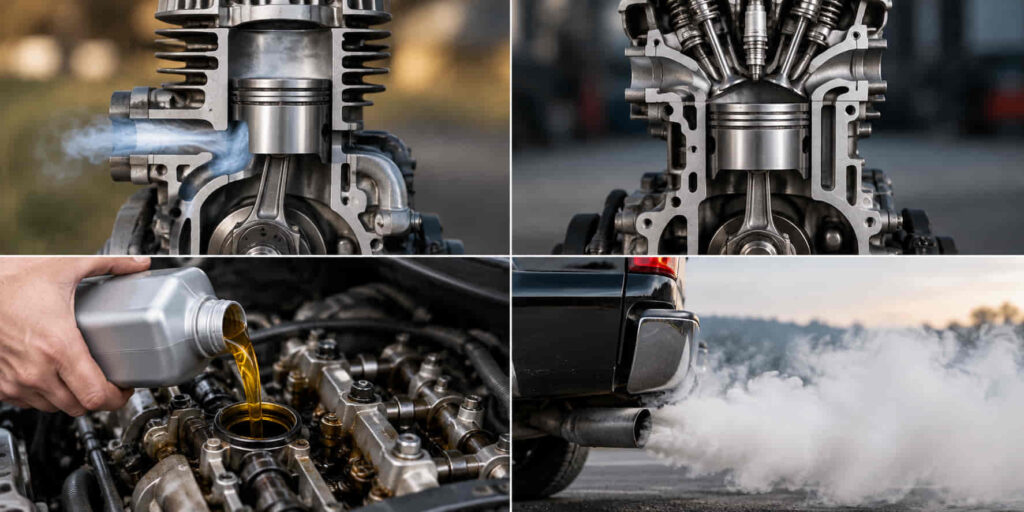
White smoke from exhaust diesel engines can indicate incomplete fuel combustion, coolant entering the combustion chamber, or normal condensation during cold weather. A small amount of white vapor immediately after startup is often harmless, but thick white smoke that continues after the engine warms up may signal a fuel injection problem, cooling system leak, or internal engine damage.
The most common causes of persistent white diesel exhaust smoke include faulty fuel injectors, incorrect injection timing, defective glow plugs, low cylinder compression, blown head gaskets, and leaking exhaust gas recirculation (EGR) coolers. Each problem affects the engine differently, making the timing, density, and behavior of the smoke important diagnostic clues.
Understanding why a diesel engine produces white smoke helps determine whether the vehicle needs routine maintenance or immediate mechanical attention. Identifying the underlying cause early can also prevent additional engine damage and unnecessary repair costs.
What Does White Smoke From a Diesel Exhaust Mean?
White smoke from a diesel exhaust generally means that unburned or partially burned fuel, water vapor, or coolant-derived steam is leaving the exhaust system. The underlying cause depends on engine temperature, combustion efficiency, and whether the smoke disappears after startup.
Diesel engines operate through compression ignition rather than using spark plugs to ignite the fuel mixture. During the compression stroke, the piston compresses air inside the cylinder, raising its temperature sufficiently to ignite diesel fuel when it is injected into the combustion chamber.
For combustion to occur efficiently, the engine must maintain adequate compression, correct injection timing, proper fuel atomization, and sufficient cylinder temperature. When these conditions are disrupted, some fuel may leave the combustion chamber without burning completely.
Unburned diesel fuel can form a visible white or grayish-white exhaust plume as fuel vapors and droplets condense. This type of smoke is particularly common when combustion chamber temperatures are too low or fuel injectors are not functioning correctly.
White exhaust can also originate from coolant entering the combustion chamber or exhaust passages. When the coolant’s water content encounters high temperatures, it can turn into steam that appears as dense white vapor at the tailpipe.
Normal condensation creates a similar visual effect. Water vapor is a natural product of combustion, and it becomes visible when hot exhaust gases mix with sufficiently cold surrounding air.
The key distinction is whether the white exhaust is temporary or persistent. Light vapor that disappears as the exhaust system warms up is often normal, while continuous white smoke accompanied by coolant loss, rough idling, or reduced engine performance requires further diagnosis.
Is White Smoke Normal When Starting a Diesel Engine?
A small amount of white smoke during a cold diesel engine startup can be normal, particularly in low ambient temperatures. However, excessive smoke, difficult starting, or white exhaust that persists after the engine reaches its normal operating temperature may indicate a mechanical problem.
Cold starting creates challenging conditions for diesel combustion because the cylinder walls, intake air, and engine components are at relatively low temperatures.
A diesel engine relies on the heat generated during compression to ignite fuel. When cylinder temperatures are low, the fuel may take longer to ignite, allowing part of the injected fuel to remain unburned or partially burned.
The resulting fuel vapor can appear as white smoke until the combustion chambers become hot enough to support more complete combustion.
This behavior is particularly noticeable in older diesel engines, engines with less sophisticated fuel injection systems, and equipment operating in extremely cold environments.
Diesel engines equipped with glow plugs or intake air heaters use these systems to improve cold-start combustion. If the glow plugs are working correctly, they help raise local temperatures and reduce the likelihood of misfiring and excessive white smoke.
Another common source of white exhaust during startup is condensation inside the exhaust system. Moisture accumulated in the exhaust pipes and muffler can evaporate as hot exhaust gases pass through them.
Condensation-related vapor typically dissipates quickly after leaving the tailpipe, although it may remain visible longer in cold, humid weather.
The duration of normal startup smoke varies by engine design and environmental conditions. A brief plume alone does not prove that an engine is defective.
However, persistent smoke after warm-up, repeated misfires, unexplained coolant loss, or unusual engine noises should not be dismissed as normal cold-start behavior.
Can Faulty Diesel Fuel Injectors Cause White Smoke?
Faulty diesel fuel injectors are an important cause of white exhaust smoke because they can disrupt fuel atomization, injection quantity, and combustion timing. When fuel does not burn completely inside the cylinder, unburned hydrocarbons may leave through the exhaust system as a visible white plume.
A diesel fuel injector delivers fuel into the combustion chamber under high pressure. Its nozzle is designed to distribute the fuel into a controlled spray pattern, allowing the droplets to mix with compressed hot air.
Proper fuel atomization increases the surface area available for evaporation and combustion. When the injector produces an uneven spray pattern or oversized droplets, some fuel may not burn completely before the exhaust valve opens.
Injector deposits, internal wear, or nozzle damage can interfere with this process.
A leaking injector can also allow fuel to enter the cylinder when it is not required. Depending on the engine design and operating conditions, this may produce white or grayish-white smoke, rough idling, increased fuel consumption, and unstable combustion.
A malfunctioning injector may be especially noticeable during cold starts because the lower combustion chamber temperature makes efficient fuel ignition more difficult.
Modern common-rail diesel engines use electronically controlled injectors to manage injection timing and fuel quantity. Their engine control modules may detect certain injector-related problems and store diagnostic trouble codes.
However, not every injector defect immediately triggers a warning light. Mechanical leakage or an abnormal spray pattern can exist without a clear dashboard indication.
Professional diagnosis may involve injector correction values, cylinder contribution testing, return-flow testing, or specialized injector equipment. The appropriate test depends on the fuel system.
Repairing the problem may require cleaning or replacing affected injectors, correcting fuel supply problems, or addressing contamination in the fuel system.
Because modern diesel injection systems operate at extremely high pressures, injector pipes and connections should never be loosened while the engine is running. Pressurized diesel fuel can penetrate the skin and cause serious injury.
How Do Glow Plug Problems and Low Compression Cause White Smoke?
Defective glow plugs and low cylinder compression can cause diesel white smoke by preventing the combustion chamber from reaching the temperature required for efficient fuel ignition. These problems are especially noticeable when starting the engine in cold weather.
Glow plugs are electrical heating devices installed in many diesel engines to support combustion during cold starting. They heat the surrounding area of the combustion chamber, improving the conditions for fuel ignition.
When a glow plug fails, the affected cylinder may struggle to ignite its fuel charge during startup.
This can cause temporary misfiring, rough idling, difficult starting, and white exhaust smoke containing incompletely burned fuel.
Multiple failed glow plugs or a defective glow plug control module may produce more noticeable symptoms, especially during winter.
Some modern diesel engines continue operating their glow plugs briefly after startup to stabilize combustion and reduce emissions. A fault in this post-heating function can also affect cold-running performance.
Low cylinder compression creates a related problem.
Diesel engines depend on compression to generate the temperature necessary for ignition. If compression pressure is insufficient, the air may not become hot enough to ignite the injected fuel efficiently.
Worn piston rings, damaged cylinder walls, leaking valves, and certain head gasket failures can reduce cylinder compression.
As compression decreases, the engine may develop hard starting, persistent white smoke, unstable idling, and reduced power.
Unlike a failed glow plug, compression loss may continue affecting the engine after it reaches operating temperature.
A compression test or cylinder leakage test can help determine whether mechanical sealing problems are contributing to the smoke.
Glow plug faults can often be corrected by repairing the relevant electrical components or replacing defective plugs, while low compression may require more extensive mechanical work.
Read more: Best Additive for Lifter Tick
Does Incorrect Fuel Injection Timing Cause White Diesel Smoke?
Incorrect fuel injection timing can produce white diesel smoke because fuel enters the combustion chamber at an unsuitable point in the engine cycle. Retarded injection timing is particularly associated with incomplete combustion and white or grayish-white exhaust.
Injection timing determines when diesel fuel enters the cylinder relative to piston position and crankshaft rotation.
In a properly operating engine, fuel is delivered at a carefully controlled point so that combustion can begin and release energy efficiently.
When injection occurs too late, the available time for fuel to ignite and burn before the exhaust valve opens is reduced.
Consequently, some fuel may remain partially burned or unburned, creating white exhaust smoke.
Late combustion can also reduce engine efficiency, increase fuel consumption, and produce sluggish acceleration.
Older mechanically controlled diesel engines rely on injection pumps and timing mechanisms to regulate fuel delivery. Wear, improper adjustment, or incorrect installation can disturb their injection timing.
Modern common-rail diesel engines use electronic control systems that calculate injection timing according to engine speed, load, temperature, and other operating conditions.
Faulty sensors, fuel pressure abnormalities, or engine control problems may interfere with this process.
However, apparent injection timing problems can also result from mechanical engine timing faults. Incorrect crankshaft-to-camshaft synchronization can affect valve operation and combustion characteristics.
Proper diagnosis requires checking the injection system and engine timing against the manufacturer’s specifications.
Adjusting fuel injection timing without accurate measurements can worsen emissions, performance, and engine reliability.
Can a Blown Head Gasket Cause White Smoke in a Diesel Engine?
A blown head gasket can cause thick white smoke from a diesel exhaust when engine coolant leaks into one or more combustion chambers. This condition is more serious than ordinary condensation because it may lead to overheating, loss of compression, and internal engine damage.
The cylinder head gasket seals the connection between the engine block and cylinder head. It helps keep combustion gases, engine oil, and coolant within their designated passages.
When the gasket fails between a coolant passage and a cylinder, coolant can enter the combustion chamber.
The water in the coolant turns into vapor during combustion and may appear as persistent white exhaust smoke.
A coolant leak may also be accompanied by a sweet or chemical odor at the exhaust, depending on the coolant formulation. However, odor alone is not a reliable diagnostic method.
One of the strongest warning signs is a falling coolant level without an obvious external leak.
The engine may also overheat, experience rough running, develop excessive cooling system pressure, or become difficult to start.
A severely leaking head gasket can allow enough coolant into a cylinder to create a risk of hydrolock. Because liquid cannot be compressed like air, attempting to start an engine with significant coolant accumulation may damage connecting rods or other internal components.
White smoke caused by a head gasket failure may become more noticeable as the engine warms up and cooling system pressure increases, although symptoms vary with the location and size of the leak.
A mechanic can investigate the problem using cooling system pressure tests, combustion gas detection, compression testing, or cylinder leakage testing.
Repair normally involves removing the cylinder head, inspecting the gasket and mating surfaces, and correcting any distortion or damage before reassembly.
A cracked cylinder head or damaged cylinder liner can produce similar symptoms, so the gasket should not be replaced without confirming the actual source of coolant intrusion.
Can a Faulty EGR Cooler Produce White Exhaust Smoke?
A leaking exhaust gas recirculation cooler can cause white smoke in a diesel engine by allowing coolant to enter the exhaust gas flow or intake system. This problem can resemble a blown head gasket because both faults may produce persistent white vapor and unexplained coolant loss.
The EGR system reduces nitrogen oxide emissions by redirecting a controlled amount of exhaust gas into the intake system.
Many diesel engines use an EGR cooler to reduce the temperature of these recirculated gases before they enter the intake manifold.
The cooler transfers heat from the exhaust gases to engine coolant while keeping the two fluids separated.
If the cooler develops an internal crack or leak, coolant may enter the gas passages and eventually reach the exhaust system or combustion chambers, depending on the engine’s design.
As the coolant encounters high temperatures, it may generate visible white steam.
A damaged EGR cooler can also cause reduced engine performance, abnormal coolant consumption, warning lights, and overheating.
One important diagnostic distinction is that an EGR cooler leak can occur without the external leakage typically associated with a damaged radiator or coolant hose.
The cooling system may gradually lose fluid even though no puddle appears beneath the vehicle.
In certain engines, coolant leaking through the EGR cooler can accumulate in the intake system and create a risk of engine damage during startup.
A qualified technician may need to isolate and pressure-test the EGR cooler to confirm whether it is responsible.
Replacing a damaged EGR cooler and addressing any resulting contamination is generally necessary. Coolant sealants should not be treated as a dependable repair for a cracked or internally leaking cooler.
Can Contaminated Diesel Fuel Cause White Smoke?
Contaminated diesel fuel can cause white exhaust smoke by interfering with fuel injection and combustion efficiency. Water, incorrect fuel specifications, and certain forms of fuel degradation can disrupt normal engine operation.
Diesel fuel must meet specific properties to ignite and burn efficiently under compression.
One important property is cetane number, which indicates how readily the fuel ignites under standardized test conditions.
Fuel with inadequate ignition quality for the engine and operating conditions can increase ignition delay, particularly during cold starts. This may contribute to rough running, incomplete combustion, and white exhaust smoke.
Water contamination is another potential cause.
Water can enter the fuel system through condensation, contaminated storage tanks, or improper handling. Unlike diesel fuel, water does not provide usable combustion energy.
When water reaches the injection system, it can disrupt combustion and contribute to misfiring or abnormal exhaust emissions. It may also damage precision fuel system components.
Dirt and other contaminants can restrict fuel filters or damage injector nozzles, producing additional fuel delivery problems.
Air entering the fuel supply system can also cause unstable fuel delivery and irregular combustion.
Fuel-related white smoke may be accompanied by difficult starting, hesitation, reduced power, and inconsistent idle speed.
If the problem begins shortly after refueling, fuel quality becomes a particularly important factor to investigate.
A suitable diagnostic procedure includes checking fuel quality, examining the water separator, inspecting the fuel filter, and evaluating fuel supply pressure.
Contaminated fuel may require draining and cleaning the affected fuel system components before refilling with diesel that meets the engine manufacturer’s specifications.
Why Does a Diesel Engine Blow White Smoke at Idle or During Acceleration?
White smoke at idle often indicates low combustion temperature, injector problems, or incomplete fuel combustion, while white smoke during acceleration can reveal fuel delivery, cylinder compression, or coolant leakage issues. The operating condition helps narrow the possible causes.
At idle, the engine operates with relatively low fuel demand and reduced heat generation.
If the engine has not fully warmed up, the combustion chamber temperature may be insufficient to burn the injected fuel efficiently.
This is particularly relevant for diesel engines that spend long periods idling in cold weather.
A thermostat stuck open can also prevent the engine from reaching its intended operating temperature. Continuous overcooling may contribute to poor combustion and white exhaust smoke.
At the same time, worn injectors or incorrect fuel delivery can become more noticeable during idle because combustion stability is reduced.
White smoke that appears mainly during acceleration may have a different origin.
As the engine load increases, fuel injection quantity and combustion pressure change. Injector defects, poor fuel atomization, or inadequate cylinder compression may become more apparent.
A coolant leak can also produce smoke under changing engine loads as temperatures and pressures vary.
Smoke that appears during acceleration should be evaluated alongside engine power, fuel consumption, coolant level, and diagnostic trouble codes.
If white smoke is accompanied by severe power loss, irregular combustion, or unusual mechanical noises, continued driving may create additional damage.
The operating pattern is a diagnostic clue rather than proof of a specific failure. The same symptom can result from different problems depending on the engine’s design.
Can DPF Regeneration Cause White Smoke From a Diesel Exhaust?
A small amount of white smoke can occur during diesel particulate filter regeneration on certain diesel vehicles, but persistent or excessive white smoke should not automatically be considered normal.
The diesel particulate filter, commonly called the DPF, captures soot particles from exhaust gases to reduce particulate emissions.
Over time, accumulated soot must be removed through regeneration, a process that raises exhaust system temperatures sufficiently to oxidize the trapped particles.
Some vehicles perform active regeneration automatically during normal operation, while others provide a manually initiated regeneration function.
Changes in exhaust temperature, fuel injection strategy, and aftertreatment operation can affect exhaust appearance during this process.
For example, Ford documentation for certain diesel vehicles states that a light amount of white smoke may be observed during manual DPF regeneration.
However, this behavior is vehicle-specific and should not be assumed normal for every diesel engine.
Dense white smoke that continues after regeneration, appears alongside warning lights, or is accompanied by coolant consumption can indicate a separate mechanical or aftertreatment problem.
The timing of the smoke is therefore important.
If the vehicle produces a brief, light plume only during a documented regeneration event and otherwise operates normally, the behavior may be consistent with the manufacturer’s description.
If smoke occurs repeatedly outside normal regeneration conditions, the engine and exhaust aftertreatment system should be diagnosed.
Regeneration also creates extremely high exhaust temperatures. Drivers should keep clear of the tailpipe, avoid combustible materials, and follow the manufacturer’s regeneration instructions.
What Is the Difference Between White, Blue, and Black Diesel Exhaust Smoke?
White diesel exhaust smoke is commonly associated with unburned fuel or coolant-derived vapor, blue smoke generally indicates engine oil burning, and black smoke typically results from soot produced during fuel-rich or oxygen-limited combustion.
Smoke color provides useful diagnostic information because each condition can result from different combustion or lubrication problems.
White smoke from incomplete diesel combustion contains fuel-related vapors and droplets that did not burn efficiently inside the cylinder.
When coolant enters the combustion chamber or exhaust system, its water content may produce a white steam plume.
Blue smoke normally occurs when lubricating oil enters the combustion process.
Worn piston rings, damaged cylinder walls, defective valve stem seals, or certain turbocharger oil leaks can allow engine oil to reach areas where it burns.
Depending on lighting and exhaust temperature, oil-related smoke may appear blue-gray or even whitish, making visual classification difficult.
Black smoke forms when combustion produces excessive soot.
This may occur when there is too much fuel for the available oxygen, inadequate airflow, poor fuel atomization, or another condition that limits complete combustion.
Restricted air filters, turbocharger boost problems, and injection system faults are among the possible causes of black diesel exhaust.
The differences are not always visually obvious. White, gray, and blue exhaust can overlap in appearance, particularly in low light or during engine warm-up.
For this reason, exhaust color should be combined with other symptoms rather than used as the sole basis for replacing engine components.
Coolant consumption, engine oil consumption, fuel odor, engine temperature, and performance changes provide additional information.
How to Diagnose White Smoke From a Diesel Exhaust
Diagnosing white smoke from a diesel exhaust requires identifying when the smoke occurs, checking fluid levels, and testing the combustion, fuel injection, and cooling systems as needed. A systematic approach reduces the risk of replacing expensive components unnecessarily.
The first consideration is engine operating temperature.
White vapor that appears only during cold starts and disappears after normal warm-up may be associated with condensation or temporary incomplete combustion.
If the smoke continues after the engine reaches its normal temperature, further inspection is justified.
The next consideration is the coolant level.
With the engine cool and following the manufacturer’s procedure, inspect the coolant reservoir for unexplained fluid loss. A declining coolant level without an external leak can indicate coolant entering the engine or exhaust system.
Never remove a pressurized coolant cap while the engine is hot because escaping coolant and steam can cause serious burns.
Engine oil should also be checked for abnormal consumption, contamination, or an unexpected increase in level.
Oil contamination can sometimes occur when coolant or excessive diesel fuel enters the crankcase. However, an oil dipstick inspection alone cannot reliably confirm or exclude these problems.
The fuel system provides another diagnostic area.
Fuel filter condition, water contamination, fuel pressure, and injector performance can all affect combustion efficiency.
If the vehicle has an electronic engine management system, a suitable diagnostic scanner can identify stored fault codes and display operating data.
Relevant information may include coolant temperature, intake temperature, fuel rail pressure, injector correction values, and glow plug system status.
Where the initial checks do not reveal the cause, more advanced testing may be necessary.
A cooling system pressure test can help locate internal or external coolant leaks. Compression and cylinder leakage tests may identify worn cylinders, damaged valves, or head gasket problems.
Professional injector testing can reveal abnormal leakage, incorrect fuel delivery, or poor spray quality.
These procedures should be performed according to the engine manufacturer’s service instructions, particularly when working near high-pressure diesel injection components.
The correct diagnosis depends on combining symptoms, operating data, and measured test results rather than assuming that every white exhaust plume has the same cause.
How to Fix White Smoke From a Diesel Engine
Fixing white smoke from a diesel engine requires correcting the specific condition responsible for incomplete combustion or coolant vapor entering the exhaust. There is no single repair that works for every type of white smoke.
When the smoke is caused by normal condensation or temporary cold-start combustion, mechanical repair may not be necessary.
The engine should be operated according to its cold-start and warm-up instructions, using the correct fuel and maintaining the starting aid system.
If defective glow plugs are responsible, the heating elements and associated control circuit should be tested. Replacing faulty plugs or repairing their electrical supply can improve cold-start combustion.
When injectors are malfunctioning, professional inspection can determine whether cleaning, replacement, or another fuel-system repair is appropriate.
Fuel injectors must operate within precise specifications, so replacing them without testing may fail to address the underlying issue.
Incorrect injection timing should be corrected using the manufacturer’s timing procedures and diagnostic equipment.
For modern electronically controlled engines, this may involve investigating sensors, fuel pressure regulation, software-related faults, or mechanical synchronization.
When contaminated diesel fuel is responsible, the repair may involve draining the contaminated supply, replacing filters, cleaning affected components, and refilling with suitable fuel.
If the problem involves coolant entering the combustion chamber, a more substantial repair is usually required.
A failed cylinder head gasket must be replaced after the sealing surfaces and surrounding components are inspected for damage.
A cracked cylinder head, damaged liner, or defective EGR cooler may require component repair or replacement.
Low cylinder compression caused by worn piston rings, cylinder damage, or leaking valves can require internal engine repairs.
In these cases, using fuel additives or changing oil viscosity will not restore damaged mechanical parts.
After the underlying fault is corrected, the engine should be checked for normal operating temperature, stable combustion, appropriate fluid levels, and the absence of abnormal exhaust smoke.
Is It Safe to Drive a Diesel Engine With White Smoke?
Driving a diesel vehicle with white smoke may be acceptable when the exhaust is limited to brief cold-start condensation, but persistent or heavy white smoke can indicate a problem that makes continued operation unsafe or damaging.
The level of risk depends on the source of the smoke.
A small amount of vapor during a cold morning startup is usually less concerning when the engine runs smoothly, maintains normal fluid levels, and produces no warning messages.
However, continuous white smoke after warm-up may indicate that fuel is not burning correctly or coolant is entering the engine.
A malfunctioning injector can affect combustion, increase fuel consumption, and potentially contribute to cylinder damage if the problem becomes severe.
Coolant leakage poses a different risk.
A failing head gasket or EGR cooler can reduce coolant levels, cause overheating, and allow liquid to accumulate in areas where it should not be present.
If significant coolant enters a cylinder, attempting to restart the engine may cause hydrolock and serious internal damage.
The vehicle should be stopped safely and the engine shut down if white smoke is accompanied by overheating, a low oil pressure warning, severe misfiring, unusual mechanical noises, or rapid coolant loss.
In those conditions, towing the vehicle for diagnosis is safer than continuing to drive.
Even when the smoke appears minor, exhaust gases should never be inhaled or evaluated inside an enclosed garage. Diesel exhaust contains harmful pollutants regardless of visible smoke color.
Persistent unexplained smoke deserves inspection before the engine is subjected to heavy loads or extended driving.
How Much Does It Cost to Fix White Smoke From Diesel Exhaust?
The cost of fixing white smoke from diesel exhaust depends on the failed component, engine design, labor requirements, and extent of the damage. A simple glow plug repair is usually less complex than replacing a cylinder head gasket or rebuilding a worn engine.
Fuel-related problems can vary significantly in repair complexity.
A contaminated fuel filter or minor fuel delivery issue may require routine service, while a damaged common-rail injector system can involve expensive precision components and specialized diagnostic work.
Injector repair costs also depend on the number of cylinders, injector accessibility, and whether components must be programmed or calibrated after replacement.
Glow plug replacement is often comparatively straightforward, although access can be difficult on certain engines. Damaged or seized glow plugs may require additional labor.
A head gasket repair generally involves substantial disassembly.
The cylinder head may need to be removed and inspected, while additional work may be required if overheating has distorted components or damaged the sealing surfaces.
Replacing an EGR cooler also varies in cost depending on where it is located and whether related intake or exhaust components must be removed.
Low compression caused by internal wear can be among the most expensive causes to repair because it may require rebuilding or replacing the engine.
Accurate diagnosis is therefore one of the most important factors in controlling repair expenses.
A technician who confirms the fault through testing can avoid replacing functioning injectors, turbochargers, or cooling system components based solely on the appearance of white exhaust.
How Can You Prevent White Smoke From a Diesel Engine?
Preventing abnormal white diesel exhaust smoke depends on maintaining proper combustion, clean fuel delivery, an effective cooling system, and the engine’s specified operating temperature.
Fuel quality is particularly important because diesel injection equipment relies on precisely controlled fuel delivery.
Using diesel that meets the manufacturer’s specifications helps maintain appropriate ignition characteristics and protects fuel system components.
Fuel filters and water separators should be serviced according to the applicable maintenance schedule.
Removing accumulated water helps reduce the risk of injector corrosion, contamination, and poor fuel delivery.
The cooling system also requires regular attention.
Maintaining the correct coolant mixture, monitoring coolant levels, and addressing leaks promptly can reduce the risk of overheating and internal coolant loss.
Thermostat operation is important because a diesel engine that consistently runs below its intended temperature may experience inefficient combustion.
Glow plugs, intake heaters, and related electrical components should be inspected when cold-start performance begins to deteriorate.
Engine oil maintenance contributes to long-term reliability by protecting cylinders, piston rings, camshafts, and other components involved in maintaining efficient engine operation.
The oil grade and change interval should follow the engine manufacturer’s requirements.
Regular diagnostic checks can also help identify developing injector, sensor, or emissions control problems before they result in persistent smoke.
Engines equipped with diesel particulate filters should be operated and serviced according to their regeneration requirements.
Frequent short trips, extended low-temperature operation, and prolonged idling may interfere with normal thermal conditions in some diesel engines.
Preventive maintenance cannot eliminate every possible mechanical failure, but it can reduce the likelihood of contamination, overheating, and lubrication-related damage that contribute to abnormal exhaust emissions.
Final Verdict: What Causes White Smoke From Exhaust Diesel Engines?
White smoke from exhaust diesel engines is most commonly associated with cold combustion, unburned diesel fuel, or coolant entering the combustion or exhaust system. The seriousness of the condition depends on whether the smoke is temporary, persistent, or accompanied by other engine symptoms.
Light white vapor immediately after starting a cold engine is often the result of condensation or temporarily incomplete combustion.
Persistent white smoke may indicate faulty injectors, incorrect injection timing, defective glow plugs, low cylinder compression, contaminated fuel, or improper operating temperature.
Thick white exhaust accompanied by coolant loss, overheating, or rough engine operation raises concern about a leaking head gasket, cracked cylinder head, or damaged EGR cooler.
The best approach is to evaluate the smoke alongside engine temperature, coolant consumption, fuel delivery, and overall performance.
If white smoke disappears after normal warm-up and the engine operates correctly, it may not require repair. If the smoke continues after warm-up or develops alongside warning signs, the diesel engine should be professionally diagnosed before further damage occurs.
Identifying the cause rather than treating the smoke as an isolated symptom provides the most reliable path to restoring efficient combustion, controlling emissions, and protecting engine longevity.