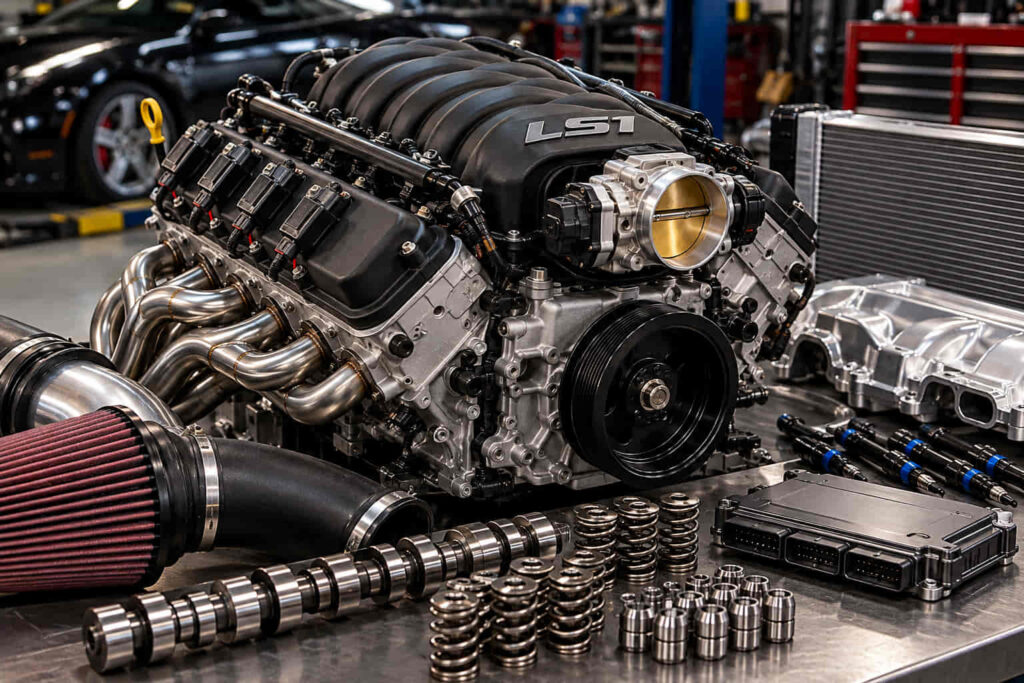
LS1 performance upgrades can significantly improve horsepower, torque, throttle response, and overall engine performance when the right modifications are combined. The most effective upgrades include a performance camshaft, long-tube headers, a cold air intake, improved cylinder heads, an upgraded intake manifold, and professional ECU tuning. For higher horsepower goals, turbochargers and superchargers offer additional potential but require substantial supporting modifications.
The General Motors LS1 is a naturally aspirated 5.7-liter V8 engine known for its lightweight aluminum construction, strong aftermarket support, and ability to respond well to performance modifications. Depending on the model and production year, factory LS1 engines were rated at approximately 305 to 350 horsepower, leaving room for improvement through optimized airflow, combustion, and engine calibration.
However, not every upgrade produces the same results. A cold air intake may provide a relatively small improvement on an otherwise stock engine, while a properly matched camshaft, cylinder head, and exhaust combination can deliver much greater gains. Understanding how each modification affects the LS1’s operating characteristics is essential for building a powerful, reliable engine without spending money on unnecessary components.
What Are the Best LS1 Performance Upgrades?
The best LS1 performance upgrades are a performance camshaft, long-tube exhaust headers, improved cylinder heads, an efficient intake system, and custom ECU tuning. These modifications target the primary factors that determine engine power: airflow, volumetric efficiency, combustion efficiency, and engine operating speed.
A naturally aspirated engine generates power by drawing air into its cylinders, mixing it with fuel, and converting combustion pressure into mechanical energy. Increasing the amount of air the engine can process efficiently allows it to burn more fuel and potentially generate additional torque and horsepower.
The LS1’s factory cylinder heads, intake manifold, and valvetrain provide a strong foundation, but each component has limitations that become more noticeable as engine speed and airflow demand increase.
A performance camshaft changes the timing, duration, and lift of the intake and exhaust valves. This allows the engine to manage cylinder filling more effectively within the intended RPM range. Cylinder head improvements can complement the camshaft by reducing airflow restrictions around the intake and exhaust ports.
Long-tube headers improve the flow of exhaust gases away from the cylinders. When correctly designed for the application, they can also take advantage of exhaust pressure waves to improve scavenging.
An upgraded intake system reduces restrictions before air reaches the intake valves, while ECU tuning adjusts fuel delivery, ignition timing, idle control, and other operating parameters to match the modified engine.
For relatively mild street builds, these upgrades offer a practical balance between increased performance and everyday usability.
More aggressive applications may benefit from forced induction, upgraded fuel delivery, forged internal components, and additional cooling capacity.
The ideal combination depends on whether the LS1 powers a daily-driven Chevrolet Camaro, a C5 Corvette, a Pontiac Firebird, a GTO, or a custom engine-swap project.
How Much Horsepower Does a Stock LS1 Engine Produce?
A factory LS1 engine generally produces between 305 and 350 horsepower, depending on the vehicle, model year, and manufacturer calibration. This variation is important when estimating the potential gains from aftermarket upgrades.
General Motors introduced the LS1 in the 1997 Chevrolet Corvette as part of its third-generation small-block V8 engine family.
The engine displaces 5.7 liters, or approximately 346 cubic inches, with a bore of about 3.90 inches and a stroke of 3.62 inches.
Its aluminum engine block and cylinder heads help reduce weight compared with traditional cast-iron V8 designs.
The original 1997 Corvette LS1 was rated at 345 horsepower and 350 lb-ft of torque. Later Corvette applications received improvements that increased the factory rating to 350 horsepower and 365 lb-ft of torque.
LS1 engines installed in the Chevrolet Camaro and Pontiac Firebird typically carried lower advertised horsepower ratings, ranging from approximately 305 to 325 horsepower depending on the specific model and year.
Although these engines share the same fundamental architecture, factory intake components, exhaust systems, calibration strategies, and other application-specific differences influence their rated output.
The LS1 also uses cathedral-port aluminum cylinder heads, hydraulic roller lifters, sequential fuel injection, and an electronically controlled engine management system.
These characteristics make it relatively adaptable to aftermarket performance modifications.
When evaluating horsepower gains, it is important to distinguish crankshaft horsepower from rear-wheel horsepower.
Factory engine ratings generally describe power measured at the crankshaft under standardized conditions. Chassis dynamometers measure power delivered to the driven wheels after losses through the transmission, differential, and other drivetrain components.
Consequently, a stock LS1 rated at 350 horsepower will normally produce a lower number when measured at the rear wheels.
Performance claims should always be compared using the same measurement method. A modification advertised as producing 30 additional crankshaft horsepower cannot be directly compared with a 30-rear-wheel-horsepower result.
Can a Cold Air Intake Increase LS1 Horsepower?
A cold air intake can improve LS1 performance by reducing intake restrictions and helping the engine draw air from a cooler location, although horsepower gains on a stock engine are usually modest.
The LS1 depends on atmospheric pressure and piston movement to draw air through its intake system.
Before entering the cylinders, incoming air passes through the air filter, intake ducting, throttle body, intake manifold, and cylinder head ports.
Every restriction along this path can create a pressure loss that reduces the amount of air available for combustion.
A performance cold air intake is designed to minimize unnecessary restrictions while supplying filtered air to the engine.
Many aftermarket systems use larger intake tubing, improved transitions, and high-flow air filters. Some also position the filter away from major underhood heat sources.
Cooler intake air is denser than warmer air at the same pressure, allowing more oxygen to enter the cylinders for a given volume.
However, the actual temperature benefit depends on the intake design, vehicle speed, ambient conditions, and engine compartment layout.
An open-element air filter positioned near hot exhaust components may draw warmer air than a well-designed factory airbox, reducing the potential benefit.
A cold air intake may also improve throttle response and change the engine’s induction sound.
The horsepower improvement depends on whether the original intake system significantly restricted airflow.
For an otherwise stock LS1, the gains are often relatively small compared with a camshaft or cylinder head upgrade. The benefit may become more noticeable when the engine has additional modifications that increase airflow demand.
Airflow measurement must also remain accurate. Intake systems that alter the airflow pattern around the mass airflow sensor can affect fuel calculations and may require recalibration.
A properly designed intake should maintain suitable filtration, protect against water ingestion, and comply with applicable emissions requirements.
For a mild LS1 street build, a cold air intake can be a sensible supporting modification, but it should not be expected to produce the same results as major internal engine upgrades.
Are Long-Tube Headers Worth It for an LS1 Engine?
Long-tube headers are among the most effective exhaust upgrades for an LS1 because they can improve exhaust scavenging and reduce restrictions compared with the factory exhaust manifolds.
During the exhaust stroke, the piston pushes combustion gases out of the cylinder through the exhaust valve.
The efficiency of this process affects how much residual exhaust gas remains in the cylinder before the next intake event.
Excessive exhaust restriction can increase pumping losses and interfere with efficient cylinder filling.
Long-tube headers use individual primary tubes that connect the exhaust ports to a collector farther downstream.
Their tube lengths and diameters influence exhaust gas velocity and pressure-wave behavior.
When properly designed, these pressure waves can help remove residual gases from the cylinder during the valve overlap period, improving volumetric efficiency.
This effect can be particularly valuable when the engine is equipped with a performance camshaft that increases valve overlap and airflow demand.
Header primary diameter is an important design consideration.
A relatively small primary tube can maintain higher exhaust gas velocity at lower engine speeds, while a larger tube may support greater exhaust flow at higher power levels.
However, larger headers are not automatically better. Excessively large primary tubes may compromise performance in the RPM range most frequently used during street driving.
The optimal header dimensions depend on displacement, camshaft specifications, cylinder head flow, exhaust configuration, and intended operating speed.
Long-tube headers are often combined with a properly sized exhaust system and catalytic converters designed for the application.
Installation can be more involved than replacing an intake component. Steering clearance, oxygen sensor locations, ground clearance, exhaust connections, and heat management must be considered.
Street-driven vehicles must also retain compliant emissions controls. Depending on local regulations, certain header configurations may not be legal for road use.
For an LS1 equipped with a suitable camshaft and professional tuning, a well-matched header system can contribute meaningfully to the engine’s overall horsepower improvement.
Does Upgrading the LS1 Intake Manifold Improve Performance?
An upgraded intake manifold can increase LS1 horsepower by improving airflow distribution and reducing restrictions, especially when the engine has a performance camshaft or upgraded cylinder heads.
The intake manifold distributes incoming air from the throttle body to the engine’s eight cylinders.
Its runner length, runner cross-sectional area, plenum volume, and internal geometry influence the engine’s torque curve.
Longer intake runners generally help support cylinder filling at lower and intermediate engine speeds, while shorter runners often favor higher-RPM operation.
This relationship helps explain why the best intake manifold for a daily-driven LS1 may differ from the ideal manifold for a racing engine.
One of the most common factory-style upgrades for early LS1 engines is the LS6 intake manifold.
The LS6 manifold was developed for improved airflow and became a popular replacement for the earlier LS1 design.
It can provide improved breathing without fundamentally changing the engine’s operating characteristics.
However, many LS1 engines produced from the 2001 model year onward already use the improved LS6-style intake manifold. Owners should verify the installed component before purchasing a replacement.
Installing another similar manifold on an engine that already has the upgraded design may provide little or no benefit.
For engines requiring greater airflow, aftermarket options include performance polymer manifolds, larger-plenum designs, and specialized high-RPM intake systems.
Manufacturers such as FAST, MSD, and Holley offer intake components for LS applications with different performance requirements.
A high-RPM racing intake may support greater peak horsepower but reduce torque at lower engine speeds.
This tradeoff can make the vehicle less responsive during ordinary driving if the intake is poorly matched to the camshaft, gearing, and operating range.
Compatibility must also be confirmed.
The LS1 uses cathedral-port cylinder heads, so intake manifolds designed for rectangle-port LS3-style heads are not direct replacements without additional engineering and compatible components.
Throttle body mounting patterns, fuel rail clearance, hood clearance, sensor provisions, and electronic throttle compatibility can also differ.
A performance intake manifold is most useful when it removes an existing airflow limitation rather than simply increasing the size of the intake opening.
Is a Bigger Throttle Body Necessary for LS1 Performance Upgrades?
A larger throttle body can improve airflow through a modified LS1 engine, but it does not automatically increase horsepower when the factory throttle body is not the limiting restriction.
The throttle body regulates the amount of air entering the intake manifold.
A larger throttle opening has the potential to support increased airflow, especially at high engine speeds when the engine requires substantial air volume.
Factory LS1 and LS6 applications commonly used a throttle body with a nominal diameter of approximately 78 mm.
Aftermarket intake manifolds may support larger throttle bodies, including designs around 90 mm, 92 mm, or 102 mm.
However, the effectiveness of a larger throttle body depends on the airflow demand of the entire engine.
A stock LS1 may not require the additional flow capacity of a significantly larger throttle body.
If the cylinder heads, camshaft, and intake manifold cannot make use of the additional airflow, replacing the throttle body may produce little measurable improvement in peak horsepower.
The difference becomes more relevant when a high-flow intake manifold, aggressive camshaft, or forced induction system increases the engine’s air requirements.
Throttle response should also be distinguished from maximum engine power.
Changes in throttle body size or electronic throttle calibration may make the engine feel more responsive without substantially increasing its maximum output.
Another important consideration is throttle control compatibility.
LS1-powered F-body vehicles and the 2004 Pontiac GTO commonly use cable-operated throttle systems, while C5 Corvettes use electronic throttle control.
These systems are not automatically interchangeable.
The throttle body, intake manifold, throttle actuator, sensors, and ECU calibration must work together correctly.
A larger throttle body is therefore best treated as a supporting upgrade when the existing component has become an airflow restriction.
Why Is a Camshaft Upgrade One of the Best LS1 Mods?
A performance camshaft is one of the most effective naturally aspirated LS1 upgrades because it changes valve timing, lift, and duration to improve cylinder filling and horsepower production.
The camshaft controls when the intake and exhaust valves open, how far they open, and how long they remain open.
These events directly affect the amount of air entering the combustion chamber and the efficiency of exhaust gas removal.
The factory LS1 camshaft is designed to provide a balance of low-speed torque, idle quality, fuel economy, emissions performance, and durability.
A performance camshaft changes this balance by optimizing valve events for a different operating range.
Increasing valve lift can allow the intake and exhaust valves to open farther, potentially improving airflow when the cylinder head ports can support the additional demand.
Increasing valve duration keeps the valves open for a longer portion of the engine cycle.
This can improve cylinder filling at higher RPM, but it may also reduce effective cylinder pressure and low-speed torque if the camshaft becomes too aggressive for the application.
Lobe separation angle and valve overlap also influence idle characteristics, exhaust behavior, and the shape of the torque curve.
A mild street camshaft is generally designed to improve performance while preserving relatively stable idle quality and usable low-speed torque.
A more aggressive camshaft may produce greater peak horsepower, but it can also create rough idling, reduced low-RPM response, increased fuel consumption, and more demanding tuning requirements.
For automatic-transmission vehicles, camshaft selection must also account for the torque converter’s stall characteristics.
A camshaft that produces its strongest torque at higher RPM may perform poorly with a converter designed for the original engine’s operating range.
Rear axle gearing, vehicle weight, transmission ratios, and intended driving conditions also affect the result.
Camshaft replacement normally requires compatible valve springs and careful verification of valvetrain geometry.
Piston-to-valve clearance, pushrod length, valve spring installed height, coil-bind clearance, and retainer-to-seal clearance should be checked.
The LS1’s factory pistons and combustion chamber geometry can limit the safe use of certain high-lift camshaft profiles.
Professional ECU tuning is also important because a new camshaft changes airflow characteristics, idle requirements, and fuel delivery behavior.
A carefully matched camshaft can deliver substantial horsepower gains, especially when combined with headers and improved cylinder head airflow.
However, the best LS1 camshaft is not necessarily the one with the highest lift or longest duration. It is the one that produces the strongest usable power within the vehicle’s intended RPM range.
Read more: White Smoke From Exhaust Diesel
Do LS1 Cylinder Head Upgrades Increase Horsepower?
Upgrading LS1 cylinder heads can significantly improve horsepower by increasing airflow through the intake and exhaust ports, particularly when combined with an appropriate camshaft and intake manifold.
Cylinder heads influence how efficiently air enters the combustion chamber and how effectively exhaust gases leave.
The factory LS1 uses aluminum cathedral-port cylinder heads that provide strong performance for their original application.
However, port shape, valve size, combustion chamber design, and available flow capacity can limit output when the engine is modified for higher horsepower.
Cylinder head upgrades generally involve improving the existing heads through porting or replacing them with aftermarket performance castings.
Porting modifies the internal surfaces and geometry of the intake and exhaust passages to improve airflow.
When performed correctly, it can reduce restrictions and improve cylinder filling across the intended operating range.
However, removing material indiscriminately can damage airflow characteristics. A larger port does not necessarily deliver better performance if air velocity and port efficiency are compromised.
Professional cylinder head development considers airflow at different valve lifts, port velocity, combustion chamber characteristics, and the intended engine combination.
The LS6 cylinder heads are another familiar option within the Gen III LS engine family.
They feature improvements over earlier LS1 designs and can be incorporated into suitable performance builds.
Aftermarket cylinder heads offer additional options, including optimized port shapes, larger valves, improved combustion chambers, and higher-flowing configurations.
Compression ratio is another important factor.
Smaller combustion chamber volumes or changes to piston design can increase compression, potentially improving thermal efficiency and naturally aspirated power.
However, increasing compression also changes the engine’s octane requirements and sensitivity to detonation.
The final compression ratio depends on piston crown volume, cylinder head chamber volume, head gasket thickness, and engine displacement.
Cylinder heads must also be matched to the intake manifold and camshaft.
A high-flow cylinder head may provide limited benefit if the intake manifold or exhaust system restricts airflow before the engine can use its increased capacity.
For a serious naturally aspirated LS1 build, cylinder heads and camshaft selection should be treated as a coordinated engineering decision.
How Important Is ECU Tuning for an Upgraded LS1?
Professional ECU tuning is essential for maximizing the performance of a modified LS1 because changes to airflow and engine hardware can alter the fuel, ignition, and idle requirements.
The LS1 uses an electronic engine control system to manage fuel injection, ignition timing, and several other operating functions.
The factory calibration is developed around the original engine configuration.
When intake components, cylinder heads, exhaust systems, or camshafts are modified, the engine may move a different amount of air than the factory calibration anticipates.
A properly developed tune adjusts the relevant control parameters to support the new configuration.
Fuel calibration is particularly important.
The engine must receive an appropriate quantity of fuel for the amount of air entering the cylinders. Excessively lean operation under high load can increase combustion temperatures and potentially contribute to engine damage.
Ignition timing also influences torque production, efficiency, and knock resistance.
An optimized calibration aims to produce strong performance while maintaining a suitable safety margin against detonation.
The correct ignition advance depends on fuel octane, compression ratio, combustion chamber design, intake temperature, and engine load.
Camshaft upgrades may require additional idle calibration because the new valve timing changes engine airflow and manifold pressure at low RPM.
For electronically controlled throttle systems, throttle mapping and idle airflow settings may also require attention.
Fuel injector changes must be reflected in the ECU calibration through accurate injector characterization and related fuel system settings.
A chassis dynamometer allows a tuner to observe horsepower and torque under controlled conditions.
However, a complete tuning process also includes data logging and validation during normal driving.
Cold starts, transient throttle response, part-throttle operation, and sustained high-load conditions are important considerations.
Tuning should not involve disabling emissions monitoring or removing required pollution-control functions on street-driven vehicles.
A professional tune cannot compensate for mechanical failures, insufficient fuel pressure, or incorrectly installed components.
Nevertheless, tuning is one of the most important steps in obtaining reliable performance from a modified LS1.
When Should You Upgrade the LS1 Fuel Injectors and Fuel Pump?
LS1 fuel injectors and fuel pumps should be upgraded when the existing fuel system can no longer provide the required fuel flow at the necessary pressure under maximum engine load.
Increasing horsepower generally increases the amount of fuel required for combustion.
As airflow rises through camshaft upgrades, improved cylinder heads, or forced induction, the fuel system must supply additional fuel without losing pressure or control accuracy.
The factory LS1 fuel injectors are sized for the original engine’s output and operating requirements.
Although some factory injectors provide limited additional capacity, they may become insufficient for aggressive naturally aspirated or boosted applications.
Injector flow rate is commonly described in pounds per hour or cubic centimeters per minute.
However, injector capacity cannot be evaluated from flow rating alone.
Fuel pressure differential, injector duty cycle, brake-specific fuel consumption, fuel type, and the target horsepower all affect the required injector size.
A fuel injector operating too close to its maximum duty cycle may provide inadequate reserve capacity when engine demand increases.
Upgrading injectors without accurate calibration can also cause drivability and fueling problems.
The ECU must be programmed with suitable injector data so it can calculate the correct pulse width across different operating conditions.
The fuel pump must also provide sufficient flow while maintaining the required pressure.
A pump that appears adequate at idle may struggle to supply fuel during full-throttle operation, particularly when fuel pressure and engine demand increase.
Fuel filters, regulators, lines, electrical supply, and tank pickup arrangements can further influence system performance.
Forced induction applications require additional consideration because fuel requirements rise as boost pressure increases.
Some high-output engines also use alternative fuels such as E85, which generally require greater fuel volume than gasoline for the same power output.
The most effective approach is to calculate fuel requirements for the intended horsepower goal and verify fuel pressure and injector operation through testing.
Replacing injectors or pumps prematurely may increase costs without improving performance.
Can a Supercharger or Turbocharger Improve LS1 Performance?
A supercharger or turbocharger can produce a much larger horsepower increase than most naturally aspirated LS1 upgrades because forced induction allows additional air to enter the cylinders.
A naturally aspirated LS1 relies primarily on atmospheric pressure to fill its combustion chambers.
Forced induction increases intake manifold pressure, allowing the engine to process more air during each combustion cycle.
When sufficient fuel is supplied and combustion is controlled correctly, the additional air can support greater torque and horsepower.
A supercharger uses mechanical energy from the engine to drive an air compressor.
Depending on the design, it can deliver rapid boost response and substantial low- or mid-range torque.
Positive-displacement superchargers are particularly associated with strong torque delivery, while centrifugal superchargers generally increase boost as compressor speed rises.
A turbocharger uses energy from exhaust gases to drive a turbine connected to an intake compressor.
Turbocharged systems can produce significant peak horsepower, although boost response depends on turbocharger sizing, exhaust configuration, engine displacement, and system design.
Both approaches introduce additional mechanical and thermal demands.
Compressing intake air increases its temperature, so many forced induction systems use an intercooler or charge-air cooling arrangement to reduce intake temperatures.
Higher cylinder pressure also places additional loads on pistons, connecting rods, bearings, head gaskets, and other internal components.
The factory LS1 rotating assembly can support some forced induction applications, but the safe operating limit varies widely with engine condition, boost pressure, fuel quality, calibration, temperature, and driving conditions.
There is no single boost pressure or horsepower number that guarantees reliability for every stock LS1.
The original hypereutectic pistons and piston ring gaps deserve particular attention because excessive combustion temperature and cylinder pressure can increase the risk of ring land damage.
A reliable forced induction build may require upgraded fuel injectors, a higher-capacity fuel pump, appropriate engine management, improved cooling, and stronger internal components.
For more demanding applications, forged pistons and connecting rods can provide additional durability when correctly selected and installed.
Forced induction offers considerable performance potential, but it is also one of the most expensive and technically demanding paths for increasing LS1 horsepower.
Are Nitrous Oxide Systems Good for LS1 Performance?
Nitrous oxide can provide a substantial temporary increase in LS1 horsepower by increasing the amount of oxygen available for combustion, but correct fuel delivery and system control are essential.
Nitrous oxide systems introduce nitrous oxide into the engine’s intake charge, increasing the oxygen available during combustion once the compound decomposes under high-temperature conditions.
This allows the engine to burn additional fuel and produce greater cylinder pressure.
Unlike a naturally aspirated camshaft or intake upgrade, nitrous oxide can produce a significant power increase when activated without requiring the engine to operate with the additional output continuously.
The LS1’s performance-oriented architecture makes it a common platform for properly engineered nitrous applications.
However, the increased combustion pressure can place substantial stress on the engine’s pistons, connecting rods, and cylinder head sealing components.
Fuel delivery must be adequate to prevent a lean condition during nitrous operation.
Ignition timing and spark plug selection must also match the system’s requirements.
Additional safeguards may include fuel pressure monitoring, suitable activation controls, and engine-speed-based protection.
A nitrous system should not be treated as a simple bolt-on solution without considering the condition of the engine and the capacity of its supporting systems.
The installation must also comply with applicable road-use and motorsport regulations.
For a dedicated performance application, nitrous oxide can offer additional horsepower without the continuous packaging requirements of a turbocharger or supercharger.
However, the engine must be evaluated for the increased loads before the system is used.
Do LS1 Exhaust Upgrades Improve Power or Just Sound?
An LS1 exhaust system can improve power when it reduces a meaningful restriction, but the amount of horsepower gained depends on the existing exhaust configuration and other engine modifications.
The exhaust system carries combustion gases away from the engine after they pass through the exhaust manifolds or headers.
Its diameter, pipe routing, catalytic converters, resonators, and mufflers all influence exhaust flow and noise.
A performance cat-back exhaust replaces the exhaust components downstream of the catalytic converters with a system designed to alter flow characteristics, sound, or both.
For an otherwise stock LS1, a cat-back system may produce only modest horsepower gains if the factory system already provides adequate flow.
The improvement can become more significant as engine airflow demand increases through camshaft upgrades, cylinder head improvements, or forced induction.
Pipe diameter must be selected according to the engine’s power level and intended use.
An excessively restrictive exhaust can increase pumping losses, while an oversized or poorly designed system may create packaging difficulties, unwanted noise, or undesirable flow characteristics.
Exhaust sound is another important consideration.
Different muffler designs and resonator configurations can produce distinctive tones, including a deeper V8 rumble or a more aggressive high-RPM exhaust note.
However, a louder exhaust does not necessarily indicate greater horsepower.
Exhaust system selection should consider noise limits, cabin resonance, ground clearance, catalytic converter compatibility, and emissions requirements.
For a street-driven LS1, a properly engineered exhaust system that maintains required emissions equipment provides a more practical solution than removing components solely to reduce restriction.
What LS1 Upgrades Are Needed for 400 or 500 Horsepower?
An LS1 can reach approximately 400 horsepower at the crankshaft with a well-matched naturally aspirated performance combination, while a 500-horsepower goal generally requires more extensive airflow improvements, aggressive engine development, or forced induction.
The exact modifications depend on whether horsepower is measured at the engine or at the driven wheels.
A 400-crank-horsepower target is significantly less demanding than a 400-rear-wheel-horsepower target because the latter requires additional engine output to compensate for drivetrain losses.
For a healthy LS1, an effective combination of improved intake airflow, long-tube headers, a suitable performance camshaft, and professional tuning can provide a path toward approximately 400 crankshaft horsepower.
The actual result depends on the starting engine configuration and the quality of the component combination.
Cylinder head improvements may allow the engine to produce additional power by increasing the airflow available at higher engine speeds.
However, a more aggressive camshaft and high-flow cylinder heads often shift the useful torque range upward.
Achieving 400 horsepower with comfortable street manners may require a different camshaft profile from an engine designed primarily for racing.
A 500-horsepower goal introduces additional considerations.
Naturally aspirated LS1 builds can reach this level at the crankshaft, but doing so generally requires carefully developed cylinder heads, camshaft specifications, intake airflow, compression ratio, and engine operating speed.
The higher-RPM characteristics of such a build may reduce low-speed drivability.
Forced induction can provide an alternative route by increasing the amount of air entering the engine without relying entirely on increased engine speed.
However, additional boost requires suitable fuel delivery, thermal management, engine calibration, and an assessment of internal component strength.
A 500-rear-wheel-horsepower target is more demanding than a 500-crankshaft-horsepower target and should be planned accordingly.
These horsepower figures represent possible build goals rather than guaranteed results from a particular set of parts.
Dyno measurements, vehicle configurations, fuel quality, and mechanical condition all influence the final output.
Which LS1 Internal Components Should Be Upgraded for Reliability?
LS1 internal upgrades become increasingly important when higher engine speed, cylinder pressure, or sustained track operation exceeds the demands anticipated by the factory engine design.
The LS1 uses an aluminum engine block, a production crankshaft, powdered-metal connecting rods, and hypereutectic aluminum pistons.
These components provide a useful balance of durability, weight, and manufacturing cost in the original engine.
However, performance modifications can increase mechanical loads and operating temperatures.
Pistons are a particularly important consideration.
The factory LS1 pistons are not forged performance pistons, and their ring lands can become vulnerable under excessive detonation, heat, or cylinder pressure.
Forged pistons are commonly selected for demanding boosted or high-output applications because they can provide improved strength when correctly engineered.
Piston ring end gap must also be appropriate for the expected operating temperature and load.
Insufficient ring end gap can allow the ring ends to contact each other when the rings expand under heat, potentially damaging the piston.
Connecting rods and rod bolts are another area of consideration.
Earlier LS1 applications have different rod bolt specifications from some later versions, making engine identification important before choosing parts.
For high-RPM or heavily loaded applications, upgraded connecting rods and suitable fasteners may provide additional protection.
The valvetrain also deserves attention.
Increased camshaft lift and engine speed place greater demands on valve springs, pushrods, lifters, rocker arms, and their associated components.
Upgraded valve springs must be matched to the camshaft’s required seat pressure, open pressure, and operating range.
Stronger pushrods and properly engineered rocker arm components may be necessary depending on the build.
Lubrication and cooling should not be overlooked.
Sustained high-speed cornering can affect oil control in a wet-sump engine, while repeated high-load operation increases oil and coolant temperatures.
Track-focused builds may benefit from improved oil control, appropriate sump baffling, additional cooling capacity, or more extensive lubrication system modifications.
Internal upgrades should be selected according to measured loads and intended operation rather than an arbitrary horsepower threshold.
A well-maintained, conservatively tuned LS1 can remain reliable with relatively mild modifications, while a poorly calibrated engine may fail at a much lower power level.
What Is the Best Order for LS1 Performance Upgrades?
The most practical LS1 upgrade path starts with engine health and supporting maintenance, progresses to intake and exhaust improvements, and then adds a camshaft, cylinder heads, and professional tuning as the horsepower target increases.
The first consideration is the mechanical condition of the engine.
Before adding performance components, the LS1 should have normal oil pressure, suitable compression, a functioning cooling system, and no unresolved ignition or fuel delivery problems.
Worn ignition components, vacuum leaks, faulty sensors, or fuel pressure issues can compromise the results of an otherwise well-designed performance build.
A baseline chassis dynamometer measurement can help establish the engine’s existing horsepower and torque.
For a relatively stock street engine, intake and exhaust improvements can provide a straightforward starting point.
A properly designed cold air intake and compliant performance exhaust system may reduce restrictions without requiring major engine disassembly.
Long-tube headers can offer further improvement where permitted and appropriately matched to the vehicle.
Once the basic airflow system is established, a performance camshaft becomes a major consideration.
The camshaft should be selected alongside compatible valve springs and the intended engine operating range.
At this stage, custom tuning becomes particularly important.
If the desired horsepower exceeds what the factory cylinder heads and intake manifold can efficiently support, additional airflow improvements may be worthwhile.
A cylinder head and intake manifold combination should be selected to complement the camshaft rather than simply maximize component size.
Fuel system modifications become necessary when the engine’s required fuel flow approaches or exceeds the capacity of the original injectors or pump.
For more substantial horsepower goals, forced induction or internal engine modifications may be appropriate.
The transmission, clutch, torque converter, differential, tires, and brakes should also be evaluated as engine output increases.
A powerful engine does not automatically produce a faster or better-performing vehicle if the drivetrain cannot deliver its output effectively.
The best upgrade order therefore follows the requirements of the complete vehicle rather than treating every engine modification as an independent improvement.
How Much Do LS1 Performance Upgrades Cost?
The cost of LS1 performance upgrades varies significantly depending on the type of modification, component quality, installation labor, and supporting equipment required.
Basic modifications such as an intake system or cat-back exhaust generally involve less engine disassembly than a camshaft or cylinder head upgrade.
However, total installed cost can rise when additional components, calibration work, or exhaust fabrication are necessary.
Long-tube headers may require specialized installation work because of limited engine bay clearance and the need to integrate the new exhaust components.
A camshaft upgrade includes more than the camshaft itself.
Compatible valve springs, pushrods where required, gaskets, seals, hardware, fluids, and professional tuning can all contribute to the final expense.
Cylinder head upgrades can involve additional costs for machining, valves, springs, installation hardware, and related valvetrain work.
The engine may also require inspection and measurement of piston-to-valve clearance and other mechanical specifications.
Forced induction installations generally involve a much larger financial commitment.
The compressor system is only one part of the project. Fuel delivery, intercooling, exhaust routing, calibration, engine internals, and drivetrain capacity may all require additional investment.
Labor charges also vary by vehicle and workshop.
For example, component access and installation requirements can differ between a C5 Corvette, fourth-generation Camaro, and a custom LS1-swapped vehicle.
Rather than estimating cost from the advertised price of a single part, the complete build should be evaluated as an integrated system.
This helps prevent unexpected expenses and reduces the risk of purchasing components that must later be replaced because they do not support the final horsepower goal.
Are LS1 Performance Upgrades Worth It for Daily Driving?
LS1 performance upgrades are worthwhile for daily driving when they improve usable torque, throttle response, and acceleration without substantially compromising reliability, idle quality, fuel economy, or emissions compliance.
A daily-driven engine operates across a wide range of conditions.
It must start reliably when cold, idle smoothly in traffic, maintain appropriate operating temperatures, and provide predictable power at relatively low engine speeds.
These requirements differ from those of a dedicated drag racing engine, where maximum horsepower within a narrow RPM range may take priority.
A moderate camshaft combined with suitable headers and professional tuning can improve LS1 performance while retaining practical street manners.
However, an excessively aggressive camshaft may reduce low-speed torque, create unstable idle characteristics, and require a higher-stall torque converter.
These changes can make the vehicle less convenient in stop-and-go traffic.
Intake manifold design also influences daily drivability.
A manifold optimized for very high engine speeds may produce less torque at the engine speeds most frequently used during normal driving.
Fuel consumption may increase if modifications encourage higher engine speed, require richer operating conditions under load, or reduce combustion efficiency.
Noise is another consideration.
A very aggressive exhaust system may be enjoyable during acceleration but produce unwanted cabin resonance during highway cruising.
Reliability depends on the quality of the entire combination.
Correct fuel delivery, suitable ignition timing, adequate cooling, and appropriate lubrication matter more than simply installing expensive components.
For daily driving, a balanced naturally aspirated build can provide a satisfying improvement without the additional complexity of high-boost forced induction.
The most effective street upgrades are those that improve performance within the operating range the driver actually uses.
What Are the Most Common Mistakes When Upgrading an LS1?
The most common LS1 upgrade mistakes involve choosing mismatched components, overlooking engine condition, underestimating fuel requirements, and failing to complete proper calibration.
A common misunderstanding is that installing the largest available components will automatically produce the highest performance.
In reality, intake runner dimensions, camshaft timing, cylinder head flow, and exhaust characteristics must work together.
A large intake manifold may support high-RPM airflow but reduce useful torque if installed on an engine with a relatively mild camshaft.
Likewise, a high-duration camshaft may not deliver its expected performance if the factory cylinder heads and exhaust system cannot support the required airflow.
Another mistake is ignoring valvetrain compatibility.
A high-lift camshaft requires suitable valve springs and careful mechanical verification.
Insufficient piston-to-valve clearance, excessive spring compression, or incorrect pushrod length can cause serious engine damage.
Fuel system capacity is another frequently overlooked issue.
A modified engine may appear to operate normally during light driving while experiencing insufficient fuel delivery at high load.
This is particularly dangerous in forced induction applications, where elevated cylinder pressure increases the consequences of poor fuel control.
Incorrect tuning can also compromise performance and durability.
Excessively aggressive ignition timing, inappropriate fuel delivery, or poorly calibrated idle settings may create problems that are incorrectly blamed on the hardware.
Some owners also purchase parts without confirming compatibility with the exact LS1 application.
Throttle body control systems, intake manifold designs, engine sensors, wiring, and available engine bay clearance can vary among vehicles.
Finally, focusing exclusively on engine horsepower can overlook the limits of the transmission, driveline, cooling system, and tires.
A complete performance build must consider how the added power will be delivered and controlled.
Avoiding these mistakes generally produces better results than selecting modifications according to advertised peak horsepower alone.
Final Verdict: What Are the Best LS1 Performance Upgrades for More Horsepower?
The best LS1 performance upgrades for naturally aspirated horsepower are a properly selected performance camshaft, long-tube headers, improved cylinder heads, an efficient intake system, and professional ECU tuning. These modifications work together to improve cylinder filling, exhaust scavenging, and combustion performance.
For a relatively stock engine, cold air intake and exhaust improvements provide an accessible starting point, although their individual horsepower gains are usually modest.
A camshaft upgrade offers greater potential because it directly changes the engine’s valve operation and usable powerband.
Cylinder head and intake manifold improvements become increasingly valuable as airflow requirements rise.
For engines targeting substantially higher horsepower, forced induction can provide additional power beyond what basic naturally aspirated upgrades typically deliver.
However, turbochargers and superchargers require adequate fuel delivery, cooling, calibration, and consideration of engine internal strength.
The LS1’s lightweight construction, proven V8 architecture, and extensive aftermarket support make it a capable foundation for a wide variety of performance applications.
The most effective LS1 build is not the one with the most modifications, but the one in which the camshaft, cylinder heads, intake, exhaust, fuel system, and ECU calibration are matched to a clearly defined horsepower goal.
Choosing compatible components and verifying the results through proper testing provides the best opportunity to increase LS1 horsepower while maintaining dependable engine performance.