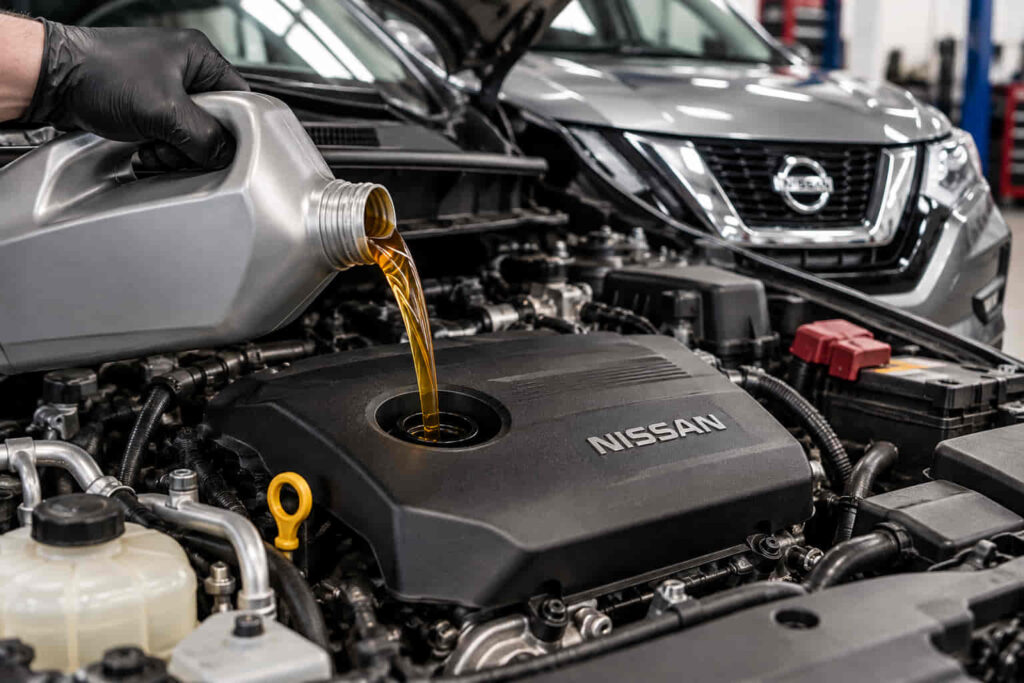
The Nissan Rogue oil capacity depends on the model year, engine type, and whether the oil filter is replaced during service. Most 2022–2026 Nissan Rogue models equipped with the 1.5-liter VC-Turbo engine require 5.0 US quarts (4.7 liters) of engine oil with a filter change. The 2021 Rogue with the 2.5-liter four-cylinder engine requires approximately 5.4 quarts (5.1 liters), while many 2015–2020 Rogue models require about 4.9 quarts (4.6 liters).
Choosing the correct oil quantity is essential for maintaining lubrication, protecting internal engine components, and preventing damage caused by overfilling or insufficient oil. Nissan also specifies different oil viscosities across generations, with many older Rogue models using 5W-30 and newer models primarily requiring 0W-20.
Understanding the oil capacity for each Nissan Rogue model helps ensure accurate oil changes, proper engine performance, and long-term reliability. The most dependable approach is to identify the engine code, consult the corresponding owner’s manual, and verify the final oil level with the dipstick rather than relying exclusively on a published refill quantity.
What Is the Nissan Rogue Oil Capacity?
The Nissan Rogue oil capacity generally ranges from approximately 4.0 to 5.4 US quarts during a standard oil and filter change, depending on the engine and model year. Most newer gasoline-powered models require either 5.0 or 5.4 quarts, while older 2.5-liter engines typically require around 4.9 quarts.
The difference originates from changes in Nissan’s engine design and lubrication system.
Earlier Rogue generations primarily used the QR25DE 2.5-liter naturally aspirated four-cylinder engine. This engine appeared in the first-generation Rogue and continued in the second generation, although the lubrication requirements and recommended engine oil changed over time.
For example, the 2019 Nissan Rogue owner’s manual specifies 4-7/8 US quarts, equivalent to approximately 4.6 liters, when replacing both engine oil and the oil filter.
The redesigned 2021 Nissan Rogue introduced the PR25DD 2.5-liter direct-injection engine, which requires approximately 5-3/8 US quarts, or 5.1 liters, with a filter change.
Most U.S.-market Rogue models from 2022 onward use the smaller KR15DDT 1.5-liter turbocharged three-cylinder engine. Despite its smaller displacement, its lubrication system requires approximately 5.0 US quarts during a normal oil and filter replacement.
These differences demonstrate why engine displacement alone does not determine oil capacity.
Oil pan design, internal lubrication passages, turbocharger requirements, and engine architecture all influence the amount of oil needed.
Nissan’s published quantities are approximate drain-and-refill specifications rather than guaranteed amounts for every individual oil change.
The final oil level should always be established through the manufacturer’s oil-checking procedure.
Nissan Rogue Oil Capacity by Year and Engine
Nissan Rogue oil capacity varies between model years because different generations use different engines and oil pan configurations. For standard U.S.-market gasoline models, the most relevant distinctions are the earlier QR25DE engine, the PR25DD engine introduced with the third generation, and the newer KR15DDT VC-Turbo engine.
The 2008–2013 Nissan Rogue with the 2.5-liter QR25DE engine generally specifies 4-7/8 US quarts, approximately 4.6 liters, with an oil filter replacement. These models commonly recommend SAE 5W-30 engine oil.
For the 2014 Rogue, the owner’s manual contains an unusual discrepancy: its capacity table lists 5-1/8 US quarts but gives 4.6 liters in the metric column. Because those values are not mathematically equivalent, the exact vehicle documentation and dipstick measurement should take precedence over a simplified online capacity chart.
The separate 2014 Rogue Select manual lists 5-1/8 US quarts, approximately 4.8 liters, with an oil filter change and specifies SAE 5W-30.
For the 2015–2020 standard Nissan Rogue equipped with the QR25DE engine, the published refill capacity is generally 4-7/8 US quarts, or 4.6 liters, including the oil filter.
The 2021 Nissan Rogue with the PR25DD 2.5-liter engine requires 5-3/8 US quarts, approximately 5.1 liters, with a filter change.
The 2022 Nissan Rogue owner’s manual provides separate specifications for the PR25DD and KR15DDT engines. The PR25DD requires 5-3/8 quarts, while the KR15DDT requires 5.0 quarts.
For the standard 2023, 2024, 2025, and 2026 Rogue models equipped with the 1.5-liter VC-Turbo engine, the manufacturer specifies 5.0 US quarts, or 4.7 liters, with an oil filter change.
Hybrid models and the separately marketed Rogue Sport have different requirements and should not automatically use the standard Rogue’s oil capacity.
These specifications apply to the indicated U.S.-market engine configurations. Other markets, engine replacements, and special vehicle configurations may require different quantities.
How Much Oil Does a 2008–2013 Nissan Rogue Take?
The 2008–2013 Nissan Rogue with the 2.5-liter QR25DE engine generally requires 4-7/8 US quarts (4.6 liters) of oil with a filter change and approximately 4-1/2 quarts (4.3 liters) without replacing the filter.
These vehicles belong to the first generation of the Nissan Rogue, which used a naturally aspirated 2.5-liter four-cylinder gasoline engine.
The QR25DE engine uses a conventional lubrication system that circulates engine oil through internal passages to protect the crankshaft bearings, piston assemblies, camshafts, timing components, and other moving surfaces.
The oil pump draws lubricant from the oil pan and distributes it through the engine under pressure.
As the oil circulates, it reduces friction, removes heat, and helps carry contaminants toward the oil filter.
The first-generation Rogue generally specifies SAE 5W-30 engine oil rather than the 0W-20 viscosity commonly used in later versions.
This distinction matters because oil viscosity influences engine protection during startup and at normal operating temperature.
The published refill quantity assumes that the used oil has been drained through the normal service procedure. Some residual oil remains in internal passages and other components.
Therefore, a routine oil change requires less oil than filling a completely dry engine following a full rebuild.
Owners of older Rogue models should also consider engine condition when checking the final level.
Higher-mileage engines may experience oil consumption or minor leakage, making regular dipstick inspections particularly important.
Using the correct refill volume and recommended viscosity helps maintain stable oil pressure and appropriate lubrication.
How Much Oil Does a 2014–2020 Nissan Rogue Take?
Most 2015–2020 Nissan Rogue models with the 2.5-liter QR25DE engine require 4-7/8 US quarts (4.6 liters) of engine oil when the oil filter is replaced. Without a filter change, the approximate refill quantity is 4-1/2 quarts (4.3 liters).
These vehicles belong to the second-generation Rogue family and retain a version of Nissan’s QR25DE four-cylinder engine.
Although the basic engine architecture is related to the earlier generation, the recommended engine oil changed.
The 2015–2020 Nissan Rogue generally specifies SAE 0W-20 oil that meets the applicable Nissan and API requirements.
The lower winter viscosity rating provides suitable cold-temperature flow characteristics, while the engine design and lubrication system are calibrated for the specified oil grade.
The 2014 model requires additional attention because the U.S. owner’s manual contains inconsistent metric and US-quart values in its engine oil capacity table.
The table gives 5-1/8 US quarts, but the corresponding metric value is printed as 4.6 liters. Since 5-1/8 US quarts is approximately 4.85 liters, owners should not assume these figures are interchangeable.
The 2014 Rogue Select is also a different configuration from the redesigned 2014 Rogue. Its manual specifies approximately 4.8 liters with the oil filter changed and recommends SAE 5W-30.
For later second-generation models, the specifications are more consistent.
The 2019 and 2020 owner’s manuals both identify 4.6 liters, or 4-7/8 US quarts, as the approximate drain-and-refill quantity with a new filter.
As with any engine, the correct final level depends on how completely the old oil drains and whether the engine is filled and checked according to Nissan’s instructions.
What Is the 2021 Nissan Rogue Oil Capacity?
The 2021 Nissan Rogue equipped with the PR25DD 2.5-liter four-cylinder engine requires 5-3/8 US quarts (5.1 liters) of engine oil with a filter change. If the oil filter is not replaced, the approximate refill capacity is 5-1/8 quarts (4.8 liters).
The 2021 model marked the beginning of the third-generation Rogue in the United States.
Its PR25DD engine differs from the earlier QR25DE engine through its direct fuel injection system and updated internal engineering.
These changes are accompanied by a different engine oil capacity.
Compared with the 2020 Rogue, the 2021 PR25DD requires approximately half a quart more oil during a standard oil and filter service.
This difference is large enough to matter when refilling the engine.
Using the earlier 4.6-liter specification could leave the 2021 engine below its intended oil level.
The 2021 owner’s manual recommends Genuine Nissan Motor Oil 0W-20 SN or an equivalent oil meeting its stated requirements.
Although the published 2021 manual also contains a separate capacity specification for the KR15DDT engine, the PR25DD is the relevant engine for the commonly sold 2021 U.S.-market gasoline Rogue.
The exact engine should be confirmed rather than assuming that every third-generation Rogue uses the same powertrain.
The 2021 Rogue also uses an oil monitoring system that helps determine when maintenance is due.
However, an oil change reminder does not measure the amount of lubricant inside the engine.
The oil level still needs to be checked independently.
For routine maintenance, the 5.1-liter specification provides the approximate starting reference, while the dipstick establishes the proper final fill.
How Much Oil Does a 2022 Nissan Rogue Take?
The 2022 Nissan Rogue generally requires 5.0 US quarts (4.7 liters) with an oil filter change when equipped with the 1.5-liter KR15DDT VC-Turbo engine. The Nissan owner’s manual also lists 5-3/8 quarts (5.1 liters) for the PR25DD 2.5-liter engine configuration.
The introduction of the 1.5-liter VC-Turbo engine represents one of the most important changes affecting modern Rogue oil capacity.
This engine uses a turbocharger and a variable compression ratio mechanism designed to adjust its operating characteristics according to driving conditions.
Although it has fewer cylinders and a smaller displacement than the previous 2.5-liter engine, its lubrication system must still supply oil to numerous moving components.
The turbocharger also depends on a reliable oil supply for bearing lubrication and heat management.
The KR15DDT’s published capacity is 5.0 quarts with the oil filter and 4-7/8 quarts, approximately 4.6 liters, when the existing oil filter is retained.
These quantities are specifically identified in Nissan’s 2022 owner’s manual.
The recommended lubricant is Nissan 0W-20 SP or an equivalent synthetic oil meeting the listed API SP and ILSAC GF-6 requirements.
Correct oil quality is particularly important in a turbocharged engine because the lubricant must maintain appropriate performance under elevated operating temperatures.
An unsuitable oil may compromise lubrication or engine protection.
The smaller refill capacity of the KR15DDT compared with the PR25DD does not indicate that it requires less attention to maintenance.
The two engines have different internal designs, oil circulation requirements, and manufacturer specifications.
Owners should identify the engine installed in their vehicle before selecting the refill amount.
What Is the Nissan Rogue Oil Capacity for 2023–2026 Models?
The standard 2023–2026 Nissan Rogue with the KR15DDT 1.5-liter VC-Turbo three-cylinder engine requires approximately 5.0 US quarts (4.7 liters) of engine oil when the oil filter is replaced.
This specification applies to the regular gasoline-powered Rogue models equipped with the 1.5-liter turbocharged engine.
The 2024, 2025, and 2026 Nissan owner’s manuals consistently identify 5.0 quarts with a filter change and 4-7/8 quarts without a filter replacement.
The recommended engine oil is SAE 0W-20 meeting the applicable Nissan specifications, including API SP and ILSAC GF-6A.
The KR15DDT engine combines a turbocharger, direct fuel injection, and Nissan’s variable compression ratio technology.
Its lubrication system must support conventional engine components as well as the turbocharger and variable-compression mechanism.
Oil quality and oil level are therefore important to reliable operation.
The published 5.0-quart capacity is an approximate service refill quantity.
It is not a requirement to pour exactly five quarts into the engine without checking the result.
Oil retained inside the engine after draining, filter replacement procedures, vehicle position, and oil temperature can influence the actual refill amount.
Nissan instructs owners to use the engine oil dipstick to determine the correct final level.
The separate 2026 Rogue Plug-in Hybrid should not be confused with the standard 1.5-liter VC-Turbo model.
The plug-in hybrid uses a different 2.4-liter gasoline engine within its hybrid powertrain and has its own maintenance documentation.
Its engine oil specifications should be confirmed using the plug-in hybrid manual rather than the standard Rogue’s KR15DDT specifications.
Does the Nissan Rogue Hybrid Have a Different Oil Capacity?
The 2017 Nissan Rogue Hybrid requires approximately 4.0 US quarts (3.8 liters) of engine oil with a filter change, which is less than the capacity of the conventional 2.5-liter gasoline Rogue.
The earlier Rogue Hybrid uses a 2.0-liter gasoline engine combined with an electric motor.
Because the hybrid powertrain uses a different internal combustion engine, its oil capacity cannot be determined from the specifications of the standard 2.5-liter Rogue.
The 2017 Rogue Hybrid owner’s manual specifies 3.8 liters with an oil filter replacement and approximately 3.6 liters without changing the filter.
It recommends Nissan 0W-20 SN or an equivalent lubricant meeting the stated specifications.
The hybrid engine’s lubrication requirements are influenced by its operating characteristics.
Unlike a conventional gasoline engine that typically runs continuously while driving, a hybrid engine may stop and restart according to vehicle speed, battery charge, power demand, and system control.
The engine oil must provide protection during these operating transitions.
However, the presence of an electric motor does not eliminate the need for regular engine oil changes.
The combustion engine still generates heat and requires lubrication whenever it operates.
Owners should also distinguish the earlier Rogue Hybrid from the separate 2026 Rogue Plug-in Hybrid, which uses a different powertrain.
Although both vehicles combine gasoline and electric propulsion, they do not necessarily share engine components, maintenance intervals, or lubricant requirements.
The correct oil capacity must always correspond to the specific hybrid model and engine.
Is Nissan Rogue Sport Oil Capacity the Same as the Regular Rogue?
The Nissan Rogue Sport generally has a lower engine oil capacity than the standard Rogue because it uses a different engine. For example, the 2020 Rogue Sport with the 2.0-liter engine requires approximately 4.0 US quarts (3.8 liters) with an oil filter change.
The Rogue Sport is a separate compact crossover model rather than simply a trim package of the standard Nissan Rogue.
Although the two vehicles share similar names and some design characteristics, their engine specifications differ.
The regular 2020 Rogue uses the 2.5-liter QR25DE engine and requires approximately 4.9 quarts with a filter change.
The 2020 Rogue Sport uses a smaller 2.0-liter engine and requires approximately 4.0 quarts.
Using the regular Rogue’s refill capacity in a Rogue Sport could result in substantial overfilling.
An excessive oil level may cause aeration, increased internal resistance, and problems with crankcase ventilation.
Consequently, owners should confirm whether the vehicle is a Rogue or Rogue Sport before purchasing oil or following an online maintenance guide.
The vehicle identification number, original owner’s manual, and engine identification information can help establish the correct configuration.
This distinction is particularly important when searching online because general results for Nissan Rogue oil capacity may combine information from both models.
Read more: Chevy V8 Firing Order
How Much Oil Does a Nissan Rogue Need With and Without an Oil Filter Change?
A Nissan Rogue requires slightly more engine oil when the oil filter is replaced because the new filter must be filled as oil circulates through the lubrication system.
The exact difference depends on the engine and the filter design.
For the 2025 Nissan Rogue 1.5-liter VC-Turbo engine, Nissan specifies 5.0 US quarts, or 4.7 liters, with a filter change.
Without replacing the oil filter, the approximate refill quantity decreases to 4-7/8 US quarts, or 4.6 liters.
The 2021 Rogue with the PR25DD 2.5-liter engine requires 5-3/8 quarts with a filter change and 5-1/8 quarts without one.
Many 2015–2020 Rogue models require 4-7/8 quarts when the filter is replaced and 4-1/2 quarts when it is retained.
The difference occurs because the oil filter holds a portion of the lubricant after the engine has been operating.
When the old filter is removed, that oil leaves the system along with the used filter.
A replacement filter must then receive oil during the refill and startup process.
If the existing filter remains installed, some oil may stay inside it, reducing the amount required to bring the overall system back to the correct level.
However, reusing an old oil filter is generally not the preferred routine maintenance practice.
The filter collects particles and contaminants that circulate through the lubrication system.
Replacing it during an oil change helps ensure the new lubricant passes through a clean filtration element.
Nissan’s specified quantities should be treated as approximate references, and the final level must be verified after oil has circulated through the engine.
What Type of Engine Oil Does a Nissan Rogue Use?
Most Nissan Rogue models from 2014 onward recommend SAE 0W-20 engine oil, while many first-generation models from 2008–2013 specify SAE 5W-30. The exact viscosity and performance standard depend on the engine and model year.
Engine oil viscosity describes the oil’s resistance to flow under defined temperature conditions.
In the SAE 0W-20 designation, the 0W rating describes low-temperature viscosity performance, while the 20 represents the viscosity grade at operating temperature.
SAE 5W-30 oil has different cold-temperature and operating-temperature viscosity requirements.
These grades should not be considered automatically interchangeable.
The engine manufacturer selects an oil viscosity based on bearing clearances, oil pump characteristics, operating temperatures, fuel efficiency requirements, and other engineering considerations.
For many 2008–2013 Nissan Rogue models, SAE 5W-30 is the recommended viscosity.
The redesigned second-generation Rogue generally specifies SAE 0W-20, with certain early manuals identifying a permitted 5W-30 alternative under specified conditions.
For the 2021 Rogue, Nissan recommends 0W-20 oil meeting the applicable API SN requirements.
The 2022 and later KR15DDT engines specify 0W-20 meeting more recent oil performance requirements, including API SP and ILSAC GF-6 or GF-6A, depending on the manual.
API SP oils are developed to satisfy modern gasoline engine performance requirements, including protection relevant to certain turbocharged direct-injection engines.
However, oil selection should not be based solely on using the newest available specification.
The replacement oil must meet the manufacturer’s required viscosity and relevant performance standards.
The owner’s manual remains the primary reference for the exact vehicle.
Does a Nissan Rogue Require Full Synthetic Oil?
Modern Nissan Rogue engines generally require or recommend synthetic 0W-20 oil that meets the manufacturer’s specified performance standards. For the 1.5-liter VC-Turbo engine, Nissan identifies synthetic 0W-20 meeting API SP and ILSAC GF-6 requirements as an acceptable equivalent to the specified Nissan motor oil.
Synthetic engine oils are manufactured and formulated to provide controlled viscosity characteristics and suitable protection under a wide range of operating conditions.
They can offer advantages in oxidation resistance, low-temperature pumpability, and maintaining oil performance during demanding operation.
However, the word synthetic alone does not establish whether an oil is suitable for a particular engine.
A full synthetic oil with an incorrect viscosity or an unsuitable performance specification may be less appropriate than a correctly specified product.
For example, the latest Rogue VC-Turbo engine requires the correct 0W-20 formulation rather than simply any full synthetic engine oil available at an automotive store.
The lubricant must support the engine’s lubrication requirements, including protection of the turbocharger and internal moving components.
Modern oil specifications also address issues such as deposits, wear, fuel economy, and low-speed pre-ignition protection in applicable engine designs.
Older Nissan Rogue models may have different oil requirements.
Some early vehicles specify 5W-30 oil and do not necessarily require the same modern 0W-20 formulation used in current models.
Therefore, whether full synthetic oil is required should be determined from the relevant owner’s manual rather than from the vehicle name alone.
Using a high-quality oil that meets Nissan’s stated requirements is generally more important than selecting a particular brand.
How Do You Check the Engine Oil Level in a Nissan Rogue?
The Nissan Rogue engine oil level should be checked using the dipstick while the vehicle is parked on a level surface and the engine has been allowed to settle according to Nissan’s instructions.
Checking the oil level is particularly important after an oil change because the published capacity is only an approximate refill quantity.
Start by parking the vehicle on level ground and applying the parking brake.
Allow the engine to reach the temperature condition specified by the owner’s manual, then turn it off and wait for the recommended period so that oil can drain back into the oil pan.
Many Nissan Rogue manuals instruct owners to wait more than 10 minutes after shutting down the engine before checking the final level following an oil change.
Remove the engine oil dipstick and wipe it clean with a lint-free cloth.
Reinsert the dipstick fully into its tube, then remove it again to read the oil level.
The oil should appear between the designated lower and upper level marks.
If the level is close to or below the lower mark, additional oil may be necessary.
Add the manufacturer-approved lubricant in small quantities and check again rather than pouring in a large amount immediately.
The goal is to maintain the oil within the acceptable dipstick range without exceeding the upper mark.
Oil color alone is not a reliable indicator of whether the lubricant requires replacement.
Engine oil can darken during normal operation as it carries contaminants and combustion byproducts.
The service interval, engine condition, and oil specifications provide better guidance.
If the oil level repeatedly falls between services, the engine should be checked for possible leakage or oil consumption.
How to Change the Engine Oil in a Nissan Rogue
Changing Nissan Rogue engine oil involves draining the used lubricant, replacing the oil filter, refilling the engine with the specified oil, and verifying the final level. The exact procedure and required tools depend on the model year and engine configuration.
Before beginning, confirm the correct oil capacity, viscosity, oil filter, and drain plug sealing washer for the vehicle.
The engine should be at the temperature recommended for the oil change procedure, and the vehicle must be securely parked on a stable, level surface.
If access beneath the vehicle is required, use the manufacturer’s designated lifting and support points. A vehicle should never be supported solely by a hydraulic jack while someone is working underneath it.
Position a suitable drain pan beneath the oil pan drain plug.
Remove the oil filler cap as directed and carefully loosen the drain plug to allow the used engine oil to drain.
Used oil may be hot enough to cause burns, so suitable gloves and appropriate precautions are necessary.
Once the oil has drained, inspect the drain plug and replace its sealing washer when required.
Remove the existing oil filter using the appropriate tool and ensure its old gasket is not left attached to the engine.
Apply clean engine oil to the new filter gasket where the filter manufacturer’s instructions require it.
Install the new filter and tighten it to the specified requirement without applying excessive force.
Reinstall the drain plug using the appropriate tightening specification for the particular engine.
Refill the engine through the oil filler opening using the recommended oil.
Rather than immediately adding the entire published quantity without measurement, approach the specified capacity carefully and check the dipstick.
Once the oil level is suitable, install the filler cap and start the engine.
Check around the oil filter and drain plug for leakage.
Shut the engine off, allow the oil to settle for the specified period, and recheck the level.
Add oil if necessary, but do not exceed the upper dipstick mark.
Finally, reset the maintenance reminder using the procedure appropriate to the model year and dispose of the used oil and filter through an authorized recycling facility.
How Often Should You Change Oil in a Nissan Rogue?
Nissan Rogue oil change intervals depend on the model year, engine, operating conditions, and maintenance schedule. For the standard 2025 and 2026 Rogue, Nissan’s U.S. maintenance schedule specifies an oil and filter replacement interval of 7,500 miles or 12 months.
Older Nissan Rogue models may require more frequent service.
For example, Nissan’s 2017 Rogue maintenance schedule identifies oil and filter replacement every 5,000 miles or six months.
This difference demonstrates why a universal oil change interval is not appropriate for every Rogue generation.
Modern Rogue models may also use an Oil Control System that calculates service requirements based on operating conditions.
The system considers driving patterns and other factors that influence oil deterioration.
A maintenance message may appear when the calculated service interval is approaching its limit.
However, these reminders do not replace the need to check engine oil levels regularly.
A vehicle can have low oil before its next scheduled change.
Driving conditions also affect the condition of engine oil.
Frequent short trips can prevent the engine from reaching a fully stabilized operating temperature for sufficient time.
Extended idling, stop-and-go traffic, dusty environments, and repeated high-load operation can create additional demands on lubrication.
Owners should follow the severe-service requirements when their driving patterns meet the manufacturer’s definition of severe operation.
The separately marketed 2026 Rogue Plug-in Hybrid has its own schedule, including different normal and severe service intervals, so its maintenance requirements should be checked independently.
For standard gasoline Rogue models, the correct interval is the one specified for the particular model year and engine, not an arbitrary mileage recommendation from a generic oil-change guide.
What Happens If You Put Too Much Oil in a Nissan Rogue?
Overfilling a Nissan Rogue engine can cause oil aeration, abnormal crankcase pressure, increased oil consumption, and potentially serious lubrication problems.
Engine oil is designed to circulate through the lubrication system while maintaining an appropriate level inside the oil pan.
When the oil level rises above the manufacturer’s intended range, rotating components may contact the oil excessively.
This can cause the lubricant to become aerated or foamy under certain operating conditions.
Aerated oil does not behave like a continuous liquid film and can interfere with effective lubrication.
Excessive oil may also increase crankcase ventilation demands and allow oil to enter the intake system.
In some circumstances, oil reaching the combustion chamber can contribute to smoke, deposits, and contamination of exhaust aftertreatment components.
Overfilling can be particularly concerning in turbocharged engines because the lubrication system must support the turbocharger as well as the engine’s main internal components.
However, the consequences depend on how much extra oil has been added.
A dipstick reading slightly above the upper mark does not necessarily mean immediate engine failure, but it should be corrected rather than ignored.
A substantially overfilled crankcase requires appropriate oil removal before normal operation continues.
The safest way to avoid overfilling is to treat Nissan’s stated capacity as a guide and verify the level using the dipstick.
Oil should be added gradually when approaching the specified refill quantity.
What Happens If a Nissan Rogue Has Too Little Oil?
Insufficient engine oil can reduce lubrication, increase friction, cause overheating of internal components, and eventually lead to major engine damage.
The engine’s lubrication system depends on an adequate oil supply within the crankcase.
When the oil level becomes too low, the oil pickup may be exposed under certain driving conditions, potentially interrupting oil delivery.
Reduced lubrication can damage crankshaft bearings, connecting rod bearings, camshaft components, and other moving surfaces.
The problem may become more severe during acceleration, braking, or cornering because engine oil moves within the oil pan.
Turbocharged Rogue engines have additional lubrication requirements associated with the turbocharger.
Inadequate oil supply can accelerate wear in the turbocharger bearing system and create further mechanical problems.
A low oil level may result from leakage, oil consumption, improper servicing, or insufficient oil added during the previous change.
Warning signs can include unusual engine noises, increased oil consumption, visible leaks, or an oil pressure warning.
However, the absence of a dashboard warning does not guarantee that the engine has the correct oil quantity.
An oil pressure warning generally indicates a pressure-related problem rather than simply reporting the amount of oil in the crankcase.
If the oil pressure warning illuminates while driving, the vehicle should be stopped safely and the engine shut down.
Continuing to drive with inadequate oil pressure can cause severe damage within a short period.
Checking the oil level regularly is a simple but important maintenance practice for preventing lubrication-related problems.
Why Is a Nissan Rogue Losing Engine Oil Between Changes?
A Nissan Rogue may lose engine oil between changes because of external leaks, internal oil consumption, crankcase ventilation problems, or mechanical wear.
Some engines consume a small amount of oil during normal operation because a thin oil film remains on the cylinder walls and certain components operate in areas exposed to combustion or intake airflow.
However, excessive or increasing oil consumption requires investigation.
External leaks can develop around oil pan seals, gaskets, the oil filter mounting area, valve covers, or other sealing surfaces.
These leaks may leave visible oil residue on the engine or create spots beneath the parked vehicle.
In some cases, the leak occurs only while the engine is running and oil pressure is present.
Internal oil consumption can occur when engine oil enters the combustion chambers.
Worn piston rings, cylinder wall damage, or issues involving valve stem seals can contribute to this condition.
A malfunctioning positive crankcase ventilation system can also allow abnormal oil movement through the intake system.
Turbocharged engines introduce additional possible oil leakage paths through turbocharger seals and oil supply or return systems.
Excessive oil consumption may be accompanied by blue or blue-gray exhaust smoke, spark plug deposits, or a repeated need to add lubricant.
Nevertheless, visible smoke is not always present.
The correct diagnostic approach is to check for external leaks, establish the actual oil consumption rate, and inspect the relevant systems.
An owner should not assume that increasing the oil viscosity or adding aftermarket treatments will resolve a mechanical oil consumption problem.
If the engine consistently requires oil between changes, the manufacturer-recommended oil should be used while the underlying cause is investigated.
Can You Use 5W-30 Instead of 0W-20 in a Nissan Rogue?
SAE 5W-30 should not automatically replace 0W-20 in a Nissan Rogue unless the owner’s manual for that particular engine permits it.
The two viscosity grades have different characteristics at low and high operating temperatures.
SAE 0W-20 is designed to meet a lower winter viscosity classification and a different operating-temperature viscosity range than 5W-30.
The correct oil grade is selected according to the engine’s design requirements.
Many 2008–2013 Rogue models specify 5W-30 as their primary engine oil viscosity.
Later Rogue generations primarily use 0W-20.
Some early second-generation owner’s manuals identify 5W-30 as an allowable alternative under particular conditions.
However, this should not be interpreted as general approval to use 5W-30 in every newer Rogue engine.
The KR15DDT VC-Turbo engine has specific lubrication requirements related to its turbocharger and variable-compression mechanism.
Using an oil outside the manufacturer’s specifications may affect engine performance, lubrication behavior, and component durability.
A thicker oil is not necessarily better for a high-mileage engine.
Likewise, switching to a lower viscosity solely to improve fuel economy may be inappropriate for an engine designed around a different grade.
Oil selection should consider the full manufacturer specification, including viscosity and performance classification.
If the correct oil is unavailable, the owner’s manual should be consulted for approved alternatives rather than relying on general advice.
Does Engine Oil Capacity Affect Nissan Rogue Performance and Reliability?
Correct engine oil capacity supports Nissan Rogue performance and reliability by maintaining suitable lubrication, oil pressure, heat control, and protection against internal wear.
Engine oil performs several functions simultaneously.
It reduces friction between moving surfaces, helps remove heat from loaded components, carries contaminants toward the oil filter, and supports the operation of hydraulic or oil-pressure-controlled mechanisms.
An engine designed for a particular oil quantity must maintain a suitable reservoir of lubricant under normal driving conditions.
If the level becomes too low, the lubrication system may struggle to maintain reliable oil delivery.
If the level is excessive, aeration and crankcase ventilation problems may occur.
The correct oil quantity is therefore part of the engine’s overall lubrication design rather than simply a maintenance convenience.
Oil quality is equally important.
A properly filled engine can still experience lubrication problems if the oil has degraded excessively or does not meet the required specification.
The filter also influences oil cleanliness by removing suspended particles as the lubricant circulates.
Regular oil changes help maintain appropriate lubrication characteristics and remove contaminants accumulated during operation.
Modern Rogue engines make this especially relevant because they may incorporate direct injection, turbocharging, and advanced mechanical systems that depend on reliable oil performance.
However, adding more oil than specified does not increase engine protection.
The optimal quantity is the amount that maintains the oil level within the manufacturer’s approved range.
Consistent maintenance, correct lubricant selection, and regular level checks provide a more reliable foundation for engine longevity than exceeding the recommended capacity.
How Can You Confirm the Correct Nissan Rogue Oil Capacity?
The most reliable way to confirm Nissan Rogue oil capacity is to identify the exact model year and engine, then check the capacities and recommended fluids section of the corresponding Nissan owner’s manual.
The vehicle’s registration and identification information can help establish its model year.
The engine code provides an additional reference because different engines may appear in closely related model years.
For example, the QR25DE identifies the earlier 2.5-liter engine family, while the PR25DD identifies the updated 2.5-liter direct-injection engine used in the third-generation Rogue.
The KR15DDT identifies the 1.5-liter VC-Turbo engine found in newer gasoline-powered models.
These engine codes are useful when searching service documentation and verifying replacement parts.
Once the engine has been identified, the appropriate manual provides the recommended engine oil type and approximate drain-and-refill capacity.
The capacity must also be matched to whether the oil filter is replaced.
US quarts and Imperial quarts should not be confused.
One US liquid quart is approximately 0.946 liters, while an Imperial quart is approximately 1.137 liters.
As a result, published capacities can appear different depending on which measurement system is used.
For example, 5.0 US quarts is approximately 4.73 liters, which Nissan rounds to 4.7 liters in its specifications.
The manufacturer’s values are approximate and may reflect normal rounding.
For older vehicles, additional caution is appropriate when manual tables contain inconsistent conversions, as seen in the 2014 Rogue documentation.
After the specified oil has been added, checking the final level with the dipstick remains essential.
This final measurement confirms that the actual engine contains an appropriate amount of lubricant.
Final Verdict: How Much Oil Does a Nissan Rogue Take?
The Nissan Rogue oil capacity depends primarily on the model year and engine configuration, with the most common standard gasoline models requiring approximately 4.9, 5.0, or 5.4 US quarts during an oil and filter change.
The 2008–2013 Rogue with the QR25DE 2.5-liter engine generally requires 4-7/8 quarts and commonly uses 5W-30 oil.
Most 2015–2020 Rogue models with the QR25DE require 4-7/8 quarts, approximately 4.6 liters, and specify 0W-20.
The 2021 Rogue equipped with the PR25DD 2.5-liter direct-injection engine requires 5-3/8 quarts, or approximately 5.1 liters.
The standard 2022–2026 Rogue with the KR15DDT 1.5-liter VC-Turbo engine requires 5.0 quarts, approximately 4.7 liters, with an oil filter replacement.
Older Rogue Hybrid models and the Rogue Sport have different capacities, while the separate 2026 Rogue Plug-in Hybrid must be checked against its own engine documentation.
For most 2023–2026 standard gasoline Nissan Rogue models, the correct oil change capacity is 5.0 US quarts (4.7 liters) of SAE 0W-20 engine oil with a new filter.
Regardless of the published capacity, the owner’s manual and dipstick should determine the final refill amount.
Using the correct oil viscosity, replacing the oil filter according to the maintenance schedule, and avoiding both overfilling and low oil levels are essential for maintaining reliable Nissan Rogue engine performance.