Modern Toyota vehicles rely on advanced electronic safety systems to deliver a smooth and secure driving experience. One of the key components behind these systems is the Steering Angle Sensor (SAS), a device that continuously monitors the position and movement of the steering wheel. This information is used by systems such as Anti-lock Braking System (ABS), Vehicle Stability Control (VSC), Traction Control (TRAC), and Electronic Power Steering to maintain vehicle stability and driver control.
However, after procedures such as a wheel alignment, battery replacement, steering rack repair, or suspension work, the steering angle sensor may lose its calibration. When this happens, warning lights may appear on the dashboard, including ABS, VSC, or traction control indicators. In some cases, drivers may notice unusual handling characteristics or reduced effectiveness of stability control systems.
Many Toyota owners assume the sensor itself has failed and immediately consider replacing expensive components. Fortunately, a sensor replacement is often unnecessary. A simple Toyota steering angle sensor reset or calibration procedure can restore proper communication between the steering system and the vehicle’s electronic control modules.
In this comprehensive guide, you will learn what the steering angle sensor does, when a reset is required, how to perform the procedure with and without a scan tool, and how to troubleshoot common issues that may arise after calibration.
What Is a Toyota Steering Angle Sensor?
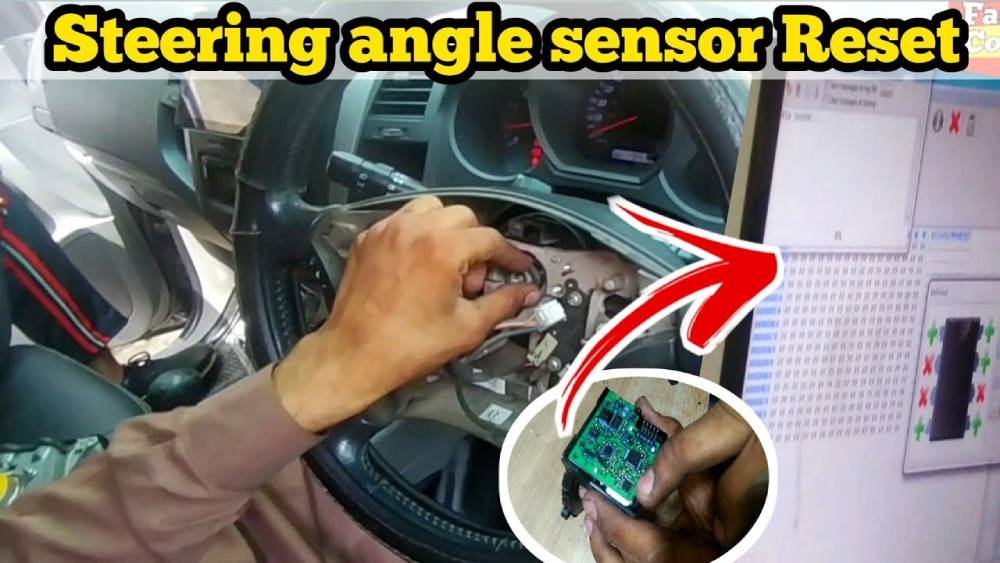
The Steering Angle Sensor, commonly referred to as the SAS, is an essential component of Toyota’s vehicle stability and safety systems. Located within the steering column, the sensor continuously measures the position, angle, and rotational speed of the steering wheel. This information is transmitted to the vehicle’s electronic control units, allowing them to determine the driver’s intended direction of travel.
Modern Toyota vehicles rely heavily on accurate steering angle data. When the driver turns the steering wheel, the sensor instantly communicates the movement to systems such as Vehicle Stability Control, Anti-lock Braking System, Traction Control, and Electronic Power Steering. These systems compare the steering input with the vehicle’s actual movement to determine whether the car is following the intended path.
For example, if a vehicle begins to skid during a sharp turn, the stability control system uses steering angle data along with information from wheel speed and yaw rate sensors to apply corrective braking force to individual wheels. This process helps maintain stability and reduces the risk of losing control.
Because these systems depend on precise steering angle information, even a slight calibration error can trigger warning lights or cause improper operation. This is why resetting and recalibrating the steering angle sensor after certain repairs is often necessary. A properly calibrated sensor ensures that all safety systems function as designed and provides the driver with optimal handling and control.
Signs Your Toyota Steering Angle Sensor Needs Resetting
A steering angle sensor does not always fail mechanically. In many cases, the sensor simply loses its calibration due to maintenance procedures or electrical interruptions. Recognizing the symptoms of an uncalibrated sensor can help prevent unnecessary repairs and save both time and money.
One of the most common signs is the illumination of the Vehicle Stability Control warning light. Drivers may also notice the ABS light or traction control indicator appearing on the dashboard. These warning lights often remain active even after the original repair has been completed successfully.
Another common symptom is an off-center steering wheel. After a wheel alignment, the vehicle may drive straight while the steering wheel appears slightly turned to one side. This mismatch between steering wheel position and wheel direction can confuse the steering angle sensor and trigger fault codes.
Some drivers report reduced effectiveness of traction control or stability control systems. In more advanced Toyota models equipped with driver assistance technologies, lane keeping assistance and adaptive steering features may also display malfunction messages when the steering angle sensor requires recalibration.
Several situations commonly trigger the need for a reset. These include wheel alignments, steering rack replacement, suspension modifications, battery replacement, clock spring replacement, and steering column repairs. Any procedure that changes steering geometry or interrupts electrical power can potentially affect the sensor’s stored reference point.
Ignoring these symptoms may not immediately create a safety hazard, but it can prevent important electronic safety systems from operating correctly. Identifying and correcting the issue early helps ensure the vehicle continues to perform as intended.
Tools You May Need Before Resetting the Sensor
Before beginning a Toyota steering angle sensor reset, it is important to gather the appropriate tools and prepare the vehicle properly. Having the correct equipment not only increases the chances of a successful calibration but also helps avoid unnecessary complications during the procedure.
The most effective tool for performing a steering angle sensor reset is a diagnostic scanner capable of accessing Toyota ABS and stability control modules. Professional technicians often use Toyota Techstream software because it provides direct access to calibration and zero point learning functions. Many advanced aftermarket scan tools also support these procedures.
A fully charged battery is equally important. Low voltage during calibration can cause communication errors and may result in failed sensor initialization. If the battery condition is questionable, connecting a battery maintainer or charger before beginning the procedure is recommended.
The vehicle should be parked on a level surface with the front wheels pointed perfectly straight ahead. This position serves as the reference point for calibration. Any deviation from a straight steering position can lead to inaccurate sensor readings and require the process to be repeated.
Having access to a repair manual or manufacturer-specific service information can also be helpful, especially since procedures vary among Toyota models and production years. While some vehicles allow limited relearning without specialized equipment, others require a scan tool to complete the calibration successfully.
Taking a few minutes to prepare the vehicle and gather the necessary tools can significantly improve the accuracy of the reset process and help restore full functionality to the vehicle’s safety systems.
Toyota Steering Angle Sensor Reset Using a Scan Tool
Using a diagnostic scan tool is the most accurate and reliable method for resetting a Toyota steering angle sensor. Professional technicians typically use Toyota Techstream software, but many high-quality aftermarket diagnostic scanners also support steering angle sensor calibration and zero point reset functions.
Begin by parking the vehicle on a level surface and ensuring that the front wheels are pointing straight ahead. Turn off all unnecessary electrical accessories and verify that the battery is fully charged. Connect the scan tool to the vehicle’s OBD-II diagnostic port, which is usually located beneath the dashboard on the driver’s side.
Turn the ignition to the ON position without starting the engine unless the scan tool instructions specify otherwise. Access the vehicle information through the diagnostic menu and navigate to the ABS, VSC, or chassis control system section. Depending on the scan tool being used, the steering angle sensor calibration option may appear under utility functions, special functions, or calibration procedures.
Select the steering angle sensor reset or calibration function and carefully follow the on-screen instructions. Most systems require the steering wheel to remain perfectly centered throughout the process. The scan tool will instruct the vehicle’s control module to erase the previous reference point and store a new center position.
Once calibration is complete, clear any diagnostic trouble codes that may be stored in the ABS or stability control modules. Turn the ignition off for several seconds and then restart the vehicle. Observe the dashboard to confirm that the ABS, VSC, and traction control warning lights have been extinguished.
A successful reset should restore proper communication between the steering angle sensor and the vehicle’s electronic stability systems. If warning lights remain illuminated, further diagnosis may be necessary to identify additional faults or calibration errors.
Toyota Steering Angle Sensor Reset Without a Scan Tool
Some Toyota models may allow a limited steering angle sensor relearn procedure without the use of a diagnostic scanner. While this method is not universally supported and may not work on every vehicle, it can sometimes help restore basic calibration after minor maintenance procedures such as a battery replacement.
Start by parking the vehicle on a flat and level surface. Ensure that the front wheels are aligned straight ahead and that the steering wheel is centered. Turn the ignition switch to the ON position without starting the engine if applicable to your specific model.
Slowly rotate the steering wheel all the way to the left until it reaches the steering stop. Hold it briefly before turning the wheel completely to the right steering stop. Again, pause for a moment before returning the wheel to the exact center position. This process allows some vehicle control modules to relearn the steering limits and establish a new reference point.
After centering the steering wheel, start the engine and drive the vehicle at a low speed in a straight line for several minutes. During this drive cycle, the control modules may compare steering input with wheel speed and yaw sensor data to determine whether recalibration can be completed automatically.
In certain Toyota models, warning lights may disappear immediately after the relearn process. In others, the vehicle may require multiple drive cycles before the calibration is fully accepted. If dashboard warning lights remain active after several driving sessions, a scan tool calibration will likely be necessary.
Although this method is simple and costs nothing to perform, it should not be considered a substitute for manufacturer-approved calibration procedures when precise sensor initialization is required.
Performing Toyota Zero Point Calibration
Zero Point Calibration is one of the most important procedures associated with a Toyota steering angle sensor reset. While a standard reset updates sensor information, zero point calibration establishes the vehicle’s true straight-ahead position and synchronizes multiple stability control components.
Toyota’s Vehicle Stability Control system relies on information from several sensors working together. In addition to the steering angle sensor, the system also uses data from yaw rate sensors, acceleration sensors, and wheel speed sensors. The zero point calibration process ensures that all of these components share the same reference point when the vehicle is stationary and traveling in a straight line.
This procedure becomes particularly important after steering rack replacement, wheel alignment adjustments, suspension modifications, ABS module replacement, or steering angle sensor replacement. Without proper calibration, the stability control system may misinterpret vehicle movement and activate corrective actions unnecessarily.
During zero point calibration, the vehicle must be positioned on a perfectly level surface with the steering wheel centered and the wheels pointed straight ahead. Depending on the model, calibration may be performed through Toyota Techstream software, a compatible scan tool, or a manufacturer-specific initialization procedure.
Once completed successfully, the control module stores a new baseline reference that allows the vehicle to accurately determine directional movement. This helps improve the effectiveness of traction control, stability control, and electronic steering assistance systems.
Failure to perform zero point calibration when required can result in recurring warning lights, inaccurate stability control interventions, and persistent diagnostic trouble codes. For this reason, many Toyota service procedures specifically require zero point calibration as the final step before returning the vehicle to normal operation.
Common Problems After a Steering Angle Sensor Reset
Although the reset process is often straightforward, some Toyota owners continue to experience issues even after completing the procedure. Understanding the most common post-reset problems can help identify whether the issue is related to calibration, another vehicle system, or a faulty component.
One of the most frequent complaints is that the ABS, VSC, or traction control warning lights remain illuminated after calibration. In many cases, this does not necessarily indicate a failed steering angle sensor. The vehicle may have additional diagnostic trouble codes stored in other control modules that must be addressed before the warning lights can be cleared. A comprehensive scan of all vehicle systems is often necessary to identify the root cause.
Another common issue occurs when the steering wheel is not perfectly centered after a wheel alignment. Even a small deviation can affect steering angle sensor readings and cause the calibration procedure to fail. If the steering wheel appears tilted while driving straight, the alignment should be checked before attempting another reset.
Some drivers notice that fault codes return shortly after being cleared. This may indicate an underlying problem such as damaged wiring, a malfunctioning clock spring, communication errors between modules, or a failing steering angle sensor. Repeated calibration failures are often a sign that further diagnosis is required.
In rare situations, the steering angle sensor itself may be defective. Internal wear, electrical damage, moisture intrusion, or impact damage can affect sensor performance. Symptoms of a failed sensor may include erratic steering angle readings, intermittent warning lights, and calibration procedures that never complete successfully.
Proper diagnosis is essential because replacing parts without confirming the actual cause can lead to unnecessary repair expenses. A professional scan tool capable of reading live steering angle data is often the fastest way to determine whether the sensor is functioning correctly.
Toyota Models Covered by Steering Angle Sensor Reset Procedures
Steering angle sensor calibration procedures are found across a wide range of Toyota vehicles. While the fundamental principles remain similar, the exact steps may vary depending on model year, trim level, and the electronic safety systems installed in the vehicle.
Popular Toyota passenger cars such as the Camry, Corolla, Avalon, and Prius commonly require steering angle sensor resets after wheel alignments, steering repairs, or battery disconnections. These vehicles often utilize integrated stability control systems that rely heavily on accurate steering position data.
Toyota sport utility vehicles including the RAV4, Highlander, 4Runner, Sequoia, and Land Cruiser also use steering angle sensors to support advanced safety features. Many of these models incorporate additional driver assistance technologies that increase the importance of accurate sensor calibration.
Truck models such as the Tacoma and Tundra similarly depend on steering angle information for traction control and stability management. Following suspension upgrades, steering component replacement, or alignment adjustments, recalibration may be necessary to restore normal system operation.
Minivans such as the Toyota Sienna also utilize steering angle sensors as part of their electronic stability systems. Because these vehicles are often used for family transportation, maintaining proper calibration contributes to both safety and driving confidence.
It is important to remember that procedures can differ significantly between generations of the same model. A calibration method that works on a 2012 Toyota Camry may not apply to a 2024 Camry equipped with newer driver assistance technologies. Always consult the appropriate service information for the specific vehicle being serviced.
Frequently Asked Questions
Can I drive with an uncalibrated steering angle sensor?
In most cases, the vehicle can still be driven if the steering angle sensor is uncalibrated. However, important safety systems such as Vehicle Stability Control and Traction Control may not function correctly. It is recommended to perform calibration as soon as possible to restore full safety system performance.
How long does a Toyota steering angle sensor reset take?
A standard calibration procedure typically takes between five and fifteen minutes when using a compatible scan tool. Additional time may be required if diagnostic trouble codes need to be investigated or if other system faults are present.
Does disconnecting the battery reset the steering angle sensor?
Disconnecting the battery may erase learned values on some Toyota models, but it does not guarantee a complete steering angle sensor calibration. In many cases, a dedicated reset or zero point calibration procedure is still required.
How much does professional steering angle sensor calibration cost?
The cost varies depending on location, vehicle model, and repair facility. Most professional calibration services range from approximately $50 to $200 when no additional repairs are needed. Costs may increase if diagnostics reveal other underlying problems.
Will a wheel alignment automatically reset the steering angle sensor?
No. A wheel alignment corrects the physical alignment of the wheels and suspension components, but it does not automatically recalibrate the steering angle sensor. In many Toyota vehicles, a separate calibration procedure is required after alignment work has been completed.
What diagnostic trouble codes are commonly associated with steering angle sensor issues?
Common codes may include C1231, C1290, C1433, and C1434, although the exact codes vary by Toyota model and year. Reading the stored codes with a professional scan tool is the most reliable way to identify the source of the problem.
Can a faulty steering angle sensor affect vehicle handling?
Yes. While the vehicle may still steer normally, incorrect steering angle data can interfere with stability control and traction control systems. This may reduce the effectiveness of electronic safety features during emergency maneuvers or low-traction conditions.
Conclusion
A Toyota steering angle sensor reset is a critical maintenance procedure that is often overlooked after wheel alignments, steering repairs, suspension modifications, battery replacements, and other service operations. Because the steering angle sensor plays a central role in communicating driver input to systems such as ABS, Vehicle Stability Control, Traction Control, and Electronic Power Steering, even a minor calibration error can trigger warning lights and affect the performance of important safety features.
Fortunately, many steering angle sensor issues can be resolved without replacing expensive components. By understanding the symptoms of a calibration problem and following the correct reset procedure, vehicle owners can often restore normal operation quickly and avoid unnecessary repair costs. Whether you choose to perform the reset using a professional scan tool or attempt a relearn procedure supported by your specific Toyota model, proper preparation and attention to detail are essential for success.
If warning lights remain illuminated after calibration, do not assume that the steering angle sensor is defective. Additional diagnostic trouble codes, alignment issues, wiring faults, or other system malfunctions may be contributing to the problem. Performing a complete vehicle scan is the most effective way to identify the true cause.
By following the steps outlined in this guide, you can confidently perform a Toyota steering angle sensor reset, maintain the accuracy of your vehicle’s electronic safety systems, and help ensure a safer and more reliable driving experience for years to come.