The red triangle on a Toyota Prius is the Master Warning Light, indicating that the vehicle has detected a condition that requires attention. The warning can appear because of a hybrid-system fault, battery problem, engine issue, cooling-system malfunction, or another condition monitored by the vehicle’s control systems. The red triangle alone does not identify which component has failed.
A red triangle also does not automatically mean that the Prius hybrid battery needs replacement. The actual cause should be determined from the warning message displayed by the vehicle, other dashboard warning lights, driving symptoms, and diagnostic trouble codes (DTCs). For example, a red triangle accompanied by abnormal hybrid-system behavior requires a different diagnostic path from a warning associated with an engine or cooling problem.
The severity of a Toyota Prius red triangle therefore depends on the fault that triggered it. Some conditions allow enough time to move the vehicle to a safe location for inspection, while faults involving overheating, braking, loss of power, or other critical systems can require the driver to stop. This guide explains what the Prius red triangle means, its major causes, how to diagnose the underlying problem, and what must be repaired before the warning can be safely cleared.
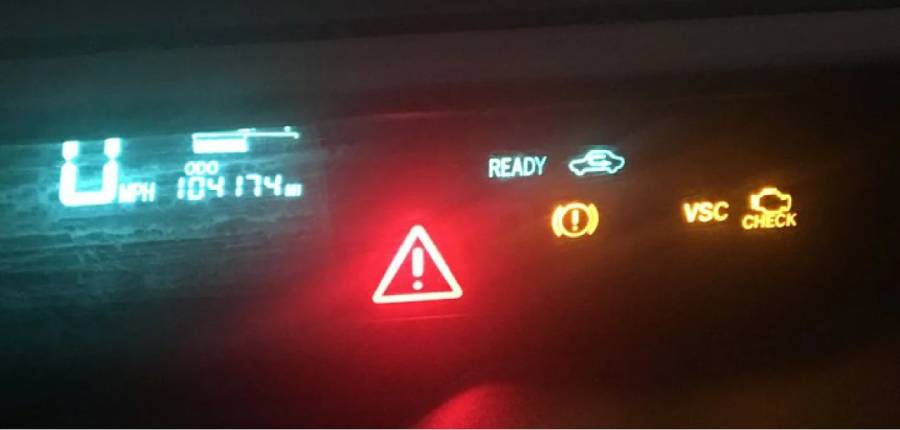
What Does the Red Triangle Mean on a Toyota Prius?
The red triangle on a Toyota Prius is the Master Warning Light, which alerts the driver that the vehicle has detected a problem requiring attention. It functions as a general warning rather than a diagnosis of one specific component. The actual problem must be identified from the accompanying warning message, other illuminated warning lights, vehicle symptoms, and diagnostic trouble codes stored by the relevant control module.
This distinction matters because the Prius uses multiple electronic control systems to monitor the gasoline engine, hybrid system, high-voltage battery, braking system, cooling systems, and other vehicle functions. A detected fault can therefore cause the Master Warning Light to illuminate while another indicator or dashboard message provides more specific context. The red triangle tells the driver to investigate the condition; it does not establish which component should be repaired or replaced.
The red triangle also does not automatically mean that the high-voltage hybrid battery has failed. A hybrid battery problem is one possible cause, but faults involving the engine, inverter cooling system, electrical system, or other monitored systems can also be associated with a master warning. Replacing the hybrid battery solely because the red triangle appears can therefore result in an unnecessary repair.
The correct diagnostic sequence is to treat the red triangle as the starting point. Check the warning message and other dashboard indicators first, then retrieve diagnostic trouble codes from the vehicle. The stored codes identify the system that detected the abnormal condition and provide substantially more diagnostic information than the red triangle alone.
Can You Drive a Toyota Prius With the Red Triangle On?
You should not assume that a Toyota Prius is safe to continue driving simply because it still operates with the red triangle illuminated. Whether the vehicle can be driven depends on the underlying fault, the accompanying warnings, and changes in vehicle behavior. The Master Warning Light can represent conditions with different levels of severity, so the cause must be evaluated before continuing normal driving.
Stop the Prius in a safe location when the red triangle appears with signs of a potentially serious problem, including engine overheating, a critical oil-pressure warning, significant loss of propulsion, braking problems, unusual mechanical noises, smoke, or a burning smell. Continuing to operate the vehicle under these conditions can increase the risk of component damage or create a driving-safety problem. Turning the warning off without identifying the cause does not make the vehicle safe to drive.
A Prius that displays the red triangle but continues to operate normally still requires diagnosis. Check the multifunction display or instrument panel for an accompanying warning message and identify every other warning indicator that appeared at the same time. A Check Engine Light, hybrid-system warning, brake warning, or other indicator can narrow the affected system and change the urgency of the situation.
Diagnostic trouble codes provide the next level of evidence. A compatible scan tool can retrieve stored faults from the control systems and help distinguish a hybrid battery problem from an engine, cooling, electrical, or other fault. This prevents repair decisions from being based solely on the appearance of the red triangle.
The practical rule is to base the decision to continue driving on the underlying fault rather than on the red triangle itself. Stop when the Prius shows symptoms of a critical mechanical, thermal, braking, or propulsion problem. When no immediate danger is evident, arrange diagnosis promptly instead of continuing to drive indefinitely with an unexplained Master Warning Light.
What Causes the Red Triangle on a Toyota Prius?
The Toyota Prius red triangle can be triggered by faults involving the hybrid system, high-voltage battery, 12V electrical system, inverter cooling system, engine, fluid levels, or other monitored vehicle systems. Because the triangle is a Master Warning Light rather than a component-specific indicator, the cause cannot be determined from the warning symbol alone. The accompanying symptoms and diagnostic trouble codes are required to identify the affected system.
A hybrid-system or high-voltage battery fault is one important cause to investigate. The Prius continuously monitors components involved in generating, storing, and delivering electrical power. When the vehicle detects an abnormal condition within the hybrid system, it can store diagnostic trouble codes and activate dashboard warnings. Battery deterioration is therefore a possible explanation for a red triangle, but the hybrid battery should not be condemned until diagnostic data supports that conclusion.
A weak or failing 12V auxiliary battery can also contribute to electrical and warning-related problems. The 12V battery serves a different purpose from the high-voltage traction battery: it supplies low-voltage electrical systems and supports the process that allows the Prius control systems to start operating. Low or unstable voltage can interfere with normal electronic operation. Battery voltage, battery condition, stored codes, and other electrical evidence should therefore be checked before deciding that the auxiliary battery requires replacement.
The inverter and its cooling system are another diagnostic area. The Prius inverter manages electrical power within the hybrid drivetrain and produces heat during operation. Its cooling circuit helps control operating temperature. A cooling-system malfunction can cause abnormal inverter temperatures and trigger hybrid-system faults. An inverter-related warning accompanied by overheating symptoms requires prompt investigation because temperature control is essential to normal hybrid-system operation.
Engine-related conditions can also be associated with the Master Warning Light. Low engine oil, an oil-related warning, overheating, or another engine fault can provide the underlying context for a red triangle. Oil level and oil pressure should not be treated as the same condition: oil level describes the amount of oil in the engine, while oil pressure reflects whether the lubrication system is maintaining sufficient pressure during operation. A critical oil-pressure warning requires more immediate action than simply discovering that the oil level needs correction.
Cooling problems extend beyond the inverter. The gasoline engine depends on its own cooling system to control operating temperature. Low coolant, a leak, circulation problems, or another cooling-system fault can cause overheating and additional dashboard warnings. If the red triangle appears while the Prius shows an overheating warning or abnormal temperature condition, the vehicle should be stopped safely rather than driven until severe overheating occurs.
Brake, sensor, wiring, and electronic-control faults can create additional warning scenarios. The Prius depends on multiple control modules and sensors to monitor vehicle operation. A fault detected by one system can illuminate several dashboard indicators at the same time, which is why multiple warning lights do not necessarily prove that several unrelated components failed simultaneously.
The correct way to identify the cause is therefore diagnosis rather than part replacement based on the warning symbol. Record the dashboard message, note every warning light that appears with the red triangle, observe any changes in vehicle behavior, and retrieve the stored DTCs. These pieces of evidence narrow the problem from a general Master Warning Light to the system that actually requires inspection.
Can a Bad Hybrid Battery Cause the Prius Red Triangle?
A failing high-voltage hybrid battery can cause the red triangle to appear on a Toyota Prius, but the warning light alone does not confirm hybrid battery failure. The Prius monitors the hybrid battery and related control systems for abnormal operating conditions. When the system detects a fault that meets its warning criteria, it can store diagnostic trouble codes and illuminate the Master Warning Light along with other hybrid-system warnings.
The high-voltage battery stores electrical energy used by the hybrid drivetrain and receives energy through regenerative braking and engine-driven charging. As the battery ages or develops a fault, its ability to store and deliver energy can become less consistent. The vehicle’s battery management and hybrid control systems monitor operating data and can detect conditions that require diagnostic attention. This makes the hybrid battery an important system to inspect when a red triangle appears, especially when the warning is accompanied by changes in hybrid operation.
Several symptoms can provide additional diagnostic context. A Prius with a deteriorating hybrid battery may show unusual changes in the displayed state of charge, reduced hybrid-system performance, changes in fuel economy, increased battery cooling-fan activity, or additional hybrid-system warnings. None of these symptoms should be treated as independent proof that the entire battery pack requires replacement. They are evidence that should be evaluated together with stored DTCs and battery data.
Diagnostic trouble codes are particularly important because the red triangle does not distinguish a battery fault from another hybrid-system problem. A scan tool capable of communicating with the relevant Toyota hybrid control modules can provide substantially more information than a basic visual inspection of the dashboard. Diagnostic data can then guide further testing of the battery or another component identified by the fault information.
For this reason, do not replace the Prius hybrid battery solely because the red triangle is illuminated. Confirm the affected system first. This distinction can prevent an expensive battery replacement when the actual problem originates in the inverter cooling system, 12V electrical system, engine, wiring, or another monitored component.
Can a Weak 12V Battery Cause the Prius Red Triangle?
A weak 12V auxiliary battery can be associated with warning and electrical problems on a Toyota Prius, but it should not automatically be diagnosed as the cause of every red triangle. The 12V battery and high-voltage hybrid battery perform different functions, so determining which battery is involved is an essential part of Prius troubleshooting.
The high-voltage battery supplies energy for the hybrid drivetrain, while the 12V battery supports the vehicle’s low-voltage electrical and control systems. Unlike a conventional gasoline vehicle, the Prius does not rely on a traditional starter motor in the same way to crank the engine. The 12V system instead plays an important role in powering electronics and allowing the vehicle’s control systems to initialize before the hybrid system reaches READY mode.
Low or unstable 12V voltage can interfere with electronic operation and may contribute to abnormal warning behavior. This becomes particularly relevant when a Prius displays multiple warning indicators, has difficulty entering READY mode, or develops electrical symptoms after sitting unused. However, warning lights are not sufficient evidence by themselves to prove that the auxiliary battery has failed.
The correct diagnosis requires checking the condition of the 12V battery and comparing that evidence with the vehicle’s stored fault information. Battery testing can identify whether the auxiliary battery is weak, while diagnostic codes can reveal whether another system has detected a separate fault. If the 12V battery tests within specification and hybrid-system codes are present, replacing the auxiliary battery is unlikely to address the underlying problem.
The practical distinction is simple: the 12V battery powers low-voltage electronics and control functions, while the high-voltage battery stores energy for the hybrid drivetrain. Both belong to the Prius electrical architecture, but they are not interchangeable diagnoses. Testing the appropriate battery and reading the relevant DTCs prevents the red triangle from being incorrectly attributed to whichever battery seems most obvious.
Can Low Oil or Overheating Cause the Prius Red Triangle?
Low engine oil, oil-related faults, engine overheating, and hybrid-system cooling problems can be associated with the Toyota Prius red triangle when the vehicle detects a condition serious enough to generate a master warning. These problems require different responses, so the driver should identify the accompanying warning and actual vehicle condition rather than assuming every fluid- or temperature-related red triangle has the same cause.
Engine oil level is one of the first physical conditions worth checking when an oil-related warning or other engine symptoms accompany the red triangle. The engine requires the correct amount of oil to lubricate moving components and control friction and heat. An insufficient oil level can therefore create conditions that require attention. Checking the dipstick can establish whether the engine contains the appropriate amount of oil, but adding oil should not be treated as a universal solution to a red triangle.
Oil level and oil pressure are also different diagnostic conditions. Oil level describes how much lubricant is present, whereas oil pressure indicates whether the lubrication system is circulating oil with sufficient pressure while the engine operates. A critical oil-pressure warning requires immediate attention because continued engine operation without adequate lubrication can cause severe damage. The warning combination and diagnostic evidence determine whether the problem involves oil quantity, lubrication-system operation, or another engine fault.
Engine overheating is another condition that requires prompt action. The Prius gasoline engine relies on coolant circulation and heat transfer to maintain its operating temperature. Coolant loss, leaks, circulation problems, or other cooling-system faults can allow temperature to rise beyond the normal range. Stop the vehicle safely when the red triangle appears with clear evidence of overheating rather than continuing to drive while waiting for the warning to disappear.
The hybrid system has separate thermal-management concerns. The inverter converts and manages electrical power within the hybrid drivetrain and generates heat during operation. Its cooling system must remove this heat effectively. A circulation or cooling fault can allow inverter temperature to increase and cause the hybrid control system to detect an abnormal condition. The resulting warning may therefore look similar to other red-triangle situations even though the failed system and required repair are different.
Fluid and temperature checks provide useful evidence, but they do not replace electronic diagnosis. Check relevant fluid levels only when it is safe to do so, identify any overheating or oil-related warnings, and retrieve the stored DTCs. This sequence distinguishes a condition that can be corrected through basic maintenance from a cooling, lubrication, engine, or hybrid-system fault requiring further repair.
What Does It Mean When the Prius Red Triangle Appears With Other Warning Lights?
A Toyota Prius red triangle accompanied by other warning lights provides more diagnostic context than the red triangle alone because the additional indicators help identify which vehicle system detected a problem. The Master Warning Light remains a general alert, while the accompanying Check Engine, VSC, brake, or hybrid-system warning can narrow the investigation.
A red triangle appearing with the Check Engine Light indicates that engine or emissions-related diagnostic information may be stored in addition to the master warning. The Check Engine Light is therefore evidence that should be investigated rather than interpreted as proof that the hybrid battery has failed. Reading the stored codes provides a more reliable starting point for identifying the system and condition that triggered the warning.
A red triangle appearing with a VSC warning also requires diagnostic context. The simultaneous appearance of several indicators does not necessarily mean that each system has suffered an independent component failure. Modern vehicle control systems exchange information, and a fault detected in one area can affect the operation or availability of related functions. The correct repair is therefore determined from the fault data rather than from the number of lights illuminated on the dashboard.
Hybrid-system warnings deserve particular attention because they direct the diagnostic process toward the Prius hybrid drivetrain and its control systems. Possible areas for investigation include the high-voltage battery, power electronics, cooling functions, wiring, sensors, and hybrid control components. Even in this situation, the red triangle itself cannot identify which of these components is responsible.
Brake-related warnings increase the urgency of the situation because braking directly affects vehicle safety. A driver who sees the Master Warning Light together with brake warnings or experiences abnormal braking behavior should prioritize stopping safely and having the system evaluated instead of continuing normal driving.
The key diagnostic principle is that warning-light combinations narrow the context, while DTCs and system testing identify the fault. Record all illuminated indicators before switching the vehicle off when circumstances allow, note any dashboard messages and driving symptoms, and scan the appropriate control modules. This preserves diagnostic information that can help distinguish one underlying problem from several warning lights produced by the same fault.
How Do You Diagnose the Red Triangle on a Toyota Prius?
Diagnose the Toyota Prius red triangle by checking the dashboard information, identifying other warning lights, inspecting obvious mechanical conditions, and retrieving diagnostic trouble codes before replacing any components. The red triangle identifies a warning condition but does not identify the failed part, so diagnosis must narrow the problem to the control system that detected the fault.
Start by parking the Prius safely when the warning appears. Pay attention to changes in vehicle behavior before shutting the vehicle down, including reduced power, abnormal engine operation, overheating, unusual braking behavior, noises, or unusual smells. These symptoms provide diagnostic context and help determine whether the vehicle should remain stopped or can be moved for further inspection.
Read the dashboard warning message next. Depending on the Prius generation and the fault involved, additional information may appear on the instrument panel or multifunction display. Record the message instead of relying on memory, especially when several indicators illuminate at the same time. The combination of the Master Warning Light and another system-specific warning can narrow the diagnostic direction.
Identify every other warning light that appeared with the red triangle. Check Engine, brake, VSC, and hybrid-system warnings point toward different areas of the vehicle, although several lights can originate from one underlying fault. Do not count illuminated warning lights and assume the same number of components have failed.
Check obvious physical conditions when it is safe to do so. Inspect the engine oil level, look for evidence of coolant loss, and check for visible leaks or signs of overheating. These checks can reveal conditions requiring immediate attention, but they should complement rather than replace electronic diagnosis. Do not open a pressurized cooling system while it is hot.
Scan the Prius for diagnostic trouble codes after the initial inspection. DTCs record faults detected by the vehicle’s electronic control systems and provide a more specific diagnostic direction than the red triangle itself. Record the complete codes before clearing them because deleting fault information too early can remove evidence needed to identify the original problem.
Identify which ECU or system stored each code. A powertrain code, hybrid-control fault, battery-related fault, or brake-system fault leads to a different diagnostic path. The presence of a code does not automatically prove that the component named in a code description requires replacement. Wiring, connectors, sensors, voltage conditions, cooling problems, and related components can contribute to a fault.
Inspect and test the system indicated by the diagnostic evidence. For example, battery-related data requires battery-system evaluation, while an inverter cooling fault requires inspection of the relevant cooling circuit. This evidence-based sequence prevents parts from being replaced solely because they are commonly associated with a Prius red triangle.
Repair the confirmed underlying fault before clearing the warning. After the repair, clear the stored codes with appropriate diagnostic equipment when required, restart the vehicle, and verify normal operation. A warning that returns indicates that the fault remains present, another related problem exists, or the original diagnosis was incomplete.
The diagnostic process can therefore be summarized in 9 steps:
- Park the Prius safely.
- Record the dashboard warning message.
- Identify all accompanying warning lights.
- Observe abnormal vehicle symptoms.
- Inspect obvious fluid, leak, and overheating conditions.
- Scan the relevant vehicle systems for DTCs.
- Identify the ECU and system associated with each fault.
- Test the indicated system and repair the confirmed problem.
- Clear the codes and verify that the warning does not return.
This sequence follows the same action-oriented grammatical structure throughout the diagnostic procedure, consistent with the Algorithmic Authorship rule for procedural lists.
Can a Regular OBD-II Scanner Diagnose the Prius Red Triangle?
A basic OBD-II scanner may retrieve engine-related codes, but it may not provide all the information needed to diagnose a Toyota Prius red triangle. The Prius contains multiple electronic control modules beyond the systems covered by basic generic code reading, including modules associated with hybrid operation and other vehicle functions.
Generic OBD-II functionality is useful when the Check Engine Light accompanies the red triangle because powertrain codes can provide important diagnostic evidence. However, finding no generic engine codes does not establish that the Prius has no stored faults. The warning may originate from a system that the basic scanner cannot access.
A Toyota-compatible or hybrid-capable diagnostic tool provides a more complete diagnostic path when it can communicate with the ECU responsible for the warning. Access to additional control modules, fault information, and relevant live data helps distinguish a high-voltage battery problem from an inverter, electrical, engine, or other system fault.
Scanner capability therefore matters more than simply connecting a code reader to the diagnostic port. Use a diagnostic tool capable of accessing the system that generated the warning. If a basic scanner reports no useful codes while the red triangle remains illuminated, further diagnosis with more capable equipment may be necessary.
Which Diagnostic Trouble Codes Can Cause the Prius Red Triangle?
Diagnostic trouble codes associated with a Toyota Prius red triangle can come from the hybrid battery, hybrid control system, engine, cooling system, or other electronic control systems. The red triangle itself is not a DTC and does not identify the failed component. The useful diagnostic information comes from the codes stored by the ECU that detected the abnormal condition.
Hybrid battery codes direct attention toward the high-voltage battery and its monitoring system. These faults can relate to battery performance, voltage differences, temperature monitoring, or other conditions detected by the battery control system. A battery-related code should begin a diagnostic process rather than automatically trigger replacement of the complete battery pack. Battery data and the relevant electrical components still need to be evaluated before selecting a repair.
Hybrid-control codes cover faults detected within the systems responsible for managing the Prius hybrid drivetrain. This diagnostic category can involve power-management components, control circuits, sensors, or related systems. Because these systems interact with each other, a code description should not be interpreted as proof that the first component mentioned in the description has physically failed.
Engine-related DTCs become especially relevant when the red triangle appears with the Check Engine Light. These codes can identify abnormal conditions detected by the engine control system and provide a starting point for further testing. The technician or vehicle owner should diagnose the condition represented by the code rather than clearing it and waiting to see whether the warning returns.
Cooling-related faults require attention because temperature control is important to both engine and hybrid-system operation. An abnormal temperature condition, circulation problem, or related electrical fault can produce warning behavior that requires inspection of the affected cooling circuit. Actual temperature data, coolant condition, circulation, electrical operation, and stored codes provide stronger evidence than the dashboard triangle alone.
The relationship between a DTC and a failed part is therefore not always one-to-one. A code identifies a detected condition within a diagnostic context. Wiring damage, poor electrical connections, low voltage, sensor faults, cooling problems, or another component upstream of the detected condition can produce similar fault information. Use the DTC to determine what must be tested, not simply what part must be purchased.
Exact trouble codes also vary according to the Prius generation, system, and underlying fault. For that reason, codes should be interpreted using information applicable to the specific vehicle rather than applying one list of Prius codes to every model year. Recording the complete DTC and identifying the ECU that stored it provides a more reliable diagnostic starting point.
How Do You Fix the Red Triangle on a Toyota Prius?
Fix the Toyota Prius red triangle by repairing the underlying fault that activated the Master Warning Light. There is no single repair for the triangle because the warning can represent faults in different vehicle systems. The appropriate fix should follow the diagnostic evidence collected from dashboard information, DTCs, physical inspection, and system testing.
Repair a confirmed hybrid battery problem according to the actual battery fault. A high-voltage battery diagnosis requires evidence that the battery or a related component is responsible for the warning. The appropriate repair depends on what testing identifies, so complete battery replacement should not be treated as the default response to every battery-related warning.
Correct a weak 12V electrical supply when testing confirms that the auxiliary battery or its electrical connections are responsible for the problem. The repair can involve addressing the failed battery or another verified issue in the low-voltage electrical path. Afterward, the vehicle should be retested to confirm that normal electrical operation has returned and that no separate faults remain.
Repair inverter cooling problems when diagnostic evidence points to inadequate cooling of the power electronics. The cooling circuit must be inspected for the specific condition preventing normal temperature control. Simply clearing the warning without restoring proper cooling leaves the underlying thermal problem unresolved and allows the warning to return.
Correct engine oil, cooling, or engine-related faults according to the condition found during diagnosis. An incorrect oil level requires a different response from an oil-pressure fault, and a coolant-level problem requires a different repair from a circulation or overheating problem. Treating these conditions as interchangeable can conceal a more serious mechanical issue.
Repair wiring, connectors, sensors, or electronic components when testing identifies an electrical or control-system fault. Modern Prius systems depend on communication between sensors, ECUs, and controlled components. A poor connection or damaged circuit can therefore create a fault without the primary mechanical component itself being defective.
The repair process should follow 4 stages: identify the affected system, confirm the fault through testing, repair the verified cause, and retest the Prius. This order reduces unnecessary parts replacement and provides evidence that the repair actually resolved the condition that activated the Master Warning Light.
Do not judge repair success only by whether the red triangle disappears immediately. After the underlying problem has been corrected, stored codes may need to be cleared according to the diagnostic procedure for the vehicle. The Prius should then be restarted and retested. If the warning or DTC returns, further diagnosis is required because the original fault remains active or another related condition has not been resolved.
How Do You Reset the Red Triangle on a Toyota Prius?
Reset the Toyota Prius red triangle only after diagnosing and correcting the fault that caused the Master Warning Light to appear. Clearing the warning does not repair a hybrid battery, cooling, engine, electrical, or control-system problem. If the underlying fault remains active, the warning can return after the vehicle performs another system check.
Start by retrieving and recording the diagnostic trouble codes before attempting a reset. Stored DTCs contain information that helps identify which system detected the problem. Clearing these codes before recording them can remove useful diagnostic evidence and make an intermittent fault more difficult to trace.
Repair the confirmed problem next. The required action depends on the diagnosis: a weak 12V battery requires a different repair from a high-voltage battery fault, and an inverter cooling problem requires a different repair from an engine-related condition. The objective is to restore normal operation of the affected system rather than simply remove the dashboard indicator.
Clear the applicable DTCs with appropriate diagnostic equipment after the repair when the diagnostic procedure calls for it. Restart the Prius and verify that it enters normal operation without the same warning condition. Relevant system data should also be checked when necessary to confirm that the repaired component or circuit is operating correctly.
Retest the vehicle after clearing the codes. A red triangle that returns indicates that the original fault remains, the repair was incomplete, or another condition still requires diagnosis. Repeatedly clearing the warning without identifying its cause can hide useful fault information while leaving the actual vehicle problem unresolved.
The correct sequence is therefore diagnose → repair → clear codes → restart → retest. Treat resetting as the final verification stage of a repair, not as the repair itself.
How Can You Prevent the Toyota Prius Red Triangle From Coming Back?
Reduce the risk of the Toyota Prius red triangle returning by maintaining the systems that can trigger the warning and addressing diagnostic faults when they first appear. Preventive maintenance cannot eliminate every electrical or component failure, but it can reduce avoidable problems involving fluids, cooling, batteries, and neglected warning conditions.
Follow the maintenance requirements applicable to the specific Prius model year. Routine inspection provides opportunities to identify deteriorating fluids, leaks, battery problems, and other conditions before they develop into faults serious enough to activate additional dashboard warnings. Maintenance intervals and procedures should be based on the requirements for the specific vehicle rather than a single schedule applied to every Prius generation.
Monitor engine oil and coolant as part of routine vehicle checks. Correct fluid levels support lubrication and temperature control, while unexplained fluid loss can indicate a leak or another condition requiring diagnosis. Repeatedly topping up a fluid without identifying why its level decreases does not correct the underlying problem.
Maintain the relevant cooling systems because both gasoline-engine operation and hybrid power electronics depend on temperature control. Investigate coolant loss, overheating indications, abnormal cooling operation, or related DTCs when they occur. An unresolved thermal-management problem can progress from an intermittent warning to a condition that affects vehicle operation.
Monitor the condition of the 12V auxiliary battery as it ages. A deteriorated low-voltage electrical supply can contribute to starting, electronic, and warning-related symptoms. Testing the battery when electrical symptoms develop provides stronger evidence than replacing it solely because multiple dashboard lights have appeared.
Investigate recurring DTCs instead of repeatedly clearing them. A code that returns after being erased indicates that the monitored condition has been detected again. Recording the code, identifying the ECU that stored it, and diagnosing the associated system preserves the evidence needed to find the underlying fault.
Finally, respond to new dashboard warnings early. The most effective preventive strategy is to treat a warning as diagnostic information rather than something that only needs to be switched off. Early diagnosis can distinguish a maintenance issue from a developing hybrid, engine, cooling, or electrical fault before the condition becomes more disruptive or expensive to repair.
Read more: P1349 Toyota Code on Camry, Corolla, RAV4: Differences Explained
When Should You Take a Prius With the Red Triangle to a Mechanic?
Take a Toyota Prius with the red triangle to a qualified mechanic when the warning is accompanied by serious driving symptoms, involves the high-voltage hybrid system, repeatedly returns after repair or reset, or cannot be diagnosed with the available equipment. Professional diagnosis becomes more important when determining the fault requires system-specific scan data, electrical testing, or work around high-voltage components.
Seek immediate assistance when the red triangle appears with overheating, significant loss of power, abnormal braking, a critical oil-pressure warning, smoke, a burning smell, or severe mechanical noise. These symptoms indicate that continuing to drive can create additional mechanical damage or a safety risk. Move the Prius to a safe location when possible and avoid continuing normal operation solely because the vehicle remains capable of moving.
Professional diagnosis is also appropriate when hybrid-system DTCs are stored. The Prius high-voltage system includes components that require appropriate diagnostic procedures and safety precautions. A red triangle combined with a hybrid warning does not automatically establish that the traction battery needs replacement, but it does justify further testing of the system identified by the stored fault information.
Take the vehicle for further diagnosis when a basic OBD-II scanner cannot access the module responsible for the warning. Generic engine-code information may be insufficient when the fault originates in a hybrid, battery, brake, or another Toyota-specific control system. A technician with compatible diagnostic equipment can retrieve additional codes and system data that a basic reader may not provide.
A recurring red triangle is another reason to escalate the diagnosis. If the warning returns after codes have been cleared or a repair has been performed, the underlying condition has not been fully resolved or another related fault remains. Repeated resets are not a substitute for identifying why the ECU continues to detect the problem.
The repair decision should ultimately follow diagnostic evidence. A mechanic should identify the affected system, confirm the fault through appropriate testing, repair the verified cause, and retest the Prius before considering the problem resolved. This process is especially important for expensive components such as the hybrid battery because replacing parts based only on the Master Warning Light can result in unnecessary repair costs.
The Toyota Prius red triangle should therefore be treated as a request for diagnosis, not a diagnosis by itself. The warning becomes actionable when it is combined with dashboard messages, other warning indicators, vehicle symptoms, DTCs, and system testing. Using those signals together provides the most reliable path from the Master Warning Light to the actual fault and the appropriate repair.