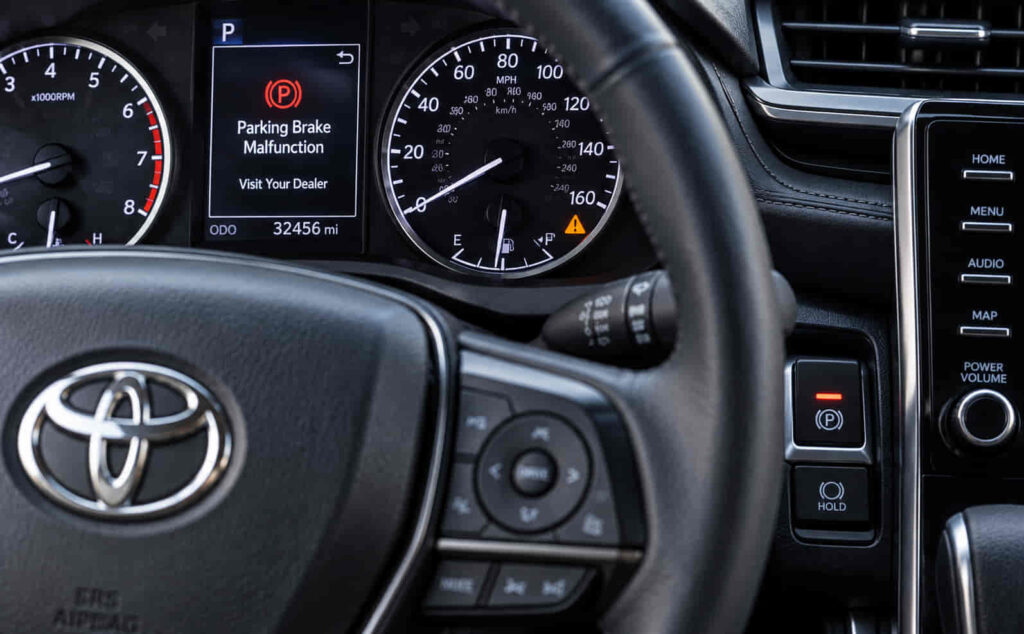
A Toyota Parking Brake Malfunction warning means the electronic parking brake system has detected a condition that may prevent the parking brake from applying or releasing normally. The warning does not identify one failed part. Depending on the Toyota model and fault condition, the cause can involve temporary system protection, low 12-volt power, a parking brake switch or wiring problem, control-module communication, ECU calibration, or the electronic parking brake actuator. Toyota service information confirms this distinction: certain RAV4 and Corolla vehicles can display the same Parking Brake Malfunction message with DTC C059746 because of a brake control module calibration or parameter-memory condition rather than a failed mechanical parking brake.
The immediate concern is the actual state of the brake. Do not continue driving normally if the parking brake remains applied, because Toyota warns that driving with the brake engaged can overheat brake components, reduce braking performance, and increase brake wear. If the brake has released but the warning remains, the fault still needs diagnosis because the electronic parking brake may not operate correctly the next time it is required.
The correct troubleshooting process therefore starts by identifying whether the brake is engaged or released, then checking temporary operating conditions and electrical power before moving to diagnostic codes, ECU software, wiring, switches, or actuator faults.
What Does Toyota Parking Brake Malfunction Mean?
Toyota Parking Brake Malfunction means the vehicle has detected a fault or abnormal condition in the electronic parking brake system that may prevent the parking brake from applying, releasing, or reporting its operating state correctly. The warning identifies the affected system, but it does not identify one universal failed component. Depending on the Toyota model, model year, and diagnostic trouble code, the cause can involve electrical power, a control-module fault, incorrect calibration, wiring or communication, a parking brake switch, or the electromechanical components that apply and release the brake.
Modern Toyota electronic parking brakes operate through a control chain rather than a direct mechanical handbrake cable. A driver command from the parking brake switch is interpreted by the brake-control electronics, which then control the electrical mechanism responsible for applying or releasing the rear parking brake. The system also monitors whether the commanded action was completed correctly. A malfunction warning can therefore appear when the problem occurs at the command, control, communication, electrical-supply, or actuator stage rather than only when the rear brake mechanism itself is physically damaged.
Toyota’s own technical service information demonstrates why the warning should not be treated as a diagnosis. Toyota Technical Service Bulletin T-SB-0078-21 Rev2 states that some 2021–2022 Corolla and Corolla Hatchback vehicles and some 2021 RAV4 vehicles can display a Parking Brake Malfunction message while storing DTC C059746, defined as Brake System Control Module “A” Calibration / Parameter Memory Failure. For that specific condition, Toyota’s repair procedure addresses control-module calibration rather than instructing technicians to replace a parking brake actuator. The bulletin also states that its procedure applies only when C059746 is present under the specified conditions and that vehicles with additional DTCs require further diagnosis.
This example establishes an important diagnostic principle: the same dashboard message can represent different underlying failures. A Toyota with an actuator circuit problem, an electrical-supply problem, or a calibration fault can present a similar warning to the driver because the multi-information display reports the system-level condition rather than a complete technical diagnosis. Replacing parts based only on the words “Parking Brake Malfunction” can therefore lead to unnecessary repairs.
The behavior of the parking brake provides additional information. If the parking brake still applies and releases normally but the warning remains, the system may have detected a control, calibration, communication, or intermittent condition that requires diagnostic-code retrieval. If the brake applies but will not release, the vehicle has a different and more urgent failure state because the rear brakes may remain mechanically applied. If the brake will not apply at all, the primary immediate concern changes to whether the vehicle can be parked securely.
Toyota documentation also shows that electronic parking brake faults can affect related functions without proving that those systems have independently failed. For example, Toyota owner documentation states that Brake Hold can be disabled when “Parking Brake Unavailable” or “EPB Malfunction Visit Your Dealer” is displayed. The relationship exists because Brake Hold and the electronic parking brake exchange operating information and depend on compatible brake-system conditions.
A warning should also be distinguished from a normal parking brake indicator. During normal operation, Toyota uses the parking brake indicator to confirm whether the brake is applied or released. For example, Toyota maintenance specifications for the 2024 Corolla state that the indicator should illuminate when the parking brake switch is pulled and turn off when the switch is pushed to release it. A malfunction warning indicates a different condition because the control system has detected a problem rather than simply reporting that the brake is engaged.
Toyota Parking Brake Malfunction should therefore be interpreted as a system-level warning, not as proof that the actuator, caliper, battery, switch, or ECU has failed. The next diagnostic information comes from whether the parking brake is currently applied or released, whether it responds to the switch, which additional warning lights are present, and which DTCs are stored in the brake-control system.
Can You Drive With a Toyota Parking Brake Malfunction?
You should not continue normal driving if a Toyota Parking Brake Malfunction leaves the parking brake applied or if you cannot confirm that it has fully released. Toyota owner documentation consistently instructs drivers to make sure the parking brake is completely released before driving because driving with the brake applied creates heat and unnecessary brake wear. Toyota specifically warns that driving with the parking brake engaged can overheat the brake, reduce its performance, and create an accident risk.
The first safety question is therefore not simply whether the warning message is displayed. It is whether the parking brake is physically holding the vehicle. If the parking brake indicator remains on, the vehicle resists movement, the rear brakes appear to drag, or the brake cannot be released through the normal procedure, continuing to drive can convert an electronic parking-brake fault into a thermal and mechanical brake problem. Friction between the applied brake surfaces generates heat continuously while the vehicle moves, which can accelerate wear and reduce braking effectiveness.
A different situation exists when the parking brake has clearly released but the malfunction warning remains. The vehicle may be physically capable of moving, but the warning still indicates that the electronic parking brake cannot be assumed to operate normally. The system may fail to apply automatically or manually when the vehicle is next parked, or an intermittent control fault may return. This condition should therefore not be treated as equivalent to a harmless informational message. Toyota directs owners to follow warning-message instructions and have malfunctioning brake-related systems inspected when indicated.
The risk also changes when the parking brake will not engage. In that condition, overheating from a stuck brake is not the primary concern because the brake is not being applied. Instead, the vehicle may not have the parking-brake restraint that the driver expects after stopping. The transmission’s Park mechanism and the electronic parking brake perform different functions, so failure of the EPB should not simply be ignored because the vehicle can be shifted into P. The applicable Toyota owner’s manual should be followed for parking procedures, particularly on slopes or when the parking brake cannot be confirmed as operational.
Additional brake warnings increase the importance of stopping and evaluating the vehicle. A Parking Brake Malfunction message by itself relates specifically to the EPB system, but simultaneous brake-system, ABS, stability-control, or other warnings can indicate that the fault extends beyond one parking-brake function. Toyota’s dashboard guidance identifies brake-related warning lights separately because different warnings correspond to different systems and levels of required action.
The operating symptoms are therefore more useful than a universal yes-or-no answer. A Toyota with an EPB that is visibly stuck on should not be driven normally. A vehicle with a released parking brake and no abnormal braking behavior may be movable to a safe location, but the malfunction should still be diagnosed rather than ignored. A Toyota that cannot securely set its parking brake should not be treated as having normal parking protection, while a vehicle showing additional braking abnormalities may require more immediate service or transport rather than continued driving.
The safest rule is to confirm the actual parking brake state before moving the vehicle. Do not drive if the parking brake remains applied, if the vehicle shows obvious brake drag, or if you cannot determine whether it has released correctly. If the brake is released but the warning remains, arrange diagnosis because the EPB may not apply or release normally during the next operating cycle. The warning message tells you which system requires attention; the brake’s actual engaged or released state determines the immediate driving risk.
Read more: Toyota Highlander Rear Hatch Not Working
No, a Toyota “Parking Brake Temporarily Unavailable” message is not necessarily the same as a persistent electronic parking brake malfunction. Toyota documents temporary unavailability as a protective condition that can occur when the parking brake is operated repeatedly within a short period. The system can restrict further operation to prevent the electronic parking brake components from overheating, and Toyota states that normal operation can return after approximately one minute when this is the cause.
This distinction matters because a temporary restriction can occur even when the electronic parking brake hardware is functioning correctly. Each application or release requires an electric actuator to generate mechanical force at the brake. Repeated commands within a short interval increase operating temperature, so the control system can temporarily prevent additional cycles before heat reaches a level that could damage the mechanism. The warning therefore describes the current availability of the system rather than proving that a component has permanently failed.
Toyota’s documented response to this condition is also different from the response to a persistent warning. When “Parking Brake Temporarily Unavailable” appears after repeated operation, Toyota advises the driver to refrain from operating the parking brake and allow the system to recover. On applicable models, normal operation returns after about one minute. Repeatedly pulling and pushing the parking brake switch during this protection period is counterproductive because the system is intentionally limiting operation.
A message such as “Parking Brake Unavailable” requires a different interpretation. Toyota instructs drivers on applicable models to operate the parking brake switch and check whether the message disappears. If the message remains after the switch is operated several times, Toyota states that the system may be malfunctioning and recommends vehicle inspection. This creates a clear diagnostic boundary between a short-duration thermal protection state and a warning that continues despite normal operating attempts.
The same principle applies to a Parking Brake Malfunction warning. A persistent malfunction message can result from control, electrical, calibration, communication, switch, or actuator faults and cannot be explained simply by the temporary overheating protection described in the owner’s manual. Earlier Toyota technical documentation also demonstrates that some malfunction messages are associated with stored DTCs and software or calibration conditions rather than temporary actuator temperature.
The timing of the message provides useful diagnostic evidence. If the warning appears immediately after the parking brake has been applied and released repeatedly and disappears after the system is left alone for roughly one minute, the behavior is consistent with Toyota’s documented protection logic. If the warning appears during normal use, returns every drive cycle, prevents the brake from applying or releasing, or remains after repeated normal switch operation, the condition deserves further diagnosis rather than being treated as temporary overheating.
The actual brake state remains important during either warning. A temporarily unavailable EPB that has already released presents a different immediate risk from a system that is unavailable while the brake remains applied. If the brake cannot release, Toyota warns against driving the vehicle because continued movement with the parking brake engaged can overheat brake components and impair braking performance.
“Parking Brake Temporarily Unavailable” should therefore be treated as a possible short-term protection state when it follows repeated EPB operation, while a persistent unavailable or malfunction warning should be treated as a fault requiring diagnosis. The warning wording, operating history, brake position, and whether normal function returns after the documented cooling period provide more useful information than assuming every EPB message represents the same failure.
Can a Weak 12V Battery Cause Toyota Parking Brake Malfunction?
Low or discharged 12-volt power can interfere with Toyota electronic parking brake operation because the EPB depends on electrical power to operate its control electronics and parking brake actuators. Toyota specifically states on applicable models that when the vehicle’s 12-volt battery is discharged, the parking brake system cannot be activated. This confirms that adequate low-voltage electrical power is a basic operating requirement for the electronic parking brake.
The reason is mechanical as well as electronic. Unlike a conventional hand-operated parking brake in which the driver directly generates cable force, an EPB uses electrical control and an electric mechanism to apply the brake. The ECU must remain powered to interpret the switch command and monitor the system, while the actuator requires sufficient voltage and current to generate the force needed to apply or release the parking brake. If the 12-volt supply falls below the operating range required by these components, normal EPB movement may not be available.
A discharged battery can therefore create several practical problems without proving that the actuator itself is defective. The parking brake may fail to apply, electronic control functions may become unavailable, or warning messages can accompany broader low-voltage behavior. If a parking brake warning appears at the same time as slow starting, multiple electrical warnings, dim lighting, or a known discharged 12-volt battery, the electrical supply becomes a relevant diagnostic area before parking brake hardware is replaced.
Battery condition is especially important because a vehicle can still have some electrical function while voltage is insufficient under load. A weak battery may power displays or warning lights but experience a substantial voltage drop when a higher-current component operates. The parking brake actuator represents an electrical load, so static battery voltage alone does not always describe how the electrical system behaves when the EPB is commanded.
The relationship should not be overstated. Toyota’s statement that a discharged 12-volt battery can prevent parking brake activation does not mean that every Parking Brake Malfunction warning is caused by a weak battery. Toyota has documented other failure mechanisms, including ECU calibration conditions, electronic control faults, switch-related conditions, communication problems, and actuator faults. Battery testing is therefore one diagnostic branch rather than a universal repair.
The symptom pattern helps determine how strongly the battery should be suspected. If the parking brake malfunction appears immediately after the battery has been deeply discharged, jump-started, replaced, or disconnected, electrical power and system voltage deserve early attention. If the battery and charging system test normally but the malfunction persists, especially when a brake-system DTC is stored, diagnosis should move toward the specific code and affected circuit rather than continuing to blame the battery.
A discharged battery also creates an important parking-safety issue. Toyota states that the parking brake system cannot be activated when the 12-volt battery is discharged on applicable models. A driver should therefore not assume the EPB has secured the vehicle merely because the parking brake normally operates automatically. The parking procedure in the owner’s manual for the exact Toyota model should be followed whenever normal EPB operation cannot be confirmed.
A weak or discharged 12-volt battery is a valid cause to investigate when a Toyota electronic parking brake becomes unavailable, particularly when other low-voltage symptoms are present. Confirming battery and charging-system condition can prevent an electrical-supply problem from being misdiagnosed as an expensive actuator or ECU failure. If normal voltage is restored and the Parking Brake Malfunction message remains, the next diagnostic steps should focus on the parking brake switch, electrical circuits, stored DTCs, ECU control, and actuator operation.
Can the Toyota Parking Brake Switch Cause the Malfunction?
Yes, a faulty Toyota parking brake switch or its input circuit can interfere with electronic parking brake operation, but the switch should not be assumed to be defective simply because a Parking Brake Malfunction warning appears. The switch is the driver-command input for the EPB system, while the actual application and release of the parking brake depend on the control electronics and electrically operated brake mechanism. A warning can therefore originate downstream of the switch even when the switch itself operates correctly.
In normal manual operation, Toyota instructs the driver to pull the electronic parking brake switch to apply the brake and push the switch while depressing the brake pedal to release it. On applicable models, the parking brake indicator illuminates after the brake has been applied and turns off after successful release. This relationship gives the switch an important diagnostic role because the system must first receive a valid apply or release request before it can command the actuator.
The response to the switch provides more useful information than the warning message alone. If pulling the switch reliably applies the parking brake but pushing it does not release the brake under the correct conditions, a completely dead switch becomes less likely because the system is still receiving at least one command state. If neither direction produces a normal response, the switch, its electrical circuit, operating conditions, ECU input, electrical supply, or downstream actuator system all remain possible causes.
Toyota also documents fail-safe behavior when the parking brake switch itself malfunctions. In the Corolla owner’s manual, Toyota states that automatic parking brake mode is turned on automatically when the parking brake switch malfunctions. This demonstrates that the control system can identify a switch-related problem and change operating strategy rather than simply disabling every parking brake function. That behavior should not be generalized to every Toyota model, but it confirms that switch malfunction and actuator malfunction are separate diagnostic conditions.
Operating conditions can also make a functioning switch appear defective. Toyota states on several electronic-parking-brake-equipped models that the parking brake cannot be released through the switch unless the ignition or power switch is in the required ON state. On the 2021 RAV4 Hybrid, Toyota further requires normal system conditions for automatic release, including a closed driver’s door, a fastened driver seat belt, an appropriate drive position, and no relevant brake-system warning. If these conditions are not satisfied, failure to release does not by itself prove that the parking brake switch is faulty.
The indicator behavior can provide another clue. Toyota advises operating the switch again if the parking brake indicator flashes rather than reaching its normal applied or released state. A flashing indicator means the system has not simply completed a normal parking brake command, so continued diagnosis should focus on why the commanded operation was not completed. This can include control logic, electrical power, stored faults, or the brake mechanism itself rather than the switch alone.
A persistent “Parking Brake Unavailable” message creates a similar distinction. Toyota instructs drivers on applicable models to operate the parking brake switch and observe whether the warning disappears. If the message remains after the switch is operated several times, Toyota states that the system may be malfunctioning and should be inspected. The purpose of this procedure is not to prove the switch is defective; it checks whether the EPB can recover through normal commanded operation before deeper diagnosis begins.
The parking brake switch becomes a stronger suspect when commands from the switch are missing or inconsistent while the rest of the EPB system can still operate under other conditions. A Parking Brake Malfunction warning by itself is insufficient evidence for switch replacement. Correct ignition state, brake-pedal input, parking brake indicator behavior, stored DTCs, switch signal data, electrical supply, and actuator response should be considered before identifying the switch as the failed component.
Why Won’t the Toyota Electronic Parking Brake Release?
A Toyota electronic parking brake may fail to release because the required operating conditions are not met, the 12-volt electrical supply is inadequate, the control system has detected a fault, or the parking brake actuator cannot mechanically complete the release command. This symptom requires more immediate attention than a warning alone because driving with the parking brake still applied can overheat the rear brake components and reduce braking performance.
The first check is whether the vehicle is in the state Toyota requires for manual release. On the 2024 bZ4X, for example, Toyota specifies that the power switch must be ON and the brake pedal must be depressed while the parking brake switch is pushed. Toyota also notes that the parking brake cannot be released through the switch when the power switch is not ON. Similar ignition-state requirements appear in other Toyota EPB systems, although the exact procedure depends on model and model year.
Automatic release has additional conditions. Toyota states on the 2021 RAV4 Hybrid that automatic release by accelerator input requires the driver’s door to be closed, the driver to be wearing the seat belt, the transmission to be in a forward or reverse position, and relevant brake-system warning lights to remain off. If automatic release fails, Toyota instructs the driver to release the parking brake manually. A failure of automatic release alone therefore does not establish an actuator fault because one of the required vehicle-state conditions may simply be missing.
Electrical power is the next major branch of diagnosis. The electronic parking brake uses an electrically driven mechanism, so a discharged or unstable 12-volt supply can prevent normal operation. Toyota explicitly states on applicable models that the parking brake system cannot be activated when the 12-volt battery is discharged. Low voltage can also affect ECUs, communication, and actuator output, making battery and charging-system condition relevant when the parking brake stops operating at the same time as other electrical warnings.
A persistent system fault can prevent release even when the operating conditions and electrical supply are correct. Toyota’s documentation states that if “Parking Brake Unavailable” remains after repeated normal switch operation, the system may be malfunctioning and should be inspected. At this stage, stored diagnostic trouble codes become more valuable than repeated attempts to release the brake because the DTC can identify whether the fault involves control electronics, calibration, wiring, communication, or an actuator circuit.
The actuator itself becomes more relevant when the EPB receives a valid release command but cannot mechanically retract the parking brake. Toyota service information for the RAV4 Prime shows separate left-side parking brake actuator assemblies mounted at the rear brake mechanisms, confirming that actuator hardware is physically responsible for parking brake operation on that application. However, Toyota’s repair procedure also assumes that electrical commands and system diagnosis have been considered before actuator removal, which is why mechanical replacement should not be the first response to a dashboard warning.
The actual brake state determines the immediate safety response. Toyota warns that driving with the parking brake still set can overheat brake components, reduce braking effectiveness, and accelerate brake wear. The manufacturer instructs owners to have the vehicle inspected immediately when the parking brake cannot be released because of a malfunction.
Older Toyota platforms illustrate why model-specific procedures matter. Some Toyota models provide a dedicated mechanical emergency-release procedure when the EPB cannot be released because of a discharged battery or switch failure. For example, Toyota’s Avensis documentation describes a manual release tool and explicitly states that this procedure is for emergency use. This procedure must not be assumed to exist or be performed the same way on every Toyota because EPB hardware and emergency-release designs differ across platforms.
Repeatedly forcing the vehicle to move is not an appropriate diagnostic test when the brake remains applied. If the parking brake indicator stays on, the vehicle resists movement, or the rear brakes clearly remain engaged, continued driving adds heat to a system that is already not releasing correctly. The safer diagnostic sequence is to confirm the proper release conditions, verify adequate 12-volt power, attempt the normal manufacturer-specified release once the conditions are satisfied, and then retrieve brake-system DTCs if release still fails.
A Toyota electronic parking brake that will not release should therefore be treated as a system fault until the actual cause is identified. Incorrect operating conditions and low voltage should be excluded first, followed by switch and control-system diagnosis, stored DTCs, wiring, and actuator operation. If the brake remains physically applied after normal release procedures, do not continue normal driving because Toyota specifically warns that doing so can overheat and damage the brake system.
Why Won’t the Toyota Electronic Parking Brake Engage?
A Toyota electronic parking brake may fail to engage because the 12-volt electrical supply is inadequate, the required control conditions are not satisfied, the brake-control ECU has detected a fault, or the EPB actuator cannot complete the commanded application. This failure state is different from a parking brake that will not release. When the EPB cannot engage, the primary immediate risk is that the vehicle may not have the parking restraint the driver expects after stopping.
Toyota confirms that electronic parking brake operation depends directly on the vehicle’s electrical system. On applicable models, Toyota states that the parking brake system cannot be activated when the 12-volt battery is discharged. This makes battery voltage and electrical supply relevant early in the diagnosis, particularly when the EPB problem appears together with other low-voltage symptoms or immediately after a discharged battery.
A failure to engage can also result from the control system rather than a mechanical actuator fault. Toyota recalled certain 2022 Tundra and Lexus NX vehicles because the Skid Control ECU could falsely detect an overcurrent condition in the electronic parking brake actuator. The ECU would then enter a fail-safe mode that prevented the EPB from being engaged. Toyota’s remedy was to reprogram the Skid Control ECU, demonstrating that an electronic parking brake can fail to apply even when the underlying problem is control logic rather than physical seizure of the brake mechanism.
This example is important because it prevents an inaccurate diagnostic shortcut. A parking brake that refuses to engage does not prove that the rear actuator or caliper has failed. The command must pass through the switch, control electronics, electrical supply, communication network, and actuator before the brake reaches its applied position. A failure anywhere along this sequence can create the same driver-visible symptom.
The parking brake indicator can provide additional diagnostic information. Toyota states on applicable vehicles that a flashing parking brake indicator can mean the parking brake is not fully engaged or released and instructs the driver to operate the parking brake switch again. If the indicator turns off after the parking brake is fully released, the system is operating normally. If the abnormal state persists, the warning becomes more consistent with a malfunction requiring diagnosis.
A vehicle that cannot engage its parking brake should not be parked as though normal EPB restraint is available. Toyota’s general parking guidance requires the vehicle to be placed in Park, the parking brake to be set, and the driver to confirm that the vehicle does not move. When the EPB cannot be applied, the normal parking procedure cannot be completed as designed.
This is particularly important on a slope. The transmission’s Park mechanism and the electronic parking brake are separate systems with different functions. Selecting P may prevent drivetrain rotation through the transmission parking mechanism, but it does not restore a malfunctioning EPB. The parking instructions and emergency guidance in the owner’s manual for the exact Toyota model should therefore be followed rather than assuming Park alone replaces the parking brake.
A persistent failure to engage deserves DTC retrieval because Toyota has documented software, calibration, and control-system conditions capable of preventing parking brake operation. The stored code can separate an ECU or electrical condition from an actuator-related failure far more accurately than the dashboard message alone. Clearing the warning before recording the code can remove useful diagnostic evidence without repairing the underlying problem.
A Toyota EPB that will not engage should therefore be diagnosed from electrical power and control conditions toward the actuator rather than beginning with mechanical replacement. Verify adequate 12-volt power and normal switch operation first, then use the stored brake-system DTCs to determine whether the problem involves software, ECU control, wiring, communication, or the physical parking brake mechanism. If the brake cannot be confirmed as applied, do not assume the vehicle has normal parking protection.
Can a Fuse or Wiring Problem Cause Toyota Parking Brake Malfunction?
Yes, a fuse, wiring, connector, power-supply, or communication fault can cause a Toyota Parking Brake Malfunction because the EPB depends on electrical power and control signals to apply and release the brake. An electronic parking brake cannot operate normally if its ECU or actuator loses the voltage, ground, or communication required to complete a command.
The relationship begins with the 12-volt power supply. Toyota states that the parking brake system cannot be activated when the 12-volt battery is discharged, demonstrating that EPB operation is fundamentally dependent on low-voltage electrical power. A blown fuse or open circuit can create a more localized version of the same problem by interrupting power to a specific part of the system even when the rest of the vehicle still has normal electrical operation.
A fuse should therefore be considered most strongly when parking brake operation disappears completely or when related brake-control components lose power. However, the exact fuse designation and location vary among Toyota models and model years. A fuse number from a RAV4, Corolla, Tundra, or bZ4X should not be applied universally. The applicable Toyota owner’s manual or service information should be used to identify the correct circuit.
A blown fuse is also not necessarily the root cause. A fuse opens because electrical current exceeds the protection level designed for that circuit. A shorted wire, damaged connector, water intrusion, internal actuator fault, or another electrical problem can therefore cause a replacement fuse to fail again. Repeatedly replacing the fuse without diagnosing the excessive-current condition does not repair the system.
Wiring faults can produce a broader range of symptoms because EPB operation requires more than power alone. The switch must communicate a driver request, the brake-control ECU must process that request, and the actuator must receive the appropriate command. An open circuit, high-resistance connection, damaged ground, corroded connector, or intermittent wire can interrupt one stage of this control path while leaving other vehicle systems apparently normal.
Toyota’s documented EPB failures also show why electrical diagnosis must include control logic rather than only continuity checks. In the 2022 recall involving certain Tundra and Lexus NX vehicles, the Skid Control ECU falsely interpreted the parking brake actuator current as an overcurrent condition and entered fail-safe mode. The result was an EPB that could not engage, even though the underlying corrective action was ECU reprogramming rather than replacing the actuator circuit.
A different Toyota campaign involving certain 2022–2023 Tundra vehicles demonstrated that ECU logic could also result in the parking brake becoming engaged and unable to release. Toyota stated that affected vehicles could display a warning, sound a chime, and remain unable to move, with the corrective repair again consisting of a Brake Actuator ECU software update.
These cases illustrate why measuring or visually inspecting a fuse is only one part of EPB electrical diagnosis. A normal fuse cannot prove that voltage reaches the actuator under load, that grounds have sufficiently low resistance, that the parking brake switch signal reaches the ECU, or that the control module interprets actuator feedback correctly.
Multiple simultaneous brake warnings can provide additional evidence that the fault is broader than one rear actuator. Toyota identifies a yellow brake-system warning on applicable vehicles as indicating a malfunction in the electronically controlled brake system or parking brake system and recommends immediate dealer inspection. When an EPB malfunction appears alongside other brake-control warnings, electrical communication or shared control-system faults become particularly relevant.
Fuse replacement should always use the rating specified by Toyota. Installing a higher-rated fuse to prevent repeated failure defeats the intended circuit protection and can allow wiring damage or overheating before the protective device opens. If the correct fuse fails again, the circuit needs diagnosis rather than a larger fuse.
A fuse or wiring problem is therefore a credible cause of Toyota Parking Brake Malfunction, but it cannot be confirmed from the dashboard message alone. Electrical diagnosis should determine whether the EPB has proper power, ground, switch input, communication, and actuator control. When these conditions are normal, stored DTCs can direct the diagnosis toward ECU calibration, actuator operation, or another specific fault instead of unnecessary electrical-part replacement.
Can an EPB Actuator or Rear Brake Caliper Cause the Warning?
Yes, an electronic parking brake actuator or a mechanical problem at the rear brake can cause a Toyota Parking Brake Malfunction warning when the system cannot apply or release the parking brake as commanded. The actuator converts the ECU’s electrical command into mechanical movement, so a locked motor, damaged actuator circuit, excessive resistance, or rear-brake mechanism that cannot move normally can prevent the EPB from reaching its requested position. Toyota describes its parking brake actuator assemblies as components that mechanically apply and release the parking brake.
The actuator should not, however, be treated as the default cause of every Parking Brake Malfunction message. The EPB system must first receive valid electrical power and a control command, while the ECU must be able to communicate with and monitor the actuator. A failure in wiring, connectors, ECU logic, calibration, or power supply can produce the same dashboard warning as a physically failed actuator. Component replacement is therefore appropriate only after diagnosis shows that the fault actually lies in the actuator or associated rear brake mechanism.
Toyota diagnostic information illustrates how a true actuator fault can be identified. On applicable 2020–2022 Corolla Hybrid models, DTC C13A7 — Actuator Malfunction is stored when the electronic parking brake is operating and the system detects conditions such as a locked motor, locked gear, motor spinning without effective movement, or repeated slipping. Toyota identifies the possible trouble areas as the parking brake actuator assembly, rear brake, or related wiring and connectors. The same condition causes an electronic parking brake system malfunction message to appear on the multi-information display.
This diagnostic definition is important because it connects the warning to a physical mechanism rather than assuming an actuator failure from the message alone. A locked motor can prevent the actuator from generating the required motion, while a mechanical restriction in the rear brake can make a functional motor encounter excessive resistance. Repeated slipping can indicate that the actuator is rotating without successfully transferring movement through the parking brake mechanism. The fault can therefore originate inside the actuator or in the components it is trying to move.
Circuit-specific DTCs can narrow the diagnosis further. Toyota service information for 2021–2024 Camry models identifies C060B13 — Left Electric Parking Brake Actuator Control Circuit Open when ECU power supply is normal but the left actuator circuit is electrically open. Toyota lists the left parking brake actuator assembly, parking brake wiring, harness or connector, and skid control ECU among the possible trouble areas. This demonstrates why an actuator-related code still does not automatically justify actuator replacement until the circuit between the ECU and actuator has been checked.
An excessive-current fault provides another example. Toyota documentation for applicable Camry Hybrid models defines C060E19 — Left Electric Parking Brake Actuator Circuit Current Above Threshold when overcurrent is detected repeatedly while the EPB is operating. Toyota’s diagnostic path includes the actuator, parking brake wire assembly, wiring and connectors, and parking brake ECU. Excessive current can result when an electric motor or mechanical mechanism requires abnormal force, but wiring or control faults also remain part of the diagnosis.
The rear brake itself therefore matters even when the actuator is electrically functional. Corrosion, binding mechanical parts, abnormal caliper movement, or another restriction can increase the force required to apply or release the parking brake. Toyota’s rear brake caliper documentation notes that calipers can corrode or become over-extended as they age, which can affect normal brake movement. A mechanically restricted brake can consequently create abnormal actuator load even though the electrical actuator initially receives the correct command.
Symptoms can help determine whether actuator or rear-brake diagnosis is appropriate. A system that attempts to apply or release the brake but stops, produces repeated motor noise, or stores actuator current or circuit DTCs provides stronger evidence of an actuator-side problem than a vehicle displaying only a warning message. Unequal behavior between the left and right rear brakes can also direct diagnosis toward one side when supported by fault codes and physical inspection.
A completely silent EPB with multiple electrical warnings requires a different diagnostic approach because the actuator may never be receiving a valid command. Battery voltage, fuses, ECU communication, switch inputs, wiring, and stored DTCs should be checked before a rear actuator is removed. This distinction prevents a control-system fault from being mistaken for a mechanical brake failure.
An EPB actuator or rear brake mechanism becomes a credible cause of Toyota Parking Brake Malfunction when diagnostic data shows a motor, current, circuit, or mechanical-movement problem. Codes such as C13A7 or actuator-specific circuit faults provide far stronger evidence than the warning message itself. The correct repair depends on whether the underlying failure is inside the actuator, in its wiring, in the control ECU, or in the rear brake mechanism resisting movement.
What Diagnostic Codes Can Cause Toyota Parking Brake Malfunction?
Toyota Parking Brake Malfunction can be associated with multiple DTCs covering ECU calibration, actuator electronics, wiring, communication, and mechanical actuator operation, so the stored code is more diagnostically useful than the dashboard message alone. Toyota uses the same general EPB malfunction warning for different failures because the driver display identifies the affected system, while the DTC records the specific abnormal condition detected by the control module.
One of the clearest examples is C059746 — Brake System Control Module “A” Calibration / Parameter Memory Failure. Toyota Technical Service Bulletin T-SB-0078-21 Rev2 applies to certain 2021 RAV4 and 2021–2022 Corolla and Corolla Hatchback vehicles displaying a Parking Brake Malfunction message with C059746. Toyota specifies that the bulletin applies when C059746 is present under the defined condition and no additional DTCs require another diagnostic path. The repair procedure includes reprogramming the skid control computer rather than replacing the parking brake actuator.
This code demonstrates why DTC retrieval should occur before expensive parts are replaced. The driver sees a parking brake warning, but the actual problem in that Toyota bulletin is a control-module calibration or parameter-memory condition. Replacing a rear parking brake actuator would not address the documented cause because the fault exists in the brake-control software or calibration state.
Toyota diagnostic information also includes codes that point more directly toward actuator-related electrical conditions. For applicable 2023–2026 Corolla Hybrid models, Toyota lists C060B49 — Left Electric Parking Brake Actuator Control Internal Electronic Failure and C061049 — Right Electric Parking Brake Actuator Control Internal Electronic Failure among codes that can cause an electric parking brake system malfunction message. The same diagnostic group includes C13CF1C and C13D41C, which relate to left- and right-side electric parking brake actuator current-sensor circuit voltage being outside the expected range.
Toyota also documents C13B000 — Electric Parking Brake Control Module Performance within that group. This type of code moves the diagnostic focus toward the control module rather than immediately toward a mechanical rear brake problem. Even when several codes ultimately point to the same ECU assembly on a particular model, their definitions explain what abnormal condition the ECU detected and help technicians distinguish control-module faults from open circuits or mechanically restricted actuators.
Other Toyota platforms use codes that explicitly identify wiring or circuit conditions. C060B13, for example, identifies an open left parking brake actuator control circuit on applicable Camry models. Toyota lists the actuator, parking brake wire assembly, harness or connector, and skid control ECU as possible fault areas. C060E19 identifies actuator current above the expected threshold and likewise requires inspection of the actuator circuit rather than automatic component replacement.
Mechanical actuator operation can generate its own code. C13A7 — Actuator Malfunction is documented by Toyota when motor lock, gear lock, motor spinning, or repeated slipping is detected during electronic parking brake operation on applicable Corolla Hybrid models. In this case, the parking brake actuator, rear brake mechanism, and wiring are all included in the diagnostic scope.
Communication codes can also trigger or accompany an EPB malfunction. Toyota’s Camry Hybrid DTC chart includes codes such as U012987, indicating lost communication with the brake system control module, and U014087, indicating lost communication with the body control module. These codes demonstrate that the parking brake depends on information exchanged across the vehicle network. A communication failure can therefore make the EPB unavailable even when the rear brake actuator itself remains mechanically intact.
Toyota has also used C13B0 for electric parking brake ECU malfunction on certain 2018–2020 Camry models. Toyota Technical Service Bulletin T-SB-0168-19 specifically addresses vehicles that may display a Parking Brake Malfunction or Cruise Control Malfunction message with C13B0 present. This again demonstrates that the same parking brake warning can originate from control-unit conditions that differ from actuator or battery faults.
The exact meaning of a code must always be interpreted for the Toyota model and model year being diagnosed. DTC definitions, control-module architecture, and repair procedures differ across Corolla, RAV4, Camry, Tundra, hybrid, EV, and other Toyota platforms. A code description found for one vehicle should not be automatically transferred to another without the applicable repair information.
The presence of multiple DTCs also matters. Toyota’s C059746 bulletin explicitly states that its prescribed procedure does not apply when other DTCs are present and directs technicians to continue diagnosis using the appropriate repair manual. This prevents a valid software bulletin from being incorrectly applied to a vehicle whose warning is actually caused by another brake-system failure.
Codes should therefore be recorded before they are cleared. Erasing a DTC may remove information about the detected condition without repairing it, and an intermittent problem may become more difficult to reproduce afterward. A scan tool capable of reading Toyota brake and chassis modules is more useful than a basic reader limited mainly to generic engine-emissions codes because EPB faults are stored within braking and chassis control systems.
The diagnostic principle is simple: the Parking Brake Malfunction message identifies the system, while the DTC identifies the condition that the system detected. A calibration code such as C059746 can lead toward software reprogramming, an open-circuit code can direct diagnosis toward wiring or an actuator circuit, an actuator code such as C13A7 can indicate mechanical or motor-related failure, and communication codes can shift the investigation toward network or ECU faults. Reading the code before replacing parts is therefore one of the most important steps in diagnosing a Toyota electronic parking brake malfunction.
Can Toyota Parking Brake Malfunction Be Caused by Software or ECU Calibration?
Yes, Toyota Parking Brake Malfunction can be caused by software or ECU calibration faults even when the mechanical parking brake actuator has not failed. Toyota has documented specific vehicles in which the dashboard warning is associated with brake-control software or calibration rather than a seized rear brake mechanism. This is why an EPB warning should be paired with the stored diagnostic trouble code before any actuator, caliper, or control module is replaced.
Toyota Technical Service Bulletin T-SB-0078-21 Rev2 provides a clear example. The bulletin applies to certain 2021–2022 Corolla and Corolla Hatchback vehicles and 2021 RAV4 vehicles that display a Parking Brake Malfunction warning while storing DTC C059746 — Brake System Control Module “A” Calibration / Parameter Memory Failure. Toyota states that the bulletin addresses this code only and instructs technicians to follow a different diagnostic path if additional DTCs are present.
The prescribed repair for this specific condition is reprogramming the skid control computer, not replacing it and not automatically replacing an EPB actuator. Toyota’s bulletin explicitly identifies the repair operation as skid-control-computer reprogramming and states that the skid control computer should not be replaced as part of this procedure. Toyota also lists updated calibration IDs for the affected RAV4, Corolla, and Corolla Hatchback applications.
This failure mechanism explains how software can produce a parking brake warning without a mechanical parking brake failure. The brake-control ECU stores calibration and parameter information that determines how it interprets inputs, controls related brake functions, and evaluates system states. If the ECU detects a calibration or parameter-memory condition outside the expected range, it can identify the brake-control system as malfunctioning even though the electric motor and rear brake hardware remain physically capable of operating.
A separate Toyota campaign demonstrates that EPB-specific programming can also prevent the brake from releasing. Toyota Special Service Campaign 23TC06 covers certain 2022–2023 Tundra vehicles. Toyota states that, because of specific programming in the Electronic Parking Brake ECU, the parking brake light may flash, a Parking Brake Malfunction message may appear, and the electronic parking brake may fail to release. Toyota’s permanent remedy is to reprogram the Electronic Parking Brake ECU.
This Tundra condition also shows why a temporary recovery should not be confused with a repair. Toyota states that switching the ignition off for approximately 50 minutes and then back on may temporarily restore electronic parking brake operation in an affected vehicle, but the condition can recur until the campaign remedy is performed. A warning disappearing after an ignition cycle therefore does not prove that the underlying software condition has been corrected.
These examples must remain model-specific. The RAV4/Corolla C059746 bulletin does not establish that every Toyota Parking Brake Malfunction requires skid-control-computer reprogramming, and the Tundra campaign does not apply to every Toyota equipped with an EPB. Toyota explicitly limits the C059746 bulletin to the listed model years and diagnostic conditions. If C059746 is absent or additional DTCs are present, Toyota directs technicians to continue diagnosis with the applicable repair manual rather than perform the bulletin procedure automatically.
The same warning can therefore lead to very different repairs. A calibration-related DTC can require ECU reprogramming, an open actuator circuit can require wiring diagnosis, an overcurrent condition can lead toward the actuator or mechanical brake, and low 12-volt power can interrupt normal EPB operation without any software fault. The warning message alone does not distinguish those mechanisms.
Software or ECU calibration should become a strong diagnostic suspect when Toyota has published a bulletin or service campaign for the specific model, model year, VIN range, and stored DTC. The correct sequence is to retrieve the brake-system codes, verify whether a Toyota bulletin or campaign applies, and then follow the specified repair procedure. Reprogramming an ECU without matching the documented condition is no more accurate than replacing an actuator without first diagnosing it.
Why Does Toyota Parking Brake Malfunction Affect Brake Hold?
Toyota Parking Brake Malfunction can disable Brake Hold because Brake Hold and the electronic parking brake are separate functions that depend on coordinated brake-system control and a valid EPB operating state. A Brake Hold problem appearing at the same time as an EPB warning does not necessarily mean both systems have independently failed. Toyota can intentionally disable Brake Hold when a parking brake malfunction prevents the vehicle from guaranteeing the expected handoff between the two brake functions.
Brake Hold is designed to maintain braking force after the vehicle has stopped and the driver releases the brake pedal. On applicable Toyota models, the system can later release that braking force when the driver accelerates. The electronic parking brake performs a different function by mechanically securing the vehicle when required. These systems are separate, but Toyota’s operating logic connects them because Brake Hold can transition to parking-brake application under specific conditions.
Toyota’s 2026 Crown owner documentation makes this dependency explicit. The manual states that Brake Hold cannot be turned on when “Parking Brake Unavailable” or “Parking Brake Malfunction Visit Your Dealer” is displayed on the multi-information display. If one of the required operating conditions becomes invalid while Brake Hold is active, the system turns off, alerts the driver, and under described conditions the parking brake is automatically set.
This logic is safety-related. Brake Hold needs the brake-control system to know that the vehicle can transition reliably between temporary brake holding and parking-brake operation when necessary. If the EPB controller reports that the parking brake is unavailable or malfunctioning, allowing Brake Hold to continue normally could leave the system unable to complete an expected parking-brake application. Toyota therefore disables or restricts Brake Hold rather than treating the EPB fault as unrelated.
The relationship also explains why drivers may see several symptoms at the same time. A Parking Brake Malfunction message, a Brake Hold warning, and a Brake Hold function that refuses to activate can all originate from one EPB-related control condition. The presence of multiple dashboard messages does not automatically prove that the Brake Hold switch, hydraulic brake actuator, and electronic parking brake have all failed separately.
Toyota’s Tundra EPB campaign provides another example of this interaction. In campaign 23TC06, Toyota identifies a flashing parking brake indicator and a Parking Brake Malfunction message as symptoms of the EPB programming condition, and the campaign documentation also shows the Brake Hold operated indicator among the warning indications that may appear. Toyota specifically cautions that these indicators can also illuminate for issues unrelated to that particular campaign, so the warning combination still requires diagnosis rather than automatic application of the software update.
This distinction matters during troubleshooting. If Brake Hold stops working at the same time as a Parking Brake Malfunction warning, the EPB fault should be diagnosed before assuming that Brake Hold itself needs a separate repair. Once the parking brake system returns to a valid operating state, Brake Hold may also become available again if no independent Brake Hold fault exists.
The stored DTC remains the strongest way to separate a shared control consequence from multiple failures. A calibration-related EPB code may explain both the parking brake warning and the disabled Brake Hold function. A communication fault can likewise affect information shared between brake modules. Conversely, an additional DTC specifically related to another brake component may show that more than one fault is present.
A Toyota Parking Brake Malfunction affects Brake Hold because Toyota’s brake-control logic requires the electronic parking brake to be available before Brake Hold can operate normally. Brake Hold becoming unavailable should therefore be treated as a possible consequence of the EPB fault first, not as proof of a second independent failure. The warning messages and stored DTCs together determine whether repairing the parking brake fault is sufficient or whether the Brake Hold system also requires separate diagnosis.
Can You Reset a Toyota Parking Brake Malfunction?
There is no single reset procedure that fixes every Toyota Parking Brake Malfunction because the warning can result from temporary protection, low electrical power, stored diagnostic faults, ECU calibration problems, wiring defects, or an EPB actuator malfunction. Turning the vehicle off and back on may make a temporary warning disappear, but that does not prove the underlying fault has been repaired. The correct response depends on what caused the electronic parking brake system to become unavailable.
A temporary high-temperature condition is one example in which the system can recover without component repair. Toyota service information for EPB-equipped vehicles identifies a high-temperature fail-safe condition in which the parking brake indicator can flash while the system temporarily restricts operation. Normal operation can return after approximately one minute once the protection condition has cleared. In this situation, repeatedly operating the parking brake switch is not a useful reset because the system is deliberately waiting for the actuator temperature condition to normalize.
A different situation exists when the warning is caused by a persistent DTC. Toyota EPB diagnostic procedures show that some faults remain stored until the underlying condition returns to normal and the applicable DTC is cleared. For example, the Toyota C-HR service information lists C13A7 for an actuator malfunction involving jamming, spinning, or repeated slipping and states that the fail-safe condition is deactivated after the fault returns to normal and the DTC is cleared. This is fundamentally different from waiting one minute for a temporary temperature-protection state.
Clearing the DTC is also not the same as repairing the problem. Toyota’s service procedure allows technicians to clear electronic parking brake DTCs with Techstream, but the same procedure states that the freeze-frame data associated with the code is erased when the DTC is cleared. More importantly, Toyota notes that if the malfunction still exists, the fault code cannot simply be eliminated as a substitute for repair. The diagnostic information should therefore be recorded before codes are cleared.
Software-related Parking Brake Malfunction conditions further demonstrate why a generic reset is unreliable. Toyota Technical Service Bulletin T-SB-0017-20 addresses certain vehicles that display a Parking Brake Malfunction or Cruise Control Malfunction message with DTC C13B0. Toyota requires technicians first to confirm that the specific code and documented condition are present; if they are not, the bulletin does not apply and diagnosis must continue through the repair manual. The prescribed repair for the applicable condition is a skid-control-computer calibration update rather than repeated ignition cycling or switch operation.
Toyota has also documented EPB conditions in which ECU programming can prevent the parking brake from applying or releasing normally. The 2018 C-HR safety recall H0W involved electronic parking brake operation that could fail to disengage after application or could fail to apply. Toyota’s remedy was reprogramming the skid control ECU. This example reinforces that a warning that disappears temporarily after restarting the vehicle does not necessarily mean the control-system defect has been corrected.
Battery-related conditions require another diagnostic path. If the malfunction began after a discharged battery, jump-start, or electrical power interruption, battery and charging-system condition should be verified before treating the warning as an actuator failure. Restoring normal voltage may allow the system to operate again when low electrical power was the only problem. If the warning immediately returns with correct voltage, the system should be scanned rather than repeatedly disconnected in an attempt to force a reset.
Some Toyota service procedures include specific switch sequences for clearing codes or placing the parking brake in service modes, but these procedures are model- and system-specific. For example, C-HR service documentation describes a switch sequence used when clearing EPB DTCs with a service check connection, while separate procedures exist for rear brake pad replacement mode. These are technician procedures tied to a particular system and should not be converted into a universal “Toyota parking brake reset” for every model.
The correct way to reset a Toyota Parking Brake Malfunction is therefore to correct the cause first and then perform the model-specific clearing or initialization procedure only when Toyota service information requires it. A temporary temperature condition may clear after the system cools, a low-voltage condition may resolve after electrical power is restored, a calibration fault may require ECU reprogramming, and an actuator or wiring fault must be repaired before code clearing has lasting value. Resetting the warning without identifying the fault only removes diagnostic information or temporarily hides a condition that can return.
When Should You Scan the Toyota Parking Brake System for DTCs?
Scan the Toyota electronic parking brake system for DTCs when the Parking Brake Malfunction warning persists, returns after basic electrical checks, prevents the brake from applying or releasing, or appears together with other brake-system warnings. A diagnostic scan becomes particularly important after temporary protection, obvious low-voltage conditions, and simple operating-state issues have been excluded because the stored code can identify which control circuit or component the ECU detected as abnormal.
Toyota’s EPB diagnostic procedures rely directly on DTC retrieval. On applicable systems, Techstream accesses the electronic parking brake through chassis menus such as ABS/VSC/TRAC/EPB or Electric Parking Brake, depending on the vehicle architecture. Toyota service information instructs technicians to read both the DTC and freeze-frame data, which records vehicle conditions when the fault was stored.
Freeze-frame information matters because an intermittent parking brake warning may not be present by the time the vehicle reaches a workshop. The stored data can preserve information about the system state at the time of failure, helping distinguish an actuator event, electrical condition, communication problem, or another operating state. Clearing codes before reading this information removes evidence that may make an intermittent problem easier to diagnose.
The warning should be scanned immediately when the parking brake fails to release. In this condition, continued attempts to drive can create brake overheating, while repeated switch operation does not explain whether the failure is electrical, mechanical, or software-related. A DTC such as an actuator malfunction or open motor circuit can move the investigation toward the rear parking brake hardware or its wiring rather than leaving the technician to diagnose from the dashboard message alone.
The same principle applies when the EPB will not engage. Toyota has documented conditions in which parking brake operation was prevented by ECU software rather than actuator failure, so the physical symptom alone does not identify the repair. A scan can determine whether the system has stored an ECU-performance, actuator-current, switch-circuit, communication, or calibration code before expensive parts are replaced.
Toyota’s diagnostic logic also emphasizes checking for additional DTCs rather than focusing only on the first code found. For example, Toyota’s actuator-malfunction procedure instructs technicians to follow the specific C13A7 path only when that is the applicable code; when other DTCs are also present, diagnosis moves to the broader diagnostic trouble code chart. Similarly, Toyota’s service procedures for parking brake actuator circuit faults begin by checking whether additional codes are stored because those codes may change the diagnostic direction.
A basic generic OBD-II reader may not be sufficient for this job. Parking brake faults are chassis and brake-control faults rather than only powertrain-emissions faults. Toyota’s own service procedures access the EPB through Techstream chassis functions, including trouble codes, freeze-frame data, Data List values, and actuator-related status information. A scan tool used for diagnosis therefore needs access to the relevant Toyota brake and EPB modules, not only generic engine codes.
Live data can be useful when the warning relates to a command that is not being completed. Toyota EPB service information includes Data List items showing whether left- and right-side parking brake lock operation is permitted. This allows technicians to determine whether the controller is authorizing actuator movement before assuming that a rear actuator is physically defective.
Scanning is also appropriate when the warning disappears but returns repeatedly. An intermittent connection, actuator load problem, or ECU condition can store history even when the system appears normal during inspection. Reading the stored DTC and freeze-frame data before clearing anything can provide more information than waiting for the warning to become permanent.
The Toyota parking brake system should be scanned before parts are replaced whenever the malfunction is persistent, recurrent, prevents normal apply or release, or involves multiple brake-related warnings. The dashboard message identifies the system that has a problem; the DTC, freeze-frame information, and live-data values identify the fault path. Reading that information before clearing codes is one of the most effective ways to prevent a battery, switch, wiring, ECU, or actuator problem from being misdiagnosed as another component failure.
When Should a Toyota Parking Brake Malfunction Be Professionally Diagnosed?
A Toyota Parking Brake Malfunction should be professionally diagnosed when the warning persists, the parking brake cannot apply or release normally, multiple brake-related warnings appear, or basic checks such as battery condition and temporary operating restrictions do not restore normal operation. At that stage, diagnosis increasingly depends on brake-system DTCs, freeze-frame data, electrical measurements, ECU communication, and actuator testing rather than repeated switch operation or generic reset attempts.
A parking brake that remains physically engaged requires particularly prompt attention. Continued driving with an applied parking brake can create excessive heat and brake wear, so the appropriate response is not to test whether the vehicle can overpower the brake. If the normal Toyota release procedure is performed under the correct vehicle conditions and the brake remains applied, electrical, control, or mechanical diagnosis is required before normal driving resumes.
A parking brake that will not engage also warrants diagnosis even though it does not create the same overheating risk. The vehicle can lose the parking restraint that the driver expects when it is stationary, particularly on an incline. A persistent failure to apply therefore needs to be differentiated between inadequate 12-volt power, a switch or input fault, ECU fail-safe operation, wiring, communication, and a problem at the rear parking brake actuator.
Professional diagnosis becomes especially valuable when the dashboard warning is accompanied by a stored DTC. Toyota’s own service bulletins demonstrate that the same Parking Brake Malfunction message can require very different repairs. Certain 2021 RAV4 and 2021–2022 Corolla and Corolla Hatchback vehicles, for example, can store C059746 for a brake-system control-module calibration or parameter-memory failure. Toyota specifies that this bulletin applies to that particular DTC and condition and directs technicians to use another diagnostic path when additional codes are present.
The same principle applies to model-specific software campaigns. Toyota Special Service Campaign 23TC06 covers certain 2022–2023 Tundra vehicles in which EPB ECU programming can cause the parking brake light to flash, display a malfunction warning, and prevent the electronic parking brake from releasing. Toyota’s remedy is an EPB ECU software update performed by an authorized dealer. The campaign applies only to covered vehicles, so eligibility must be established for the specific vehicle rather than assumed from the symptom alone.
Repeated warning recurrence after an ignition cycle is another reason to scan the system. A temporary disappearance can occur when the fault is intermittent or when a fail-safe state resets, but disappearance of the message does not establish that the cause has been repaired. Electrical connections, actuator load, ECU programming, and communication faults can reappear under the same operating conditions that originally triggered the warning.
Multiple warning lights also raise the diagnostic threshold. The electronic parking brake exchanges information with other brake and vehicle-control modules, so communication or control problems can cause more than one function to become unavailable. Brake Hold may stop operating when an EPB malfunction is present, and other brake-related indicators may appear depending on the fault. Diagnosing each dashboard message as an independent component failure can therefore lead to unnecessary replacement when the warnings share one underlying control-system condition.
Abnormal actuator behavior should likewise be inspected professionally. Repeated electric motor noise without successful brake application or release, one rear brake remaining applied, a brake that drags after a release command, or actuator-related DTCs can indicate an electrical or mechanical fault that requires testing at the rear brake assembly. Correct diagnosis must establish whether the actuator itself is defective, whether its circuit is open or shorted, or whether the mechanical brake is creating abnormal resistance.
A fuse that fails repeatedly is another point where basic troubleshooting should stop. A replacement fuse of the correct rating that opens again indicates excessive current or a circuit fault. Installing another fuse without locating the short, damaged wiring, failing actuator, or other electrical cause does not repair the system and can obscure the original problem.
Professional diagnosis is therefore appropriate whenever the EPB malfunction persists beyond a clearly temporary condition or affects the brake’s ability to apply and release normally. The technician should identify the stored DTCs before clearing them, verify power and ground, examine relevant switch and communication data, and determine whether any Toyota TSB, recall, or service campaign applies to that exact model and model year. This approach identifies the failed function before expensive components are replaced.
How Do You Fix a Toyota Parking Brake Malfunction?
Fix a Toyota Parking Brake Malfunction by identifying whether the warning is caused by a temporary operating restriction, inadequate 12-volt power, an electrical or switch problem, a diagnostic-code condition, ECU software or calibration, or an EPB actuator and rear-brake fault before replacing components. There is no universal repair because Toyota uses the same system-level warning for several different failure mechanisms.
The repair path begins with the actual parking brake state. If the brake is stuck engaged, normal driving should stop until it can be released correctly. If the brake will not engage, the vehicle should not be treated as having normal parking-brake protection. If the brake appears to apply and release normally but the warning remains, the system still needs diagnosis because an intermittent or control-related fault can return during the next operating cycle.
Temporary operating restrictions should be eliminated before component diagnosis. Repeated EPB operation can place some Toyota systems into temporary protection, while low 12-volt power can prevent an electrically controlled parking brake from functioning normally. When a warning follows a discharged battery or broader low-voltage symptoms, battery and charging-system condition should be established first. Restoring electrical power is the repair only when low voltage was the actual cause; it does not repair a persistent ECU, wiring, or actuator fault.
The next step is to retrieve the brake-system DTC rather than clear the dashboard warning blindly. The code determines whether the diagnostic direction is software, control electronics, wiring, communication, or actuator operation. This distinction is demonstrated by Toyota’s C059746 bulletin. Certain specified RAV4 and Corolla-family vehicles can show the Parking Brake Malfunction warning because of a Brake System Control Module calibration or parameter-memory failure. The bulletin requires a specific diagnostic condition and directs repair toward control-module calibration rather than automatic replacement of the parking brake hardware.
Software repair is equally model-specific. Certain 2022–2023 Tundras covered by Toyota campaign 23TC06 can experience a flashing parking brake light, a Parking Brake Malfunction message, and an EPB that does not release because of EPB ECU programming. Toyota’s documented remedy is to update the ECU software free of charge for covered vehicles. This is strong evidence that an apparently mechanical “brake will not release” symptom can originate in software, but it is not evidence that every Toyota with the same dashboard message needs reprogramming.
Electrical faults require a different repair. A failed parking brake switch may require switch or circuit repair, while an open wire, poor connector, damaged ground, or blown fuse requires correction of the affected electrical path. If a fuse repeatedly opens, the excessive-current condition must be diagnosed before another fuse is installed. If communication with the brake-control module is lost, network or ECU diagnosis becomes more relevant than rear-caliper replacement.
Mechanical repair becomes appropriate when diagnostic evidence points to the EPB actuator or rear brake mechanism. An actuator that cannot move, draws abnormal current, or repeatedly fails to achieve the commanded position may need circuit repair or replacement depending on the DTC and inspection results. A binding rear brake can create the same control problem by forcing a functioning actuator to work against excessive mechanical resistance. The repair must therefore address the failed mechanism identified by testing rather than the warning text alone.
Any applicable Toyota service bulletin or campaign should be checked by exact vehicle details before repair. Toyota explicitly limits TSB C059746 to specified vehicles and conditions, and campaign 23TC06 covers a defined population of Tundras. Applying a bulletin because another Toyota on the internet displayed the same warning can produce the wrong repair. Toyota itself directs technicians to continue normal diagnosis when the required code or condition is not present.
A successful repair should restore normal application and release of the parking brake and prevent the relevant DTC or warning from returning. Simply deleting the code or disconnecting power is not sufficient if the system detects the same fault again. Persistent recurrence means the underlying condition remains.
The correct Toyota Parking Brake Malfunction repair sequence is to confirm the brake state, rule out temporary and low-voltage conditions, retrieve and preserve the DTC information, check for model-specific Toyota service information, and then repair the electrical, software, control, or mechanical fault identified by diagnosis. The dashboard warning identifies the affected system; the operating symptoms and diagnostic trouble codes identify the repair.
Is an Older Toyota Camry More Reliable Than a Newer Camry?
An older Toyota Camry is not automatically more reliable than a newer Camry because vehicle age, accumulated wear, powertrain design, maintenance history, and available long-term data all affect reliability differently. Older Camrys may use simpler mechanical and electronic systems, but they have also experienced more years of heat cycles, corrosion, seal deterioration, suspension wear, and previous repairs. Newer Camrys have less age-related wear but may use more complex electronics and have less long-term durability data available.
The strongest reliability evidence currently exists for some older generations because they have accumulated enough mileage and ownership years to be measured properly. iSeeCars currently gives the 2012–2017 Toyota Camry generation a reliability score of approximately 8.7 out of 10 based on its longevity model. The same source does not yet publish a comparable generation reliability score for the 2018–2024 Camry because there is insufficient long-term data. This difference does not prove that the newer generation is less reliable; it means the older generation has a larger body of observed lifespan data.
The newest Camry creates an even clearer example of this distinction. The current generation began with the 2025 model year and uses a hybrid-only powertrain in the U.S. market. It has not existed long enough for the same type of high-mileage survival analysis available for older Camrys. Declaring a 2025 or 2026 Camry more reliable than a 2015 Camry solely because it has fewer reported failures would therefore compare vehicles at completely different stages of their ownership life. A newer vehicle has simply had less time to accumulate aging-related problems.
Older Camrys can benefit from simpler systems, but simplicity should not be confused with guaranteed reliability. A 15-year-old Camry may have fewer advanced driver-assistance modules or infotainment components than a newer vehicle, yet its rubber bushings, engine mounts, seals, hoses, cooling components, electrical connectors, suspension parts, and body structure have experienced substantially more aging. Corrosion can also become a decisive factor in regions that use road salt. These age-related conditions can reduce practical reliability even when the engine and transmission remain mechanically sound.
Newer Camrys have an advantage in current condition because major components have experienced fewer years of use. A five-year-old Camry generally has less accumulated aging than a 15-year-old example with a similar maintenance philosophy. However, newer vehicles can introduce new powertrains, control systems, sensors, software, and electronic functions that have not yet accumulated enough long-term data to establish their full 15- or 20-year durability. Reliability assessment therefore becomes a tradeoff between observed long-term history and reduced physical aging.
Generation maturity also matters. The first model year after a major redesign can introduce new engines, transmissions, software calibration, electrical architecture, or other systems that have not previously accumulated large-scale field experience. The 2018 Camry illustrates this principle because Toyota issued a service bulletin addressing a specific drivability condition on some early eighth-generation vehicles. Later model years within the same generation can benefit from production changes or updated software, although this does not mean that every first-year vehicle is unreliable.
Maintenance can outweigh generation age in many used-car comparisons. Toyota states that many of its vehicles follow maintenance visits at approximately 5,000-mile or six-month intervals, while the exact schedule depends on the specific vehicle. Staying current with factory-recommended service supports long-term reliability and allows developing problems to be addressed before they create additional damage. A newer Camry that has missed maintenance can therefore represent more risk than an older example with complete records and consistent service.
A fair comparison should consequently separate historical reliability from remaining reliability. A 2015 Camry can have a stronger proven long-term reliability record as a model year, but a particular 2015 vehicle may already have 180,000 miles, corrosion, suspension wear, and several deferred repairs. A 2022 Camry may not yet have the same decade of longevity data, but its lower age and mileage can give the individual vehicle more remaining service life. The best choice depends on both the model’s reliability record and the condition of the specific car.
The practical conclusion is that older Camrys can offer more proven reliability data, while newer Camrys generally offer less age-related wear; neither age group is automatically more reliable in every case. For a used-car buyer, the strongest decision combines generation-level evidence with the actual vehicle’s mileage, maintenance records, mechanical condition, recall status, and repair history.
What Makes One Toyota Camry More Reliable Than Another?
The reliability of an individual Toyota Camry is determined primarily by maintenance history, model year and powertrain, accumulated mileage, previous use, accident history, environmental exposure, and the quality of past repairs. These factors explain why two Camrys from the same model year can have substantially different ownership risk even when they share the same engine and transmission.
Maintenance history has the greatest influence because long-term durability depends on repeated servicing rather than one major repair. Engine oil, filters, fluids, cooling-system components, brakes, tires, and inspections must be addressed according to the needs of the specific vehicle. Toyota states that its factory-recommended maintenance schedules are designed to maintain performance, support long-term reliability, and identify developing issues early. A Camry with documented service therefore provides stronger evidence of proper care than one whose maintenance history is unknown.
Model year and powertrain determine which known reliability issues are relevant. A Camry equipped with an engine covered by an oil-consumption service bulletin requires a different inspection from a later Camry using another engine family. The same principle applies to transmission calibration, hybrid components, and generation-specific electronics. Reliability assessment should therefore begin by identifying the exact model year, engine, transmission or hybrid configuration before applying any known problem pattern.
Mileage becomes meaningful when combined with condition. A 140,000-mile Camry with consistent servicing, normal engine operation, smooth transmission behavior, and a healthy cooling system can remain a strong ownership candidate. A 70,000-mile Camry with neglected oil changes, repeated overheating, collision damage, or extensive short-trip use can be the higher-risk vehicle. Mileage measures accumulated use but does not describe how the vehicle was maintained during that use.
Previous driving conditions also influence component wear. Frequent highway driving allows longer periods at stable operating temperature and typically creates a different wear pattern from repeated short trips and heavy urban stop-and-go driving. Toyota’s maintenance guidance recognizes that some operating conditions require additional attention, which reinforces that two Camrys with equal mileage may not have experienced equal mechanical stress.
Accident history affects reliability when previous structural or mechanical repairs alter alignment, cooling performance, wiring, suspension geometry, or water sealing. A properly repaired minor collision may have little long-term effect, while poor-quality repair after significant damage can create recurring electrical, tire-wear, alignment, or corrosion problems. The Camry’s reputation for reliability cannot compensate for damage that was repaired incorrectly.
Climate exposure changes the condition of the same components in different ways. Road salt and moisture can accelerate underbody and suspension corrosion, while sustained heat can deteriorate rubber components, batteries, interior materials, and fluids. A Camry that has spent its life in a dry climate can therefore age differently from an identical vehicle exposed to repeated winters in a heavy road-salt region.
Repair quality matters after problems occur. A vehicle can remain reliable after significant repairs when the root cause is diagnosed correctly and appropriate parts and procedures are used. Repeated temporary fixes can create the opposite outcome. An owner who replaces a leaking component but does not correct the condition that caused the leak may face another failure, while a properly diagnosed repair restores the vehicle to a stable operating state.
Recall completion is another part of individual-vehicle condition. Toyota provides a VIN-based recall and service-campaign lookup because recall applicability is determined by the specific vehicle rather than simply by model name. A used Camry can have a strong mechanical history but still require an outstanding recall repair. Checking the 17-digit VIN identifies whether applicable safety recalls or service campaigns remain open.
The final distinction is between reputation and evidence. A Toyota Camry begins with a strong model-level reliability record, including a current iSeeCars reliability score of 7.6 out of 10 and an estimated average lifespan of approximately 172,000 miles. However, those statistics describe the Camry population rather than the exact car being inspected. The most reliable individual Camry is the one whose model-specific risk is supported by complete maintenance records, healthy current condition, appropriate repairs, manageable mileage-related wear, and no unresolved safety or mechanical problems.