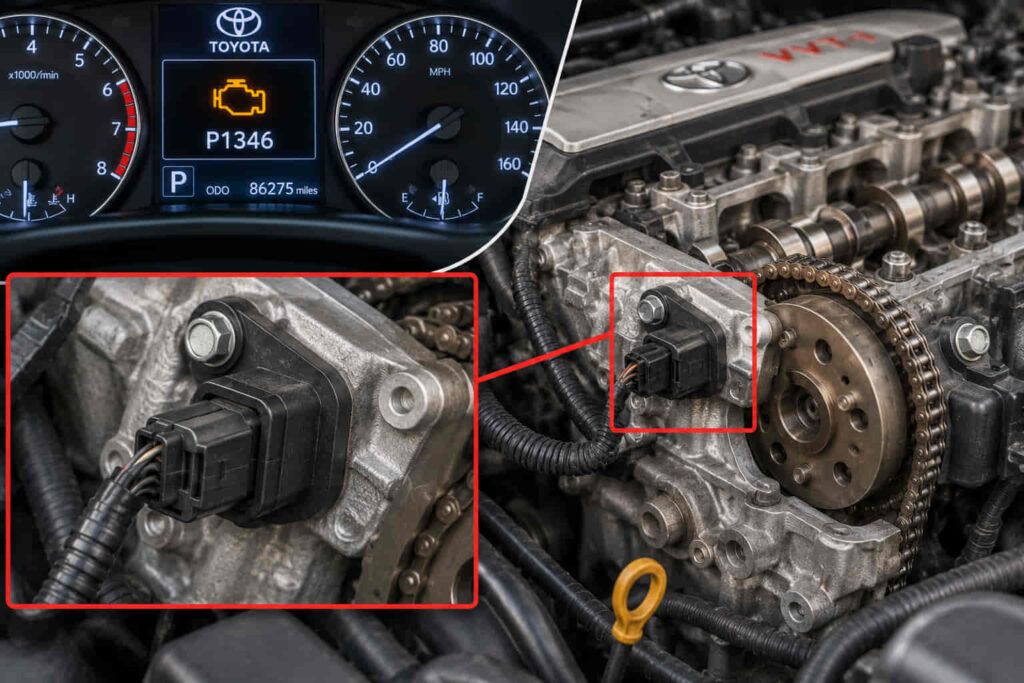
The Toyota P1346 code indicates a problem involving the engine’s variable valve timing control and the signal used to monitor camshaft timing. When the engine control module detects that the relevant camshaft or VVT sensor signal does not meet the expected operating condition, it can store diagnostic trouble code P1346 and illuminate the Check Engine Light. The code identifies the system and abnormal condition that require diagnosis; it does not, by itself, prove that a specific component has failed.
Several faults can lead to a Toyota P1346 code, including problems with the VVT sensor or its electrical circuit and conditions that affect camshaft timing. Because these faults do not require the same repair, replacing a VVT sensor immediately after retrieving P1346 can result in an unnecessary repair if the actual problem is located elsewhere in the circuit or timing system.
Diagnosing P1346 therefore requires identifying the underlying cause before replacing parts. This guide explains what Toyota code P1346 means, the symptoms and causes associated with it, how the code should be diagnosed and repaired, how serious it is, whether the vehicle can still be driven, and what determines the final repair cost.
What Does the P1346 Code Mean on a Toyota?
The Toyota P1346 code means the engine control module has detected an abnormal condition involving the VVT sensor signal used to monitor camshaft timing. The code is associated with Toyota’s Variable Valve Timing system, which changes valve timing according to engine operating conditions. P1346 indicates that the ECM has identified a problem in the information it uses to determine camshaft position and timing; it does not automatically confirm that the VVT sensor itself has failed.
The relationship between the VVT sensor and camshaft timing explains why P1346 requires diagnosis rather than immediate parts replacement. The ECM needs position information from the engine to determine whether valve timing is operating as expected. The VVT sensor provides information related to camshaft position, while crankshaft position information gives the ECM another reference for engine position and speed. The ECM can compare these inputs as part of monitoring engine operation. An abnormal sensor signal, an electrical circuit fault, or a mechanical timing condition can therefore create a fault that leads to P1346.
Toyota’s VVT system adds another layer to this diagnostic process because camshaft timing is not fixed under all operating conditions. The system controls valve timing to match engine operating requirements, so the ECM must distinguish commanded changes in camshaft timing from an abnormal signal or timing condition. For this reason, diagnosing P1346 requires checking the condition responsible for the code instead of treating “P1346” and “failed VVT sensor” as equivalent statements.
This distinction also affects how the vehicle should be repaired. A defective sensor requires a different repair from damaged wiring, a poor electrical connection, or a mechanical timing problem. Reading the stored DTC is therefore the beginning of the diagnostic process. The next step is to determine which part of the VVT sensor circuit or camshaft timing system is producing the abnormal condition.
What Are the Symptoms of Toyota Code P1346?
The most direct symptom of Toyota code P1346 is an illuminated Check Engine Light, while additional engine-performance symptoms depend on the condition that caused the code. P1346 can be stored when the ECM detects the relevant abnormality even when the driver has not yet noticed a dramatic change in how the engine runs. This makes the warning light and retrieved diagnostic code important evidence, but neither one identifies the failed component on its own.
Engine performance can change when the underlying fault interferes with accurate camshaft position information or valve timing. Incorrect timing can affect when the intake and exhaust valves operate relative to piston movement, while an unreliable position signal can interfere with the ECM’s ability to monitor that timing correctly. Depending on the actual failure, the driver may notice abnormal engine operation rather than a warning light alone. The presence and severity of these symptoms should be considered diagnostic information because they help distinguish an electrical signal problem from a more significant timing-related condition.
P1346 should therefore be evaluated together with the vehicle’s behavior and any other stored diagnostic trouble codes. A Toyota that stores P1346 while otherwise operating normally presents a different diagnostic situation from a vehicle that stores the same code while showing substantial engine-performance problems. Additional DTCs can also provide context by identifying another circuit, sensor, or system that the ECM has detected as abnormal.
The symptoms should not be used to select a replacement part without testing. A Check Engine Light confirms that the engine management system has detected a fault, but poor engine operation can result from multiple conditions. The correct diagnostic approach connects the stored P1346 code, observed symptoms, related DTCs, electrical inspection, and timing-system checks before determining the repair.
Read more: Toyota P1155
What Causes the P1346 Code on a Toyota?
Toyota code P1346 can be caused by a fault in the VVT sensor circuit or by a condition that prevents the ECM from receiving the expected camshaft timing information. The diagnostic distinction is important because P1346 identifies an abnormal operating condition rather than naming one component that must be replaced. The cause must therefore be isolated within the sensor, electrical circuit, or mechanical system involved in generating and interpreting the camshaft position signal.
A faulty VVT sensor is one possible cause because the ECM relies on its signal to monitor camshaft position. A sensor that cannot generate the expected signal prevents the ECM from receiving reliable information about camshaft operation. This creates a direct relationship between the component and the DTC: the sensor monitors camshaft position, the signal becomes abnormal, the ECM detects that abnormality, and P1346 is stored. Sensor replacement is appropriate only when testing confirms that the sensor itself is responsible for the signal fault.
The electrical circuit between the VVT sensor and ECM can produce the same diagnostic result without a failed sensor. Damaged wiring, an open or short circuit, a loose connection, or poor terminal contact can interrupt or distort the electrical signal before it reaches the ECM. This is why inspecting the wiring harness and connectors is part of a proper P1346 diagnosis. Replacing a functioning sensor will not correct the code when the actual failure is an electrical connection between the sensor and control module.
Camshaft timing also has to be considered when electrical testing does not explain the fault. The ECM interprets camshaft information in relation to engine position, so a mechanical condition that changes the expected timing relationship can produce information inconsistent with normal engine operation. A timing-related fault therefore requires a different repair path from a sensor circuit failure. Mechanical timing should be verified rather than assumed, especially before replacing major timing components.
The VVT system and engine oil condition may also require inspection when the specific engine design and diagnostic procedure connect them to the observed timing problem. Toyota variable valve timing depends on controlled changes in camshaft timing, and oil is part of the hydraulic operation of many VVT systems. However, low, dirty, or incorrect engine oil should not automatically be labeled the cause of every P1346 code. The oil condition becomes diagnostically relevant when testing shows that VVT operation or actual camshaft timing is involved in the fault.
The ECM is part of the complete signal path, but it should not be treated as the first replacement candidate. Sensor and circuit faults are tested before condemning an engine control module because an ECM-related diagnosis requires evidence that the input components, wiring, connections, and applicable mechanical conditions are operating correctly. This diagnostic hierarchy prevents P1346 from becoming a parts-replacement exercise and keeps the repair focused on the condition that actually generated the code.
The correct cause of P1346 is therefore established by connecting the stored code with sensor output, circuit integrity, camshaft timing, VVT operation, and other diagnostic evidence available for the specific Toyota engine. This cause-and-effect approach is more reliable than replacing the component most commonly associated with the code because several different failures can interfere with the same information monitored by the ECM.
How Do You Diagnose Toyota Code P1346?
To diagnose Toyota code P1346, confirm the stored fault first, inspect the VVT sensor and its electrical circuit, and then investigate camshaft timing or VVT operation when the initial checks do not identify the problem. The purpose of this sequence is to determine whether the ECM is receiving an abnormal signal because of the sensor, wiring and connections, or an underlying timing condition. Diagnosis should identify that failure before any component is replaced.
Start by confirming P1346 with a diagnostic scan tool and checking whether other trouble codes are stored at the same time. Related DTCs provide additional context because P1346 does not identify every detail of the underlying failure by itself. Diagnostic information captured when the fault occurred can also help establish the engine conditions associated with the code. Clearing P1346 before recording this information can remove useful evidence and make an intermittent problem more difficult to reproduce.
The VVT sensor, connector, and nearby wiring should then be inspected for visible conditions that could interfere with the signal reaching the ECM. A connector that is not fully seated, damaged terminals, deteriorated wiring, or an electrical open or short can create a sensor-related fault even when the sensor itself remains functional. This inspection establishes whether the signal path has an obvious physical problem before more detailed electrical testing begins.
Test the VVT sensor and circuit according to the procedure specified for the Toyota engine being diagnosed. The objective is to determine whether the sensor produces the expected signal and whether that signal can travel through the circuit correctly. Circuit testing should distinguish a failed sensor from a wiring or connection problem because both conditions can affect the information received by the ECM. Exact terminal locations, electrical values, and test procedures should come from the repair information for the specific engine rather than from a universal P1346 specification.
Camshaft timing becomes a stronger diagnostic target when the sensor and electrical circuit pass their required checks but P1346 remains present. The ECM monitors camshaft information in the context of engine position, so an incorrect mechanical timing relationship can produce an abnormal condition even when the electrical components are working. At this stage, the technician needs to verify the applicable timing components and camshaft position rather than assuming that another sensor will solve the problem.
VVT operation and engine oil condition should also be evaluated when the engine-specific diagnostic procedure indicates that they can affect the observed timing condition. Oil level, condition, and the correct specification matter to systems that use engine oil hydraulically to control variable valve timing. An oil-related VVT problem should nevertheless be demonstrated through diagnosis rather than inferred simply because P1346 is present.
The ECM should be considered only after the relevant sensor, circuit, connections, and applicable mechanical conditions have been verified. Replacing the ECM before eliminating these inputs reverses the diagnostic hierarchy and can create a costly repair without resolving P1346. The same principle applies to timing components: mechanical disassembly should be supported by diagnostic evidence instead of being the first response to the code.
A successful P1346 diagnosis ends by reproducing or confirming the fault, identifying its cause, completing the appropriate repair, clearing the stored DTC, and checking whether the code returns under suitable operating conditions. If P1346 remains absent and the monitored system operates correctly after verification, the repair addresses the detected fault rather than merely removing the warning code from memory.
How Do You Fix Toyota Code P1346?
To fix Toyota code P1346, repair the sensor, electrical circuit, VVT-related condition, or camshaft timing problem that diagnostic testing confirms as the cause of the fault. P1346 should not be repaired by replacing the VVT sensor automatically because the code identifies an abnormal condition involving camshaft timing information rather than proving that one specific component has failed. The correct repair is determined by the diagnostic result.
Replace the VVT sensor when testing confirms that the sensor cannot provide the expected signal while its wiring, connections, and related conditions remain functional. The replacement addresses the source of the abnormal input in this situation: a functioning sensor restores the camshaft position information required by the ECM. Replacing the sensor without confirming its failure can leave P1346 unresolved when the actual problem is located elsewhere in the circuit.
Repair the electrical circuit when testing identifies damaged wiring, an open or short circuit, poor terminal contact, or another connection problem between the sensor and ECM. Electrical faults can interrupt or alter an otherwise valid sensor signal before the ECM receives it. Correcting the damaged circuit restores the signal path, whereas replacing a functioning sensor does not repair a broken wire or defective connection.
Correct the VVT or oil-related condition when diagnosis demonstrates that it is preventing the system from controlling camshaft timing correctly. The repair must address the condition that affects VVT operation rather than treating an oil change as a universal solution for P1346. Oil level, condition, and specification should be corrected when they are relevant to the diagnosed problem, while a fault in a VVT control component requires the corresponding component or circuit repair.
Repair the mechanical timing system when inspection confirms that the camshaft is no longer operating in the required timing relationship. This repair can involve substantially more work than replacing a sensor because the fault exists in the mechanical system rather than solely in an electrical input. Mechanical timing components should therefore be disturbed only after diagnostic evidence supports this repair path.
An ECM-related repair belongs at the end of the diagnostic process. The ECM receives and evaluates information from the monitored system, so an apparent control-module problem must be separated from abnormal information entering the module. The relevant sensor, circuit, connections, and mechanical conditions should be verified before the ECM is identified as the failed component.
After completing the confirmed repair, clear P1346 and verify the result rather than considering code deletion itself a repair. Operate the engine under appropriate conditions, monitor its behavior, and scan the vehicle again to determine whether P1346 or a related DTC returns. A repair is successful when the underlying fault has been corrected and the ECM no longer detects the abnormal condition that originally caused P1346.
Is Toyota Code P1346 Serious?
Toyota code P1346 should be treated as a fault that requires diagnosis because its severity depends on whether the underlying problem is electrical, VVT-related, or mechanical. A sensor or wiring fault and an incorrect camshaft timing condition can both lead to P1346, but they do not create the same level of mechanical risk. The stored code therefore cannot determine severity without considering the cause and the way the engine is operating.
A P1346 code associated with a sensor signal or electrical connection problem may exist without an immediately obvious change in engine operation. The ECM has still detected information outside the expected condition, so ignoring the code can make it harder to distinguish an existing fault from additional problems that develop later. Diagnosis establishes whether the abnormal signal is limited to the monitoring circuit or reflects a problem with actual camshaft timing.
Mechanical timing problems require greater attention because camshaft timing determines when the engine valves operate relative to piston movement. A confirmed timing fault is fundamentally different from an intermittent connector problem even though both conditions can exist within the diagnostic context of P1346. Continued operation with a significant mechanical problem can allow poor engine operation to persist and may expose the engine to additional risk depending on the specific failure.
The practical severity of P1346 should therefore be determined from three pieces of evidence: the underlying cause, the engine’s current behavior, and the results of diagnostic testing. The presence of P1346 alone does not justify assuming catastrophic engine damage, but the absence of severe symptoms does not justify ignoring the code either. Prompt diagnosis is the appropriate response because it separates a sensor or circuit fault from a condition involving actual valve timing.
Can You Drive a Toyota With the P1346 Code?
A Toyota with P1346 should only be driven when the engine is operating normally enough to reach an appropriate diagnostic or repair location and there are no signs of a serious mechanical problem. The decision should be based on the vehicle’s behavior rather than on the trouble code alone because P1346 can result from faults with different levels of severity.
Limited driving is less concerning when the Check Engine Light is the primary observed symptom and the engine starts, idles, accelerates, and runs without substantial abnormal behavior. This does not mean the fault is safe to ignore. It means the available symptoms do not by themselves demonstrate an immediate mechanical failure. The vehicle should still be diagnosed promptly so the cause can be identified before normal use continues.
Stop driving when the engine develops severe abnormal operation or other evidence suggests that the fault may involve mechanical timing. Continuing to operate an engine with a significant timing problem creates a different risk from driving with an isolated electrical signal fault. Towing the vehicle for diagnosis is the safer choice when engine behavior indicates that continued operation could worsen the underlying condition.
Driving distance should also be kept proportional to the purpose. Using the vehicle briefly to reach a repair facility is different from continuing daily driving for days or weeks while P1346 remains unresolved. The longer the fault is ignored, the longer the engine operates without confirmation that the sensor signal, VVT operation, and camshaft timing are functioning correctly.
P1346 should therefore be treated as a diagnose-before-normal-use code rather than automatically classified as either safe or unsafe to drive. Confirming the root cause provides the information needed to make that distinction. An electrical connection problem, failed sensor, VVT-related condition, and mechanical timing fault require different responses even when the ECM stores the same P1346 code.
How Much Does It Cost to Fix Toyota Code P1346?
The cost to fix Toyota code P1346 depends on the confirmed cause because the repair can range from an electrical or sensor repair to work involving the VVT or mechanical timing system. P1346 does not identify one failed component, so there is no single repair price that accurately applies to every Toyota with this code. Diagnostic cost, replacement parts, labor time, engine configuration, and local labor rates all affect the final amount.
A VVT sensor-related repair is different from a wiring repair because the required parts and labor are not the same. When testing confirms that the sensor itself has failed, the repair cost is primarily determined by the replacement component and the labor required to access and install it. When damaged wiring, terminals, or connectors are responsible, the cost instead depends on the location and extent of the electrical damage. A small connection repair and an extensive wiring-harness repair should not be placed in the same price category simply because both can occur within a P1346 diagnosis.
A VVT-related problem can create another level of repair cost because the technician must correct the condition preventing the system from operating as intended. The required work depends on what diagnosis identifies within the system. An oil-related operating condition, an electrical control problem, and a failed mechanical component represent different repairs and therefore different costs.
Mechanical timing work can become the more labor-intensive repair path when diagnosis confirms that actual camshaft timing is incorrect. Accessing and correcting timing components requires substantially different work from replacing an externally accessible sensor or repairing a connector. This is why receiving a P1346 code should not be interpreted as evidence that an expensive timing repair is automatically required. Mechanical work becomes justified when diagnostic testing supports a mechanical timing fault.
Diagnostic labor should also be considered part of the total repair expense rather than treated as unnecessary cost. Proper testing separates a relatively limited sensor or circuit problem from a more involved VVT or timing condition. Paying for accurate diagnosis can therefore prevent the greater expense of replacing functioning components without eliminating P1346.
The most useful P1346 repair estimate is consequently one produced after the root cause has been identified. An estimate made from the trouble code alone cannot reliably account for the component required, labor time, engine configuration, or extent of the failure. Diagnosis converts P1346 from a broad fault indication into a specific repair that can be priced accurately.
Which Toyota Models Can Have the P1346 Code?
Toyota P1346 applicability should be determined by the vehicle’s engine and manufacturer-specific diagnostic information rather than by assuming that every Toyota model uses the code in the same way. Diagnostic trouble codes can be associated with particular engine-management systems, and the same Toyota model name may be sold with different engines across model years and markets. Model name alone is therefore not sufficient for selecting a P1346 diagnostic procedure.
The engine configuration matters because sensor location, wiring layout, VVT design, timing components, and diagnostic specifications can differ between applications. A procedure that correctly identifies terminals or test specifications for one Toyota engine should not automatically be transferred to another engine simply because both vehicles display P1346. The applicable repair information should match the vehicle, model year, engine, and market specification being diagnosed.
This distinction is particularly important when searching for repair instructions online. A result describing P1346 on one Toyota application can help explain the general diagnostic context, but component locations and testing values still need to match the vehicle being repaired. Using an incorrect specification can cause a functioning sensor or circuit to be classified as faulty and lead to unnecessary replacement.
The vehicle identification information and engine application should therefore be established before performing model-specific P1346 tests. Once the exact application is known, the technician can use the corresponding wiring information, component locations, diagnostic specifications, and repair procedure. This application-specific approach is more reliable than treating “Toyota P1346” as one identical mechanical problem across every Toyota vehicle.
How Can You Prevent Toyota Code P1346 From Returning?
Prevent Toyota code P1346 from returning by correcting its confirmed root cause completely and maintaining the engine systems that directly affect VVT operation and camshaft timing. P1346 cannot always be prevented because an electrical sensor or another component can fail independently of routine maintenance. Prevention is most effective when it targets conditions that can be inspected, maintained, or corrected before they interfere with the signal and timing information monitored by the ECM.
A previous P1346 repair should first eliminate the complete failure rather than only its immediate symptom. Replacing a sensor will not prevent the code from returning when damaged wiring or a poor electrical connection remains in the circuit. Likewise, clearing the DTC removes the stored code from memory but does not correct the condition that caused the ECM to store it. Repair verification is therefore part of prevention because it confirms that the underlying fault has actually been removed.
Engine oil also deserves attention when the specific Toyota VVT system relies on oil pressure and flow to control camshaft timing. Maintaining the correct oil level, using the specification required for the engine, and changing the oil according to the appropriate service requirements help preserve the operating conditions required by the VVT system. This does not mean that routine oil maintenance prevents every P1346 fault. Its preventive value applies when oil condition or oil-dependent VVT operation has a direct relationship with the timing problem being diagnosed.
Electrical connections should remain secure and protected from conditions that can compromise the sensor circuit. Wiring damage, deteriorated terminals, and poor connector contact can alter the signal received by the ECM even when the sensor itself remains functional. Correctly repairing these faults, rather than temporarily repositioning a connector or clearing the code, reduces the likelihood that the same electrical condition will reproduce P1346.
Mechanical timing faults require prevention through correct repair and installation rather than through repeated sensor replacement. When timing-system work has been performed, the relevant components must be installed and verified according to the procedure for that engine. An incorrect mechanical relationship cannot be compensated for by clearing the ECM or installing another sensor.
The most effective preventive strategy is therefore cause-specific. Maintain oil-related VVT operating conditions when they are relevant, repair electrical faults completely, verify mechanical timing after applicable repairs, and confirm that P1346 does not return. This approach keeps preventive maintenance connected to the mechanisms that can actually produce the fault instead of treating general vehicle maintenance as a guaranteed P1346 prevention method.
What Toyota Trouble Codes Are Related to P1346?
Trouble codes related to Toyota P1346 are codes that provide additional diagnostic information about camshaft position, variable valve timing, crankshaft position, or the timing relationship monitored by the engine control system. Their diagnostic value comes from the system relationship rather than simply appearing numerically close to P1346. A related code can help determine whether the fault is isolated to one signal or forms part of a broader engine timing or control problem.
Related DTCs should be interpreted together when more than one code is stored. For example, a code associated with another position signal can change the diagnostic context because the ECM uses multiple inputs to determine engine position and operation. A VVT-related code can likewise provide evidence that the problem extends beyond the signal represented by P1346. The technician should therefore record all stored codes before clearing them and determine how their monitored systems interact.
The order in which multiple codes appeared can also provide useful diagnostic context when that information is available from the scan and repair process. One underlying electrical or mechanical problem can influence more than one monitored condition, so replacing a separate component for every DTC can misidentify the root cause. Diagnostic relationships should be established before deciding whether the codes represent one failure or independent problems.
Exact related-code definitions must also be matched to the Toyota application being diagnosed. Manufacturer-specific DTCs and diagnostic procedures should not be assigned a universal meaning across engines without confirming the applicable repair information. For this reason, a related-code cluster should be built from verified Toyota diagnostic definitions rather than from codes that merely share similar numbers.
For a broader diagnostic strategy, P1346 belongs within a semantic group covering Toyota VVT operation, camshaft and crankshaft position information, camshaft timing, sensor circuits, and related engine-control DTCs. Separate guides for verified related codes can then explain each fault in depth while linking back to P1346 where the diagnostic relationship is relevant. This creates a more useful troubleshooting path than attempting to explain every Toyota timing-related fault inside a single P1346 guide.