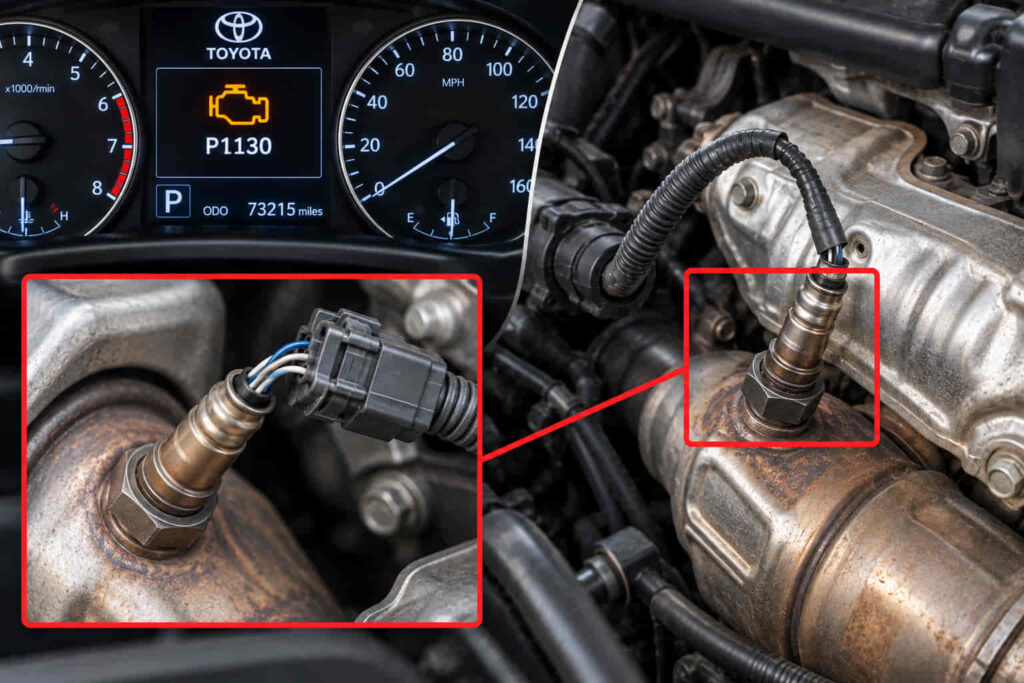
The Toyota P1130 code indicates a fault involving the air-fuel ratio sensor circuit monitored by the engine control module. The A/F sensor provides information the ECM uses to evaluate the air-fuel mixture and manage engine operation. When the monitored sensor circuit does not operate within the expected conditions, the ECM can store diagnostic trouble code P1130 and illuminate the Check Engine Light.
P1130 points technicians toward the A/F sensor and its circuit, but the presence of the code does not automatically prove that the sensor itself has failed. A problem with the sensor, wiring, electrical connections, or another condition affecting the monitored system can require a different diagnostic and repair path. Replacing the sensor without confirming the root cause can therefore result in unnecessary parts replacement while leaving the original fault unresolved.
Diagnosing Toyota P1130 requires connecting the stored code with the condition of the sensor circuit and the engine application being tested. This guide explains what Toyota code P1130 means, how the A/F sensor relates to the fault, which symptoms and causes should be investigated, how to diagnose and repair the problem, how serious the code is, whether the vehicle can still be driven, and what determines the final repair cost.
What Does the P1130 Code Mean on a Toyota?
The Toyota P1130 code means the ECM has detected an abnormal condition involving the air-fuel ratio sensor circuit. The code directs diagnosis toward the A/F sensor system and the electrical information the ECM receives from it. P1130 identifies the monitored circuit in which the abnormality was detected, but it does not independently establish which component has failed.
The ECM uses sensor information to monitor combustion conditions and control engine operation. An A/F sensor is positioned in the exhaust stream, where it responds to oxygen-related conditions in the exhaust gas and provides information that the ECM can use when evaluating the air-fuel mixture. When the relevant circuit does not behave as expected under the conditions monitored by the ECM, P1130 can be stored and the Check Engine Light can illuminate.
This distinction between a diagnostic trouble code and a confirmed component failure is important. P1130 can direct attention toward the A/F sensor circuit without proving that installing a new sensor will correct the fault. The sensor itself, its wiring, electrical connections, or another condition affecting the monitored system must be evaluated before selecting the repair.
The exact diagnostic procedure also needs to match the Toyota application being tested. Engine-management systems, component locations, electrical specifications, and diagnostic procedures can differ between engines and model years. For that reason, Toyota P1130 should first be interpreted as a direction for diagnosis, followed by application-specific testing that identifies why the ECM detected the abnormal circuit condition.
How Does the Air-Fuel Ratio Sensor Relate to Toyota P1130?
The air-fuel ratio sensor relates directly to Toyota P1130 because its circuit provides the ECM with information used to evaluate the air-fuel mixture and engine fuel control. The sensor converts conditions in the exhaust stream into an electrical response that the control system can interpret. P1130 becomes relevant when the ECM determines that the monitored A/F sensor circuit is not operating within its expected conditions.
The A/F sensor functions as part of a feedback process rather than as an isolated emissions component. Combustion produces exhaust gas, the sensor responds to the exhaust condition, and the ECM evaluates the resulting information while controlling engine operation. This creates a functional relationship between combustion, exhaust composition, sensor response, electrical signal, and ECM fuel control. A fault anywhere in the monitored portion of that relationship can therefore require investigation when P1130 is stored.
An air-fuel ratio sensor should also not be treated as interchangeable with every component commonly described as an oxygen or O2 sensor. These terms are frequently used together because both types of sensors operate in the exhaust and provide oxygen-related information, but the sensor design and the way its signal is interpreted can differ. Correct component identification matters when diagnosing P1130 because testing or replacing the wrong sensor type can produce an incorrect diagnosis.
The sensor circuit is equally important as the sensor element itself. A functional A/F sensor cannot provide usable information to the ECM when damaged wiring, poor terminal contact, or another circuit fault prevents its electrical response from reaching the control module correctly. This is why P1130 diagnosis must evaluate the sensor and its signal path as a system rather than reducing the code to an automatic A/F sensor replacement.
Understanding this relationship establishes the diagnostic logic for the rest of the repair. P1130 indicates where the ECM has detected an abnormality, the A/F sensor circuit explains how that information reaches the control system, and diagnostic testing determines which condition disrupted that process. The repair should follow that confirmed condition rather than the name of the sensor most closely associated with the code.
Read more: Toyota P1346
What Are the Symptoms of Toyota Code P1130?
The most direct symptom of Toyota code P1130 is an illuminated Check Engine Light, while additional engine symptoms depend on the condition affecting the A/F sensor circuit and fuel control. The ECM can detect and store the fault before the driver notices a substantial change in vehicle operation. For this reason, P1130 may initially appear as a diagnostic code retrieved after the warning light turns on rather than as an obvious driveability problem.
Engine operation can change when the underlying fault prevents the ECM from receiving reliable air-fuel ratio information. The A/F sensor participates in the feedback the engine-management system uses to evaluate combustion and fuel control. An abnormal sensor response or circuit condition can therefore affect the information available to the ECM, although the resulting vehicle behavior depends on the nature and extent of the failure.
Observed symptoms should be evaluated together with P1130 rather than used independently to identify a failed component. An engine-performance problem does not prove that the A/F sensor itself has failed because fuel delivery, intake conditions, exhaust conditions, electrical faults, and other engine-management problems can influence combustion or sensor information. Conversely, a vehicle that appears to run normally can still have a stored P1130 because the ECM has detected an electrical or operating condition that the driver cannot directly feel.
Other stored DTCs provide additional diagnostic context when symptoms extend beyond the Check Engine Light. A second code involving fuel control, another sensor circuit, or a related engine-management condition can change the direction of diagnosis. Recording the complete code set and the vehicle’s operating behavior before clearing the codes therefore provides more useful evidence than treating P1130 as an isolated instruction to replace a sensor.
What Causes the P1130 Code on a Toyota?
Toyota P1130 is caused by a condition that prevents the monitored air-fuel ratio sensor circuit from operating within the range or behavior expected by the ECM. The fault can originate in the A/F sensor, its electrical circuit, or another condition that affects the sensor’s ability to provide the expected information. Identifying which part of this relationship has failed is necessary before selecting a repair.
The A/F sensor itself becomes a cause when an internal failure prevents it from producing the response expected by the engine control system. The sensor operates continuously in the exhaust environment and must convert changing exhaust conditions into information the ECM can interpret. When the sensor can no longer respond correctly, the ECM can detect an abnormal circuit condition and store P1130. Sensor replacement is justified when diagnostic testing confirms this failure rather than merely because the sensor appears in the code definition.
Wiring and connector faults can produce an abnormal sensor circuit even when the A/F sensor remains functional. Damaged wiring, an electrical open or short, poor terminal contact, or a compromised connection can alter or interrupt the electrical path between the sensor and ECM. The control module then receives information that does not represent normal circuit operation. This mechanism explains why circuit inspection and electrical testing must occur before a functioning sensor is condemned.
Conditions affecting the sensor’s operating environment also require consideration when diagnostic evidence points beyond the electrical circuit. The A/F sensor measures conditions in the exhaust stream, so an engine or exhaust problem capable of changing what reaches the sensor can influence the information the ECM receives. Such a condition must be distinguished from an actual sensor failure because replacing the sensor does not correct an upstream problem that continues to produce abnormal operating information.
The ECM belongs at the end of the causal investigation rather than at the beginning. The control module evaluates information arriving from the monitored circuit, which means an apparent ECM-side fault must first be separated from defective sensor output, damaged wiring, poor electrical connections, and applicable engine or exhaust conditions. Identifying the ECM as the cause without eliminating these upstream possibilities can result in an expensive repair that leaves P1130 unresolved.
The root cause is therefore established by testing the complete monitored relationship rather than selecting the component whose name is most closely associated with P1130. The diagnostic question is whether the sensor generates the correct response, whether the circuit delivers that information correctly, and whether another operating condition is influencing what the sensor detects. The answer determines whether P1130 requires sensor replacement, electrical repair, correction of an underlying engine condition, or further control-system diagnosis.
How Do You Diagnose Toyota Code P1130?
To diagnose Toyota code P1130, confirm the stored DTC first, inspect the air-fuel ratio sensor and its electrical circuit, and then determine whether the abnormal condition originates from the sensor, wiring, operating environment, or engine control system. The purpose of diagnosis is to identify why the ECM detected the P1130 condition before replacing any component.
Begin by confirming P1130 with a compatible scan tool and recording any other stored or pending diagnostic trouble codes. Freeze-frame or other available diagnostic data should be preserved before codes are cleared because it can show the operating conditions present when the ECM detected the fault. A related DTC can also change the diagnostic direction by indicating that P1130 is part of a broader fuel-control, sensor, or electrical problem rather than an isolated sensor failure.
The A/F sensor connector and wiring should then be inspected for physical conditions capable of disrupting the circuit. Damaged insulation, loose connections, poor terminal contact, corrosion, or wiring exposed to excessive heat can interfere with the electrical information traveling between the sensor and ECM. Finding a circuit problem at this stage prevents unnecessary sensor replacement because a new sensor cannot correct an open, short, or defective connection elsewhere in the signal path.
Electrical testing should determine whether the A/F sensor and its circuit operate according to the specifications for the exact Toyota application. The test procedure must match the vehicle’s model year, engine, and engine-management system because connector arrangements and diagnostic specifications are not necessarily identical across Toyota applications. Generic resistance, voltage, or pin values should not be substituted for the correct service information simply because the same P1130 code is present.
The diagnostic process should move beyond the sensor circuit when electrical testing does not explain the code. Because the A/F sensor responds to conditions in the exhaust stream, an underlying engine or exhaust condition can influence the information detected by the sensor. The technician must distinguish between a sensor that is reporting an abnormal condition correctly and a sensor or circuit that is itself producing incorrect information. This distinction prevents a functioning sensor from being replaced when the actual fault originates elsewhere.
Sensor data should be interpreted in context rather than judged from one isolated reading. The diagnostic objective is to determine whether the sensor responds as expected to changing engine conditions and whether the ECM receives that response correctly. A signal that appears abnormal can result from the sensor, the circuit carrying its information, or the combustion and exhaust condition the sensor is measuring. Each possibility requires a different repair.
The ECM should only become a primary suspect after the applicable sensor, wiring, connections, and underlying operating conditions have been tested. The control module sits at the receiving end of the monitored relationship, so replacing it before verifying the information entering it reverses the diagnostic sequence. An ECM diagnosis requires evidence that the relevant upstream components and circuits function correctly while the control system still fails to process or monitor them as specified.
Diagnosis is complete when testing identifies the condition responsible for P1130 rather than simply when the code has been cleared. After the confirmed fault is repaired, clear the stored DTC, operate the vehicle under appropriate conditions, and scan the system again. P1130 remaining absent after verification provides evidence that the repair corrected the underlying fault instead of temporarily removing the code from ECM memory.
How Do You Fix Toyota Code P1130?
To fix Toyota code P1130, repair the confirmed fault in the air-fuel ratio sensor, its electrical circuit, or the underlying condition that is causing the ECM to detect abnormal A/F sensor operation. Replacing the A/F sensor can correct P1130 when testing confirms that the sensor has failed, but sensor replacement should not be treated as the automatic repair for every vehicle that stores this code.
Replace the A/F sensor when diagnostic testing shows that the sensor cannot produce the expected response while its wiring, connections, and relevant operating conditions remain correct. In this situation, the failed sensor is the source of the abnormal information detected by the ECM. Installing the correct sensor for the Toyota engine restores the component responsible for monitoring the exhaust condition, after which the system must be tested again to confirm that P1130 does not return.
Repair the electrical circuit when the sensor is functional but its information cannot reach the ECM correctly. Damaged wiring, an open or short circuit, poor terminal contact, or a defective connector can alter the electrical path and reproduce the same diagnostic condition associated with a sensor problem. The appropriate repair is to restore circuit integrity rather than replace a functioning A/F sensor. Connector and wiring repairs should also address the reason for the damage when that cause can be identified, such as heat exposure or physical deterioration.
Correct an underlying engine or exhaust condition when testing demonstrates that the A/F sensor is responding to an abnormal operating environment rather than generating false information itself. The distinction is important because the sensor measures conditions in the exhaust stream. A functioning sensor can therefore report information that appears abnormal when combustion or another relevant operating condition is actually responsible. Replacing that sensor would leave the original condition unchanged and can allow P1130 or related engine-management faults to return.
An ECM-related repair should only be considered after the relevant sensor, wiring, electrical connections, and applicable operating conditions have passed their required tests. The ECM receives and evaluates information from the monitored circuit, so a control-module diagnosis requires evidence that the information entering the module is correct but the system still fails to monitor or process it as specified. This places ECM replacement at the end of the repair hierarchy rather than at the beginning.
After completing the repair, clear P1130 from ECM memory and verify the result under appropriate operating conditions. Clearing the code alone does not constitute a repair because it only removes the stored diagnostic information. The vehicle should be operated, monitored for abnormal behavior, and scanned again for P1130 and related DTCs. A successful repair corrects the condition that caused the ECM to detect the fault and prevents the same diagnostic condition from returning.
The correct P1130 repair is therefore determined by evidence rather than by the name of the component associated with the code. Sensor failure requires sensor replacement, circuit failure requires electrical repair, and an underlying operating problem requires correction at its source. This cause-specific approach reduces unnecessary parts replacement and provides a verifiable endpoint for the diagnostic process.
Is Toyota Code P1130 Serious?
Toyota code P1130 should be diagnosed promptly, but its actual severity depends on the condition causing the A/F sensor circuit fault and its effect on engine operation. P1130 does not by itself indicate catastrophic engine failure. It shows that the ECM has detected an abnormal condition in a monitored circuit involved in air-fuel ratio information, making the underlying cause more important than the presence of the code alone when determining severity.
A sensor or electrical circuit fault can exist while the engine continues to operate without an immediately obvious driveability problem. The absence of severe symptoms does not mean the fault should be ignored because the ECM is no longer receiving the expected information from the monitored system. Leaving the condition unresolved can also make subsequent diagnosis more difficult if additional engine-management faults develop.
Severity increases when the underlying problem affects fuel control or produces noticeable changes in engine operation. The A/F sensor provides information that the ECM uses when evaluating the air-fuel mixture, so a fault that compromises this feedback can affect how accurately the engine-management system responds to combustion conditions. The practical importance of the fault therefore depends on whether P1130 represents an isolated circuit problem or forms part of a broader operating problem.
A condition outside the sensor itself can also change the severity assessment. When the A/F sensor is correctly responding to an abnormal engine or exhaust condition, replacing the sensor does not address the problem responsible for the diagnostic information. The underlying condition must be identified because its consequences can differ substantially from those of an isolated sensor or connector failure.
P1130 should therefore be classified according to diagnostic evidence rather than the DTC number alone. The condition of the sensor circuit, the presence of related codes, the way the engine operates, and the confirmed root cause provide the information needed to determine urgency. Prompt diagnosis separates a manageable sensor or wiring repair from an engine-management condition that requires more immediate attention.
Can You Drive a Toyota With the P1130 Code?
A Toyota with P1130 can be driven a limited distance for diagnosis when the engine operates normally and no severe warning signs are present, but normal long-term driving should not continue until the cause has been identified. The decision depends on vehicle behavior because P1130 can represent different sensor, circuit, and operating conditions.
Limited driving is less concerning when the Check Engine Light is the primary observed symptom and the vehicle starts, idles, accelerates, and responds normally. This situation does not establish that the fault is harmless. It indicates only that the available symptoms do not show an immediate severe driveability problem. The appropriate next action is still to diagnose the A/F sensor circuit rather than continue using the vehicle indefinitely with the code stored.
Continued driving becomes less appropriate when P1130 appears together with substantial changes in engine operation or additional warning conditions. Abnormal engine behavior provides evidence that the problem may extend beyond a stored electrical fault and can affect the system the A/F sensor helps the ECM monitor. In this situation, continued operation can complicate the fault and should not be preferred over prompt inspection.
Related DTCs also affect the driving decision. P1130 stored by itself provides less diagnostic information than P1130 accompanied by codes indicating other fuel-control, sensor, or engine-management abnormalities. Multiple related faults can point toward a broader condition that deserves investigation before the vehicle returns to normal use.
The purpose and distance of continued driving should therefore remain limited. Driving directly to an appropriate repair location is different from continuing routine commuting for an extended period while P1130 remains unresolved. The latter leaves the vehicle operating without confirmation that the A/F sensor circuit and related fuel-control information are functioning as intended.
The safest practical approach is to use the vehicle’s behavior as an immediate risk indicator and diagnosis as the final decision point. P1130 alone does not prove that the Toyota must be stopped immediately, but it also does not provide evidence that unrestricted driving is appropriate. Identifying whether the fault originates from the sensor, electrical circuit, or an underlying operating condition determines the correct response.
How Much Does It Cost to Fix Toyota Code P1130?
The cost to fix Toyota code P1130 depends on the confirmed cause because a failed A/F sensor, damaged electrical circuit, and underlying engine or exhaust condition require different parts and labor. P1130 identifies a diagnostic condition rather than one repair, so a single price cannot accurately represent every vehicle with this code. The final cost is determined by diagnostic labor, the component or system that actually failed, vehicle application, parts pricing, and local labor rates.
A confirmed A/F sensor failure creates a different repair scope from a wiring or connector problem. Sensor replacement requires the correct component for the engine and the labor necessary to access, remove, and install it. The cost can therefore change according to sensor location and vehicle configuration. A replacement estimate should also distinguish the sensor itself from other components that may be described generically as oxygen sensors because selecting the correct part is necessary for an accurate repair.
Electrical faults are priced according to the location and extent of the circuit damage rather than the P1130 code itself. Repairing a poor connector terminal can require substantially different labor from locating an intermittent open or short within a wiring harness. A functioning A/F sensor does not need replacement when circuit testing establishes that damaged wiring or a connection problem is responsible for the abnormal condition detected by the ECM.
The repair can become more involved when diagnosis identifies an underlying engine or exhaust condition rather than a sensor or wiring failure. Because the A/F sensor responds to conditions in the exhaust stream, the sensor can provide abnormal information when another problem changes the environment it is measuring. The cost in this situation belongs to correcting that underlying condition, not automatically to replacing the sensor associated with P1130.
Diagnostic labor should therefore be included when estimating the total cost of repairing P1130. Testing adds an upfront expense, but it establishes whether the repair requires a sensor, circuit work, or investigation of another operating condition. Accurate diagnosis can cost less than replacing a functioning A/F sensor and then paying for a second repair when the code returns.
A useful P1130 repair estimate can only be produced after the root cause and exact Toyota application are known. The code provides the starting point for diagnosis; it does not specify the final parts bill or labor time. Once testing identifies the failed component or condition, the repair can be priced according to the actual work required.
Which Toyota Models Can Have the P1130 Code?
Toyota P1130 applicability should be confirmed from the vehicle’s model year, engine, and manufacturer-specific diagnostic information rather than from the Toyota model name alone. The same model can use different engines and engine-management systems across production years and markets, so a P1130 diagnostic procedure found for one application should not automatically be applied to another.
Engine application is particularly important because the A/F sensor arrangement, sensor location, electrical circuit, connector configuration, and ECM strategy can differ between vehicles. These differences affect both diagnosis and repair. A sensor test specification that is correct for one engine can produce an incorrect conclusion when applied to a different engine-management system.
This application-specific approach also prevents mistakes when identifying Bank 1, Sensor 1, or another sensor position. Sensor terminology should be matched to the engine layout and Toyota repair information for the vehicle being diagnosed. Choosing a replacement part from the DTC number and model name alone can result in the wrong sensor being tested or replaced.
Model year matters for the same reason. A Toyota nameplate can remain in production through multiple engine and emissions-system generations while diagnostic strategies change. Search results describing P1130 on another production year can provide general context, but they should not replace the service information applicable to the vehicle being repaired.
Confirm the vehicle identification and engine application before using P1130-specific wiring diagrams, connector locations, electrical specifications, or component replacement procedures. This creates a direct diagnostic chain from vehicle application to correct service information, testing, confirmed cause, and repair. It is more reliable than treating Toyota P1130 as an identical component failure across every Toyota vehicle.
How Can You Prevent Toyota Code P1130 From Returning?
Prevent Toyota code P1130 from returning by correcting its confirmed root cause completely and verifying that the A/F sensor circuit operates correctly after the repair. P1130 cannot always be prevented through routine maintenance because a sensor or electrical component can fail independently of vehicle maintenance. Prevention is most effective when it addresses the specific condition that previously caused the ECM to detect the fault.
A sensor replacement should be followed by verification that the electrical circuit and related connections are functioning correctly. Installing a new A/F sensor does not prevent P1130 from returning when damaged wiring, poor terminal contact, or another unresolved circuit problem continues to interfere with the information reaching the ECM. The complete signal path therefore matters as much as the replacement component.
Electrical repairs should correct the source and extent of the circuit failure rather than temporarily restore contact. A loose connector, damaged wire, deteriorated terminal, or heat-related wiring problem can become intermittent and cause P1130 to return after the code has been cleared. Restoring circuit integrity and confirming that the connection remains stable reduces the chance that the same electrical condition will reproduce the fault.
Underlying engine or exhaust conditions should also be corrected when diagnosis shows that they are influencing what the A/F sensor detects. The sensor responds to the environment in the exhaust stream, so replacing a functioning sensor cannot prevent recurrence when another condition continues to produce abnormal information. Prevention in this situation means repairing the source of the abnormal operating condition and then confirming that sensor behavior returns to the expected state.
Clearing the DTC should occur after the repair, not in place of it. Removing P1130 from ECM memory only resets the stored diagnostic information and provides no evidence that the original fault has disappeared. Operating the vehicle under appropriate conditions and scanning it again establishes whether the ECM continues to detect the condition responsible for the code.
The most effective P1130 prevention strategy is therefore cause-specific. Correct the sensor failure when the sensor is defective, restore the circuit when the electrical path is damaged, repair an underlying operating condition when it affects sensor information, and verify the result after every repair. This approach prevents recurrence by addressing the mechanism that generated P1130 rather than relying on generic maintenance advice.
What Toyota Trouble Codes Are Related to P1130?
Toyota trouble codes related to P1130 are DTCs that provide additional diagnostic information about the A/F sensor system, its electrical circuit, fuel control, or another condition that affects the information monitored by the ECM. Diagnostic relationship is more important than numerical proximity, so a code should not be considered related to P1130 simply because its number appears close to P1130.
Related codes become particularly useful when several DTCs are stored at the same time. A second sensor-circuit code can indicate that the diagnostic problem extends beyond the condition represented by P1130, while a fuel-control-related code can provide evidence about the engine conditions occurring when the ECM detected the fault. Interpreting the codes together can therefore narrow the diagnostic path more effectively than treating every DTC as an independent component failure.
Multiple codes also need to be evaluated for a shared root cause. One electrical, engine, or exhaust condition can influence more than one monitored parameter and cause the ECM to store several DTCs. Replacing one component for each stored code can therefore create unnecessary repairs when the codes originate from the same underlying problem. The relationship between the monitored systems should be established before individual components are condemned.
Manufacturer-specific definitions remain important when identifying related Toyota codes. A numerical sequence alone does not establish that two DTCs describe the same sensor, circuit, or failure mechanism. The exact definition and diagnostic procedure for each code should be confirmed for the applicable Toyota engine-management system before it is connected diagnostically with P1130.
P1130 can therefore serve as part of a broader Toyota diagnostic content cluster covering air-fuel ratio sensors, sensor circuits, fuel-control feedback, and verified related DTCs. Separate pages can explain each related fault in depth and link back to P1130 when their diagnostic contexts overlap. This structure gives users a clear path from one stored code to the systems and faults that are genuinely relevant to its diagnosis.