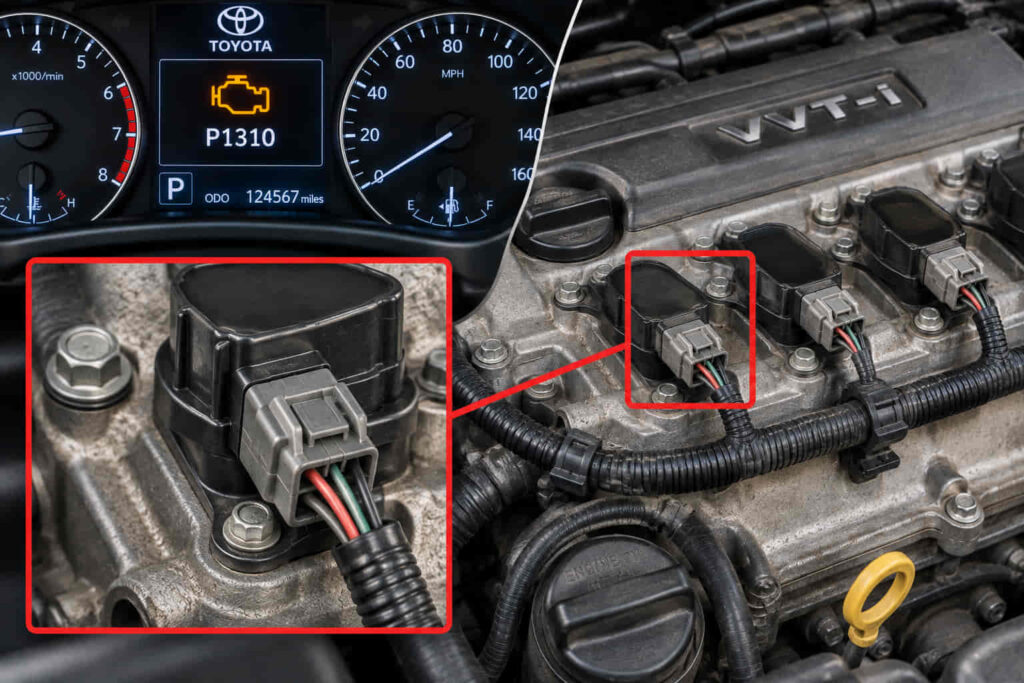
The Toyota P1310 code indicates a malfunction in the ignition control circuit, meaning the engine control module (ECM) has detected a problem with the signals used to control or confirm ignition operation. On applicable Toyota engines, the ECM uses ignition-related signals such as IGT and IGF to coordinate spark generation and verify that the ignition system is operating as expected. When the expected signal is missing or abnormal, the ECM can store P1310 and turn on the Check Engine Light.
P1310 does not automatically mean that the ignition coil needs replacement. The fault can originate from the ignition coil or igniter, electrical wiring, connectors, power supply, or another part of the ignition control circuit. An ignition problem may also produce engine symptoms such as misfiring, rough running, hesitation, or reduced acceleration, depending on the underlying failure and engine configuration.
Diagnosing Toyota P1310 therefore requires identifying the affected ignition circuit before replacing components. A systematic diagnosis examines accompanying trouble codes, ignition components, wiring and electrical connections, then verifies the suspected failure through appropriate testing. The sections below explain what Toyota P1310 means, what causes it, which symptoms can occur, and how to diagnose and repair the fault correctly.
What Does the P1310 Code Mean on a Toyota?
Toyota P1310 is an ignition-system diagnostic trouble code that indicates an ignition control circuit malfunction. The code is stored when the engine control module detects that the expected operation of the ignition system has not been confirmed correctly. This makes P1310 an electrical and ignition-control fault rather than a code that identifies one failed component by itself.
The ignition process depends on communication between the ECM and the components responsible for producing spark. On Toyota ignition systems that use IGT and IGF signals, the ECM sends an IGT ignition timing command to initiate ignition. After the ignition event occurs, an IGF feedback signal confirms ignition operation to the ECM. A missing or abnormal signal can therefore indicate that the commanded ignition event has not been confirmed as expected.
This distinction is important because P1310 does not mean “replace the ignition coil.” The code identifies a malfunction within the monitored ignition circuit, while diagnosis identifies the component or electrical condition responsible for that malfunction. The ignition coil or igniter may be involved, but wiring, connectors, electrical supply, and other parts of the circuit must also be considered before a component is replaced.
P1310 may also appear with other diagnostic trouble codes. Those accompanying codes provide additional context because they can identify a misfire, another ignition-related fault, or a circuit problem that helps narrow the diagnostic area. Reading all stored and pending codes before clearing them preserves information that can make the cause of P1310 easier to isolate.
What Causes the P1310 Code on a Toyota?
Toyota P1310 is caused by a fault that prevents the ignition control circuit from operating or reporting ignition operation as the ECM expects. The diagnostic process should therefore focus on the ignition coil or igniter and its electrical circuit before considering less direct causes.
A defective ignition coil or igniter is one area that requires inspection because these components are directly involved in producing and controlling ignition. An internal electrical failure can prevent the ignition event from occurring correctly or interfere with the feedback the ECM expects to receive. The result can be P1310 together with noticeable engine operation problems when the failure affects combustion.
Damaged wiring and poor electrical connections can produce the same code without the ignition component itself being defective. An open circuit, short circuit, loose terminal, corrosion, damaged connector, or compromised harness can interrupt the electrical path between the ECM and ignition components. For example, replacing a functioning ignition coil will not correct P1310 when a damaged wire prevents the required signal from reaching or returning from that coil.
Spark plugs also need to be evaluated in the broader ignition diagnosis when engine performance indicates poor combustion or misfiring. A worn, contaminated, incorrectly gapped, or otherwise defective spark plug can prevent reliable spark at the combustion chamber even when other ignition components are functioning. Its presence should be confirmed through inspection and related diagnostic evidence rather than assuming every P1310 requires spark plug replacement.
Power supply and ground integrity are equally important because an ignition component cannot operate correctly without the required electrical conditions. Voltage problems, excessive resistance, or a poor ground can produce ignition-system behavior that resembles component failure. Testing the circuit before replacing parts separates an electrical supply problem from an internally failed ignition component.
The ECM should be considered only after the ignition components and their circuits have been tested according to the applicable Toyota diagnostic procedure. P1310 alone is not evidence that the ECM has failed. Replacing the ECM before verifying the coil or igniter, wiring, connectors, power supply, ground, and relevant signals can result in an expensive repair that leaves the original fault unchanged.
Read more: Toyota P1130
What Symptoms Can Occur With Toyota Code P1310?
Toyota P1310 can occur with a Check Engine Light, engine misfire, rough running, hesitation, and reduced engine performance when the underlying ignition fault disrupts combustion. The exact symptoms depend on which part of the ignition circuit has failed and whether the failure is intermittent or continuous. P1310 identifies an ignition-control malfunction, so the code itself should not be treated as a guarantee that every vehicle will exhibit the same drivability symptoms.
The Check Engine Light is one of the clearest indications that the ECM has detected and stored an abnormal condition. A vehicle may still appear to run normally when the electrical fault is intermittent or has not substantially affected ignition. This is why the absence of severe drivability symptoms does not establish that the ignition system is operating correctly.
Engine misfire can develop when the affected ignition system fails to produce a reliable spark for combustion. A cylinder requires properly timed ignition of the air-fuel mixture to produce useful power. An ignition coil, igniter, electrical connection, or related circuit fault that interrupts this process can cause incomplete or missed combustion events. The driver may experience this as shaking, uneven engine operation, or a noticeable loss of smoothness.
Rough idle and hesitation can occur through the same mechanism. Stable engine operation depends on consistent combustion across the cylinders. When ignition becomes inconsistent, engine speed can fluctuate at idle and power delivery can become uneven during acceleration. A more substantial ignition failure can also reduce engine performance because the affected cylinder or cylinders are no longer contributing power normally.
These symptoms are not exclusive to P1310. Misfire, rough idle, and poor acceleration can originate from ignition, fuel, air-intake, mechanical, or engine-control problems. The presence of P1310 makes the monitored ignition circuit a diagnostic priority, but the code should be interpreted together with accompanying DTCs and test results rather than symptoms alone.
How Do You Diagnose Toyota Code P1310?
Diagnosing Toyota P1310 requires identifying the ignition circuit responsible for the fault and testing that circuit before replacing components. The diagnostic sequence should begin with stored trouble-code information, continue through physical and electrical inspection, and finish by confirming that the suspected repair eliminates the fault.
Start with a diagnostic scan of the ECM and preserve all stored and pending trouble codes before clearing anything. Companion codes can provide diagnostic direction that P1310 alone does not provide. A related ignition or misfire code, for example, can help narrow the investigation to a particular circuit or combustion problem. Clearing the codes at the beginning removes information that may be useful for identifying the original failure.
The ignition components and their connections should then be inspected for visible abnormalities. The inspection should focus on the ignition coil or igniter configuration used by the applicable engine, its connectors, the associated wiring harness, and other accessible parts of the ignition circuit. Loose terminals, corrosion, damaged insulation, broken wires, heat damage, and poor connector contact can interrupt a signal even when the connected component remains functional.
Electrical testing is necessary when visual inspection does not establish the cause. The relevant circuit should be checked for the electrical conditions specified by the applicable Toyota diagnostic information, including power supply, ground integrity, continuity, and ignition-control or feedback signals where required. This separates a defective ignition component from a wiring or circuit fault that can produce similar symptoms.
Ignition components should be condemned only when the diagnostic evidence supports that conclusion. A suspected coil, for example, should not be replaced solely because P1310 is stored. The technician must determine whether the component itself has failed or whether its operation is being disrupted by its connector, wiring, power supply, ground, or control circuit.
Spark plugs should also be inspected when misfire or poor combustion is part of the symptom pattern. Their physical condition can provide useful evidence about ignition and combustion, but spark plug replacement should address an identified condition rather than serve as a default response to P1310.
The ECM belongs near the end of the diagnostic path. Before suspecting an ECM failure, the relevant ignition components, electrical connections, wiring, supply voltage, grounds, and required circuits should be verified. This order prevents an expensive control module from being replaced when the actual cause is a coil, connector, damaged wire, or another repairable circuit fault.
Diagnosis is complete only after the repair has been verified. The DTC can be cleared after the identified fault is corrected, followed by an appropriate engine operation or drive verification to determine whether P1310 returns. A code that does not return after the underlying fault has been repaired provides stronger confirmation than simply clearing the Check Engine Light.
How Do You Fix the P1310 Code on a Toyota?
Fixing Toyota P1310 requires repairing the ignition component or electrical circuit confirmed to be responsible for the fault. There is no single replacement part that fixes every P1310 case because the code identifies an ignition-control malfunction rather than one specific failed component. The correct repair must therefore follow the diagnostic result.
An ignition coil or igniter should be replaced when testing confirms that the component cannot perform its required ignition function despite having the correct electrical supply and circuit conditions. This distinction prevents a functioning component from being replaced when the actual failure is located in its wiring or connector. Installing a new coil without testing the circuit can leave P1310 unchanged when an open circuit, short circuit, poor terminal connection, or damaged harness is responsible.
Damaged wiring and connectors require electrical repair rather than ignition-component replacement. Corroded terminals, loose connections, broken conductors, damaged insulation, or excessive resistance can interrupt communication between the ECM and ignition system. Repairing the affected wiring or connector restores the electrical path that the ignition circuit requires to operate and report its status correctly.
Spark plugs should be replaced when inspection confirms excessive wear, contamination, physical damage, an incorrect gap, or another condition that prevents reliable ignition. They should not automatically be replaced simply because P1310 is present. The same diagnostic principle applies to related ignition components: the repair should address an observed or measured failure rather than a presumed cause.
ECM replacement should remain one of the final repair considerations. A suspected ECM fault requires the relevant ignition circuits, wiring, connectors, power supplies, grounds, and components to be verified first. Replacing an ECM without eliminating these possibilities increases repair cost and may leave the original P1310 condition unresolved.
After completing the repair, clear the stored DTC and verify engine operation under appropriate conditions. The objective is not merely to switch off the Check Engine Light but to confirm that the ECM no longer detects the ignition malfunction. If P1310 returns, the underlying problem remains present or the original diagnosis did not identify the complete fault.
How Serious Is the Toyota P1310 Code?
Toyota P1310 should be treated as an ignition-system fault that requires diagnosis rather than ignored as a harmless stored code. Its practical severity depends on the underlying failure and the effect that failure has on engine operation. A vehicle with an intermittent electrical problem and normal engine operation presents a different immediate situation from one with continuous misfiring and substantial loss of power.
The code becomes more significant when the ignition malfunction interferes with combustion. Repeated misfire can cause rough running, hesitation, poor acceleration, and unstable engine operation because one or more combustion events are not producing power normally. The presence of these symptoms means the problem affects more than the warning-light system and should be investigated promptly.
A persistent misfire can also place additional stress on other vehicle systems. Fuel entering a cylinder without being burned correctly can pass into the exhaust, where abnormal combustion conditions can increase exhaust-system temperatures. For this reason, a severe ignition-related misfire should not be treated in the same way as a stored P1310 on an otherwise normally running engine.
Severity should therefore be determined from both the DTC and the vehicle’s actual operating condition. P1310 identifies the diagnostic area, while engine behavior and related trouble codes provide the information needed to judge how urgently the vehicle requires repair.
Can You Drive a Toyota With the P1310 Code?
A Toyota with P1310 may remain drivable when the engine runs normally, but continued driving is not advisable when the code is accompanied by persistent misfire, severe rough running, substantial power loss, or other significant drivability problems. The decision should be based on the underlying ignition failure rather than the code number alone.
Driving for a short period is different from treating the fault as safe to ignore. An intermittent circuit problem can become continuous as a damaged wire, connector, or ignition component deteriorates. A vehicle that initially shows only a Check Engine Light may therefore develop rough operation or loss of performance later if the ignition fault progresses.
Driving should be minimized when the engine is actively misfiring or running poorly. Under those conditions, combustion is already being disrupted, and continued operation can increase the consequences of the original ignition fault. The appropriate response is to diagnose the ignition system and repair the confirmed cause rather than repeatedly clearing P1310 and continuing to operate the vehicle.
The Check Engine Light also provides useful context. A stored warning with otherwise normal operation still requires diagnosis, while a warning accompanied by severe engine symptoms indicates a more immediate problem. Clearing P1310 without repairing its cause does not make the vehicle mechanically repaired or establish that continued driving is safe.
Which Toyota Models Can Have the P1310 Code?
Toyota P1310 should be interpreted according to the specific Toyota model, engine, model year, and ignition-system configuration being diagnosed. The presence of the same five-character DTC does not justify assuming that every Toyota vehicle uses an identical ignition circuit or requires the same diagnostic procedure.
Toyota has used different ignition-system designs across engines and production periods. These differences affect the number and arrangement of ignition coils, igniters, electrical circuits, connectors, and ECM connections involved in diagnosis. A diagnostic procedure that applies to one engine configuration should therefore not be transferred automatically to another vehicle simply because both vehicles display P1310.
The vehicle identification information becomes important before detailed electrical testing begins. The technician should identify the exact model year, engine, and applicable ignition configuration, then use the corresponding Toyota repair information to determine which circuit and components require testing. This approach prevents specifications, connector terminals, wiring diagrams, or test procedures from another engine from being applied to the vehicle being repaired.
The same principle applies when P1310 appears alongside other DTCs. Companion codes should be interpreted within the diagnostic strategy for the specific vehicle rather than through a universal assumption about Toyota ignition systems. The combination of vehicle identification, DTC information, symptoms, and circuit testing provides a more reliable diagnostic direction than the P1310 code number alone.
How Much Does It Cost to Fix Toyota Code P1310?
The cost to fix Toyota P1310 depends on the component or circuit that diagnosis confirms has failed, so P1310 does not have one fixed repair price. A damaged connector or section of wiring requires a different repair from a failed ignition component, and an extensive electrical diagnosis requires different labor from a straightforward component replacement.
Diagnostic labor is the first part of the repair cost when the cause is not already known. A technician may need to scan the ECM, interpret accompanying trouble codes, inspect ignition components, examine the wiring harness and connectors, and perform electrical tests. Paying for accurate diagnosis can reduce the total repair expense when it prevents replacement of functioning parts.
Ignition-component replacement adds the price of the confirmed failed component and the labor required to install it. The final amount varies with the Toyota model, engine configuration, component design, parts source, and local labor rate. Spark plug service can also change the total when inspection identifies worn or damaged plugs that require replacement as part of correcting the engine’s ignition problem.
Wiring and connector repairs are priced according to the location and extent of electrical damage rather than the P1310 code itself. An accessible damaged terminal may require relatively limited labor, while a fault buried within a wiring harness can require considerably more diagnostic and repair time. Electrical faults should therefore be estimated after the failed section of the circuit has been located.
ECM replacement can represent a substantially different repair category and should not be included automatically in a P1310 estimate. The ECM should only become a repair candidate after testing has eliminated the ignition components, wiring, connectors, power supply, grounds, and other relevant circuit conditions. This diagnostic order reduces the risk of paying for an expensive control module that does not correct the original fault.
An accurate Toyota P1310 repair estimate should therefore be based on the confirmed failure, required parts, diagnostic time, and repair labor rather than the trouble code alone. A diagnosis-first approach provides a more useful cost estimate and reduces unnecessary parts replacement.