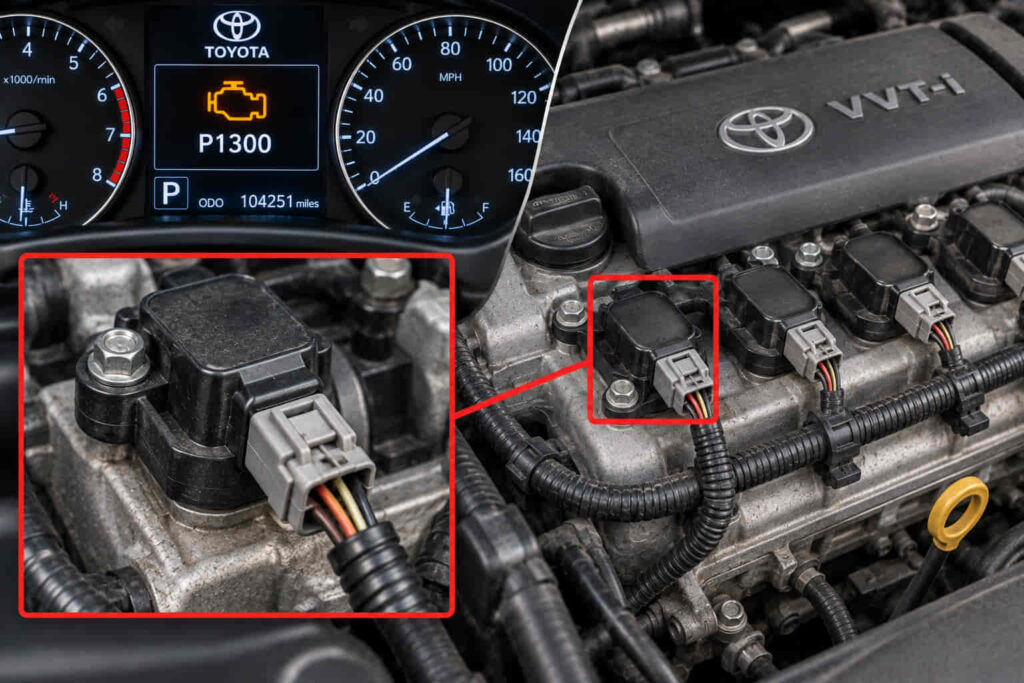
The Toyota P1300 code indicates a malfunction in the ignition control circuit, meaning the engine control module (ECM) has detected an abnormal condition in the system responsible for controlling or confirming an ignition event. On applicable Toyota ignition systems, the ECM communicates with ignition components through control and feedback signals, including IGT and IGF. When the expected ignition operation cannot be confirmed, the ECM can store P1300 and illuminate the Check Engine Light.
P1300 identifies the ignition circuit as the primary diagnostic area, but it does not prove that one specific component has failed. The underlying problem can involve an ignition coil or igniter, damaged wiring, a poor electrical connection, an incorrect power or ground condition, or another fault within the monitored ignition circuit. Engine misfire, rough running, hesitation, and reduced performance can also occur when the ignition malfunction disrupts combustion.
Correct diagnosis therefore requires testing the affected ignition circuit instead of replacing parts based on the trouble code alone. The diagnostic process should use accompanying DTCs, engine symptoms, physical inspection, and electrical testing to isolate the actual failure. This guide explains what Toyota P1300 means, what causes the code, which symptoms can occur, and how to diagnose and repair the underlying ignition fault correctly.
What Does the P1300 Code Mean on a Toyota?
Toyota P1300 is an ignition-system diagnostic trouble code that indicates an ignition control circuit malfunction. The engine control module stores the code when it detects that the expected operation of the ignition system has not been confirmed correctly. P1300 therefore identifies an area of the ignition system that requires diagnosis rather than identifying one failed component by itself.
On applicable Toyota ignition systems, the ECM controls ignition through electrical communication with the components responsible for generating spark. The IGT signal is used as an ignition timing command, while the IGF signal provides feedback associated with ignition operation. This communication allows the ECM to control ignition timing and monitor whether the expected ignition event has occurred.
P1300 can be stored when the ECM does not receive the ignition-related response it expects. The problem can exist within an ignition component itself or within the electrical circuit connecting that component to the ECM. This is why the code should be interpreted as an ignition control circuit fault rather than as automatic confirmation that an ignition coil, igniter, or ECM has failed.
The distinction between a trouble code and a failed component is essential during diagnosis. A DTC records the abnormal condition detected by the control system, while electrical and component testing determines the actual cause. Replacing an ignition coil solely because P1300 is present can therefore leave the code unresolved when the failure originates from a damaged wire, connector, power supply, ground, or another part of the monitored circuit.
Other stored or pending DTCs can provide additional diagnostic context. A related ignition or misfire code may help narrow the affected area and establish whether the fault is isolated or associated with a broader engine-performance problem. All available codes should therefore be recorded before they are cleared.
What Causes the P1300 Code on a Toyota?
Toyota P1300 is caused by a fault that prevents the monitored ignition control circuit from operating or reporting ignition operation as the ECM expects. The primary diagnostic area includes the ignition component involved in the circuit, its wiring and connectors, and the electrical conditions required for that component to operate correctly.
An internally defective ignition coil or igniter can interfere with normal ignition operation. These components participate directly in producing or controlling the spark required for combustion. When a component cannot respond correctly to the ignition command or the expected ignition operation cannot be confirmed, the ECM can detect an abnormal condition and store an ignition-related DTC such as P1300.
A wiring fault can create the same result even when the ignition component remains functional. Broken conductors, short circuits, damaged insulation, excessive resistance, loose terminals, and corroded connectors can interrupt the electrical path between the ECM and the ignition system. For example, a functioning ignition component cannot respond normally when an open circuit prevents the required electrical signal from reaching it.
Power supply and ground conditions also require verification. Ignition components depend on the correct voltage and a reliable electrical ground to operate. Low voltage, excessive circuit resistance, or a poor ground can change component behavior and create symptoms that resemble an internally failed ignition coil or igniter. Electrical testing is therefore necessary before a component is condemned.
Spark plugs become relevant when P1300 is accompanied by misfire, rough running, or evidence of poor combustion. A worn, contaminated, damaged, or incorrectly gapped spark plug can prevent reliable ignition inside the combustion chamber. However, a spark plug condition and an ignition control circuit malfunction are not automatically the same fault, so spark plug replacement should follow inspection and diagnostic evidence rather than the presence of P1300 alone.
An ECM-related failure belongs near the end of the diagnostic path. P1300 by itself does not establish that the ECM is defective. The ignition component, wiring, connectors, power supply, ground, and applicable control or feedback circuits should be verified before the ECM becomes the primary repair candidate. This diagnostic order isolates the actual failure and reduces unnecessary replacement of functioning parts.
Read more: Toyota P1310
What Symptoms Can Occur With Toyota Code P1300?
Toyota P1300 can occur with a Check Engine Light, engine misfire, rough running, hesitation, and reduced engine performance when the underlying ignition fault disrupts combustion. The exact symptom pattern depends on the type and severity of the ignition-system failure. An intermittent electrical fault may store P1300 without producing continuous drivability problems, while a persistent ignition failure can make the engine run noticeably poorly.
The Check Engine Light can illuminate when the ECM detects and records the ignition control malfunction. This warning does not identify which ignition component has failed, but it establishes that diagnostic information is available from the engine control system. A vehicle that appears to run normally should therefore still be diagnosed when P1300 remains stored because an intermittent electrical problem can exist without producing a constant symptom.
Engine misfire can occur when the ignition fault prevents a cylinder from receiving reliable spark. Normal combustion requires the air-fuel mixture to ignite at the correct time. When an ignition coil, igniter, electrical connection, or related circuit cannot support the required ignition event, combustion can become incomplete or fail during individual engine cycles. The driver may experience the result as shaking, uneven engine operation, or an irregular idle.
Hesitation and reduced acceleration can develop when inconsistent combustion reduces the amount of useful power produced by the engine. The effect becomes more noticeable when the engine is placed under load because each cylinder must contribute consistently to power output. A substantial ignition failure can therefore produce both rough operation at lower engine speeds and weaker performance during acceleration.
These symptoms do not prove that P1300 is the only fault affecting the engine. Misfire, rough idle, hesitation, and reduced performance can also result from fuel delivery, air intake, mechanical, or other engine-control problems. P1300 makes the ignition control circuit a diagnostic priority, while accompanying DTCs and test results determine whether that circuit explains the complete symptom pattern.
How Do You Diagnose Toyota Code P1300?
Diagnosing Toyota P1300 requires identifying the affected ignition circuit, checking its components and electrical connections, and confirming the failure through testing before replacing parts. The diagnosis should move from information already stored by the ECM toward increasingly specific circuit tests. This approach preserves diagnostic evidence and reduces unnecessary component replacement.
The diagnostic scan should be reviewed before stored codes are erased. P1300 can provide the primary diagnostic direction, while additional stored or pending DTCs can narrow the investigation. Related ignition or misfire codes are particularly useful because they can reveal whether another monitored condition occurred at the same time. Freeze-frame or other available diagnostic data can also provide operating context for the moment when the fault was recorded.
Physical inspection should follow the initial scan. The ignition components, electrical connectors, and accessible wiring associated with the relevant circuit should be examined for damage or poor connections. Heat-damaged insulation, broken wiring, loose terminals, corrosion, damaged connector locks, and contaminated connections can create an intermittent or continuous electrical interruption. Finding one of these conditions can redirect the diagnosis away from an otherwise functional ignition component.
Electrical testing should then determine whether the affected ignition component receives the conditions required for normal operation. The applicable circuit may require verification of power supply, ground integrity, wiring continuity, and relevant control or feedback signals. The exact test points and specifications depend on the Toyota model, engine, and ignition-system configuration, so vehicle-specific repair information should be used rather than applying one universal electrical specification to every P1300 case.
An ignition coil or igniter should be identified as defective only when the test results support that conclusion. If the component has the required electrical supply and circuit integrity but fails to operate as specified, replacement becomes a justified repair. If the component does not receive the correct electrical conditions, the wiring, connector, supply, ground, or control circuit should be investigated before the component itself is condemned.
Spark plug condition should be examined when engine misfire or poor combustion accompanies P1300. Wear, contamination, physical damage, or an incorrect gap can interfere with reliable combustion and provide additional diagnostic evidence. Spark plug inspection is therefore part of determining the complete cause of an ignition-related performance problem rather than an automatic P1300 repair.
The ECM should be investigated only after the external ignition circuit has been verified. A control module should not be replaced because other tests failed to identify an obvious problem. Its relevant inputs, outputs, wiring, power supplies, grounds, and connected ignition components must first be evaluated according to the applicable diagnostic procedure.
The diagnosis is confirmed when the identified fault is repaired and P1300 does not return under the conditions required to verify the repair. Clearing the DTC before verification only removes stored information; it does not demonstrate that the ignition malfunction has been corrected. Successful verification establishes the final connection between the diagnosed cause, the completed repair, and the original P1300 condition.
How Do You Fix the P1300 Code on a Toyota?
Fixing Toyota P1300 requires repairing the ignition component, wiring, connector, or electrical condition that diagnostic testing confirms is causing the malfunction. P1300 does not have one universal repair because the code identifies an abnormal condition within the monitored ignition system rather than proving that one specific component has failed.
A defective ignition coil or igniter should be replaced when testing confirms an internal component failure and verifies that the component receives the electrical conditions required for normal operation. Replacing an ignition component before checking its circuit can produce an unsuccessful repair because a damaged wire, poor connector, incorrect power supply, or ground problem can prevent a functional component from operating correctly.
Wiring and connector faults require repair of the electrical path. A broken conductor, short circuit, corroded terminal, loose connection, or damaged connector can interrupt communication within the ignition circuit. Repairing the affected wiring or terminal restores circuit integrity without replacing an ignition component that remains functional.
Spark plugs should be serviced when inspection confirms wear, contamination, physical damage, or another condition that interferes with reliable combustion. Their replacement should address an identified spark plug problem rather than serve as a default response to P1300. When misfire is present, correcting both the ignition control fault and any confirmed combustion-related problem is necessary to restore normal engine operation.
ECM replacement should remain one of the final repair options. The external ignition circuit, connected components, wiring, connectors, power supply, and grounds should be verified before a control module is considered defective. This sequence is important because replacing an ECM is unlikely to correct P1300 when the actual interruption remains elsewhere in the ignition circuit.
The repair must be verified after the confirmed fault has been corrected. P1300 can be cleared from memory, followed by engine operation or an appropriate drive verification to determine whether the malfunction returns. Clearing Toyota P1300 removes the stored code; correcting and verifying its underlying cause fixes the problem.
How Serious Is the Toyota P1300 Code?
Toyota P1300 is an ignition-system fault that should be diagnosed promptly, while its actual severity depends on how strongly the underlying malfunction affects engine operation. An intermittent electrical fault with no noticeable drivability symptoms is different from a persistent ignition failure that causes continuous misfire, rough running, or substantial power loss.
A persistent ignition failure becomes more significant when it prevents reliable combustion. Each cylinder must ignite its air-fuel mixture at the required time to contribute power normally. When an ignition fault repeatedly interrupts that process, the engine can shake, hesitate, idle unevenly, or lose performance because combustion is no longer consistent.
Continuous misfire can also create consequences beyond the original ignition circuit. Fuel that is not burned correctly in the combustion chamber can enter the exhaust system. This makes an active ignition fault accompanied by substantial misfire more urgent than a stored intermittent P1300 on an engine that continues to operate normally.
The severity of P1300 should therefore be judged using the code, accompanying DTCs, engine symptoms, and diagnostic findings together. P1300 identifies the system that requires attention, while the underlying failure determines how serious the vehicle’s condition actually is.
Can You Drive a Toyota With the P1300 Code?
A Toyota with P1300 may remain drivable when the engine operates normally, but continued driving should be avoided when the ignition fault causes persistent misfire, severe rough running, substantial power loss, or unstable engine operation. The vehicle’s actual behavior provides more useful information about immediate drivability than the P1300 code number alone.
An intermittent ignition circuit fault can initially produce a Check Engine Light without substantially changing how the engine runs. This does not make the malfunction safe to ignore. Electrical faults can change as wiring, connectors, or ignition components deteriorate, turning an intermittent problem into a continuous failure.
Driving becomes a greater concern when combustion is already being disrupted. Persistent misfire means one or more combustion events are not occurring normally, which reduces engine performance and can affect the exhaust system. Continuing to drive under these conditions extends the period during which the engine operates with the unresolved ignition malfunction.
Clearing the Check Engine Light does not change this assessment. Erasing P1300 removes diagnostic information from ECM memory but does not repair a damaged wire, poor connector, defective ignition component, or another underlying fault. The appropriate way to restore normal drivability is to diagnose P1300, repair the confirmed cause, and verify that the ignition malfunction does not return.
Which Toyota Models Can Have the P1300 Code?
Toyota P1300 should be interpreted according to the specific Toyota model, model year, engine, and ignition-system configuration being diagnosed. The same diagnostic trouble code should not be used to assume that every Toyota vehicle has an identical ignition circuit, component arrangement, or diagnostic procedure.
Toyota ignition systems differ across engines and production periods. These differences can affect the arrangement of ignition coils or igniters, ECM connections, wiring circuits, connector terminals, and the control or feedback signals involved in ignition monitoring. The correct diagnostic procedure therefore depends on the vehicle configuration rather than the P1300 code number alone.
Accurate vehicle identification is particularly important before electrical testing begins. The model year and engine should be matched with the applicable Toyota repair information so the technician can identify the correct wiring diagram, connector terminals, circuit specifications, and test procedure. Using specifications from a different engine can lead to incorrect measurements and an inaccurate diagnosis even when both vehicles store an ignition-related DTC.
The same requirement applies when P1300 appears with other trouble codes. Companion DTCs should be interpreted according to the engine and control system installed in the vehicle. A combination of vehicle identification, stored diagnostic information, engine symptoms, physical inspection, and electrical testing provides a stronger basis for diagnosis than assuming P1300 has one identical repair path across every Toyota application.
How Much Does It Cost to Fix Toyota Code P1300?
The cost to fix Toyota P1300 depends on the fault confirmed during diagnosis, so the code does not have one fixed repair price. The final expense consists of diagnostic labor and the parts and labor required to correct the actual ignition-system or electrical failure.
Diagnostic time is an important part of the total cost because P1300 does not identify a replacement part by itself. A technician may need to retrieve and interpret related DTCs, inspect the ignition system, examine connectors and wiring, and perform electrical tests before identifying the failed circuit or component. Accurate diagnosis can reduce the overall repair cost by preventing replacement of functioning ignition parts.
An ignition component that is confirmed to have failed creates a different repair cost from a wiring or connector fault. Component replacement combines the price of the applicable part with installation labor, while an electrical repair depends more heavily on the location and extent of circuit damage. An accessible damaged terminal can require substantially less labor than an intermittent wiring fault located deep within a harness.
Spark plug service can add to the repair when inspection confirms that the plugs are worn, contaminated, damaged, or otherwise contributing to poor combustion. Spark plugs should not be included automatically in every P1300 estimate because their replacement should correspond to their actual condition and the diagnostic findings.
ECM replacement represents a different cost category and should not be treated as a standard P1300 repair. The ignition components, wiring, connectors, power supply, grounds, and relevant circuits should be verified before the ECM becomes a repair candidate. This diagnostic order reduces the risk of paying for an expensive control module while leaving the original ignition fault unresolved.
An accurate Toyota P1300 repair estimate should be calculated from the confirmed cause, diagnostic time, required parts, and repair labor rather than from the trouble code alone. Identifying the failure first provides a more reliable estimate and prevents the cost of unnecessary parts replacement.