Imagine you’re driving your Subaru as usual when suddenly the Check Engine Light illuminates on the dashboard. Before you have time to process what happened, another warning appears: EyeSight Disabled. For many Subaru owners, this combination of alerts can be confusing and concerning. Is the vehicle still safe to drive? Has the EyeSight system failed? Will the repair be expensive?
The good news is that an EyeSight warning does not always indicate a problem with the cameras or driver-assistance technology itself. In many cases, the EyeSight system is temporarily disabled because the vehicle has detected an engine, transmission, electrical, or sensor-related issue that triggered the Check Engine Light. As a precaution, Subaru’s advanced safety systems may limit certain functions until the underlying fault is diagnosed and repaired.
This design helps ensure that features such as Adaptive Cruise Control, Pre-Collision Braking, and Lane Keep Assist operate only when the vehicle is functioning correctly. While this safety-first approach protects drivers, it can also create frustration when warning lights appear unexpectedly.
In this guide, you’ll learn why the Subaru Check Engine Light can disable EyeSight, the most common causes behind these warnings, how to diagnose the problem, and the steps you can take to restore full functionality to your vehicle.
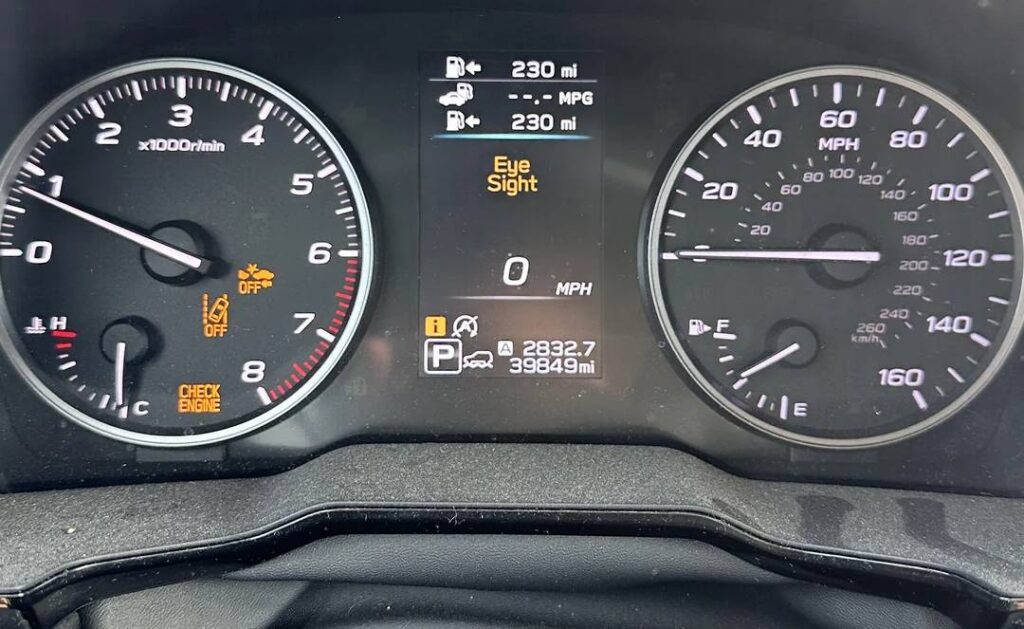
Quick Answer: Why Is My Subaru EyeSight Disabled?
If your Subaru Check Engine Light is on and the EyeSight system has been disabled, the most likely reason is that the vehicle has detected a fault that could affect the safe operation of its advanced driver assistance features. Subaru designed EyeSight to work alongside multiple vehicle systems, including the engine, transmission, braking system, and electronic control modules. When a problem is detected in any of these areas, the vehicle may temporarily disable EyeSight as a precaution.
In most cases, the EyeSight cameras themselves are not defective. Instead, the warning serves as an indication that another issue requires attention. Once the underlying fault is repaired and the diagnostic codes are cleared, EyeSight often returns to normal operation automatically.
For this reason, the first step is not to assume that the EyeSight system has failed. Instead, focus on identifying the root cause behind the Check Engine Light. A simple issue such as a loose gas cap, weak battery, or faulty sensor can sometimes trigger both warnings simultaneously.
How Subaru EyeSight Works
Subaru EyeSight is one of the brand’s most advanced safety technologies. Using a pair of forward facing stereo cameras mounted near the windshield, the system continuously monitors traffic conditions, road markings, and potential hazards ahead of the vehicle.
The technology supports several important safety and convenience features. These include Adaptive Cruise Control, which automatically adjusts vehicle speed based on surrounding traffic, Pre Collision Braking that can help reduce the severity of an accident, Lane Departure Warning, Lane Keep Assist, and Lead Vehicle Start Alert.
What makes EyeSight unique is its ability to communicate with many other vehicle systems. It relies on information from the engine control module, transmission control unit, braking system, wheel speed sensors, and various electronic components throughout the vehicle. This interconnected design allows EyeSight to make accurate driving decisions in real time.
Because EyeSight depends on data from multiple systems, even a fault that appears unrelated to the cameras can impact its operation. If the vehicle cannot guarantee that all required systems are functioning properly, EyeSight may be temporarily disabled until the issue is resolved.
Why the Check Engine Light Can Disable EyeSight
Many Subaru owners are surprised to learn that a simple engine related issue can cause EyeSight to stop working. The reason lies in Subaru’s safety focused engineering philosophy.
Modern vehicles contain dozens of electronic modules that constantly exchange information through a communication network. This network allows systems such as the engine, transmission, anti lock brakes, traction control, and EyeSight to work together seamlessly.
When the Check Engine Light comes on, it indicates that the vehicle has detected an abnormal condition. Depending on the nature of the fault, the vehicle may no longer be able to guarantee that EyeSight features will perform exactly as intended. Rather than risk inaccurate braking, steering assistance, or cruise control behavior, Subaru’s software may disable EyeSight until the problem is corrected.
This protective strategy helps prevent situations where a faulty sensor or engine performance issue could interfere with safety related decisions. While it may seem inconvenient, the temporary shutdown is designed to prioritize driver and passenger safety above all else.
Understanding this relationship can save owners from unnecessary worry. In many situations, fixing the issue that triggered the Check Engine Light is all that is required to restore full EyeSight functionality.
10 Common Causes of a Subaru Check Engine Light and EyeSight Warning
When both the Check Engine Light and EyeSight warning appear at the same time, the underlying cause can range from a simple maintenance issue to a more complex mechanical or electrical problem. Understanding the most common triggers can help narrow down the diagnosis.
A loose or damaged gas cap is one of the simplest causes. If the fuel system cannot maintain proper pressure, the vehicle may detect an evaporative emissions leak and illuminate the Check Engine Light. Although this issue is usually inexpensive to fix, it can still trigger additional warning messages.
Faulty oxygen sensors are another frequent culprit. These sensors monitor exhaust gases and help regulate fuel delivery. When they fail, engine performance and fuel economy may suffer, causing diagnostic trouble codes that can affect related vehicle systems.
A malfunctioning mass air flow sensor can also create problems. This component measures the amount of air entering the engine. Incorrect readings may lead to poor acceleration, rough idling, and warning lights.
Battery and charging system issues are especially common in modern vehicles packed with electronics. Low voltage can cause communication errors between modules, resulting in both Check Engine and EyeSight warnings.
Engine misfires caused by worn spark plugs, failing ignition coils, or fuel delivery problems often trigger protective system responses. Similarly, transmission faults, particularly in vehicles equipped with a continuously variable transmission, may disable driver assistance functions.
Wheel speed sensor failures can affect braking, stability control, and EyeSight operation because these systems rely on accurate speed data. Brake system faults, including ABS issues, may also lead to warning messages.
In some cases, the EyeSight cameras themselves may be affected by dirt, snow, fog, windshield damage, or improper calibration after windshield replacement. Software glitches and communication errors between control modules can also cause temporary system shutdowns.
Can You Still Drive a Subaru When EyeSight Is Disabled?
One of the first questions drivers ask is whether it is safe to continue driving after seeing an EyeSight disabled warning. The answer depends largely on the severity of the issue that triggered the warning.
In many situations, the vehicle remains fully drivable. The engine, steering, brakes, and other primary systems may continue operating normally. The main difference is that EyeSight related features such as Adaptive Cruise Control, Lane Keep Assist, and Pre Collision Braking will not be available.
Drivers should remember that EyeSight is designed to assist, not replace, safe driving practices. Even when the system is disabled, the vehicle can often be driven safely if no other significant symptoms are present.
However, certain warning signs require immediate attention. A flashing Check Engine Light may indicate an active engine misfire capable of causing catalytic converter damage. Severe power loss, unusual noises, overheating, transmission problems, or brake system warnings should never be ignored.
If any of these symptoms accompany the warning lights, it is advisable to stop driving as soon as it is safe to do so and seek professional assistance. Continuing to drive under these conditions could increase repair costs and potentially compromise safety.
How to Diagnose the Problem
Proper diagnosis is essential because replacing parts without identifying the root cause can waste both time and money.
The first step is to read the vehicle’s diagnostic trouble codes using an OBD II scanner. These codes provide valuable clues about the source of the problem and often point technicians toward the affected system. Many automotive parts stores offer basic code scanning services at no cost.
Next, perform a visual inspection. Check that the gas cap is properly tightened and free of damage. Inspect battery terminals for corrosion or loose connections. Verify that the windshield area in front of the EyeSight cameras is clean and unobstructed.
Pay attention to weather conditions as well. Heavy rain, snow, ice, fog, and direct sunlight can occasionally interfere with camera visibility and trigger temporary EyeSight warnings.
It is also important to monitor other dashboard indicators. Additional warnings involving the ABS system, traction control, transmission, or battery can provide important clues regarding the underlying fault.
If the diagnostic codes indicate complex engine, transmission, or electronic issues, professional diagnosis is recommended. Modern Subaru vehicles contain sophisticated networks of sensors and control modules that often require advanced diagnostic equipment and manufacturer specific software.
A thorough diagnosis ensures that the true cause of the problem is identified before any repairs begin, reducing the likelihood of unnecessary expenses and repeat visits to the repair shop.
How to Fix Subaru EyeSight Disabled Warnings
Once the underlying cause has been identified, the next step is restoring normal vehicle operation and reactivating the EyeSight system. The exact repair process depends on the fault that triggered the warning, but the primary goal is always to correct the root problem rather than simply clearing the warning lights.
If the issue is related to the engine, such as a faulty oxygen sensor, mass air flow sensor, ignition coil, or evaporative emissions leak, the affected component should be repaired or replaced according to Subaru specifications. After the repair is completed, the diagnostic trouble codes can be cleared using a scan tool. In many cases, the EyeSight system will automatically reactivate after the vehicle confirms that the fault is no longer present.
When the warning is caused by battery or charging system issues, replacing a weak battery or repairing the alternator may restore proper communication between electronic modules. Modern vehicles rely heavily on stable voltage levels, and even minor electrical irregularities can create multiple warning messages.
If the EyeSight cameras are obstructed by dirt, snow, condensation, or debris, cleaning the windshield area around the cameras may resolve the issue. Drivers should also inspect the windshield for cracks, chips, or aftermarket tinting that could interfere with camera operation.
Vehicles that have undergone windshield replacement often require EyeSight recalibration. Because the cameras must be precisely aligned, even a slight change in position can affect system performance. Recalibration should be performed using manufacturer approved equipment to ensure accurate operation.
Software updates may also resolve certain issues. Subaru periodically releases updates that improve communication between vehicle modules and address known software concerns. A dealership or qualified repair facility can determine whether any updates are available for the vehicle.
How Much Does It Cost to Repair the Problem?
Repair costs can vary significantly depending on the source of the warning. Some issues can be resolved with minimal expense, while others may require more extensive diagnostic work and component replacement.
Minor repairs are generally the least expensive. Replacing a gas cap may cost between $20 and $60, while battery terminal cleaning or simple maintenance procedures may cost even less. A new battery typically ranges from $150 to $350 depending on the model and battery type.
Moderate repairs often involve sensor replacement. Oxygen sensors commonly cost between $200 and $500 including labor. A mass air flow sensor replacement may range from $250 to $600. Spark plug and ignition coil repairs can vary from $200 to over $800 depending on the number of components involved.
More advanced repairs tend to be significantly more expensive. EyeSight camera recalibration often costs between $250 and $700. If camera hardware requires replacement, costs may exceed $1,000. Transmission related repairs can range from several hundred dollars to several thousand dollars depending on the severity of the issue.
Electronic control module failures are relatively uncommon but can be costly. Depending on the specific module and programming requirements, repairs may range from $500 to more than $2,000.
The most effective way to control repair costs is to address warning lights promptly. Delaying diagnosis can allow minor problems to develop into larger and more expensive repairs.
Frequently Asked Questions
Will EyeSight Turn Back On By Itself?
In many cases, yes. Once the underlying fault has been repaired and the vehicle no longer detects a problem, EyeSight may automatically reactivate. Some situations may require diagnostic codes to be cleared before the system returns to normal operation.
How Do I Reset Subaru EyeSight?
There is no universal reset button for EyeSight. The correct approach is to identify and repair the issue that caused the warning. Simply disconnecting the battery or clearing codes without fixing the root problem may result in the warning returning.
Can a Dead or Weak Battery Disable EyeSight?
Yes. Low battery voltage is one of the most common reasons for multiple warning lights appearing simultaneously. Because EyeSight relies on communication between numerous electronic systems, insufficient voltage can cause temporary system shutdowns.
Does Every Check Engine Light Disable EyeSight?
Not always. Some faults may trigger the Check Engine Light without affecting EyeSight. However, many engine, transmission, and communication related faults can cause Subaru to disable EyeSight as a precautionary measure.
Is EyeSight Covered Under Warranty?
Warranty coverage depends on the vehicle’s age, mileage, and the specific component involved. Certain repairs may be covered under Subaru’s factory warranty, extended warranty plans, or emissions related warranties. Owners should consult their warranty documentation or contact a Subaru dealership for specific coverage information.
Conclusion
Seeing both the Check Engine Light and an EyeSight warning on your Subaru can be alarming, but it does not necessarily mean that the EyeSight system itself has failed. In most cases, EyeSight is simply responding to another issue within the vehicle and temporarily disabling advanced driver assistance features until the problem is corrected.
Because EyeSight works closely with the engine, transmission, braking system, and electronic control modules, even relatively minor faults can trigger protective shutdowns. Common causes include sensor failures, battery issues, engine misfires, transmission faults, and communication errors between vehicle systems.
The key to resolving the problem is proper diagnosis. Reading diagnostic trouble codes, performing a basic inspection, and addressing faults promptly can often restore normal operation without unnecessary repairs. Ignoring warning lights, on the other hand, may lead to increased repair costs and reduced vehicle reliability.
If your Subaru Check Engine Light and EyeSight warning appear together, take the time to investigate the cause rather than assuming the worst. In many situations, a straightforward repair is all that is needed to restore full functionality and get you back on the road with confidence.
Have you experienced an EyeSight disabled warning in your Subaru? Share your experience and the solution that worked for you in the comments below.