The Honda Accord Fuel Pump Recall has become an important topic for many vehicle owners. A faulty fuel pump can stop the engine from starting or cause it to stall while you are driving. These problems can increase the risk of an accident and leave you stranded without warning. Knowing whether your vehicle is affected is the first step toward protecting your safety.
Many drivers assume that every Honda Accord from a certain model year qualifies for the recall. However, that is not how the process works. Honda has launched several fuel pump recall campaigns over the years, and each one covers specific vehicles. Your Vehicle Identification Number, or VIN, determines whether your Accord qualifies for a free repair. As a result, checking your VIN is far more accurate than relying on the model year alone.
This guide explains everything you need to know about the Honda Accord Fuel Pump Recall. You will learn why Honda issued the recall, which Accord models may qualify, and what warning signs you should never ignore. You will also discover how to check your VIN, understand your recall status, and schedule a free repair with an authorized Honda dealership. In addition, we answer the most common questions that Honda Accord owners ask before visiting a dealer.
Whether your Accord already shows symptoms or runs normally, you should not ignore an open safety recall. Taking action early can reduce the risk of unexpected breakdowns and help keep your vehicle safe on every trip.
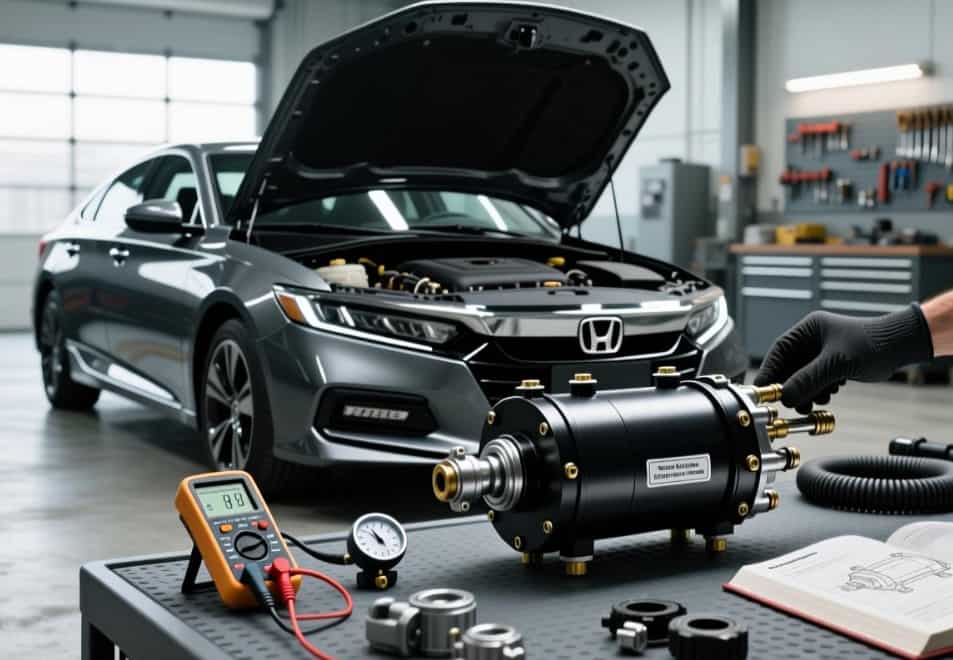
What Is the Honda Accord Fuel Pump Recall?
The Honda Accord Fuel Pump Recall is a safety campaign that addresses a defect in the low pressure fuel pump installed in certain Honda Accord vehicles. The fuel pump delivers gasoline from the fuel tank to the engine at the correct pressure. When it works properly, the engine starts quickly and runs smoothly. If the pump fails, the engine may not receive enough fuel to operate correctly.
Honda issued this recall after discovering that some fuel pumps contain an impeller that may deform over time. As the impeller changes shape, it can interfere with the pump housing and reduce fuel flow. In some cases, the pump may stop working completely. When this happens, the engine may hesitate, lose power, fail to start, or stall while the vehicle is moving.
An engine stall creates a serious safety concern because it can happen without much warning. Drivers may lose engine power in traffic or while traveling at highway speeds. Although the steering and braking systems still function, controlling the vehicle often becomes more difficult. This situation increases the risk of a collision, especially in busy traffic or poor weather conditions.
Many owners believe every Honda Accord from a specific model year is part of the recall. However, Honda does not determine recall eligibility by model year alone. Production dates, engine configurations, and manufacturing information also affect whether a vehicle qualifies. Two Accord models from the same year may have different recall statuses because they use different components.
The most reliable way to confirm whether your vehicle is affected is to check its 17 digit VIN through Honda’s official recall lookup tool. The VIN identifies your vehicle individually and shows whether an open recall exists. If your Accord qualifies, an authorized Honda dealership will perform the required repair at no cost to you.
Understanding how the recall works helps you make informed decisions about your vehicle. It also allows you to recognize potential warning signs before they develop into more serious safety issues.
Which Honda Accord Models Are Affected?
Many Honda owners ask the same question after hearing about the Honda Accord Fuel Pump Recall. They want to know whether their vehicle is included. The answer depends on more than the model year. Honda has launched several fuel pump recall campaigns, and each one covers specific vehicles based on production details and installed components.
Some Honda Accord models built between 2018 and 2022 may qualify for a fuel pump recall. Certain earlier models may also appear in separate recall campaigns. However, these model years only provide a general reference. They do not confirm that every vehicle from those years has an open recall.
| Honda Accord Model Year | Recall Status |
|---|---|
| 2018 | Some vehicles may qualify. Check the VIN. |
| 2019 | Some vehicles may qualify. Check the VIN. |
| 2020 | Some vehicles may qualify. Check the VIN. |
| 2021 | Some vehicles may qualify. Check the VIN. |
| 2022 | Some vehicles may qualify. Check the VIN. |
The Vehicle Identification Number, or VIN, is the most reliable way to verify recall eligibility. Every Honda Accord has a unique 17 character VIN that records important manufacturing information. Honda uses this number to identify vehicles equipped with the affected fuel pump. As a result, two Accords from the same model year may have different recall statuses.
If you purchased a used Honda Accord, you should also verify the VIN before assuming the recall has been completed. A previous owner may not have scheduled the repair, or the vehicle may have entered a recall campaign after it changed ownership.
Checking your VIN takes only a few minutes, but it can provide valuable peace of mind. If your vehicle appears in an active recall, contact an authorized Honda dealership to schedule a free repair. Acting early helps reduce the risk of unexpected fuel pump failure and keeps your Honda Accord operating safely and reliably.
Common Warning Signs of a Failing Fuel Pump
A failing fuel pump does not always stop working without warning. In many cases, it develops problems gradually and produces noticeable symptoms before complete failure occurs. Recognizing these warning signs early can help you avoid an unexpected breakdown and reduce the risk of a dangerous situation on the road.
One of the most common symptoms is difficulty starting the engine. Your Honda Accord may crank longer than usual before it starts, or it may fail to start after several attempts. This often happens because the fuel pump cannot deliver enough fuel pressure to the engine.
Another common warning sign is engine hesitation during acceleration. The vehicle may respond slowly when you press the accelerator, especially while merging onto a highway or climbing a hill. Some drivers also notice a temporary loss of power before the engine returns to normal.
A faulty fuel pump can also cause rough idling. Instead of maintaining a smooth idle speed, the engine may vibrate, shake, or fluctuate while the vehicle remains stationary. Although several issues can cause rough idling, a weak fuel supply is one possible reason.
The most serious symptom is engine stalling while driving. If the fuel pump suddenly stops supplying fuel, the engine can shut off without warning. This situation becomes especially dangerous in heavy traffic or at highway speeds because it reduces the vehicle’s ability to accelerate when needed.
Some drivers also report poor engine performance, reduced fuel efficiency, or an illuminated check engine light. While these symptoms do not always indicate a failing fuel pump, they deserve immediate attention when they appear together.
If your Honda Accord shows one or more of these warning signs, do not ignore them. Schedule an inspection as soon as possible and check whether your vehicle has an open fuel pump recall. Early diagnosis can prevent further damage and help keep you safe behind the wheel.
Is It Safe to Drive a Honda Accord With an Open Recall?
Many owners continue driving after learning about the Honda Accord Fuel Pump Recall because their vehicle still runs normally. Although this may seem reasonable, an open recall should never be ignored. A defective fuel pump can fail without warning, even if the engine has shown no previous signs of trouble.
The greatest risk comes from an unexpected engine stall. If the fuel pump stops supplying fuel, the engine may shut off while the vehicle is moving. This can happen on city streets, busy intersections, or highways. Losing engine power in these situations can make it difficult to react to changing traffic conditions and increase the chance of a collision.
Some drivers experience warning signs before the fuel pump fails completely. The engine may hesitate during acceleration, start slowly, or lose power for a few seconds. However, not every vehicle provides these early symptoms. In some cases, the fuel pump stops working without any noticeable warning, leaving the driver with little time to respond.
If your Honda Accord has an open recall, you should arrange the repair as soon as possible. Honda performs recall repairs at no cost for eligible vehicles, so delaying the appointment offers little benefit. Completing the repair also helps protect passengers, other road users, and your vehicle from additional problems caused by an unexpected breakdown.
If the engine stalls while driving, remain calm and avoid sudden movements. Turn on the hazard lights and guide the vehicle to the side of the road if you can do so safely. Once the vehicle stops, contact roadside assistance or your local Honda dealership for further guidance. Do not continue driving if the engine repeatedly stalls or fails to restart.
Even if your Honda Accord appears to operate normally today, an open fuel pump recall deserves immediate attention. Taking action early is the safest way to reduce risk and restore confidence every time you get behind the wheel.
How to Check Your Honda Accord Fuel Pump Recall by VIN
Checking your recall status is simple and only takes a few minutes. The Vehicle Identification Number, or VIN, is the key to finding accurate recall information. Every Honda Accord has a unique 17 character VIN that identifies its production details and installed components. Honda uses this number to determine whether your vehicle qualifies for a free recall repair.
You can usually find the VIN in several locations. Look through the lower corner of the windshield on the driver’s side, check the sticker inside the driver’s door frame, or review your vehicle registration and insurance documents. Once you have the VIN, you can verify your recall status online.
Visit Honda’s official recall lookup page and enter the complete 17 character VIN. The system will search Honda’s database and display any active safety recalls associated with your vehicle. If your Accord appears in the fuel pump recall, the website will provide instructions for scheduling the repair.
You can also contact an authorized Honda dealership and provide your VIN by phone. The service department can confirm whether your vehicle has an open recall and help you arrange an appointment. This option is useful if you have questions about repair availability or replacement parts.
If the VIN search does not show an active recall, keep your information updated and check again from time to time. Manufacturers occasionally expand recall campaigns as new information becomes available. Staying informed helps ensure that you receive important safety updates as soon as they are released.
A VIN check is the fastest and most reliable way to verify your recall status. It eliminates guesswork and confirms whether your Honda Accord requires a free fuel pump replacement. Taking a few minutes to complete this step can help prevent unexpected problems and give you greater confidence every time you drive.
How the Free Recall Repair Works
If your Honda Accord qualifies for the fuel pump recall, the repair process is straightforward. Honda covers the full cost of the repair, including replacement parts and labor. You do not need to pay any service fee as long as your vehicle is eligible for the recall.
The first step is to schedule an appointment with an authorized Honda dealership. When you contact the service department, provide your VIN so the staff can confirm your recall status and check that the required replacement part is available. Booking an appointment in advance can help reduce waiting time.
On the day of your appointment, a technician will inspect your vehicle and verify the recall information. The technician will then remove the defective fuel pump assembly and install the updated replacement part specified by Honda. After completing the repair, the technician will test the fuel system to ensure it operates correctly and meets factory standards.
The repair usually takes a few hours, although the total visit may vary depending on the dealership’s schedule and parts availability. Some dealerships offer a shuttle service, a waiting area, or a loaner vehicle for longer repairs. You can ask about these options when scheduling your appointment.
Once the repair is complete, keep the service record with your vehicle documents. This record confirms that the recall work has been finished and may prove useful if you sell the vehicle in the future. A completed recall also gives potential buyers greater confidence in the vehicle’s maintenance history.
If you receive a recall notice, do not delay the repair simply because your Honda Accord seems to run normally. A fuel pump can fail without warning, and completing the recall service eliminates a known safety risk. Taking advantage of Honda’s free repair program is the safest and most practical way to protect both your vehicle and everyone who travels in it.
What to Do If Your Honda Accord Stalls
An engine stall can be frightening, especially if it happens in heavy traffic or at highway speeds. Although a failing fuel pump is only one possible cause, you should treat every unexpected stall as a serious safety concern. Acting quickly and staying calm can help protect you and other road users.
If the engine stalls while you are driving, keep a firm grip on the steering wheel and avoid sudden movements. Turn on the hazard lights immediately to warn nearby drivers. If traffic conditions allow, guide your Honda Accord toward the shoulder or another safe location. Avoid stopping in an active traffic lane unless you have no other option.
Once the vehicle has stopped, shift the transmission into Park and try to restart the engine. If the engine starts and continues running normally, drive only if you can safely reach a nearby service location. If the engine will not restart or stalls again, do not continue driving. Repeated stalling may indicate a fuel pump problem or another issue that requires professional inspection.
Contact roadside assistance if your vehicle cannot move safely. You should also contact an authorized Honda dealership and provide your VIN. The service department can confirm whether your Accord has an open fuel pump recall and explain the next steps. If your vehicle qualifies, Honda will replace the affected fuel pump at no cost.
After the incident, record as many details as possible. Note the date, mileage, weather conditions, fuel level, and any warning lights that appeared on the dashboard. This information can help technicians diagnose the problem more quickly.
Never ignore a vehicle that stalls without warning. Even if the engine restarts, the underlying problem may remain. Prompt inspection and repair reduce the risk of another unexpected failure and help ensure that your Honda Accord remains safe and reliable for everyday driving.
What If You Already Paid for a Fuel Pump Replacement?
Many Honda Accord owners replaced a faulty fuel pump before learning about the recall. If this happened to you, you may qualify for reimbursement. Honda often offers compensation for eligible repairs that owners paid for before the recall service became available. However, reimbursement depends on the specific recall campaign and whether the repair meets Honda’s requirements.
Start by collecting all repair records. Keep the original invoice, payment receipt, and any documents that describe the work performed. These records should clearly identify your Honda Accord, the repair date, the replacement parts, and the total amount you paid. Complete documentation helps speed up the review process.
Next, confirm that your vehicle qualifies for the recall by checking the VIN. If your Accord has an active fuel pump recall, contact an authorized Honda dealership or Honda customer support. A representative can explain whether your previous repair meets the reimbursement guidelines and provide instructions for submitting your claim.
Do not assume that every fuel pump replacement qualifies for reimbursement. Honda may review several factors before approving a claim. These factors can include the repair date, the replacement part used, and whether the repair addressed the same issue covered by the recall. Following the official process gives you the best chance of receiving compensation.
If your claim is approved, Honda may reimburse part or all of the eligible repair costs. Processing times vary, so keep copies of every document you submit and monitor the status of your request if additional information is required.
Even if you already replaced the fuel pump, checking your VIN remains an important step. Some vehicles may have additional recall work that still needs attention. Confirming your recall status ensures that your Honda Accord meets the latest safety standards and helps prevent future problems.
Fuel Pump Recall vs Other Fuel System Problems
A fuel pump recall does not mean that every engine problem comes from a defective fuel pump. Several fuel system components can produce similar symptoms, including hard starting, poor acceleration, rough idling, and engine stalling. Understanding the differences can help you describe the problem more accurately and avoid unnecessary repairs.
The fuel pump moves gasoline from the fuel tank to the engine. When it begins to fail, fuel pressure drops below the level the engine needs. As a result, the engine may crank for a long time before starting, hesitate during acceleration, lose power, or stall unexpectedly. These symptoms often become more frequent as the pump continues to wear.
A clogged fuel filter can also restrict fuel flow. However, this problem usually develops gradually rather than appearing suddenly. Drivers often notice reduced engine performance and slower acceleration before more serious issues occur. Replacing the filter may restore normal operation if the fuel pump remains in good condition.
Faulty fuel injectors create another set of problems. Dirty or damaged injectors may cause rough idling, engine misfires, poor fuel economy, or uneven acceleration. Unlike a failing fuel pump, injector problems often affect one or two cylinders instead of reducing fuel delivery to the entire engine.
A weak battery or failing starter motor can also make the engine difficult to start. In these cases, the engine may crank slowly or fail to crank at all. A defective fuel pump, by contrast, usually allows the engine to crank normally but prevents it from receiving enough fuel to start.
Because several issues share similar symptoms, professional diagnosis is the safest approach. If your Honda Accord shows signs of fuel system trouble, check your VIN for an active fuel pump recall before paying for repairs. A recall repair is free for eligible vehicles and may resolve the problem without additional expense.
Frequently Asked Questions
Does every Honda Accord have a fuel pump recall?
No. The Honda Accord Fuel Pump Recall only applies to certain vehicles included in specific recall campaigns. Honda determines eligibility by using the Vehicle Identification Number rather than the model year alone. The most accurate way to verify your status is to check your VIN through Honda’s official recall lookup system.
Can I continue driving if my Honda Accord has an open recall?
Your vehicle may continue to operate normally for some time, but driving with an open recall is not recommended. A defective fuel pump can fail without warning and cause the engine to stall. Scheduling the free recall repair as soon as possible is the safest option.
How much does the recall repair cost?
Honda performs recall repairs at no cost for eligible vehicles. The manufacturer covers both replacement parts and labor. If your Accord qualifies for the recall, you should not pay for the fuel pump replacement.
How long does the repair take?
The repair often takes a few hours. However, the total visit depends on the dealership’s schedule and the availability of replacement parts. Your local Honda dealership can provide a more accurate estimate when you schedule your appointment.
What happens if my engine stalls before my appointment?
If the engine stalls while driving, turn on the hazard lights and move to a safe location if possible. Do not continue driving if the vehicle repeatedly stalls or fails to restart. Contact roadside assistance and inform your Honda dealership about the situation.
Can I receive reimbursement if I already paid for the repair?
You may qualify for reimbursement if you paid for an eligible fuel pump replacement before the recall repair became available. Honda reviews each request according to the terms of the recall campaign. Keep all repair records and contact Honda or your authorized dealership for reimbursement instructions.
How often should I check for recalls?
It is a good practice to check your VIN at least once or twice each year, especially before long trips or after purchasing a used vehicle. Regular checks help you stay informed about new safety recalls and ensure that your Honda Accord remains up to date with important repairs.
Final Checklist for Honda Accord Owners
Before you finish reading this guide, take a few minutes to confirm that your Honda Accord is safe to drive. A simple inspection today can help prevent unexpected problems in the future. It can also ensure that you receive any free recall repairs available for your vehicle.
Use the checklist below to stay on top of the Honda Accord Fuel Pump Recall.
| Checklist | Status |
|---|---|
| Locate your 17 character VIN | ☐ |
| Check your VIN using Honda’s official recall lookup tool | ☐ |
| Confirm whether your Accord has an active fuel pump recall | ☐ |
| Watch for warning signs such as hard starting, engine hesitation, or stalling | ☐ |
| Schedule a free repair with an authorized Honda dealership if your vehicle qualifies | ☐ |
| Keep a copy of the completed recall repair record | ☐ |
| Save all repair receipts if you previously paid for a fuel pump replacement | ☐ |
| Check your VIN periodically for future safety recalls | ☐ |
Completing each step only takes a short time, but it can make a significant difference. An active recall should never remain unresolved because the fuel pump may fail without warning. Addressing the issue early reduces the risk of engine stalling and helps keep your vehicle dependable for daily driving.
If you recently bought a used Honda Accord, do not assume that every recall has already been completed. Verify the VIN yourself and keep a record of the results. Staying informed is the best way to protect your investment, improve safety, and enjoy greater peace of mind every time you drive.
Conclusion
The Honda Accord Fuel Pump Recall is an important safety issue that every owner should understand. Although many Honda Accord vehicles continue to perform reliably, a defective fuel pump can increase the risk of hard starting, engine stalling, and unexpected breakdowns. Ignoring an open recall may place both you and other road users at unnecessary risk.
The good news is that checking your recall status is quick and easy. Your VIN provides the most accurate information about your vehicle and confirms whether it qualifies for a free repair. If your Honda Accord appears in an active recall campaign, schedule an appointment with an authorized Honda dealership as soon as possible. The repair costs you nothing and replaces the affected fuel pump with an updated component.
Even if your vehicle shows no warning signs today, regular recall checks remain a smart part of routine vehicle ownership. Staying informed helps you address potential safety issues before they become serious problems. It also helps maintain the reliability and long term value that Honda Accord owners expect.
If you found this guide helpful, consider sharing it with other Honda Accord owners who may not know about the recall. A simple VIN check can prevent unexpected engine failure and improve road safety for everyone. Taking a few minutes today can save time, reduce stress, and help ensure that every journey remains safe and dependable.