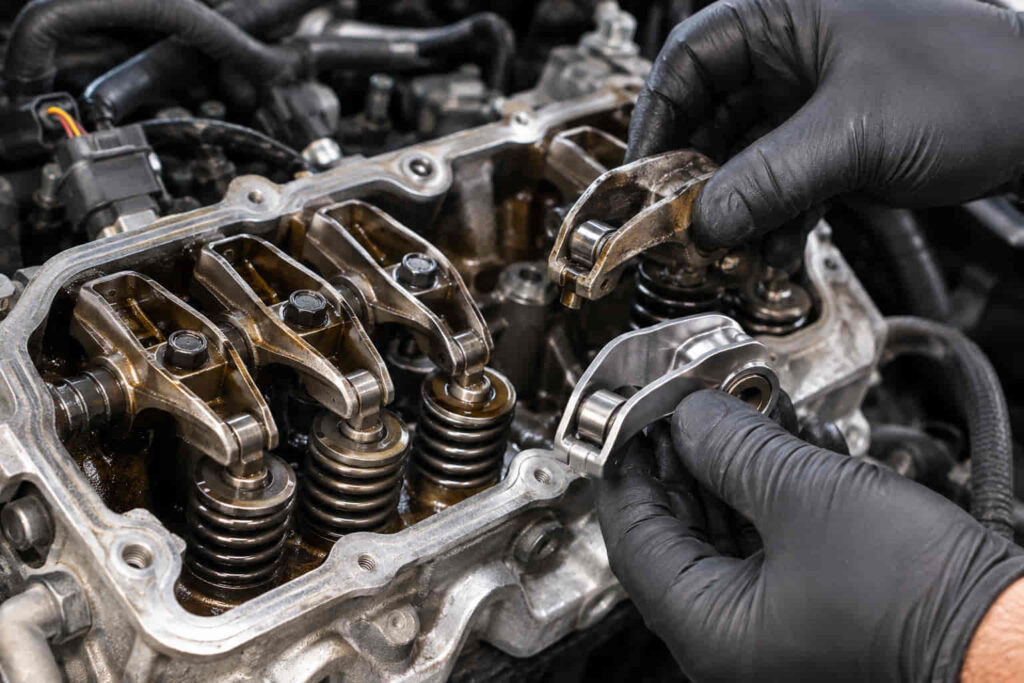
Rocker arm replacement is necessary when a rocker arm becomes worn, cracked, loose, damaged, or unable to transfer camshaft movement correctly to an engine valve. Common symptoms include ticking or tapping noises from the cylinder head, engine misfires, rough idle, reduced power, and abnormal valvetrain movement. However, these symptoms can also result from worn lifters, hydraulic lash adjusters, damaged camshaft lobes, low oil pressure, or incorrect valve clearance.
The average rocker arm replacement cost depends heavily on engine design and repair complexity. A straightforward repair involving an accessible rocker arm may cost a few hundred dollars, while replacing multiple rocker arms and a damaged camshaft can cost several thousand dollars.
The rocker arm is an essential part of the engine valvetrain. It transfers mechanical motion to the intake or exhaust valve, allowing the engine to control airflow and combustion gases. When the rocker arm fails, valve movement may become inconsistent or stop entirely.
However, rocker arm replacement procedures vary significantly between engines. A traditional pushrod Chevrolet V8 uses a different arrangement from a Honda K24 i-VTEC engine, a Chrysler 3.6L Pentastar V6, or a modern overhead-camshaft engine with roller finger followers.
The correct repair therefore requires identifying the exact engine, confirming the defective component, inspecting related valvetrain parts, and following the manufacturer’s installation and torque procedures.
This guide explains rocker arm failure symptoms, diagnostic methods, replacement steps, labor costs, related camshaft damage, and how to prevent premature valvetrain wear.
What Is a Rocker Arm in an Engine?
A rocker arm is a valvetrain component that transfers mechanical motion from the camshaft or pushrod to an intake or exhaust valve.
In a four-stroke engine, the intake valves must open to admit air or an air-fuel mixture into the cylinders. The exhaust valves must open to release combustion gases after the power stroke.
The camshaft controls when these valves open and close.
A rocker arm acts as an intermediate mechanical link in many engine designs.
On a conventional pushrod engine, the camshaft is located inside the engine block. Lifters follow the camshaft lobes and transmit movement through pushrods to the rocker arms.
Each rocker arm pivots to press against the end of a valve stem, opening the valve against the resistance of the valve spring.
When the camshaft lobe rotates away, the spring closes the valve.
In certain overhead-camshaft engines, the camshaft acts on a rocker arm or roller finger follower without requiring a pushrod.
These components can be mounted on shafts, pivots, or individual hydraulic lash adjusters.
Some rocker arms incorporate rollers to reduce sliding friction where the camshaft contacts the follower.
Others use sliding contact surfaces.
The specific arrangement depends on the engine’s valvetrain architecture.
Although rocker arms are relatively small, their condition directly affects valve operation, cylinder filling, exhaust flow, and combustion efficiency.
How Does a Rocker Arm Work?
A rocker arm converts camshaft-driven movement into the force needed to open an engine valve, operating through a pivot, shaft, or follower arrangement.
The camshaft contains carefully shaped lobes that determine valve timing and lift.
As a lobe rotates, it applies force to the corresponding valvetrain component.
In an overhead-valve engine, the camshaft acts on a lifter.
The lifter moves a pushrod, which applies force to one end of the rocker arm.
The rocker arm pivots and pushes the valve downward.
The valve spring resists this movement and returns the valve to its closed position when the camshaft lobe rotates away.
In an overhead-camshaft engine, the lobe may act directly on a roller finger follower.
The follower transfers the movement to the valve.
A hydraulic lash adjuster may support one end of the follower and automatically maintain the intended mechanical contact.
Some engines use more complicated rocker arm assemblies.
Honda’s VTEC system, for example, can use multiple rocker arms and locking mechanisms to change effective valve lift under selected operating conditions.
Modern engines with cylinder deactivation may also use switching rocker arms.
These components can selectively change valve operation according to engine load and control system commands.
Because different designs have different mechanical requirements, rocker arm replacement must be performed according to the exact engine configuration.
What Are the Symptoms of a Bad Rocker Arm?
The most common signs of a bad rocker arm are ticking or tapping sounds from the upper engine, misfires, rough idle, reduced acceleration, and visible valvetrain damage.
However, not every failed rocker arm produces all these symptoms.
A worn rocker arm pivot may develop increased clearance and generate abnormal noise.
A damaged roller can create ticking as it moves against the camshaft.
If the roller stops rotating properly, its contact surface may wear rapidly and damage the camshaft lobe.
A cracked rocker arm may change valve movement or fail to open the valve correctly.
This can reduce the amount of air entering the cylinder or interfere with exhaust gas removal.
A severe failure may cause the valve to stop operating.
The engine may then misfire or run unevenly.
In some cases, the check engine light illuminates because the engine control module detects abnormal combustion.
However, the symptoms can resemble ignition or fuel system problems.
A defective ignition coil or fuel injector can create a misfire without any rocker arm damage.
Likewise, hydraulic lifters and lash adjusters can produce ticking noises that sound similar to a worn rocker arm.
The correct diagnosis requires mechanical inspection rather than relying on sound alone.
Why Does a Bad Rocker Arm Make a Ticking Noise?
A damaged rocker arm may produce a ticking or tapping noise because excessive clearance, worn contact surfaces, or a defective roller disrupts smooth valvetrain movement.
The valvetrain contains several components that move rapidly while the engine operates.
The camshaft must open and close each valve at precise intervals.
The rocker arm transfers this movement through its pivot or roller arrangement.
When the rocker arm is in good condition, its contact surfaces operate with the intended clearance and lubrication.
However, wear can change this relationship.
A worn rocker arm pivot may allow additional movement.
A damaged roller bearing can create rough or uneven contact with the camshaft.
The resulting mechanical impacts may produce a repetitive ticking sound.
The sound often changes with engine speed because the valvetrain operates faster as RPM increases.
However, ticking does not always indicate a worn rocker arm.
Hydraulic lash adjusters, valve lifters, fuel injectors, and exhaust leaks can create similar noises.
Some engines also produce normal mechanical sounds that are more noticeable when the engine is cold.
The technician should identify where the sound originates and inspect the appropriate components before recommending replacement.
Can a Bad Rocker Arm Cause an Engine Misfire?
Yes. A failed rocker arm can cause a misfire when the affected intake or exhaust valve does not open and close correctly.
Combustion depends on the proper movement of the intake and exhaust valves.
The intake valve must allow sufficient air into the cylinder.
The exhaust valve must release combustion gases at the appropriate time.
A broken or severely worn rocker arm may reduce valve lift.
This can disrupt cylinder filling or exhaust evacuation.
As a result, the cylinder may not produce the expected combustion force.
The engine control module may detect this condition as a misfire.
Diagnostic trouble code P0300 indicates a random or multiple-cylinder misfire.
Codes P0301 through P0308 are commonly used for individual-cylinder misfires, depending on the number of cylinders.
However, these codes do not specifically identify rocker arm failure.
Ignition, fuel delivery, compression loss, and other mechanical problems can cause similar codes.
A technician may begin by checking the spark plug, ignition coil, and fuel injector associated with the affected cylinder.
If those components function normally, the valvetrain may require further inspection.
A mechanical inspection can reveal whether the rocker arm is moving correctly and whether the associated camshaft lobe or hydraulic lash adjuster is damaged.
What Causes Rocker Arm Failure?
Rocker arm failure can result from inadequate lubrication, mechanical wear, defective bearings, excessive valvetrain loading, manufacturing defects, or incorrect installation.
The exact failure mechanism depends on the rocker arm design.
A roller rocker arm relies on a bearing or pivot mechanism to maintain smooth movement.
If the roller bearing deteriorates, the roller may develop excessive clearance or stop rotating correctly.
This can increase friction against the camshaft.
A conventional sliding-contact rocker can develop wear at the valve stem contact surface or pivot.
Lubrication problems can accelerate these conditions.
Engine oil helps protect moving valvetrain components.
Low oil pressure, restricted oil passages, contamination, or unsuitable lubricant can increase wear.
However, lubrication problems are not the only cause.
Excessive valve spring pressure can increase mechanical loading.
A performance camshaft with incorrect spring selection may place additional stress on the rocker arm.
Improper rocker arm geometry can also cause uneven contact.
Incorrect pushrod length, worn rocker shafts, damaged lifters, or assembly errors may contribute to failure.
Some engines have experienced manufacturer-recognized rocker arm or camshaft wear concerns.
In those cases, the correct repair may involve revised components or a specific service kit.
A reliable repair should address the underlying cause rather than simply install another rocker arm.
How Do You Diagnose a Bad Rocker Arm?
A bad rocker arm is diagnosed by connecting the engine symptoms with mechanical inspection, valvetrain movement, lubrication condition, and any relevant manufacturer service information.
The process begins with understanding the complaint.
A ticking noise, rough idle, or misfire provides a starting point but does not identify the failed component.
A scan tool can retrieve diagnostic trouble codes and available engine operating data.
When a misfire is limited to one cylinder, the technician can focus on that cylinder’s ignition, fuel, compression, and valvetrain systems.
A mechanic’s stethoscope may help identify the area producing abnormal noise.
However, sound travels through engine components, so noise location alone is not conclusive.
The engine’s oil level and condition should also be checked.
Some valvetrain components depend on hydraulic oil pressure to maintain normal operation.
Once other likely causes have been evaluated, the valve cover may be removed to inspect the rocker arm assembly.
The technician should look for damaged rollers, worn pivots, broken components, excessive clearance, abnormal camshaft wear, or displaced rocker arms.
The inspection may also reveal a collapsed hydraulic lash adjuster.
These findings are important because replacing a rocker arm will not correct a defective lash adjuster or damaged camshaft.
The final diagnosis should identify the actual failed components and the cause of abnormal wear.
Bad Rocker Arm vs Bad Lifter: What Is the Difference?
A rocker arm and a valve lifter perform different functions, and both can produce similar engine noises when worn or damaged.
In a traditional pushrod engine, the lifter follows the camshaft lobe and transmits motion through the pushrod.
The rocker arm receives that movement and opens the valve.
A hydraulic lifter also helps maintain the intended operating clearance through its internal oil-controlled mechanism.
A defective lifter may collapse or fail to maintain the correct preload.
This can create ticking, abnormal valve operation, or reduced cylinder performance.
A rocker arm problem may involve the pivot, roller, contact surfaces, or physical structure of the arm itself.
Because the components are connected mechanically, a fault in either one may appear to originate from the same area of the engine.
Modern overhead-camshaft engines introduce another distinction.
Some use hydraulic lash adjusters supporting roller finger followers.
In these systems, a collapsed lash adjuster may cause noise even when the rocker or follower remains serviceable.
Stellantis published technical guidance in May 2023 concerning certain 3.6L Pentastar applications.
The guidance instructs technicians to inspect intake hydraulic lash adjusters before replacing rocker arms for abnormal ticking.
If the intake lash adjusters are collapsed, the specified repair may involve replacing the affected adjusters rather than the rocker arms.
This demonstrates why accurate diagnosis can prevent unnecessary replacement.
Can a Bad Rocker Arm Damage the Camshaft?
Yes. A rocker arm with a seized roller, damaged contact surface, or abnormal alignment can damage the camshaft lobe that operates it.
The camshaft lobe and follower must maintain the intended contact relationship.
In engines using roller followers, the roller should rotate smoothly as it follows the camshaft.
If the roller bearing fails, the roller may stop moving correctly.
This can create abnormal friction and concentrated loading.
The camshaft lobe may develop scoring, pitting, or more extensive wear.
Sliding-contact rocker arms can also damage their mating surfaces when lubrication or alignment is incorrect.
Once a camshaft lobe becomes severely worn, replacing the rocker arm alone may not provide a lasting repair.
The damaged camshaft surface may rapidly wear the new component.
Some manufacturers therefore recommend replacing both parts when wear exceeds acceptable limits.
Stellantis has published technical guidance addressing excessive wear on intake camshaft high-lift lobes and matching rocker arm slider surfaces in certain 3.6L Pentastar engines.
The recommended repair includes the affected intake camshaft and associated rocker arms when that specific condition is confirmed.
The engine oil and lubrication system may also require inspection for debris.
A technician should determine whether damage is limited to the valvetrain or has affected other engine components.
The most economical repair is not always the one involving the fewest new parts.
It is the repair that restores the complete affected mechanical system.
What Tools Are Needed for Rocker Arm Replacement?
Rocker arm replacement generally requires appropriate hand tools, a calibrated torque wrench, engine-specific service information, and any special equipment needed to access or position the valvetrain.
The basic tools vary by engine.
A pushrod engine may require sockets, ratchets, extensions, and tools for removing valve covers and rocker arm fasteners.
A torque wrench is necessary because rocker arm fasteners must be tightened to the correct specification.
Some engines require special tools to secure pushrods or position the rocker assembly.
Overhead-camshaft engines may require additional equipment.
Depending on the design, replacing the rocker arm or finger follower can require camshaft removal or controlled valve spring compression.
If the camshaft must be removed, timing chain locking or positioning tools may be necessary.
Certain engines also require specialized equipment for removing rocker shafts.
A feeler gauge may be required when the engine uses adjustable mechanical valve clearance.
Engines with hydraulic lash adjusters may instead use a fixed fastening or preload procedure.
Replacement gaskets and seals should be available before disassembly.
The technician should also use the specified assembly lubricant or engine oil on the rocker arm contact surfaces.
The exact service instructions are essential because an incorrect camshaft removal procedure can create mechanical damage.
For example, Honda K-series engine service information requires camshaft holder fasteners to be loosened gradually in a specified sequence to reduce the risk of camshaft damage.
Read more: Is the Subaru 2.4 Turbo Reliable
How to Replace Rocker Arms on a Pushrod Engine
Rocker arm replacement on a conventional pushrod engine involves accessing the valvetrain, removing the defective rocker arm, inspecting the pushrod and related components, and installing the correct replacement with the specified adjustment or tightening procedure.
The engine should be switched off and allowed to cool.
The valve cover is removed to expose the rocker arms.
Before removing components, the technician should identify the defective rocker and inspect the surrounding assembly.
Depending on the engine, the rocker arm may be secured by a bolt, nut, pedestal, or shaft.
The removal procedure must match the design.
The fasteners are loosened according to the service instructions.
The rocker arm is removed and inspected for visible damage.
The pushrod should also be checked.
A bent or damaged pushrod may indicate excessive loading or another valvetrain problem.
The lifter or associated operating mechanism must be inspected when symptoms suggest additional wear.
The new rocker arm is then installed with the correct supporting components.
Lubricant should be applied to the contact surfaces specified by the manufacturer.
The pushrod must sit correctly in the lifter and rocker arm socket.
Fasteners are tightened using the correct torque and sequence.
Some engines require hydraulic lifter preload adjustment.
Others use nonadjustable pedestal-mounted rocker arms and a fixed torque specification.
After assembly, the valvetrain should be checked for correct positioning before the valve cover is installed.
The engine can then be tested according to the required service procedure.
How to Replace Rocker Arms on an Overhead-Cam Engine
Rocker arm replacement on an overhead-camshaft engine can be more complex because the camshaft may act directly on a roller finger follower or on rocker arms mounted within an integrated shaft assembly.
The valve cover is removed to expose the valvetrain.
The technician identifies the affected rocker arm and evaluates the camshaft contact surface.
Some engines allow individual followers to be replaced using a specialized tool without complete camshaft removal.
Other designs require removal of one or more camshafts.
The correct procedure depends on the cylinder head arrangement.
On certain Honda K24 engines, for example, the rocker arm assembly is mounted on shafts.
Honda’s service procedures require timing chain work and removal of the camshafts and their holders to access the rocker arm assembly.
The camshaft holder bolts must be loosened gradually in the specified order.
This helps prevent uneven mechanical loading.
A modern roller finger follower may instead be supported by a hydraulic lash adjuster.
The technician must inspect both the follower and the adjuster.
If the camshaft lobe has been damaged, additional repairs may be necessary.
During reassembly, the camshaft timing must be restored correctly.
Incorrect valve timing can cause poor engine operation or internal contact between valves and pistons in certain engines.
The complete job should therefore be performed using model-specific instructions rather than a generic rocker arm replacement procedure.
Rocker Arm Replacement on a Chrysler 3.6L Pentastar
Rocker arm and roller follower problems are an important diagnostic concern on some Chrysler 3.6L Pentastar V6 engines, although the exact failure pattern and repair procedure depend on engine generation and application.
The 3.6L Pentastar is used in numerous Chrysler, Dodge, Jeep, and Ram vehicles.
Its valvetrain includes rocker arm or roller finger follower components that operate between the camshafts and valves.
Certain applications have experienced abnormal ticking, valvetrain wear, and misfire-related complaints.
However, ticking alone does not prove rocker arm failure.
Stellantis’s 2023 technical guidance identifies collapsed intake hydraulic lash adjusters as one possible cause of abnormal ticking.
The document advises checking those components before replacing rocker arms.
It also describes a separate condition involving excessive wear on an intake camshaft high-lift profile and the matching rocker arm slider.
When this condition is confirmed, the repair may require replacing the affected intake camshaft and associated rocker arms.
Stellantis issued additional technical information in 2025 concerning certain 3.6L applications that may display rough idle, misfire codes, and valvetrain noise associated with camshaft and rocker wear.
The document describes a specialized repair kit containing the relevant camshaft, rocker arms, seals, and gaskets.
This type of repair can avoid unnecessary replacement of the entire engine when damage is limited to the specified components.
For owners, the correct approach is to verify the engine code, inspect the actual valvetrain, and determine which manufacturer service guidance applies.
Is There a Pentastar Rocker Arm Warranty Update?
Stellantis issued a January 21, 2026 warranty bulletin introducing additional preapproval and maintenance-documentation requirements for certain Pentastar Classic 3.6L camshaft and rocker arm replacement claims.
The bulletin is identified as D-25-17, Revision A.
It applies to specified 2019–2021 vehicles equipped with the Pentastar Classic 3.6L engine, identified by sales code ERB.
The listed applications include certain Ram ProMaster, Ram 1500, Dodge Challenger, Dodge Charger, and Chrysler 300 vehicles.
Beginning January 26, 2026, qualifying warranty claims for camshaft or rocker arm replacement require preapproval through Stellantis’s Powertrain Service Center program.
The bulletin also requires evidence of maintenance.
Acceptable documentation may include recent oil change records or photographs showing the condition of the engine with its covers removed.
However, this bulletin is not a universal recall or a promise of free repairs for every Pentastar engine.
Warranty eligibility still depends on the specific vehicle, coverage, failure circumstances, and applicable terms.
The bulletin is useful because it confirms the importance of diagnosis and maintenance documentation when evaluating certain camshaft and rocker arm claims.
Owners should check their vehicle identification number and existing warranty coverage rather than assume the policy applies to every model year.
Rocker Arm Replacement on a Chevy LS Engine
Many GM LS-based V8 engines use individual rocker arms secured by bolts, making rocker arm access relatively straightforward compared with certain overhead-camshaft engines.
The LS engine family includes numerous Chevrolet and GM applications.
Popular examples include the LS1, LS2, LS3, and several truck-based 4.8L, 5.3L, and 6.0L engines.
These engines use a pushrod valvetrain with a camshaft located inside the block.
Each rocker arm transfers movement from its pushrod to the corresponding valve.
When a rocker arm becomes damaged, the technician removes the valve cover and accesses the affected component.
The rocker arm and pushrod should be inspected together.
A damaged rocker trunnion or bearing can create excessive play.
A bent pushrod may indicate another problem involving valve movement, lifter operation, or mechanical interference.
For many factory LS engines, the rocker arm bolt tightening specification is 22 lb-ft, approximately 30 Nm.
However, that value should only be used when it matches the specific engine and fastener.
The crankshaft and camshaft must also be positioned according to the service procedure so the rocker arms are tightened under the intended conditions.
Aftermarket rocker arms may use different fasteners and tightening instructions.
Certain modified LS engines also require checking pushrod length and valvetrain geometry.
The replacement procedure should not be confused with repairing a failed hydraulic lifter.
A defective lifter may require more extensive engine disassembly than a simple rocker arm replacement.
Rocker Arm Replacement on a 5.7 HEMI Engine
The Chrysler 5.7L HEMI uses shaft-mounted rocker arm assemblies, so replacement differs from the individual pedestal-mounted arrangement found in many GM LS engines.
The 5.7L HEMI is used in various Dodge, Chrysler, Jeep, and Ram vehicles.
Its overhead-valve architecture uses pushrods to operate the rocker arms.
The rocker arms are mounted in assemblies that must be installed correctly.
The intake and exhaust rocker shaft assemblies have different configurations.
For example, the 2005 Ram 1500 5.7L service procedure identifies intake rocker arms with an I marking.
It also specifies different pushrod lengths for the intake and exhaust sides.
These components must not be mixed.
The service procedure requires the rocker shaft fasteners to be loosened and tightened in a specific sequence.
For that application, the rocker shaft bolt tightening specification is 22 Nm, approximately 195 in-lb.
The manual also instructs technicians to allow the hydraulic tappets time to bleed down after installation before rotating or starting the engine.
However, this figure and procedure should not be applied automatically to every 5.7L HEMI production year.
Later engines may use different components or service requirements.
The technician should also inspect the lifters and camshaft when abnormal valvetrain noise is present.
Replacing the rocker arm assembly alone will not correct a damaged lifter or camshaft lobe.
Rocker Arm Replacement on a Honda K24 Engine
Honda K24 rocker arm replacement requires careful attention to the engine’s i-VTEC valvetrain, rocker shafts, camshaft timing, and mechanical valve clearance.
The Honda K24 is a 2.4-liter inline-four engine used in vehicles such as the Accord, CR-V, Civic Si, and Acura TSX.
Its rocker arm design differs from a conventional Chevrolet pushrod engine.
Honda uses an overhead-camshaft valvetrain with rocker arm arrangements that vary by engine version.
Certain engines use VTEC locking mechanisms that allow different rocker operating modes.
Because the rocker arms interact with the camshafts and related mechanisms, replacement can require significant disassembly.
Honda’s service manual for the 2011 Accord 2.4L describes removing the timing chain and camshaft holders before removing the rocker arm assembly.
The camshaft holder bolts must be loosened progressively in the specified sequence.
The rocker arm components should be inspected for wear and returned to their original positions when reused.
After replacement and reassembly, the engine may require valve clearance adjustment.
Many K24 engines use mechanical adjusting screws and locknuts.
However, the specified intake and exhaust clearances depend on the exact K24 engine code.
A replacement rocker assembly must also match the engine’s VTEC configuration.
Incorrect component selection can interfere with valve operation even when the parts appear similar.
For this reason, Honda K24 rocker arm replacement is best performed using the corresponding engine-specific service documentation.
Should You Replace One Rocker Arm or All of Them?
Replacing one rocker arm may be appropriate when damage is isolated and the remaining components meet the manufacturer’s inspection requirements. However, multiple rocker arms should be replaced when wear is widespread or the relevant service procedure specifies a group replacement.
The decision depends on the cause of failure.
A single cracked rocker arm may not indicate that every other rocker arm has reached the end of its service life.
If the surrounding components are undamaged, replacing the isolated rocker may be sufficient.
However, a failed roller bearing can create contamination or abnormal wear that affects nearby components.
The other rocker arms on the same shaft or cylinder head should be inspected.
Some manufacturers specify replacing a defined group of rocker arms.
For example, Stellantis’s technical guidance for certain 3.6L Pentastar high-lift camshaft and rocker arm wear conditions recommends replacing the affected intake camshaft and the corresponding group of intake rocker arms.
This is different from replacing one rocker arm in isolation.
The appropriate repair must account for the full mechanical relationship between the camshaft and followers.
A damaged camshaft can quickly wear a new follower if the mating surface is not restored.
Likewise, a lubrication problem affecting multiple components should be corrected before installing new parts.
Replacing all rocker arms unnecessarily increases cost.
Replacing too few when the manufacturer requires a group repair can lead to repeat failure.
The final decision should be based on inspection findings and the specific service instructions.
Do You Need to Replace the Camshaft With the Rocker Arms?
Camshaft replacement is necessary when its lobes or associated contact surfaces are damaged beyond acceptable limits, but a healthy camshaft does not automatically require replacement during every rocker arm repair.
The camshaft controls valve motion through its precisely machined lobes.
Each lobe is designed to produce a specific valve lift and timing profile.
When a rocker arm or roller follower fails, abnormal contact can damage this surface.
Scoring, pitting, flattening, or excessive wear may change the camshaft’s effective profile.
If the damage is significant, the engine may continue running poorly after the rocker arm is replaced.
A damaged camshaft can also accelerate wear on the new rocker.
The technician should inspect the camshaft surface and measure relevant dimensions when required.
If the camshaft remains within specification, replacement may not be necessary.
However, certain manufacturer service programs require replacing a camshaft and associated rocker arms together when a specific wear pattern is confirmed.
The replacement decision should also consider whether metal particles have entered the lubrication system.
When extensive wear is present, the oil and filter may require replacement and other components may need inspection.
A new rocker arm should not be installed against a severely damaged camshaft without correcting the underlying problem.
Does Rocker Arm Replacement Require Valve Adjustment?
Some engines require valve lash adjustment after rocker arm replacement, while others use hydraulic lash adjusters or fixed valvetrain geometry that does not require a conventional manual clearance adjustment.
The correct procedure depends on engine design.
Traditional adjustable pushrod valvetrains may require hydraulic lifter preload to be established.
A rocker arm is adjusted while the lifter rests on the appropriate portion of the camshaft.
The manufacturer’s specified preload is then applied.
Other pushrod engines use pedestal-mounted rocker arms with a fixed tightening specification.
For example, certain GM engines require the rocker arm bolts to be tightened to a defined torque without additional manual valve lash adjustment.
Overhead-camshaft engines vary.
Some use hydraulic lash adjusters that automatically compensate for operating clearance.
Others use mechanical adjusting screws, shims, or different arrangements.
Honda K24 engines commonly require mechanical valve clearance inspection and adjustment.
The intake and exhaust specifications must match the exact engine code.
Incorrect valve lash can cause ticking, reduced valve movement, compression problems, or valve damage.
However, adjusting the valves cannot correct a mechanically broken rocker arm or seized roller.
The appropriate procedure must be determined by the installed valvetrain rather than assuming every engine uses the same adjustment method.
What Are the Correct Rocker Arm Torque Specs?
There is no universal rocker arm torque specification because different engines use different rocker arm shafts, pedestals, bolts, nuts, and fastening procedures.
Using an incorrect value can damage the valvetrain or allow a component to loosen during operation.
For many conventional GM LS V8 applications, the factory rocker arm bolts are tightened to approximately 22 lb-ft, or 30 Nm.
A 2004 Chevrolet Silverado 4.3L V6 service procedure also specifies 30 Nm for its rocker arm mounting bolts.
However, this does not mean that every Chevrolet engine uses 30 Nm.
Other GM pushrod engines have different specifications.
For the 2005 Dodge Ram 1500 5.7L HEMI, the published rocker shaft fastening specification is 22 Nm, approximately 195 in-lb.
That value is different from the common LS specification.
Honda K24 engines use yet another arrangement.
Their rocker arm adjustment locknut values differ according to the engine and valve configuration.
These locknut specifications must not be confused with rocker shaft or camshaft holder bolt torque.
Aftermarket rocker arms may also use specialized fasteners.
Certain performance rocker systems require different torque values and lubricants.
The correct procedure should include both the final torque and any required tightening sequence.
A mechanic should confirm the exact engine code and hardware before tightening any rocker arm fastener.
How Much Does Rocker Arm Replacement Cost?
Rocker arm replacement can cost approximately $300–$700 for a relatively simple isolated repair, while more involved valvetrain work may cost around $500–$1,500 or more. These are broad U.S. budgeting ranges rather than guaranteed prices.
The rocker arm itself may not be expensive.
Some individual replacement rockers or roller followers cost only a few tens of dollars.
However, the final bill includes diagnosis, component access, removal, inspection, replacement parts, reassembly, and testing.
Labor can therefore represent the largest part of the cost.
A pushrod engine with easy valve cover access may be less expensive to repair.
A modern overhead-camshaft engine can require additional work involving the timing chain, camshaft, or rocker shaft assembly.
If the repair requires several rocker arms, the parts cost increases.
Replacement gaskets, seals, or hydraulic lash adjusters can add further expenses.
The largest cost increase occurs when the camshaft has been damaged.
A repair involving a worn camshaft and multiple followers may cost approximately $1,500–$3,000 or more, depending on the engine.
Some complex applications can be substantially more expensive.
A 2026 consumer cost analysis by ThePricer identifies similar ranges for simple rocker replacement, labor-intensive work, and camshaft-related repairs.
However, these estimates are not a universal industry average.
Actual prices vary according to vehicle model, engine design, local labor rates, parts availability, and damage severity.
A written diagnosis and itemized quotation provide the most reliable estimate.
Why Is Rocker Arm Replacement Labor Expensive?
Rocker arm replacement labor can be expensive because the technician may need to remove multiple components, preserve mechanical timing, inspect related parts, and reassemble the valvetrain with precise fastener procedures.
The rocker arm may appear to be a simple metal component.
However, accessing it can require significant work.
The valve cover must usually be removed.
Depending on the vehicle, intake components, ignition coils, wiring, brackets, or other equipment may obstruct access.
Some engines require removing an intake manifold to access the cylinder head cover.
Overhead-camshaft engines can involve additional labor.
If the camshaft must be removed, the timing chain or belt may need to be controlled or disconnected.
The camshaft and bearing cap fastening sequence must be followed correctly.
After replacing the rocker arm, the technician must restore the timing system.
An incorrect timing procedure can cause serious engine damage.
Related components also require inspection.
A failed rocker roller may damage the camshaft.
A damaged hydraulic lash adjuster may create the original ticking noise.
When metal debris is present, lubrication components may need additional attention.
The repair must also include appropriate seals and gaskets.
After reassembly, the engine should be checked for proper operation and oil leakage.
These steps explain why the price of the rocker arm itself often represents only a small part of the total repair expense.
How Long Does Rocker Arm Replacement Take?
Rocker arm replacement time depends on the vehicle and the amount of disassembly required, with straightforward repairs potentially taking a few hours and complex camshaft-related repairs requiring substantially more labor.
A conventional pushrod engine with accessible rocker arms may be relatively quick to service once the failed component is identified.
The technician removes the valve cover, replaces the rocker, verifies related components, and completes the necessary adjustment or torque procedure.
However, diagnosis may take additional time when the engine produces only intermittent noise.
An overhead-camshaft engine may require camshaft removal or specialized tools.
If the timing chain must be handled, the job becomes more time-consuming.
Some engines also have limited access because of the surrounding vehicle structure.
A transverse V6 may require substantial intake or accessory removal.
A longitudinal engine can have different access challenges.
Additional damage also increases the required time.
Replacing a camshaft, multiple rocker arms, and hydraulic lash adjusters is more extensive than replacing one accessible rocker.
The repair facility may also need to obtain replacement components or inspect damaged parts before completing the work.
For an accurate estimate, the shop should use the manufacturer or industry labor guide corresponding to the specific vehicle and procedure.
A general time estimate should not replace a model-specific labor quotation.
Can You Drive With a Bad Rocker Arm?
Continuing to drive with a confirmed damaged rocker arm can increase the risk of additional valvetrain or engine damage, particularly when the component is broken, displaced, or wearing against the camshaft abnormally.
The severity depends on the failure.
A minor wear-related ticking noise may not cause immediate loss of engine operation.
However, the sound does not establish how serious the underlying condition is.
A failed rocker arm roller can damage the camshaft.
A broken rocker arm may prevent a valve from opening normally.
A displaced component can interfere with surrounding valvetrain parts.
In severe cases, broken metal components may create further damage.
A misfiring engine can also allow unburned fuel to reach the exhaust system, potentially overheating the catalytic converter.
If the check engine light flashes, the engine misfires severely, or mechanical knocking is present, continuing to drive can make the problem worse.
A low oil pressure warning requires particularly urgent attention.
The engine should be shut off as soon as it is safe to do so.
When a rocker arm failure is suspected, the safest approach is to limit operation and arrange a professional diagnosis.
If severe noise, substantial misfiring, or signs of mechanical damage are present, towing is preferable to driving the vehicle.
The cost of a tow can be substantially lower than the cost of repairing a damaged camshaft or replacing an engine.
Can You Replace a Rocker Arm Yourself?
Rocker arm replacement can be a reasonable DIY repair on certain accessible pushrod engines, but modern overhead-camshaft engines may require advanced mechanical experience and specialized timing tools.
An experienced home mechanic may be able to replace an individual rocker arm on a conventional V8.
However, the procedure still requires correct diagnosis.
Removing a functioning rocker arm will not solve a problem caused by a defective lifter or damaged camshaft.
The technician must also know how to position the engine correctly.
Tightening a rocker arm against excessive valve spring loading can create problems when the service procedure requires a particular crankshaft position.
Fastener torque and lubrication requirements must be followed.
If the engine has adjustable valvetrain components, the correct preload or valve clearance must be established.
Overhead-camshaft engines create additional challenges.
Camshaft removal may require controlling the timing chain and preserving the correct relationship between crankshaft and camshaft position.
Incorrect reassembly can result in serious mechanical damage.
Some engines also require special tools to remove rocker followers safely.
The cost of these tools may eliminate much of the savings from DIY labor.
For beginners, a professional repair may be more appropriate when the job involves camshaft timing or complex VTEC systems.
The decision should depend on the mechanic’s experience and the specific engine rather than assuming all rocker arm replacements are equally simple.
What Should Be Checked After Rocker Arm Replacement?
After rocker arm replacement, the engine should be inspected for correct valvetrain movement, fastener security, lubrication, mechanical timing, and normal operation.
Before the valve cover is installed, the technician should verify that the rocker arm is properly seated.
The pushrod, if present, must sit correctly in its mating components.
The rocker arm should contact the intended valve stem surface.
Any roller or pivot should move according to the manufacturer’s requirements.
Fasteners must be tightened to the correct specifications.
For engines with mechanical valve lash, the clearance should be checked and adjusted.
Hydraulic lifter systems may require the specified preload or bleed-down procedure.
If the camshaft was removed, the timing system must be verified before starting the engine.
The crankshaft may need to be rotated manually through the appropriate cycle according to the service instructions.
This helps identify unexpected mechanical resistance.
The valve cover gasket and other seals should be installed correctly.
After startup, the engine should be checked for abnormal noise, oil leaks, misfires, and warning lights.
Oil pressure should remain within the specified operating range.
A diagnostic scan may be appropriate when the original complaint involved misfire codes or electronically controlled valvetrain systems.
A repair is successful only when the underlying problem has been corrected and the engine operates normally.
How Can You Prevent Rocker Arm Failure?
The most important ways to reduce avoidable rocker arm wear are maintaining correct engine lubrication, following service intervals, using compatible valvetrain components, and addressing abnormal engine noises promptly.
Engine oil protects many rocker arm contact surfaces.
Some roller rocker designs depend on oil lubrication for the roller bearing or pivot.
Other engines use sliding contact surfaces that require an adequate oil film.
Low oil pressure can accelerate wear.
Contaminated oil can also damage precision surfaces.
The correct lubricant should be selected according to the vehicle manufacturer’s requirements.
Oil changes should follow the specified maintenance schedule.
However, lubricant maintenance cannot prevent every mechanical defect.
Manufacturing issues, component fatigue, or incorrect valvetrain geometry may still cause failure.
Performance modifications introduce additional considerations.
Higher-lift camshafts, stronger valve springs, and aggressive engine speed targets can increase valvetrain loading.
The rocker arms, pushrods, lifters, and springs must be compatible with the modified engine.
A performance rocker arm is not automatically more durable if it is incorrectly matched to the valvetrain.
Unusual ticking or misfire symptoms should also be investigated early.
A worn roller can potentially damage the camshaft if operation continues.
Addressing the original problem before widespread damage develops may reduce repair costs significantly.
Is Rocker Arm Replacement Worth It?
Rocker arm replacement is usually worthwhile when the failure is confined to the valvetrain and the engine’s other major components remain mechanically healthy.
A failed rocker arm does not automatically justify replacing the entire engine.
In many cases, the damaged component can be repaired without removing the cylinder heads or rebuilding the lower rotating assembly.
Even when the camshaft has sustained wear, a targeted repair may remain more economical than an engine replacement.
Stellantis’s April 2025 technical guidance provides an example.
For certain 3.6L engines with confirmed intake camshaft and rocker arm wear, the manufacturer identifies a specialized repair kit rather than replacing the complete engine or long block.
However, the repair must be selected according to the actual damage.
If a failed rocker has caused extensive internal contamination or if the engine has several unrelated mechanical problems, the economics may be different.
An older vehicle with a failing transmission, significant corrosion, or multiple expensive defects may not justify extensive engine work.
The correct comparison is between the total repair cost and the vehicle’s condition and remaining service life.
For a mechanically sound vehicle with localized valvetrain damage, rocker arm replacement can restore reliable operation at a fraction of the cost of a complete replacement engine.
Final Verdict: When Is Rocker Arm Replacement Necessary?
Rocker arm replacement is necessary when inspection confirms damage, excessive wear, abnormal movement, or failure of the rocker arm to operate the valve correctly.
The most common warning signs include valvetrain ticking, tapping noises, misfires, rough idle, reduced power, and abnormal mechanical movement.
However, these symptoms do not uniquely identify rocker arm failure.
Hydraulic lifters, lash adjusters, camshafts, fuel injectors, and ignition components can create similar symptoms.
Correct diagnosis is essential.
The replacement procedure depends on engine architecture.
A conventional GM LS pushrod engine may allow relatively direct rocker arm access.
A shaft-mounted HEMI valvetrain requires a specific removal and tightening sequence.
A Honda K24 may require camshaft and rocker shaft assembly removal.
Certain Chrysler 3.6L Pentastar applications require particular attention to hydraulic lash adjusters and camshaft contact wear.
Replacement costs vary accordingly.
An isolated repair may cost a few hundred dollars, while extensive camshaft and rocker arm damage can increase the total into the thousands.
The camshaft must be inspected whenever rocker arm wear has affected its contact surface.
Installing a new rocker arm against a damaged camshaft may produce another failure.
The engine’s lubrication condition and supporting valvetrain components should also be evaluated.
The best rocker arm replacement is a correctly diagnosed repair that restores proper valve operation, addresses related damage, and follows the exact manufacturer’s torque, timing, and installation procedures.
For most vehicles, replacing a defective rocker arm promptly is significantly less expensive than allowing continued valvetrain damage to develop into a major engine repair.