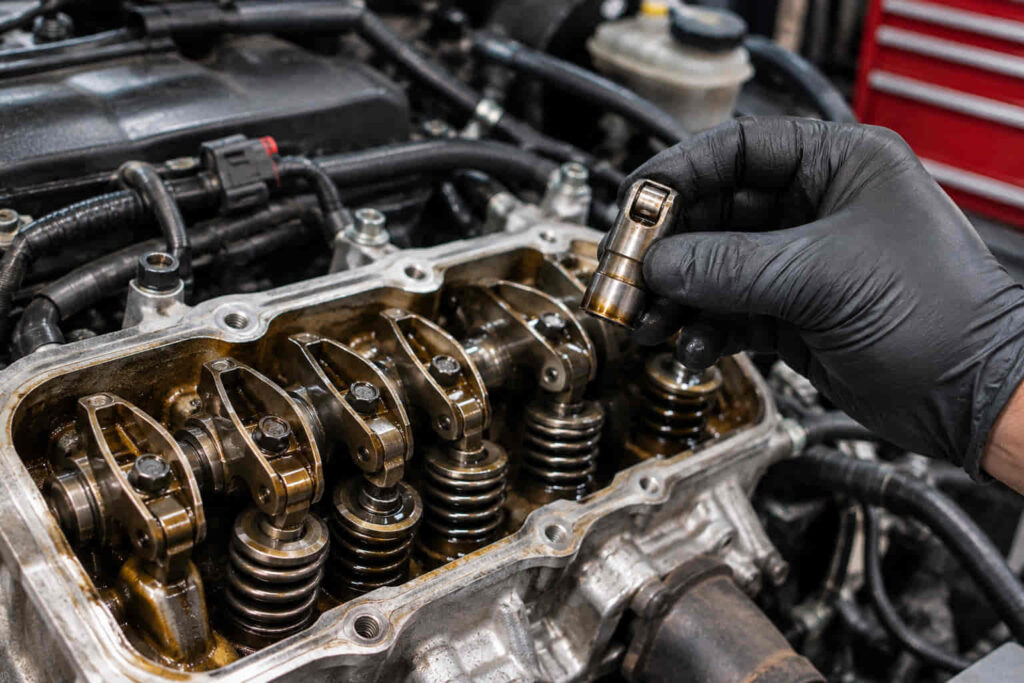
The best way to fix lifters ticking is to identify the source of the noise, check the engine oil level and condition, verify oil pressure, and determine whether the valve lifter is dirty, temporarily drained of oil, incorrectly adjusted, or mechanically damaged. In some cases, changing the engine oil and filter with the correct manufacturer-approved lubricant can reduce or eliminate the ticking. However, a collapsed hydraulic lifter, worn roller bearing, or damaged camshaft generally requires mechanical repair.
Lifter ticking is a common concern in gasoline engines, particularly those using hydraulic valve lifters. The sound is usually described as a rhythmic tapping, clicking, or ticking noise that changes with engine speed. It may appear immediately after startup, disappear as the engine warms up, or continue during normal operation.
Several conditions can produce similar symptoms. Low engine oil, incorrect oil viscosity, sludge accumulation, internal lifter wear, rocker arm damage, and inadequate oil pressure can all affect valvetrain operation. Fuel injector noise, exhaust manifold leaks, and other mechanical problems can also be mistaken for lifter ticking.
General Motors has published service bulletins documenting lifter noise associated with insufficient oil inside hydraulic lifters, contaminated lubricant, and mechanically collapsed lifters. These issues have been identified in certain Chevrolet, GMC, and Cadillac engines, including V8 applications using Active Fuel Management or Dynamic Fuel Management.
However, not every ticking engine has a defective lifter. Replacing lifters without confirming the actual problem can lead to unnecessary repair costs and may leave the original noise unresolved.
Understanding how lifters work, why they make noise, and which repairs are appropriate helps prevent additional engine damage while avoiding ineffective treatments.
What Is Lifter Ticking?
Lifter ticking is a repetitive mechanical noise associated with excessive clearance, abnormal movement, or inadequate hydraulic control within an engine’s valvetrain.
A valve lifter, sometimes called a tappet or cam follower, helps transfer movement from the camshaft to the engine valves.
In a traditional overhead-valve engine, the camshaft is located inside the engine block. Its rotating lobes act on valve lifters, which move the pushrods and rocker arms responsible for opening the intake and exhaust valves.
Hydraulic lifters use engine oil pressure and an internal mechanism to maintain the intended operating clearance.
When the hydraulic mechanism functions correctly, it helps reduce unwanted valvetrain noise and compensates for normal thermal expansion.
However, a lifter that cannot maintain its internal oil pressure may allow excessive movement between connected components.
This can create a tapping or ticking sound.
The noise often follows the speed of the camshaft, which rotates at half the crankshaft speed in a conventional four-stroke engine.
The exact sound depends on the engine design and the cause of the problem.
A lightly drained hydraulic lifter may produce a brief tick after startup.
A severely worn lifter roller can create a persistent mechanical noise and eventually damage the camshaft.
Because these situations require different repairs, the sound should be treated as a diagnostic clue rather than proof that the lifter must be replaced.
What Causes Engine Lifters to Tick?
The most common causes of lifter ticking include low engine oil, dirty or degraded lubricant, incorrect oil viscosity, oil aeration, inadequate oil pressure, internal lifter leakage, and mechanical wear.
Hydraulic valve lifters depend on a reliable oil supply.
If the engine oil level becomes too low, the oil pump may draw air under certain operating conditions.
Aerated oil cannot provide the same hydraulic behavior as a stable supply of liquid oil.
As a result, the lifter may fail to maintain its intended operating position.
Contaminated oil can create similar problems.
Sludge or small particles may interfere with the internal check valve or oil passages.
Incorrect lubricant viscosity can also affect how quickly oil reaches the lifter, particularly during cold startup.
However, the problem may be mechanical rather than lubrication-related.
A lifter can develop excessive internal leakage as its components wear.
A roller lifter may suffer damage to its roller or bearing assembly.
On engines with cylinder deactivation, a specialized lifter may fail to lock or unlock correctly.
GM’s service bulletin 10-06-01-007E identifies low oil level, incorrect oil viscosity, contaminated oil, aerated oil, and internal lifter leakage as potential causes of startup lifter ticking in certain engines.
The proper repair therefore depends on determining which condition is present.
Simply adding an aftermarket treatment cannot correct every possible cause.
How to Fix Lifters Ticking Without Replacing Them
Lifter ticking may be corrected without replacing the lifters when the problem is caused by low oil level, incorrect lubricant, contaminated oil, or a temporary hydraulic pressure condition rather than permanent mechanical damage.
The first step is to establish whether the engine has adequate oil.
The oil level should be checked according to the vehicle owner’s manual.
If the level is low, the correct manufacturer-approved oil should be added.
However, overfilling the engine must be avoided because excessive oil can become aerated and interfere with lubrication.
If the oil is overdue for replacement or its condition is questionable, an oil and filter change may be appropriate.
The lubricant must meet the specified viscosity and performance requirements.
After the service, the engine can be evaluated for changes in noise, provided there are no oil pressure warnings or symptoms of severe mechanical damage.
A brief startup tick may diminish after the hydraulic lifters receive sufficient oil.
However, a persistent tick should not be ignored simply because it becomes less noticeable at higher engine speeds.
Oil pressure should be measured when lubrication problems are suspected.
If the pressure is outside specification, the cause must be corrected.
When oil level, oil condition, and pressure are normal but the noise persists, internal lifter wear or another valvetrain fault becomes more likely.
In that situation, further inspection is more useful than repeatedly changing oil or adding chemicals.
How to Check Engine Oil When Lifters Are Ticking
Checking engine oil level is one of the most important initial steps when diagnosing lifter ticking because hydraulic lifters depend on consistent lubrication.
The vehicle should be positioned on level ground.
The engine should be switched off, and the oil should be allowed to drain into the sump for the period specified in the owner’s manual.
For engines equipped with a dipstick, it should be removed, cleaned, reinserted fully, and removed again to obtain an accurate reading.
The oil level should remain within the manufacturer’s acceptable range.
If the reading is below the minimum mark, the correct oil should be added according to the manufacturer’s instructions.
However, low oil level is not the only concern.
An excessively high oil level can also create problems.
If the crankshaft contacts excessive oil in the crankcase, the oil may become aerated.
This can interfere with hydraulic lifter operation.
The oil’s condition should also be evaluated.
Significant sludge, metal particles, or contamination may indicate more serious problems.
A milky appearance can sometimes suggest coolant contamination, although further testing is necessary to establish its cause.
An unusually strong fuel smell may indicate fuel dilution.
The oil should be replaced when necessary, but the source of contamination must also be investigated.
If the engine has a low oil pressure warning, checking the dipstick is not sufficient to confirm that it is safe to drive.
The engine should be shut off as soon as safely possible and the lubrication system diagnosed.
Can an Oil Change Stop Lifter Ticking?
An oil change can stop or reduce lifter ticking when degraded, contaminated, or incorrectly specified oil is preventing the hydraulic lifters from operating correctly.
Engine oil performs several important functions.
It lubricates moving components, helps control internal temperatures, and supplies hydraulic pressure to systems that depend on oil.
Hydraulic lifters rely on this oil to maintain the correct operating relationship between the camshaft and valves.
As oil ages, it can accumulate contaminants and experience changes in its operating characteristics.
Neglected maintenance may contribute to deposits that interfere with small internal passages.
Replacing the oil and filter can restore the correct lubricant condition.
However, the result depends on the cause of the noise.
If a lifter is temporarily affected by dirty oil, servicing the lubrication system may improve its operation.
If the lifter contains a damaged internal spring, worn plunger, or defective roller bearing, changing the oil will not restore the damaged metal components.
The same applies when a camshaft lobe has suffered severe wear.
A new oil filter also cannot reverse existing mechanical damage.
GM’s lifter noise diagnostic guidance recommends inspecting the oil level and condition and correcting unsuitable oil before proceeding to lifter replacement in applicable cases.
This supports oil service as a reasonable initial diagnostic step, not as a guaranteed repair.
The engine should be reassessed after the service.
Persistent abnormal noise requires further investigation.
What Oil Is Best for Ticking Lifters?
The best engine oil for ticking hydraulic lifters is an approved lubricant with the viscosity and performance specification required by the vehicle manufacturer.
There is no universal oil viscosity that eliminates lifter noise on every engine.
A modern engine designed for SAE 0W-20 may have different lubrication requirements from an older V8 specified for SAE 5W-30 or another grade.
The correct viscosity affects oil flow during cold startup and at normal operating temperature.
Using an oil that is excessively thick can change how quickly it reaches certain components.
Using oil that is too thin for the engine’s requirements may affect lubrication under some conditions.
However, oil viscosity should not be selected solely according to the amount of ticking heard.
The engine’s bearing clearances, oil pump characteristics, hydraulic systems, and temperature requirements must be considered.
Modern engine oil standards also include requirements concerning oxidation resistance, wear protection, deposits, and compatibility with other engine systems.
An oil that meets the appropriate manufacturer approval is generally a safer choice than an unapproved lubricant marketed specifically to silence lifters.
For older performance engines with flat-tappet camshafts, oil selection may require additional consideration of camshaft and lifter requirements.
However, the correct product should still be selected using the engine builder’s recommendations.
If an engine begins ticking immediately after an oil change, the installed oil viscosity, specification, oil filter, and fill level should be checked.
A change in noise after servicing may provide useful diagnostic information.
Can Low Oil Pressure Cause Lifter Ticking?
Yes. Low engine oil pressure can cause hydraulic lifters to tick because their internal mechanisms depend on a reliable supply of pressurized oil.
Hydraulic lifters are designed to maintain the appropriate operating clearance.
The oil pump supplies lubricant through the engine’s internal passages.
When oil pressure is inadequate, certain lifters may not remain properly filled.
This can create additional movement and mechanical tapping.
However, low oil pressure can also affect much more important components.
Crankshaft bearings, connecting rod bearings, camshaft bearings, and other moving surfaces depend on adequate lubrication.
A low oil pressure condition can therefore become a serious engine problem.
Possible causes include insufficient oil, a defective oil pump, a restricted pickup screen, excessive bearing clearance, oil leakage, or other lubrication system faults.
An electrical oil pressure sensor may also provide an inaccurate reading.
For this reason, a technician may verify actual pressure using an appropriate mechanical gauge or other manufacturer-approved diagnostic method.
The pressure should be compared with specifications for the exact engine and operating temperature.
A pressure reading that is normal at one engine speed does not necessarily establish normal operation under every condition.
If the engine displays a low oil pressure warning, it should not be driven merely to see whether the ticking disappears.
Continuing to operate it can cause extensive internal damage.
Correcting the oil pressure problem takes priority over treating the noise.
How Do You Test Oil Pressure on a Ticking Engine?
Oil pressure testing helps determine whether the lifter noise is associated with inadequate lubrication or a localized mechanical problem.
The exact procedure depends on the engine.
A professional technician may connect a calibrated mechanical pressure gauge at an appropriate engine oil pressure port.
Some vehicles also provide electronic oil pressure data through a scan tool.
However, scan tool information should be interpreted according to the design and reliability of the installed sensor.
Testing conditions are important.
Oil pressure changes with engine speed and temperature.
Cold oil is generally more resistant to flow than oil at normal operating temperature.
Therefore, pressure measured immediately after startup may differ substantially from pressure measured at hot idle.
The technician should follow the manufacturer’s testing conditions and compare the readings with the correct specification.
If pressure is low, the lubrication system requires further diagnosis.
A defective oil pressure relief valve, worn pump, restricted pickup, or excessive internal bearing clearance may contribute to the problem.
If pressure is normal, the technician can focus more closely on individual lifters and related valvetrain components.
However, normal pressure at the test port does not automatically prove that every small oil passage inside the engine is unobstructed.
A localized lifter can still develop problems because of contamination or internal wear.
The complete diagnosis should combine pressure measurements with mechanical inspection and the noise’s operating characteristics.
Why Do Lifters Tick During Cold Startup?
Hydraulic lifters may tick during cold startup when their internal oil supply has partially drained while the engine was switched off and has not yet been fully restored.
This condition is sometimes called lifter bleed-down.
When an engine remains stopped, certain hydraulic components may gradually lose oil from their internal chambers.
At the next startup, the engine’s oil pump must restore normal oil circulation.
A lifter that is temporarily short of oil may produce a tapping noise until its hydraulic mechanism stabilizes.
The length of time required depends on the engine design, oil condition, temperature, and condition of the lifter.
Some engines may produce a brief startup tick without indicating major mechanical damage.
However, a noise that persists for an extended period requires greater attention.
GM’s service bulletin 19-NA-218 addresses cold-start ticking in certain GM V8 engines.
The document identifies insufficient oil within a lifter during startup as a possible cause.
It also provides diagnostic procedures to distinguish temporary noise from a persistent lifter problem.
The key factor is whether the noise disappears normally and whether additional symptoms are present.
A short, isolated tick after startup is different from loud, continuous ticking accompanied by misfires or low oil pressure.
Owners should follow the vehicle manufacturer’s guidance rather than assume that any cold-start ticking is harmless.
Why Do Lifters Tick When the Engine Is Hot?
Lifter ticking that becomes more noticeable when the engine is hot can indicate excessive internal lifter leakage, oil pressure problems, or mechanical wear.
As engine temperature increases, engine oil becomes less resistant to flow.
This change is normal and is considered in the engine’s lubrication design.
However, a worn hydraulic lifter may have difficulty maintaining its internal hydraulic position when oil is hot.
Excessive internal leakage can allow the lifter to lose pressure.
The resulting clearance may produce a ticking sound.
Low hot-idle oil pressure can also contribute to abnormal valvetrain noise.
A worn engine with excessive bearing clearance may provide less oil pressure at idle than expected.
However, these conditions must be confirmed by measurement.
A hot-engine tick can also come from other sources.
An exhaust manifold leak may change its sound as metal components expand with temperature.
Fuel injectors can produce normal clicking noises.
A damaged rocker arm or camshaft lobe may also create a persistent mechanical sound.
The technician should compare the noise at cold startup, warm idle, and different engine speeds.
If the engine has normal oil pressure and the ticking is isolated to one cylinder, a local valvetrain fault may be more likely than a general lubrication problem.
Persistent hot ticking deserves inspection rather than repeated attempts to conceal the sound with heavier oil.
Can Engine Oil Additives Fix Lifter Ticking?
Some products marketed for lifter noise may alter oil behavior or claim to help with deposits, but additives cannot reliably repair mechanically damaged lifters, worn camshaft lobes, or broken valvetrain components.
Lifter additives are often marketed as a low-cost alternative to mechanical repair.
Their intended functions may include cleaning deposits, changing lubricant properties, or improving the operation of certain hydraulic components.
However, the effectiveness of a product depends on the actual condition causing the noise.
If a lifter is affected by removable deposits, changes in oil cleanliness may help.
However, this does not prove that a particular additive will restore normal operation.
A lifter with a seized roller, worn internal plunger, or damaged locking mechanism requires a different repair.
Adding chemicals cannot restore damaged metal surfaces or replace broken components.
Manufacturer recommendations also matter.
General Motors advises against adding unapproved substances to engine oil in many of its owner manuals.
Ford similarly warns that supplemental oil additives are unnecessary and may contribute to engine damage not covered by warranty.
Some manufacturers also discourage engine oil flushes.
These recommendations should take precedence over general aftermarket claims.
An additive should not be used to compensate for low oil pressure or a severe mechanical fault.
For most modern engines, using the correct approved oil and filter is the safer initial approach.
If ticking continues, professional diagnosis provides more value than repeatedly adding different treatments.
Should You Use Thicker Oil to Silence Lifters?
Using thicker engine oil solely to silence lifters is not a reliable repair and may interfere with lubrication or hydraulic control systems when the viscosity differs from the manufacturer’s specification.
Oil viscosity influences its behavior at different temperatures.
A thicker lubricant may temporarily change the sound produced by worn components.
However, reducing noise does not necessarily mean the underlying mechanical problem has been corrected.
An engine can become quieter while still experiencing abnormal wear.
Hydraulic lifters, camshaft actuators, and other oil-operated components are designed around particular lubricant properties.
Changing viscosity outside the approved range can affect their operation.
Cold-start lubrication is another concern.
An oil that is unsuitable for low temperatures may circulate differently during startup.
This can be especially important when the engine is operated in a cold climate.
Older engines sometimes receive different oil recommendations based on operating temperature or engine condition.
However, any change should follow manufacturer-approved viscosity options or qualified engine builder guidance.
A worn lifter cannot be restored to its original dimensions by using thicker oil.
Likewise, an oil pump problem must be corrected mechanically.
The best strategy is to identify the cause of the ticking and use the lubricant appropriate for the engine.
Read more: Rocker Arm Replacement
How to Tell Whether Lifter Ticking Is Serious
Lifter ticking becomes more concerning when it is persistent, grows louder, appears with a misfire, or is accompanied by low oil pressure, severe vibration, or loss of engine power.
The timing and behavior of the noise provide useful information.
A brief sound immediately after startup may have a different cause from continuous ticking during every driving condition.
A noise that disappears after a short warm-up may be associated with temporary hydraulic lifter filling.
However, a loud and persistent tick can indicate a damaged lifter or another valvetrain component.
Misfires increase the concern.
A collapsed lifter may prevent the associated valve from opening as intended.
This can reduce cylinder filling or exhaust flow.
The engine may develop rough idle, reduced power, or a check engine light.
A damaged lifter roller can also wear the camshaft lobe.
If metal particles enter the lubrication system, the repair may become more extensive.
Low oil pressure is an especially important warning sign.
The engine should be shut down as soon as it is safe to do so.
A flashing check engine light, severe misfiring, metallic knocking, or significant power loss also justifies stopping operation and arranging professional inspection.
The severity cannot be determined reliably from sound volume alone.
A proper diagnosis is necessary to distinguish a minor startup condition from progressive mechanical damage.
How to Diagnose Lifter Ticking Step by Step
A reliable diagnosis begins by identifying the operating conditions that produce the noise and then checking the lubrication system, diagnostic trouble codes, and relevant valvetrain components.
The first consideration is when the ticking occurs.
The technician should determine whether the noise appears only during cold startup, remains at hot idle, increases with engine speed, or occurs under particular loads.
Next, the oil level and condition should be checked.
Incorrect oil or an overdue service may justify changing the oil and filter.
However, this should not delay investigation of severe symptoms.
Oil pressure must be verified when there is reason to suspect inadequate lubrication.
A diagnostic scan can identify stored and pending trouble codes.
Misfire codes may help narrow the investigation to a particular cylinder.
The engine should then be evaluated for noises that resemble lifter ticking.
An exhaust leak, injector click, damaged rocker arm, or timing component problem may produce a similar sound.
If the evidence points to the valvetrain, further mechanical inspection may be appropriate.
Depending on the engine, this may involve removing a valve cover, measuring valve movement, or examining lifters and camshaft surfaces.
GM’s bulletin 19-NA-219 describes diagnostic procedures for distinguishing worn camshaft lobes, damaged lifter rollers, broken valve springs, sticking valves, and collapsed AFM lifters.
These procedures emphasize that accurate component identification should precede replacement.
The correct diagnosis determines whether the repair requires oil service, valve adjustment, lifter replacement, or more extensive engine work.
How to Locate a Lifter Ticking Noise
A ticking noise should be located carefully because several engine components can produce similar sounds and vibrations that travel through the engine block and cylinder heads.
A mechanic may begin by listening to different areas of the engine.
A mechanic’s stethoscope can help compare sounds near the valve covers, intake manifold, timing cover, and other accessible locations.
However, the tool must be used carefully around moving belts, pulleys, and hot components.
Mechanical sound travels through metal.
Consequently, the loudest audible location may not always be the actual source.
The engine’s operating conditions also provide clues.
A lifter or camshaft-related noise may follow the valvetrain’s operating speed.
A fuel injector may produce a normal clicking noise during injection.
An exhaust manifold leak can produce a sharp ticking or puffing sound, especially near a damaged gasket or broken fastener.
A loose accessory or pulley may create a different type of repetitive sound.
The technician should compare the noise with the engine’s speed and temperature.
Diagnostic trouble codes can provide additional information.
A ticking sound accompanied by a specific-cylinder misfire deserves closer examination of that cylinder.
However, listening alone is not sufficient to condemn a lifter.
A mechanical inspection should confirm the failed component before expensive engine disassembly begins.
Lifter Tick vs Fuel Injector Tick: What’s the Difference?
Fuel injectors can produce normal clicking sounds during operation, while a defective hydraulic lifter typically produces noise associated with abnormal valvetrain clearance or movement.
Modern fuel injectors open and close rapidly under electronic control.
The movement of their internal components can create audible clicking.
In some engines, direct-injection fuel systems produce particularly noticeable mechanical noise.
This sound may be normal.
Lifter ticking can have a similar rhythm, making it difficult to distinguish by listening from outside the vehicle.
However, the location and operating characteristics may differ.
Injector noise is generally associated with the fuel injection system.
Valvetrain noise is associated with the camshaft, lifters, rocker arms, and valves.
A defective lifter may also cause abnormal valve movement or misfires.
Fuel injector noise alone does not mean the injector is defective.
Likewise, a ticking sound near the fuel rail does not necessarily prove the absence of valvetrain problems because sound can travel through the engine.
A technician should evaluate the sound in combination with the engine’s diagnostic data.
Misfire codes, valve movement, and component-specific inspection can help identify the actual source.
Replacing hydraulic lifters because normal injector clicking was mistaken for a fault would create unnecessary expense.
Correct noise identification is therefore an essential part of the repair process.
Lifter Tick vs Exhaust Leak: How Can You Tell?
An exhaust manifold leak can create a sharp ticking noise that resembles hydraulic lifter noise, particularly during cold startup.
Exhaust gases leave the cylinders under pressure and flow through the exhaust manifold.
The manifold and its gasket must maintain a seal against the cylinder head.
If the gasket fails or a mounting fastener breaks, exhaust gas can escape near the engine.
The escaping pulses may create a ticking or tapping sound.
On certain engines, the noise becomes more noticeable when the engine is cold.
As the manifold heats and expands, the sound may change.
This behavior can resemble lifter ticking that diminishes during warm-up.
However, an exhaust leak has different mechanical causes.
The technician may look for soot deposits near the manifold, damaged gaskets, loose fasteners, or evidence of escaping exhaust gases.
The inspection should be performed safely because exhaust components can become extremely hot.
An exhaust leak may also produce an unusual smell or altered exhaust sound.
A properly diagnosed manifold leak can often be repaired without replacing any internal engine components.
This is why exhaust inspection is important before assuming a persistent tick comes from a hydraulic lifter.
Can a Bad Rocker Arm Sound Like a Ticking Lifter?
Yes. A worn rocker arm, damaged roller follower, loose valvetrain component, or collapsed hydraulic lash adjuster can produce sounds similar to a defective valve lifter.
Rocker arms transfer mechanical motion to the intake and exhaust valves.
Their design varies according to engine architecture.
A traditional pushrod V8 uses rocker arms driven by pushrods.
Many overhead-camshaft engines use finger followers or rocker assemblies that operate directly beneath the camshafts.
If a rocker pivot develops excessive clearance, it may create ticking.
A roller bearing that becomes damaged can also produce abnormal mechanical noise.
In some overhead-camshaft engines, the hydraulic lash adjuster is separate from the rocker or follower.
A failed adjuster can create noise even when the rocker remains serviceable.
This distinction is important because not every engine has conventional block-mounted hydraulic lifters.
For example, a Chrysler 3.6L Pentastar V6 uses a valvetrain arrangement involving rocker or finger follower components and hydraulic lash adjusters.
Certain Pentastar ticking complaints may involve these parts rather than a traditional pushrod lifter.
The technician must inspect the specific design.
Replacing the wrong component may not eliminate the noise.
The repair should address the failed rocker, follower, lash adjuster, camshaft, or related component identified through diagnosis.
Can Spark Plugs or Ignition Problems Cause Lifter-Like Ticking?
A loose spark plug or certain ignition-related conditions may produce sounds or symptoms that are mistaken for lifter problems, although they do not represent hydraulic lifter failure.
Spark plugs must seal properly against the cylinder head.
A loose plug can allow combustion pressure to escape near the threaded opening.
This may create a repetitive sound that resembles an exhaust or valvetrain tick.
The condition can also affect combustion and engine performance.
However, spark plug problems more commonly produce misfires, rough idle, or reduced power.
These symptoms overlap with those caused by damaged lifters.
A mechanic may therefore suspect a valvetrain problem when the actual cause involves the ignition system.
Diagnostic trouble codes can help narrow the investigation.
A specific-cylinder misfire should prompt evaluation of the spark plug, ignition coil, fuel injector, and mechanical condition.
A loose spark plug should be handled according to the engine manufacturer’s service procedure.
Incorrect tightening can damage cylinder head threads.
Replacing lifters without checking the ignition and combustion systems can be unnecessary.
This is particularly important when the engine has a misfire but no confirmed abnormal valve movement.
A complete diagnosis should separate noise generation from combustion-related symptoms.
Can Valve Adjustment Fix Lifter Ticking?
Valve adjustment can correct ticking caused by excessive mechanical valve lash on engines equipped with adjustable valvetrains, but it does not repair a physically damaged hydraulic lifter.
Different engines use different methods for maintaining valve clearance.
A solid-lifter engine requires a specified mechanical clearance between valvetrain components.
As wear occurs, the clearance can change.
Excessive lash may produce ticking.
Adjusting the clearance to the manufacturer’s specification can eliminate noise caused by incorrect adjustment.
Hydraulic lifter engines operate differently.
Their hydraulic mechanisms maintain the intended operating clearance.
Some traditional pushrod engines require an initial hydraulic lifter preload adjustment.
Others use fixed rocker arm mounting arrangements that do not provide routine manual adjustment.
On engines with separate hydraulic lash adjusters, the correct repair may involve replacing a failed adjuster rather than changing mechanical clearance.
An adjustment cannot restore a worn roller bearing or damaged camshaft lobe.
Incorrectly tightening a rocker arm in an attempt to silence the engine can create additional problems.
Excessive preload may prevent the valve from closing correctly.
This can reduce compression or cause valve damage.
The correct procedure must therefore match the engine’s actual valvetrain design.
For engines using mechanical valve lash, a properly performed adjustment can be an effective repair.
For a mechanically collapsed hydraulic lifter, replacement is generally necessary.
When Should You Replace a Ticking Hydraulic Lifter?
Hydraulic lifter replacement becomes appropriate when diagnostic testing confirms internal failure, excessive leakage, a defective roller, a collapsed mechanism, or another condition that cannot be corrected through normal lubrication and service procedures.
A brief startup tick does not automatically justify replacement.
The oil level, oil condition, and pressure should be evaluated first.
However, persistent ticking with normal oil pressure may indicate localized mechanical wear.
A worn lifter may fail to maintain the required hydraulic position.
This can create excessive valvetrain movement.
A collapsed lifter can also reduce valve lift and cause a misfire.
Certain cylinder-deactivation lifters have additional internal locking components.
If those components fail, the lifter may remain collapsed or function incorrectly.
In these situations, the damaged component generally requires replacement.
The repair may involve removing the cylinder head, intake manifold, pushrods, rocker arms, or other components, depending on the engine.
The camshaft must also be inspected for damage.
If the lifter roller has worn the camshaft lobe, replacing only the lifter may not provide a lasting repair.
Some manufacturers specify replacing multiple lifters or an entire affected bank.
The actual service procedure should determine which parts are replaced.
For a confirmed mechanical failure, continued use of additives or thicker oil is not an appropriate substitute for repair.
How to Replace Hydraulic Valve Lifters
Hydraulic lifter replacement involves gaining access to the lifter assembly, removing damaged components, inspecting the camshaft and related valvetrain, and installing the correct replacement parts according to engine-specific service procedures.
The engine must first be identified accurately.
A conventional pushrod V8 may have its lifters positioned inside the engine block.
Depending on the design, removal can require taking off the intake manifold, valve covers, rocker arms, pushrods, and cylinder heads.
Some engines allow lifter access through different arrangements.
The precise procedure varies.
Before removal, the technician should document the location of each component and inspect the affected valvetrain.
A damaged pushrod, rocker arm, or valve spring may explain the symptoms.
The lifter is then removed using the method specified for the engine.
The camshaft contact surface must be inspected.
A worn roller lifter may have produced damage that requires camshaft replacement.
The lifter bore and any retaining guides should also be checked.
Replacement lifters must be compatible with the engine’s camshaft and operating system.
The installation procedure may require specific lubrication, orientation, or oil preparation.
Certain lifter types also require attention to hydraulic preload during reassembly.
The engine’s timing and fastening procedures must be followed correctly.
After installation, the lubrication system should be prepared as specified.
The engine is then checked for normal operation, oil pressure, abnormal noise, and diagnostic trouble codes.
Because access and assembly procedures vary significantly, this repair should not be attempted using a generic torque chart or universal engine teardown procedure.
Should You Replace All Lifters or Only the Noisy One?
Replacing one lifter may be appropriate when the defect is isolated and the manufacturer permits individual replacement, but some engine designs and failure patterns require replacing several lifters or an entire affected bank.
The correct decision depends on the cause of failure.
A single hydraulic lifter may develop a local internal problem while other lifters remain serviceable.
However, multiple lifters may have experienced similar wear.
A lubrication problem can also affect several components.
If the engine contains metal debris from a damaged lifter roller, the condition of the remaining components becomes especially important.
Cylinder-deactivation engines introduce additional considerations.
GM has published service procedures requiring replacement of an affected bank of lifters in certain conditions involving collapsed AFM or DFM lifters.
Some procedures also require replacing lifter guides and related oil control components.
However, the exact repair depends on the engine family, production year, and diagnostic findings.
The cost of disassembly also matters.
If major labor is already required to access the lifters, replacing other worn components may be more economical than repeating the same work later.
Nevertheless, replacing every lifter without evidence or manufacturer instructions can increase cost unnecessarily.
The mechanic should evaluate the condition of the camshaft, lifter rollers, guides, and other relevant components before deciding on the replacement scope.
What Happens If a Ticking Lifter Damages the Camshaft?
A lifter with a damaged roller or abnormal contact surface can wear the camshaft lobe, potentially requiring replacement of the camshaft and associated lifters.
The camshaft controls valve timing and lift.
Its lobes are machined to precise profiles.
When a lifter or roller operates correctly, it follows the camshaft surface according to the intended design.
If the roller becomes damaged or stops rotating properly, abnormal friction can develop.
The camshaft lobe may become scored, pitted, flattened, or otherwise worn.
This changes the movement transmitted to the valve.
The engine may then develop reduced valve lift, rough running, or a persistent misfire.
GM’s service bulletin 19-NA-219 identifies worn camshaft lobes and damaged lifter rollers as possible causes of ticking and misfire complaints.
The bulletin also explains that a damaged camshaft may not always be identified through basic compression testing.
Inspection of valve movement and camshaft condition can be necessary.
When the camshaft is damaged, replacing the lifter alone may not correct the problem.
The affected components must be repaired as a matched mechanical system.
Metal particles generated by wear may also require additional inspection of the lubrication system.
Delaying the repair can allow damage to progress and increase the total cost.
How to Fix Lifter Ticking on Chevy and GMC V8 Engines
For Chevrolet and GMC V8 engines, lifter ticking should be diagnosed with attention to oil condition, engine-specific service bulletins, AFM or DFM operation, camshaft wear, and possible misfire codes.
General Motors has used hydraulic lifters in numerous V8 engine families.
Traditional small-block Chevrolet engines use conventional hydraulic lifters in many configurations.
Later engines introduced Active Fuel Management.
More recent applications use Dynamic Fuel Management, depending on engine and production year.
These technologies allow certain cylinders to be deactivated during selected operating conditions.
The systems use specialized lifter mechanisms and oil control strategies.
A failure can cause abnormal valvetrain movement, ticking, or a misfire.
GM issued bulletin 15-06-01-002 for certain 5.3L and 6.2L engines experiencing misfire or ticking related to a mechanically collapsed AFM lifter.
The document identifies internal lifter locking pin damage as a possible cause.
Another bulletin, 19-NA-218, describes cold-start ticking when a lifter has not received sufficient oil.
These conditions are different.
One may involve a temporary hydraulic filling problem.
The other may involve a mechanically damaged lifter.
The correct repair therefore depends on testing.
A technician may inspect oil pressure, verify camshaft and valve movement, and use scan tool functions appropriate to the engine.
Applicable service bulletins and warranty coverage should be checked using the vehicle identification number.
Replacing lifters without identifying the exact failure mechanism can create unnecessary expense.
Does Disabling AFM or DFM Stop Lifter Ticking?
Disabling cylinder deactivation does not reliably repair a mechanically damaged lifter, and it should not be confused with replacing defective internal engine components.
Active Fuel Management and Dynamic Fuel Management are designed to reduce fuel consumption under selected operating conditions.
Their specialized valvetrain systems allow certain cylinders to stop operating temporarily.
When an AFM or DFM lifter develops a mechanical fault, it may fail to lock or unlock correctly.
A collapsed lifter can interfere with valve operation.
The engine may develop ticking or misfires.
Some aftermarket products claim to prevent lifter problems by changing the operation of cylinder deactivation.
However, a software change cannot restore a broken locking pin, damaged roller, or worn camshaft lobe.
A mechanically failed lifter remains damaged regardless of whether the engine control system requests cylinder deactivation.
Certain performance engine builds use hardware conversions involving different lifters, camshafts, and associated components.
These are substantial mechanical modifications, not simple repairs.
They may also affect emissions certification, electronic compatibility, warranty coverage, and road-use legality.
Owners should follow applicable regulations and manufacturer service procedures.
The appropriate first step is diagnosing the lifter failure and determining whether the vehicle has relevant service bulletins or warranty coverage.
The best repair addresses the defective mechanical components rather than merely changing the control strategy.
Can a HEMI Engine Develop Lifter Ticking?
Yes. HEMI engines can develop valvetrain ticking, but the noise may involve hydraulic lifters, camshaft wear, exhaust manifold leakage, or other components depending on the exact engine.
Chrysler’s 5.7L HEMI uses an overhead-valve arrangement with hydraulic lifters and rocker arms.
Certain applications also use a Multi-Displacement System, commonly called MDS.
The system allows selected cylinders to be deactivated under suitable operating conditions.
However, not every ticking HEMI has a damaged MDS lifter.
An exhaust manifold leak can create a similar sound.
Broken manifold fasteners may produce a sharp tick, particularly during cold startup.
Mechanical lifter or camshaft wear can also cause noise.
The technician should determine whether the sound originates from the exhaust system or the internal valvetrain.
Oil pressure and lubricant condition should be evaluated when lifter problems are suspected.
If abnormal camshaft or lifter wear is confirmed, the affected components require inspection and repair.
Engine operating history also matters.
A high-mileage engine with poor maintenance may have different mechanical risks from a low-mileage engine with complete service records.
The correct repair depends on the exact HEMI engine variant and confirmed fault.
A universal recommendation to replace all lifters based only on ticking is not supported.
Can Lifter Ticking Happen on Overhead-Camshaft Engines?
Yes. Overhead-camshaft engines can produce lifter-like ticking, although they may use hydraulic lash adjusters or roller finger followers instead of traditional block-mounted hydraulic lifters.
The term lifter is often used broadly to describe valvetrain components that maintain clearance or transfer camshaft movement.
However, modern engine architectures differ.
A traditional pushrod engine has a camshaft located inside the block.
Its lifters operate between the camshaft and pushrods.
An overhead-camshaft engine has one or more camshafts mounted near the valves.
Some designs use hydraulic lash adjusters supporting roller finger followers.
Others use mechanical adjustment systems.
A failed hydraulic lash adjuster can create ticking that resembles conventional lifter noise.
A worn finger follower or rocker roller can produce similar symptoms.
However, a mechanical valve lash problem may require adjustment instead of replacing a hydraulic component.
For example, many Honda K-series engines use mechanical valve clearance adjustment.
Excessive clearance can create a tapping sound.
The appropriate repair involves measuring and setting the specified lash.
Other overhead-camshaft engines use different systems and may not have a routine valve adjustment procedure.
Therefore, the engine’s mechanical design must be identified before selecting a repair.
Calling every valvetrain noise a bad lifter can lead to incorrect parts replacement.
Can You Drive With Lifter Ticking?
Driving with lifter ticking may be possible in some minor cases, but continuing to operate an engine with persistent mechanical noise can increase the risk of camshaft, valvetrain, or other internal damage.
The appropriate response depends on the symptoms.
A brief startup tick that disappears normally and is recognized by the manufacturer may not require immediate engine disassembly.
However, a persistent or progressively louder noise deserves inspection.
A damaged lifter roller can wear the camshaft.
A collapsed lifter may prevent the corresponding valve from moving correctly.
This can cause a misfire or loss of power.
Driving with severe misfiring can also damage the catalytic converter because unburned fuel may enter the exhaust system.
Oil pressure warnings require immediate attention.
If the engine has a low oil pressure warning, loud metallic knocking, severe shaking, a flashing check engine light, or significant power loss, it should be stopped as soon as safely possible.
The vehicle may need to be towed to a repair facility.
The absence of a warning light does not prove that a persistent tick is harmless.
Mechanical problems can develop before the engine management system identifies a fault.
The safest approach is to identify the noise early and determine whether continued operation is appropriate.
How Much Does It Cost to Fix Lifter Ticking?
Lifter ticking repair costs range from a relatively inexpensive oil service to several thousand dollars when internal lifters and camshaft components require replacement.
The cost depends on the root cause.
If the noise results from low oil level, the immediate expense may involve adding the correct lubricant.
If the oil is degraded or incorrect, an oil and filter change may be sufficient.
These services usually cost much less than internal engine repairs.
However, professional diagnosis may be necessary when the noise continues.
Lifter replacement is significantly more expensive because the components may be difficult to access.
Some engines require cylinder head removal or extensive valvetrain disassembly.
For a general 2026 U.S. budgeting reference, estimates for professional lifter replacement on many V6 and V8 engines fall around $1,500–$3,500.
More involved repairs requiring a camshaft and additional components may reach approximately $2,500–$4,500 or more.
These figures are broad estimates rather than official manufacturer prices.
Certain engines can cost substantially less or more.
The actual repair depends on labor rates, engine design, the number of failed lifters, and whether the camshaft has been damaged.
Additional gaskets, fasteners, oil system components, or related repairs may increase the invoice.
The most reliable estimate is obtained after confirming the failed components and identifying the required labor.
Replacing expensive parts before diagnosis can make the repair unnecessarily costly.
How Long Does Lifter Replacement Take?
Lifter replacement time varies according to engine architecture, component accessibility, and the amount of additional damage requiring repair.
In a conventional pushrod engine, the lifters are often located inside the engine block.
Access can require removing the intake manifold, rocker arms, pushrods, and cylinder heads.
The actual labor time depends on the engine.
Some designs allow more direct access than others.
An overhead-camshaft engine with hydraulic lash adjusters may require a different procedure.
Certain applications need specialized tools or camshaft removal.
If the camshaft is damaged, the repair becomes more extensive.
Timing components, additional gaskets, and other parts may also require removal.
The technician must then inspect and clean the affected components.
Any debris from mechanical wear should be addressed according to the service instructions.
After reassembly, the engine must be checked for correct lubrication, valve operation, and noise.
Repair duration also depends on parts availability and whether machine shop work is necessary.
A straightforward repair may require several hours of labor.
A complicated lifter and camshaft repair can require substantially more time.
The correct estimate should come from the specific engine’s labor guide and actual repair findings.
Can You Fix Lifter Ticking Yourself?
Some causes of lifter ticking can be addressed through basic maintenance, but replacing internal hydraulic lifters usually requires more advanced mechanical skills and engine-specific tools.
An owner can often begin with checking the engine oil level and reviewing maintenance records.
Changing the oil and filter is also a reasonable DIY task for someone familiar with the vehicle’s service requirements.
However, the correct oil specification and fill quantity must be followed.
Overfilling the engine or using unsuitable lubricant may create additional problems.
A persistent ticking sound requires more careful diagnosis.
A scan tool can help identify misfire codes.
However, the presence of a code does not prove that a lifter has failed.
Mechanical inspections may require removing valve covers or other engine components.
Lifter replacement on a pushrod V8 can involve cylinder head removal, correct engine timing, torque-to-yield fasteners, and precision assembly.
An incorrect repair may cause severe engine damage.
Certain overhead-camshaft engines require camshaft timing tools and specialized procedures.
For these applications, professional service may be more appropriate.
A DIY repair should be attempted only when the owner has the required equipment, reliable service documentation, and sufficient experience.
The safest approach is to perform basic maintenance correctly and obtain a confirmed diagnosis before disassembling the internal engine.
How to Prevent Lifters From Ticking Again
The best ways to reduce avoidable lifter noise are maintaining the correct engine oil level, using the approved lubricant, replacing oil and filters on schedule, and addressing lubrication or valvetrain problems promptly.
Hydraulic lifters depend on clean, stable oil pressure.
Routine maintenance helps protect their internal mechanisms.
The engine oil should meet the manufacturer’s specified viscosity and performance approval.
Oil changes should follow the applicable maintenance schedule.
Severe driving conditions may require more frequent service where the manufacturer specifies it.
The engine oil level should also be monitored.
Leaks or abnormal oil consumption can gradually reduce the amount of available lubricant.
Allowing the oil level to become excessively low can create problems throughout the engine.
However, excessive oil should also be avoided because it may become aerated.
The cooling system deserves attention.
Severe overheating can affect engine oil behavior and damage internal components.
Fuel and ignition problems should also be diagnosed because abnormal combustion may place additional demands on the engine.
For engines with known lifter-related service issues, applicable manufacturer bulletins should be reviewed.
A properly repaired engine should receive the required replacement components and any associated hardware updates.
However, maintenance cannot prevent every mechanical defect.
Manufacturing issues or component fatigue can still cause failure.
The objective is to reduce avoidable wear and identify abnormal conditions before they develop into major engine damage.
What Is the Fastest Way to Stop Lifter Ticking?
The fastest appropriate fix depends on the cause: correct a low oil level, replace incorrect or degraded oil, or repair the damaged valvetrain component once it has been identified.
A ticking engine should not automatically receive an additive or thicker lubricant.
The most useful immediate action is checking the oil level and identifying whether serious symptoms are present.
If the engine is low on oil, adding the correct approved lubricant may help restore normal hydraulic operation.
However, an oil pressure warning or loud metallic noise requires stopping the engine rather than continuing to run it.
If the oil condition is poor, an oil and filter service may improve the operation of a lifter affected by contamination.
However, persistent ticking after normal pressure and lubrication have been established suggests that further diagnosis is necessary.
A collapsed lifter will not become mechanically sound simply because the engine is operated longer.
A worn roller bearing cannot be restored by changing viscosity.
Likewise, damaged camshaft lobes require mechanical evaluation.
The fastest lasting solution is the repair that addresses the actual fault.
For some engines, that is ordinary maintenance.
For others, it means replacing lifters, rocker components, or camshaft parts.
Avoiding unnecessary treatments can save time and prevent additional damage.
Final Verdict: How to Fix Lifters Ticking Permanently
The most reliable way to fix lifters ticking is to diagnose the root cause and correct the underlying lubrication or mechanical problem rather than simply trying to silence the noise.
Hydraulic lifter ticking may result from low oil level, contaminated oil, incorrect viscosity, oil aeration, insufficient oil pressure, internal lifter leakage, or damaged valvetrain components.
The appropriate initial response is to check the engine oil level and condition.
The correct manufacturer-approved lubricant should be used.
If the oil is overdue for replacement or contaminated, changing the oil and filter may help restore normal hydraulic lifter operation.
However, persistent ticking requires further inspection.
Oil pressure should be verified when lubrication problems are suspected.
A mechanic should also distinguish actual lifter noise from fuel injector clicking, exhaust manifold leakage, damaged rocker arms, and other engine sounds.
When a hydraulic lifter has collapsed mechanically or its roller has become damaged, replacement is generally necessary.
If the camshaft has also suffered wear, both components may require repair or replacement.
Certain engines, particularly GM V8 applications with AFM or DFM systems, have manufacturer service bulletins addressing specific lifter-related conditions.
These procedures should guide diagnosis when the vehicle is within the affected application range.
Aftermarket additives and thicker oil should not be treated as universal solutions.
Some manufacturers discourage supplemental oil additives, and no chemical treatment can rebuild a broken internal lifter mechanism.
For temporary lifter ticking caused by oil-related conditions, correcting the oil level or performing a proper oil service may be sufficient. For persistent ticking caused by worn or collapsed lifters, mechanical replacement is the dependable solution.
Addressing abnormal valvetrain noise early, maintaining proper lubrication, and following the manufacturer’s service procedures can reduce the risk of camshaft damage and help preserve long-term engine reliability.