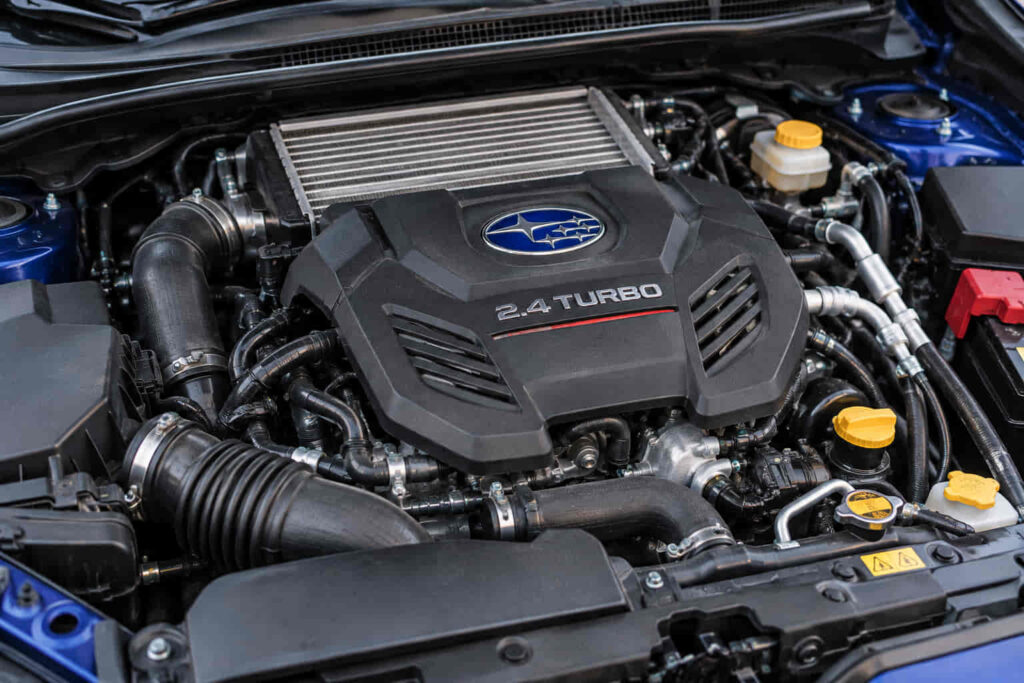
Is the Subaru 2.4 Turbo reliable? Yes, the Subaru FA24 turbocharged engine is generally a promising and capable powerplant, especially when maintained according to factory recommendations. It offers strong low-RPM torque, modern engine management, and a more relaxed driving experience than some older high-strung turbocharged Subaru engines. However, its long-term reliability depends on maintenance, engine condition, vehicle application, and whether any applicable recalls or service issues have been addressed.
The Subaru 2.4-liter turbocharged BOXER engine, commonly identified as the FA24F or FA24DIT, powers vehicles such as the Subaru Ascent, Outback XT, Outback Wilderness, and WRX. It also appeared in the turbocharged Subaru Legacy before that model ended production after the 2025 model year.
In the 2026 Subaru Outback and Ascent, the engine produces 260 horsepower and 277 lb-ft of torque. The 2026 WRX uses a performance-oriented version producing 271 horsepower and 258 lb-ft of torque.
The most important reliability concerns to investigate include oil leakage, certain early Ascent fuel pump and PCV valve recalls, reports involving excess engine sealant, and transmission problems that may be mistaken for engine failures. Subaru has also published diagnostic information for oil leakage on FA-series engines and chain slip or hesitation concerns involving certain Lineartronic CVT transmissions.
However, a technical service bulletin or individual owner complaint does not prove that every FA24 turbo engine has the same problem.
The engine has been used in production vehicles since the 2019 model year, giving it a meaningful service history. Nevertheless, there is still insufficient public evidence to establish a universally reliable average lifespan or a definitive failure rate across every vehicle and model year.
Understanding which problems affect the engine itself, which involve supporting components, and which apply only to specific recalled vehicles is essential before buying or maintaining a Subaru 2.4 Turbo.
What Is the Subaru 2.4 Turbo Engine?
The Subaru 2.4 Turbo is a 2,387 cc turbocharged, horizontally opposed four-cylinder gasoline engine belonging to Subaru’s FA engine family.
Unlike a conventional inline-four, the Subaru BOXER engine uses two horizontally opposed cylinder banks.
This arrangement allows the pistons to move horizontally and helps position the engine’s mass relatively low in the vehicle.
Subaru uses the configuration as part of its broader powertrain design, which includes Symmetrical All-Wheel Drive in models such as the Outback, Ascent, and WRX.
The FA24 turbo engine features an aluminum-alloy engine construction, dual overhead camshafts, electronically controlled variable valve timing, and chain-driven camshafts.
The engine uses direct gasoline injection and a turbocharger to increase airflow and improve power output from its relatively compact displacement.
The factory bore and stroke measure 94.0 mm and 86.0 mm, respectively.
Its compression ratio is approximately 10.6:1 in current North American turbocharged applications.
A twin-scroll turbocharger helps deliver responsive boost across a broad operating range.
This allows the engine to generate useful torque at relatively low RPM.
However, turbocharging also increases the importance of correct lubrication, cooling, air filtration, and fuel quality.
The engine is designed to provide a balance of performance and everyday usability rather than maximum racing output.
Its reliability should therefore be evaluated according to the intended factory operating conditions.
How Reliable Is the Subaru FA24 Turbo Engine?
The Subaru FA24 turbo engine has a reasonable reliability outlook in stock form, but the available evidence does not support calling it trouble-free or guaranteeing that it will outperform every previous Subaru turbo engine.
The FA24 was developed after Subaru had accumulated substantial experience with horizontally opposed turbocharged engines.
It incorporates modern engine management and a larger displacement than the older FA20 turbo engine used in previous WRX models.
The additional displacement allows the FA24 to produce strong torque without relying solely on extremely high engine speed.
In factory applications, Subaru calibrates the engine to balance performance, emissions, fuel economy, and durability.
The engine also benefits from modern diagnostic systems capable of detecting certain abnormal operating conditions.
However, mechanical complexity remains a consideration.
The FA24 uses direct injection, variable camshaft timing, turbocharging, and advanced electronic controls.
These systems introduce components that can require repair independently of the engine block and rotating assembly.
For example, an oil leak may develop without internal engine failure.
A fuel pump problem may cause stalling even when the cylinders and crankshaft remain mechanically healthy.
Similarly, transmission hesitation can resemble poor engine performance.
The FA24 has attracted generally favorable attention as a daily-driving and performance platform, but public owner reports do not establish a scientifically controlled failure rate.
The most meaningful reliability indicators are documented service history, oil consumption, mechanical condition, recall completion, and the absence of unresolved operating problems.
Read more: 1.3L Ecotec Turbo Engine Problems
Which Subaru Models Have the 2.4 Turbo Engine?
The FA24 turbo engine is used in several Subaru models, but horsepower, torque, transmission configuration, and intended operating conditions vary by vehicle.
The Subaru Ascent introduced the 2.4-liter turbocharged BOXER engine for the 2019 model year.
Its powertrain was designed to provide the torque needed for a three-row family SUV.
The engine produces 260 horsepower and 277 lb-ft of torque in the 2026 Ascent.
The Subaru Outback adopted the FA24 turbo for the 2020 model year in XT configurations.
The Outback Wilderness also uses the engine.
These applications deliver the same published 260 horsepower and 277 lb-ft of torque in the 2026 lineup.
The Subaru Legacy offered a turbocharged 2.4-liter engine in selected models from 2020 through the end of Legacy production after the 2025 model year.
The 2022 Subaru WRX introduced the larger FA24 turbo engine to the WRX lineup.
Its calibration differs from the Outback and Ascent.
For 2026, the WRX produces 271 horsepower and 258 lb-ft of torque.
The WRX is also available with a six-speed manual transmission, while other applications primarily use Subaru’s Lineartronic continuously variable transmission.
These differences influence long-term ownership.
A family SUV used for highway commuting may experience different mechanical demands from a modified WRX used for aggressive driving.
The same basic engine family can therefore develop different maintenance patterns depending on the vehicle.
What Are the Most Common Subaru 2.4 Turbo Problems?
The main Subaru 2.4 Turbo concerns worth investigating are engine oil leakage, certain early-production PCV and fuel pump defects, possible oil-system contamination, turbocharging-related issues, and problems with the transmission or supporting systems.
Some of these conditions have been addressed through official Subaru recalls.
Others appear in technical service bulletins intended to help technicians diagnose specific complaints.
A third category involves owner reports and independent workshop observations.
These categories should not be treated as equivalent evidence.
A manufacturer recall confirms a defect within a defined affected vehicle population.
A technical service bulletin provides service information for a condition that may occur, but it does not establish how frequently that condition affects all vehicles.
An individual complaint can identify a potential problem but cannot demonstrate a widespread manufacturing defect by itself.
Oil leakage is one example of a concern addressed through Subaru service information.
Certain 2019 Ascent vehicles were affected by a PCV valve recall.
A separate fuel pump recall included certain 2019–2020 Ascent vehicles.
Early turbocharged Outback, Legacy, and Ascent vehicles also had a CVT-related recall involving potential chain slip.
However, that recall concerns the transmission rather than the FA24’s pistons, cylinder heads, or crankshaft.
This distinction matters because a vehicle’s overall reliability record may reflect problems beyond the engine itself.
Subaru 2.4 Turbo Oil Leak Problems
Oil leakage is a relevant maintenance and diagnostic concern for the FA24 turbo engine, although the presence of an oil leak does not automatically indicate serious internal engine damage.
Subaru published Service Bulletin 02-192-24, later revised as 02-192-24R, addressing oil leak diagnostic procedures across FA and FB engine families.
The bulletin identifies procedures for locating leaks and determining which sealing surfaces require attention.
It also discusses improvements to the factory application of formed-in-place gasket material.
This material, commonly abbreviated FIPG, is used to seal certain joints between engine components.
On a horizontally opposed engine, oil can travel across several exterior surfaces before becoming visible.
Consequently, the location where oil collects may not be the location where the leak began.
Possible inspection areas include the timing chain cover, cylinder head interfaces, camshaft carrier areas, and other engine sealing joints.
A technician should clean the affected area and identify the source before authorizing major repairs.
Some leaks may require replacing a gasket or resealing a component.
Others may involve more labor because access to the affected joint is difficult.
However, Subaru’s bulletin applies broadly to FA and FB engines.
It should not be interpreted as proof that every FA24 turbo develops an oil leak.
A properly maintained engine with dry sealing surfaces and stable oil level may require no corrective action.
Does the Subaru FA24 Have an RTV Sealant Problem?
Reports of excess RTV sealant inside certain FA24 engines have raised concerns about possible oil pickup restriction, particularly in enthusiast discussions involving the WRX and the naturally aspirated BRZ. However, the available public evidence does not establish that every FA24 turbo engine has a clogged oil pickup.
RTV stands for room-temperature-vulcanizing sealant.
It is used to seal certain engine components instead of conventional precut gaskets.
When properly applied, the material forms a sealing joint that prevents oil leakage.
However, excessive application can potentially leave surplus material inside the engine.
If loose sealant enters the oil pan, it may collect around the oil pickup strainer.
In principle, sufficient blockage could reduce oil flow.
Inadequate oil supply can damage bearings, camshafts, and turbocharger components.
Owners and independent workshops have reported finding excess sealant material in certain FA24 applications.
However, reports must be interpreted carefully.
The naturally aspirated FA24D found in the Subaru BRZ and Toyota GR86 is not identical to the turbocharged FA24 used in the WRX, Outback, or Ascent.
Some discussions also involve oil pressure behavior during sustained high-performance cornering in the BRZ and GR86.
Those observations should not automatically be applied to ordinary driving in an FA24 turbo-powered SUV.
If an FA24 engine displays a persistent oil pressure warning, abnormal bearing noise, or evidence of oil starvation, it should be shut off as soon as safely possible and professionally inspected.
There is not sufficient evidence to recommend removing the oil pan on every healthy, unmodified FA24 turbo as routine preventive maintenance.
Did Subaru Recall the 2.4 Turbo for PCV Valve Failure?
Yes. Certain 2019 Subaru Ascent vehicles equipped with the FA24 turbo were included in Subaru’s PCV valve safety recall, identified as WUW-08 and NHTSA recall 19V-856.
The positive crankcase ventilation valve helps control gases and pressure within the engine crankcase.
It allows crankcase gases to be routed through the appropriate ventilation system.
In the affected vehicles, an aluminum PCV valve could separate.
If that happened, engine oil could enter the combustion chambers.
The vehicle might produce abnormal exhaust smoke or experience changes in engine operation.
More seriously, separated valve components could enter the engine.
Continued operation could result in engine damage or loss of motive power.
Subaru’s recall procedure required replacement and inspection of the PCV valve on affected vehicles.
If the valve had separated, technicians were instructed to investigate whether the missing components could be recovered.
When the separated components could not be located, the corrective procedure could include replacing the engine short block.
This is an important documented engine-related recall.
However, it applies to a specific population of 2019 Ascent vehicles.
It does not mean that every FA24 turbo engine has a defective PCV valve.
The appropriate response is to check the vehicle identification number through Subaru’s recall system and confirm whether the recall has been completed.
Subaru 2.4 Turbo Fuel Pump Recall
Certain early Subaru Ascent vehicles equipped with the 2.4 Turbo were affected by a low-pressure fuel pump recall that could cause rough running, stalling, or an inability to restart.
Subaru’s WRG-21 recall, associated with NHTSA campaign 21V-587, included certain 2019–2020 Ascent vehicles.
The problem involved the low-pressure fuel pump located inside the fuel tank.
The pump’s impeller could become deformed.
If the impeller contacted the surrounding pump housing, the pump could stop operating correctly.
This could interrupt fuel delivery to the engine.
Drivers might experience rough running, warning lights, stalling, or a failure to restart.
Because the engine depends on a consistent fuel supply, the symptoms can resemble a serious mechanical engine problem.
However, the underlying cause is the fuel delivery system.
Subaru instructed dealers to replace affected low-pressure fuel pumps without charging owners for the recall repair.
The recall included several Subaru models with different engines.
Therefore, it should not be described as a unique internal defect of the FA24.
A used Ascent buyer should verify whether the specific vehicle was included in the recall and whether the repair was performed.
The absence of current fuel system symptoms does not eliminate the importance of checking recall completion.
Are Subaru 2.4 Turbo CVT Problems Actually Engine Problems?
No. Certain Subaru vehicles equipped with the 2.4 Turbo have experienced documented CVT concerns, but a continuously variable transmission problem is not the same as an internal FA24 engine failure.
This distinction is especially important when researching Subaru Ascent and Outback reliability.
The FA24 engine produces substantial low-speed torque.
In automatic-equipped applications, that torque is transferred through Subaru’s Lineartronic CVT.
The transmission uses a different mechanical arrangement from a conventional stepped automatic gearbox.
Its internal components and control system are responsible for managing the ratio between engine speed and road speed.
A transmission malfunction can produce hesitation, shuddering, unusual noises, or a loss of drive.
Some of these symptoms may feel like the engine is losing power.
Subaru has published service information for TR690 CVT chain slip, judder, shudder, and hesitation conditions.
For example, Subaru Service Bulletin 16-151-24R provides diagnostic guidance for relevant Ascent, Legacy, Outback, and automatic WRX applications.
However, the bulletin does not establish that every TR690 transmission will fail.
It instructs technicians on how to identify actual transmission problems and avoid unnecessary component replacement.
For buyers, a Subaru 2.4 Turbo vehicle should be evaluated as a complete powertrain.
A mechanically healthy engine does not guarantee that its transmission is free from problems.
Which Subaru 2.4 Turbo Models Had the CVT Chain Recall?
Certain 2019–2020 Subaru Ascent and 2020–2021 turbocharged Legacy and Outback vehicles were included in Subaru’s CVT chain guide recall program, identified through WRK-21 and WRK-22.
Subaru documented a transmission control module programming issue that could allow the CVT chain to slip.
Under certain conditions, the slipping chain could damage the chain guide.
If the vehicle continued operating with this problem, further transmission damage could occur.
In a serious case, the transmission could lose the ability to transmit power.
This created a safety concern because the vehicle might lose motive power while driving.
The corrective procedures involved updating transmission control software and inspecting the transmission as required.
Vehicles showing sufficiently severe chain slip could require CVT replacement.
Subaru also issued warranty-related guidance for certain vehicles affected by the recall.
However, the warranty extension and exact coverage depend on the individual recall program, repair status, and vehicle eligibility.
The recall is particularly relevant to early Ascent and turbocharged Outback or Legacy ownership.
It should not be generalized to every subsequent model year.
It also should not be described as an FA24 crankshaft, piston, or turbocharger defect.
When evaluating a used vehicle, the buyer should request documentation showing that the required recall procedures were completed.
Does the Subaru 2.4 Turbo Have Turbocharger Problems?
A turbocharger can develop problems over time, but the presence of a turbocharger does not establish that the FA24 has a widespread premature turbo failure defect.
The FA24 uses a twin-scroll turbocharger to provide additional airflow.
This system helps the engine produce strong torque at relatively low speeds.
The turbocharger operates at high rotational speeds and depends on suitable lubrication and temperature control.
Oil contamination, inadequate oil supply, foreign object damage, or excessive operating stress can affect its durability.
Possible symptoms of a turbocharging problem include abnormal whistling, reduced acceleration, persistent underboost codes, unusual exhaust smoke, or oil leakage near the turbocharger.
However, these symptoms are not specific to turbocharger failure.
A damaged intake hose, leaking charge-air connection, defective sensor, or electronic control issue can create similar complaints.
The turbocharger should therefore be diagnosed rather than replaced based only on reduced engine power.
Aftermarket tuning can also influence turbocharger operating conditions.
Increasing commanded boost or changing fuel calibration may increase thermal and mechanical loading