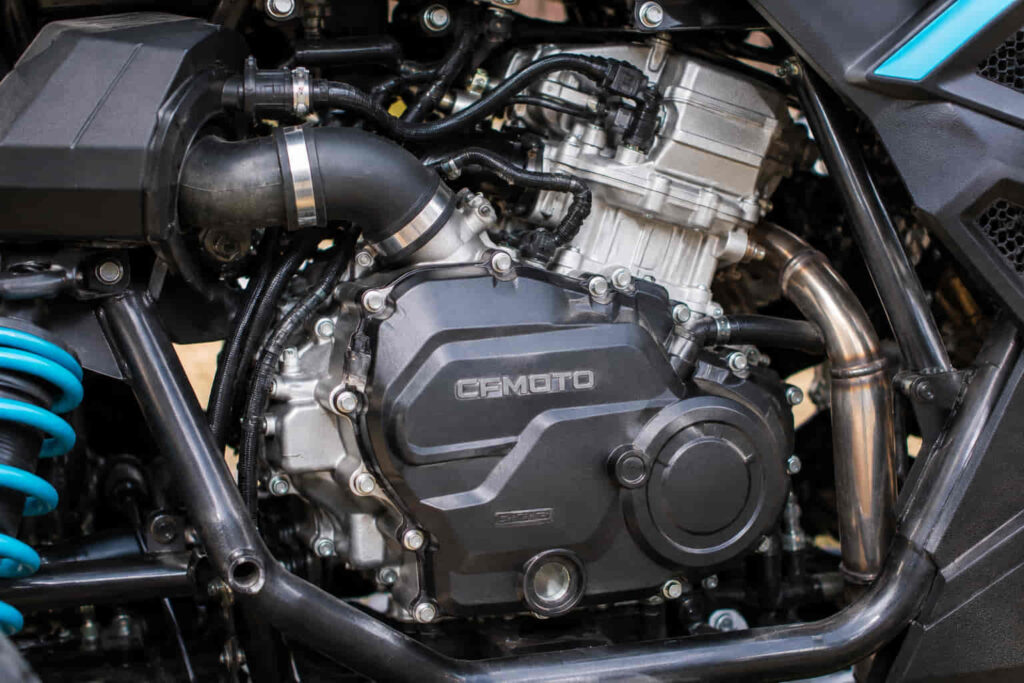
CFMOTO engines are primarily manufactured by Zhejiang CFMOTO Power Co., Ltd., a Chinese powersports manufacturer headquartered in Hangzhou, Zhejiang Province, China. The company designs, develops, and manufactures engines for its motorcycles, all-terrain vehicles, utility vehicles, and side-by-side vehicles. CFMOTO has produced its own engines since 1997 and has grown into an international manufacturer with products distributed across more than 100 countries and regions.
CFMOTO is not owned by KTM, Honda, Yamaha, or Kawasaki. However, the company has an important engineering and manufacturing partnership with Austrian motorcycle manufacturer KTM. The partnership includes a joint venture established in 2018 that develops and manufactures selected motorcycles and engine platforms, including models associated with KTM’s 790 LC8c parallel-twin architecture.
This relationship explains why certain CFMOTO motorcycles, particularly the 800MT and related 800cc models, use technology derived from KTM engine platforms. However, many other CFMOTO engines are developed through the Chinese manufacturer’s own engineering programs.
For example, the CFMOTO 450SS uses a 449cc parallel-twin engine with a 270-degree crankshaft, while the 675SS features a 675cc inline-three engine developed by CFMOTO. The company’s off-road division also produces its own engines for CFORCE ATVs, UFORCE utility vehicles, and ZFORCE sport side-by-sides.
Understanding who manufactures CFMOTO engines, where they are built, and how the KTM partnership works helps buyers evaluate their engineering, reliability, service requirements, and long-term value.
Who Makes CFMOTO Engines?
The manufacturer behind CFMOTO engines is Zhejiang CFMOTO Power Co., Ltd., a Chinese company specializing in motorcycles, off-road vehicles, engines, and other powersports components.
CFMOTO is both a vehicle manufacturer and an engine manufacturer.
This distinction matters because some motorcycle and ATV companies purchase complete engines from unrelated suppliers and install them in vehicles carrying their own branding.
CFMOTO operates differently.
The company has its own engine development and manufacturing capabilities, allowing it to design and produce powertrains for numerous applications.
Its engine portfolio covers single-cylinder, parallel-twin, inline-three, and V-twin configurations.
These engines serve different purposes.
Small-displacement single-cylinder engines are suitable for lightweight motorcycles and accessible everyday transportation.
Parallel-twin engines provide a balance of compact packaging, power, and refinement for road motorcycles.
Three-cylinder engines support higher-performance motorcycle applications.
V-twin engines are used in certain off-road vehicles requiring strong torque and dependable operation under demanding conditions.
CFMOTO also works with outside technology suppliers.
However, using components from an international supplier does not mean that supplier manufactures the complete engine.
For example, certain CFMOTO motorcycles use Bosch electronic fuel injection equipment.
Bosch supplies fuel management technology, but the complete engine remains part of CFMOTO’s manufacturing program.
The most accurate answer is that CFMOTO manufactures its own engines while also using licensed technology, collaborative platforms, and selected components supplied by other companies.
Where Are CFMOTO Engines Made?
CFMOTO engines are strongly associated with the company’s manufacturing operations in China, particularly Hangzhou, Zhejiang Province, where its headquarters and major engineering facilities are located.
CFMOTO began in China and developed much of its manufacturing infrastructure there.
Its Hangzhou operations support vehicle design, engine development, production, and related engineering work.
The company’s international expansion has also introduced additional manufacturing locations.
CFMOTO’s European corporate website identifies facilities in China, Thailand, and Mexico that support the production of engines, motorcycles, off-road vehicles, and electric mobility products.
However, this does not establish that every engine model is produced at every facility.
The specific manufacturing location depends on the vehicle, production period, and supply-chain arrangements.
For many CFMOTO motorcycles and off-road vehicles, China remains the primary country associated with the powertrain’s origin.
The company’s manufacturing partnership with KTM also operates in Hangzhou.
Selected KTM motorcycles and LC8c engines are produced through this arrangement.
Buyers who want to identify the exact origin of a particular motorcycle or ATV should inspect the vehicle identification label and manufacturer documentation.
The country where a finished vehicle is assembled does not always identify the origin of every component.
Engines, transmissions, electronic modules, and other parts may follow different supply chains.
Therefore, the precise production origin should be confirmed for the specific model rather than assumed from the CFMOTO brand name alone.
Is CFMOTO a Chinese Company?
Yes. CFMOTO is a Chinese manufacturer established in 1989, with its headquarters in Hangzhou, China.
The company’s history began with a family-operated motorcycle parts business in Wenzhou, Zhejiang Province.
Its early activities focused on supplying components for the growing motorcycle industry.
As the business expanded, CFMOTO moved into engine design and manufacturing.
The company successfully developed its first liquid-cooled engine in 1997.
This was an important milestone because liquid cooling allowed the manufacturer to pursue more advanced powertrain designs.
CFMOTO subsequently expanded into complete motorcycles.
Its business also grew to include all-terrain vehicles and other off-road equipment.
In 2005, the company introduced its first ATV.
CFMOTO established a presence in the United States in 2007 through its American powersports operations.
The business continued expanding its distribution and manufacturing capabilities.
In 2017, Zhejiang CFMOTO Power was listed on the Shanghai Stock Exchange under stock code 603129.
Today, the company develops and markets motorcycles, ATVs, side-by-sides, electric mobility products, and associated engine technologies.
Its Chinese origin is a factual part of the company’s manufacturing history.
However, country of origin alone does not establish whether a particular engine is reliable or unreliable.
Engine durability depends on engineering quality, materials, production tolerances, quality control, maintenance, and operating conditions.
When Did CFMOTO Start Making Engines?
CFMOTO began producing its own engines in 1997, several years after the company’s founding in 1989.
The original business was focused on motorcycle parts.
Developing its own engine manufacturing capability allowed CFMOTO to move beyond supplying basic components.
In 1997, the company completed its first liquid-cooled engine.
This provided a technical foundation for later motorcycles and powersports equipment.
The manufacturer subsequently expanded into larger displacement engines.
Its growing product range required improvements in cooling, fuel delivery, combustion control, and manufacturing precision.
As international sales increased, CFMOTO developed engines for different regulatory and operating requirements.
Modern motorcycles use electronically controlled fuel injection, advanced valve trains, and sophisticated electronic management systems.
Off-road applications require engines suited to low-speed torque, frequent load changes, dust exposure, and challenging terrain.
CFMOTO’s engineering activities expanded to support these different requirements.
The company also established partnerships with international manufacturers, most notably KTM.
However, its internal engine development history began before the KTM joint venture.
This is an important distinction for anyone asking whether CFMOTO merely purchases or rebadges engines from another company.
CFMOTO has its own engine manufacturing experience extending back several decades.
Does CFMOTO Make Its Own Engines?
Yes. CFMOTO develops and manufactures its own engines, although some engine families incorporate technology developed through partnerships or shared engineering platforms.
The company’s engine development activities include combustion engines for motorcycles and off-road vehicles.
CFMOTO also operates a dedicated powertrain business known as HENGINE, established in 2019.
This business focuses on engine research, development, manufacturing, and commercialization.
Its published product range includes engine platforms covering various displacement classes from approximately 125cc through 1000cc.
The company describes its experience with single-cylinder and multicylinder designs.
Its capabilities include liquid-cooled powertrains and larger-displacement engines.
An important modern example is the 675cc three-cylinder motorcycle engine.
CFMOTO describes this engine as an independently developed powerplant.
It is used in models such as the 675SR-R and the related 675SS.
The company has also developed its own 450cc parallel-twin engine platform.
However, some larger CFMOTO motorcycles use engines based on technology shared with KTM.
This does not contradict the company’s ability to manufacture engines independently.
Vehicle manufacturers frequently use a combination of internal engineering, collaborative development, and supplier technologies.
CFMOTO should therefore be understood as an established engine manufacturer with both proprietary engine designs and selected jointly developed powertrains.
Does KTM Make CFMOTO Engines?
KTM does not manufacture every CFMOTO engine. Instead, CFMOTO and KTM cooperate on selected motorcycle and engine programs, including platforms associated with the KTM 790 LC8c parallel-twin engine.
The relationship is sometimes misunderstood because certain CFMOTO motorcycles use engine technology closely related to KTM models.
However, the manufacturing arrangement also works in the opposite direction.
CFMOTO has produced engines and motorcycles for KTM through its manufacturing operations in China.
KTM’s official production facility information identifies the Chinese partnership as responsible for the global production of the KTM 790 Duke and KTM 790 Adventure.
The companies also established a joint venture to support this cooperation.
This arrangement provides KTM with access to manufacturing capacity while allowing CFMOTO to participate in the development and production of more advanced motorcycle platforms.
However, an 800cc CFMOTO engine based on KTM technology should not automatically be described as an engine imported from Austria.
The engine may be manufactured in China using the relevant platform and production arrangements.
Likewise, the existence of the KTM partnership does not mean the 450SS, 675SS, and CFMOTO off-road engines are all KTM products.
These motorcycles and vehicles use different engine families.
The correct description depends on the specific model.
For the 800MT and related motorcycles, KTM technology is an important part of the engine’s development history.
For many other models, CFMOTO’s own engineering program is the more relevant source.
What Is the CFMOTO and KTM Partnership?
The CFMOTO–KTM partnership is a long-running commercial and manufacturing relationship that developed into a formal joint venture in 2018.
The companies began cooperating before establishing the joint venture.
Their earlier relationship involved motorcycle distribution and activities supporting KTM’s presence in China.
CFMOTO became an important KTM partner in the Chinese market.
The relationship expanded as the manufacturers explored additional production opportunities.
In 2018, they established Zhejiang CFMOTO-KTMR2R Motorcycles Co., Ltd.
The joint venture is based in Hangzhou, China.
Its official corporate information identifies CFMOTO and KTM as the founding companies.
It also describes the business as developing and producing motorcycles based on KTM 790 engine and chassis technology.
The venture’s stated production capacity was approximately 50,000 motorcycles annually at establishment.
The manufacturing program includes motorcycles carrying several brands associated with the partnership.
The most recognizable products include KTM 790 models and CFMOTO motorcycles derived from the 799cc parallel-twin platform.
This partnership is important because it demonstrates that CFMOTO operates within an international motorcycle manufacturing network.
However, a joint venture is not the same as ownership of one company by the other.
CFMOTO remains a separate Chinese manufacturer with its own motorcycle, ATV, UTV, and engine businesses.
Who Owns CFMOTO?
CFMOTO is operated by Zhejiang CFMOTO Power Co., Ltd., a publicly traded Chinese company with historical ownership associated with its founding Lai family.
The company trades on the Shanghai Stock Exchange.
Its stock code is 603129.
CFMOTO’s manufacturing relationship with KTM does not mean KTM owns the CFMOTO brand.
The companies are separate businesses that cooperate through commercial agreements and a joint venture.
A 2025 corporate document published by the former KTM parent-group organization also identified the founding Lai family as the majority shareholder of CFMOTO.
However, publicly traded company ownership can change over time.
The latest shareholder information should be checked through the company’s official financial disclosures when exact ownership percentages are required.
The important distinction for consumers is that CFMOTO is not simply a KTM product line.
It has its own management, engineering organization, manufacturing operations, product development, and distribution network.
Its motorcycle and off-road engines are therefore part of CFMOTO’s manufacturing activities, even when specific models share technology with KTM.
Who Makes the CFMOTO 800MT Engine?
The CFMOTO 800MT uses a 799cc liquid-cooled parallel-twin engine derived from KTM’s LC8c engine platform and manufactured through CFMOTO’s Chinese manufacturing network.
The 800MT is an adventure-touring motorcycle.
Its engine development is directly connected to the partnership between CFMOTO and KTM.
The original KTM 790 Adventure and 790 Duke use the LC8c parallel-twin architecture.
CFMOTO’s 800MT was developed using related engine technology.
This allowed the Chinese manufacturer to introduce a higher-displacement adventure motorcycle with a modern twin-cylinder powertrain.
The 799cc engine uses dual overhead camshafts and electronic fuel injection.
Its output depends on the motorcycle version and market.
For example, the original 800MT was marketed with approximately 94 horsepower in certain configurations.
The engine’s characteristics are intended to provide a combination of midrange torque and highway performance.
However, the 800MT’s calibration, exhaust system, electronics, and supporting components should not automatically be assumed identical to the KTM 790 Adventure.
Even engines based on a shared architecture may use different components or software.
Owners should therefore use the CFMOTO service manual and model-specific replacement parts.
A component that fits one KTM LC8c engine may not necessarily fit every CFMOTO version without modification.
The correct maintenance procedures should correspond to the actual motorcycle.
Who Makes the CFMOTO 800NK Engine?
The CFMOTO 800NK uses a 799cc parallel-twin engine associated with the larger-displacement engine platform developed through CFMOTO’s KTM technology partnership.
The 800NK is a naked street motorcycle.
It emphasizes responsive acceleration, manageable weight, and modern electronic equipment.
The engine shares important architectural characteristics with the 800cc platform used in related CFMOTO models.
For the 2026 United States model, CFMOTO publishes an output of approximately 100 horsepower and 59.7 lb-ft of torque.
The engine uses liquid cooling, dual overhead camshafts, electronic fuel injection, and a six-speed transmission.
Its specifications differ from those of the 800MT because the motorcycles serve different purposes.
The 800NK is intended primarily for sport-oriented road riding.
The 800MT is configured for adventure touring.
Even when engine architecture is related, the motorcycles may have different calibration, gearing, exhaust systems, and ancillary equipment.
The 800NK should therefore be maintained according to its own service documentation.
For buyers interested in the relationship between CFMOTO and KTM, the 800NK is an important example of how the Chinese manufacturer uses advanced middleweight engine technology.
However, the motorcycle is still manufactured and marketed as a CFMOTO product.
The KTM partnership explains the engine platform’s development background rather than making the entire motorcycle an Austrian-made KTM.
Who Makes the CFMOTO 450SS and 450SR Engines?
The CFMOTO 450SS and 450SR use a 449cc parallel-twin engine developed and manufactured within CFMOTO’s own motorcycle powertrain program.
These motorcycles are positioned in the lightweight sportbike category.
The engine uses two cylinders arranged in parallel.
It features liquid cooling and a dual-overhead-camshaft valvetrain.
One of its distinctive engineering features is a 270-degree crankshaft.
This configuration changes the firing characteristics compared with a conventional parallel twin using a different crankshaft arrangement.
The result is an exhaust note and power delivery character often associated with a V-twin motorcycle.
CFMOTO also uses balancing technology to control engine vibration.
For the 2026 Canadian-market 450SS, CFMOTO lists a displacement of 449cc and approximately 51 horsepower at 9,500 RPM.
Its maximum torque is approximately 29.5 lb-ft at 7,750 RPM.
However, power specifications can vary by market because of calibration, emissions requirements, and model configuration.
The engine is not simply a KTM 790 design reduced in displacement.
It belongs to a different engine platform.
This distinction matters for replacement parts and maintenance.
Components associated with the KTM LC8c engine family should not be assumed compatible with the 450 platform.
The CFMOTO 450 engine also powers other motorcycles in the company’s lineup, with model-specific tuning and equipment differences.
Read more: Kohler 7000 Series Problems
Who Makes the CFMOTO 450NK and 450CL-C Engines?
The CFMOTO 450NK and 450CL-C use engines from CFMOTO’s 449cc parallel-twin family, but their output characteristics and associated motorcycle equipment differ.
The 450NK is a naked street motorcycle.
It uses the compact parallel-twin engine to provide accessible performance for everyday riding.
The 450CL-C is a cruiser-oriented motorcycle.
Its engine emphasizes smooth power delivery and relaxed riding characteristics.
For the 2026 United States lineup, CFMOTO lists approximately 50 horsepower for the 450NK and approximately 40 horsepower for the 450CL-C.
However, these figures are associated with the published U.S. configurations.
The underlying engine platform shares important features.
Both motorcycles use a liquid-cooled parallel-twin layout with a 270-degree crankshaft configuration.
The motorcycles differ in engine calibration, final drive, chassis design, and intended use.
For example, the 450CL-C uses a belt final drive in the relevant configuration.
That feature does not change who makes the engine.
It affects how engine power reaches the rear wheel and what maintenance is required outside the engine.
The shared 450 platform demonstrates how CFMOTO develops one basic engine family for several motorcycle segments.
However, shared displacement does not guarantee that every engine component or electronic calibration is interchangeable.
Who Makes the CFMOTO 675SS and 675SR-R Engines?
The CFMOTO 675SS and 675SR-R use a 675cc inline-three engine developed by CFMOTO, representing an important expansion beyond its single-cylinder and parallel-twin motorcycle powertrains.
CFMOTO describes the CF675 engine as an independently developed three-cylinder powerplant.
This is an important example of the manufacturer’s internal engineering capabilities.
The engine uses three cylinders arranged in a straight line.
It features liquid cooling, dual overhead camshafts, and four valves per cylinder.
The 675cc configuration provides a different balance of operating characteristics from a parallel-twin engine.
The design is intended to combine useful midrange torque with stronger high-RPM performance.
For the 2026 U.S. 675SS, CFMOTO publishes an output of approximately 95 horsepower at 11,000 RPM and 51.6 lb-ft of torque at 8,250 RPM.
The 675SR-R is marketed in other regions with closely related engine specifications.
However, power ratings may vary by market and model.
CFMOTO’s technical materials describe work on balancing and noise control to improve the engine’s refinement.
The development of this three-cylinder platform is significant because it demonstrates that the company does not rely exclusively on KTM-derived engines for higher-performance motorcycles.
The engine is also used in the related 675NK naked motorcycle.
The 675 family represents a distinct CFMOTO engine development program rather than a simple rebadging of KTM’s 799cc twin.
Are CFMOTO Engines Copies of KTM Engines?
Not all CFMOTO engines are copies of KTM engines. Certain models use technology derived from shared KTM platforms, while other CFMOTO engines are developed independently.
The distinction depends on the motorcycle.
The 800MT is clearly associated with KTM’s LC8c architecture.
Its 799cc parallel-twin engine shares development history with the KTM 790 family.
However, this relationship does not mean the engine is counterfeit or unauthorized.
The technology is used through an established partnership between the companies.
Other CFMOTO motorcycles have different engine origins.
The 450cc parallel-twin platform is part of CFMOTO’s own motorcycle product development.
The 675cc inline-three engine is another example of independent engineering.
CFMOTO’s off-road V-twin engines also belong to a different application category from KTM’s middleweight street and adventure motorcycles.
The question of copying should therefore be separated from licensed technology and joint development.
Manufacturers regularly share technology through partnerships.
A shared engine architecture can involve different calibrations, manufacturing specifications, ancillary systems, and component suppliers.
The fact that two motorcycles use related engine technology does not establish that all their parts are identical.
For owners, the most important issue is whether the engine has been manufactured and maintained according to the correct specifications.
Its exact platform matters more than assumptions based on visual similarity.
Who Makes CFMOTO ATV Engines?
CFMOTO manufactures engines for its CFORCE ATV range through its own powersports engine business and associated production facilities.
CFORCE models are designed for off-road use.
Their engines must operate under conditions involving variable loads, low-speed movement, and changing terrain.
The engine configurations differ according to displacement and vehicle purpose.
Some smaller CFORCE models use single-cylinder engines.
Larger models use V-twin configurations.
Many applications feature liquid cooling and electronic fuel injection.
Liquid cooling is particularly useful because ATVs may operate at low road speeds while the engine continues producing substantial torque.
The cooling system helps manage engine temperature under these conditions.
Electronic fuel injection regulates the fuel mixture according to engine operating conditions.
However, the complete powertrain includes more than the engine.
Many CFORCE ATVs use a continuously variable transmission with a drive belt.
This transmission is a separate system that transfers engine power to the drivetrain.
A belt problem should not automatically be described as an engine failure.
The same distinction applies to overheating caused by a blocked radiator or inadequate cooling airflow.
The engine’s durability depends on both internal construction and the maintenance of supporting systems.
The specific engine code and model year should be verified before ordering components.
Who Makes CFMOTO CFORCE 1000 Engines?
The CFMOTO CFORCE 1000 uses a large-displacement V-twin engine manufactured as part of CFMOTO’s off-road powertrain lineup.
Depending on model year and configuration, the engine is commonly described as having a displacement of approximately 963cc.
It uses a four-stroke V-twin arrangement.
Liquid cooling helps regulate engine temperature during demanding riding conditions.
Electronic fuel injection manages fuel delivery.
The V-twin configuration provides strong torque characteristics suited to off-road riding, towing within the rated limits, and utility work.
However, the CFORCE 1000 is not powered by a KTM 790 LC8c parallel-twin engine.
The two engine families have different cylinder arrangements, displacement characteristics, and intended applications.
The CFORCE engine is designed around an off-road vehicle operating environment.
It must work with the vehicle’s CVT, drive system, cooling arrangement, and electronic controls.
The engine’s exact dimensions and performance ratings may change between generations.
Therefore, a specification associated with an older CFORCE 1000 should not automatically be applied to a newer model.
Replacement parts should be selected using the vehicle identification number and the correct engine information.
This helps avoid confusion between similarly named models with different mechanical configurations.
Who Makes CFMOTO UFORCE and ZFORCE Engines?
CFMOTO also produces engines for its UFORCE utility side-by-sides and ZFORCE recreational sport vehicles.
These vehicles share some engineering principles with the CFORCE ATV lineup.
However, their applications differ.
UFORCE models are designed primarily for utility tasks.
They may be used for property maintenance, agricultural work, transporting equipment, and other practical activities.
Their engines are selected to provide appropriate torque, drivability, and durability.
ZFORCE models are more focused on recreational off-road performance.
Depending on the model, they may use higher-output engine calibrations and different suspension and drivetrain arrangements.
Several CFMOTO side-by-sides use liquid-cooled V-twin engines.
A service manual for an earlier CF1000US-2 configuration identifies a 962.6cc V-twin with four-stroke operation, liquid cooling, and eight valves.
However, this specification belongs to that particular engine arrangement.
It should not be assumed that every modern UFORCE or ZFORCE uses exactly the same components.
CFMOTO continues updating its off-road lineup.
The engines must also operate with compatible CVT systems, cooling equipment, and electronic controls.
For service purposes, the exact model year and vehicle identification number remain essential.
Are CFMOTO Engines Made by Honda, Yamaha, or Kawasaki?
CFMOTO engines are not generally manufactured by Honda, Yamaha, or Kawasaki. The primary engine manufacturer is CFMOTO itself, although the company works with outside suppliers and has international manufacturing partnerships.
The confusion often comes from the fact that several motorcycle manufacturers use similar engine layouts.
A 450cc parallel-twin engine may resemble another manufacturer’s engine in overall arrangement.
However, similar displacement or cylinder configuration does not prove that one company manufactured both engines.
Motorcycle manufacturers regularly use comparable engineering solutions because they must meet similar performance, packaging, and emissions requirements.
CFMOTO also uses components supplied by international brands.
For example, selected motorcycles feature Bosch fuel injection equipment.
Some models use braking components from Brembo or J.Juan.
These suppliers contribute specific parts and technologies.
They do not manufacture the entire CFMOTO engine merely because their components appear on the motorcycle.
CFMOTO has also established additional industry partnerships over time.
However, those relationships do not establish that every CFMOTO engine is supplied by a Japanese motorcycle manufacturer.
The most clearly documented engine-platform partnership involves KTM and the LC8c-related middleweight engines.
For a specific vehicle, the exact powertrain origin should be determined from official technical information rather than brand comparisons or visual similarities.
Are CFMOTO Engines Reliable?
CFMOTO engines can provide reliable service when maintained correctly, but durability varies by model, engine family, riding conditions, and maintenance history.
A motorcycle engine intended for regular road use experiences different operating conditions from an ATV engine frequently exposed to water, mud, and dust.
The maintenance requirements therefore differ.
A 450cc motorcycle engine depends on correct oil changes, coolant service, air filtration, and valve train inspection.
A CFORCE ATV engine must also operate in environments where dust and debris can affect the intake and cooling system.
A side-by-side used for heavy utility work may experience prolonged low-speed operation under load.
CFMOTO’s decades of manufacturing experience and its partnership with KTM provide useful evidence of established engineering and production capabilities.
However, these facts do not establish a universal engine lifespan or failure rate.
Publicly available information does not support one reliable average mileage figure for every CFMOTO motorcycle and off-road engine.
Likewise, an engine’s Chinese origin should not be treated as proof that it is either unreliable or equal in durability to every Japanese competitor.
A meaningful reliability assessment requires information about the exact model, maintenance records, operating hours, and known technical issues.
For used vehicles, mechanical condition is more important than relying on brand reputation alone.
What Are the Most Common CFMOTO Engine Problems?
Potential CFMOTO engine problems include overheating, hard starting, rough running, oil leaks, cooling system faults, and fuel delivery issues, but the prevalence of these conditions varies between engine models.
A hard-starting motorcycle may have a weak battery, damaged spark plug, faulty fuel pump, or electrical connection problem.
An ATV that stalls under load may have fuel delivery restrictions or a separate drivetrain fault.
Overheating can result from low coolant level, a damaged fan, restricted radiator airflow, or other cooling system problems.
Off-road vehicles are particularly exposed to mud and debris.
If the radiator becomes obstructed, cooling performance may decline.
Dust ingestion is another important consideration.
An air filter that is damaged or incorrectly sealed can allow abrasive particles into the intake system.
Continued operation under these conditions may accelerate internal wear.
However, none of these symptoms proves that the basic engine design is defective.
A check engine light may indicate an electronic sensor issue rather than mechanical engine damage.
Similarly, a CVT drive belt problem can cause poor acceleration even though the engine is operating normally.
Owners should consult the correct service manual and use appropriate diagnostic methods.
Replacing major engine components without identifying the actual cause can create unnecessary expense.
How Does CFMOTO Engine Quality Compare With Japanese Brands?
CFMOTO competes with manufacturers such as Honda, Yamaha, Kawasaki, and Suzuki, but engine quality comparisons should be based on specific models and documented performance rather than country of origin alone.
Japanese motorcycle manufacturers have extensive production histories and well-established service networks in many markets.
Certain Japanese engine families also have decades of documented use.
CFMOTO has a shorter history in some international motorcycle segments, although it has manufactured engines since 1997.
Its engineering capabilities have expanded considerably.
The company produces modern liquid-cooled engines with electronic fuel injection, sophisticated valve trains, and increasingly complex electronic controls.
Its collaboration with KTM also demonstrates participation in international motorcycle manufacturing.
However, a shared platform does not guarantee identical reliability, and advanced specifications do not automatically establish longer engine life.
The availability of replacement parts and trained technicians can also affect ownership.
A motorcycle with a reliable engine may still become inconvenient to maintain if a specific replacement component is difficult to obtain locally.
Therefore, buyers should evaluate the complete ownership experience.
The most meaningful comparison involves the exact motorcycles being considered, their warranty coverage, local dealer support, service costs, and actual maintenance requirements.
A broad claim that all CFMOTO engines are better or worse than all Japanese engines would be misleading.
How Long Do CFMOTO Engines Last?
There is no universal mileage or operating-hour figure that accurately describes the lifespan of every CFMOTO engine.
CFMOTO produces engines for several different categories of vehicles.
Motorcycles are generally evaluated through mileage and maintenance history.
ATVs and side-by-sides may also be evaluated through operating hours because they frequently operate at low road speeds or under heavy load.
The engine’s duty cycle matters.
A motorcycle used for highway commuting may spend much of its operating time under moderate load.
An ATV used in mud or on steep terrain may operate under higher engine loads and more demanding environmental conditions.
Lubrication is essential in both cases.
Oil that becomes contaminated or is not replaced according to schedule can accelerate engine wear.
Air filtration is another major factor.
A poorly maintained air filter can allow abrasive dust into the cylinders.
Cooling system condition also affects longevity.
Repeated overheating can damage gaskets, pistons, cylinder heads, and other components.
The engine’s original manufacturing quality matters, but maintenance and operating conditions remain significant.
CFMOTO’s warranty programs should not be interpreted as guaranteed engine lifespans.
A multi-year warranty defines contractual coverage rather than the number of miles or hours an engine will necessarily last.
The best estimate of remaining service life comes from the actual vehicle’s mechanical condition and maintenance history.
What Maintenance Do CFMOTO Engines Require?
CFMOTO engines require routine oil service, air filter maintenance, cooling system inspection, fuel system care, and valve train servicing according to the exact model’s maintenance schedule.
The required service intervals vary by engine and application.
A high-revving sport motorcycle may have different requirements from a utility ATV.
Engine oil should meet the manufacturer’s specified viscosity and performance classification.
The correct quantity must also be used.
Overfilling or underfilling can cause lubrication problems.
Oil filters should be replaced according to the service schedule.
Air filters are especially important for off-road vehicles.
Dust and mud can quickly contaminate the filter system.
Owners who ride in severe conditions may need to inspect the intake and filter more frequently than the normal schedule suggests.
Liquid-cooled engines also require proper coolant condition.
The radiator should be kept clear of debris, and the cooling fan must function correctly.
Fuel injection systems depend on clean gasoline and reliable electrical connections.
Spark plugs and valve clearances also require inspection according to the manufacturer.
On models using a CVT, belt inspection and transmission maintenance are separate from engine oil service.
Using the correct maintenance manual is essential because service intervals and fluid specifications are not interchangeable across every CFMOTO engine.
Does CFMOTO Use Bosch Engines or Bosch Fuel Injection?
Certain CFMOTO motorcycles use Bosch electronic fuel injection, but Bosch does not manufacture the complete CFMOTO engine simply because its fuel system is installed.
Electronic fuel injection uses sensors, electronic controls, and injectors to regulate fuel delivery.
The system helps the engine respond to operating conditions such as throttle position, temperature, and engine speed.
Bosch supplies engine management technology to numerous vehicle manufacturers.
CFMOTO is among the companies using Bosch-branded components in selected motorcycles.
For example, its 2026 U.S. motorcycle specification material identifies Bosch EFI systems across several models.
However, the engine’s crankshaft, pistons, cylinder head, crankcase, and other major mechanical components are part of the vehicle manufacturer’s engine platform.
Bosch’s involvement concerns particular fuel management components and associated technology.
This distinction is important when researching who makes an engine.
Vehicle manufacturing often depends on several suppliers.
The engine manufacturer may produce the main mechanical assembly while purchasing sensors, electronic modules, bearings, injectors, or other components from specialized suppliers.
Therefore, the presence of Bosch equipment does not mean a CFMOTO engine is a Bosch engine.
It means the engine uses specified Bosch technology as part of its control system.
Does CFMOTO Manufacture Engines for Other Brands?
Yes. CFMOTO’s manufacturing activities extend beyond engines used in its own branded vehicles, most notably through its partnership with KTM.
The company has supplied manufacturing support for selected KTM models.
Its Chinese joint venture produces motorcycles associated with the KTM 790 platform.
KTM’s official production information identifies the partnership as responsible for the KTM 790 Duke and KTM 790 Adventure.
This makes CFMOTO an example of a motorcycle manufacturer that also participates in manufacturing products for another internationally recognized brand.
However, such arrangements are not unusual in the automotive and powersports industries.
Manufacturers often share production capacity or cooperate on components while maintaining separate brands.
The technical requirements for an engine depend on the customer and the specific product.
An engine produced for a KTM model may use different parts, calibration, and assembly procedures from a related CFMOTO-branded engine.
Therefore, a shared manufacturing source does not establish complete parts interchangeability.
CFMOTO’s broader powertrain business also develops products that may be offered to other manufacturers.
However, individual supply relationships should be verified rather than inferred from an engine’s appearance or displacement.
The most clearly documented international arrangement remains the KTM partnership.
How Can You Identify a CFMOTO Engine Manufacturer?
The best way to identify a specific CFMOTO engine is to use the vehicle identification number, engine model or identification code, production year, and manufacturer documentation.
The model name alone may not provide enough information.
A CFORCE 1000 from one production year may differ from a later CFORCE 1000.
The same applies to motorcycles that share a displacement class.
Engine codes can distinguish configurations that appear similar externally.
The vehicle identification number helps identify the manufacturing record and intended market.
For U.S.-market vehicles, Zhejiang CFMOTO Power Co., Ltd. appears in the National Highway Traffic Safety Administration manufacturer database.
The company’s registered vehicle models include motorcycles, ATVs, and other off-road products.
However, the vehicle VIN identifies the complete vehicle.
It does not automatically provide the origin of every individual engine component.
The engine identification markings and official parts catalog should be used when selecting mechanical parts.
For engines associated with KTM-developed platforms, component compatibility should be checked carefully.
A similar-looking engine does not guarantee matching mounting points, sensors, electronics, or internal dimensions.
An authorized dealer can help identify the correct engine arrangement and part numbers.
This is particularly important for imported motorcycles and off-road vehicles that may have different specifications across markets.
Are CFMOTO Engine Parts Easy to Find?
CFMOTO engine parts availability depends on the market, model, production year, and strength of the local dealer and distributor network.
CFMOTO has expanded its global distribution substantially.
The manufacturer reports that its products are available in more than 100 countries and regions.
However, the presence of a brand in a country does not guarantee immediate availability of every internal engine part.
Routine maintenance items may be easier to obtain.
These include oil filters, air filters, spark plugs, and certain service gaskets.
More specialized components may require ordering.
Examples include crankshafts, pistons, camshafts, cylinder heads, fuel injection components, and electronic modules.
Parts availability can also differ between popular and discontinued models.
Owners of high-volume motorcycles may have broader service support than those operating a relatively uncommon vehicle.
The KTM partnership can create confusion about parts interchangeability.
A CFMOTO engine based on an LC8c platform should not automatically receive KTM replacement parts without confirmation.
Internal component dimensions and supporting systems can differ.
The correct approach is to use the CFMOTO parts catalog associated with the exact model and production year.
For used buyers, asking a local dealer about replacement engine components and typical delivery times can provide useful information about long-term ownership practicality.
What Warranty Comes With CFMOTO Engines?
CFMOTO engine warranty coverage varies by country, vehicle category, model year, and the specific terms offered by the authorized distributor.
A warranty is an important part of evaluating a relatively new engine platform.
However, coverage cannot be assumed identical worldwide.
For example, CFMOTO Canada advertises a five-year limited warranty program on eligible new vehicles.
The published program includes an initial period of broader coverage followed by additional limited powertrain protection, subject to the stated conditions.
The Canadian terms apply to eligible products distributed and sold through authorized Canadian dealers.
They should not automatically be applied to motorcycles or ATVs purchased in the United States, Europe, or another market.
Other markets may offer different warranty durations and exclusions.
The coverage may also distinguish between manufacturing defects and damage caused by incorrect maintenance, racing, modifications, or improper operation.
An engine failure caused by inadequate lubrication or dust ingestion may be treated differently from a confirmed manufacturing defect.
The complete written warranty should therefore be reviewed before purchase.
Buyers should confirm the coverage period, whether labor is included, what components qualify as part of the powertrain, and whether commercial use changes the terms.
A strong warranty can improve ownership confidence, but it does not independently establish an engine’s expected lifespan.
Is CFMOTO Expanding Its Own Engine Technology?
Yes. CFMOTO has continued investing in proprietary engine development, including modern three-cylinder engines and experimental high-performance engine architectures.
The 675cc inline-three is an important example.
CFMOTO identifies it as an independently developed engine.
It demonstrates the company’s ability to develop powertrains beyond conventional single-cylinder and parallel-twin platforms.
The company’s HENGINE business also emphasizes independent engine research and development.
Its product range covers different displacement classes and applications.
CFMOTO has also presented more advanced engine concepts.
At the 2024 EICMA motorcycle exhibition, the company unveiled its V.04 engine development concept.
The concept features a 997cc 90-degree V4 configuration.
CFMOTO announced projected performance exceeding 156 kW, along with advanced hardware such as titanium components and a counter-rotating crankshaft.
However, an announced engineering concept is not the same as a fully established production engine.
Its final production specifications, availability, and long-term durability must be evaluated separately.
The significance of the V.04 project lies in demonstrating CFMOTO’s expanding powertrain ambitions.
The company is developing motorcycle engines that extend beyond the smaller displacement categories with which it was previously associated.
This continued development supports the conclusion that CFMOTO is an engine manufacturer in its own right rather than merely a vehicle assembly company relying on other brands for every powerplant.
Are CFMOTO Engines Worth Buying?
CFMOTO engines can be a worthwhile choice for riders who value modern engine technology, competitive vehicle pricing, and a suitable local service network.
The company’s broad engine portfolio provides several options.
A 450cc parallel twin may appeal to riders seeking a lightweight sportbike or naked motorcycle.
The 675cc inline-three offers a different balance of midrange performance and higher-RPM power.
The 799cc parallel-twin platform provides stronger output for middleweight street and adventure motorcycles.
CFMOTO’s V-twin off-road engines support utility and recreational applications.
However, choosing an engine involves more than horsepower or displacement.
Maintenance requirements, parts availability, warranty coverage, operating environment, and local dealer support all affect long-term ownership.
The KTM partnership is a positive indicator of CFMOTO’s participation in international motorcycle engineering.
However, that relationship should not be used as a guarantee that every engine will achieve the same durability as a particular KTM model.
Similarly, independent engine development does not automatically establish superior reliability.
A buyer should evaluate the exact motorcycle or off-road vehicle being considered.
Used examples deserve particular attention to service history.
A carefully maintained vehicle with no unresolved mechanical problems may offer better value than one with aggressive modifications, contaminated oil, or repeated overheating.
For buyers with dependable dealer support and appropriate maintenance plans, CFMOTO represents a credible option in the modern powersports market.
Final Verdict: Who Really Makes CFMOTO Engines?
CFMOTO engines are made primarily by Zhejiang CFMOTO Power Co., Ltd., a Chinese manufacturer headquartered in Hangzhou. The company has developed and produced engines since 1997 and manufactures powertrains for motorcycles, ATVs, UTVs, and side-by-side vehicles.
CFMOTO is not a subsidiary of KTM, Honda, Yamaha, or Kawasaki.
However, the company has a significant partnership with KTM.
The companies established a joint venture in 2018, supporting the manufacture of selected KTM motorcycles and CFMOTO models using related engine technology.
The CFMOTO 800MT and 800NK are important examples of motorcycles associated with the 799cc LC8c-derived engine platform.
However, other CFMOTO engines have different origins.
The 449cc parallel twin used in the 450SS, 450SR, 450NK, and 450CL-C belongs to CFMOTO’s own engine range.
The 675cc three-cylinder engine used in the 675SS, 675SR-R, and 675NK is described by the company as independently developed.
CFMOTO also manufactures the V-twin and single-cylinder engines used across many of its off-road vehicles.
These include CFORCE ATVs, UFORCE utility vehicles, and ZFORCE recreational side-by-sides.
Engine manufacturing is concentrated around CFMOTO’s Chinese industrial operations, although the company also maintains an international manufacturing presence.
The specific origin and configuration of any individual engine should be confirmed using official model documentation.
The key takeaway is that CFMOTO is a genuine engine manufacturer with its own engineering capabilities, not simply a company that imports KTM engines and installs them into Chinese motorcycles.
Its relationship with KTM provides access to shared technology in selected engine families, while its independent engine development continues expanding into more advanced powertrain categories.
For buyers, the best way to judge a CFMOTO engine is through its actual design, maintenance requirements, reliability history, warranty coverage, and available service support rather than the country where the manufacturer is headquartered.