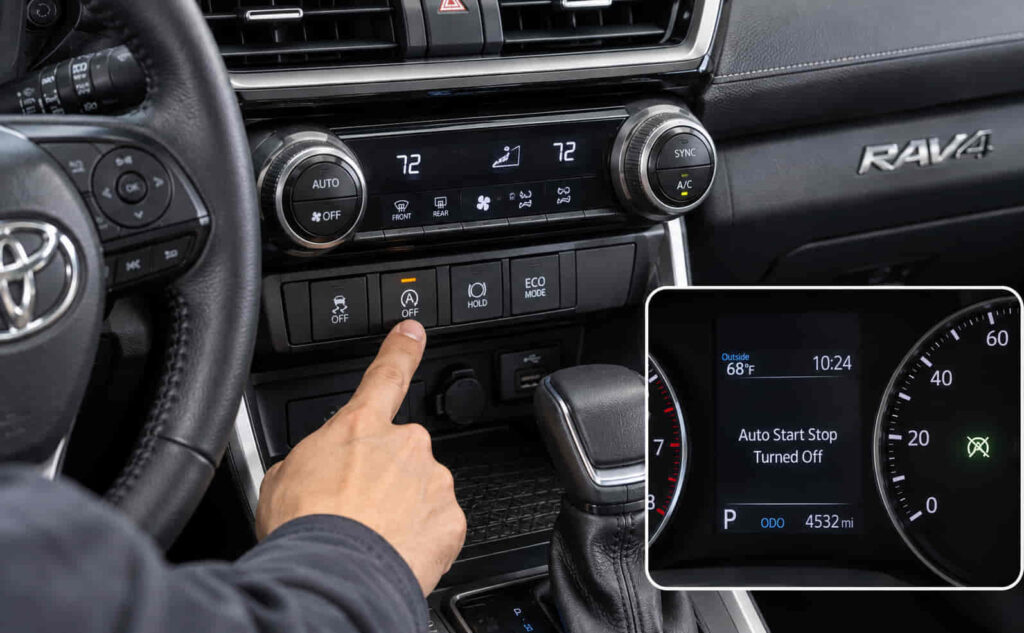
You can disable Auto Start Stop on an equipped Toyota RAV4 by using the Stop & Start cancel control, but factory cancellation and permanent deactivation are not the same thing. The factory control allows the driver to cancel automatic engine stopping when the feature is available, so the gasoline engine continues running when the RAV4 comes to a stop. Depending on the model year and market configuration, the Stop & Start system may become active again after the vehicle is switched off and restarted.
This distinction matters because many drivers searching for a RAV4 Auto Start Stop disable procedure actually want the system to remain off permanently. Pressing the factory cancel switch does not necessarily create a permanent setting. Aftermarket start-stop eliminators are designed to change this behavior on compatible vehicles, but installing an external device is different from using Toyota’s built-in cancellation function and requires separate consideration of compatibility and vehicle electronics.
Auto Start Stop can also remain inactive without being manually disabled. Battery condition, engine temperature, climate-control demand, and other operating requirements can affect whether the system stops the engine on an equipped RAV4. This guide explains how to turn RAV4 Auto Start Stop off, what happens after cancellation, why it may return after restarting the vehicle, and what to consider before attempting a permanent-disable solution.
How Do You Disable Auto Start Stop on a Toyota RAV4?
On a Toyota RAV4 equipped with the Stop & Start system, you can temporarily disable automatic engine stopping by pressing the Stop & Start cancel switch. When cancellation is active, the system no longer performs its normal automatic engine-stop function under conditions in which Stop & Start would otherwise operate. This is the factory method for preventing the gasoline engine from automatically shutting off while the vehicle is stopped.
The procedure applies only to RAV4 configurations actually equipped with Toyota’s Stop & Start system. Equipment varies by model year, engine, trim, and market, so the presence of a gasoline engine does not by itself establish that a particular RAV4 has the same Stop & Start controls. The vehicle’s switch layout and owner information should be used to confirm the system on the exact RAV4.
The cancel switch is designed to change the operating state of Stop & Start rather than shut down the engine-management system. Pressing it does not disable the starter, ignition, fuel injection, or normal ability to start and drive the vehicle. It specifically prevents the automatic stop function from operating while cancellation is active.
The vehicle provides an indication that the Stop & Start function has been canceled on applicable configurations. This feedback is important because pressing the switch and assuming the feature is off is less reliable than confirming the system status through the corresponding indicator or display. The exact indicator presentation can differ between RAV4 configurations.
Factory cancellation should also be distinguished from conditions that prevent Stop & Start from operating automatically. The engine may continue running at a stop because the battery condition, engine operating state, cabin climate demand, or another system requirement does not permit an automatic stop. In that situation, the feature has not necessarily been manually disabled.
The factory cancel function should likewise not be described as a permanent modification. On configurations where cancellation does not persist through the next vehicle-start cycle, the driver must cancel Stop & Start again after restarting the RAV4 if they want the automatic engine-stop function to remain inactive. This behavior is part of the distinction between using Toyota’s provided control and modifying the system to remember an off state.
A RAV4 Hybrid also requires separate interpretation. The gasoline engine in a hybrid can stop and restart as part of normal hybrid-system operation while the vehicle remains in READY mode. That behavior should not automatically be treated as the same conventional Stop & Start function controlled by a Stop & Start cancel switch.
The correct factory RAV4 Auto Start Stop disable method is therefore to use the Stop & Start cancel control on a vehicle equipped with that feature and confirm that cancellation is active. This turns off the automatic stop function for the applicable operating period without converting the vehicle to a permanently disabled configuration.
Where Is the Auto Start Stop Button on a Toyota RAV4?
The RAV4 Auto Start Stop button is the Stop & Start cancel switch on models equipped with the system, but its exact location should be confirmed for the specific model year and market rather than assumed from another RAV4. Toyota has changed interior layouts and equipment across RAV4 generations, so a button location shown for one configuration may not match another vehicle.
The switch can be identified by its Stop & Start cancellation symbol or labeling rather than by position alone. This is a more reliable identification method because the surrounding switch panel can contain controls for other functions. Using the symbol and the vehicle-specific owner information prevents another dashboard or console switch from being mistaken for the Stop & Start control.
If no Stop & Start cancel switch is visible where an online guide says it should be, that does not automatically mean the button is hidden or missing. The RAV4 may have a different model-year layout, a different market specification, or a powertrain that does not use the same conventional Stop & Start system. Equipment should be confirmed before attempting to locate or add a control that the vehicle was not designed to have.
This distinction is especially relevant when comparing gasoline and hybrid RAV4 models. Automatic gasoline-engine shutdown in a hybrid is integrated into hybrid operation and should not be diagnosed from the absence of a conventional Stop & Start cancel button. The hybrid system can stop the engine because electric propulsion and other hybrid functions allow the gasoline engine to remain off under appropriate conditions.
The cancel switch should also not be confused with the engine Start/Stop button. The engine switch turns the vehicle’s powertrain operating state on or off, whereas the Stop & Start cancel switch controls the automatic engine-stop feature while the vehicle is being operated. Similar terminology makes these two controls easy to confuse in search queries even though their functions are fundamentally different.
Once the correct cancel switch has been identified, its effect should be verified through the vehicle’s corresponding system indication. If pressing the identified switch does not produce the expected status change, the next step is to confirm the exact RAV4 configuration and system operation rather than repeatedly pressing unrelated controls.
The correct way to locate the RAV4 Auto Start Stop button is therefore to identify the Stop & Start cancel switch for the exact vehicle configuration, not to rely on one universal dashboard position. Model year, powertrain, trim, and market specification determine whether the system is installed and where its factory control is located.
Read more: Toyota ECU Reset
What Happens When You Turn Off RAV4 Auto Start Stop?
When you turn off Auto Start Stop on an equipped Toyota RAV4 using the factory cancel switch, the system stops performing its automatic engine-stop function while cancellation is active. The gasoline engine therefore remains running during stops in situations where the Stop & Start system would otherwise be permitted to shut it off automatically. Normal engine starting, driving, braking, and other vehicle functions are not being switched off by the cancel command.
The main change occurs when the RAV4 comes to a stop. With Stop & Start enabled and all required operating conditions satisfied, the system can automatically stop the engine to reduce unnecessary idling. When the driver cancels the function, the system does not perform that automatic stop simply because the vehicle has reached the normal Stop & Start operating condition.
Canceling the feature does not mechanically disconnect the starter or disable the engine ECU. The engine-management system continues controlling fuel, ignition, electronic throttle, emissions functions, and other normal operations. The Stop & Start cancel command changes whether the automatic stop function is permitted to operate; it does not remove the systems required to run or restart the engine.
This distinction also explains why the RAV4 can still be turned off normally. Pressing the vehicle’s engine switch or otherwise shutting down the vehicle according to its normal procedure is separate from Stop & Start operation. The factory cancel switch only controls automatic engine stopping during vehicle operation.
The effect on idling is straightforward. If the engine remains running during a stop because Stop & Start has been canceled, fuel continues to be consumed while the engine idles. The amount involved depends on how frequently and how long the vehicle remains stopped, so disabling the system does not produce one fixed fuel-economy penalty for every driver.
Climate-control behavior can also be relevant because engine operation and cabin demands interact differently depending on the RAV4 configuration. Stop & Start itself considers operating conditions before allowing an automatic engine stop. Manually canceling the feature removes the expected automatic stop event while cancellation remains active rather than forcing the system to stop and restart the engine according to those conditions.
A dashboard indication on applicable vehicles provides confirmation that Stop & Start has been canceled. This is more useful than judging the state only from whether the engine happens to remain running at one traffic light. An enabled Stop & Start system can also keep the engine running when its operating requirements are not satisfied, so engine behavior at a single stop does not prove that the driver manually disabled it.
Canceling the system also does not create a fault simply because the engine no longer shuts off automatically. The cancel control exists to allow the driver to prevent Stop & Start operation when desired. This factory function should be distinguished from deliberately disconnecting sensors, altering wiring, or creating an operating condition intended to prevent the ECU from allowing an automatic stop.
Turning off RAV4 Auto Start Stop with the factory control therefore changes one specific function: it prevents automatic engine stopping while cancellation is active. It does not shut down normal engine management or permanently modify the vehicle’s Stop & Start programming.
Does RAV4 Auto Start Stop Stay Off After You Restart the Vehicle?
On RAV4 configurations where the factory Stop & Start cancellation is reset with the vehicle’s operating cycle, Auto Start Stop does not remain permanently disabled after the RAV4 is switched off and restarted. The driver must use the Stop & Start cancel control again when they want the automatic engine-stop function canceled during the next applicable operating period.
This behavior explains a common misunderstanding about the factory button. Pressing the cancel switch can successfully disable Stop & Start for current operation without changing the system’s default behavior permanently. The feature becoming available again after a later restart does not mean that the cancel button failed.
The distinction is between a current system state and a persistent configuration change. The factory control can request cancellation while the vehicle is operating, whereas permanent deactivation would require the off state to remain after subsequent vehicle starts. Those are different functions and should not be described as equivalent methods of disabling Auto Start Stop.
The exact behavior still needs to be tied to the specific RAV4 configuration. Toyota has sold the RAV4 across multiple generations, engines, trims, and markets, and Stop & Start equipment is not identical across all of them. The owner information for the exact model should therefore determine how cancellation behaves after the engine or vehicle power state is cycled.
This also explains why drivers sometimes look for a permanent RAV4 Auto Start Stop disable method after using the factory button. If cancellation must be requested again after each restart, the button solves the immediate engine-stop preference but does not provide the persistent setting the driver is seeking.
A system becoming active again after restart should not be confused with the ECU ignoring the previous command. The new operating cycle establishes the system state according to the vehicle’s programmed logic. Pressing the cancel switch again changes that state for the applicable cycle without rewriting the underlying control strategy.
The reverse situation also requires careful interpretation. If Stop & Start does not operate after restarting the RAV4 even though the driver has not canceled it, this does not prove that the system has somehow remembered the disabled state. The automatic stop may simply be unavailable because one or more operating conditions are not satisfied.
Battery state, power demand, engine operating conditions, and climate requirements can influence whether Stop & Start is permitted to stop the engine on applicable vehicles. A system can therefore be enabled while the gasoline engine continues running. This is different from manual cancellation and should not be used as evidence that a permanent disable procedure has occurred.
Drivers who specifically want the system to remain canceled after every restart are therefore asking for something different from the standard factory cancel function on configurations that restore Stop & Start availability with a new operating cycle. That distinction leads to the separate question of whether the RAV4 provides a factory permanent-off option or whether achieving persistent cancellation would require an aftermarket modification.
RAV4 Auto Start Stop should therefore be considered temporarily canceled when the factory control does not preserve the off state across vehicle restarts. If the goal is to keep Stop & Start disabled automatically after every restart, permanent-disable options must be evaluated separately from normal factory cancellation.
Can You Permanently Disable Auto Start Stop on a Toyota RAV4?
The factory Stop & Start cancel switch on an equipped Toyota RAV4 should not be treated as a permanent-disable function when the system is designed to become available again after the vehicle is restarted. Pressing the cancel switch can prevent automatic engine stopping during the current operating cycle, but permanent deactivation requires the disabled state to persist through subsequent vehicle starts.
This difference is important because the factory button can appear to solve the problem completely until the RAV4 is switched off. If Stop & Start becomes active again during the next operating cycle, the system is following its programmed behavior rather than ignoring the previous cancellation request. The driver can press the cancel switch again, but that action creates another temporary cancellation rather than rewriting the default configuration.
Whether a particular RAV4 offers another factory-supported setting must be determined from the exact model year, powertrain, market specification, and owner information. Toyota has used different Stop & Start configurations across vehicles and markets, so a procedure available on one Toyota model should not automatically be transferred to every RAV4. A dashboard menu should likewise not be assumed to contain a permanent-off setting unless the vehicle documentation identifies that function.
A persistent disable solution therefore belongs to a different category from the factory cancel switch. Aftermarket start-stop eliminators are designed for this purpose on compatible vehicles by changing how the cancellation state is handled when the vehicle is started. Depending on the device, the objective may be to restore the previously selected state or automatically request cancellation rather than permanently rewriting the Toyota ECU itself.
This distinction prevents another common misconception: installing a start-stop eliminator does not necessarily mean that the Stop & Start software has been removed from the vehicle. The Toyota control system can remain present while an external device changes the way the cancel command is applied. The exact mechanism depends on the device, which is why compatibility with the specific RAV4 configuration matters.
Deliberately creating a fault is not an equivalent permanent-disable method. Disconnecting a sensor, altering wiring without an appropriate interface, or manipulating a vehicle condition solely to prevent Stop & Start operation can affect diagnostics or other functions that depend on the same information. A system refusing to perform an automatic stop because it detects an abnormal condition is not the same as the driver selecting a supported cancellation state.
Battery condition should not be used as a permanent-disable strategy either. Stop & Start can remain unavailable when the electrical system cannot support the required operation, but maintaining a weak or inadequately charged battery introduces an electrical-system problem rather than a controlled preference setting. The appropriate response to a battery-related restriction is diagnosis of the battery and charging system.
Permanent modification also needs to be separated from ordinary factory use when evaluating consequences. Using Toyota’s provided cancel switch operates the system through a control intended for the driver. An aftermarket device introduces another component into the vehicle’s electrical or control environment, so installation method, compatibility, diagnostic behavior, reversibility, and warranty implications deserve separate consideration.
For drivers who simply dislike the engine stopping at traffic lights, repeatedly using the factory cancel control is the lowest-change approach because it does not require modifying the system. A persistent solution addresses the inconvenience of repeating that action, but it should be evaluated as a modification rather than described as a hidden Toyota factory setting.
A Toyota RAV4 can therefore have Auto Start Stop canceled through the factory control, but that does not automatically mean it can be permanently disabled through the same factory function. If the exact RAV4 does not provide a supported persistent-off setting, keeping the system canceled across restarts requires a different approach from pressing the standard Stop & Start button.
Why Does RAV4 Auto Start Stop Turn Back On After Restarting?
RAV4 Auto Start Stop can turn back on after restarting because the factory cancellation state can be temporary and the Stop & Start system returns to its normal available state during a new vehicle operating cycle. The system becoming available again is therefore expected behavior on configurations designed this way, not evidence that the cancel switch or ECU has malfunctioned.
When the driver presses the Stop & Start cancel switch, the vehicle receives a request to prevent automatic engine stopping while that cancellation state remains active. The command does not necessarily change the default configuration stored for future starts. Once the vehicle is shut down and another operating cycle begins, the control system can initialize with Stop & Start available again.
This mechanism explains why pressing the button harder, holding it longer, or repeatedly pressing it during the same drive does not create a permanent setting unless the exact vehicle documentation specifies such a function. The switch communicates a cancellation request; it is not automatically a programming control for changing the ECU’s long-term default behavior.
The system should also not be described as “forgetting” the driver’s preference in the same sense as a memory failure. A temporary cancellation can be intentionally designed to expire when the vehicle is switched off. In that case, returning to the enabled state is the programmed result of the ignition or operating cycle rather than lost memory.
This is also different from an ECU reset. The driver does not need to disconnect the battery or clear control-module memory for Stop & Start to become available again. Normal vehicle shutdown and restart can be sufficient when the cancellation logic is designed around the current operating cycle.
The fact that the system is enabled again does not guarantee that the engine will immediately perform an automatic stop. Stop & Start must still evaluate its operating requirements. If the battery state, engine condition, climate-control demand, or another applicable requirement does not permit engine shutdown, the engine can continue running even though the driver has not pressed the cancel switch.
This creates two states that can look identical from the driver’s seat. In the first, Stop & Start has been manually canceled and therefore does not attempt to stop the engine. In the second, the system remains enabled but does not stop the engine because its operating criteria are not satisfied. The relevant indicator or system status helps distinguish these conditions.
If the cancel indicator remains active or system behavior differs from the documented operation after multiple vehicle starts, the issue should be evaluated according to the exact RAV4 configuration. An unexpected state can involve system settings, electrical conditions, control inputs, or another fault, and should not automatically be attributed to a permanent-disable feature.
Drivers seeking a system that remains off after every restart are therefore seeking persistent cancellation rather than the normal behavior of a temporary factory cancel command. That requirement is why aftermarket start-stop eliminators exist for compatible vehicles, although using one introduces considerations that do not apply to pressing Toyota’s factory switch.
RAV4 Auto Start Stop turns back on after restarting when the vehicle is designed to reset the temporary cancellation state at the beginning of a new operating cycle. The factory button can still be functioning exactly as intended; the distinction is that it cancels the feature temporarily rather than permanently changing its default state.
Can You Permanently Disable Auto Start Stop on a Toyota RAV4?
The factory Stop & Start cancel switch on an equipped Toyota RAV4 should not be treated as a permanent-disable function when the system is designed to become available again after the vehicle is restarted. Pressing the cancel switch can prevent automatic engine stopping during the current operating cycle, but permanent deactivation requires the disabled state to persist through subsequent vehicle starts.
This difference is important because the factory button can appear to solve the problem completely until the RAV4 is switched off. If Stop & Start becomes active again during the next operating cycle, the system is following its programmed behavior rather than ignoring the previous cancellation request. The driver can press the cancel switch again, but that action creates another temporary cancellation rather than rewriting the default configuration.
Whether a particular RAV4 offers another factory-supported setting must be determined from the exact model year, powertrain, market specification, and owner information. Toyota has used different Stop & Start configurations across vehicles and markets, so a procedure available on one Toyota model should not automatically be transferred to every RAV4. A dashboard menu should likewise not be assumed to contain a permanent-off setting unless the vehicle documentation identifies that function.
A persistent disable solution therefore belongs to a different category from the factory cancel switch. Aftermarket start-stop eliminators are designed for this purpose on compatible vehicles by changing how the cancellation state is handled when the vehicle is started. Depending on the device, the objective may be to restore the previously selected state or automatically request cancellation rather than permanently rewriting the Toyota ECU itself.
This distinction prevents another common misconception: installing a start-stop eliminator does not necessarily mean that the Stop & Start software has been removed from the vehicle. The Toyota control system can remain present while an external device changes the way the cancel command is applied. The exact mechanism depends on the device, which is why compatibility with the specific RAV4 configuration matters.
Deliberately creating a fault is not an equivalent permanent-disable method. Disconnecting a sensor, altering wiring without an appropriate interface, or manipulating a vehicle condition solely to prevent Stop & Start operation can affect diagnostics or other functions that depend on the same information. A system refusing to perform an automatic stop because it detects an abnormal condition is not the same as the driver selecting a supported cancellation state.
Battery condition should not be used as a permanent-disable strategy either. Stop & Start can remain unavailable when the electrical system cannot support the required operation, but maintaining a weak or inadequately charged battery introduces an electrical-system problem rather than a controlled preference setting. The appropriate response to a battery-related restriction is diagnosis of the battery and charging system.
Permanent modification also needs to be separated from ordinary factory use when evaluating consequences. Using Toyota’s provided cancel switch operates the system through a control intended for the driver. An aftermarket device introduces another component into the vehicle’s electrical or control environment, so installation method, compatibility, diagnostic behavior, reversibility, and warranty implications deserve separate consideration.
For drivers who simply dislike the engine stopping at traffic lights, repeatedly using the factory cancel control is the lowest-change approach because it does not require modifying the system. A persistent solution addresses the inconvenience of repeating that action, but it should be evaluated as a modification rather than described as a hidden Toyota factory setting.
A Toyota RAV4 can therefore have Auto Start Stop canceled through the factory control, but that does not automatically mean it can be permanently disabled through the same factory function. If the exact RAV4 does not provide a supported persistent-off setting, keeping the system canceled across restarts requires a different approach from pressing the standard Stop & Start button.
Why Does RAV4 Auto Start Stop Turn Back On After Restarting?
RAV4 Auto Start Stop can turn back on after restarting because the factory cancellation state can be temporary and the Stop & Start system returns to its normal available state during a new vehicle operating cycle. The system becoming available again is therefore expected behavior on configurations designed this way, not evidence that the cancel switch or ECU has malfunctioned.
When the driver presses the Stop & Start cancel switch, the vehicle receives a request to prevent automatic engine stopping while that cancellation state remains active. The command does not necessarily change the default configuration stored for future starts. Once the vehicle is shut down and another operating cycle begins, the control system can initialize with Stop & Start available again.
This mechanism explains why pressing the button harder, holding it longer, or repeatedly pressing it during the same drive does not create a permanent setting unless the exact vehicle documentation specifies such a function. The switch communicates a cancellation request; it is not automatically a programming control for changing the ECU’s long-term default behavior.
The system should also not be described as “forgetting” the driver’s preference in the same sense as a memory failure. A temporary cancellation can be intentionally designed to expire when the vehicle is switched off. In that case, returning to the enabled state is the programmed result of the ignition or operating cycle rather than lost memory.
This is also different from an ECU reset. The driver does not need to disconnect the battery or clear control-module memory for Stop & Start to become available again. Normal vehicle shutdown and restart can be sufficient when the cancellation logic is designed around the current operating cycle.
The fact that the system is enabled again does not guarantee that the engine will immediately perform an automatic stop. Stop & Start must still evaluate its operating requirements. If the battery state, engine condition, climate-control demand, or another applicable requirement does not permit engine shutdown, the engine can continue running even though the driver has not pressed the cancel switch.
This creates two states that can look identical from the driver’s seat. In the first, Stop & Start has been manually canceled and therefore does not attempt to stop the engine. In the second, the system remains enabled but does not stop the engine because its operating criteria are not satisfied. The relevant indicator or system status helps distinguish these conditions.
If the cancel indicator remains active or system behavior differs from the documented operation after multiple vehicle starts, the issue should be evaluated according to the exact RAV4 configuration. An unexpected state can involve system settings, electrical conditions, control inputs, or another fault, and should not automatically be attributed to a permanent-disable feature.
Drivers seeking a system that remains off after every restart are therefore seeking persistent cancellation rather than the normal behavior of a temporary factory cancel command. That requirement is why aftermarket start-stop eliminators exist for compatible vehicles, although using one introduces considerations that do not apply to pressing Toyota’s factory switch.
RAV4 Auto Start Stop turns back on after restarting when the vehicle is designed to reset the temporary cancellation state at the beginning of a new operating cycle. The factory button can still be functioning exactly as intended; the distinction is that it cancels the feature temporarily rather than permanently changing its default state.
Does Disabling Auto Start Stop Hurt a Toyota RAV4?
Using the factory Stop & Start cancel control to disable Auto Start Stop does not by itself damage an equipped Toyota RAV4 because the cancel function is a driver control provided for preventing automatic engine stops when desired. The important distinction is how the system is disabled. Pressing the factory cancel switch is fundamentally different from altering wiring, disconnecting sensors, creating a battery-related condition, or installing an incompatible aftermarket device.
When Stop & Start is canceled through the factory control, the engine simply continues running in situations where the system might otherwise shut it off automatically. The engine ECU continues managing fuel injection, ignition, electronic throttle, emissions-related functions, and other normal operating parameters. The cancellation command does not remove normal engine protection or disable the systems required to operate the vehicle.
Keeping the engine running at a traffic light also does not create a new operating condition that conventional gasoline engines are inherently unable to tolerate. Engines operate at idle as part of normal vehicle use. The direct consequence of canceling Stop & Start is that the engine accumulates additional idling time that could have been avoided if the automatic stop function had operated.
This additional idling creates trade-offs rather than an immediate mechanical failure. While the engine remains running, it continues consuming fuel and producing exhaust emissions. Over repeated urban trips with frequent stops, the total amount of engine-running time can therefore be higher than it would be with Stop & Start active. The difference will be smaller for driving patterns with few or short stops.
Using the factory cancel button should also not be confused with defeating a malfunctioning system. If Stop & Start is unavailable because of a weak battery, an electrical problem, or another abnormal condition, the vehicle needs diagnosis based on that condition. The fact that a driver prefers the system disabled does not make an underlying fault irrelevant.
Aftermarket permanent-disable methods require a separate assessment. A compatible device that cleanly manages the cancellation request is not the same as cutting wires or manipulating a sensor input, but it still changes the vehicle from its factory configuration. The reliability of that modification depends on correct compatibility, installation, and interaction with the vehicle’s electronics.
An improperly selected or installed device can introduce electrical or diagnostic problems that would not result from simply pressing Toyota’s factory cancel switch. This is why statements such as “disabling Auto Start Stop cannot hurt the RAV4” are too broad unless the disable method is specified. Factory cancellation and electrical modification do not carry the same technical implications.
The same distinction applies when evaluating future faults. If a RAV4 develops a starting, charging, warning-light, or drivability problem after an aftermarket modification, the modification should be considered during diagnosis rather than automatically assumed to be unrelated. Returning the vehicle to its original configuration can help isolate whether the added device affects the symptom.
Disabling RAV4 Auto Start Stop with the factory cancel control is therefore a normal driver-selected operating state, not an inherently harmful condition. The main consequences are continued engine idling and the loss of the fuel-saving opportunity provided by automatic engine stops, while the risks associated with permanent aftermarket disabling depend on the method used.
Does Disabling Auto Start Stop Affect Fuel Economy?
Disabling RAV4 Auto Start Stop can reduce the fuel-saving benefit of the system because the gasoline engine continues consuming fuel during stops where Stop & Start would otherwise shut it off. The size of the effect depends primarily on how much eligible idling the vehicle encounters, so there is no single fuel-economy penalty that applies to every RAV4 or every driving pattern.
Stop & Start targets a specific source of fuel consumption: engine operation while the vehicle is stationary and propulsion is not required. When the system shuts the engine off during an eligible stop, fuel that would have been consumed during that portion of idling is avoided. When the driver cancels the system, the engine continues running and that fuel consumption remains.
The effect is therefore strongly related to driving environment. A RAV4 driven through urban traffic with repeated traffic lights and extended stationary periods presents more opportunities for automatic engine stops than a RAV4 driven mainly on uninterrupted highways. Canceling Stop & Start removes more potential stop-time savings in the first operating pattern than in the second.
Stop frequency alone does not determine the difference. Stop duration matters because an engine that remains off for a longer eligible period avoids more idling than one that would have stopped only briefly. System operating conditions matter as well because Stop & Start does not necessarily shut the engine off every time the vehicle becomes stationary.
This is why fuel-economy comparisons should not assume that every second spent at zero vehicle speed would have become an engine-off event. Battery condition, engine operating requirements, climate demand, and other control conditions can prevent automatic stopping even while Stop & Start remains enabled. Only stops during which the system would actually operate contribute to the fuel-saving difference between enabled and canceled states.
The effect should also be separated from highway fuel economy. Stop & Start provides its direct benefit when the vehicle is stationary under qualifying conditions, not while the RAV4 is cruising continuously at road speed. Disabling the feature therefore does not directly change the engine’s basic fuel-management strategy during steady highway driving simply because the cancel indicator is active.
A driver may prefer uninterrupted engine operation for comfort or driving preference and accept the associated loss of stop-time fuel savings. That is a trade-off rather than evidence that one operating state is universally correct for every driver. The purpose of the factory cancel control is to let the driver prevent automatic stops when desired without presenting temporary cancellation as a fuel-saving strategy.
Aftermarket persistent cancellation does not create a separate fuel-economy mechanism. If its practical result is that Stop & Start remains canceled on every trip, the engine loses eligible automatic-stop opportunities more consistently than when the driver occasionally presses the factory button. The fuel impact still comes from additional idling rather than from the eliminator itself changing normal combustion efficiency.
The fuel-economy effect of disabling RAV4 Auto Start Stop is therefore determined by the amount of eligible idling that remains because the engine is no longer automatically stopped. Frequent urban stops create more opportunity for a measurable difference, while continuous driving provides fewer situations in which Stop & Start could have saved fuel in the first place.
Does Disabling Auto Start Stop Save the Starter or Battery?
Disabling RAV4 Auto Start Stop reduces the number of automatic stop-and-restart events, but that does not automatically mean it will produce a meaningful increase in starter or battery life. The relationship is more complex because a vehicle equipped with Stop & Start is designed around repeated engine-stop events, and component life depends on operating conditions, electrical load, battery condition, driving pattern, and the specific starting-system design.
The concern about starter wear comes from a reasonable mechanical observation: an engine that automatically shuts down and restarts in traffic experiences more starting events than an engine that remains running continuously. Canceling Stop & Start removes the restart events that would have occurred during eligible stops. However, counting fewer starts is not enough to calculate how much longer the starting system will last because component durability depends on the design and the conditions under which those starts occur.
The same principle applies to the 12-volt battery. Stop & Start requires the electrical system to support vehicle loads while the gasoline engine is stopped and to maintain sufficient capacity for a reliable restart. Battery condition is therefore relevant to whether the system is permitted to operate. If the vehicle determines that electrical conditions are unsuitable for an automatic stop, Stop & Start can keep the engine running rather than prioritizing an engine-off event.
Canceling Stop & Start changes this operating pattern because the engine remains running instead of entering eligible automatic-stop periods. That does not turn the battery into a conventional component with a predictable additional lifespan. Battery aging is affected by factors such as temperature, state of charge, discharge cycles, vehicle usage, charging-system performance, electrical demand, and periods of inactivity.
This distinction matters when a driver notices that an older RAV4 battery is associated with less frequent Stop & Start operation. The reduced activity should not be interpreted as the system successfully extending battery life. It can instead indicate that the vehicle is restricting automatic stops because electrical conditions do not satisfy the requirements for reliable Stop & Start operation.
A weak battery should therefore be tested rather than treated as a convenient way to keep Auto Start Stop disabled. If battery condition deteriorates far enough, the consequences can extend beyond loss of Stop & Start availability to slow cranking, starting problems, low-voltage behavior, or other electrical symptoms. Maintaining a healthy electrical system is more important than forcing the feature to remain unavailable.
The starter should be approached similarly. If a starting-system problem develops, disabling Stop & Start does not repair a worn component, poor electrical connection, weak battery, or another cause of unreliable starting. A symptom that occurs during engine restart requires diagnosis even if canceling the feature temporarily reduces how often the symptom appears.
Disabling RAV4 Auto Start Stop can reduce automatic restart frequency, but it should not be presented as a guaranteed method for extending starter or battery life by a specific amount. Component durability depends on the complete starting and charging environment, while a weak battery or starter problem should be diagnosed independently of the driver’s preference to use the Stop & Start feature.
Why Is RAV4 Auto Start Stop Not Working Even When It Is Enabled?
RAV4 Auto Start Stop can remain enabled without shutting the engine off because the system only performs an automatic stop when its required operating conditions are satisfied. An engine that continues idling at a traffic light therefore does not automatically indicate that Stop & Start has been disabled or that the system has failed.
This distinction is central to diagnosing Stop & Start behavior. Manual cancellation is a driver-selected state created through the appropriate factory control. System inhibition occurs when Stop & Start remains available but the vehicle determines that an automatic engine stop should not occur under the current conditions. Both situations can leave the engine running while the RAV4 is stationary, but the underlying reasons are different.
Battery condition is one important factor because the vehicle must retain enough electrical capability to support loads and restart the engine. If the available electrical state does not meet the system’s operating requirements, keeping the engine running protects the ability to continue operating the vehicle rather than forcing an unnecessary automatic stop.
Engine operating conditions can also influence availability. Stop & Start is a controlled engine-management function rather than a simple command that shuts the engine off every time vehicle speed reaches zero. The control system evaluates applicable operating information before deciding whether an engine stop is appropriate.
Cabin climate demand provides another reason the engine may remain running. Heating, cooling, defogging, and other climate-related requirements can affect whether stopping the gasoline engine is compatible with the requested cabin conditions on the specific RAV4 configuration. As those requirements change, Stop & Start behavior can change without the driver pressing the cancel switch.
The system can therefore behave differently during two stops on the same trip. At one traffic light, all required conditions may be satisfied and the engine can stop automatically. At another, a change in electrical state, temperature, climate demand, or another operating input can keep the engine running. This variation is not sufficient by itself to diagnose a malfunction.
The vehicle’s Stop & Start status or indicator provides better evidence than observing engine operation alone. If the system shows that it has been canceled, the lack of an automatic stop has a direct explanation. If it remains enabled but does not operate, the relevant operating conditions should be considered before assuming a fault.
Persistent non-operation deserves more attention when the system previously worked under similar conditions or when another symptom appears at the same time. A warning message, abnormal starting behavior, battery-related symptom, diagnostic trouble code, or other electrical problem provides a stronger reason for inspection than one isolated stop where the engine remained running.
Repeatedly resetting the vehicle or manipulating system inputs is not a substitute for that diagnosis. If Stop & Start is expected to operate but consistently remains unavailable, the correct process is to determine which operating requirement or fault is preventing activation. Creating another condition that disables the system only makes the original cause harder to identify.
A RAV4 Auto Start Stop system that does not shut the engine off is therefore not necessarily disabled or defective. First determine whether the driver has canceled the feature, whether the required operating conditions are satisfied, and whether another symptom indicates an actual electrical or control-system problem.
Can a Weak Battery Stop RAV4 Auto Start Stop From Working?
A weak or insufficiently charged 12-volt battery can prevent Auto Start Stop from operating on an equipped Toyota RAV4 when the electrical conditions required for an automatic engine stop are not satisfied. The system must account for the vehicle’s ability to support electrical loads and restart the gasoline engine, so battery condition is directly relevant to whether an automatic stop is permitted.
This protection is necessary because stopping the engine removes the engine-driven operating state that normally supports vehicle electrical demand through the charging system. During an automatic stop, electrical components can continue requiring power. The control system therefore needs adequate electrical capacity before allowing the engine to shut down and must preserve enough starting capability for the subsequent restart.
As battery condition deteriorates, the RAV4 may keep the engine running more frequently even though Stop & Start has not been manually canceled. This creates an important diagnostic distinction. The driver can observe the same immediate result—an engine that continues idling at a stop—but the system state is different from pressing the Stop & Start cancel switch.
Battery state of charge and battery health should also be treated as related but different concepts. A battery can be temporarily undercharged because of operating conditions without necessarily being at the end of its service life. Conversely, an aging battery can have reduced ability to store and deliver electrical energy even after charging. Proper testing is more informative than assuming the battery is defective solely because Stop & Start does not activate.
Driving pattern can influence electrical state as well. Repeated short trips, extended periods of inactivity, high accessory demand, and other conditions can affect how much charge is available. Stop & Start behavior can consequently change as the electrical condition of the vehicle changes, even when the driver has made no change to the cancel switch.
A battery-related restriction should not be used as a permanent RAV4 Auto Start Stop disable method. Intentionally allowing the battery to remain weak sacrifices electrical-system reliability to prevent a convenience or fuel-saving feature from operating. The same battery is required for dependable vehicle operation, so maintaining it in poor condition creates a larger problem than the Stop & Start behavior the driver is trying to avoid.
If reduced Stop & Start operation occurs together with slow starting, low-voltage symptoms, battery warnings, or other electrical abnormalities, battery and charging-system evaluation becomes more important. Replacing a battery solely because the engine failed to stop at one traffic light would be premature because other normal operating requirements can also inhibit Stop & Start.
A weak battery can therefore make RAV4 Auto Start Stop unavailable without actually disabling the system. If Stop & Start consistently stops operating and battery-related symptoms are present, the electrical condition should be tested rather than treating the lack of automatic engine stops as a permanent off setting.
How Do You Know RAV4 Auto Start Stop Is Disabled?
The most reliable way to determine whether RAV4 Auto Start Stop is manually disabled is to confirm the Stop & Start cancellation status shown by the vehicle after using the factory cancel control. Engine behavior alone is not sufficient because an enabled system can also keep the gasoline engine running when its operating requirements are not satisfied.
After the driver activates the Stop & Start cancel function, the applicable indicator or vehicle display provides system-status feedback. That indication establishes that automatic engine stopping has been intentionally canceled rather than merely unavailable because of battery condition, climate demand, engine conditions, or another operating requirement.
Observing what happens at a stop can provide supporting evidence, but it should be interpreted in context. If cancellation is active, the system should not perform its normal automatic engine-stop function simply because the RAV4 reaches an otherwise eligible stop. The engine remaining on is therefore consistent with cancellation, but the same behavior without the cancellation indication can have another explanation.
The distinction becomes especially important after restarting the vehicle. If the RAV4 configuration resets factory cancellation between operating cycles, the previous off state should not be assumed to remain active. The driver should check the system status again rather than relying on what was selected during the previous trip.
An aftermarket eliminator changes the verification question slightly. The objective of a compatible persistent-cancellation device is generally to make the desired cancellation behavior occur again after startup or retain the selected state, depending on its design. Verification should therefore confirm that the expected factory cancellation status is established after restarting the vehicle rather than simply assuming the device works because the engine remains running at one stop.
Unexpected indicators or warning messages should not be treated as proof of successful disabling. A warning can represent a fault or an unavailable system rather than a normal driver-selected cancellation state. A modification that keeps Stop & Start from operating by producing a diagnostic problem has not achieved the same condition as clean factory cancellation.
The same reasoning prevents confusion when the system is enabled but rarely activates. If there is no cancellation status and the engine remains running, the next question is whether the Stop & Start operating requirements are satisfied. Battery condition, electrical demand, climate requirements, and other applicable inputs should be considered before concluding that the system has somehow been permanently disabled.
RAV4 Auto Start Stop is properly confirmed as disabled when the vehicle indicates that the Stop & Start function has been canceled, not merely because the engine happens to remain running. System status separates intentional cancellation from normal inhibition and from a fault that prevents Stop & Start operation.
Should You Disable RAV4 Auto Start Stop or Leave It On?
Whether you should disable RAV4 Auto Start Stop depends on whether you prefer uninterrupted engine operation at stops or want the vehicle to retain the fuel-saving benefit of automatically eliminating eligible idle periods. Using the factory cancel control allows that choice without treating either operating state as a repair.
Leaving Stop & Start enabled allows the vehicle to automatically shut the gasoline engine off when the system determines that the required conditions are satisfied. The direct benefit comes from avoiding fuel consumption during eligible stationary periods. Drivers who spend substantial time in stop-and-go traffic provide the system with more potential engine-off opportunities than drivers whose trips contain little stationary idling.
Disabling the system with the factory cancel switch keeps the engine running through those potential stop events. A driver may prefer this behavior because they dislike repeated engine restarts or simply want consistent engine operation while stationary. The trade-off is that fuel continues to be consumed during idling periods that could otherwise have become automatic engine stops.
The decision should not be based on the assumption that factory cancellation is harmful to the RAV4. The cancel control exists as part of the equipped system and allows the driver to prevent automatic stopping when desired. At the same time, disabling Stop & Start should not be presented as a guaranteed way to dramatically extend starter or battery life because component durability depends on more than the number of automatic restart events.
Permanent cancellation requires a separate decision. If pressing the factory switch on every trip is acceptable, no persistent modification is necessary. If the driver wants the off state applied automatically after every restart and the exact RAV4 does not provide that behavior through a supported factory setting, a compatible aftermarket solution may address the preference but introduces installation, compatibility, diagnostic, and warranty considerations.
A system fault should never determine this preference decision. If Stop & Start is unavailable because of a weak battery, electrical problem, warning condition, or another malfunction, the underlying issue should be diagnosed even when the driver normally prefers the feature turned off. Manual cancellation and system failure are different vehicle states.
The appropriate choice is therefore based on the desired operating behavior. Drivers who want to minimize eligible idling can leave Stop & Start active and allow the control system to decide when an automatic engine stop is appropriate. Drivers who prefer the gasoline engine to continue running can use the factory cancel function when needed without confusing that temporary selection with permanent ECU reprogramming.
For most drivers deciding how to disable RAV4 Auto Start Stop, the factory cancel switch is the lowest-change method because it provides the desired temporary behavior without modifying the vehicle. Permanent disabling only becomes a separate consideration when persistent cancellation across vehicle restarts is the specific goal.