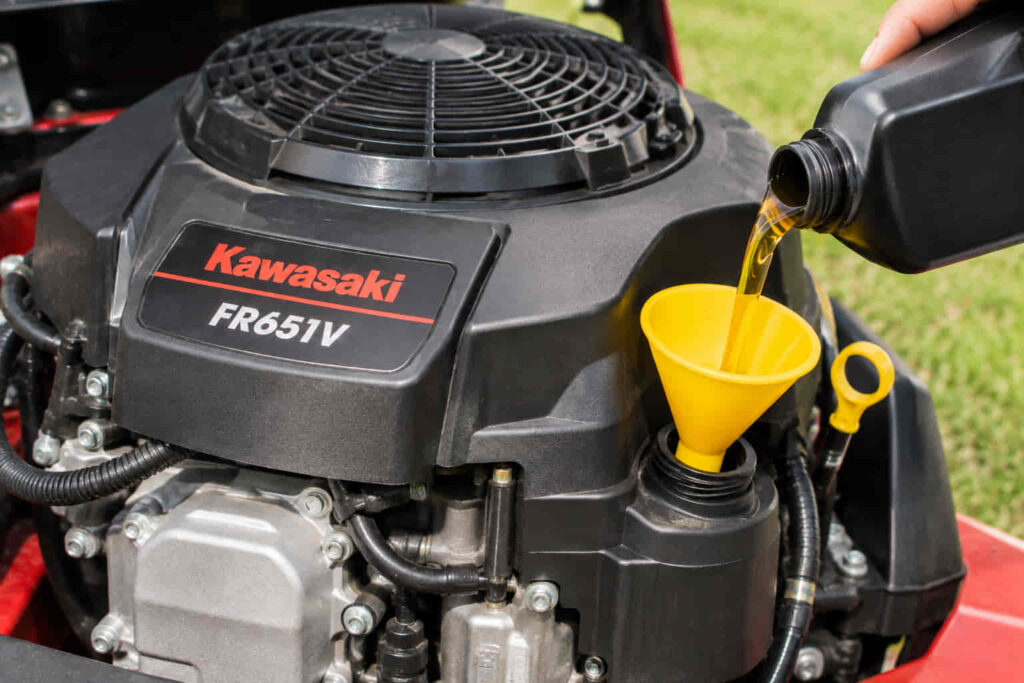
The Kawasaki FR651V oil capacity is 2.2 US quarts (2.1 liters) when replacing the engine oil and oil filter. Without replacing the oil filter, the refill capacity is approximately 1.9 US quarts (1.8 liters). These specifications are confirmed by Kawasaki’s official FR651V owner’s manual and the manufacturer’s current U.S. engine specifications.
Kawasaki recommends SAE 10W-40 engine oil for most operating conditions, although SAE 10W-30, SAE 20W-50, and other approved viscosity grades may be suitable depending on ambient temperature. The oil should meet the applicable gasoline-engine API service classification specified in the engine’s documentation.
The FR651V is a 726cc, air-cooled, four-stroke V-twin engine used in residential riding lawn mowers and zero-turn mowers. It produces a published maximum output of 21.5 horsepower at 3,600 RPM and uses a pressurized lubrication system to protect its moving components.
Proper oil maintenance is particularly important because the engine may operate at relatively constant speed while mowing loads and environmental conditions change. Insufficient oil can damage the crankshaft bearings, connecting rods, and other internal components, while overfilling can cause smoking and abnormal oil movement.
Kawasaki’s service documentation specifies an oil change every 100 operating hours or once per year, whichever comes first. The oil filter is scheduled for replacement every 200 hours. Certain manual editions also specify an initial oil change after the first eight operating hours.
Understanding the correct Kawasaki FR651V oil capacity, recommended viscosity, filter part number, and oil change procedure helps protect the engine and avoid common maintenance mistakes.
What Is the Kawasaki FR651V Oil Capacity?
The Kawasaki FR651V requires approximately 2.2 US quarts (2.1 liters) of engine oil during a normal oil change that includes replacing the oil filter.
Kawasaki publishes this quantity in its official U.S. engine specifications.
The same capacity appears in the manufacturer’s owner’s manual covering the FR651V, FR691V, and FR730V engines.
The specified quantity includes oil needed to refill the engine’s lubrication system and the replacement oil filter.
However, the published capacity should not replace the final dipstick measurement.
A normal oil change does not necessarily remove every drop of lubricant from the engine.
Some oil remains in internal passages and on mechanical components.
The actual amount drained can also vary depending on oil temperature, drainage time, and whether the mower is parked level.
For this reason, the correct procedure involves adding the specified oil gradually and checking the level before returning the mower to service.
The dipstick should indicate a level within the approved operating range.
The engine should not be filled above the FULL mark.
Likewise, the oil should not be allowed to remain below the acceptable range.
For most owners performing a complete oil and filter service, preparing approximately 2.2 quarts of suitable oil is the correct starting point.
Kawasaki FR651V Oil Capacity With Filter
With a new oil filter installed, the Kawasaki FR651V oil refill capacity is 2.2 US quarts, equivalent to approximately 2.1 liters.
The engine uses a replaceable oil filter to remove contaminants from the circulating lubricant.
During operation, engine oil flows through the lubrication system and helps protect bearings, the camshaft, and other internal components.
The oil filter captures debris that can contribute to mechanical wear.
When the old filter is removed, the lubricant inside it is also discarded.
The replacement filter must receive oil when the engine is restarted.
This explains why the published oil capacity is higher when the filter is replaced.
However, the engine should not be overfilled in anticipation of the filter filling.
A practical approach is to add most of the specified amount, check the dipstick, and then complete the final level adjustment after oil circulation.
Kawasaki’s filter replacement instructions specify running the engine for approximately three minutes after installing the new filter.
The engine is then stopped so the filter area can be checked for leakage and the oil level verified.
A small amount of additional oil may be required as the new filter fills.
The correct final quantity is determined by the dipstick rather than by forcing the entire nominal refill amount into the engine.
Kawasaki FR651V Oil Capacity Without Filter
The Kawasaki FR651V oil capacity without replacing the oil filter is approximately 1.9 US quarts (1.8 liters).
This is the lower refill specification listed in Kawasaki’s service documentation.
When the oil filter remains installed, some oil stays inside the filter housing and associated passages.
Therefore, the engine requires less replacement oil.
This difference matters because Kawasaki’s published maintenance schedule specifies different service intervals for oil and filter replacement.
The engine oil is scheduled for replacement every 100 hours or annually.
The oil filter is scheduled for replacement every 200 hours.
Consequently, the manufacturer’s maintenance schedule allows an oil-only service between filter changes.
However, Kawasaki’s general oil change guidance also recommends replacing the filter during each oil change for additional protection.
Owners should follow the schedule applicable to their engine and operating conditions.
If the filter is not replaced, the lower 1.9-quart refill quantity should be used as the initial reference.
The oil should be added gradually.
After servicing, the level must be checked using the dipstick.
Adding 2.2 quarts during an oil-only change without checking the level can result in excessive oil.
Kawasaki FR651V Oil Capacity in Liters
The Kawasaki FR651V oil capacity is approximately 2.1 liters with a filter change and 1.8 liters without a filter change.
These metric specifications correspond to the manufacturer’s published US-quart quantities.
The distinction is helpful when buying oil sold in one-liter containers.
A complete service requires enough lubricant to supply approximately 2.1 liters.
However, oil containers may be marked in US quarts, imperial quarts, or liters depending on the market.
These units are not identical.
One US quart equals approximately 0.946 liter.
Therefore, 2.2 US quarts corresponds to approximately 2.08 liters.
Kawasaki rounds this to 2.1 liters.
Similarly, 1.9 US quarts corresponds to approximately 1.80 liters.
The difference between the two refill quantities reflects the additional oil associated with filter replacement.
Owners should not confuse engine oil capacity with gasoline tank capacity or another mower fluid reservoir.
The FR651V is a four-stroke engine with a separate oil lubrication system.
Engine oil is added through the oil filler rather than mixed into gasoline.
When converting between different units, the dipstick remains the final reference for the proper operating level.
What Type of Engine Is the Kawasaki FR651V?
The Kawasaki FR651V is a 726cc, 90-degree V-twin gasoline engine designed primarily for residential lawn mowing equipment.
It belongs to Kawasaki’s FR engine series.
The engine has two cylinders and an overhead-valve configuration.
Its cylinder bore measures 78 mm, while the piston stroke measures 76 mm.
The total displacement is approximately 44.3 cubic inches.
Kawasaki publishes a maximum output of 21.5 horsepower at 3,600 RPM.
Maximum torque is approximately 39.3 lb-ft at 2,200 RPM.
These ratings describe the engine’s measured performance under the manufacturer’s testing conditions.
Actual available power can vary depending on equipment installation, operating environment, and accessories.
The engine uses an aluminum-based construction with cast-iron cylinder liners.
It also features electronic spark ignition, an automatic compression release system, and a carburetor with a fuel shutoff solenoid.
Its pressurized lubrication system distributes oil to critical internal components.
Unlike a liquid-cooled automotive engine, the FR651V relies on forced-air cooling.
A fan directs air around the cylinders and cooling fins.
This design makes engine cleanliness and proper airflow important for operating temperature control.
The lubricant also helps remove heat from internal engine components.
Maintaining the correct oil capacity supports reliable operation during normal mowing.
What Is the Best Oil for a Kawasaki FR651V?
Kawasaki recommends SAE 10W-40 engine oil for most FR651V operating conditions, provided it meets the appropriate API service classification.
The manufacturer’s owner’s manual includes an ambient-temperature chart showing several approved viscosity grades.
These include SAE 10W-40, SAE 10W-30, SAE 20W-50, SAE 5W-20, SAE 30, and SAE 40.
However, these oils are intended for different temperature ranges.
The manual specifically identifies 10W-40 as the general recommendation.
It also notes that oil viscosity may need to change according to atmospheric conditions.
The FR651V is an air-cooled engine.
Its lubrication system must continue protecting the engine during changing mowing loads and environmental temperatures.
Using an appropriate oil helps maintain the lubricating film between moving components.
The oil should also meet the API gasoline-engine service requirements identified in the owner’s manual.
The referenced Kawasaki manual lists API service categories SF, SG, SH, SJ, or SL.
Modern products may carry newer API classifications, but their suitability should be verified for the specific engine.
Kawasaki markets KTECH lubricants designed for outdoor power equipment.
However, the correct viscosity and performance requirements matter more than selecting oil by brand alone.
The appropriate lubricant should be chosen according to the engine documentation and expected operating temperature.
Can You Use 10W-30 in a Kawasaki FR651V?
Yes. SAE 10W-30 is an approved viscosity option for the Kawasaki FR651V within the ambient-temperature range specified in the owner’s manual.
SAE 10W-30 is a multigrade engine oil.
The first part of the designation describes its cold-temperature viscosity performance.
The second number identifies its high-temperature viscosity grade.
SAE 10W-30 is widely used in gasoline-powered lawn equipment.
However, it is not identical to 10W-40.
The two grades have different high-temperature viscosity requirements.
Kawasaki recommends 10W-40 for most operating conditions in the referenced FR651V manual.
Nevertheless, 10W-30 remains an acceptable option when the ambient temperature falls within its published range.
The engine’s operating environment should guide the decision.
A mower operating during cool spring mornings may experience different temperature conditions from one used during hot summer afternoons.
The chosen oil must also meet the applicable performance specification.
Using a product with the correct viscosity but an unsuitable formulation may not provide the intended engine protection.
Oil level should be checked regularly regardless of which approved viscosity is selected.
Kawasaki’s manual notes that certain multigrade oils may be associated with increased oil consumption.
This makes routine dipstick checks especially important.
Can You Use 10W-40 in a Kawasaki FR651V?
Yes. SAE 10W-40 is the viscosity Kawasaki recommends for most FR651V operating conditions.
This makes it a suitable default when the ambient-temperature chart and engine specifications support its use.
The oil provides multigrade performance across a broad range of conditions.
However, viscosity alone does not determine lubricant quality.
The engine oil must also meet the applicable gasoline-engine performance requirements.
Kawasaki’s KTECH oil range includes products developed for its four-cycle engines.
An equivalent lubricant can be considered when it satisfies the relevant specifications.
The correct oil should be used throughout the service interval.
Mixing incompatible or unsuitable lubricants is not a good maintenance strategy.
Likewise, adding unapproved aftermarket treatments does not substitute for proper engine oil.
The FR651V depends on a consistent oil supply to protect its rotating assembly and valvetrain.
Oil maintenance also becomes more important as operating hours accumulate.
A mower used in dusty conditions may experience greater contamination risks.
The owner should therefore monitor oil level, replace the oil at the proper interval, and maintain the engine’s air filtration system.
For most normal applications, a suitable SAE 10W-40 is a practical choice.
Can You Use 20W-50 in a Kawasaki FR651V?
SAE 20W-50 is included in Kawasaki’s FR651V oil viscosity chart for suitable higher-temperature operating conditions.
However, it is not necessarily the best choice for every climate.
SAE 20W-50 is more viscous at operating temperature than SAE 10W-40.
Kawasaki notes that 20W-50 may reduce oil consumption in hotter environments.
This can be relevant when the engine operates under high ambient temperatures.
However, the lubricant must remain suitable for cold starting.
A heavy oil may not behave as intended in low temperatures.
Therefore, selecting 20W-50 solely because the engine produces noise or has accumulated many operating hours is not recommended.
Oil consumption should also be investigated when it becomes excessive.
A worn piston ring, damaged cylinder wall, leaking gasket, or crankcase ventilation problem can cause oil loss.
A different viscosity may influence consumption but cannot repair damaged internal components.
The correct approach is to review the manufacturer’s ambient-temperature chart.
If 20W-50 is suitable for the operating conditions, it may be used according to the relevant instructions.
Otherwise, the general SAE 10W-40 recommendation remains appropriate.
Is Synthetic Oil Good for the Kawasaki FR651V?
Synthetic engine oil can be suitable for the Kawasaki FR651V when it meets the manufacturer’s viscosity and performance requirements.
Synthetic lubricants are formulated to provide consistent viscosity characteristics and resistance to degradation.
These properties can be useful in engines exposed to repeated heating and cooling cycles.
However, the term synthetic does not automatically mean a lubricant is suitable for every engine.
A product with an incorrect viscosity may not meet Kawasaki’s requirements.
Likewise, the performance classification should be checked.
The engine manufacturer’s instructions take precedence over general marketing claims.
Synthetic oil does not eliminate the need for regular maintenance.
The FR651V operates in environments containing grass clippings, dust, and airborne debris.
If the air filtration system is not maintained correctly, contamination can increase engine wear.
Fuel dilution and other operating conditions can also affect lubricant condition.
Therefore, the normal oil change interval should still be followed.
An owner should not extend the service interval merely because synthetic oil is used.
The lubricant should be maintained at the correct level and replaced according to engine hours and time.
A quality oil filter is also essential.
Together, proper lubrication and filtration help protect internal engine components during repeated mowing cycles.
What Oil Filter Does a Kawasaki FR651V Use?
Kawasaki’s current U.S. genuine parts catalog lists oil filter part number 49065-0736 for the FR, FS, FT, and FX 600 and 730 engine families, which include compatible FR651V applications.
This is the manufacturer’s current published oil filter listing for the engine family.
However, the exact part number should be confirmed using the engine’s model, specification, and serial number.
Older Kawasaki parts catalogs may list different part numbers.
Some of those parts have been superseded by newer filters.
A supersession means the manufacturer has identified an updated replacement part for specified applications.
It does not mean every filter with a similar appearance is interchangeable.
Oil filters contain internal components that influence filtration and lubrication.
Kawasaki describes its genuine filters as using a pressure-activated bypass valve.
This valve helps maintain oil circulation when the filter media becomes restricted.
The filter also contains sealing components designed for the engine’s operating environment.
The correct replacement must fit the engine and provide the specified performance.
A filter that screws onto the mounting surface is not automatically suitable.
The safest approach is to check the current Kawasaki parts catalog.
The filter should be installed according to the manufacturer’s instructions and inspected for leakage after startup.
How Often Should You Change Kawasaki FR651V Oil?
Kawasaki specifies an oil change every 100 operating hours or once per year, whichever comes first, in the referenced FR651V owner’s manual.
The engine is used primarily in lawn equipment rather than road vehicles.
Therefore, maintenance is based on operating hours rather than mileage.
An hour meter is useful because mowing equipment may operate at relatively constant engine speed for extended periods.
The engine can accumulate substantial operating time without traveling a large distance.
However, the oil change interval also includes a calendar limit.
A mower used for only a few hours during the year may still require an annual oil service.
Oil can deteriorate over time, and seasonal storage can introduce additional considerations.
Kawasaki also advises performing maintenance more frequently when operating conditions require it.
Dusty environments may expose the engine and air filter to additional contamination.
Heavy mowing loads and high temperatures can also increase demands on the lubrication system.
However, the standard interval should not automatically be shortened or extended without considering the applicable maintenance instructions.
For most normal residential applications, the published 100-hour or annual service requirement provides a practical schedule.
The oil level should still be checked daily before use.
This helps identify oil leaks or consumption between scheduled changes.
Does the Kawasaki FR651V Need an Initial Break-In Oil Change?
Certain Kawasaki FR651V owner’s manual editions specify an initial oil change after the first eight operating hours.
This initial service is separate from the normal 100-hour interval.
New engines undergo a period in which their moving components establish normal running contact.
During early operation, small amounts of wear-related material may enter the engine oil.
An initial oil change helps remove contaminants associated with this process.
However, Kawasaki has issued several editions of the FR651V documentation.
Some printed maintenance schedules present the initial eight-hour service requirement, while later versions emphasize the normal 100-hour or annual interval.
For this reason, the applicable engine and mower instructions should be checked.
Owners should not assume that every manual edition uses identical break-in language.
If the manual for a new engine specifies an initial oil change, that requirement should be followed.
The replacement oil should meet the appropriate viscosity and performance classification.
The oil filter should be serviced according to the applicable instructions.
After the first service, the normal maintenance schedule applies.
Correct break-in maintenance is particularly important for engines expected to provide years of residential mowing service.
How Often Should You Change the Kawasaki FR651V Oil Filter?
The Kawasaki FR651V owner’s manual specifies oil filter replacement every 200 operating hours.
This is separate from the oil change interval.
The oil is scheduled for replacement every 100 hours or annually.
The filter is scheduled for replacement every 200 hours.
However, Kawasaki’s current general oil change guidance also recommends replacing the oil filter during each oil change for optimal protection.
Both statements should be understood in context.
The scheduled 200-hour interval is the published minimum maintenance timing in the referenced FR651V manual.
Replacing the filter at every oil change may provide additional filtration maintenance, provided the correct part and installation procedure are used.
The oil filter helps prevent contaminants from circulating through the engine.
However, it cannot compensate for oil that is excessively degraded or contaminated.
A filter also cannot correct low oil pressure caused by a defective oil pump or worn internal bearings.
The correct filter should be selected using Kawasaki’s parts information.
After replacement, the oil level should be checked because the new filter receives lubricant during initial operation.
The engine should also be inspected for leaks around the filter mounting surface.
Read more: Kawasaki FX730V Oil Capacity
How to Change Oil in a Kawasaki FR651V
Changing the Kawasaki FR651V oil involves draining the used lubricant, replacing the oil filter when required, adding approved engine oil, and verifying the final level with the dipstick.
The mower should be placed on a flat, level surface.
The cutting blades must be disengaged, the parking brake applied, and the engine switched off.
Before draining, the engine may be operated briefly to warm the oil.
Warm lubricant generally drains more easily than cold lubricant.
However, extremely hot oil can cause burns.
The engine should be allowed to cool to a safe working temperature before the drain plug is handled.
The spark plug leads should be disconnected when required by the maintenance procedure to prevent accidental starting.
A suitable container should be placed beneath the oil drain location.
The drain plug is removed and the used oil is allowed to drain.
The plug is then reinstalled according to the engine and mower manufacturer’s instructions.
If the filter is being replaced, the old filter is removed and the mounting surface cleaned.
The new filter should be installed using the specified procedure.
Fresh oil is added gradually through the filler opening.
For a complete oil and filter change, the published capacity is 2.2 quarts.
The final oil level must be checked before normal operation resumes.
How to Change the Oil Filter on a Kawasaki FR651V
The Kawasaki FR651V oil filter is replaced by removing the old filter, cleaning the mounting surface, lubricating the new gasket, and installing a compatible filter according to Kawasaki’s instructions.
The engine must be stopped and allowed to cool.
The oil should be drained using the appropriate procedure.
A container should be positioned beneath the filter to capture any remaining lubricant.
The old filter is rotated counterclockwise.
A suitable filter wrench may be used when necessary.
However, the technician should avoid damaging surrounding engine components.
After removal, the filter mounting surface must be inspected.
The old rubber sealing gasket must not remain attached.
A new filter is prepared by applying a thin film of clean engine oil to its sealing gasket.
For the filter arrangement described in Kawasaki’s FR651V manual, the filter is installed until the gasket contacts the mounting surface.
It is then tightened approximately three-quarters of a turn further by hand.
After the engine is refilled, the oil should be circulated by running the engine briefly.
Kawasaki’s procedure specifies approximately three minutes of operation.
The engine is then stopped and the filter inspected for leakage.
The oil level must be checked again.
Any necessary top-up should be performed carefully without exceeding the FULL mark.
How to Check Kawasaki FR651V Oil Level
The Kawasaki FR651V oil level should be checked daily before operation, with the mower parked on level ground and the engine stopped.
The dipstick provides the actual oil level inside the crankcase.
Before removing it, the area surrounding the filler should be cleaned.
This helps prevent grass clippings, dust, or other debris from entering the engine.
The dipstick is removed and wiped clean.
It should then be inserted into the filler tube according to Kawasaki’s instructions.
For the referenced FR651V service procedure, the dipstick is inserted without screwing it into the filler neck.
It is then removed to obtain the reading.
The oil should remain between the ADD and FULL markings.
If the level is below the acceptable range, the correct oil should be added gradually.
The dipstick should then be checked again.
The engine must not be overfilled.
A reading taken while the mower is on a slope may be inaccurate.
Likewise, the oil level immediately after shutdown can differ from the level after oil has returned to the crankcase.
The manufacturer’s checking procedure should therefore be followed consistently.
Daily oil level checks are particularly useful for identifying gradual oil consumption and external leakage before they become serious problems.
What Happens If You Overfill a Kawasaki FR651V?
Overfilling a Kawasaki FR651V can cause excessive oil movement, engine smoking, and potentially higher operating temperature.
The crankcase is designed to contain a specific volume of lubricant.
The oil level must remain within the manufacturer’s approved operating range.
If too much oil is added, internal moving components may disturb the excess lubricant.
This can contribute to oil aeration.
Excess oil may also be drawn into the engine’s crankcase ventilation system.
The result can include oil entering the intake system and producing visible exhaust smoke.
Kawasaki explicitly warns that excessive oil can cause smoking and may contribute to overheating.
However, overfilling does not always produce immediate symptoms.
The engine may appear to operate normally despite containing too much lubricant.
Therefore, checking the dipstick is essential.
If the level is above the FULL mark, the excess oil should be removed using an appropriate method.
The engine should then be checked again.
Adding extra oil because the mower will be used in thick grass or hot weather is not a safe substitute for proper maintenance.
The correct protection comes from using the approved lubricant and maintaining the specified level.
What Happens If a Kawasaki FR651V Runs Low on Oil?
Low oil level can cause severe internal damage to a Kawasaki FR651V because the crankshaft, connecting rods, camshaft, and other moving components depend on adequate lubrication.
The engine’s oil pump circulates lubricant through internal passages.
The oil film helps prevent direct metal-to-metal contact.
When the amount of available oil becomes insufficient, the pump may fail to maintain normal lubrication under certain conditions.
This can increase friction and mechanical wear.
The engine may develop unusual ticking, knocking, or other abnormal sounds.
However, these symptoms can also result from unrelated faults.
A serious lubrication problem may eventually cause internal engine seizure.
Kawasaki’s owner manual specifically warns that insufficient engine oil can lead to severe damage, including seizure.
This is why the manufacturer recommends checking the oil level before each use.
An external leak may lower the level gradually.
Internal oil consumption can also reduce the amount of oil remaining in the crankcase.
If the engine has a low oil pressure warning or severe mechanical noise, it should be stopped as soon as safely possible.
Adding oil may restore the level, but it cannot reverse existing internal damage.
Further inspection may be necessary before continued operation.
Kawasaki FR651V Oil Pressure Problems
Low oil pressure in a Kawasaki FR651V may result from insufficient lubricant, a lubrication pump fault, excessive internal wear, or another problem affecting oil circulation.
The engine uses a pressurized lubrication system.
An oil pump draws lubricant from the crankcase and sends it through the engine’s oil passages.
The filter removes contaminants from the circulating oil.
A pressure relief mechanism helps control oil pressure under operating conditions.
However, the system must have an adequate oil supply.
If the level is too low, lubrication may become inconsistent.
A worn oil pump or damaged internal component can also affect pressure.
The corresponding Kawasaki service manual identifies a reference oil pressure range of approximately 43–85 psi when tested at 3,200 RPM and an oil temperature of 122–144°F.
This value is associated with specific testing conditions.
It should not be interpreted as the correct pressure at hot idle or at every engine speed.
Some mowers do not have a dashboard oil pressure gauge.
Therefore, an owner may not know the actual oil pressure without specialized testing.
If a low-pressure condition is suspected, a qualified technician can use the manufacturer’s test procedure.
The engine should not continue operating when a genuine lubrication problem is present.
Why Does a Kawasaki FR651V Burn Oil?
Oil consumption on a Kawasaki FR651V may result from excessive crankcase oil level, piston ring wear, cylinder wear, crankcase ventilation problems, or other internal sealing faults.
A small amount of oil consumption can occur during normal operation.
However, a sudden or excessive increase should be investigated.
The first step is to determine whether oil is being burned or leaking externally.
An engine may lose oil through a damaged crankshaft seal, valve cover gasket, or another sealing joint.
This can lower the dipstick reading without producing blue exhaust smoke.
Internal consumption is different.
Oil may pass the piston rings and enter the combustion chamber.
It can then burn with the gasoline-air mixture.
Blue or blue-gray exhaust smoke may be visible.
However, overfilling can also cause oil to enter the intake through the breather system.
Therefore, the oil level must be checked before assuming that the piston rings are worn.
The air filter and breather system may also require inspection.
If internal wear remains suspected, a mechanic can perform mechanical tests to evaluate cylinder sealing.
Changing oil viscosity may influence consumption under some conditions, but it cannot restore damaged metal components.
The appropriate repair depends on the confirmed cause.
Kawasaki FR651V Oil Leak Problems
Kawasaki FR651V oil leaks can develop around the oil filter, drain plug, crankshaft seals, valve covers, and other engine sealing surfaces.
Gaskets and seals are exposed to heat and vibration during operation.
Over time, sealing materials can deteriorate.
A loose or incorrectly installed oil filter can also create leakage.
This is particularly important after routine maintenance.
If the original filter gasket remains attached to the mounting surface, the new filter may not seal properly.
A drain plug that has been installed incorrectly can also allow oil to escape.
However, the location where oil collects does not always identify the original leak.
Oil may travel along the engine block before dripping onto the mower frame.
The correct diagnosis involves cleaning the affected area and determining where the oil first appears.
Oil leakage should be repaired promptly.
A developing leak can lower the crankcase level between maintenance services.
Oil contacting a hot muffler or other exhaust component may also create a fire hazard.
The correct repair depends on the damaged gasket, seal, filter connection, or other component.
A professional inspection is appropriate when the leak is substantial or its source is unclear.
Does Hot Weather Affect Kawasaki FR651V Oil Capacity?
Hot weather does not change the Kawasaki FR651V’s specified oil capacity, but it can influence oil viscosity selection, engine temperature, and maintenance requirements.
The engine uses forced-air cooling.
Its cooling system depends on an engine-driven fan and unobstructed air passages.
During hot weather, the cooling system must remove heat while the surrounding air is already warm.
Heavy mowing loads can increase engine temperature further.
The engine oil also plays a role in lubrication and internal heat transfer.
However, adding extra oil above the FULL mark is not an appropriate solution.
The correct capacity remains approximately 2.2 quarts with a filter change.
Oil viscosity may be selected according to the ambient-temperature chart.
Kawasaki identifies SAE 10W-40 as the general recommendation.
It also includes SAE 20W-50 as an option for suitable higher-temperature conditions.
However, the correct viscosity should be chosen according to the owner’s manual rather than assumptions.
Cooling airflow is equally important.
Grass clippings and debris can accumulate around the cooling fins and fan screen.
This can increase operating temperature regardless of oil viscosity.
Regular cleaning and correct lubrication provide better protection than overfilling the crankcase.
Kawasaki FR651V Oil Capacity vs FR691V
The Kawasaki FR651V and FR691V have the same published oil capacity of 2.2 US quarts (2.1 liters) when replacing the oil filter.
Both engines belong to Kawasaki’s FR residential V-twin family.
They have similar displacement and internal architecture.
The FR651V produces a published maximum output of 21.5 horsepower.
The FR691V is rated at 23 horsepower in Kawasaki’s current U.S. specifications.
However, the difference in power does not require a different oil refill quantity.
Both engines use the same nominal 726cc displacement.
Kawasaki’s owner manual covers the FR651V, FR691V, and FR730V together.
It identifies 1.8 liters without the filter and 2.1 liters with the filter for these engines.
However, shared capacity does not mean every replacement component is necessarily identical.
Air cleaner equipment, fuel system calibration, and other supporting parts may vary.
Oil filters should still be verified through the parts catalog.
Owners should also use the correct model and serial number when ordering maintenance components.
For ordinary oil service, both the FR651V and FR691V use the published 2.2-quart capacity with a new filter.
Kawasaki FR651V Oil Capacity vs FR730V
The Kawasaki FR651V and FR730V also share a published oil capacity of 2.2 US quarts (2.1 liters) with an oil filter change.
The FR730V is another member of Kawasaki’s residential V-twin engine family.
It produces a higher published horsepower rating than the FR651V.
Kawasaki currently rates the FR730V at 24 horsepower.
However, both engines use a 726cc displacement.
The manufacturer groups the FR651V, FR691V, and FR730V in the same owner’s manual.
Their published oil capacities are identical.
The refill requirement without removing the filter is approximately 1.9 quarts.
The oil requirement with a new filter is approximately 2.2 quarts.
However, the correct maintenance parts should still be selected according to the exact engine configuration.
A mower’s original engine may also have been replaced.
If so, the model information printed on the mower does not necessarily describe the installed powerplant.
The engine identification label should be checked before purchasing parts.
For normal factory configurations, the FR651V and FR730V share the same oil capacity.
Kawasaki FR651V Oil Capacity vs FS651V
The Kawasaki FR651V and FS651V are both 726cc V-twin engines, and Kawasaki’s current U.S. specifications list 2.2 US quarts with an oil filter change for both models.
However, the engine families serve somewhat different market positions.
The FR series is primarily intended for residential mowing applications.
The FS series incorporates features suited to more demanding mowing equipment.
For example, the FS651V uses a different air filtration arrangement, including a dual-element air filter system.
This can provide additional filtration capability in dusty conditions.
The engines also have differences in published power ratings and equipment features.
However, their nominal oil refill capacities remain the same.
Owners should not assume that every service part is interchangeable simply because the engines share displacement and oil quantity.
The correct filter, air cleaner, and other components should be selected using the parts catalog.
The FX651V is another related engine, but it belongs to Kawasaki’s commercial FX family.
Its maintenance requirements and equipment features may differ.
The safest approach is to identify the exact engine model before performing service.
Kawasaki FR651V Oil Capacity vs FR600V
The Kawasaki FR651V has a larger oil capacity than the FR600V, making correct engine identification important before servicing.
Kawasaki lists the FR651V at 2.2 US quarts with an oil filter change.
The smaller FR600V uses approximately 1.8 US quarts, or 1.7 liters, according to Kawasaki’s current U.S. specifications.
The difference is important because both engines belong to the FR series.
An owner who assumes every FR engine uses the same refill quantity could add too much oil to a smaller engine.
The engines also differ in displacement.
The FR651V has a 726cc displacement.
The FR600V belongs to a smaller displacement category.
The lubrication systems are therefore not necessarily identical.
The correct oil filter and maintenance specifications should be verified separately.
A mower’s horsepower label may help identify the likely engine, but it should not replace the actual model identification.
The safest approach is to consult the engine label and corresponding Kawasaki manual.
For a confirmed FR651V, the published oil capacity remains 2.2 quarts with a new filter.
How Much Does a Kawasaki FR651V Oil Change Cost?
A Kawasaki FR651V oil change is generally a relatively inexpensive maintenance service compared with repairing internal engine damage caused by inadequate lubrication.
The engine requires approximately 2.2 quarts of oil during a complete oil and filter service.
The actual cost depends on the selected lubricant, filter, local prices, and whether the owner performs the work.
SAE 10W-40 engine oil is commonly available in several package sizes.
Owners should purchase enough to complete the refill without substituting an unsuitable lubricant.
The filter cost also matters.
Kawasaki’s genuine oil filter catalog lists 49065-0736 for the relevant engine family.
However, the correct part should be verified before purchase.
Professional service includes labor.
The total price may also depend on how easily the mower’s oil drain plug and filter can be accessed.
Some equipment manufacturers install drain hoses or other features intended to simplify maintenance.
A DIY oil change can reduce labor costs when the owner has the correct tools and understands the procedure.
However, used oil must be collected and recycled or disposed of properly.
A service performed with the wrong oil quantity, damaged drain plug, or leaking filter can cause expensive problems.
The best value comes from correct maintenance rather than simply choosing the lowest initial price.
Common Kawasaki FR651V Oil Change Mistakes
Common FR651V oil change mistakes include overfilling, using an unsuitable lubricant, installing the wrong filter, failing to remove the old filter gasket, and checking the oil level incorrectly.
One important mistake is confusing the refill capacity with and without filter replacement.
The published quantities differ.
An oil-only change requires approximately 1.9 quarts.
A complete oil and filter change requires approximately 2.2 quarts.
Using the wrong quantity without checking the dipstick can create overfilling.
Another mistake is using an oil grade without considering temperature.
Kawasaki provides an ambient-temperature chart for a reason.
The viscosity should match the engine and operating conditions.
A third mistake involves filter installation.
The old sealing gasket must not remain attached to the mounting surface.
The new filter should be installed using the specified tightening procedure.
Drain plug sealing also deserves attention.
A damaged plug or incorrectly installed seal may allow oil to leak.
Finally, checking the oil level on uneven ground can produce an inaccurate reading.
The engine should be level, and the dipstick should be inserted according to the manufacturer’s instructions.
A complete oil change should end with checking for leaks and confirming the final oil level.
How Can You Prevent Kawasaki FR651V Oil-Related Problems?
The best way to prevent avoidable Kawasaki FR651V lubrication problems is to maintain the correct oil level, use approved oil, follow the service schedule, replace filters properly, and keep the engine cooling system clean.
The oil level should be checked before each operating session.
This helps identify unexpected leaks or consumption.
A mower can lose oil between scheduled changes even when it previously operated normally.
The correct viscosity should be selected using Kawasaki’s temperature recommendations.
SAE 10W-40 is the general recommendation for most conditions.
The oil should also meet the specified API performance classification.
Oil changes should follow the applicable maintenance interval.
The referenced owner’s manual identifies every 100 hours or once per year.
The oil filter is scheduled for replacement every 200 hours.
However, more frequent service may be appropriate under demanding conditions.
Air filtration is another important factor.
Dust entering the engine can increase wear.
Cooling system maintenance is equally important because the FR651V is air-cooled.
Grass clippings should not be allowed to block cooling airflow.
Any persistent oil leak, abnormal knocking, or excessive oil consumption should be investigated promptly.
Correct maintenance cannot prevent every mechanical fault, but it can substantially reduce the risk of avoidable internal engine damage.
Final Verdict: What Is the Correct Kawasaki FR651V Oil Capacity?
The Kawasaki FR651V oil capacity is 2.2 US quarts (2.1 liters) with a new oil filter and approximately 1.9 US quarts (1.8 liters) when the existing filter remains installed. These specifications are supported by Kawasaki’s official engine documentation.
The FR651V is a 726cc, four-stroke, air-cooled V-twin gasoline engine commonly used in residential riding and zero-turn lawn mowers.
It has a pressurized lubrication system that requires the correct amount of suitable engine oil.
Kawasaki recommends SAE 10W-40 for most conditions.
SAE 10W-30, SAE 20W-50, and other specified grades may be suitable within the temperature ranges shown in the owner’s manual.
For filtration, Kawasaki’s current U.S. genuine parts catalog lists oil filter 49065-0736 for the compatible FR 600 and 730 engine family.
The engine oil is scheduled for replacement every 100 operating hours or annually in the referenced manual.
The oil filter is scheduled for replacement every 200 hours.
Some manual editions also specify an initial oil change after the first eight hours.
The oil level should be checked daily, using the dipstick with the engine stopped and the mower positioned on level ground.
Overfilling must be avoided because it can cause smoking and other problems.
Insufficient oil is equally dangerous because it can result in severe internal wear or engine seizure.
For most owners, the practical answer is to prepare 2.2 quarts of manufacturer-approved oil for a complete Kawasaki FR651V oil and filter change, add it gradually, and verify the final level using the dipstick.
Regular maintenance, correct filtration, and unobstructed cooling airflow provide the best foundation for reliable FR651V operation throughout the mower’s service life.