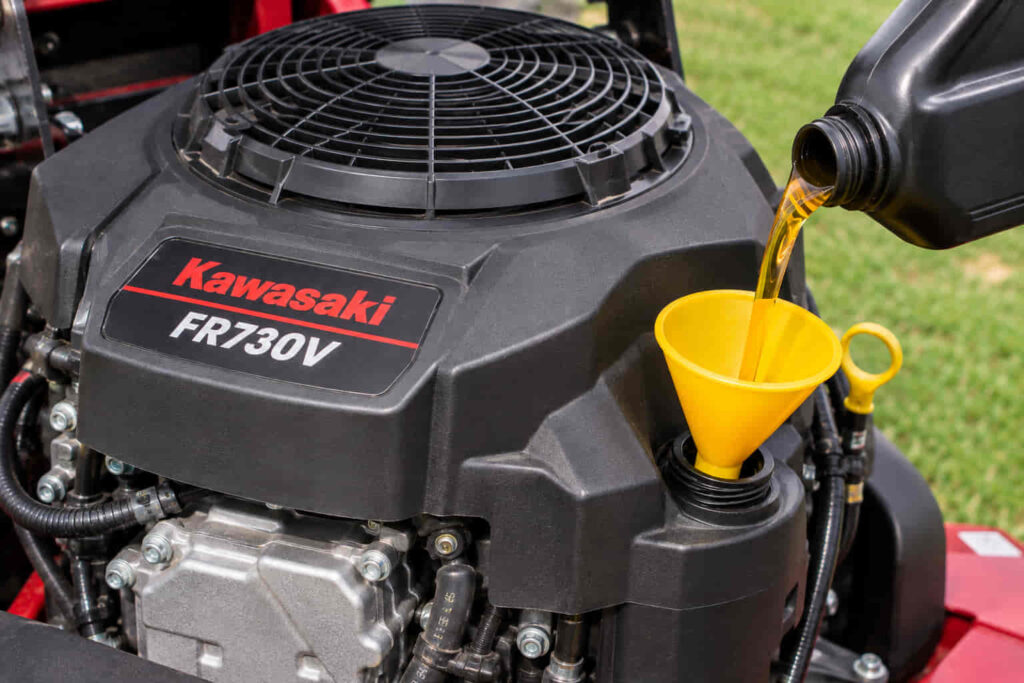
The Kawasaki FR730V oil capacity is 1.9 US quarts (1.8 liters) without an oil filter replacement and 2.2 US quarts (2.1 liters) when the oil filter is replaced. These specifications come from Kawasaki’s official service documentation. The correct refill amount depends on whether the maintenance procedure includes a new oil filter, as replacing the filter increases the amount of oil needed to fill the engine’s lubrication system.
The Kawasaki FR730V is a 726cc, four-stroke V-twin gasoline engine commonly used in riding lawn mowers and other outdoor power equipment. Its pressurized lubrication system distributes engine oil to moving components, reducing friction and protecting internal surfaces from premature wear. Adding too little oil can lead to inadequate lubrication, while overfilling can cause excessive smoking and engine overheating. Maintaining the correct oil level is therefore essential for reliable engine operation.
This guide explains the Kawasaki FR730V’s oil capacity with and without filter replacement, recommended engine oil types and viscosity grades, proper oil-level checking procedures, and oil-change requirements. It also addresses common oil-filling mistakes and maintenance intervals to help owners service the engine according to Kawasaki’s specifications.
How Much Oil Does a Kawasaki FR730V Engine Hold?
The Kawasaki FR730V engine holds 1.9 US quarts (1.8 liters) of oil without an oil filter replacement and 2.2 US quarts (2.1 liters) when the oil filter is replaced. These capacities are specified in Kawasaki’s official owner’s manual for the FR730V, a 726cc, four-stroke V-twin gasoline engine. The difference depends on whether the existing oil filter remains installed or a new filter is added during the oil change.
When changing the engine oil without replacing the filter, the recommended capacity is 1.9 US quarts. The existing oil filter retains some oil, so the refill quantity is lower than during a complete oil and filter replacement. This specification applies to a routine oil change in which the old engine oil is drained while the oil filter remains attached. The actual amount needed to reach the correct level can vary depending on how completely the used oil drains from the crankcase.
When replacing both the engine oil and oil filter, the recommended capacity increases to 2.2 US quarts. The additional oil accounts for the lubrication system’s requirements after a new filter is installed. For example, an FR730V receiving a new oil filter requires approximately 0.3 US quart more oil than the same engine undergoing an oil change without filter replacement.
Both quantities are manufacturer-specified service capacities rather than fixed amounts that must be poured into the engine regardless of its existing oil level. Kawasaki instructs owners to check the oil using the dipstick with the engine on a level surface. The oil level must remain between the ADD and FULL marks, since exceeding the FULL mark can cause excessive smoking and engine overheating.
Why Does the Kawasaki FR730V Need More Oil When You Replace the Filter?
The Kawasaki FR730V requires approximately 0.3 US quart (0.3 liter) more oil when its oil filter is replaced because the new filter must fill with engine oil as part of the lubrication system. Kawasaki specifies a capacity of 2.2 US quarts with filter replacement, compared with 1.9 US quarts when the existing filter remains installed. This difference reflects the additional oil required during the filter replacement service.
The FR730V uses a pressurized lubrication system that circulates oil through the engine to protect moving components. Oil is drawn from the crankcase by the oil pump, passes through the filtration system, and reaches lubricated engine components through internal passages. When a new oil filter is installed, its internal space initially contains little or no oil. Once the engine starts, the lubrication system supplies oil to the filter, which changes the amount remaining in the crankcase.
The published 0.3-quart difference should not be interpreted as an exact measurement of the oil filter’s internal volume. It represents the difference between Kawasaki’s two specified service capacities. After an oil and filter change, Kawasaki instructs owners to run the engine for approximately three minutes, stop it, inspect the filter area for leaks, and recheck the oil level. Additional oil should be added only as needed to restore the correct dipstick reading. This final inspection confirms that the engine has sufficient oil after the new filter has filled.
Read more: Kawasaki FR651V Oil Capacity
Does a Kawasaki FR730V Need All 2.2 Quarts Every Time You Add Oil?
The Kawasaki FR730V does not require 2.2 US quarts of oil every time oil is added to the engine. The 2.2-quart (2.1-liter) specification applies to an oil change that includes oil filter replacement, while 1.9 US quarts (1.8 liters) is the specified capacity when the existing filter remains installed. Adding oil between scheduled changes requires only enough to restore the correct level on the dipstick, not the engine’s full service capacity.
The amount of oil needed during a refill depends on how much oil remains inside the engine. During an oil change, residual oil can remain in the crankcase, internal passages, and lubrication components after draining. Consequently, the actual quantity required to reach the FULL mark may be slightly lower than the published service capacity. Pouring the entire specified amount without checking the dipstick increases the risk of overfilling.
For example, an FR730V engine with an oil level slightly below the FULL mark does not need another 1.9 or 2.2 quarts. It only needs enough oil to bring the level back into the recommended operating range. Kawasaki specifies that the oil level must remain between the ADD and FULL marks on the dipstick. Adding oil gradually and checking the level after each addition prevents unnecessary overfilling.
The correct refill procedure also depends on whether the oil filter has been replaced. After installing a new filter, some of the engine oil circulates into the filter when the engine starts. The oil level should therefore be checked again after the engine has operated briefly and been shut down according to Kawasaki’s maintenance instructions. The final dipstick reading determines whether additional oil is necessary.
What Type of Oil Does the Kawasaki FR730V Engine Require?
The Kawasaki FR730V requires four-stroke engine oil that meets the manufacturer’s specified API service classification and SAE viscosity requirements. Kawasaki recommends SAE 10W-40 for most operating conditions in its FR730V owner’s manual, while SAE 10W-30, SAE 20W-50, SAE 30, SAE 40, and SAE 5W-20 are listed as alternatives for appropriate temperature ranges. Selecting the correct viscosity ensures the oil flows adequately during startup and maintains a protective lubricating film as the engine reaches operating temperature.
SAE 10W-40 is a multigrade oil designed to provide suitable flow characteristics during cold starts while maintaining higher viscosity at elevated operating temperatures. The number before the letter W describes the oil’s low-temperature viscosity performance, while the second number represents its viscosity classification at higher temperatures. This makes SAE 10W-40 suitable for a broad range of operating conditions covered by Kawasaki’s recommendations. However, the appropriate grade still depends on ambient temperature rather than engine displacement or horsepower alone.
Kawasaki’s viscosity chart also identifies SAE 10W-30 as an option for moderate operating temperatures, while SAE 30 and SAE 40 are intended for warmer conditions within their specified temperature ranges. SAE 5W-20 is listed for lower ambient temperatures, and SAE 20W-50 is included for higher-temperature operation. Kawasaki notes that SAE 20W-50 may reduce oil consumption in hot conditions. Owners should therefore match the oil grade to the expected operating temperature instead of assuming that one viscosity is ideal throughout the year.
The engine oil must also meet the appropriate American Petroleum Institute (API) service requirements. Kawasaki’s owner’s manual lists API service classifications SF, SG, SH, SJ, and SL, while its service manual specifies SJ or SL. The API classification identifies an oil’s performance standard, whereas the SAE grade identifies its viscosity characteristics. Both specifications matter because an oil with the correct viscosity does not automatically meet the engine manufacturer’s specified performance requirements.
Kawasaki additionally warns that multigrade oils, including SAE 5W-20, SAE 10W-30, and SAE 10W-40, may increase oil consumption under certain operating conditions. Checking the dipstick regularly is therefore important, particularly during extended mowing sessions or operation in high ambient temperatures. The correct oil selection, combined with the manufacturer’s specified 1.9- or 2.2-quart service capacity, helps maintain adequate lubrication without exceeding the recommended oil level.
How Do You Check the Engine Oil Level on a Kawasaki FR730V?
To check the oil level on a Kawasaki FR730V, place the engine on a level surface, remove and clean the dipstick, insert it into the filler tube without screwing it in, and verify that the oil level is between the ADD and FULL marks. Kawasaki recommends checking the engine oil daily before operation because insufficient lubrication can damage internal components and lead to engine seizure.
The engine must be positioned on level ground before checking the oil. An uneven surface causes oil to collect toward one side of the crankcase, which can produce an inaccurate dipstick reading. After positioning the mower correctly and stopping the engine, clean the area surrounding the oil filler cap to prevent grass clippings, dust, and other contaminants from entering the lubrication system. Remove the oil gauge and wipe the dipstick with a clean, lint-free cloth to eliminate residual oil that could interfere with the measurement.
Insert the cleaned dipstick fully into the filler tube without threading the cap into place, then remove it to inspect the oil level. This distinction is important because screwing the dipstick into the tube changes its measuring position and can produce an incorrect reading. The oil should reach the designated operating range between the ADD and FULL marks. A reading near or below ADD indicates that additional oil is needed, while a reading above FULL indicates overfilling.
When the oil level is low, add a small quantity of the manufacturer-approved engine oil through the filler opening and repeat the measurement. Continue until the oil reaches the recommended operating range without exceeding the FULL mark. For example, an FR730V with oil near the ADD mark should receive only enough oil to restore the proper level rather than the complete 1.9-quart or 2.2-quart service capacity. Once the measurement is correct, reinstall and securely tighten the oil filler cap before operating the engine.
How Do You Change the Oil in a Kawasaki FR730V Engine?
To change the oil in a Kawasaki FR730V, warm the engine, shut it off, drain the used oil, reinstall the drain plug, refill the crankcase with the specified engine oil, and verify the final oil level using the dipstick. Kawasaki specifies 1.9 US quarts (1.8 liters) for an oil change without filter replacement and 2.2 US quarts (2.1 liters) when installing a new oil filter. The procedure should be performed with the mower on a level surface to support complete drainage and accurate oil-level measurements.
Begin by operating the engine briefly to warm the oil, which reduces its viscosity and allows it to drain more readily. Stop the engine, engage the parking brake, and secure the mower against accidental movement according to the equipment manufacturer’s instructions. Allow the engine to cool from hot to warm before handling the drain components, since hot engine oil can cause severe burns. Position a suitable oil collection container beneath the engine’s oil drain outlet, then remove the drain plug and allow the used oil to flow into the container. Once draining is complete, inspect the drain plug and its sealing O-ring for damage. The Kawasaki service manual specifies replacing the drain plug O-ring during this procedure and tightening the drain plug to 6.9 N·m (61 in-lb).
If the maintenance service includes oil filter replacement, position a collection pan beneath the filter connection to capture oil remaining in the filter and lubrication passages. Rotate the existing filter counterclockwise to remove it, then inspect the engine’s filter mounting surface and ensure the old sealing gasket has not remained attached. Apply a thin film of clean engine oil to the new filter’s rubber seal before installation. Thread the replacement filter clockwise until its seal contacts the mounting surface, then tighten it an additional three-quarters of a turn by hand, as specified in Kawasaki’s maintenance instructions. Proper gasket contact helps prevent oil leakage without excessive tightening.
After reinstalling the drain plug and, when applicable, the new oil filter, remove the oil filler cap and gradually add the recommended oil. Use the 1.9-quart specification when the existing filter remains installed or the 2.2-quart specification when the filter has been replaced. These quantities provide a reference for refilling, but the final amount should be determined by the dipstick because some residual oil may remain inside the engine. Check the oil level with the dipstick inserted without screwing it in, and avoid filling above the FULL mark.
When the initial oil level is correct, reinstall the filler cap and start the engine in a properly ventilated outdoor area. Kawasaki instructs owners to run the engine for approximately three minutes after an oil filter replacement, then stop it and inspect the filter area for leakage. Check the oil level again after shutdown and add oil if necessary to compensate for the oil that has entered the new filter. Confirm that the oil remains within the designated operating range before returning the mower to service.
Collect the used engine oil and any removed oil filter for proper recycling or disposal. Used motor oil contains contaminants and must not be poured onto the ground, into household drains, or into waterways. Following the appropriate disposal procedure completes the oil change while preventing environmental contamination.
What Happens If You Put Too Much Oil in a Kawasaki FR730V?
Putting too much oil in a Kawasaki FR730V can cause excessive exhaust smoke and engine overheating. Kawasaki’s owner’s manual warns against filling the crankcase above the FULL mark on the dipstick because excess oil can interfere with normal engine operation. The FR730V requires an oil level within the manufacturer’s specified operating range, regardless of whether the engine has received a complete oil change or a routine top-off.
Overfilling increases the amount of oil inside the crankcase beyond its intended operating level. When the oil level becomes excessively high, rotating engine components may contact and agitate the surplus oil, potentially causing aeration and increasing crankcase oil mist. Excess oil can also enter the crankcase ventilation system and reach the intake, where it may be burned during combustion. This explains why an overfilled engine can produce visible exhaust smoke even when its internal components have no existing mechanical damage.
The risk of overfilling increases when owners confuse the Kawasaki FR730V’s two published service capacities. For example, adding 2.2 US quarts during an oil change without replacing the filter introduces approximately 0.3 US quart more oil than the specified 1.9-quart service capacity. The actual dipstick level depends on how much used oil remains inside the engine, but adding the larger quantity without verification can push the level above the FULL mark.
An overfilled Kawasaki FR730V should not be operated until the excess oil has been removed. Position the engine on a level surface, remove the dipstick, and confirm the oil level using Kawasaki’s specified measuring procedure. If the oil exceeds the operating range, drain a controlled amount through the oil drain plug and check the dipstick again. Repeat until the reading returns to the proper range. If excessive smoke continues after correcting the oil level, further inspection is necessary to determine whether oil remains in the intake system or another engine problem is present.
What Happens If the Kawasaki FR730V Oil Level Is Too Low?
Running a Kawasaki FR730V with insufficient engine oil can cause accelerated internal wear, overheating, and engine seizure due to inadequate lubrication. Kawasaki specifically warns that an oil shortage can seriously damage the engine and instructs owners to check the oil level daily before starting it. The oil must remain within the operating range indicated on the dipstick to support normal lubrication of internal engine components.
The Kawasaki FR730V uses a pressurized lubrication system that circulates oil through critical engine components, including crankshaft bearings, connecting rod bearings, and other moving surfaces. Engine oil forms a protective film between metal components, reducing direct contact, friction, and wear during operation. When the oil supply becomes insufficient, the lubrication system may fail to maintain adequate oil delivery under certain operating conditions. This increases friction and operating temperatures, potentially damaging bearings and other internal surfaces.
Low oil levels can develop through external leakage, oil consumption, or incomplete refilling after maintenance. For example, an FR730V that develops a leak around its oil filter seal or drain plug may gradually lose oil during operation. The remaining quantity can eventually fall below the recommended dipstick range, increasing the risk of lubrication problems during extended mowing sessions. A low oil level should therefore be treated as a maintenance issue even when the engine starts and operates normally.
The consequences become more severe when the engine continues running without sufficient lubrication. Increased metal-to-metal contact can damage bearing surfaces and produce excessive heat. In severe cases, the resulting friction can cause moving components to seize, preventing the engine from operating. Engine seizure may require extensive mechanical repair or replacement, making regular oil-level inspections an important part of preventive maintenance.
If the Kawasaki FR730V oil level is below the ADD mark, stop the engine and restore the correct level before continuing operation. Place the engine on level ground, remove and clean the dipstick, and add manufacturer-approved oil gradually until the reading falls within the specified range. Inspect the engine for visible leaks if the oil level repeatedly decreases. If the oil-pressure warning light illuminates during operation on equipment fitted with this indicator, stop the engine immediately and investigate the cause rather than continuing to run it. Correcting the oil level before further operation helps prevent lubrication-related engine damage.
How Often Should You Change the Oil in a Kawasaki FR730V?
The Kawasaki FR730V engine requires its first oil change after 8 operating hours, followed by oil changes every 100 hours or once a year, whichever comes first. These maintenance intervals are specified in Kawasaki’s engine documentation and help prevent oil degradation from compromising lubrication. The oil filter has a separate replacement interval of 200 operating hours, meaning it does not need to be replaced during every scheduled oil change under normal operating conditions.
The initial oil change after 8 hours is particularly important because a new engine undergoes a break-in period as its internal components settle into their operating surfaces. During this period, small amounts of metallic wear particles and other contaminants can enter the engine oil. Replacing the original oil removes accumulated contaminants and provides fresh lubrication before the engine enters its regular maintenance cycle. For example, a newly installed Kawasaki FR730V should receive its first oil change when its hour meter reaches approximately 8 hours, rather than waiting until the standard 100-hour service interval.
After the initial service, the engine oil should be replaced every 100 operating hours or annually, whichever occurs first. Engine oil gradually deteriorates through heat exposure, oxidation, and contamination during combustion and operation. These processes reduce its ability to maintain consistent lubrication and protect internal surfaces. An FR730V that operates for only 60 hours during a mowing season still requires an annual oil change, while an engine that accumulates 100 hours in several months reaches its scheduled service interval sooner.
The Kawasaki FR730V oil filter is scheduled for replacement every 200 operating hours. The filter removes circulating contaminants from the lubrication system, helping prevent abrasive particles from reaching engine bearings and other lubricated components. Under the standard maintenance schedule, the engine may therefore receive one oil change without filter replacement before the next scheduled service includes both engine oil and a new filter. The appropriate refill specification remains 1.9 US quarts without filter replacement or 2.2 US quarts when the filter is changed.
Operating conditions also influence maintenance requirements. Kawasaki recommends more frequent servicing when conditions demand it, particularly in environments with substantial dust and debris. Regular mowing in dusty areas exposes the engine to greater contamination risks, making proper air filtration and oil-level monitoring especially important. Owners should check the oil level before each operation, inspect for visible leaks, and record engine hours to ensure maintenance is performed at the appropriate intervals.
Why Does a Kawasaki FR730V Lose Oil Between Changes?
A Kawasaki FR730V can lose engine oil between scheduled changes because of external oil leaks or oil consumption during normal engine operation. These two conditions affect the crankcase oil level differently. External leakage allows oil to escape through seals, gaskets, or service connections, while oil consumption occurs when small amounts of lubricant enter the combustion process and are burned. Identifying the source of oil loss is necessary before determining whether the engine requires routine maintenance or mechanical repair.
External oil leaks commonly develop around components that seal the engine’s lubrication system, including the oil filter gasket, oil drain plug, and crankcase sealing surfaces. A damaged gasket, loose connection, or improperly installed filter can allow oil to escape when the engine is operating. For example, an oil filter installed with a damaged gasket may leak around its mounting surface as oil circulates under pressure. Visible oil residue near the filter or drain plug provides a starting point for inspection, although the exact leak source must be confirmed before replacing parts.
Engine oil consumption occurs when lubricant enters areas where it can be burned during combustion. Small amounts of oil can pass through the piston ring area or valve-related sealing surfaces, particularly as internal components experience wear. Operating temperature, engine condition, and oil viscosity can influence consumption. Kawasaki’s owner’s manual specifically notes that multigrade oils such as SAE 5W-20, SAE 10W-30, and SAE 10W-40 can increase oil consumption and recommends checking the oil level more frequently when using them. The manual also identifies SAE 20W-50 as an option that may reduce oil consumption at higher ambient temperatures.
A gradual reduction in oil level does not automatically indicate a serious mechanical defect. However, repeated oil loss requires attention because the FR730V depends on an adequate oil supply for pressurized lubrication. Owners should check the dipstick with the engine on level ground, inspect the oil filter and drain plug for leakage, and monitor how quickly the oil level decreases between operating sessions. Persistent blue exhaust smoke, substantial oil consumption, or recurring leaks after routine maintenance warrant inspection by a qualified engine technician.
Maintaining the correct oil level is more important than waiting until the next scheduled oil change to address a shortage. The FR730V should be topped off with manufacturer-approved oil whenever the dipstick indicates that additional lubricant is needed. Monitoring oil consumption alongside the engine’s operating hours helps identify abnormal changes early and reduces the risk of running the engine with insufficient lubrication.
Do Kawasaki FR651V and FR691V Engines Have the Same Oil Capacity as the FR730V?
The Kawasaki FR651V, FR691V, and FR730V engines have the same specified oil capacity of 1.9 US quarts (1.8 liters) without oil filter replacement and 2.2 US quarts (2.1 liters) with oil filter replacement. Kawasaki lists all three engines together in its official owner’s manual, confirming that their oil service capacities are identical despite differences in engine performance and model specifications.
All three engines belong to Kawasaki’s FR Series of air-cooled, four-stroke V-twin gasoline engines designed for outdoor power equipment. The FR651V has a displacement of 726cc, as do the FR691V and FR730V. Although these engines have different power ratings, their shared displacement and related engine architecture allow Kawasaki to specify the same oil service volumes. Engine horsepower alone does not determine oil capacity because the volume of oil required depends on the lubrication system and crankcase design rather than the engine’s maximum power output.
For example, an owner replacing the oil and oil filter on a Kawasaki FR691V should use the same published 2.2-quart service capacity as an owner performing the equivalent maintenance on an FR730V. If the filter remains installed, both engines have a specified capacity of 1.9 quarts. This consistency simplifies maintenance across compatible FR Series engines, although the actual amount added should always be checked against the dipstick.
The shared capacity specifications do not mean that every maintenance component is automatically interchangeable between the three engines. Owners should verify replacement oil filters, service parts, and maintenance instructions using the exact engine model and applicable manufacturer documentation. Confirming the engine identification before purchasing parts or performing maintenance helps prevent compatibility errors while ensuring the correct oil capacity is used.
Where Can You Confirm the Oil Capacity for a Specific Kawasaki FR730V Model?
The most reliable way to confirm Kawasaki FR730V oil capacity is to consult the official Kawasaki Engines specifications, the engine owner’s manual, or the applicable Kawasaki service manual. These manufacturer resources identify the correct oil quantities, lubrication requirements, and maintenance procedures. Kawasaki’s published specifications establish a service capacity of 1.9 US quarts without oil filter replacement and 2.2 US quarts with oil filter replacement.
The Kawasaki FR651V, FR691V, and FR730V Owner’s Manual, publication number 99920-2289-03, provides the oil capacity information in its General Information and Preparation sections. It also explains how to check the dipstick, select engine oil according to operating temperature, and perform scheduled oil changes. The corresponding Kawasaki service manual provides additional technical information about the lubrication system and service procedures. These documents are particularly useful when confirming specifications that may be presented inconsistently on third-party websites.
Owners should identify their exact engine model and serial number before selecting replacement components or relying on a specific manual revision. Kawasaki identifies the engine serial number as the distinguishing identifier for individual engines and explains that it is needed when ordering parts through a dealer. The engine identification label provides a practical reference when checking service documentation or requesting assistance from an authorized Kawasaki engine dealer.
The published oil capacity should always be used together with the manufacturer’s oil-level checking procedure. Kawasaki instructs owners to position the engine on level ground, insert the cleaned dipstick without screwing it into the filler tube, and confirm that the reading remains between the ADD and FULL marks. This measurement is the final verification after an oil change because the actual refill requirement depends on the amount of oil remaining inside the engine.
Following the official Kawasaki documentation and verifying the final dipstick reading ensures that the FR730V receives the correct quantity of engine oil for its maintenance condition. It also helps prevent overfilling, insufficient lubrication, and avoidable engine damage associated with incorrect oil servicing.