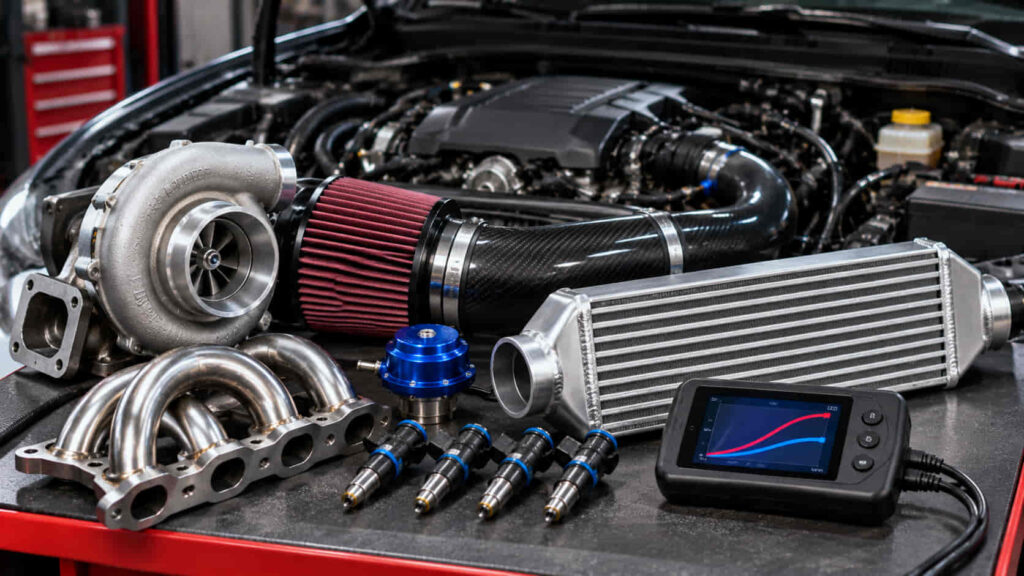
To understand how to increase torque in a car, you need to focus on improving the engine’s ability to generate rotational force through combustion, airflow, and mechanical efficiency. Effective methods include ECU tuning, optimizing the intake and exhaust systems, upgrading turbochargers or superchargers, and modifying internal engine components. However, the actual torque increase depends on the engine’s design, existing performance limitations, fuel quality, and supporting hardware. A modification that improves torque in a turbocharged engine may produce little measurable benefit in a naturally aspirated engine.
Engine torque is measured in pound-feet (lb-ft) or Newton-meters (Nm) and influences how effectively a vehicle accelerates under different operating conditions. Increasing peak torque is not the same as improving low-end torque, which affects performance at lower engine speeds. Similarly, changing transmission gear ratios can increase torque delivered to the wheels without increasing the engine’s output. Understanding these differences is essential when selecting performance modifications that deliver measurable improvements rather than simply changing throttle response or engine sound.
This guide explains eight methods for increasing engine torque, including their operating principles, practical limitations, and potential reliability risks. It also covers low-RPM performance, dynamometer testing, modification costs, and the differences between naturally aspirated and turbocharged engines to help you choose upgrades suited to your vehicle.
How Can You Increase Torque in a Car?
You can increase torque in a car by improving engine airflow, optimizing combustion, adjusting engine calibration, or modifying mechanical components that influence the amount of force produced during each combustion cycle. The most effective approach depends on whether the engine is naturally aspirated or turbocharged, its current mechanical condition, and the limitations of its fuel, cooling, and drivetrain systems. Common performance upgrades include ECU tuning, intake and exhaust improvements, turbocharger or supercharger modifications, and changes to camshaft specifications or engine displacement. However, each method affects torque differently, and not every modification produces measurable gains on every vehicle.
ECU tuning is one approach to increasing torque when the engine has sufficient mechanical capacity to support revised operating parameters. The Engine Control Unit regulates ignition timing, fuel delivery, electronic throttle operation, and boost pressure on applicable engines. A properly developed calibration can improve torque production by optimizing these parameters within the engine’s operating limits. Turbocharged engines may respond particularly well when the original calibration leaves usable boost and torque capacity. Naturally aspirated engines generally have fewer opportunities for substantial gains through software changes alone because their airflow is primarily constrained by atmospheric pressure and mechanical design.
Mechanical modifications can increase torque by changing how effectively an engine fills its cylinders or converts combustion pressure into rotational force. An appropriately designed intake or exhaust system may reduce a genuine airflow restriction, while a turbocharger or supercharger increases the mass of air delivered to the cylinders. Internal engine modifications, including changes to camshaft timing or displacement, can also alter torque production. For example, a camshaft designed to improve cylinder filling at higher RPM may increase output near the top of the rev range while reducing torque at lower engine speeds. This trade-off makes the complete torque curve more important than a single peak measurement.
Before modifying the engine, confirm that it is operating correctly and identify the performance improvement you actually want. Maintenance can restore torque lost through mechanical faults, but it does not necessarily increase output beyond factory specifications. Similarly, shorter transmission gearing can improve wheel torque multiplication without changing the engine’s crankshaft torque. A suitable upgrade should therefore be selected according to the desired RPM range, measurable performance gains, compatibility with the engine, and the ability of supporting components to handle additional load.
What Is Engine Torque and How Does It Affect Acceleration?
Engine torque is the rotational force produced at the crankshaft, and it contributes to vehicle acceleration by providing the force that the transmission and drivetrain deliver to the wheels. Torque is commonly measured in pound-feet (lb-ft) or Newton-meters (Nm). An engine’s torque output changes with RPM because airflow, combustion efficiency, valve timing, and other operating conditions vary with engine speed. The relationship between torque and horsepower is expressed as horsepower equals torque in lb-ft multiplied by RPM, divided by 5,252. This formula explains why an engine can produce more horsepower at higher RPM even when its torque output remains constant or begins to decline.
Acceleration depends on more than the engine’s peak torque rating. The transmission multiplies engine torque through its gear ratios, while the final drive provides additional torque multiplication before power reaches the driven wheels. Vehicle mass, tire traction, drivetrain efficiency, and the selected gear determine how effectively that torque produces acceleration. For example, an engine producing 200 lb-ft of torque through a 3:1 transmission gear ratio delivers 600 lb-ft before final-drive multiplication and drivetrain losses. Changing the transmission ratio can alter wheel torque, but it does not increase the 200 lb-ft generated by the engine.
The torque curve is especially important when evaluating everyday driving performance. Low-end torque describes output at lower engine speeds, while midrange torque influences acceleration when the engine is operating between its low-RPM and high-RPM ranges. An engine with strong midrange torque may deliver responsive acceleration without requiring frequent downshifts. By contrast, an engine that produces most of its torque near the upper end of the RPM range may require higher engine speeds to achieve comparable performance. Understanding where torque is produced helps drivers select modifications that improve the operating conditions they use most frequently.
Read more: how much does lojack cost
Can Engine Maintenance Restore Lost Torque?
Engine maintenance can restore lost torque when worn components, airflow restrictions, ignition problems, or fuel delivery faults prevent the engine from producing its designed output. An engine generates torque by converting combustion pressure into rotational force at the crankshaft. When combustion becomes inefficient or the cylinders receive an incorrect mixture of air and fuel, the available torque may decrease. Restoring the affected systems to their specified operating condition can recover performance that has deteriorated over time. However, routine maintenance does not automatically increase torque beyond the manufacturer’s original specifications.
Ignition system problems are a common cause of reduced performance in gasoline engines. Worn spark plugs, malfunctioning ignition coils, or incorrect ignition timing can interfere with combustion and reduce the force generated during the power stroke. For example, a spark plug that fails to ignite the air-fuel mixture consistently may cause misfires under acceleration, resulting in hesitation and reduced engine output. Replacing a confirmed defective ignition component can restore normal combustion and recover the torque lost because of that malfunction. Installing new spark plugs in an engine with a fully functional ignition system, however, does not guarantee an increase in maximum torque.
Airflow and fuel delivery problems can produce similar performance losses. A severely restricted air filter, intake obstruction, contaminated fuel injector, or incorrect sensor reading may prevent the engine management system from maintaining the intended combustion conditions. Turbocharged vehicles may also lose torque when damaged charge-air hoses allow compressed intake air to escape. For example, a boost leak can reduce the amount of oxygen entering the cylinders during acceleration, limiting the fuel that can be burned efficiently and reducing engine torque. Repairing the leak restores the intended boost performance rather than increasing the engine’s original mechanical capacity.
Before investing in performance modifications, the engine should be inspected for diagnostic trouble codes, abnormal operating conditions, and maintenance issues relevant to its symptoms. Compression problems, incorrect valve timing, overheating, and restricted exhaust flow may require professional diagnosis when basic maintenance does not restore performance. A chassis dynamometer can help document changes in wheel output, although testing conditions must remain consistent for meaningful comparisons. Restoring lost torque is the appropriate first step because performance upgrades cannot reliably compensate for unresolved mechanical or electronic faults.
Can ECU Tuning Increase Engine Torque?
ECU tuning can increase engine torque when revised engine calibration improves combustion performance or uses additional airflow capacity that the original configuration does not fully exploit. The Engine Control Unit (ECU) manages operating parameters such as ignition timing, fuel delivery, electronic throttle behavior, and turbocharger boost targets on applicable vehicles. Adjusting these parameters can change the torque produced at different engine speeds. However, the available improvement depends on engine design, fuel quality, component condition, and the manufacturer’s original calibration. ECU tuning cannot create unlimited torque without increasing mechanical and thermal loads.
Turbocharged engines often provide greater opportunities for measurable torque gains through calibration because boost pressure can be adjusted within the capacity of the turbocharger and supporting systems. Increasing the mass of air entering the cylinders allows an appropriate additional quantity of fuel to be burned, potentially increasing cylinder pressure and crankshaft torque. For example, a conservatively calibrated factory turbocharged engine may have unused boost capacity under certain operating conditions. A properly engineered tune can make use of that capacity, but only when the fuel system, charge-air cooling, engine internals, and drivetrain can safely support the resulting torque.
Naturally aspirated engines generally have less flexibility because they rely on atmospheric pressure and mechanical airflow efficiency to fill their cylinders. ECU tuning may optimize ignition timing, fueling, or variable valve timing within the engine’s available operating range, but software changes alone cannot overcome a major mechanical airflow limitation. Furthermore, ignition timing must account for combustion knock, while fueling must remain appropriate for the engine’s load and operating conditions. A calibration that produces more torque during one dynamometer test may be unsuitable for repeated driving if it creates excessive temperatures or requires fuel the owner does not consistently use.
The safest approach is to use a qualified calibration specialist who understands the specific engine and can evaluate performance using appropriate diagnostic equipment and dynamometer testing. Before-and-after measurements should compare the torque curve under similar conditions rather than relying only on an advertised peak gain. The calibration must also respect transmission torque capacity, emissions requirements, and the vehicle’s intended operating environment. For road-driven vehicles, tuning should preserve applicable emissions-control functions and comply with relevant regulations. A successful ECU tune delivers measurable torque improvement without relying on unsafe operating conditions or compromising essential engine protection systems.
Does a Cold Air Intake Increase Torque?
A cold air intake can increase engine torque when it reduces an existing intake restriction or supplies denser air under operating conditions where the engine can use the additional airflow. The amount of improvement depends on the factory intake design, engine configuration, intake air temperature, and engine management calibration. A properly engineered intake system may improve cylinder filling and combustion efficiency, but installing an aftermarket intake does not guarantee measurable torque gains. Modern factory air intake systems are often designed to provide sufficient airflow for the engine’s original power output, which limits the benefit of replacing them without additional performance modifications.
Intake air temperature affects torque production because cooler air is generally denser than warmer air at the same pressure. Denser air contains more oxygen per unit volume, allowing the engine management system to deliver an appropriate amount of fuel while maintaining the intended air-fuel mixture. An intake system that draws relatively cool air from outside the engine compartment can therefore support torque production when the original arrangement allows excessive intake temperatures. However, an aftermarket intake that draws heated air from the engine bay may increase intake temperature despite providing a less restrictive airflow path. This trade-off explains why intake placement and thermal management matter as much as filter size or pipe diameter.
The effectiveness of a cold air intake also depends on the engine’s airflow requirements. A naturally aspirated engine operating near its maximum airflow capacity may benefit from a well-designed intake that reduces pressure losses, particularly at higher RPM. A turbocharged engine with sufficient factory intake capacity may experience smaller gains unless other modifications increase airflow demand. For example, a tuned turbocharged car requesting greater airflow than its original intake can efficiently supply may respond differently from an otherwise stock version of the same vehicle. The intake must also maintain accurate airflow sensor readings, as unsuitable designs can interfere with engine management and reduce drivability.
A reliable evaluation compares engine performance before and after installation using consistent dynamometer conditions. The resulting torque curve reveals whether gains occur at low, middle, or high engine speeds and whether any portion of the operating range experiences a loss. Changes in intake sound or accelerator response should not be treated as proof of additional torque. A cold air intake is a worthwhile torque upgrade only when its design addresses a real airflow or temperature limitation and testing confirms a useful improvement.
Can an Exhaust Upgrade Increase Engine Torque?
An exhaust upgrade can increase engine torque when it improves exhaust gas flow or cylinder scavenging in an RPM range where the original exhaust system limits engine performance. Exhaust manifolds, headers, piping, and mufflers influence how efficiently combustion gases leave the engine. Excessive flow restriction can increase the work required to expel exhaust gases, reducing the energy available at the crankshaft. However, exhaust modifications do not automatically increase torque, because their effectiveness depends on engine displacement, valve timing, exhaust gas velocity, and the original system’s design.
Exhaust manifold and header geometry can influence torque production through pressure-wave behavior and exhaust scavenging. As exhaust pulses move through the manifold, pressure waves can help or hinder the removal of residual combustion gases from the cylinders. Properly matched runner lengths and diameters can improve cylinder clearing at targeted engine speeds, allowing a more effective intake charge during the next combustion cycle. For example, a header designed to support midrange scavenging may improve torque during everyday acceleration, while a different design optimized for high-RPM airflow may shift the strongest gains toward the upper end of the engine’s operating range.
Pipe diameter also affects exhaust system performance. A larger pipe may reduce restriction when exhaust flow is sufficiently high, but excessive diameter can alter gas velocity and pressure-wave behavior in ways that provide little benefit at lower engine speeds. On a relatively stock naturally aspirated engine, replacing a properly sized factory exhaust with oversized piping may increase exhaust noise without producing a meaningful torque improvement. Turbocharged engines have different exhaust flow requirements, and reductions in restriction downstream of the turbine can influence turbine operation and pumping losses. Nevertheless, the actual improvement depends on the turbocharger, engine calibration, and existing exhaust configuration.
The most useful exhaust modification is one selected for a specific engine and verified through comparable performance testing. A chassis dynamometer can reveal changes throughout the torque curve, while appropriate diagnostic measurements can help identify restrictions or operating problems. For road-driven vehicles, exhaust upgrades must also preserve required emissions-control equipment and comply with applicable noise and emissions regulations. Removing a catalytic converter or disabling emissions monitoring is not an appropriate substitute for properly engineering an exhaust system. A successful exhaust upgrade improves torque in the desired RPM range without sacrificing essential reliability, emissions compliance, or everyday drivability.
Can a Turbocharger Upgrade Increase Engine Torque?
A turbocharger upgrade can increase engine torque by delivering a greater mass of compressed air into the cylinders, allowing more fuel to burn and generate higher combustion pressure. A turbocharger uses energy from the engine’s exhaust gases to drive a turbine connected to an intake air compressor. By increasing the density of the incoming air, the compressor allows the engine to produce more torque than it could under the same conditions without additional boost. However, the actual improvement depends on turbocharger sizing, engine calibration, fuel delivery, charge-air cooling, and the mechanical strength of the engine.
Turbocharger selection determines where additional torque becomes available in the engine’s RPM range. A smaller turbocharger generally responds more quickly to exhaust flow and can provide useful boost at relatively low engine speeds. A larger turbocharger may support greater airflow at high RPM but require more exhaust energy before reaching its intended operating pressure. For example, replacing a factory turbocharger with a substantially larger unit may increase peak torque and horsepower while delaying boost response during low-speed acceleration. This trade-off explains why the largest available turbocharger is not necessarily the best upgrade for a street-driven car.
Increasing boost also places additional demands on the engine’s supporting systems. Higher intake air pressure raises the mass of air entering the cylinders, but compression increases air temperature, which can reduce charge density and increase the likelihood of engine knock. An appropriately sized intercooler helps manage charge-air temperature, while the fuel system must supply sufficient fuel under increased load. Engine calibration must coordinate boost control, ignition timing, and fueling to maintain suitable combustion conditions. The resulting cylinder pressure and torque must also remain within the capabilities of the pistons, connecting rods, clutch, and transmission.
A successful turbocharger upgrade should be evaluated through the complete torque curve rather than peak output alone. Before-and-after dynamometer testing can reveal whether the modification improves low-end response, midrange acceleration, or high-RPM performance. The installation should also include appropriate calibration and verification of boost control, temperatures, and fuel delivery under load. The most effective turbocharger upgrade is one matched to the engine’s intended operating range and supported by components capable of handling the increased torque reliably.
Can a Supercharger Increase Engine Torque?
A supercharger can increase engine torque by compressing the intake air before it enters the cylinders, allowing the engine to burn more fuel and produce greater combustion force. Unlike a turbocharger, which is driven by exhaust gas energy, a conventional supercharger receives mechanical power from the engine, typically through a belt-driven system. This direct connection allows the compressor to operate according to engine speed, although the resulting boost characteristics depend on the supercharger design. The additional air mass can increase torque when the fuel system, engine calibration, and mechanical components are properly matched to the higher cylinder pressure.
Different supercharger designs influence the shape of the torque curve. Roots-type and twin-screw superchargers can provide substantial airflow at relatively low engine speeds, making them suitable for applications that prioritize immediate torque response. Centrifugal superchargers generally produce boost that rises with compressor speed, which can favor stronger gains as engine RPM increases. For example, a positive-displacement supercharger installed on a compatible gasoline engine may provide a noticeable increase in low- and midrange torque, while a centrifugal system may emphasize higher-RPM performance. These differences make compressor selection an important part of matching the upgrade to the driver’s intended use.
Superchargers also introduce mechanical and thermal demands. Because the compressor draws power from the crankshaft, part of the engine’s output is consumed in driving it. The net torque gain depends on whether the additional combustion output exceeds this parasitic power requirement. Compressing intake air generates heat, so adequate charge-air cooling becomes important as boost increases. Supporting modifications may include upgraded fuel delivery components, suitable engine management calibration, and stronger drivetrain parts when the resulting torque exceeds the original system’s capacity. Installing a supercharger without addressing these requirements can lead to engine knock, excessive temperatures, or premature mechanical wear.
The choice between a supercharger and turbocharger should reflect the desired torque delivery, installation complexity, engine compatibility, and reliability requirements. A supercharger may be attractive when predictable response at lower RPM is a priority, but it does not guarantee greater torque than a properly matched turbocharger system. Consistent dynamometer measurements can establish how much additional torque the supercharger delivers across the operating range. A properly engineered supercharger system increases torque by improving cylinder air charge while maintaining appropriate fueling, cooling, calibration, and mechanical durability.
Can a Performance Camshaft Increase Torque?
A performance camshaft can increase engine torque by improving cylinder filling within a specific RPM range through changes in valve lift, duration, and timing. The camshaft controls when the intake and exhaust valves open, how far they open, and how long they remain open during the engine cycle. These valve events influence the amount of fresh air entering the cylinders and the effectiveness of exhaust gas removal. When valve timing is matched to the engine’s airflow characteristics, the cylinders can receive a more effective air charge, allowing combustion to generate greater crankshaft torque. However, a camshaft upgrade does not guarantee higher torque throughout the entire operating range.
Camshaft duration and valve overlap strongly influence where the engine produces its greatest torque. Longer valve duration can support airflow at high RPM because the valves remain open for a greater portion of the engine cycle. However, excessive duration or overlap at low engine speeds may reduce effective cylinder filling and weaken low-end torque. For example, an aggressive racing camshaft may increase horsepower near the engine’s maximum RPM while making the car less responsive during low-speed acceleration. A street-oriented camshaft with more moderate valve timing can provide a better balance between low-RPM drivability and midrange torque.
Valve lift and the engine’s existing cylinder head design also affect the results of a camshaft upgrade. Increasing valve lift can improve airflow when the intake and exhaust ports can use the additional opening, but the benefit becomes limited when other components restrict flow. Camshaft changes may also require compatible valve springs, appropriate piston-to-valve clearance, and modifications to the engine management calibration. Engines equipped with variable valve timing introduce additional considerations because their control systems already adjust valve events across different operating conditions. The replacement camshaft must work with the engine’s mechanical architecture and control strategy.
The effectiveness of a performance camshaft should be verified using before-and-after dynamometer measurements that show torque across the full RPM range. A peak horsepower increase alone does not establish that the modification improved the low-end or midrange performance the driver wanted. For a daily-driven vehicle, the ideal camshaft is one that enhances torque where the engine operates most frequently without introducing unacceptable idle instability, reduced drivability, or reliability problems. A camshaft increases useful torque when its valve timing characteristics match the engine’s airflow capacity and intended operating range.
Can Increasing Engine Displacement Increase Torque?
Increasing engine displacement can raise engine torque potential because a larger engine can draw in and process a greater volume of air and fuel during each operating cycle. Engine displacement represents the combined swept volume of all cylinders and is determined by cylinder bore, piston stroke, and cylinder count. When other relevant conditions are comparable, increasing swept volume allows the engine to produce more total combustion force and therefore more crankshaft torque. However, displacement alone does not determine actual output because combustion efficiency, volumetric efficiency, compression ratio, and engine speed also influence performance.
Displacement can be increased by enlarging cylinder bore, increasing crankshaft stroke, or combining both changes when the engine architecture permits them. Increasing bore enlarges the cylinder diameter, while increasing stroke extends the distance traveled by the piston between top dead center and bottom dead center. For example, a compatible engine rebuilt with a longer-stroke crankshaft may have greater displacement and improved torque potential at lower or middle engine speeds. The actual outcome depends on the resulting compression ratio, cylinder head airflow, intake and exhaust configuration, and engine calibration. A longer stroke does not automatically guarantee greater torque at every RPM.
Major displacement changes introduce mechanical engineering requirements that are more demanding than typical bolt-on performance upgrades. Enlarging cylinder bores may reduce cylinder wall thickness and require careful evaluation of block strength and cooling capacity. A longer-stroke configuration can change piston speed, connecting rod geometry, and internal component clearances. The modified engine may require different pistons, connecting rods, balancing work, fuel delivery adjustments, and a revised calibration. These factors affect both the cost and reliability of the completed build. Without suitable component selection and machining, increasing displacement can create mechanical problems that outweigh the potential torque improvement.
Increasing displacement is generally most appropriate for a comprehensive engine build where the desired performance justifies substantial mechanical work. A larger-displacement engine may produce stronger torque without relying on the same level of boost pressure as a smaller engine, but it can also increase fuel consumption and impose greater loads on the drivetrain. Professional engine design, precision machining, and appropriate calibration are essential for achieving reliable results. Displacement upgrades can produce meaningful torque gains, but their complexity and cost make them less practical than targeted tuning or simpler modifications for many street-driven vehicles.
How Can You Increase Low-End Torque in a Car?
You can increase low-end torque in a car by selecting engine modifications that improve cylinder filling, combustion efficiency, and torque production at lower engine speeds. Low-end torque refers to the rotational force an engine produces in the lower portion of its RPM range, where drivers typically operate during initial acceleration, city driving, and moderate hill climbing. Improving torque in this region can reduce the need for frequent downshifts and make the vehicle more responsive during everyday driving. However, modifications designed to maximize peak horsepower do not necessarily improve low-RPM performance because engine airflow requirements change with rotational speed.
Camshaft selection and intake system design influence how effectively an engine fills its cylinders at low RPM. A camshaft with appropriate valve duration and overlap can support cylinder pressure and stable combustion at lower engine speeds, while excessive overlap may allow part of the fresh intake charge to escape or reduce effective compression. Intake manifold runner length and geometry also influence airflow behavior through pressure-wave tuning. For example, an intake manifold designed to improve cylinder filling at moderate engine speeds may provide stronger low-end and midrange torque than a configuration optimized exclusively for maximum airflow at high RPM. The correct design depends on engine displacement, valve timing, and the intended operating range.
Forced-induction engines offer additional opportunities to shape low-end torque through compressor selection and calibration. A suitably matched turbocharger can produce useful boost earlier in the RPM range when sufficient exhaust energy is available, while certain positive-displacement superchargers can deliver substantial airflow at relatively low engine speeds. Engine management calibration also influences how torque is delivered by controlling ignition timing, fueling, boost targets, and applicable torque limits. For example, a turbocharged street car with a properly matched smaller turbocharger may respond more quickly during low-speed acceleration than the same engine fitted with a significantly larger turbocharger designed primarily for high-RPM output. This improvement must still respect knock limits, charge-air temperatures, and drivetrain capacity.
The best way to evaluate low-end torque improvements is to examine the torque curve across the RPM range used during normal driving. A modification that increases maximum torque at 6,000 RPM but reduces output at 2,000–3,000 RPM may make a daily-driven vehicle less responsive despite improving its peak performance figures. Chassis dynamometer testing under consistent conditions helps reveal these differences, although drivetrain losses must be considered when interpreting wheel torque measurements. For street-driven vehicles, increasing usable torque across the lower and middle RPM ranges is often more valuable than pursuing the highest possible peak torque figure.
Is It Easier to Increase Torque in a Turbocharged Car?
Increasing torque through engine calibration is generally more achievable in a turbocharged car than in a comparable naturally aspirated car when the turbocharger and supporting components have sufficient unused operating capacity. A turbocharged engine uses compressed intake air to increase the oxygen available for combustion, and its Engine Control Unit (ECU) regulates boost pressure alongside fueling and ignition timing. If the original calibration leaves additional boost capacity, an appropriately engineered tune may increase the air mass entering the cylinders and produce greater crankshaft torque. A naturally aspirated engine does not have an equivalent boost-pressure adjustment because its cylinder filling depends primarily on atmospheric pressure and mechanical airflow efficiency.
The difference becomes clearer when comparing how each engine responds to calibration changes. In a turbocharged engine, increasing boost within appropriate limits can raise cylinder air charge without requiring immediate changes to engine displacement or major internal components. In a naturally aspirated engine, optimizing ignition timing, fueling, and variable valve timing may improve torque, but the available gains are constrained by the airflow the engine can physically draw into its cylinders. For example, a factory turbocharged engine with reserve compressor capacity may show a measurable increase in midrange torque after suitable calibration, while a naturally aspirated version of similar displacement may require changes to intake geometry, camshaft timing, or other hardware to achieve a comparable improvement.
However, turbocharged engines are not automatically easier to modify safely. Higher boost can increase cylinder pressure, charge-air temperature, and mechanical loading, while the turbocharger may already be operating near its efficient airflow limit. Fuel injector capacity, fuel pump delivery, intercooler performance, knock resistance, and transmission torque limits can restrict the amount of additional torque that the powertrain can support. A turbocharger operating outside its suitable compressor range may generate excessive heat without delivering a proportional increase in usable airflow. Similarly, an aggressive calibration can create unreliable performance if the engine requires higher-octane fuel than the owner consistently uses.
The suitability of a turbocharged torque upgrade should therefore be established through diagnostics, component specifications, and controlled performance measurements. Before-and-after dynamometer testing can show whether the additional torque appears at low, middle, or high RPM, while operating data can help verify that boost pressure, air-fuel control, and temperatures remain within appropriate limits. Naturally aspirated engines may require more extensive mechanical changes for substantial gains, but both engine types depend on sound engineering and compatible hardware. Turbocharging provides an additional way to influence torque production, not an exemption from the mechanical and thermal limits that determine engine reliability.
Can Changing Gear Ratios Increase Engine Torque?
Changing gear ratios does not increase engine torque, but it can increase the amount of torque delivered to the wheels through mechanical torque multiplication. Engine torque is generated at the crankshaft through combustion, while wheel torque depends on engine output, transmission gearing, final-drive ratio, and drivetrain efficiency. Selecting a shorter gear ratio allows the drivetrain to multiply crankshaft torque more strongly, which can improve the force available at the driven wheels. However, this improvement does not represent an increase in the engine’s actual torque production, making it fundamentally different from ECU tuning, forced induction, or internal engine modifications.
Transmission gear ratios determine how many times the engine rotates for each rotation of the transmission output shaft. A numerically higher gear ratio generally provides greater torque multiplication while reducing the vehicle speed achievable at a given engine RPM. For example, an engine producing 200 lb-ft of torque through a 3:1 transmission ratio delivers a theoretical 600 lb-ft at the transmission output before drivetrain losses. Changing to a 4:1 ratio increases that theoretical output to 800 lb-ft without changing the engine’s original 200 lb-ft. These values demonstrate the mechanical relationship between gearing and torque multiplication rather than an improvement in combustion performance.
The final-drive ratio provides another stage of torque multiplication before power reaches the wheels. Installing a numerically higher final-drive ratio can improve acceleration characteristics by increasing wheel torque at a given engine speed and transmission gear. However, shorter gearing also causes the engine to operate at higher RPM at a given road speed, which can affect fuel consumption, noise, and highway driving comfort. It may also require more frequent gear changes during acceleration. The actual performance benefit depends on the engine’s torque curve, available traction, transmission ratios, and vehicle weight.
Gear ratio changes should therefore be considered drivetrain modifications rather than methods of increasing engine torque. A shorter final-drive ratio can help a vehicle accelerate more effectively when additional wheel force is useful, but it cannot create additional engine power or overcome tire traction limits. For example, a car with strong low-end torque may experience increased wheelspin rather than improved acceleration if shorter gearing overwhelms available tire grip. Changing gear ratios is an effective way to modify torque delivery, but increasing crankshaft torque requires improvements to the engine’s actual operating performance.
How Do You Measure Torque Gains After Modifying a Car?
The most reliable way to measure torque gains after modifying a car is to compare before-and-after dynamometer results under consistent testing conditions. A dynamometer measures rotational performance and allows changes in torque output to be evaluated across the engine’s operating range. This is important because performance modifications rarely affect every RPM equally. An intake upgrade may change torque at higher engine speeds, while ECU calibration or forced induction can influence a broader portion of the torque curve. Comparing complete results provides more useful information than relying on a single advertised peak torque figure.
A chassis dynamometer measures torque and power through the driven wheels, accounting for the vehicle’s transmission, differential, and other drivetrain components in the testing process. An engine dynamometer measures output directly from the engine before power passes through the drivetrain. Consequently, wheel torque and crankshaft torque are not interchangeable measurements. For example, a vehicle may produce 300 lb-ft of engine torque while delivering a different measured torque value at the wheels because of drivetrain losses and the method used to calculate or report dynamometer results. Any estimated conversion between wheel and engine output depends on assumptions and should not be treated as an exact measurement.
Consistent testing conditions are essential for determining whether a modification produces a genuine improvement. Ambient temperature, intake air temperature, engine operating temperature, fuel quality, tire pressure, and the selected transmission gear can influence chassis dynamometer results. Different dynamometers and correction methods may also produce different reported values. For example, comparing a baseline test performed with a relatively cool engine against a post-modification test conducted after repeated high-load runs may produce misleading results because elevated intake temperatures can affect available torque. Testing the same vehicle with the same equipment and comparable procedures reduces these sources of variation.
The complete torque curve should be evaluated to determine where the modification changes engine performance. A peak increase of 20 lb-ft provides limited information if the engine loses torque across the RPM range used during normal driving. Comparing output at representative low, middle, and high engine speeds helps identify whether the modification supports the intended performance objective. Repeated measurements and appropriate diagnostic data can further establish whether the results are consistent. A successful torque upgrade should demonstrate a repeatable improvement in the desired operating range while maintaining safe engine temperatures, appropriate fueling, and reliable mechanical operation.
How Much Does It Cost to Increase Torque in a Car?
The cost of increasing torque in a car depends on the engine type, selected modifications, installation labor, supporting components, and professional calibration requirements. Relatively simple upgrades may involve limited parts and labor, while major performance modifications can require extensive mechanical work. ECU tuning, intake improvements, exhaust modifications, forced induction, and internal engine upgrades have different cost structures because they affect engine performance through different mechanisms. The total budget should account for the complete modification rather than only the advertised price of an individual component.
ECU tuning can be a comparatively accessible option for vehicles with suitable engine management systems and available performance capacity. The expense generally includes calibration development, diagnostic work, and any required dynamometer testing. However, the price varies according to vehicle compatibility, tuning software, and whether the engine requires additional hardware. A turbocharged car with sufficient factory fuel delivery and cooling capacity may achieve measurable torque gains through an appropriate calibration, while another vehicle may require intercooler, fuel system, or drivetrain upgrades before additional torque can be used reliably. These supporting modifications can substantially increase the overall expense.
Mechanical modifications involve additional installation and compatibility considerations. An intake or exhaust upgrade may require relatively limited work when compatible parts are available, whereas a turbocharger conversion, supercharger installation, or major displacement increase can involve extensive labor and component replacement. For example, installing a supercharger on a naturally aspirated engine may require compatible mounting hardware, intake modifications, fuel system upgrades, charge-air cooling, and a revised ECU calibration. Purchasing the compressor alone does not represent the complete installation cost. Internal engine modifications can be more expensive because machining, precision assembly, and additional durability improvements may be necessary.
The most useful way to evaluate modification costs is to compare the complete project expense with the torque improvement expected in the desired RPM range. A written estimate should identify parts, labor, calibration, testing, and any components needed to maintain reliability. Verified dynamometer measurements from comparable vehicle configurations can help establish realistic performance expectations, although actual results still depend on the engine’s condition and setup. The most cost-effective torque upgrade is not necessarily the cheapest modification, but the one that delivers a measurable and usable improvement without creating disproportionate reliability or maintenance expenses.
Can Increasing Torque Damage Your Engine or Transmission?
Increasing engine torque can damage the engine or transmission when the additional mechanical and thermal loads exceed the capacity of the vehicle’s components. Greater torque generally involves increased combustion pressure or a change in how effectively engine output is delivered through the drivetrain. These changes can increase stress on pistons, connecting rods, crankshaft bearings, clutches, transmission components, and other powertrain parts. The risk depends on the magnitude of the torque increase, the condition of the components, the operating environment, and the quality of the modification. A moderate, properly engineered upgrade may operate reliably, while an aggressive modification can accelerate wear or cause mechanical failure.
Combustion pressure and temperature are particularly important when torque is increased through ECU tuning or forced induction. Raising boost pressure increases the air mass available for combustion, but it can also increase cylinder pressure and charge-air temperature. If ignition timing, fuel delivery, or cooling capacity is inadequate, the engine may experience knock, excessive exhaust temperatures, or other damaging operating conditions. For example, a turbocharged engine calibrated for higher-octane fuel may become vulnerable to knock when operated with fuel below the required specification. Proper calibration must account for fuel quality, thermal conditions, and the engine’s mechanical limits rather than maximizing torque during a single performance test.
The transmission and drivetrain must also be considered because additional crankshaft torque creates greater loading on downstream components. A clutch designed for the factory engine output may begin slipping after a substantial torque increase, while an automatic transmission may encounter additional clutch loading or heat during repeated acceleration. Driveshafts, differential components, and axle assemblies also have mechanical limits. For example, an engine modification that produces substantially more midrange torque can create greater transmission stress during acceleration even when the vehicle’s peak horsepower increase appears relatively modest. Supporting upgrades should be selected according to the complete powertrain’s capabilities.
Maintaining reliability requires an appropriate balance between performance, calibration, cooling, and component strength. A qualified technician should assess the engine’s condition before major modifications and verify operating data after the work is completed. Dynamometer testing can help confirm the torque increase, while suitable diagnostic monitoring can identify abnormal temperatures, fueling behavior, or other operating concerns. Road-driven vehicles must also comply with applicable emissions and safety requirements; disabling emissions controls or engine protection functions is not a reliable method of improving performance. A successful torque modification increases usable engine output while preserving sufficient mechanical and thermal margins for the vehicle’s intended operating conditions.