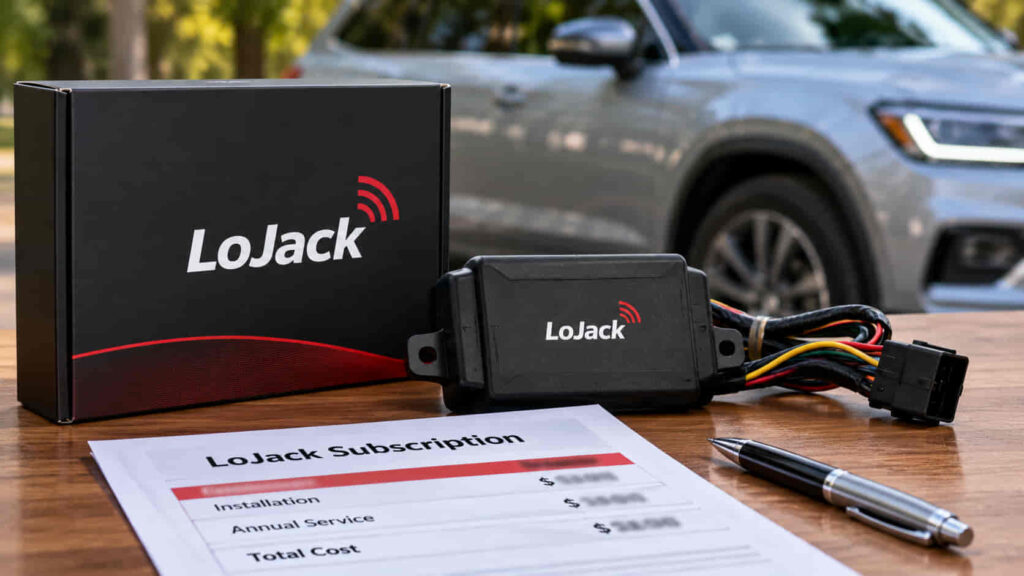
How much does LoJack cost? Published prices from LoJack Direct start at $695 for a three-year plan, $795 for five years, and $895 for seven years. These packages include the tracking device, professional installation, and prepaid service for the selected term. However, LoJack does not have a single nationwide price because dealerships and authorized resellers may offer different packages, service periods, and additional features. Understanding what each quote includes is essential before purchasing a vehicle tracking and stolen-vehicle recovery system.
LoJack subscription costs also depend on the payment structure. Some new purchases require one upfront payment with no monthly charges during the included service period. Existing customers may pay renewal fees after their original coverage expires. Published renewal options include monthly-equivalent rates ranging from $7.50 to $10.75, although these plans are billed upfront for the full renewal term rather than as ordinary monthly installments. Installation charges and dealer-added fees may further affect the final purchase price.
This guide explains LoJack installation costs, subscription fees, renewal pricing, dealership charges, and total ownership expenses. It also compares multi-year plans, examines potential insurance discounts, and explains how LoJack pricing compares with other GPS vehicle tracking systems. The goal is to help you calculate the actual cost of LoJack and determine whether its theft-recovery features justify the investment.
How Much Does LoJack Cost?
LoJack costs $695 for a three-year plan, $795 for a five-year plan, or $895 for a seven-year plan through LoJack Direct, based on its published November 2026 pricing. These prices include the vehicle tracking device, professional installation, and service coverage for the selected period. They represent specific retailer offers rather than a guaranteed nationwide LoJack price. Dealerships and other authorized resellers may charge different amounts depending on their packages, included services, and sales arrangements.
The advertised purchase price is important because LoJack combines physical tracking equipment with access to vehicle location and stolen-vehicle recovery services. Unlike a basic GPS tracker sold without a service plan, these LoJack Direct packages include a defined subscription period in the initial payment. For example, purchasing the $695 three-year plan covers the advertised equipment, installation, and three years of service without an additional monthly subscription charge during that included term. Buyers should still review the agreement to understand coverage conditions, eligibility requirements, and what happens when the prepaid period ends.
Pricing also varies between sellers offering comparable service periods. VG Motors Direct, another LoJack retailer, advertises a three-year device and service package for $895, a five-year package for $1,100, and a seven-year package for $1,250, with installation included. The difference illustrates why customers should compare offers from more than one provider before purchasing. A higher price does not automatically mean that the tracking technology is superior, because differences may reflect the seller’s pricing structure, bundled benefits, service conditions, or installation arrangements.
The total cost of LoJack also depends on how long the owner intends to maintain the service. A prepaid package covers its stated term, but continuing the connected tracking service afterward may require renewal. Additional charges may apply when the seller excludes installation, adds optional services, or collects applicable taxes. Therefore, the most useful price comparison is the complete amount required for the desired coverage period, including equipment, installation, service access, and any separately disclosed charges.
How Much Does LoJack Installation Cost?
LoJack installation can cost nothing extra when it is included in the purchase package, although a separate installation fee may apply under other sales arrangements. LoJack Direct currently advertises installation as included in its $695 three-year, $795 five-year, and $895 seven-year packages. VG Motors Direct likewise states that professional installation is included with its published vehicle tracking packages. In these examples, installation is part of the advertised purchase price rather than an additional service charge.
Professional installation matters because LoJack tracking equipment requires an appropriate setup to support vehicle location and connected security features. The technician must account for vehicle compatibility, electrical requirements, and the product’s installation specifications. The amount of labor involved can vary by vehicle design and installation arrangement. For example, a retailer offering nationwide mobile installation may incorporate technician travel and installation labor into its package price, while a dealership may use a different pricing model. An included installation service should not be interpreted as having no labor cost to the seller; it means the customer is not charged an additional installation fee under that particular offer.
When comparing dealership prices, buyers should determine whether the quote represents the complete installed system or only part of the purchase. An invoice may identify tracking equipment, installation, activation, and service coverage as separate charges, even when another seller combines those items into a single package. This difference in presentation can make two offers appear less comparable than they actually are. For example, a lower advertised device price may provide little savings if installation and activation must be purchased separately.
Before accepting an installation quote, confirm the total amount due, the included service period, vehicle compatibility, and whether additional labor charges are possible. Buyers should also ask who performs the installation and what support is available if the system develops a problem. Because published LoJack packages already include professional installation from certain sellers, there is no sound basis for treating a single standalone installation price as standard across all providers. An itemized written quote provides the clearest explanation of what the customer is paying for.
Read more: how to remove lojack
Does LoJack Have a Monthly Subscription Fee?
LoJack does not always require a monthly subscription payment because some packages include several years of prepaid service, while eligible customers can renew their subscriptions when the initial coverage expires. The billing structure depends on the product, purchase channel, and service agreement. For example, LoJack Direct advertises three-year, five-year, and seven-year packages that include the tracking device, professional installation, and service coverage for the selected term. Customers purchasing these packages make one upfront payment rather than paying an additional monthly fee throughout the included coverage period.
LoJack’s published renewal pricing uses monthly-equivalent rates to help customers compare subscription lengths. The renewal store lists a 12-month plan at $10.75 per month, a two-year plan at $8.00 per month, and a three-year plan at $7.50 per month. However, these advertised options are billed once for the full subscription term rather than through individual monthly payments. For example, the three-year renewal has an equivalent monthly cost of $7.50, but customers selecting that option pay for 36 months of service upfront. The standard calculated total is $270 before any applicable promotion or additional charge.
The distinction between a monthly-equivalent cost and a recurring monthly bill is important when evaluating affordability. A customer comparing a prepaid five-year LoJack package with another GPS tracking service that charges monthly should calculate the total expense over the same period. A lower monthly advertised rate does not necessarily mean the service allows monthly cancellation or payment. Similarly, an upfront LoJack package advertised as having no monthly fees still has a defined service duration, after which continued access may require another payment.
Subscription arrangements can also differ across service channels. Eligible customers may encounter renewal options through the LoJack application, and the applicable billing terms should be checked before purchasing. The most reliable way to determine whether LoJack requires a monthly fee for a specific vehicle is to review the actual agreement, identify the included coverage period, and confirm the renewal method. This ensures that the customer understands both the amount payable and when that payment becomes due.
How Much Does It Cost to Renew LoJack?
LoJack’s published renewal rates are $10.75 per month for a 12-month subscription, $8.00 per month for a two-year subscription, and $7.50 per month for a three-year subscription, with each plan billed upfront for its full term. Based on these advertised monthly equivalents, the calculated standard totals are approximately $129 for one year, $192 for two years, and $270 for three years. The renewal store separately displays a starting purchase price of $129.99, so customers should use the actual checkout total rather than assume that a calculation from the rounded monthly rate is the final charge.
Longer renewal periods reduce the advertised average annual cost. The two-year plan represents $96 per year, compared with $90 per year for the three-year plan and approximately $129 per year for the 12-month option. Over three years, purchasing three consecutive annual renewals at the advertised monthly-equivalent rate would cost approximately $387, compared with $270 for a single three-year renewal. This $117 difference illustrates the potential savings from a longer commitment, assuming the published standard rates remain unchanged and no promotions or other charges apply.
Renewal pricing should not be confused with the original LoJack purchase price. A new package may include the GPS tracking device, professional installation, and several years of service, while a renewal extends eligible connected services for equipment already installed in the vehicle. According to LoJack’s renewal information, continued service includes access to supported features such as vehicle location, stolen-vehicle recovery assistance, trip history, and selected vehicle alerts. However, renewing the service does not extend the original Theft Benefit Warranty, and a renewed subscription does not provide the same theft-related financial benefit that may have accompanied the initial purchase.
The renewal store also advertises limited-time promotional discounts, including a 15% renewal offer at the time of review. Promotional prices can change, so they should not be treated as guaranteed long-term rates. Before renewing, vehicle owners should confirm the applicable discount, complete payment amount, service expiration date, and features included in the renewed subscription. Choosing a longer plan can lower the effective annual cost, but the financial advantage depends on how long the owner intends to keep the vehicle and continue using LoJack’s connected services.
How Much Does LoJack Cost at a Dealership?
LoJack dealership pricing varies by dealer, vehicle, and security package, with no single nationwide retail price applying to every dealership. Dealers may sell LoJack as an individual vehicle tracking product, include it in a broader security package, or install the equipment before placing a vehicle on the sales lot. The amount charged to the customer depends on the dealership’s pricing strategy, included service period, and any additional products bundled with the system. Consequently, a dealership quote should be evaluated according to its complete terms rather than compared solely with the advertised cost of a tracking device.
Dealership pricing can differ substantially from independently advertised LoJack packages. LoJack Direct publishes a three-year package for $695, while dealer-installed products may appear on vehicle purchase agreements at different prices. A Federal Trade Commission complaint filed in December 2024 documented allegations involving LoJack add-on charges of $1,595 and $2,595 at certain dealerships. These examples illustrate how dealership charges can exceed published retail offers, but they are historical allegations involving particular sellers, not representative prices for all dealerships. Buyers should request a current, itemized quote to determine what they would actually pay.
The structure of a dealership offer also affects its value. A LoJack charge may cover tracking equipment, installation, activation, and a prepaid subscription, but the included coverage period must be confirmed. For example, a $900 package with five years of service cannot be compared fairly with a $700 package providing only three years without accounting for the difference in coverage. Buyers should also distinguish optional accessories from charges included in an advertised vehicle price. In its May 2026 guidance discussing federal pricing requirements, LoJack explained that mandatory dealer add-ons should be reflected in the advertised vehicle price, while genuinely optional products must be presented so customers have a meaningful opportunity to decline them.
Before signing a purchase agreement, confirm the LoJack package price, subscription duration, included features, and whether installation or activation will generate additional charges. If the purchase is financed, the amount added to the vehicle loan may also generate interest over the repayment period. An itemized quote makes it easier to compare dealership pricing with independently available packages and determine whether the added protection justifies the total expense.
How Much Does LoJack Cost for 3, 5, and 7 Years?
LoJack Direct advertises three-year coverage for $695, five-year coverage for $795, and seven-year coverage for $895, with equipment, professional installation, and prepaid service included. These packages offer different upfront commitments and different average annual costs. Because the initial payment covers the advertised service period, calculating the annual equivalent helps buyers compare the financial value of each option without treating the package as a recurring monthly subscription.
The three-year package costs approximately $231.67 per year when its $695 purchase price is divided by 36 months of coverage. The five-year package reduces the average annual cost to $159, based on its $795 upfront price. The seven-year package averages approximately $127.86 per year, calculated from its $895 purchase price. These figures represent the total package price spread across the advertised service term, including equipment and installation. They are not separate annual bills or standalone subscription charges.
The longer packages provide additional coverage for a relatively small increase in upfront cost. Moving from three years to five years adds $100 and extends the service period by two years. Increasing the five-year package to seven years requires another $100 for two additional years of coverage. For example, a driver who expects to keep the same vehicle for at least seven years would pay $200 more upfront for the seven-year package than for the three-year option, while receiving four additional years of included service. This comparison applies to the published packages and assumes that their stated coverage terms satisfy the owner’s needs.
However, the lowest average annual cost is not necessarily the best financial decision for every buyer. Someone planning to sell a vehicle after three years may receive limited value from purchasing seven years of coverage unless the agreement permits a useful transfer or another applicable benefit. Subscription transferability, cancellation conditions, and the treatment of unused coverage should therefore be checked before choosing a longer term. Buyers should compare the expected vehicle ownership period with the prepaid service duration and evaluate whether the additional years of theft-recovery coverage are likely to be used. The best-value LoJack package is the one that balances total upfront cost with the coverage period the owner realistically needs.
What Is the Total Cost of Owning LoJack?
The total cost of owning LoJack includes the original purchase package, any installation or activation charges not already included, applicable taxes, and subscription renewals after the prepaid coverage expires. The initial purchase price does not represent the full long-term expense when a vehicle owner plans to maintain tracking services beyond the included term. However, prepaid service must not be counted twice. For example, a LoJack package that includes three years of tracking service does not require adding three years of separate subscription charges to calculate its initial cost.
The total ownership calculation begins with the amount paid for the complete installed system. Based on LoJack Direct’s previously published package examples, a customer purchasing the $695 three-year plan receives the device, installation, and three years of service for that advertised price. If the customer keeps the vehicle for five years and wants uninterrupted coverage, an additional two-year renewal would be necessary after the original term ends. Using the published renewal equivalent of $8 per month, that renewal would cost approximately $192 for 24 months. The resulting illustrative five-year cost would be $887 before applicable taxes, additional charges, or future price changes.
Choosing a longer prepaid package can produce a different result. The published five-year package costs $795, which is $92 less than the illustrative $887 total calculated by combining the three-year package with a subsequent two-year renewal at the stated rate. Similarly, the seven-year package costs $895 upfront, while purchasing the five-year package for $795 and later adding a two-year renewal at $192 would produce an illustrative total of $987. These comparisons demonstrate the potential value of selecting sufficient prepaid coverage at the beginning. They do not guarantee future renewal prices, eligibility, transferability, or identical benefits between packages.
The vehicle’s expected ownership period is another important part of the calculation. A driver planning to keep a car for seven years may benefit from a longer prepaid service term, while someone expecting to replace the vehicle after two or three years may not use all the coverage purchased. Buyers should review whether unused service can be transferred, canceled, or refunded under the applicable agreement before making a long-term commitment. If LoJack is included in vehicle financing, loan interest attributable to the financed add-on can also increase the amount ultimately paid. The most accurate total ownership estimate therefore matches the purchase price, payment method, contract terms, and expected service duration to the individual vehicle owner’s circumstances.
Are There Any Hidden Fees With LoJack?
LoJack can involve charges beyond an advertised base price, but additional fees depend on the seller, package, and service agreement rather than applying to every purchase. Some published LoJack packages already include the device, professional installation, and prepaid tracking service, while other sales arrangements may present these components separately. A charge should not automatically be considered hidden simply because it appears as a separate line item. The important question is whether the full amount was disclosed before the customer agreed to purchase the system.
Installation and activation charges are two items buyers should verify when evaluating an offer. If the advertised package includes professional installation, the seller should clarify whether any additional labor, scheduling, or activation payment is required. Dealership packages may also bundle LoJack with other vehicle protection products, making it difficult to determine how much of the quoted price applies to tracking services alone. For example, a security package could combine LoJack with an additional protection agreement or accessory. The buyer should request an itemized explanation rather than assume that every component is necessary to activate the tracking system.
Subscription terms can create expenses that are easy to overlook when comparing upfront prices. A package may provide several years of prepaid service but require a separate renewal payment after that period ends. Renewal prices, promotional discounts, cancellation conditions, and the treatment of unused coverage should be reviewed in the actual agreement. A lower initial package price may become more expensive over a longer ownership period if its included service term is shorter. Conversely, an owner who sells the car before a prepaid plan expires may not recover the value of unused coverage unless the contract provides an applicable transfer or refund option.
Taxes, financing charges, and optional dealership products can further affect the final amount paid. When LoJack is financed as part of a vehicle purchase, interest can increase its effective cost over the loan term. Buyers should also verify whether any separately advertised benefits, such as theft-related protection programs, are included in the selected package and whether those benefits continue after renewal. Before purchasing, obtain the complete written price and review the duration of service, payment schedule, renewal terms, and any separately disclosed charges. This provides a reliable basis for comparing offers without assuming that every LoJack package has the same additional fees.
Can You Negotiate LoJack Pricing at a Car Dealership?
Yes, you can negotiate LoJack pricing at a car dealership by asking the dealer to reduce the add-on charge, explain the package’s value, or provide a vehicle purchase offer without the optional product. However, the outcome depends on the dealership’s pricing policy, the vehicle purchase agreement, and whether the LoJack package is genuinely optional. Dealerships may set their own retail prices for vehicle security products, which means the quoted amount can differ from prices advertised by independent LoJack retailers. Buyers should evaluate the total vehicle purchase price rather than assume that every dealership-installed tracking system has a fixed, nonnegotiable cost.
A successful negotiation begins with understanding exactly what the dealership is selling. A LoJack add-on may include the GPS tracking device, installation, activation, a prepaid service term, or additional protection benefits. These elements should be identified separately when the sales documentation does not clearly explain the package. For example, a dealership offering LoJack for $1,200 with three years of service is presenting a different value proposition from a retailer advertising an installed three-year package for $695. The $505 difference provides a concrete basis for discussing price, although differences in coverage or additional benefits must be considered before treating the products as equivalent.
The timing of the negotiation also matters. Buyers should review LoJack charges before signing the vehicle purchase agreement or financing documents. If the dealership presents the product as mandatory, ask whether the charge is included in the advertised vehicle price and request a written explanation of the applicable terms. A device already installed on the vehicle does not, by itself, establish that the customer must purchase an associated optional service. However, the buyer’s ability to decline or remove a charge depends on the actual offer, contract, and applicable consumer protection requirements. The dealership may choose to reduce the price, adjust the overall transaction, or offer a different vehicle configuration.
Financing can increase the financial impact of a dealer add-on. When the cost of LoJack is included in an auto loan, the buyer may pay interest on that amount throughout the repayment period. For example, negotiating a $500 reduction in the financed purchase price can save more than $500 over the loan term because it also reduces the principal on which interest is calculated. The precise savings depend on the interest rate and repayment schedule. Comparing itemized offers and reviewing the total amount payable provides a stronger basis for negotiation than focusing only on the monthly car payment.
Does LoJack Lower Your Car Insurance Premium?
LoJack may lower your car insurance premium if your insurer offers a discount for an eligible stolen-vehicle recovery system, but the discount is not guaranteed. Insurance companies determine eligibility based on their underwriting rules, state regulations, vehicle characteristics, and the coverage selected by the policyholder. Installing a GPS tracking system does not automatically reduce the entire insurance bill because different policy components cover different risks. Any potential savings should be confirmed directly with the insurance provider before being included in the calculation of LoJack’s long-term cost.
The connection between LoJack and insurance pricing involves the vehicle theft risk associated with comprehensive coverage. Comprehensive insurance generally covers qualifying theft losses, subject to the policy’s terms and deductible. A recognized stolen-vehicle recovery system may help locate a vehicle after a theft, which can be relevant to how an insurer evaluates theft-related losses. However, a tracking device does not prevent every theft, guarantee recovery, or eliminate repair costs after a vehicle has been recovered. Insurers therefore apply their own criteria when deciding whether a particular tracking product qualifies for a premium reduction.
The financial value of an insurance discount depends on the portion of the premium to which it applies. For example, suppose a driver pays $400 annually for comprehensive coverage and receives a confirmed 5% discount on that component. The resulting savings would be $20 per year, or $100 over five years if the premium and discount remain unchanged. This is an illustrative calculation, not a universal LoJack discount rate. If the discount applies only to comprehensive coverage, it should not be calculated against the total insurance premium, which may also include liability, collision, and other coverage.
Before purchasing LoJack for insurance savings, ask the insurer whether the specific product qualifies, what documentation is required, and whether the discount remains available throughout the service period. Some insurers may require proof that the tracking service is active rather than merely confirming that hardware is installed. The owner should also verify whether a discount continues after the original subscription expires. Comparing confirmed annual insurance savings with the purchase and renewal costs provides a more accurate assessment of LoJack’s financial value. Insurance savings can help offset the cost, but they should be treated as a verified benefit rather than an assumed return on the investment.
Is LoJack Worth the Cost?
LoJack is worth the cost for vehicle owners who value professional stolen-vehicle recovery services, want ongoing access to vehicle location information, and expect to use the system throughout its prepaid service period. Its value depends on the vehicle’s replacement cost, local theft risk, existing security features, and the total amount paid for equipment, installation, and subscription coverage. LoJack is not automatically a worthwhile purchase for every driver because the financial and practical benefits vary according to individual ownership circumstances.
The primary benefit of LoJack is its ability to support vehicle location and recovery after a theft. Modern GPS-based LoJack services use location technology and connected communications to provide supported tracking and recovery features. This differs from a conventional car alarm or electronic immobilizer, which primarily helps deter unauthorized access or operation. For example, an immobilizer may prevent a vehicle from starting without an authorized key, while an active stolen-vehicle recovery service can provide additional assistance if the car is taken. Neither system guarantees that theft will be prevented or that a stolen vehicle will be recovered, but they address different aspects of vehicle security.
The value calculation should also consider the period during which the owner expects to keep the vehicle. A prepaid seven-year package may provide a lower average annual cost than a shorter package, but that advantage matters only when the customer can use the additional service years or benefit from applicable transfer provisions. Someone planning to replace a vehicle after three years may find a shorter service commitment more practical. Insurance savings can also influence the decision, although any discount must be confirmed with the insurer and calculated against the relevant coverage rather than the entire policy premium.
Existing vehicle technology is another factor. Many newer cars already include factory immobilizers, alarms, and manufacturer-supported connected services. If those systems provide the security and location features the owner needs, purchasing LoJack may create overlapping expenses. By contrast, an owner whose vehicle lacks connected recovery services may place greater value on an independently installed system. The strongest purchase decision comes from comparing LoJack’s actual contractual benefits with the vehicle’s existing protection, expected ownership period, and complete service cost.
How Does LoJack Compare With Other GPS Trackers?
LoJack differs from other GPS vehicle trackers primarily in its service model, professional installation options, and supported stolen-vehicle recovery features, rather than GPS technology alone. Competing trackers may offer lower initial hardware prices, different subscription structures, or simpler installation requirements. However, the cheapest device is not necessarily the least expensive option over several years. A meaningful comparison must account for equipment, installation, cellular service, subscription renewals, and the features included in each provider’s plan.
Consumer GPS trackers commonly use satellite positioning to determine location and cellular connectivity to transmit that information to an application or online account. Depending on the product, these devices may offer location updates, movement alerts, geofencing, and trip history. LoJack’s modern GPS-based offerings also provide connected vehicle services, with certain packages emphasizing stolen-vehicle recovery support. The distinction is important because receiving a vehicle’s location through an application is not equivalent to receiving a provider’s recovery assistance. Buyers should verify which recovery services are actually included rather than assume that every GPS tracker offers the same level of support.
Installation requirements create another difference in overall cost and ownership experience. Some consumer tracking devices are designed for straightforward setup, while professionally installed systems require an installation appointment and may involve additional service considerations. A device with a relatively inexpensive purchase price can accumulate substantial subscription expenses when used over an extended period. For example, a hypothetical GPS tracker costing $100 upfront with a $15 monthly subscription would cost $640 over three years before taxes or additional charges. That calculation illustrates why comparing hardware prices alone can be misleading; it is not a quote for a particular competing product.
Manufacturer-connected vehicle services provide a third comparison category. Some vehicles offer factory telematics platforms with location features, security notifications, or stolen-vehicle assistance, depending on the manufacturer, model, and subscription. These services may reduce the need for separate aftermarket hardware, although their prices, availability, and included benefits differ. Before choosing between LoJack and another GPS tracking solution, compare equivalent service periods, installation requirements, coverage limitations, account privacy controls, and recovery features. The better-value system is the one that provides the required protection at the lowest appropriate total ownership cost, not necessarily the product with the lowest advertised monthly rate.
What Happens When Your LoJack Subscription Expires?
When your LoJack subscription expires, access to supported GPS tracking, connected vehicle features, and stolen-vehicle recovery services may end unless you renew the applicable service plan. The physical tracking device generally remains installed in the vehicle, but retaining the hardware does not guarantee that its connected services will continue operating. The exact consequences depend on the LoJack product, service provider, and subscription agreement. Vehicle owners should therefore distinguish between owning installed tracking equipment and maintaining an active account that provides access to location information and recovery assistance.
Modern GPS-based LoJack services depend on more than the tracking device itself. GPS technology determines the vehicle’s location, while cellular connectivity and the provider’s service platform make supported information available through connected applications and recovery services. When an eligible subscription expires, the provider may suspend access to some or all of these functions according to the applicable terms. For example, a driver whose prepaid three-year coverage ends should not assume that location updates, vehicle alerts, or recovery assistance will remain available simply because the original equipment is still installed.
Subscription expiration also affects the financial decision to continue using LoJack. An owner who wants uninterrupted service should review the renewal options before the existing term ends and confirm the amount required for the next coverage period. Published renewal offers may provide different effective monthly rates for one-, two-, or three-year commitments, with payment collected upfront for the selected term. These renewal charges are separate from the original purchase package, which already included service for its advertised duration. Customers should also verify whether any theft-related protection benefits from the initial purchase continue after renewal, because renewing connected services does not necessarily extend an original protection warranty.
If the owner decides not to renew, the next step is to confirm the account’s status and understand which services will no longer be available. The provider can explain applicable cancellation terms, renewal eligibility, and whether the account requires additional action. Subscription expiration does not automatically mean that the tracking hardware has been physically removed from the vehicle. Owners who also want the equipment removed should request a separate assessment from an appropriate service provider or qualified automotive electronics technician. Understanding these distinctions prevents unexpected service interruptions, unnecessary renewal expenses, and confusion about the vehicle’s remaining security features.