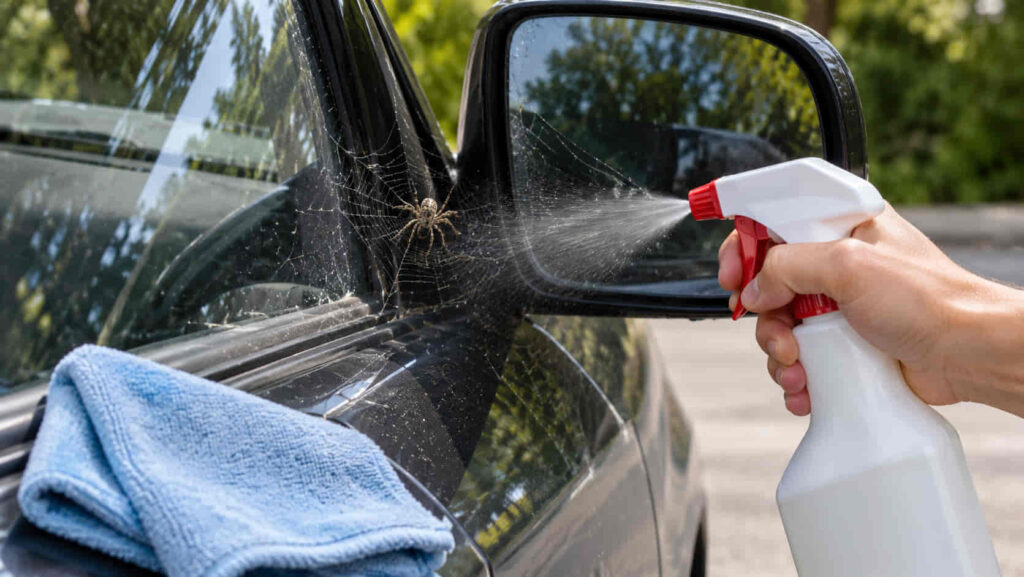
Getting rid of spiders in a car involves removing visible spiders, vacuuming webs and egg sacs, cleaning hidden spaces, and preventing spiders from entering the vehicle again. The safest approach is to park the car, inspect common hiding spots, and remove spiders using a vacuum cleaner or a container without touching them directly. Regular interior cleaning and inspection of door seals, windows, and exterior components help reduce recurring spider activity.
Spiders enter cars through open doors, windows, and other accessible gaps while searching for shelter or insects. They can hide beneath seats, around dashboard edges, inside door panels, and behind side mirrors, where narrow spaces provide protection from disturbance. Simply removing a visible spider may not resolve the problem if additional spiders, webs, or egg sacs remain in hard-to-reach areas.
Effective spider removal requires methods that protect both passengers and vehicle components. Household insecticides, for example, should not be sprayed into air vents or onto interior surfaces unless the product is specifically approved for that application. This guide explains how to get rid of spiders in a car, clean common hiding places, remove webs and egg sacs, and prevent spiders from returning through practical vehicle maintenance.
How Do You Get Rid of Spiders in a Car?
To get rid of spiders in a car, remove visible spiders, vacuum the interior thoroughly, eliminate spider webs and egg sacs, and clean areas where spiders can hide. Physical removal and thorough cleaning are the safest starting methods because they reduce spider activity without introducing unnecessary pesticides into the enclosed passenger cabin. Park the vehicle in a safe, well-lit location, turn off the engine, and open the doors before beginning the cleaning process.
Start by locating visible spiders around the seats, dashboard, floor mats, door panels, and window edges. A spider resting on an accessible surface can be captured using a transparent container and a stiff piece of paper. Place the container over the spider, slide the paper underneath, and release it outside away from the vehicle. Avoid handling spiders directly, particularly when the species cannot be identified. If the spider disappears into a narrow opening, inspect the surrounding area instead of reaching into the gap with your fingers.
Next, use a vacuum cleaner with a narrow crevice attachment to remove spiders, loose webs, and debris from accessible hiding places. Focus on the spaces beneath the front seats, along seat tracks, between seat cushions, around carpet edges, and inside storage compartments. Move the seats forward and backward to expose additional areas, keeping the vacuum nozzle clear of wiring and moving components. Vacuuming removes visible material and disturbs sheltered spaces where spiders may remain undetected.
Remove spider webs from interior corners, window seals, and door frames using a soft detailing brush or microfiber cloth. Inspect these locations for spider egg sacs, which may appear as small silk-covered bundles attached to protected surfaces. Carefully collect accessible egg sacs without crushing them or scattering their contents. Dispose of collected material in a sealed bag outside the vehicle. Empty the vacuum canister or remove its bag promptly after cleaning to prevent captured spiders from remaining in the equipment.
Finish by wiping accessible interior surfaces with a cleaner approved for the vehicle’s materials and removing unnecessary clutter from storage areas. Avoid spraying household insecticides into dashboard openings, electrical components, or ventilation ducts. Inspect the cleaned areas for fresh webs or renewed spider activity over the following days. Removing spiders and their hiding places together addresses the immediate problem more effectively than removing a single visible spider alone.
Read more: Audi 2.0 TFSI Problems
What Should You Do if You See a Spider While Driving?
If you see a spider while driving, stay calm, maintain control of the vehicle, and pull over at a safe location before attempting to remove it. Avoid swatting the spider, reaching across the dashboard, or making sudden steering movements. An unexpected spider can distract a driver from surrounding traffic, creating a greater immediate safety risk than the spider itself.
Keep your eyes on the road and both hands available for steering while looking for a suitable place to stop. Do not brake abruptly or stop in an active traffic lane because a spider has appeared near the windshield, steering wheel, or sun visor. Once the vehicle is safely parked, switch off the engine and assess the spider’s location. Opening a door may allow the spider to leave without further intervention.
If the spider remains visible, use a container and a piece of stiff paper to capture it without direct contact. However, avoid attempting to catch a spider that has moved behind the dashboard, steering column, or other inaccessible components. Searching inside these areas without proper access can damage vehicle parts or interfere with controls. A thorough inspection should take place only while the vehicle is stationary.
Drivers who are frightened by spiders should avoid resuming their journey until they feel able to concentrate on driving. The Royal Automobile Club of Victoria (RACV) identifies driver distraction as a significant concern when spiders unexpectedly appear inside vehicles. Maintaining control of the car and stopping safely should always take priority over immediate spider removal.
Where Do Spiders Hide in a Car?
Spiders hide in cars primarily in dark, narrow, and relatively undisturbed spaces, including beneath seats, behind dashboard edges, around sun visors, inside door frames, and behind exterior side mirrors. These locations provide shelter from movement, direct light, and environmental exposure. Identifying these hiding places helps car owners locate spiders that remain concealed after visible webs have been removed.
Inside the passenger cabin, spiders can shelter beneath seat cushions, along carpet edges, around seat mounting points, and inside storage compartments. Dashboard gaps and the spaces around interior trim also provide narrow openings where spiders can remain difficult to detect. Sun visors and headliner edges are particularly relevant because they remain undisturbed until adjusted or touched. A spider hiding beneath a sun visor may suddenly emerge when the driver lowers it, creating an unexpected distraction.
Air vents and ventilation openings are additional areas worth inspecting when spider activity is suspected. Spiders may occupy accessible spaces around vent grilles or nearby dashboard openings, although finding a spider near an air vent does not necessarily mean it has entered the entire HVAC system. Similarly, spiders may appear around door seals, window channels, and the edges of interior panels. These locations should be inspected visually before attempting any cleaning that requires component removal.
On the vehicle’s exterior, spiders commonly shelter behind side mirror housings, around wheel arches, beneath bodywork edges, and near the front grille. Side mirrors provide protected spaces where certain web-building spiders can establish webs that become visible across the mirror glass or surrounding trim. Spiders may also occupy sheltered areas beneath the hood, particularly when a vehicle remains parked for extended periods. Inspect the engine compartment only when the engine is switched off and its components have cooled sufficiently.
The presence of spider webs, silk-covered egg sacs, or repeated spider sightings helps identify areas that require closer inspection. However, an old web does not confirm that a spider is still present, and a single spider does not establish an infestation. Checking both interior and exterior hiding places provides a more complete assessment than inspecting the passenger cabin alone. This approach also helps car owners distinguish between spiders temporarily entering the vehicle and recurring activity around specific components.
How Do You Remove Spiders From Car Side Mirrors?
To remove spiders from car side mirrors, clean the webs around the mirror housing, inspect the gaps behind the mirror glass, and remove any visible spiders using a soft brush or a suitable vacuum attachment. The most effective approach is to clean both the exposed mirror surfaces and accessible sheltered areas where spiders establish their webs. Removing only the webs from the mirror glass does not necessarily eliminate a spider hiding inside the housing.
Spiders commonly shelter behind car side mirrors because the housing provides a protected space away from direct wind and rain. The narrow gaps between the mirror glass and its surrounding frame allow spiders to remain concealed while building webs across nearby surfaces. These webs may reappear shortly after cleaning if the spider continues occupying the same location. Repeated web formation around one mirror is therefore a reason to inspect the housing rather than repeatedly wiping the glass alone.
Begin by parking the vehicle and inspecting the outer edges of the side mirror for visible spiders, webs, or egg sacs. Use a soft detailing brush to loosen webbing and a microfiber cloth to remove loose debris from the mirror frame. A low-pressure stream of water may help rinse accessible exterior gaps when permitted by the vehicle manufacturer’s cleaning instructions. Avoid directing high-pressure water into the mirror housing because powered adjustment mechanisms, heating elements, cameras, and electrical connections may be located inside. Do not force the mirror glass away from its mounting assembly to reach hidden areas.
After cleaning, inspect the mirror for remaining webs and confirm that its adjustment mechanism operates normally. Remove leaves, dirt, and accumulated debris from nearby exterior surfaces that provide shelter for insects and spiders. If webs repeatedly return from an inaccessible space behind the glass, a qualified automotive technician can inspect the mirror assembly without damaging its mounting clips or electrical components. Cleaning accessible hiding places while preserving the mirror’s mechanical and electrical systems is the priority when removing spiders from car side mirrors.
How Do You Get Spiders Out of Car Air Vents?
To get spiders out of car air vents, inspect the vent openings, remove visible webs with a soft detailing brush, and use a vacuum cleaner to collect accessible debris or spiders. Cleaning the vent opening without pushing objects or liquids into the ventilation system is the safest initial approach. Spiders found around dashboard vents may be hiding near the grille rather than deep inside the heating, ventilation, and air conditioning (HVAC) system.
Car air vents contain narrow openings and adjustable louvers that create sheltered spaces near the dashboard. Spiders may occupy these accessible areas or move through nearby gaps in the interior trim. However, spotting a spider at the vent does not confirm that it has established a hiding place inside the ventilation ducts. The first inspection should focus on the visible grille, surrounding dashboard seams, and adjacent surfaces where webs or spider activity can be identified without disassembling the vehicle.
Park the vehicle, switch off the ventilation system, and inspect the vent opening with a flashlight. Use a soft brush to loosen visible webbing from the vent louvers, then hold a vacuum attachment near the opening to collect the loosened material. Avoid forcing the nozzle or rigid tools between the louvers because these components can break or become disconnected from their adjustment mechanisms. Wipe the surrounding dashboard with a lightly dampened microfiber cloth and a cleaner suitable for the interior material.
Do not spray insecticides, essential oils, water, or household cleaning solutions directly into the ventilation ducts. Liquids and chemical residues can reach internal HVAC components, while substances introduced into the airflow may circulate through the passenger cabin. Running the fan at maximum speed is not a reliable method of removing a spider and may cause loose debris to enter the cabin. If spider activity persists inside an inaccessible duct, the ventilation system should be inspected by a qualified automotive technician.
The cabin air filter may also be checked during scheduled vehicle maintenance, particularly when airflow is restricted or debris has accumulated around the ventilation intake. However, replacing the filter alone does not establish that a spider has been removed from the system. Regular cleaning of accessible vents, inspection of surrounding dashboard gaps, and maintenance of the vehicle’s ventilation components help reduce sheltered areas without compromising HVAC operation.
How Do You Prevent Spiders From Getting Into Your Car?
To prevent spiders from getting into your car, keep the interior clean, close potential entry points, choose parking locations carefully, and inspect common hiding places regularly. These preventive measures reduce the shelter and access points that allow spiders to enter or remain inside a vehicle. Maintaining a clean car is particularly important because spiders can occupy narrow, undisturbed spaces and hunt insects that enter the passenger cabin.
Regular interior cleaning helps eliminate conditions that support spider activity. Vacuum carpets, seat gaps, floor mats, and storage compartments to remove accumulated dust, loose debris, and insect remains. Remove food wrappers, discarded packaging, and unnecessary items from the cabin because clutter creates additional sheltered spaces and food residues can attract insects that spiders prey on. Pay particular attention to areas that are rarely disturbed, including spaces beneath rear seats, around the trunk lining, and inside door pockets. Keeping these locations clean makes spider activity easier to identify before webs accumulate.
Inspecting door and window seals is another important part of preventing spiders from entering a car. Spiders can move through accessible gaps around poorly sealed doors, partially open windows, and damaged weatherstripping. Check the rubber seals surrounding each door, window, and sunroof for cracks, deformation, or missing sections. Replace damaged weatherstripping when necessary and ensure that all windows are fully closed before leaving the vehicle parked. Maintaining these seals also supports the vehicle’s protection against water intrusion, dust, and outside noise. Avoid blocking factory-designed drainage openings or ventilation passages when addressing potential entry points.
Parking location also influences the likelihood of spiders reaching a vehicle. Cars parked beneath trees, beside dense vegetation, or near piles of leaves and debris are exposed to environments where spiders and their insect prey may be present. Choosing a clean parking area away from overhanging branches and accumulated vegetation reduces direct contact with these surroundings. When parking in a garage, remove unnecessary storage materials and clear existing webs from nearby walls and corners. A garage provides shelter from outdoor conditions but does not automatically prevent spiders from approaching the vehicle.
Inspect the vehicle during routine cleaning, focusing on side mirrors, door frames, wheel arches, dashboard edges, and other sheltered areas. Cars that remain stationary for extended periods deserve additional attention because spiders have more opportunities to establish webs around undisturbed exterior components. Fresh webs appearing repeatedly in the same location indicate that the area requires closer inspection. Consistent cleaning, properly maintained seals, and suitable parking conditions provide a more reliable long-term prevention strategy than relying on spider repellents alone.
Can You Use Spider Repellents Inside a Car?
Spider repellents can be used inside a car only when the product’s label specifically permits application in vehicle interiors and its instructions can be followed safely. Physical removal and routine cleaning should remain the primary control methods because an enclosed passenger cabin presents additional considerations for chemical exposure, ventilation, and interior material compatibility. A product labeled for household pest control is not automatically suitable for automotive upholstery, dashboards, carpets, or ventilation components.
Commercial spider sprays contain active ingredients intended to repel or control pests, but their suitability depends on the formulation and approved application surfaces. Before using a pesticide, check whether the label permits treatment inside passenger vehicles and follow all restrictions regarding application locations, occupants, drying time, and ventilation. Avoid applying chemicals to steering wheels, pedals, seat belts, electronic controls, or other frequently touched surfaces unless the instructions explicitly permit that use. Spraying pesticides into air vents or electrical openings can also introduce residues into inaccessible areas and expose occupants when the ventilation system operates.
Peppermint oil is frequently recommended as a natural spider repellent, although scientific evidence does not establish that it reliably prevents spiders from entering cars. A study published in the Journal of Economic Entomology in 2018 tested peppermint oil, lemon oil, and chestnut-derived odors against three spider species. Peppermint oil showed significant repellent effects against Latrodectus geometricus and Araneus diadematus, while Steatoda grossa was less responsive. These results demonstrate that repellent effectiveness varies by spider species rather than proving that peppermint oil protects an entire vehicle. The study also found no repellent effect from lemon oil against the three tested species.
Essential oils should not be sprayed directly onto automotive leather, plastics, touchscreens, or ventilation openings without confirming material compatibility and occupant safety. Concentrated oils can leave residues, and strong fragrances may cause discomfort in confined spaces. Natural ingredients are not automatically harmless, particularly when passengers or pets may be exposed. Even when an oil has demonstrated repellent activity under laboratory conditions, its concentration, persistence, and effectiveness inside a parked vehicle remain uncertain.
Household bug bombs, also called total-release foggers, should not be used inside a car. The U.S. Environmental Protection Agency warns that foggers can create fire and explosion hazards in small enclosed spaces, while the National Pesticide Information Center specifically advises against their use in most vehicles. Foggers also cannot guarantee that pesticide reaches spiders hidden behind interior panels or inside narrow structural gaps. For recurring spider activity that cannot be resolved through cleaning and physical removal, consult a pest control professional familiar with vehicle interiors rather than attempting an unapproved chemical treatment.
Why Do Spiders Keep Coming Back to Your Car?
Spiders keep coming back to a car because accessible entry points, sheltered hiding places, and nearby insect populations continue to provide suitable conditions for them. Removing a spider or its web addresses the immediate problem but does not prevent another spider from entering the same location. Recurring spider activity is especially noticeable around side mirrors, door frames, and other protected exterior surfaces where webs can be rebuilt after cleaning.
Spiders can enter a parked vehicle through open windows, briefly opened doors, damaged weatherstripping, and other accessible gaps. They may also crawl onto exterior components from nearby vegetation or surrounding surfaces. Once inside, narrow spaces behind trim panels, beneath seats, and around storage compartments provide shelter from disturbance. A car that remains parked for extended periods offers additional opportunities for spiders to occupy protected areas, although prolonged parking does not necessarily indicate an infestation.
The availability of insect prey also influences recurring spider activity. Spiders feed on insects rather than food crumbs or vehicle materials, but food residues and accumulated debris may attract insects that become their prey. Web-building spiders can remain near locations where flying or crawling insects are regularly encountered. For example, a spider that repeatedly constructs a web behind a side mirror may continue using that sheltered location as long as suitable conditions remain.
Repeated sightings should be evaluated by location and frequency rather than treated as proof of a large spider population. Fresh webs appearing around the same mirror suggest recurring activity in that area, while spiders appearing in different interior locations may indicate multiple entry opportunities. Inspecting where activity occurs helps determine whether the problem involves an overlooked spider, newly arriving spiders, or an inaccessible hiding place. Reducing recurring spider activity requires addressing the conditions that allow spiders to return, not simply removing each new web.
Are Spiders in Cars Dangerous?
Most spiders found in cars are not dangerous to humans, but certain venomous species and unexpected encounters while driving can create genuine safety risks. Spiders generally avoid human contact and are more likely to bite when trapped, pressed against the skin, or handled. The level of risk depends on the spider species, the circumstances of the encounter, and the driver’s reaction.
Spider bites inside vehicles can occur when a person accidentally presses against a spider hiding beneath a seat, inside clothing, or near an armrest. Most bites cause localized discomfort, such as pain, redness, itching, or swelling. However, medically significant spiders, including black widows and brown recluses in parts of the United States, can cause more serious reactions. Black widow bites may produce intense muscle pain and cramping, while brown recluse bites can occasionally cause substantial tissue injury. The presence and distribution of these species vary by geographic region, so not every unidentified spider should be assumed to be medically dangerous.
Unexpected spider encounters can also threaten driving safety even when the spider itself is harmless. A spider crawling across the windshield, descending from a sun visor, or appearing near the steering wheel may cause a startled driver to look away from traffic or make an abrupt movement. Maintaining vehicle control and stopping safely are more important than attempting immediate removal. Drivers should never reach beneath seats, remove interior panels, or search for spiders while the vehicle is moving.
If a suspected spider bite occurs, wash the affected area with soap and water and apply a cold compress to reduce discomfort. Seek medical assessment for worsening pain, significant swelling, blistering, or other concerning symptoms, particularly when a medically significant species may be involved. Difficulty breathing, severe muscle cramping, fainting, or signs of a serious allergic reaction require emergency medical attention. Avoid handling an unfamiliar spider for identification; a photograph taken from a safe distance may help a qualified professional assess the species.
Although most spider encounters in cars can be resolved without injury, preventing direct contact and avoiding driving distractions remain essential. The safest response combines careful spider removal, awareness of potentially dangerous species, and responsible vehicle operation.
When Should You Call a Professional to Remove Spiders From Your Car?
You should call a professional to remove spiders from your car when spider activity persists after thorough cleaning, potentially dangerous spiders are present, or removal requires access to enclosed vehicle components. Professional assistance is particularly appropriate when repeated sightings, fresh webs, or egg sacs indicate that spiders remain in areas the owner cannot safely reach. A single spider sighting generally does not require professional pest control if the spider can be removed safely.
A qualified pest control professional can assess recurring spider activity, identify suspected species, and recommend appropriate control methods. This is especially important when potentially dangerous spiders are suspected or spiders continue appearing despite repeated physical removal. Any proposed pesticide treatment must be specifically authorized for use in the relevant vehicle areas, with precautions for passenger exposure and interior materials. Professional treatment should address the source of recurring activity rather than depend on indiscriminate insecticide application.
An automotive detailer or mechanic may be more suitable when spiders occupy inaccessible spaces behind dashboard panels, inside ventilation ducts, or within side mirror assemblies. Professional detailers can clean accessible interior areas, while automotive technicians can inspect components that require specialized tools or disassembly. Attempting to remove these parts without proper knowledge risks damaging electrical connections, ventilation controls, mounting clips, or other vehicle components.
Before booking a service, explain where spiders have appeared, how frequently webs return, and which cleaning methods have already been attempted. These details help the professional determine whether the problem requires pest management, interior detailing, or mechanical inspection. Professional spider removal is most valuable when it resolves persistent activity while protecting the vehicle and its occupants from unnecessary risks.