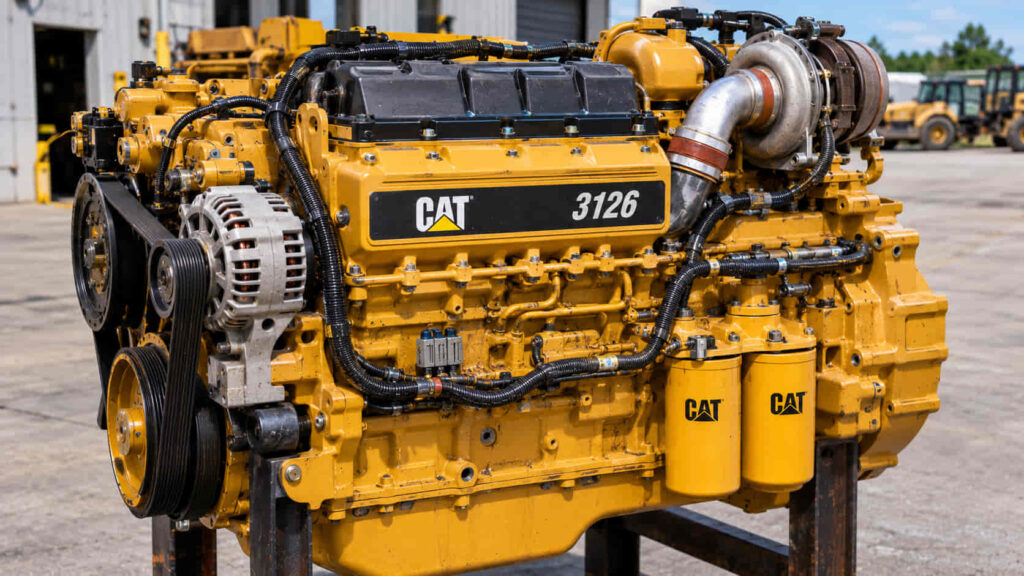
The Caterpillar 3126 is a 7.2-liter, inline-six, four-stroke diesel engine designed for medium-duty trucks, buses, motorhomes, industrial equipment, and marine applications. Its core specifications include a 110 mm (4.33-inch) bore and a 127 mm (5.0-inch) stroke. However, horsepower, torque, physical dimensions, and service capacities vary according to the engine version, application, and factory configuration.
The Caterpillar 3126 engine family includes the original 3126, 3126B, and 3126E, which have different engine controls and performance ratings. According to Caterpillar’s technical specifications, the 3126B truck engine produces 175–330 horsepower and 420–860 lb-ft of peak torque, depending on its rating. A typical 3126B truck configuration weighs approximately 1,295 pounds (588 kg) dry, while a documented 3126 marine configuration weighs approximately 1,592 pounds (722 kg). These differences make correct engine identification essential when comparing specifications.
This guide covers Caterpillar 3126 engine specifications, including horsepower, torque, displacement, compression ratio, firing order, dimensions, weight, fuel injection, oil capacity, coolant capacity, and fuel consumption. It also explains the differences between the 3126, 3126B, and 3126E and how to identify the correct engine configuration before selecting parts, planning an installation, or performing maintenance.
What Are the Key Caterpillar 3126 Engine Specifications?
The Caterpillar 3126 is a 7.2-liter, inline-six diesel engine with a 110 mm (4.33-inch) bore, 127 mm (5.0-inch) stroke, and four-stroke operating cycle. Its six cylinders are arranged in a single row, with each cylinder completing intake, compression, combustion, and exhaust strokes during two crankshaft revolutions. The engine family was developed for applications requiring diesel power in commercial vehicles, industrial equipment, and marine installations.
The Caterpillar 3126B truck engine is rated at 175–330 horsepower, with peak torque ranging from 420 to 860 lb-ft (569–1,166 Nm), depending on the factory rating. This configuration uses turbocharging, air-to-air aftercooling, and a Hydraulically Actuated Electronically Controlled Unit Injector (HEUI) fuel system. The Electronic Control Module (ECM) manages fuel injection and engine operation. Caterpillar specifies a 16:1 compression ratio for the 175–300 hp truck ratings.
Physical specifications and service capacities depend on the engine arrangement. The referenced 3126B truck engine weighs approximately 1,295 pounds (588 kg) dry, including the flywheel. Its standard oil refill capacity is 18 liters (4.75 US gallons), while its engine-only cooling system holds approximately 13.2 liters (3.5 US gallons). Other sump arrangements and marine configurations have different capacities and installation dimensions, so the engine serial and arrangement numbers must be verified before using these figures for maintenance or replacement.
Read more: Audi 2.0 TFSI Problems
How Much Horsepower Does a Caterpillar 3126 Engine Produce?
The Caterpillar 3126 engine produces different horsepower outputs depending on its version and application, with documented 3126B truck ratings ranging from 175 to 330 hp (131–246 kW). The engine’s 7.2-liter displacement remains consistent, but its factory calibration, fuel delivery and operating speed determine the available power. Consequently, a Caterpillar 3126 installed in a commercial truck may have a substantially different horsepower rating from one used in a motorhome or marine vessel.
The Caterpillar 3126B truck engine was available in multiple power configurations, including 175, 190, 210, 230, 250, 275 and 300 hp. Caterpillar also documented a 330 hp rating at 2,400 rpm, specifically for recreational vehicles and fire trucks. These ratings reflect different performance requirements rather than changes in engine displacement. For example, a 175 hp configuration is intended to deliver lower maximum output than a 300 hp version, while both belong to the same engine family.
The Caterpillar 3126E has documented advertised horsepower ratings from 190 to 330 hp in Caterpillar’s on-highway performance handbook. Its 330 hp configuration is also identified as a fire truck and recreational vehicle rating. Advertised horsepower must be distinguished from maximum horsepower because certain calibrations produce higher peak output than their advertised rating. For example, Caterpillar lists 190 advertised hp and 207 maximum hp for one 3126E configuration.
Marine versions of the original Caterpillar 3126 have higher documented ratings of 350 and 420 bhp at 2,800 rpm. These engines use application-specific configurations designed for marine propulsion and should not be compared directly with on-highway ratings without considering operating conditions and duty cycles. The correct horsepower specification must therefore be confirmed using the engine model, serial number and factory rating information.
How Much Torque Does the Caterpillar 3126 Engine Produce?
The Caterpillar 3126B truck engine produces between 420 and 860 lb-ft (569–1,166 Nm) of peak torque, depending on its factory horsepower rating. Caterpillar specifies peak torque at 1,440 rpm for the documented 3126B truck configurations. Torque represents the rotational force generated by the crankshaft and determines how effectively the engine can move heavy loads, maintain road speed on inclines, and accelerate under demanding operating conditions.
The 175 hp Caterpillar 3126B produces 420 lb-ft (569 Nm), while the 190 hp version develops 520 lb-ft (705 Nm). The 210 hp engine is available with either 520 lb-ft or 605 lb-ft (820 Nm), depending on whether it uses the standard or high-torque calibration. At higher ratings, the 230 hp configuration delivers 660 lb-ft (895 Nm), while the 250 hp version offers 660 or 800 lb-ft (1,085 Nm). The 275 hp and 300 hp configurations are available with 800 or 860 lb-ft of peak torque. Caterpillar also specifies 860 lb-ft for the 330 hp recreational vehicle and fire truck rating.
Peak torque and maximum horsepower occur at different engine speeds because they describe different performance characteristics. Torque measures rotational force, whereas horsepower reflects how quickly that force performs work. The 3126B develops its published peak torque at 1,440 rpm, allowing substantial pulling force below its governed engine speed. Higher-torque calibrations provide additional pulling capability without necessarily increasing advertised horsepower.
The correct torque specification must be matched to the engine’s factory rating and application. Two Caterpillar 3126B engines with identical displacement and advertised horsepower can have different peak torque outputs. Engine serial and arrangement numbers should therefore be checked before selecting drivetrain components or relying on a published torque figure.
What Are the Caterpillar 3126 Engine Displacement, Bore and Stroke?
The Caterpillar 3126 engine has a displacement of approximately 7.2 liters (442 cubic inches), a cylinder bore of 110 mm (4.33 inches), and a piston stroke of 127 mm (5.0 inches). These dimensions apply to the core six-cylinder engine architecture used across the 3126 family, including the 3126B and 3126E. The engine features an inline-six configuration, with all six cylinders arranged in a single row along the crankshaft.
Engine displacement is determined by cylinder bore, piston stroke, and the total number of cylinders. Bore refers to the internal diameter of each cylinder, while stroke measures the distance a piston travels between top dead center and bottom dead center. Using the nominal 110 mm bore and 127 mm stroke, the combined swept volume of six cylinders is approximately 7,242 cubic centimeters, equivalent to 7.24 liters. Caterpillar generally identifies this engine family by its rounded 7.2-liter displacement.
The Caterpillar 3126 uses an undersquare design because its 127 mm stroke is longer than its 110 mm bore. This geometry determines the distance each piston travels during a crankshaft revolution and influences piston speed at a given engine RPM. However, stroke length alone does not determine engine torque. Actual performance also depends on fuel injection, turbocharging, combustion efficiency, and factory calibration.
Although horsepower and operating characteristics differ between Caterpillar 3126 applications, the fundamental bore and stroke dimensions remain consistent within the documented engine family. These measurements are important when identifying engine specifications, checking internal component compatibility, and distinguishing the 3126 from other Caterpillar diesel engines.
What Are the Caterpillar 3126 Compression Ratio and Firing Order?
The Caterpillar 3126 engine uses a firing order of 1-5-3-6-2-4, while its compression ratio depends on the engine version and factory rating. Caterpillar specifies a 16:1 compression ratio for the documented 175–300 hp 3126B truck configurations. This ratio describes the relationship between the cylinder’s total volume when the piston is at bottom dead center and its remaining clearance volume at top dead center. It should not be treated as a universal specification for every 3126, 3126B, or 3126E application.
The 16:1 compression ratio allows the diesel engine to raise cylinder air temperature through compression before fuel injection. During the compression stroke, the piston reduces the volume of air inside the cylinder, increasing its pressure and temperature. Fuel injected near the end of compression ignites in the heated air without requiring spark plugs. The compression ratio is a fixed geometric characteristic of the engine configuration, whereas actual cylinder pressure also depends on valve timing, engine speed, intake conditions, and mechanical condition.
The Caterpillar 3126 firing order determines the sequence in which its six cylinders complete their power strokes. With a firing order of 1-5-3-6-2-4, combustion events are distributed across the engine’s 720-degree four-stroke operating cycle. In an evenly firing inline-six engine, successive power strokes begin at 120-degree crankshaft intervals. This arrangement provides regular torque delivery and helps maintain smooth operation. The firing order is also essential when identifying cylinders during injector testing, valve adjustments, and engine diagnostics.
Caterpillar specifies counterclockwise crankshaft rotation when viewed from the flywheel end for the documented 3126B configuration. The viewing direction is important because the same rotating shaft appears to turn clockwise when observed from the opposite end. Technicians must follow the applicable service manual when positioning the crankshaft for valve adjustments or other mechanical procedures. Confirming the engine serial number and arrangement ensures that compression ratio and service specifications are matched to the correct configuration.
What Are the Caterpillar 3126 Engine Dimensions and Dry Weight?
The Caterpillar 3126B truck engine measures approximately 42.5 inches long, 31.4 inches wide, and 34.0 inches high (1,078 × 798 × 862 mm). Its approximate net dry weight is 1,295 pounds (588 kg), including the flywheel. These dimensions describe the engine configuration covered by Caterpillar’s 3126B truck specifications rather than a universal measurement for every engine in the 3126 family.
The Caterpillar 3126 marine propulsion engine is larger, measuring approximately 46.7 inches long, 36.9 inches wide, and 35.7 inches high (1,183.9 × 937 × 905.6 mm). Caterpillar lists its net dry weight at approximately 1,592 pounds (722 kg). This marine configuration is therefore about 297 pounds (134 kg) heavier than the referenced 3126B truck engine. Its equipment includes a heat exchanger, seawater aftercooler, auxiliary seawater pump, and water-cooled exhaust components, which distinguish its installation requirements from those of a road vehicle engine.
Dry weight is not the same as installed engine weight. A dry-weight specification provides a reference for the engine in its documented configuration without operating fluids. Once installed, the complete powertrain may also include engine oil, coolant, mounting hardware, transmission components, and application-specific accessories. These additional items affect the total weight supported by the vehicle chassis or vessel structure.
Published Caterpillar 3126 dimensions should not be used as final installation clearances. Engine arrangements differ in flywheel housings, oil pans, accessory placement, cooling connections, and mounting points. Caterpillar specifically directs installers of the documented marine engine to its detailed general dimension drawing rather than relying solely on the published specification sheet. Before an engine replacement or installation, verify the arrangement number and obtain the correct dimensional drawing for that configuration.
How Does the Caterpillar 3126 HEUI Fuel Injection System Work?
The Caterpillar 3126B and 3126E use a Hydraulically Actuated Electronically Controlled Unit Injector (HEUI) system that relies on pressurized engine oil to operate the fuel injectors. Unlike an injection system driven mechanically by a camshaft, HEUI uses hydraulic force to generate fuel injection pressure while an Electronic Control Module (ECM) controls injection timing and fuel delivery. This arrangement allows fuel injection to be adjusted according to engine speed and operating load.
The HEUI system uses a high-pressure oil pump, an injection actuation pressure control valve, an oil pressure sensor, and six electronically controlled injectors. The hydraulic pump draws oil from the engine lubrication system and raises its pressure to operate the injectors. Caterpillar’s 3126B and 3126E service documentation specifies injection actuation oil pressures ranging from approximately 870 to 4,000 psi (6–27.5 MPa). Inside each injector, hydraulic pressure acts on an intensifier piston that drives a smaller fuel plunger, creating substantially higher fuel injection pressure.
The ECM regulates injection by processing signals from engine sensors and controlling the injector solenoids. It determines the required fuel quantity, injection timing, and hydraulic actuation pressure based on operating conditions. The injection actuation pressure sensor reports actual oil pressure to the ECM, which adjusts the pressure control valve to match the required value. This closed-loop process enables precise fuel delivery during starting, acceleration, and changes in engine load.
The HEUI system also makes engine oil condition important to fuel injection performance. Because oil provides the hydraulic force that operates the injectors, insufficient oil pressure or restricted oil flow can affect injection operation. Diagnosis therefore involves both the lubrication system and electronic fuel controls. However, not every engine identified as a Caterpillar 3126 uses this configuration: Caterpillar’s original 3126 marine propulsion specification identifies a mechanically governed engine. The exact fuel system must be confirmed from the engine model and arrangement before applying HEUI-specific service procedures.
What Are the Caterpillar 3126 Turbocharger and Aftercooler Specifications?
The Caterpillar 3126 is a turbocharged diesel engine that uses an aftercooler to reduce compressed intake-air temperature before air enters the cylinders. Caterpillar specifies air-to-air aftercooling (ATAAC) for the 3126B truck engine, while its documented 3126 marine propulsion configuration uses a seawater aftercooler. Both arrangements increase the density of the intake air, but their cooling methods and installation requirements differ.
The turbocharger uses exhaust-gas energy to drive a turbine connected to an intake-air compressor. The compressor raises intake-air pressure, allowing more air to enter the cylinders than would be available through natural aspiration. Compression also heats the air, which is why an aftercooler is installed downstream of the compressor. On the 3126B truck engine, the air-to-air aftercooler transfers heat from the compressed intake air to outside air flowing through a separate heat exchanger.
Caterpillar 3126 turbocharger configurations differ according to engine rating and arrangement. Some truck configurations use a wastegate to control boost by directing part of the exhaust flow around the turbine when required. Other configurations use different turbocharger hardware. As a result, a single turbocharger part number, maximum boost pressure, or wastegate setting cannot be assigned reliably to every Caterpillar 3126 engine. The correct values must be obtained from the specifications associated with the engine serial number and factory rating.
The Caterpillar 3126 marine configuration uses a seawater aftercooler and includes a water-cooled exhaust manifold and turbocharger. Its gear-driven auxiliary seawater pump supports the marine cooling arrangement, which differs from the airflow-dependent aftercooling system used in trucks. This distinction matters when identifying replacement components, diagnosing elevated intake-air temperatures, or planning an engine installation. Turbocharger and aftercooler components should be matched to the documented engine arrangement rather than selected solely by the Caterpillar 3126 model name.
What Are the Caterpillar 3126 Oil and Coolant Capacities?
The Caterpillar 3126 engine’s oil and coolant capacities vary according to its application, oil pan configuration, and cooling system design. For the documented 3126B truck engine, Caterpillar specifies a standard lubrication system refill capacity of 18 liters (4.75 US gallons). An optional 28-liter (7.5 US gallon) oil pan was also available in certain truck chassis. Because different oil pans require different quantities of lubricant, the correct refill volume must be matched to the installed engine arrangement.
The Caterpillar 3126B industrial engine has an approximate oil refill capacity of 21 liters (22 US quarts) with a shallow sump or 31 liters (33 US quarts) with a deep sump. These figures come from Caterpillar’s industrial operation and maintenance manual and include the standard factory-installed oil filters. Engines equipped with auxiliary filtration systems require additional oil. The difference between shallow and deep sump capacities makes oil pan identification essential before an oil change.
The original Caterpillar 3126 marine propulsion engine has a lubrication system refill capacity of 25 liters (6.6 US gallons) and a cooling system capacity of 28 liters (7.4 US gallons). Its marine cooling arrangement incorporates a heat exchanger and a separate seawater circuit, so the published coolant capacity should not be interpreted as the total volume of every cooling-related component installed in a vessel. Marine oil and coolant specifications must be taken from documentation for the exact propulsion engine configuration.
For the 3126B truck engine, Caterpillar lists an engine-only cooling system capacity of 13.2 liters (3.5 US gallons). The complete vehicle cooling system holds more coolant because it also includes the radiator, connecting hoses, and potentially a cab heater. Industrial cooling system capacity likewise depends on the radiator and equipment supplied by the manufacturer. Before servicing any Caterpillar 3126, confirm the engine arrangement, identify the installed oil sump, and obtain the complete cooling system capacity from the applicable engine and equipment manuals. After refilling, verify the engine oil level and check the cooling system for proper coolant level and leaks.
How Much Fuel Does a Caterpillar 3126 Engine Consume?
The Caterpillar 3126 has no single fuel consumption rate because fuel use depends on engine rating, operating speed, load, and application. Caterpillar publishes fuel consumption in gallons per hour (GPH) for specific operating conditions, while vehicle fuel economy is measured in miles per gallon (MPG). An engine running at a higher load requires more fuel to produce additional power, even when its rotational speed remains unchanged.
The 350 bhp Caterpillar 3126 remanufactured marine engine consumes approximately 18.0 US gallons per hour at 2,800 rpm under the published propeller-demand conditions. At 2,400 rpm, the same performance table specifies 10.8 GPH while producing 220 bhp. Consumption decreases to 6.3 GPH at 2,000 rpm and 128 bhp. These figures describe points on a marine propeller-demand curve, where the power required by the propeller changes with engine speed. They are not fuel consumption figures for a stationary engine operating at a constant load.
The 420 bhp marine configuration has a higher published fuel rate of 22.9 GPH at 2,800 rpm. Under its specified propeller-demand conditions, consumption is approximately 13.3 GPH at 2,400 rpm and 7.8 GPH at 2,000 rpm. The difference between the 350 bhp and 420 bhp configurations illustrates how fuel consumption changes with the power delivered. These figures apply to the documented marine ratings and should not be used to estimate truck or motorhome fuel economy.
For a Caterpillar 3126 installed in a road vehicle, actual MPG depends on vehicle weight, gearing, speed, terrain, and driving conditions. The engine’s factory horsepower rating alone cannot establish a reliable MPG figure because two vehicles with the same engine can operate at different loads. The most useful vehicle-specific measurement is obtained by dividing miles traveled by gallons consumed over a representative period. For technical comparisons, use the fuel consumption data associated with the engine’s serial number, rating, and intended duty cycle rather than applying marine GPH figures to an on-highway installation.
How Do Caterpillar 3126, 3126B and 3126E Engine Specs Differ?
The Caterpillar 3126, 3126B, and 3126E share the same basic 7.2-liter inline-six engine architecture but differ in their fuel-system configurations, electronic controls, factory ratings, and application-specific components. All three belong to the 3126 engine family, yet their model designations do not establish complete parts interchangeability. Identifying the correct version is essential when comparing performance specifications or ordering replacement components.
The original Caterpillar 3126 was produced in electronically controlled on-highway configurations as well as mechanically governed marine configurations. Caterpillar’s parts documentation identifies hydraulic electronic unit injectors for original 3126 truck engines, while its remanufactured 3126 marine specification identifies a mechanical governor. The distinction therefore depends on the engine’s application and arrangement, not simply on whether the model name includes a letter suffix.
The Caterpillar 3126B uses electronically controlled HEUI injection in its documented truck configuration, with factory ratings from 175 to 330 hp. Its Electronic Control Module regulates fuel delivery and engine speed, while the published truck specification identifies air-to-air aftercooling. The 3126B also exists in other applications with different equipment. For example, Caterpillar documented a 3126B marine engine with electronic governing, illustrating why truck and marine specifications must be compared separately even when the model designation is identical.
The Caterpillar 3126E is a later on-highway development that retains HEUI injection and electronic engine management. Caterpillar’s performance handbook lists 3126E truck ratings from 190 to 330 advertised horsepower, while its remanufacturing reference guide identifies multiple horsepower groups and serial-number ranges for replacement assemblies. These documents show that model designation alone is insufficient to determine the correct engine rating or replacement parts. The engine serial number, arrangement number, application, and ECM configuration must be checked before selecting injectors, turbochargers, engine assemblies, or calibration-related components.
Which Trucks, Motorhomes and Equipment Use Caterpillar 3126 Engines?
The Caterpillar 3126 engine was installed in selected medium-duty trucks, diesel motorhomes, school buses, and construction equipment. Documented truck applications include the Freightliner FL50, FL60, and FL70, Ford F-650 and F-750, Chevrolet Kodiak, and GMC TopKick. These vehicles served commercial purposes such as freight delivery, utility operations, and vocational transport. However, the 3126 was one of several engine options offered across these vehicle lines, so a model name alone does not confirm which engine was installed.
Caterpillar 3126 engines were also used in Class A diesel motorhomes, particularly those built on Freightliner Custom Chassis platforms. Freightliner documentation identifies the 3126, 3126B, and 3126E in its diesel motorhome chassis maintenance information. Documented vehicle examples include certain Fleetwood Discovery and Alfa See Ya motorhomes equipped with Caterpillar 3126 engines and Allison automatic transmissions. The precise engine version and horsepower rating depend on the individual chassis configuration.
School bus applications include Caterpillar-powered Thomas Built Buses Saf-T-Liner models. Thomas service documentation identifies the Caterpillar 3126 engine control module in Saf-T-Liner ER and HD systems, while application catalogs also document the engine in selected Saf-T-Liner FS-65 buses. These applications demonstrate the engine’s use in passenger transportation, where operating conditions differ from those of freight trucks and recreational vehicles.
Outside road vehicles, the Caterpillar 3126 powered construction and industrial equipment, including the Cat 938G wheel loader and IT38G integrated toolcarrier. Caterpillar identifies the 3126 engine in the 938G’s product documentation and lists compatible engine assemblies for both machines. The 3126B was also supplied as an industrial engine for stationary and equipment-driven applications, including generator and compressor installations. Because mounting arrangements, accessories, cooling systems, and engine ratings vary by equipment, the correct service specifications must be established from the engine serial number and the equipment manufacturer’s documentation.
Where Can You Find the Caterpillar 3126 Engine Serial Number and Rating Information?
On Caterpillar 3126B and 3126E truck engines, the serial number plate is located on the right side of the cylinder block near the rear of the engine. Caterpillar identifies this location in its operation and maintenance manual. The plate contains three essential identifiers: the engine serial number, engine model, and arrangement number. These markings establish the engine’s identity and help determine which components were installed during factory assembly.
The engine information plate is located on the valve cover and provides additional performance details. For the documented 3126B and 3126E truck engines, Caterpillar lists the engine serial number, model, arrangement number, rated horsepower, high-idle speed, full-load RPM, fuel settings, and maximum altitude at which the engine can achieve its rated power. These figures are important because two engines with the same model designation can have different factory performance calibrations.
The serial number identifies the individual engine, while the arrangement number identifies its factory component configuration. Caterpillar engine serial numbers generally consist of a three-character prefix followed by a five-digit sequence. The prefix helps identify the applicable engine records, but it does not independently establish every performance or service specification. The arrangement number provides additional information needed to identify compatible parts, including components that differ between truck, industrial, and marine applications.
To verify a Caterpillar 3126 engine, inspect both identification plates and record their information before ordering parts or performing rating-specific maintenance. Check the plates with the engine shut down and cool, clean any accumulated dirt carefully, and confirm that the numbers are legible. Do not substitute the vehicle identification number or chassis serial number for the engine serial number. If a plate is missing, damaged, or inconsistent with the installed engine, a Caterpillar dealer can use available identification records to help establish the correct arrangement and factory specifications.
What Are the Caterpillar 3126 Maintenance and Valve Lash Specifications?
The Caterpillar 3126B and 3126E truck engines have a specified intake valve lash of 0.015 ± 0.003 inches (0.38 ± 0.08 mm) and an exhaust valve lash of 0.025 ± 0.003 inches (0.64 ± 0.08 mm). Valve lash is the clearance that allows valve-train components to expand during operation while ensuring the valves close completely. Incorrect clearance can affect valve operation, reduce engine efficiency, and accelerate component wear.
Valve lash must be measured with the engine stopped, the valve train cool, and the valves fully closed. On the documented 3126B and 3126E truck engines, intake clearance is measured between the rocker arm and the inlet valve bridge, while exhaust clearance is measured between the rocker arm and the exhaust valve stem. Caterpillar’s adjustment procedure begins with No. 1 piston at top dead center on its compression stroke. The crankshaft is then rotated 360 degrees to inspect the remaining valves at the specified positions. The procedure requires the appropriate feeler gauges and correct rocker-arm adjustment sequence.
The initial valve lash inspection interval depends on the engine application and oil sump configuration. Caterpillar’s 3126B and 3126E truck maintenance manual specifies an initial inspection at 250 service hours or six months for shallow-sump engines, and 400 service hours or six months for deep-sump engines, with distance and fuel-consumption limits also applying. Subsequent inspection is scheduled at 2,000 service hours or two years. For the 3126B industrial engine, Caterpillar specifies an initial inspection at 500 service hours and a recurring interval of 2,000 service hours or one year. Maintenance is due when the first applicable limit is reached.
Routine Caterpillar 3126 maintenance also includes engine oil and filter replacement, fuel filter service, coolant checks, air cleaner inspection, and periodic cooling-system maintenance. The applicable service intervals depend on operating conditions, fuel consumption, and the installed equipment. Because the HEUI injection system relies on engine oil for injector actuation, maintaining the specified lubricant condition is particularly important for electronically controlled configurations. Caterpillar recommends that qualified service personnel perform valve adjustments using the correct service manual. The engine must be secured against accidental starting, and the starter motor must never be used to rotate the flywheel during valve lash adjustment.