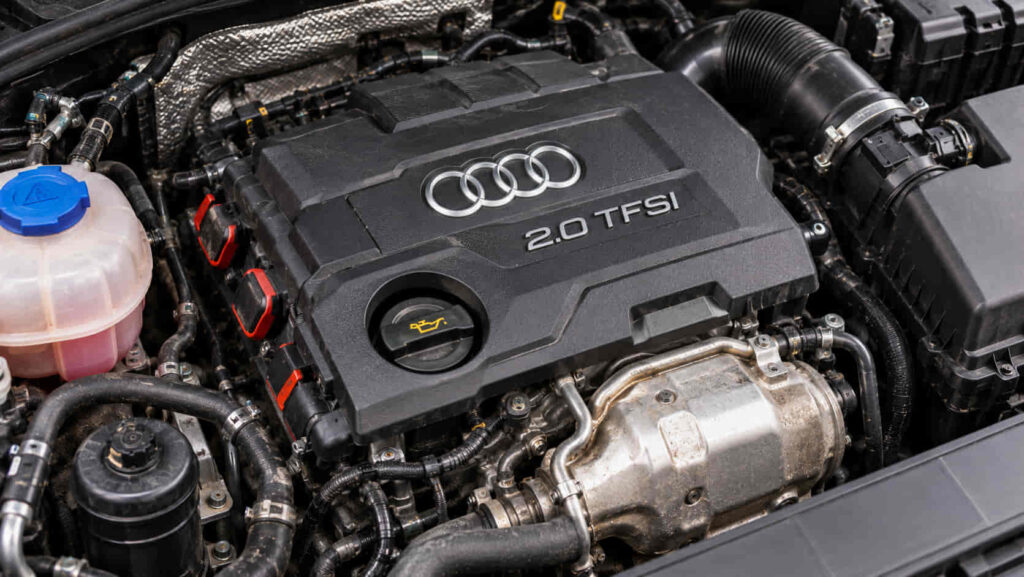
The Audi 2.0 TFSI engine is associated with several recurring mechanical and engine management problems, although the risks depend on the engine generation, production year and maintenance history. Common concerns include excessive oil consumption, timing system faults, crankcase ventilation failure, coolant leaks, carbon buildup on intake valves and ignition misfires. These problems do not affect every 2.0 TFSI engine, and similar symptoms can have different underlying causes.
The 2.0 TFSI designation covers multiple engine families, including EA113 and several generations of EA888. Understanding these differences is essential because the engines use different components and have distinct fault patterns. For example, certain early EA888 engines are associated with oil consumption and timing chain concerns, while many EA113 versions use a timing belt for their primary camshaft drive. Identifying the correct engine code is therefore an important first step before diagnosing a fault or choosing replacement parts.
This guide explains the most common Audi 2.0 TFSI problems, the mechanical causes behind their symptoms and the diagnostic methods used to identify faulty components. It also covers repair options, differences between engine generations, UK repair costs and preventive maintenance. The aim is to help Audi owners recognise developing engine faults, understand their potential consequences and make informed decisions about repairs.
What Are the Most Common Audi 2.0 TFSI Engine Problems?
The most common Audi 2.0 TFSI problems involve excessive oil consumption, timing system faults, PCV valve failure, coolant leaks, carbon buildup, ignition misfires and turbocharger-related issues. These faults affect different engine systems, including lubrication, valve timing, crankcase ventilation, cooling and combustion. However, their frequency and severity depend on the engine generation, production year and maintenance history. Not every Audi 2.0 TFSI engine is affected by the same mechanical weaknesses.
Excessive oil consumption and timing chain problems are particularly important concerns in certain early EA888 engines. Oil consumption can increase when piston rings fail to control the oil film on cylinder walls or when crankcase ventilation malfunctions. This may require frequent oil top-ups and increase the risk of insufficient lubrication. Timing chain tensioner faults can also disrupt the relationship between crankshaft and camshaft rotation, potentially causing cold-start rattling, incorrect valve timing and serious internal damage if the chain jumps.
PCV valve failures, carbon deposits and cooling system leaks are additional problems worth investigating. A defective PCV valve can disturb crankcase pressure and contribute to rough idling or oil leakage. Carbon accumulation on intake valves can interfere with airflow and combustion, particularly in direct-injection configurations without supplementary port injection. Water pump and thermostat housing leaks may cause progressive coolant loss and overheating if the problem remains unresolved.
Ignition coil faults, worn spark plugs, injector problems and turbocharger boost-control malfunctions can also affect engine performance. Symptoms include hesitation, misfires, reduced acceleration and engine warning lights. Because the Audi 2.0 TFSI designation covers both EA113 and multiple EA888 generations, identifying the engine code is essential before linking a symptom to a known fault or selecting a repair procedure.
Read more: Citroen Engine Fault Repair Needed
Why Does the Audi 2.0 TFSI Engine Consume Excessive Oil?
Excessive oil consumption in Audi 2.0 TFSI engines can result from ineffective piston oil-control rings, crankcase ventilation problems or oil entering the combustion system through worn components. Certain early EA888 engines are particularly associated with oil consumption complaints, although the underlying cause must be confirmed before repairs begin. Engine oil normally forms a thin lubricating film between the pistons and cylinder walls. Excessive consumption occurs when more oil than intended enters the combustion chambers or escapes through another part of the engine.
Piston oil-control ring problems are a significant cause of excessive oil burning in some early EA888 engines. Oil-control rings remove surplus lubricant from cylinder walls as the pistons move through the engine. When these rings become restricted by deposits, wear excessively or fail to maintain effective oil control, additional lubricant can remain on the cylinder walls and enter the combustion chambers. The oil is then burned during combustion, increasing consumption without necessarily producing visible exhaust smoke. Persistent low oil levels can also compromise lubrication and accelerate wear to internal engine components.
Crankcase pressure regulation can also influence oil consumption. The positive crankcase ventilation system manages gases that pass the piston rings and helps maintain appropriate pressure inside the engine. Abnormal pressure conditions can increase oil movement through ventilation passages or contribute to leakage. Audi documented this concern in a technical service bulletin covering certain 2009–2011 EA888-equipped A4, A5 and Q5 vehicles. Its specified service procedure included crankcase pressure regulation changes, an updated crankshaft seal and engine control software adjustments. The bulletin’s applicability must be checked against the individual vehicle rather than assumed for every 2.0 TFSI engine.
An oil consumption test is necessary to establish whether the engine is using an abnormal quantity of oil. A technician measures consumption over a controlled driving distance, checks the correct oil specification and investigates external leaks before attributing the problem to internal engine wear. Further testing may be needed to assess crankcase ventilation, turbocharger oil leakage or piston ring condition. A confirmed mechanical defect requires the appropriate repair; repeatedly topping up the oil does not address its cause. If an oil pressure warning appears, the engine should be stopped as soon as it is safe to do so to prevent serious damage.
What Causes Timing Chain Problems in Audi 2.0 TFSI Engines?
Timing chain problems in Audi 2.0 TFSI engines are primarily associated with chain wear, inadequate tension and faults in the timing chain tensioner, particularly on certain earlier EA888 engines. The timing chain synchronises crankshaft and camshaft rotation so that the intake and exhaust valves open at the correct points in the combustion cycle. When the chain becomes loose or its effective length increases through wear, valve timing can move outside the intended operating range, affecting engine performance and potentially causing mechanical damage.
Timing chain tensioner failure is a significant concern in some early EA888 engines. The tensioner maintains pressure against the chain through a combination of mechanical and oil-pressure-dependent components. If an older tensioner design fails to maintain sufficient tension, the chain can become slack, especially during engine startup. This may produce a metallic rattling noise for several seconds after a cold start. Worn chain links, guides and tensioner components can further increase movement within the timing system, although a brief startup rattle alone does not confirm that the chain is defective.
Incorrect camshaft timing is another important consequence of timing chain deterioration. As the chain wears, the relationship between crankshaft and camshaft positions can deviate from the expected values. The engine control unit may detect this discrepancy and store a fault such as P0016, which indicates a crankshaft-to-camshaft correlation problem. Symptoms can include difficult starting, an illuminated engine management light and irregular engine operation. However, camshaft adjustment faults and related oil-control problems can produce similar diagnostic findings, so the timing chain should not be condemned solely because a correlation code is present.
A timing chain that jumps teeth can cause severe internal engine damage. In affected interference-engine designs, incorrect valve timing may allow the pistons to contact open valves, resulting in bent valves or cylinder head damage. Persistent timing chain rattling, significant timing deviation or a sudden no-start condition therefore requires prompt professional inspection. The engine should not be repeatedly started when a slipped chain is suspected. Diagnosis involves checking the engine’s timing data and inspecting the chain, tensioner and guides according to the manufacturer’s procedure.
Not every Audi 2.0 TFSI engine uses the same timing arrangement. EA888 engines use a timing chain for the primary camshaft drive, whereas many earlier EA113 engines use a timing belt alongside a separate camshaft chain arrangement. Identifying the engine code is essential because the relevant failure mechanisms, inspection methods and replacement procedures differ between these engine families.
How Does a Faulty PCV Valve Affect the Audi 2.0 TFSI Engine?
A faulty PCV valve can cause rough idling, whistling noises, oil leaks and engine management warnings in Audi 2.0 TFSI engines by disrupting crankcase pressure regulation. The Positive Crankcase Ventilation (PCV) system removes blow-by gases from the crankcase and routes them into the intake system for combustion. Its pressure-regulating components maintain controlled crankcase vacuum while preventing excessive intake manifold pressure from entering the engine.
PCV diaphragm and check valve failures can produce different symptoms depending on how the system malfunctions. A damaged pressure-regulating diaphragm may allow excessive crankcase vacuum, creating a noticeable whistling sound and making the oil filler cap unusually difficult to lift while the engine is idling. If a check valve fails to close under turbocharger boost, positive pressure can enter the crankcase and force oil past seals or gaskets. Audi has documented this failure mechanism in technical service information for certain earlier 2.0 TFSI applications.
A defective PCV system can also interfere with the engine’s air-fuel mixture. Air leaks through the ventilation system may affect the airflow entering the engine, leading to unstable idling, hesitation or lean-mixture fault codes. These symptoms can resemble intake hose leaks or other air-management problems, making diagnosis essential before replacing components.
PCV diagnosis involves checking crankcase pressure, inspecting ventilation hoses and examining the valve assembly for leakage or mechanical damage. A technician may use a pressure measurement and a smoke test to identify abnormal airflow. If the PCV assembly is defective, replacement must match the specific engine code and part revision. Correct operation should be confirmed by checking crankcase pressure and idle stability after the repair.
Why Does Carbon Buildup Occur in Audi 2.0 TFSI Engines?
Carbon buildup occurs in Audi 2.0 TFSI engines when oil vapour and combustion-related residues accumulate on intake valves and form hardened deposits under engine operating temperatures. This problem is particularly relevant to engines that rely exclusively on direct fuel injection. Unlike port injection, which sprays petrol into the intake ports, direct injection delivers fuel straight into the combustion chambers. Consequently, petrol does not wash over the backs of the intake valves to remove developing deposits.
The crankcase ventilation system contributes to intake valve deposits by introducing oil-containing gases into the intake airflow. These gases carry small quantities of oil mist and other combustion by-products. When the residues contact hot intake surfaces, they can gradually form deposits around the valve stems and valve heads. As the accumulation becomes substantial, it can disturb airflow entering the cylinders and interfere with stable combustion. The rate of buildup depends on the engine configuration, operating conditions and mechanical condition.
Excessive intake valve deposits can cause rough idling, cold-start misfires, hesitation and reduced engine performance. Deposits may restrict the effective airflow around the valves or disrupt the air movement required for consistent combustion. Audi’s technical service guidance identifies deposits in inlet ports and valves as a possible cause of uneven idling after cold starts, particularly in vehicles used mainly for short journeys. However, these symptoms can also result from ignition or fuel-delivery faults, so carbon buildup should be confirmed rather than assumed.
Intake valve inspection and professional cleaning are the appropriate responses when significant deposits are identified. A technician can inspect the valves using suitable access and a borescope, then remove hardened deposits through a procedure such as walnut-shell blasting. This process requires appropriate isolation of the combustion chambers and removal of cleaning debris. Petrol-tank additives do not directly wash intake valves in engines using only direct injection. Some later Audi 2.0 TFSI configurations combine direct and port injection, which changes the valves’ exposure to fuel and their susceptibility to deposit accumulation.
Why Do Audi 2.0 TFSI Water Pumps and Thermostat Housings Leak?
Audi 2.0 TFSI water pumps and thermostat housings can leak when seals deteriorate, mating surfaces lose their seal or cooling system components become damaged. These problems have been documented on certain EA888-equipped vehicles, although the affected parts and repair procedures vary by engine generation. The water pump circulates coolant through the engine, while the thermostat regulates coolant flow according to operating temperature. Both components must maintain a sealed cooling circuit to prevent coolant loss and maintain stable engine temperatures.
Coolant leaks can develop around the water pump seals, thermostat housing joints or connections between cooling system components. Repeated heating and cooling expose these parts to temperature changes and pressure fluctuations, which can contribute to sealing deterioration over time. Audi Technical Service Bulletin 19 22 33 specifically addresses coolant loss around the thermostat housing and coolant pump on certain 2.0 TFSI vehicles. The bulletin distinguishes the two components and instructs technicians to replace the part responsible for the leak rather than automatically replacing both.
Common symptoms include falling coolant levels, dried coolant residue, fluid collecting beneath the engine and coolant temperature warnings. A small external leak may initially cause gradual coolant loss without affecting engine performance. As the coolant level falls, however, the system can lose its ability to regulate temperature effectively. Continued operation with insufficient coolant increases the risk of overheating, cylinder head distortion and other serious engine damage. If the temperature warning indicates overheating, the driver should stop safely, switch off the engine and allow it to cool before further inspection.
A cooling system pressure test helps identify whether the water pump, thermostat housing or another component is leaking. A technician pressurises the system according to the manufacturer’s specifications and inspects the relevant joints, seals and coolant connections. This distinguishes an external leak from faults such as a thermostat that fails to regulate temperature correctly. Once the defective component has been identified, the appropriate repair involves replacing the leaking part, using the specified coolant and verifying that the system maintains pressure and operates at the correct temperature.
What Causes Misfires and Rough Idling in Audi 2.0 TFSI Engines?
Audi 2.0 TFSI misfires and rough idling are caused by irregular combustion resulting from ignition faults, incorrect fuel delivery, intake air leaks or mechanical problems affecting individual cylinders. A misfire occurs when the air-fuel mixture fails to burn correctly, reducing the power produced during the combustion cycle. The engine control unit detects these irregularities by monitoring changes in crankshaft speed. Common symptoms include engine vibration, hesitation during acceleration, unstable idle speed and an illuminated engine management light.
Faulty ignition coils and worn spark plugs are important causes of combustion failure in Audi 2.0 TFSI engines. Each ignition coil generates the high voltage required for its spark plug to ignite the compressed air-fuel mixture. A deteriorating coil may produce insufficient spark energy, particularly under acceleration when cylinder pressures increase. Spark plugs with worn electrodes, incorrect gaps or heavy deposits can cause similar symptoms. When a single cylinder misfires, a technician can test the ignition system and, where appropriate, exchange a coil with another cylinder to determine whether the fault follows the component.
Fuel injection and air-fuel mixture problems can also cause persistent or intermittent misfires. A restricted or malfunctioning injector may deliver an incorrect quantity of petrol, while inadequate fuel pressure can affect combustion across several cylinders. Unmetered intake air can disturb the mixture and produce rough idling. Mechanical defects, including poor valve sealing or reduced cylinder compression, must also be considered when ignition and fuel delivery tests do not identify the cause.
Diagnostic trouble codes help identify the affected cylinders but do not establish the underlying fault by themselves. P0300 indicates random or multiple-cylinder misfires, while P0301 to P0304 identify misfires in individual cylinders of the four-cylinder engine. A technician should compare stored fault codes with live misfire counts, fuel pressure readings and component test results before recommending repairs. Audi’s diagnostic guidance also cautions against replacing ignition coils without confirming that they are defective. If the engine management light flashes during a misfire, the vehicle should be stopped safely because continued operation can damage the catalytic converter.
What Turbocharger Problems Affect Audi 2.0 TFSI Engines?
Audi 2.0 TFSI turbocharger problems include wastegate wear, boost pressure leaks, diverter valve failure and mechanical deterioration of the turbocharger itself. These faults can prevent the engine from achieving its required boost pressure, resulting in reduced acceleration, hesitation or an engine management warning. The turbocharger uses exhaust gas energy to compress incoming air, allowing the engine to burn more fuel and produce greater torque. When actual boost pressure differs significantly from the engine control unit’s requested value, the vehicle may reduce engine output to protect its components.
Wastegate problems are a documented cause of underboost faults in certain Audi 2.0 TFSI engines. The wastegate regulates exhaust gas flow through the turbine to control boost pressure. Excessive wear in its linkage can prevent the flap from sealing correctly, allowing exhaust gases to bypass the turbine and reducing available boost. Audi has also documented disconnected wastegate actuator linkages on certain 2013–2014 2.0 TFSI vehicles. Depending on the confirmed defect and applicable service procedure, repair may involve restoring the linkage or replacing the affected turbocharger assembly.
A defective diverter valve or leaking charge-air pipe can produce similar symptoms without the turbocharger itself being damaged. The diverter valve manages pressurised intake air when throttle conditions change. If its diaphragm or sealing mechanism fails, boost pressure can escape instead of reaching the intake manifold. Split hoses, loose connections and damaged intercooler components can also reduce pressure. These faults may trigger diagnostic trouble code P0299, indicating that the requested boost pressure has not been achieved.
Mechanical turbocharger failure requires a different repair approach from a boost-control fault. Worn bearings, damaged compressor components or lubrication problems can affect turbocharger operation and may produce unusual noises, smoke or reduced performance. Diagnosis should compare requested and actual boost pressure, inspect the intake system for leaks and verify wastegate and diverter valve operation before condemning the turbocharger. Replacing a faulty control component can restore correct boost when the turbocharger remains mechanically sound, whereas confirmed internal damage may require turbocharger replacement and investigation of the underlying cause.
How Do You Diagnose Audi 2.0 TFSI Engine Problems?
Diagnosing Audi 2.0 TFSI engine problems requires identifying the engine variant, retrieving diagnostic trouble codes and testing the mechanical or electronic system associated with the symptoms. The process should begin with the engine code, production year, mileage and service history because EA113 and different EA888 generations have distinct components and known fault patterns. Recording when a problem occurs, such as during cold starts, acceleration or prolonged idling, helps narrow the investigation before any parts are replaced.
An OBD-II scanner provides an initial assessment, while Audi-compatible diagnostic tools such as VCDS or ODIS offer access to additional manufacturer-specific information. A complete diagnostic scan should identify stored and pending fault codes, affected control modules and available freeze-frame data. Freeze-frame information may record engine speed, temperature, load and other operating conditions when a fault was detected. These details help technicians reproduce the circumstances associated with an intermittent problem. Fault codes should be recorded before they are cleared because removing them prematurely can eliminate useful diagnostic evidence.
Live engine data helps distinguish a detected symptom from its underlying cause. For example, code P0301 identifies a misfire on cylinder one but does not establish whether the fault involves a spark plug, ignition coil, injector or mechanical compression. Similarly, P0299 indicates insufficient boost pressure without proving that the turbocharger itself is defective. Comparing requested and actual operating values, including boost pressure, fuel pressure and camshaft adjustment data where supported, allows technicians to investigate the system responsible for the discrepancy.
Mechanical testing is necessary when electronic diagnostics cannot confirm the source of a fault. Excessive oil consumption requires a measured consumption assessment and inspection for leaks. Suspected timing faults may require camshaft correlation checks and mechanical inspection, while coolant loss can be investigated through cooling-system pressure testing. Compression or leak-down testing can help identify cylinder sealing problems when misfires persist despite satisfactory ignition and fuel-system results. Each test should be selected according to the evidence already collected rather than performed as an unrelated series of checks.
A diagnosis is complete only when the suspected defect has been confirmed and the repair can be verified. After corrective work, technicians should reassess the relevant live data, check for recurring fault codes and conduct an appropriate operating test. This evidence-based approach reduces unnecessary component replacement and helps distinguish a resolved engine problem from a warning that has merely been cleared.
How Can You Fix Common Audi 2.0 TFSI Engine Problems?
Common Audi 2.0 TFSI engine problems are fixed by repairing or replacing the components responsible for the confirmed fault, rather than replacing parts based on symptoms alone. The appropriate repair depends on the engine generation, component design and extent of mechanical damage. Minor faults involving ignition coils, crankcase ventilation or cooling system seals generally require less extensive work than internal engine repairs. Using replacement parts compatible with the specific engine code is essential to restore correct operation.
Excessive oil consumption requires a repair that addresses the mechanism allowing oil to escape or enter the combustion chambers. If testing confirms a defective PCV assembly, replacing the pressure-regulating component may restore normal crankcase ventilation. Audi’s documented service procedure for certain early EA888 engines also involved an updated crankshaft seal and engine control software. However, engines with confirmed piston ring defects may require replacement pistons or rings, cylinder inspection and substantial engine disassembly. A PCV replacement alone cannot correct worn or ineffective piston rings.
Timing system repairs must restore accurate crankshaft and camshaft synchronisation. When inspection confirms a worn timing chain or defective tensioner, the repair may involve replacing the chain, tensioner, guides and other components specified for the affected engine. Technicians must verify mechanical timing before restarting the engine. If the chain has jumped and caused valve-to-piston contact, cylinder head repairs or more extensive engine work may be necessary.
Cooling, ignition and intake-related problems require repairs specific to the failed component. A leaking water pump or thermostat housing should be replaced or resealed according to the applicable Audi repair procedure. Defective ignition coils and worn spark plugs require suitable replacements, while substantial intake valve deposits may justify professional cleaning. Fuel injector faults require confirmation before replacement, and boost pressure problems should be resolved by repairing the defective hose, valve, actuator or turbocharger rather than automatically replacing the complete turbocharger assembly.
Every repair should finish with verification that the engine operates correctly under the conditions that originally produced the fault. This includes checking relevant diagnostic data, confirming that fluid levels remain stable and testing engine performance after the work. Successful repair means the underlying malfunction has been corrected, not simply that the engine warning light has been cleared.
Which Audi 2.0 TFSI Engine Generations Have the Most Problems?
Certain early EA888 engines have some of the best-documented Audi 2.0 TFSI reliability concerns, particularly excessive oil consumption and timing chain tensioner failure. However, the 2.0 TFSI designation covers several engine families with different mechanical designs, so no single generation can be classified as the least reliable without comparable failure-rate data. The most relevant factors are the engine code, production period, documented component weaknesses and maintenance history.
Earlier EA113 2.0 TFSI engines have a different fault profile from the EA888 family. Many EA113 applications use a timing belt for the primary camshaft drive rather than the EA888’s chain-driven arrangement. One documented EA113 concern involves wear of the cam follower that transfers camshaft movement to the high-pressure fuel pump. Severe wear can damage the camshaft lobe, disrupt fuel pressure and trigger engine management faults. Audi issued technical guidance covering this problem on certain engines, including BPG, BPY and BWT variants.
Early EA888 Gen 1 and Gen 2 applications warrant particular attention when assessing oil consumption and timing system history. Audi issued service bulletins addressing excessive oil consumption on selected 2009–2011 vehicles and provided a timing chain and tensioner warranty extension for certain EA888-equipped models. These documents establish recognised problems within specific vehicle populations, although they do not mean every engine from those years will develop either fault. Confirmed repairs and updated components can materially change the condition of an individual engine.
EA888 Gen 3 introduced substantial engineering revisions, including an integrated exhaust manifold, revised thermal management and updated engine components. These changes distinguish it from earlier designs, but they do not eliminate the possibility of mechanical faults. Coolant leaks involving water pump and thermostat housing assemblies remain documented concerns on certain Gen 3 applications. Later EA888 derivatives, including Gen 3B and evo4, incorporate further changes, but their reliability should be assessed using evidence specific to the installed engine rather than assuming that newer automatically means fault-free.
For used Audi buyers, the engine code and documented repair history are more useful than the 2.0 TFSI badge alone. Checking previous oil consumption complaints, timing system repairs, cooling system work and manufacturer service information provides a more accurate assessment of mechanical risk. Model year can help narrow the search, but it cannot independently establish which engine version is installed or whether a known weakness has already been corrected.
Which Audi Models Are Affected by 2.0 TFSI Engine Problems?
Audi 2.0 TFSI engine problems can affect petrol-powered versions of the Audi A3, A4, A5, A6, Q3, Q5 and TT, but the applicable faults depend on the engine code and production period. These vehicles have used different versions of the 2.0-litre turbocharged petrol engine, including EA113 and several EA888 generations. Sharing the 2.0 TFSI designation does not mean that two vehicles have identical components, maintenance requirements or mechanical weaknesses.
Earlier Audi A3 8P and TT 8J models illustrate why engine identification matters. Depending on the version and production year, these vehicles were equipped with different 2.0 TFSI engine designs. An EA113-equipped model requires attention to its belt-driven timing system and relevant fuel pump components, while an EA888-equipped vehicle has a different timing arrangement. Applying an EA888 timing chain repair procedure to an EA113 engine would therefore be inappropriate.
Audi A4 B8, A5 8T and first-generation Q5 models are particularly relevant when researching documented early EA888 concerns. Selected engine and model-year combinations were covered by Audi technical guidance addressing excessive oil consumption or timing chain tensioner problems. However, this does not establish that every A4, A5 or Q5 has the same defect. Later A4, A5 and Q5 generations, together with various A3, A6, Q3 and TT versions, use revised EA888 engines with different component designs.
The most reliable way to establish which problems apply to a particular Audi is to identify its engine code. This information may appear on the vehicle data label or in the service documentation, while an Audi dealer can help confirm the engine specification using the vehicle identification number (VIN). Once the engine code and production details are known, the owner or technician can check the relevant technical bulletins, parts compatibility and repair procedures without relying on model name alone.
How Much Does It Cost to Repair Audi 2.0 TFSI Problems in the UK?
Audi 2.0 TFSI repair costs in the UK range from under £100 for certain minor component replacements to several thousand pounds for major internal engine repairs. The final price depends on the confirmed fault, engine generation, labour requirements and whether additional components have been damaged. An accurate estimate should identify the necessary parts and labour rather than assume that every engine displaying the same symptom requires an identical repair.
Initial diagnostics and ignition system repairs are generally less expensive than major mechanical work. FixMyCar reports an average Audi diagnostic test price of approximately £51, although additional investigation may increase the total. ClickMechanic lists an average Audi ignition coil replacement cost of around £149 and estimates Audi PCV valve replacement at approximately £75–£95. These are platform estimates rather than fixed prices for every 2.0 TFSI variant. Replacing multiple ignition coils or repairing additional ventilation components increases the overall bill.
Cooling system repairs and timing chain replacement involve higher parts and labour costs. FixMyCar’s Audi-specific quote data indicates an average water pump replacement price of approximately £477 and a timing chain replacement quote of around £1,058. The actual cost depends on component accessibility, the parts included and the engine’s timing system design. A timing repair becomes substantially more expensive if a failed chain has damaged valves or other internal components. Specialist intake valve cleaning also adds a separate maintenance expense, with one UK provider advertising 2.0 TFSI walnut blasting services from £450 before VAT.
Excessive oil consumption can produce the highest repair bills when internal engine work is necessary. Replacing a defective ventilation component costs considerably less than dismantling an engine to replace pistons or piston rings. Historical UK reports describe Audi dealer quotations of approximately £5,000–£6,000 for extensive piston-related repairs, although these figures are individual reported quotations rather than current nationwide averages. The cost also depends on whether cylinder damage or additional engine wear is discovered during disassembly.
Independent Audi specialists and authorised dealerships may quote different prices for the same repair. Labour rates, genuine or approved replacement parts, warranty coverage and the extent of diagnostic work all influence the final amount. Owners should request an itemised quotation that identifies the confirmed fault, required components, labour charges and VAT before authorising repairs. Comparing quotations is most useful when each garage proposes the same repair procedure and includes equivalent parts and warranty terms.
Is the Audi 2.0 TFSI Engine Reliable?
The Audi 2.0 TFSI can be a reliable petrol engine when properly maintained, but its long-term dependability varies significantly between engine generations and individual vehicles. Earlier EA888 engines have documented oil consumption and timing chain concerns, while later versions incorporate revised components that address several weaknesses of the original designs. However, improved engineering does not eliminate normal mechanical wear, and a newer engine is not automatically more reliable than an older example with a comprehensive service and repair history.
The reliability of an early EA888 engine depends heavily on whether its known mechanical weaknesses have been addressed. A vehicle with documented timing system repairs, stable oil consumption and regular servicing presents a different ownership risk from one with an unknown maintenance history. Previous repairs should be supported by invoices identifying the components replaced and the work performed. An engine that runs smoothly during a short test drive may still have developing problems that become apparent only during cold starts or extended operation.
Later EA888 generations generally benefit from revised engine designs, but cooling system and crankcase ventilation faults remain relevant ownership concerns. A properly maintained later engine may offer a more reassuring purchase than an unrepaired early example, although reliability also depends on mileage, operating conditions and servicing quality. There is no universally guaranteed lifespan for the Audi 2.0 TFSI, and high mileage alone does not establish whether an engine is mechanically sound.
A pre-purchase inspection is the most effective way to assess the reliability of a used Audi 2.0 TFSI. Buyers should establish the engine code, review service invoices and confirm whether relevant repairs have been completed. A cold-start inspection, diagnostic scan, coolant system assessment and review of oil consumption history can reveal problems that are not obvious during ordinary driving. An Audi 2.0 TFSI with a verified maintenance history and no unresolved mechanical faults offers a stronger basis for ownership than one selected solely because of its model year or engine generation.
How Can You Prevent Common Audi 2.0 TFSI Engine Problems?
Common Audi 2.0 TFSI engine problems can be reduced through correct oil maintenance, regular cooling system inspections, scheduled component replacement and early investigation of abnormal engine behaviour. Preventive servicing helps protect lubrication, cooling and combustion systems, but it cannot eliminate every mechanical failure. Certain engine generations have design-related weaknesses that may require updated components or specific repairs regardless of how carefully the vehicle has been maintained.
Using engine oil that meets the correct Audi-approved specification is essential for protecting the 2.0 TFSI engine. Oil lubricates the crankshaft bearings, turbocharger and timing components while helping control friction and operating temperatures. Audi UK offers fixed oil servicing at 9,300 miles or one year and flexible servicing at up to 18,600 miles or two years, although eligibility and requirements depend on the vehicle. Owners should follow the schedule applicable to their engine and driving conditions. Checking the oil level between services and recording unusual top-up requirements helps identify developing consumption problems before lubrication becomes insufficient.
Regular cooling system inspections help detect coolant leaks before they cause overheating. Owners should check the coolant level when the engine is cold and investigate repeated losses, dried coolant deposits or unusual temperature readings. A falling coolant level should not be treated as normal maintenance because it may indicate a leaking water pump, thermostat housing or coolant connection. Prompt inspection reduces the risk of operating the engine with inadequate cooling.
Early attention to unusual engine noises and changes in performance can also prevent secondary damage. Persistent cold-start rattling, repeated misfires, rough idling or reduced acceleration should be investigated rather than ignored. Spark plugs, filters and other service components must be replaced according to the specific engine’s maintenance requirements. Maintaining service records, checking applicable manufacturer technical information and repairing confirmed faults promptly provide the strongest practical foundation for long-term Audi 2.0 TFSI reliability.