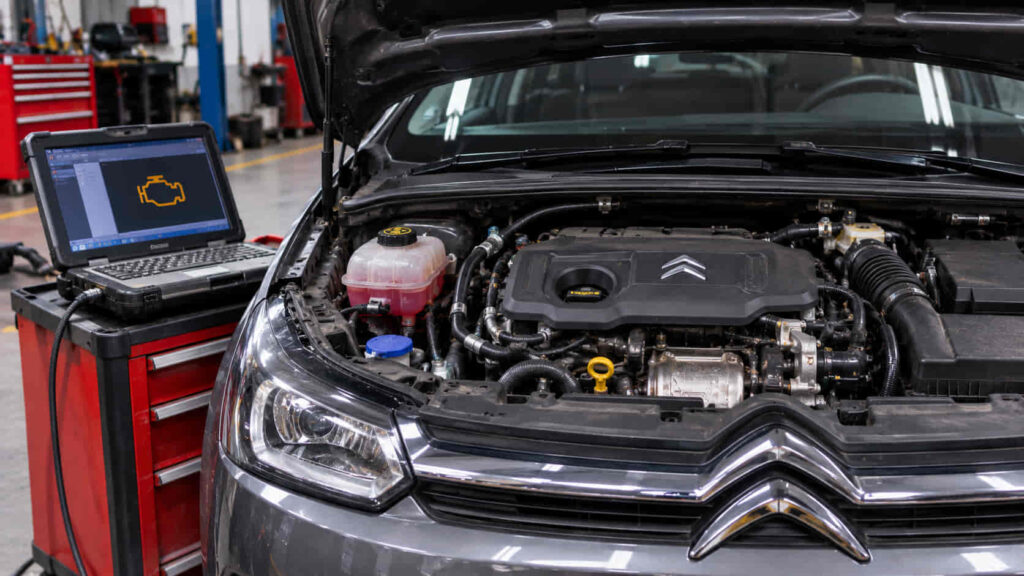
The “Engine Fault: Repair Needed” warning on a Citroën means the vehicle has detected a problem that requires diagnosis. The message does not identify a specific faulty component, as it can be triggered by problems involving the engine management system, fuel injection, ignition components, sensors, or emission control systems. The severity depends on the underlying fault, the associated dashboard warning lights, and whether the engine shows symptoms such as reduced power, rough idling, or unusual noises.
A Citroën displaying this warning may continue running normally, enter limp mode, or develop noticeable performance problems. However, normal driving performance does not mean the engine is free from faults. A flashing engine warning requires urgent attention, while a red STOP warning or signs of overheating or oil pressure failure require the driver to stop safely and follow the vehicle manufacturer’s instructions. Identifying the actual problem requires reading diagnostic trouble codes (DTCs) with an appropriate OBD-II diagnostic tool and verifying the results through mechanical or electrical checks.
This guide explains what causes the Citroën Engine Fault: Repair Needed warning, how to diagnose the underlying problem, and which repairs can resolve it. It also covers driving safety, common engine-related symptoms, repair costs, and preventive maintenance for Citroën models, including the C3, C4, and Berlingo.
What Does “Engine Fault: Repair Needed” Mean on a Citroen?
The “Engine Fault: Repair Needed” warning on a Citroen indicates that the vehicle has detected a malfunction in an engine-related system that requires diagnosis or repair. It does not necessarily mean the engine has suffered mechanical damage. The engine control unit (ECU) monitors operating conditions through sensors that measure parameters such as air intake pressure, engine temperature, fuel delivery, and exhaust emissions. When the monitoring system detects readings outside expected operating limits, it can record a diagnostic trouble code (DTC) and display an engine fault warning on the dashboard.
The warning can appear on Citroen models such as the C3, C4, C5, and Berlingo, although the underlying problem depends on the engine type and vehicle configuration. For example, a petrol-powered Citroen may display the message because of an ignition misfire, a faulty oxygen sensor, or a fuel injection problem. On diesel models equipped with a diesel particulate filter (DPF), exhaust gas recirculation (EGR) valve, or selective catalytic reduction (SCR) system, faults involving these components can also trigger engine-related warnings. The dashboard message alone cannot distinguish between these conditions because different malfunctions can produce similar alerts.
The severity of a Citroen engine fault depends on the associated warning lights and the engine’s operating condition. A vehicle may continue running normally despite a stored fault, while another may experience reduced acceleration, rough idling, or restricted engine power. A flashing engine diagnostic light requires urgent attention, and a red STOP warning requires the driver to stop safely. Identifying the exact fault requires retrieving stored diagnostic codes and checking the affected system before any repairs are carried out.
Read more: 3116 Cat Engine Specs
Can You Drive a Citroen With the “Engine Fault: Repair Needed” Warning?
You may be able to drive a Citroen with the “Engine Fault: Repair Needed” warning if the engine runs normally and no critical warning lights are illuminated, but continuing to drive is not always safe. The appropriate action depends on whether the engine warning light is steady or flashing, whether the red STOP warning appears, and whether the vehicle shows symptoms such as reduced power, overheating, or abnormal engine noises. A steady engine warning generally requires prompt professional diagnosis, while a flashing warning indicates a more urgent engine management problem.
Stop driving immediately when the engine fault message appears alongside a red STOP warning, an oil pressure alert, or an overheating warning. These indicators can signal conditions that may cause severe engine damage if the vehicle continues operating. For example, insufficient oil pressure can prevent critical engine components from receiving adequate lubrication, increasing friction and the risk of mechanical failure. Pull over as soon as it is safe, switch off the engine, and contact a qualified garage or roadside assistance provider. Do not restart the vehicle until the cause has been assessed.
A flashing engine warning light also requires urgent attention because it can indicate a malfunction that threatens the catalytic converter. Citroen owner handbooks specifically identify catalytic converter damage as a risk associated with a flashing engine diagnostic light. If the engine begins shaking, misfiring, losing substantial power, or producing unusual sounds, stop in a safe location and arrange professional assistance rather than attempting to complete the journey.
A Citroen with a steady engine warning and no noticeable performance problems may still have an underlying fault that requires repair. For example, an oxygen sensor malfunction or an emissions control fault may activate the warning before the driver notices changes in acceleration or fuel consumption. A short journey to a nearby garage may be appropriate only when the vehicle remains safe to operate and the instructions for the specific model permit it. The safest decision is to seek professional guidance before driving further, particularly when the cause is unknown. Diagnostic trouble codes should be retrieved promptly to determine whether continued operation could damage the engine or emissions system.
What Causes the “Engine Fault: Repair Needed” Warning on a Citroen?
The “Engine Fault: Repair Needed” warning on a Citroen can be caused by ignition system failures, fuel injection problems, faulty engine sensors, emission control malfunctions, turbocharger faults, or mechanical engine problems. These faults affect the engine’s ability to maintain the correct combustion conditions, regulate exhaust emissions, or operate within its programmed limits. The exact cause depends on the engine type, vehicle age, maintenance history, and diagnostic trouble codes stored in the engine control unit (ECU).
Ignition system faults are one potential cause of the warning in petrol-powered Citroen vehicles. Worn spark plugs and defective ignition coils can prevent the air-fuel mixture from burning correctly inside the cylinders, resulting in engine misfires. A misfiring engine may produce rough idling, hesitation during acceleration, increased fuel consumption, or noticeable vibrations. Fuel injection problems can produce similar symptoms. For example, a malfunctioning injector may deliver an incorrect quantity of fuel, disrupting combustion and causing the ECU to detect irregular engine operation. Persistent misfires can also allow unburned fuel to enter the exhaust system, potentially damaging the catalytic converter.
Faulty engine sensors can trigger the Citroen engine fault warning by supplying inaccurate information to the ECU. The mass airflow (MAF) sensor and manifold absolute pressure (MAP) sensor provide information used to calculate the engine’s air supply, while oxygen sensors help monitor combustion and exhaust conditions. Crankshaft and camshaft position sensors provide timing information required for engine control. When these signals are missing, inconsistent, or outside expected operating ranges, the ECU may adjust engine operation and register a fault. Damaged wiring, corroded connectors, and electrical supply problems can produce similar symptoms without the sensor itself being defective.
Diesel emission control problems are another potential cause, particularly in Citroen HDi and BlueHDi engines. A diesel particulate filter (DPF) captures soot from exhaust gases and requires periodic regeneration to remove accumulated particles. Excessive soot accumulation, failed regeneration, or a defective pressure sensor can result in an emissions-related warning. The exhaust gas recirculation (EGR) valve can also cause problems when carbon deposits or mechanical faults prevent it from regulating exhaust gas flow correctly. On BlueHDi models equipped with selective catalytic reduction (SCR), faults involving the AdBlue dosing system, nitrogen oxide sensors, or SCR components can activate additional emissions warnings. A low AdBlue level and an SCR system malfunction are different conditions and require different corrective actions.
Turbocharger and air intake faults can cause the engine warning to appear when actual boost pressure differs from the ECU’s expected values. A damaged intercooler hose, leaking intake connection, defective boost pressure sensor, or malfunctioning turbocharger control mechanism can prevent the engine from receiving the required air pressure. This may result in poor acceleration, reduced engine power, or limp mode. However, an underboost fault does not automatically indicate a failed turbocharger, because leaks and control-system problems can produce similar diagnostic results.
Mechanical and lubrication problems must also be considered, particularly on certain previous-generation Citroen PureTech petrol engines. Citroen has acknowledged premature timing belt deterioration and associated oil pressure problems affecting specific generations of its 1.0 and 1.2 PureTech engines. Excessive oil consumption is another issue covered by the manufacturer’s support programme. These conditions require inspection of the affected engine and its lubrication system rather than assuming that the dashboard message identifies a timing belt failure. A separate oil pressure warning demands immediate action because inadequate lubrication can cause serious internal engine damage.
The underlying cause cannot be confirmed from the “Engine Fault: Repair Needed” message alone because several unrelated components can produce similar warnings. For example, reduced acceleration may result from insufficient turbocharger boost, restricted fuel delivery, or an emissions-system malfunction. Identifying the defective system requires reading stored fault codes, examining relevant live data, and testing the suspected components before replacement.
How Do You Diagnose the “Engine Fault: Repair Needed” Warning on a Citroen?
To diagnose the “Engine Fault: Repair Needed” warning on a Citroen, identify the associated symptoms, retrieve diagnostic trouble codes (DTCs), examine engine operating data, and test the components linked to the recorded faults. The diagnostic process must establish why the engine control unit (ECU) activated the warning before any parts are replaced. A diagnostic scanner provides the starting point, but fault codes alone do not always identify the defective component.
The first step is to establish when the warning appears and how the engine behaves. Record whether the message occurs during startup, acceleration, idling, or normal driving. Symptoms such as rough idling, hesitation, excessive exhaust smoke, and reduced engine power help narrow down the affected systems. The vehicle’s model, production year, engine type, and maintenance history are equally important because Citroen petrol and diesel engines use different fuel delivery, ignition, and emission control technologies. If a red STOP warning, oil pressure alert, or overheating warning is present, the vehicle must be stopped safely rather than operated for further testing.
An OBD-II diagnostic scanner can retrieve engine-related fault codes through the vehicle’s diagnostic connector. Depending on the scanner and vehicle, it can display stored codes, pending faults, and freeze-frame data showing operating conditions when a malfunction was recorded. For example, code P0300 indicates random or multiple-cylinder misfires, while P0299 identifies an underboost condition. However, P0299 does not automatically mean the turbocharger needs replacing, because damaged boost hoses, pressure sensor faults, or turbocharger control problems can produce similar readings. These codes must be interpreted alongside the vehicle’s symptoms and manufacturer-specific diagnostic information.
A basic OBD-II reader primarily accesses standardised emissions-related information, whereas Citroen-compatible diagnostic systems provide broader access to manufacturer-specific functions. Citroen’s DiagBox diagnostic software supports ECU fault-code reading and vehicle-specific diagnostic procedures. This additional functionality is particularly valuable when investigating complex faults involving fuel injection, turbocharger control, diesel particulate filters, or selective catalytic reduction systems. Professional diagnostic equipment also allows technicians to compare live sensor readings with the expected operating conditions for the relevant engine.
Confirming the underlying fault requires testing the affected system rather than relying exclusively on the scanner’s fault description. For example, an underboost fault can be investigated by comparing requested and actual boost pressure, inspecting intake hoses, and checking turbocharger control operation. A suspected ignition misfire requires inspection of the relevant ignition components and cylinder operation. Similarly, diesel emission faults may require examination of exhaust pressure readings, DPF condition, or AdBlue system operation. Electrical faults should be investigated through appropriate voltage, continuity, and wiring checks.
Diagnostic codes and freeze-frame information should be recorded before clearing the ECU memory, because erasing them can remove evidence needed to identify an intermittent problem. Once the cause has been established, the technician can determine the necessary repair and verify that the original fault no longer occurs. This approach reduces unnecessary component replacement and helps prevent the Citroen engine fault warning from returning after an incomplete repair.
How Can You Fix the “Engine Fault: Repair Needed” Warning on a Citroen?
To fix the “Engine Fault: Repair Needed” warning on a Citroen, the underlying mechanical, electrical, or emission control fault must be repaired before the warning is cleared. The correct repair depends on the diagnostic findings and the affected engine system. Replacing components without confirming the cause can leave the original problem unresolved, while simply erasing the fault codes may temporarily remove the dashboard message without restoring normal engine operation.
Ignition and fuel system faults are resolved by repairing or replacing the components responsible for incorrect combustion. On petrol-powered Citroen models, a confirmed defective ignition coil or worn spark plug should be replaced with a component that meets the manufacturer’s specifications. Faulty fuel injectors may require cleaning, testing, or replacement, depending on their mechanical and electrical condition. Fuel pressure problems require repair of the defective part of the delivery system, such as a pressure regulator or fuel pump. After the repair, the engine should idle smoothly, respond normally to acceleration, and operate without recurring misfire faults.
Sensor-related engine faults require correction of the defective sensor, wiring, or electrical connection. A malfunctioning mass airflow sensor, manifold pressure sensor, or oxygen sensor may need replacement when testing confirms that it cannot provide accurate readings. However, damaged wiring, loose connectors, and intake air leaks must be repaired independently because replacing a functioning sensor will not correct these problems. Turbocharger-related faults follow the same principle. A damaged boost hose or defective boost control actuator should be repaired before considering turbocharger replacement, which is unnecessary when the turbocharger itself operates correctly.
Diesel emission system repairs depend on whether the fault affects the DPF, EGR valve, or AdBlue system. A diesel particulate filter containing excessive soot may require a controlled regeneration or professional cleaning when its condition and the manufacturer’s procedures permit it. A filter damaged internally or excessively loaded with non-combustible ash may require replacement. A malfunctioning EGR valve may need cleaning or replacement, depending on the cause of its failure. On BlueHDi engines, confirmed AdBlue or selective catalytic reduction (SCR) faults require repair of the affected dosing components, sensors, wiring, or associated control systems. Adding AdBlue resolves a low-fluid condition but does not repair a defective SCR component.
Certain Citroen PureTech engine faults require mechanical repairs rather than electronic adjustments. On affected previous-generation 1.0 and 1.2 PureTech engines, premature timing belt deterioration can contribute to oil pressure problems. Repairs may require timing belt replacement, inspection of the lubrication system, and correction of damage or restrictions associated with belt deterioration. These procedures should be performed by a qualified technician using the manufacturer’s specifications. Owners should also check whether their vehicle qualifies for Citroen’s applicable PureTech support programme.
A successful Citroen engine fault repair must be confirmed through post-repair testing. The technician should check that the original malfunction has been corrected, clear relevant fault codes when appropriate, and verify engine operation under suitable conditions. Sensor readings, combustion performance, boost pressure, or emissions-system operation should be checked according to the repaired system. If the warning returns, further investigation is necessary because the original fault may remain unresolved or an additional problem may be present. Clearing the message alone is not evidence of a completed repair.
Why Does a Citroen Show “Engine Fault: Repair Needed” Without Losing Power?
A Citroen can display the “Engine Fault: Repair Needed” warning without losing power because the engine control unit (ECU) can detect abnormal sensor readings, emission control problems, or intermittent electrical faults before they noticeably affect engine performance. The warning is triggered when monitored conditions fall outside programmed limits, even if the engine continues producing normal power and acceleration. This means a Citroen C3, C4, or Berlingo can appear to drive normally while an underlying fault remains active.
Emission control faults are one reason a Citroen engine warning can appear without noticeable performance problems. For example, an ageing oxygen sensor may produce inaccurate readings that affect exhaust emission monitoring without immediately causing rough idling or reduced acceleration. On diesel-powered Citroen vehicles, an early-stage DPF or SCR system malfunction may also activate a warning before the engine enters a reduced-power operating mode. These faults can develop gradually as the vehicle’s monitoring systems identify conditions that require attention.
Intermittent electrical faults can produce similar behaviour. A loose connector, damaged wiring, or inconsistent sensor signal may trigger a diagnostic trouble code during specific operating conditions, such as cold starts or changes in engine load. The warning may disappear after subsequent driving cycles if the fault is no longer detected, but this does not confirm that the underlying problem has been permanently resolved.
A Citroen engine fault warning should be investigated even when the vehicle drives normally. Retrieving stored diagnostic codes and examining the associated operating data allows a technician to distinguish temporary irregularities from developing mechanical or electrical problems. Early diagnosis can prevent an unresolved fault from progressing into reduced engine performance or more expensive repairs.
Why Does a Citroen Enter Limp Mode When an Engine Fault Appears?
A Citroen enters limp mode when its engine control system detects a fault that requires reduced engine performance to limit the risk of further mechanical damage. Also known as limp-home mode, this protective operating strategy restricts engine torque, acceleration, or engine speed according to the detected malfunction. The vehicle may remain operational, but its performance is deliberately limited until the underlying problem is resolved.
Limp mode reduces engine power by changing how the ECU controls critical operating functions. For example, when the system detects abnormal turbocharger boost pressure, it may restrict engine torque to prevent excessive mechanical stress. A fuel pressure regulation fault can also cause the ECU to limit engine output when the required fuel delivery conditions cannot be maintained. Depending on the vehicle and fault, drivers may experience sluggish acceleration, limited engine revolutions, or restricted gear selection in automatic models.
The symptoms of Citroen limp mode are distinguishable from ordinary engine performance problems because the reduction in power is imposed by the vehicle’s control system. Pressing the accelerator further may produce little additional acceleration, and the engine may struggle to maintain speed on steep roads. The degree of restriction varies according to the engine configuration and the fault responsible for activating the protective mode.
A Citroen in limp mode should be moved to a safe location and professionally assessed before further driving. Reduced performance does not guarantee that continued operation is safe, particularly when overheating, oil pressure warnings, or abnormal engine noises accompany the fault. Restoring normal performance requires correcting the underlying malfunction and confirming that the protective operating conditions are no longer present. Restarting the engine may temporarily remove the restriction, but it does not establish that the fault has been repaired.
Does the Engine Fault Warning Mean the Same Thing on a Citroen C3, C4 and Berlingo?
The “Engine Fault: Repair Needed” warning has a similar general meaning on Citroen C3, C4, and Berlingo vehicles, but the underlying faults differ according to the engine type, model year, and emission control technology. Each model uses engine management systems that monitor operating conditions and report detected malfunctions. However, differences between PureTech petrol engines and BlueHDi diesel engines mean that the same dashboard message can require different diagnostic procedures.
On the Citroen C3, engine fault diagnosis depends primarily on whether the vehicle has a petrol or diesel engine. Earlier C3 generations were available with 1.2-litre PureTech petrol engines and 1.5-litre BlueHDi diesel engines. Petrol variants require attention to ignition, fuel injection, and engine timing systems, while diesel variants have additional exhaust emission components that must be considered. The vehicle’s production year is particularly important because engine designs and applicable manufacturer service campaigns have changed between generations.
The Citroen C4 shares certain engine technologies with the C3 but has different engine configurations across its production generations. For example, the 2023 C4 range included PureTech 100 and 130 petrol engines alongside a BlueHDi 130 diesel option. These configurations have different engine control requirements, meaning that diagnostic procedures must correspond to the installed powertrain rather than the C4 model name alone.
Citroen Berlingo engine fault warnings also depend on the vehicle’s petrol or diesel configuration. Versions equipped with the 1.2 PureTech engine require petrol-engine diagnostics, whereas BlueHDi variants require checks appropriate to diesel fuel delivery and exhaust treatment systems. Certain Citroen C3, C4, and Berlingo vehicles equipped with 1.5 BlueHDi engines manufactured between 2017 and 2023 are also included in Citroen’s camshaft-chain recall programme. Owners must check their vehicle identification number (VIN) to determine whether their specific vehicle is affected.
The correct diagnostic approach is determined by the engine code, production year, stored fault codes, and applicable manufacturer technical information, not simply by whether the vehicle is a C3, C4, or Berlingo. Identifying these details prevents incorrect assumptions about shared faults and helps ensure that repairs match the vehicle’s actual engine configuration.
How Much Does It Cost to Repair a Citroen Engine Fault in the UK?
The cost of repairing a Citroen engine fault in the UK depends on the faulty component, the vehicle’s engine configuration, and the labour required to complete the repair. A basic diagnostic inspection generally costs less than replacing engine management or emission control components. According to FixMyCar’s published UK pricing data, the average quote for diagnosing a Citroen engine management warning is approximately £59. However, this initial charge does not necessarily include additional fault-finding, replacement parts, or repair labour.
Minor ignition system repairs are generally less expensive than major mechanical or emission system repairs. ClickMechanic reports an average Citroen ignition coil replacement cost of approximately £166. This repair may resolve an engine warning when diagnostic testing confirms that a defective coil is responsible for an ignition misfire. Sensor replacements vary according to the component’s location, accessibility, and specification. For example, replacing an accessible engine sensor generally requires less labour than repairing a fuel injection system that involves additional component testing and specialist equipment.
Diesel emission control repairs can cost several hundred pounds, particularly when the EGR valve or diesel particulate filter requires attention. FixMyCar reports an average Citroen EGR valve replacement cost of approximately £356, while ClickMechanic lists an average Citroen DPF cleaning and regeneration cost of around £225. A DPF that cannot be restored through an appropriate cleaning procedure may require replacement, which can be considerably more expensive. The final charge depends on the filter design, component availability, and whether additional emission control faults must be repaired.
Major engine and turbocharger repairs represent a higher potential expense. FixMyCar reports an average Citroen turbocharger repair or replacement cost of approximately £899. However, a turbocharger-related diagnostic code does not automatically justify replacing the entire unit, as damaged hoses or defective boost control components can produce similar faults. Internal engine repairs, including those involving timing components or lubrication problems, require individual quotations because labour time and replacement-part requirements differ substantially between engine variants.
The most reliable way to determine Citroen engine fault repair costs is to obtain a written quotation after the underlying problem has been diagnosed. UK garage prices vary according to location, labour rates, and whether genuine or suitable aftermarket parts are used. Owners should confirm whether the quotation includes diagnostic work, replacement components, labour, VAT, and post-repair testing. Checking applicable manufacturer warranties, recalls, and support programmes before authorising major repairs may also prevent unnecessary expenditure.
How Do You Reset the “Engine Fault: Repair Needed” Warning on a Citroen?
To reset the “Engine Fault: Repair Needed” warning on a Citroen, the underlying fault should first be repaired, and the relevant diagnostic trouble codes (DTCs) can then be cleared using a compatible OBD-II scanner or Citroen diagnostic equipment. Clearing fault codes removes stored diagnostic information but does not repair defective components. If the engine control unit (ECU) detects the same malfunction again, the warning may return immediately or during a subsequent driving cycle.
Resetting the warning with an OBD-II scanner requires access to the vehicle’s diagnostic system. After confirming the repair, connect a compatible scanner to the diagnostic port, establish communication with the engine control module, and access the fault-code management function. Record the stored codes and available freeze-frame information before selecting the appropriate clear-code command. The scanner should then be used to check whether the fault codes have been successfully cleared. Some Citroen models require manufacturer-compatible equipment, such as DiagBox, to access additional control modules or perform specific post-repair procedures.
A Citroen engine fault warning can return after a reset when the ECU detects an unresolved or recurring malfunction. For example, clearing a fault associated with an oxygen sensor will not prevent the warning from reappearing if the sensor continues providing incorrect signals. Similarly, an intermittent wiring fault may trigger another warning only when the vehicle reaches the operating conditions that originally caused the problem. Diagnostic verification and appropriate post-repair testing are therefore necessary to confirm that the malfunction has been resolved.
Disconnecting the battery is not a reliable method for permanently resetting a Citroen engine fault warning. Battery disconnection may erase certain diagnostic information and reset emission-system readiness monitors without correcting the original problem. After fault codes are cleared, these monitors must complete their required operating checks before their status returns to ready. A successful reset should therefore be followed by verification of normal engine operation, relevant fault-code status, and the absence of recurring warnings.
How Can You Prevent the Citroen Engine Fault Warning From Returning?
To reduce the risk of the “Engine Fault: Repair Needed” warning returning on a Citroen, follow the manufacturer’s maintenance schedule, use approved engine oil, replace worn service components, and address developing mechanical or electrical problems promptly. Regular maintenance helps maintain correct engine operation and reduces preventable faults involving combustion, lubrication, and emission control systems. However, servicing cannot eliminate every engine warning because electronic components and mechanical parts can still fail unexpectedly.
Maintaining the correct engine oil specification and level is particularly important for Citroen PureTech petrol engines. Engine oil lubricates moving components, reduces friction, and helps control operating temperatures. Using oil that meets the manufacturer’s requirements and replacing it at the prescribed intervals helps protect the engine and its lubrication system. Owners should also inspect oil levels regularly and investigate abnormal oil consumption rather than repeatedly topping up without identifying its cause. Spark plugs, air filters, and other scheduled service components should be replaced according to the requirements of the specific engine.
Proper diesel engine maintenance helps reduce faults involving the DPF, EGR valve, and AdBlue system. Diesel particulate filters require suitable operating conditions for regeneration, while the EGR system must function correctly to regulate exhaust gas recirculation. BlueHDi models also require the correct AdBlue fluid and a functioning selective catalytic reduction system. Repeated regeneration problems, abnormal exhaust behaviour, or recurring emissions warnings should be investigated before they develop into more serious faults.
Checking manufacturer recalls and maintaining an accurate service history are also important parts of Citroen engine maintenance. Owners can use the vehicle identification number (VIN) to check applicable safety recalls and contact an authorised Citroen repairer about relevant technical campaigns. Keeping records of oil changes, inspections, and completed repairs helps technicians identify recurring problems and may support eligibility for manufacturer assistance programmes. A Citroen that receives appropriate maintenance and timely fault diagnosis is less likely to experience preventable engine management problems, although no maintenance programme can guarantee that the warning will never return.