A clogged catalytic converter is fixed by confirming the exhaust restriction, identifying the underlying cause, and then cleaning or replacing the converter based on its physical condition. Cleaning is appropriate only when removable contamination or deposits are restricting exhaust flow and the internal substrate remains intact. A catalytic converter with a melted, collapsed, cracked, or broken honeycomb cannot be restored through cleaning and requires replacement.
Diagnosis should come before cleaning because several engine problems can produce symptoms similar to a clogged catalytic converter. Loss of power, sluggish acceleration, hard starting, stalling, and a check engine light can indicate exhaust restriction, but these symptoms alone do not confirm a blockage. An OBD-II scan, exhaust backpressure test, vacuum test, temperature measurements, and physical inspection can provide stronger evidence of the converter’s condition.
The underlying engine problem also needs to be identified before the repair is considered complete. Engine misfires, an excessively rich air-fuel mixture, oil consumption, and coolant leaks can contaminate or overheat the catalytic converter. Cleaning or replacing the converter without correcting these faults can cause the restriction or converter failure to return. This guide explains how to diagnose a clogged catalytic converter, determine whether it can be cleaned, identify when replacement is necessary, and prevent the problem from recurring.
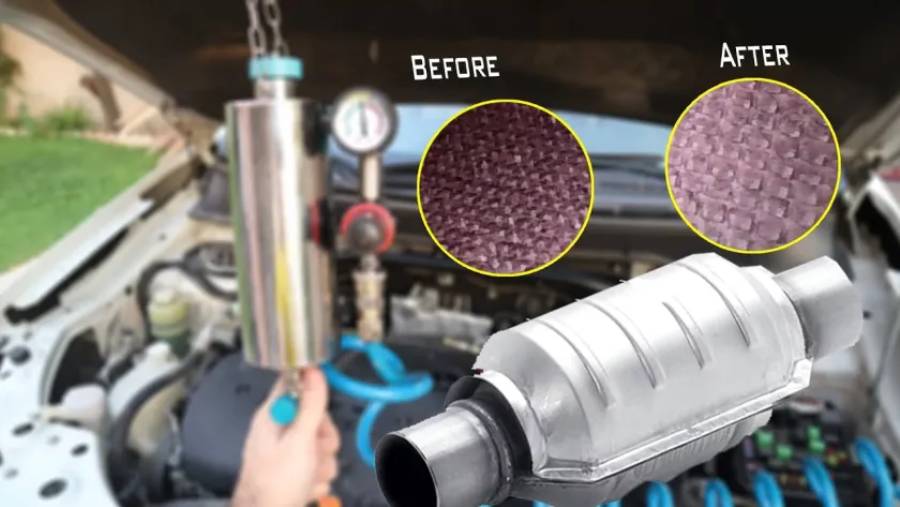
How Do You Fix a Clogged Catalytic Converter?
Fix a clogged catalytic converter by confirming the restriction, finding the underlying engine problem, inspecting the converter, and cleaning or replacing it according to the condition of its internal substrate. Cleaning is appropriate when deposits or contamination can be removed without damage to the catalyst. Replacement is necessary when the honeycomb substrate has melted, collapsed, cracked, or broken because cleaning cannot restore its physical structure.
The repair process has 6 main stages: confirm the symptoms, scan the vehicle for diagnostic trouble codes, test for exhaust restriction, identify the cause of the failure, inspect or clean the converter when appropriate, and replace it if physical damage is present. This sequence prevents unnecessary replacement because poor acceleration or loss of engine power can originate from problems outside the catalytic converter. An OBD-II scanner, exhaust backpressure test, vacuum test, temperature measurements, and physical inspection can narrow the diagnosis before a repair decision is made.
The underlying fault must also be corrected as part of the repair. For example, an engine misfire can send unburned fuel into the exhaust, where continued combustion can raise catalytic converter temperatures and damage the substrate. Oil consumption and internal coolant leaks can contaminate the catalyst, while an excessively rich air-fuel mixture can expose it to excess fuel. Replacing the converter without addressing these conditions leaves the new component exposed to the same failure mechanism.
Cleaning and replacement therefore solve different types of catalytic converter problems. Cleaning targets removable contamination or deposits when the substrate remains structurally intact. Replacement addresses irreversible physical damage or a restriction that cannot be removed. The correct repair depends on diagnosis rather than the presence of a check engine light or a single symptom.
What Are the Symptoms of a Clogged Catalytic Converter?
The main symptoms of a clogged catalytic converter are loss of engine power, sluggish acceleration, reduced high-RPM performance, hard starting, stalling, abnormal exhaust behavior, and a check engine light. These symptoms develop because a restricted converter prevents exhaust gases from leaving the engine at the required rate. As restriction increases, exhaust backpressure rises and interferes with the engine’s ability to move gases efficiently through the combustion and exhaust cycle.
Loss of power is especially relevant when engine load increases. An engine requires greater airflow as the driver accelerates, climbs a hill, or operates at higher RPM. A restricted catalytic converter limits the corresponding increase in exhaust flow, so the vehicle may accelerate normally at light throttle but become noticeably weak when more power is demanded. Severe restriction can progress to poor high-RPM operation, hard starting, or stalling because the engine cannot expel exhaust gases efficiently enough to maintain normal combustion.
A check engine light can accompany the performance symptoms, but a diagnostic trouble code related to catalyst efficiency does not by itself prove that the catalytic converter is clogged. The emissions system uses upstream and downstream oxygen-sensor information to monitor engine operation and catalyst performance. A fault involving catalyst efficiency, fuel mixture, ignition, or an oxygen sensor therefore needs to be interpreted as part of the complete diagnosis rather than treated as confirmation of a physical blockage.
Symptoms also need to be separated from their possible causes. Poor acceleration, stalling, and reduced engine performance can occur with ignition, fuel-delivery, airflow, and other exhaust-system problems. For example, an engine misfire may cause poor performance while simultaneously overheating and damaging the catalytic converter. The presence of several compatible symptoms increases suspicion of exhaust restriction, but testing is required to determine whether the converter itself is clogged.
How Can You Tell if a Catalytic Converter Is Clogged?
You can tell if a catalytic converter is clogged by combining engine symptoms with diagnostic trouble codes and tests that measure exhaust restriction. No single symptom confirms a blockage because loss of power, poor acceleration, hard starting, and stalling can also result from ignition, fuel-delivery, airflow, or sensor problems. A reliable diagnosis therefore moves from electronic diagnosis to physical restriction testing before the catalytic converter is cleaned or replaced.
Start by checking when the performance problem occurs. A restricted exhaust system becomes more noticeable as exhaust volume increases, so a vehicle may idle normally but lose power during acceleration or at higher engine speeds. The diagnostic process should then determine whether this behavior corresponds with abnormal exhaust restriction rather than assuming the catalytic converter is responsible. This distinction matters because replacing a converter based only on poor engine performance can leave the actual fault unresolved.
How Do You Diagnose a Clogged Catalytic Converter With an OBD-II Scanner?
An OBD-II scanner helps diagnose a clogged catalytic converter by identifying emissions, fuel-mixture, ignition, and sensor faults that may be related to converter failure. Connect the scanner to the vehicle’s diagnostic port, retrieve stored and pending diagnostic trouble codes, and review relevant live data where the scan tool and vehicle support it. The objective is not simply to find a catalytic-converter code but to identify faults that explain both the symptoms and the condition of the converter.
Catalyst-efficiency codes require careful interpretation. For example, P0420 indicates that catalyst-system efficiency for Bank 1 has fallen below the threshold monitored by the vehicle, while P0430 applies to Bank 2 on engines equipped with that bank. Neither code independently proves that the converter is physically clogged. Catalyst efficiency and exhaust restriction describe different conditions, so a converter can have an efficiency problem without being severely blocked.
The scanner should also be used to look for faults that could damage the converter. Misfire codes, fuel-trim abnormalities, oxygen-sensor faults, and rich-running conditions can reveal an upstream engine problem that exposes the catalyst to excessive fuel or abnormal exhaust conditions. For example, persistent misfires can allow unburned fuel to enter the exhaust and generate excessive heat inside the converter. Finding that fault changes the repair from simply replacing a converter to correcting the engine problem responsible for the damage.
Diagnostic codes should therefore guide the next test rather than end the diagnosis. If the vehicle has symptoms consistent with exhaust restriction, a physical restriction test provides stronger evidence that the exhaust path is actually blocked.
How Do You Test a Catalytic Converter for Exhaust Restriction?
Test a catalytic converter for exhaust restriction by measuring exhaust backpressure or evaluating engine vacuum behavior, with temperature measurements used as supporting evidence when appropriate. These tests examine the physical effects of restricted exhaust flow and therefore provide different information from an OBD-II scan.
An exhaust backpressure test directly evaluates resistance in the exhaust system. A pressure gauge can be connected at an appropriate test point in the exhaust path, depending on the vehicle and test procedure. Pressure is then observed under specified engine operating conditions. Excessive pressure upstream of the catalytic converter supports the presence of an exhaust restriction, although the location of the blockage still needs to be established because other exhaust components can also restrict flow.
A vacuum gauge provides an indirect method of identifying restricted exhaust. Engine vacuum is observed at idle and under controlled changes in engine speed. A restriction can cause vacuum behavior to deteriorate as exhaust gases accumulate and the engine becomes less able to move air through the cylinders. Because vacuum readings can also be affected by other engine conditions, the result should be interpreted with the vehicle’s symptoms and other diagnostic evidence.
Temperature measurements can add another layer of evidence, but temperature alone should not be used to declare a catalytic converter clogged. Converter temperature depends on engine load, air-fuel mixture, catalyst activity, and the location and timing of the measurement. An unusual temperature pattern can justify further investigation, while backpressure and physical inspection provide more direct evidence of a restriction.
The diagnosis is strongest when several findings point to the same conclusion. For example, loss of power under load combined with excessive exhaust backpressure and evidence locating the restriction at the converter provides a substantially stronger basis for repair than a check engine light alone. Once the blockage has been confirmed, the next step is to determine what caused the catalytic converter to become restricted because that cause determines whether cleaning, replacement, or additional engine repair is required.
What Causes a Catalytic Converter to Become Clogged?
A catalytic converter becomes clogged or restricted when contamination accumulates on the catalyst or excessive heat damages the internal honeycomb substrate and reduces exhaust flow. Four important underlying problems are engine misfires, an excessively rich air-fuel mixture, engine oil consumption, and coolant entering the combustion process. Identifying which condition caused the failure is essential because cleaning or replacing the converter without correcting the source can lead to repeated damage.
Engine misfires can damage a catalytic converter by allowing unburned fuel and oxygen to enter the exhaust system. Instead of completing combustion inside the cylinder, part of the fuel reaches the converter, where reactions can generate excessive heat. Persistent overheating can damage or melt sections of the honeycomb substrate. Once the internal passages deform or collapse, the available path for exhaust gas becomes smaller and backpressure increases. Ignition faults such as defective spark plugs or coils therefore need attention when diagnosing converter damage rather than treating the catalytic converter as an isolated component.
An excessively rich air-fuel mixture can create a similar problem because more fuel enters the engine than can be efficiently burned under the operating conditions. Fuel-delivery faults, sensor problems, or other engine-management issues can contribute to rich operation. The resulting exhaust conditions increase the thermal load on the converter and can contribute to catalyst deterioration. Diagnostic evidence such as fuel-trim data and relevant trouble codes can help identify this type of upstream problem before a replacement converter is installed.
Oil and coolant create a different failure mechanism. An engine that burns oil can send combustion byproducts into the exhaust, where deposits can contaminate the catalyst and interfere with the converter’s internal surfaces. Coolant entering the combustion chamber because of an internal engine fault can also contaminate the exhaust stream and converter. Cleaning the catalytic converter does not repair worn engine components or an internal coolant leak, so the source of contamination must be corrected to prevent the problem from returning.
Physical damage must also be distinguished from removable contamination. A converter with deposits and an intact substrate presents a different repair situation from one with melted, collapsed, cracked, or broken honeycomb material. This distinction determines whether cleaning is worth attempting or whether replacement is required.
Can You Clean a Clogged Catalytic Converter Without Removing It?
A clogged catalytic converter can sometimes be cleaned without removal when the restriction involves removable contamination and the internal substrate remains structurally intact. In-tank catalytic converter cleaners and appropriate engine operation may be used as non-removal approaches, but neither method can repair a converter with melted, collapsed, cracked, or broken internal material. The condition of the converter therefore determines whether non-removal cleaning is a reasonable repair attempt.
Catalytic converter cleaners are generally added to the fuel according to the product manufacturer’s instructions. The objective is to address certain deposits as the treated fuel passes through the combustion and exhaust process. These products should not be treated as a guaranteed cure for exhaust restriction. A chemical treatment cannot reconstruct damaged honeycomb passages, correct an engine misfire, stop oil consumption, or repair an internal coolant leak.
Driving the vehicle until the exhaust system reaches its normal operating temperature is also sometimes presented as a way to “unclog” a catalytic converter. Normal operating temperature may support normal catalyst operation, but highway driving does not repair a physically damaged converter. A converter whose passages have melted or collapsed remains mechanically restricted regardless of how long the vehicle is driven. Continuing to drive a vehicle with severe power loss, overheating, or other signs of major exhaust restriction can also worsen the underlying problem.
Non-removal cleaning makes the most sense after diagnosis has ruled out severe physical damage and the engine faults responsible for contamination are being addressed. For example, attempting to clean a converter while an active misfire continues to send unburned fuel into the exhaust does not remove the mechanism damaging the catalyst. The same principle applies when the engine is burning significant oil or allowing coolant into the combustion chamber.
Evaluate the result after any cleaning attempt rather than assuming the treatment worked. Engine performance, acceleration, diagnostic information, and evidence of exhaust restriction should improve if removable contamination was responsible for the problem. Persistent restriction indicates that further inspection is necessary. At that point, removing the converter for inspection can reveal whether the honeycomb is cleanable or has sustained physical damage that requires replacement.
How Do You Clean a Catalytic Converter After Removing It?
Clean a removed catalytic converter only after inspecting the internal substrate and confirming that it is structurally intact. Removal provides access for a closer inspection and can help distinguish surface contamination from permanent physical damage. A converter with an intact honeycomb may be a candidate for cleaning, while melted, collapsed, cracked, or broken material indicates that cleaning will not restore normal exhaust flow.
Allow the exhaust system to cool completely before removal because catalytic converters operate at high temperatures. Disconnect the converter according to the vehicle-specific service procedure and inspect both ends where the substrate is visible. Look for heavy deposits, blocked passages, discoloration associated with excessive heat, loose material, cracks, and deformation. The inspection should occur before cleaning because physical damage changes the repair decision from cleaning to replacement.
If the substrate is intact and cleaning is appropriate, use a method and cleaning product that are compatible with the converter and follow the product or vehicle manufacturer’s instructions. Avoid aggressive mechanical cleaning that can fracture the honeycomb or damage the catalyst-coated surfaces. The objective is to remove suitable contamination without damaging the internal structure that performs the emissions-control function.
The converter must be sufficiently dry and free of loose material before reinstallation. Reinstall it using the correct mounting hardware, seals, and vehicle-specific torque procedures where applicable. After installation, start the engine and inspect the exhaust system for leaks before evaluating whether the original restriction symptoms have improved.
How Can You Tell if a Catalytic Converter Is Too Damaged to Clean?
A catalytic converter is too damaged to clean when its internal honeycomb is melted, collapsed, broken, severely cracked, or permanently obstructed. These conditions change the physical structure of the exhaust passages. Chemical cleaning cannot rebuild missing catalyst material, reopen passages that have physically collapsed, or restore a substrate that has melted from excessive heat.
A visual inspection can reveal several forms of structural failure. Melted sections can appear deformed and close passages that should allow exhaust gases through. Broken substrate may produce loose fragments inside the converter, while cracks can indicate thermal or mechanical damage. Severe contamination also requires further evaluation because deposits may coexist with structural deterioration rather than being the only cause of restriction.
The distinction between contamination and structural damage prevents ineffective repairs. An intact but contaminated substrate may justify cleaning; a physically damaged substrate requires replacement. If inspection cannot establish the converter’s condition or the restriction remains after cleaning, additional diagnosis is preferable to repeatedly applying cleaning products.
When Should You Replace a Clogged Catalytic Converter?
Replace a clogged catalytic converter when the substrate is physically damaged, the restriction cannot be removed through an appropriate cleaning attempt, or the converter remains unable to perform correctly after the underlying engine faults have been addressed. Replacement is therefore based on the condition and performance of the converter rather than on a check engine light alone.
Melted or collapsed honeycomb is a strong reason for replacement because the exhaust passages have permanently changed shape. Broken substrate also requires replacement when fragments have separated or the internal structure can no longer function as designed. Cleaning these conditions cannot restore the original exhaust passages or catalyst surface.
Persistent restriction after an appropriate cleaning attempt provides another reason to consider replacement. If diagnosis continues to show restricted exhaust flow and other possible blockage locations have been excluded, the converter may contain contamination or internal damage that cleaning cannot resolve. Repeating chemical treatments does not address permanent restriction and can delay the repair actually required.
Fix the underlying engine problem before or at the same time as replacing the catalytic converter. A replacement converter is exposed to the same exhaust stream that damaged the previous unit. An unresolved misfire can continue sending unburned fuel into the exhaust, a rich-running engine can continue increasing thermal stress, and an engine that burns oil or coolant can continue contaminating the catalyst.
For example, replacing a heat-damaged converter while leaving an active ignition misfire unresolved addresses the result but not the cause. The new converter can again receive unburned fuel and experience abnormal temperatures. A complete repair therefore consists of both restoring the exhaust system and eliminating the engine condition responsible for the converter failure.
How Do You Check if the Catalytic Converter Repair Worked?
Check whether a catalytic converter repair worked by confirming that the original symptoms have disappeared and that the exhaust system no longer shows evidence of abnormal restriction. Verification should cover engine performance, acceleration, diagnostic information, and the specific test results that originally identified the problem. A repair is incomplete if the converter has been cleaned or replaced but the vehicle still exhibits the same restriction symptoms.
Start by comparing engine performance before and after the repair. Loss of power and sluggish acceleration caused by exhaust restriction should improve when normal exhaust flow is restored. The engine should also operate normally through the RPM range where the problem previously appeared. If the vehicle still loses power as engine speed or load increases, additional diagnosis is required because the restriction may remain or another engine problem may be responsible for the symptom.
Check the vehicle again with an OBD-II scanner after completing the repair. Diagnostic trouble codes and relevant live data can show whether emissions, misfire, fuel-mixture, or sensor problems remain. Clearing a code alone does not prove that the repair worked because the engine control system may need to complete its monitoring process before a fault returns. The important result is whether the fault remains absent after the vehicle has operated under the conditions required for the relevant system monitor.
Repeat the diagnostic test that confirmed the original restriction when appropriate. For example, if excessive exhaust backpressure was used to establish that the converter was restricted, a post-repair measurement can confirm whether that restriction has been reduced. Comparing the same type of measurement before and after repair provides stronger evidence than relying only on a change in how the vehicle feels.
The final check is the underlying cause. A repaired exhaust system should not be considered complete while an active misfire, rich-running condition, oil-consumption problem, or coolant leak continues. These faults can expose a cleaned or replacement catalytic converter to the same conditions that damaged the previous unit.
Can You Drive With a Clogged Catalytic Converter?
You should not continue driving normally with a severely clogged catalytic converter because increasing exhaust restriction can reduce engine performance and place additional stress on the engine and exhaust system. Whether a vehicle can be moved for diagnosis depends on the severity of the symptoms, but significant power loss, stalling, or evidence of excessive heat requires greater caution than a vehicle with only a suspected minor restriction.
A clogged converter restricts the route used by exhaust gases to leave the engine. As the blockage becomes more severe, exhaust backpressure can increase and interfere with the engine’s ability to move gases through the cylinders. The driver may notice that the vehicle struggles to accelerate, loses power under load, or cannot reach higher engine speeds normally. Severe restriction can make continued operation increasingly difficult.
Driving also fails to address the fault that caused the converter problem. If an active misfire or rich air-fuel mixture is sending unburned fuel into the exhaust, continued operation can expose the catalytic converter to additional heat. Similarly, oil or coolant entering the combustion process can continue contaminating the converter. The distance driven is therefore not the only consideration; the active failure mechanism also matters.
Stop treating the vehicle as suitable for normal driving if it develops severe loss of power, repeated stalling, abnormal overheating, or another symptom that makes operation unsafe. The appropriate next step is diagnosis rather than attempting to clear a serious restriction through extended driving. Once the converter and the underlying engine fault have been repaired, post-repair testing can confirm that normal exhaust flow and engine performance have been restored.
Read more: Door Lock Actuator Replacement: Symptoms, Cost, and Process
How Much Does It Cost to Fix a Clogged Catalytic Converter?
The cost to fix a clogged catalytic converter depends on whether the vehicle needs diagnosis, cleaning, catalytic converter replacement, or repairs to the engine problem that caused the converter to fail. Cleaning an intact converter and replacing a physically damaged converter are different repair paths, so there is no single repair price that applies to every clogged catalytic converter.
Diagnosis should be included when estimating the total repair cost. A technician may need to scan diagnostic trouble codes, evaluate engine data, test exhaust restriction, and inspect the converter before deciding whether cleaning or replacement is appropriate. This step can prevent unnecessary parts replacement because loss of power and catalyst-related trouble codes do not independently prove that the converter is physically clogged.
Cleaning can reduce the repair cost when contamination is removable and the honeycomb substrate remains intact. The total expense depends on whether the converter can be treated without removal or must be removed for inspection and cleaning. Labor requirements also vary by vehicle because converter location, exhaust-system design, corrosion, and access to mounting hardware affect the amount of work required.
Replacement is the more extensive repair when the substrate has melted, collapsed, broken, or remained permanently restricted. Converter prices vary according to the vehicle, converter design, emissions requirements, and whether the replacement is an original-equipment or compatible aftermarket component. Labor costs also change according to converter location and the amount of exhaust-system disassembly required.
The final repair bill may include correcting the underlying engine fault. For example, replacing a converter damaged by persistent misfires without repairing the ignition problem leaves the replacement component exposed to the same failure mechanism. Oil consumption, coolant leakage, rich operation, and fuel-system faults can likewise add repair work beyond the catalytic converter itself. For this reason, the useful cost question is not only how much a converter costs, but how much it costs to correct both the restriction and its cause.
How Can You Prevent a Catalytic Converter From Clogging Again?
Prevent a catalytic converter from clogging again by correcting combustion faults, controlling oil and coolant contamination, maintaining the ignition and fuel systems, and responding to engine or emissions faults before they damage the converter. Prevention focuses on controlling what enters the catalytic converter because the component operates downstream of the engine and receives the products of combustion.
Repair engine misfires promptly. Worn spark plugs, defective ignition coils, fuel-delivery problems, and other combustion faults can prevent fuel from burning correctly inside the cylinder. Unburned fuel that reaches the exhaust can increase the thermal load on the catalytic converter and contribute to substrate damage. A flashing or persistent check engine light associated with a misfire should therefore be treated as an engine problem that can also threaten the emissions system.
Maintain the correct air-fuel mixture. Fuel injectors, oxygen sensors, airflow-related components, and engine-management systems influence how much fuel enters the combustion process. A persistent rich-running condition can expose the converter to excessive fuel and heat. Diagnosing fuel-trim abnormalities and related trouble codes helps address the cause before prolonged operation damages the catalyst.
Address excessive oil consumption and coolant loss instead of treating converter contamination as an isolated problem. Oil entering the combustion chamber produces residues that can reach the catalyst, while internal coolant leakage can contaminate the exhaust stream. Cleaning or replacing the converter does not stop either fluid from entering the engine, so the mechanical source must be repaired to protect the converter from recurring contamination.
Use diagnostic warnings as an opportunity for early intervention. A check engine light does not automatically mean that the catalytic converter is clogged, but codes involving misfires, fuel mixture, oxygen sensors, and catalyst performance can reveal conditions that deserve investigation. Correcting these faults before they progress reduces the likelihood that a relatively small engine problem will become a catalytic converter failure.
A successful long-term repair therefore addresses both sides of the problem: restore normal exhaust flow and remove the condition that caused the converter to become contaminated, overheated, or physically damaged. This approach reduces repeated converter failure and prevents cleaning or replacement from becoming a temporary fix.