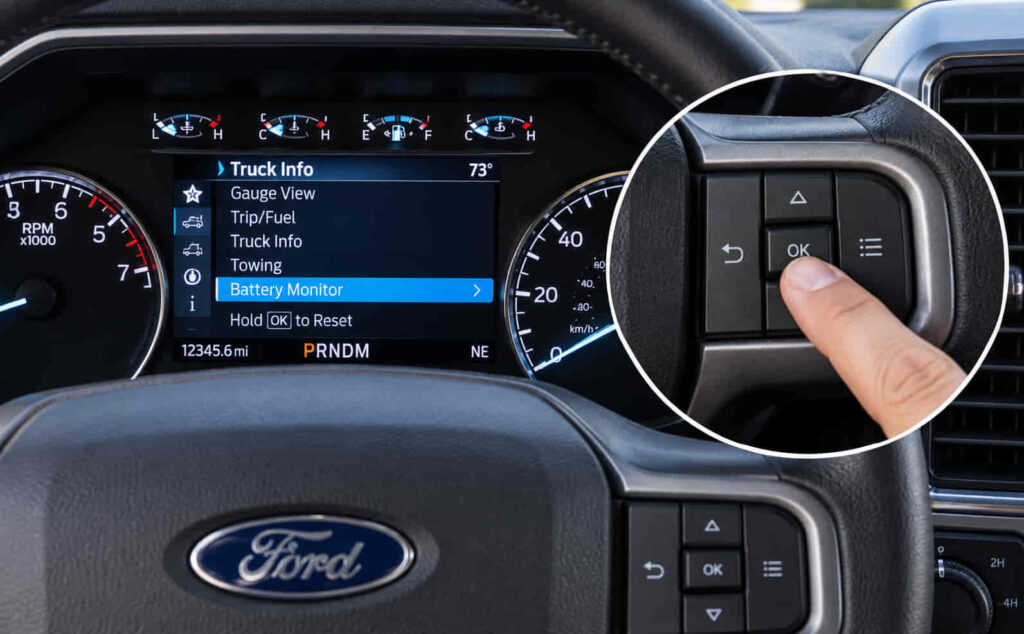
A Ford F150 Battery Monitor reset tells the Battery Monitoring System (BMS) that the 12-volt battery has been replaced so the system can begin monitoring the new battery from an updated baseline. Replacing the physical battery and resetting the battery monitoring data are separate processes. The new battery can start the truck normally while the BMS still requires the appropriate reset or relearn process after replacement.
The Battery Monitoring System is part of the F-150’s electrical and charging management strategy. It uses battery-related information to determine battery condition and manage electrical operation accordingly. This is why a BMS reset should not be treated as a general solution for a weak battery, faulty charging system, poor electrical connection, or another physical problem. Its purpose is to update the monitoring system after the battery-related service for which a reset is required.
The correct Ford F150 battery monitor reset procedure can depend on the model year and electrical system configuration, so the applicable procedure should be confirmed before using a manual reset sequence or diagnostic tool. This guide explains how the Ford F-150 BMS works, why and when it needs to be reset, how to perform and verify a reset, what can happen when the system is not reset after battery replacement, and how to diagnose a BMS that does not reset correctly.
What Is the Battery Monitoring System on a Ford F150?
The Battery Monitoring System on a Ford F150 monitors the condition and use of the 12-volt battery so the vehicle can manage charging and electrical loads based on the battery’s monitored state. The BMS is therefore not the battery itself and does not create electrical energy. It is part of the vehicle’s electrical management strategy and uses battery-related information to determine how the charging system and electrical functions should be managed.
Battery monitoring begins at the 12-volt battery and its associated sensing system. The vehicle needs more information than whether the battery can start the engine at a particular moment. Battery condition changes as the battery is charged, discharged, aged, and exposed to different electrical demands. Monitoring these changes allows the vehicle to maintain an ongoing representation of battery condition instead of treating every battery as though it were always in the same state.
This distinction is important when diagnosing Ford F-150 battery problems. A battery can be a physical source of stored electrical energy, while the BMS is the system responsible for monitoring battery-related conditions and contributing information to the vehicle’s electrical management strategy. Replacing the battery corrects a physical battery problem when replacement is necessary, but replacement alone does not serve the same function as resetting the monitoring system.
The BMS also should not be confused with the alternator or charging system. The alternator supplies electrical power and charges the battery while the engine is operating, whereas battery monitoring provides information used as part of the vehicle’s management of that electrical system. A battery that repeatedly becomes discharged can therefore require diagnosis of the battery, charging system, electrical connections, or parasitic electrical loads rather than automatically requiring a BMS reset.
Understanding this relationship explains why the reset procedure exists. The Ford F-150 does not only have a battery installed under the hood; it also has a system that monitors that battery over time. When the monitored battery is replaced, the physical component changes immediately, while the monitoring system must begin accounting for the replacement battery appropriately.
Why Does a Ford F150 Battery Monitor Need to Be Reset?
A Ford F150 Battery Monitor needs to be reset after an applicable battery replacement so the Battery Monitoring System can recognize that the previously monitored battery has been replaced and establish a new monitoring baseline. The reset separates the operating history associated with the previous battery from the monitoring process used for the replacement battery.
This matters because an old battery and a new battery do not represent the same electrical condition. The battery removed from the truck may have experienced years of charging and discharging, declining capacity, or repeated low states of charge. A replacement battery begins its service life under different conditions. If the vehicle is designed to use a BMS reset following replacement, informing the monitoring system about that change allows battery management to proceed from the appropriate replacement event rather than treating the physical change as though it never occurred.
The reset does not charge the new battery, repair the alternator, increase battery capacity, or correct a poor terminal connection. It changes the relevant battery-monitoring state used by the vehicle. This distinction prevents a common diagnostic mistake: using a BMS reset as a repair for an electrical fault that exists somewhere else in the system. A truck with a defective battery or charging-system problem still requires diagnosis of that fault even if the BMS reset procedure is completed successfully.
Battery replacement and BMS reset should therefore be understood as two connected but different service actions. Battery replacement changes the physical energy-storage component. The BMS reset updates the monitoring system for the battery change. One action cannot automatically substitute for the other.
The exact reset requirement and procedure must still match the Ford F-150 model year and system configuration being serviced. Ford F-150 production spans multiple electrical architectures, so a procedure confirmed for one application should not automatically be generalized to every F-150. Establishing the exact vehicle application before performing the reset prevents an unrelated Ford procedure from being mistaken for the correct F-150 BMS reset method.
Read more: Ford F150 Spark Plug Blowout
When Should You Reset the Ford F150 Battery Monitoring System?
A Ford F150 Battery Monitoring System should be reset when the 12-volt battery is replaced and the specific model year and electrical system require the BMS to register that replacement. The reset is tied to a change in the monitored battery, not simply to the appearance of a battery warning, a temporary low-voltage condition, or an unrelated electrical problem.
Battery replacement is the primary context for a BMS reset because the vehicle is beginning to operate with a different physical battery. The previous battery may have accumulated a monitoring history associated with its age, charging cycles, state of charge, and electrical use. Installing a replacement changes the component being monitored, so the applicable reset procedure allows the system to recognize the replacement event and begin monitoring the new battery from an appropriate baseline.
Disconnecting and reconnecting the same battery should not automatically be treated as equivalent to installing a new battery. The physical battery has not changed simply because its terminals were temporarily disconnected during service. Performing a replacement-related reset without confirming that the procedure is required can incorrectly treat an existing battery as though a new battery had been installed. The reason for the reset should therefore be established before the procedure is performed.
A low or discharged battery also does not by itself establish a need for a BMS reset. A battery can become discharged because of insufficient charging, extended vehicle storage, an electrical load while the engine is off, a deteriorated battery, poor electrical connections, or another charging-system problem. Resetting battery monitoring information does not restore the battery’s physical capacity or remove the electrical condition that caused the discharge.
The same distinction applies when a Ford F-150 repeatedly displays battery-related symptoms after a new battery has been installed. A required BMS reset may be part of completing the battery replacement correctly, but persistent symptoms should not automatically be attributed to an unreset BMS. The replacement battery, battery connections, monitoring sensor, charging system, and relevant electrical circuits may need to be evaluated according to the symptoms present.
A BMS reset is therefore a specific service action rather than a general battery troubleshooting technique. Reset the Ford F150 Battery Monitoring System when the applicable service procedure requires the vehicle to register a battery replacement, and diagnose the electrical system separately when the underlying problem is a weak battery, charging fault, connection problem, or abnormal electrical drain. This distinction prevents the reset procedure from being used to mask a physical fault that still requires repair.
How Do You Reset the Battery Monitor on a Ford F150?
A Ford F150 Battery Monitoring System can be reset on compatible models by switching the ignition on without starting the engine, flashing the high beams five times, and pressing and releasing the brake pedal three times within 10 seconds. When the procedure is accepted, the battery warning indicator should flash to indicate that the Battery Monitoring System reset has been completed. The exact procedure should be confirmed for the specific F-150 model year before it is used because Ford electrical systems and reset methods are not identical across every generation.
Begin with the replacement battery correctly installed and the vehicle in the required operating state. Switch the ignition to the on position without starting the engine. This allows the vehicle’s electronic modules to operate while the engine remains off, creating the condition needed for the manual Battery Monitoring System reset sequence.
With the ignition on, flash the high beams five times. Immediately follow this action by pressing and releasing the brake pedal three times. The sequence needs to be completed within approximately 10 seconds so the vehicle interprets the headlight and brake inputs as a BMS reset command rather than unrelated driver inputs.
After the sequence is completed successfully, watch the battery warning indicator for confirmation. A flashing battery indicator is used as the visible acknowledgement that the reset command has been recognized on vehicles supporting this procedure. The confirmation signal is important because completing the physical sequence does not by itself prove that the BMS accepted the reset.
The manual procedure does not replace battery installation or repair a charging-system fault. It registers the applicable battery replacement with the monitoring system. If the new battery has a poor terminal connection, insufficient charge, an incompatible specification, a battery sensor problem, or a separate charging-system fault, those conditions can remain after a successful BMS reset.
A diagnostic scan tool can provide another method of performing or confirming battery-monitoring service on applications where the appropriate diagnostic function is supported. This becomes particularly relevant when the manual procedure does not produce the expected confirmation or when the vehicle’s model year does not use the same manual sequence. The correct diagnostic function should match the exact Ford F-150 configuration rather than relying on a generic battery reset command intended for another vehicle.
The model year should therefore be confirmed before treating the manual sequence as universal. For a compatible Ford F150, the manual BMS reset sequence is ignition on without starting the engine, five high-beam flashes, and three brake-pedal presses within 10 seconds, followed by confirmation from the battery indicator. If that sequence does not produce the expected acknowledgement, verify the procedure for the specific model year before repeatedly attempting the reset or assuming that the Battery Monitoring System has failed.
Can You Reset a Ford F150 BMS Without a Scan Tool?
A Ford F150 BMS can be reset without a scan tool on compatible models that support the manual Battery Monitoring System reset procedure. The manual method uses a specific sequence of vehicle controls to send the reset command, so specialized diagnostic equipment is not required when the procedure is supported and successfully acknowledged by the vehicle.
The manual reset is useful after an applicable 12-volt battery replacement because it allows the Battery Monitoring System to register the replacement without connecting an external diagnostic device. As described in the reset procedure, the ignition is switched on without starting the engine before the required high-beam and brake-pedal inputs are completed. The vehicle then provides a confirmation signal when the command has been recognized.
A scan tool and a manual reset procedure perform the same general service objective only when the diagnostic function and manual procedure are applicable to the vehicle being serviced. The difference is how the command reaches the vehicle’s electronic system. The manual procedure relies on a predefined combination of driver inputs, whereas a compatible diagnostic tool communicates with the relevant vehicle modules and accesses the available battery-monitoring service function.
A scan tool becomes particularly useful when the manual sequence does not produce the expected confirmation. Failure to receive confirmation does not immediately prove that the BMS itself is defective. The vehicle may use a different procedure, the sequence may not have been entered correctly, or further electrical diagnosis may be necessary. Diagnostic equipment can help separate a procedure problem from a fault that requires additional investigation.
Resetting without a scan tool should therefore not mean repeatedly trying different Ford reset sequences until one appears to work. The procedure must correspond to the specific F-150 application. Use the manual BMS reset when the vehicle supports it and use the appropriate diagnostic procedure when the manual method is not applicable or does not receive the expected confirmation.
Does the Ford F150 BMS Reset Procedure Change by Model Year?
The Ford F150 BMS reset procedure can differ by model year and electrical system configuration, so one manual reset sequence should not automatically be applied to every F-150 generation. The F-150 has been produced with changing electrical architectures, control modules, battery-management strategies, and vehicle interfaces, making application identification an important part of the reset process.
Model year matters because a reset sequence is a command recognized by a particular vehicle configuration rather than a mechanical action performed directly on the battery. The high-beam and brake-pedal sequence only works as a reset method when the vehicle’s electronic system is programmed to interpret those inputs accordingly. Performing the same physical actions on an unsupported configuration does not make the procedure valid for that vehicle.
The exact engine alone is also insufficient for selecting a reset procedure. Battery monitoring belongs to the vehicle’s electrical management system, so the relevant configuration can extend beyond engine displacement. Model year, electrical architecture, installed battery-monitoring equipment, and applicable Ford service information provide a stronger basis for determining the correct procedure.
This distinction becomes especially important when instructions found for another Ford vehicle are applied to an F-150. Ford uses related technologies across multiple vehicle lines, but similarity between vehicles does not establish that every reset sequence, confirmation signal, or diagnostic function is interchangeable. Instructions should therefore be matched to the F-150 rather than generalized from another Ford model.
The same principle applies to online instructions that describe a broad range of F-150 model years as though every truck uses an identical procedure. A manual reset sequence should only be presented as applicable where the corresponding vehicle configuration supports it. When applicability is uncertain, the correct approach is to verify the service information for the specific model year instead of assuming that a procedure used by an earlier or later F-150 will produce the same result.
Model-year verification is therefore part of the Ford F150 Battery Monitor reset procedure itself. Identifying the correct vehicle configuration before performing the reset reduces failed attempts, prevents unrelated control sequences from being mistaken for a BMS command, and establishes which confirmation method should be used to determine whether the reset was accepted.
How Do You Know If the Ford F150 BMS Reset Worked?
A successful Ford F150 BMS reset is confirmed when the vehicle provides the expected acknowledgement for the reset procedure used on that specific model year. On F-150 configurations that support the manual high-beam and brake-pedal sequence, the battery indicator flashing after the sequence is the immediate sign that the Battery Monitoring System has recognized the reset command.
This confirmation is more reliable than judging the reset by how the truck starts immediately afterward. Engine cranking primarily shows that the 12-volt battery can supply enough power for the starting system at that moment. It does not independently confirm that the BMS has registered the battery replacement. A new battery can start the engine normally even when the monitoring reset has not been completed.
The reset confirmation and subsequent battery behavior should also be treated as two different diagnostic observations. The confirmation indicates that the reset command was accepted, while later charging or electrical behavior depends on the condition of the entire system. A successful BMS reset cannot make a defective battery, loose terminal connection, faulty battery sensor, or charging-system problem disappear.
If the expected acknowledgement does not occur, do not assume that the reset succeeded simply because the control sequence was completed. First confirm that the ignition state, timing, and sequence were correct for the vehicle. The next step is to verify that the procedure actually applies to the F-150 model year being serviced. If those conditions are correct and the BMS still does not acknowledge the reset, diagnosis with compatible equipment may be required.
For this reason, the expected vehicle acknowledgement is the primary immediate evidence that a manual Ford F150 Battery Monitor reset has been accepted. Normal starting or the absence of a warning after battery replacement should not be substituted for the confirmation specified by the applicable reset procedure.
What Happens If You Do Not Reset the Ford F150 BMS After Replacing the Battery?
If a Ford F150 requires a BMS reset after battery replacement and the reset is not performed, the Battery Monitoring System can continue operating without properly registering the replacement battery as a new monitoring event. The physical battery has changed, but the monitoring system has not received the corresponding reset information required by the applicable service procedure.
This creates a mismatch between the component installed in the truck and the battery information being used by the monitoring strategy. The previous battery may have reached the end of its service life after a long period of charging, discharging, and capacity loss, while the replacement battery begins operation under a different condition. Resetting the applicable monitoring information allows the new battery to be evaluated from the intended baseline instead of carrying the replacement forward without registering that change.
The practical concern is battery and electrical management rather than an immediate assumption that the truck will fail to start. A newly installed battery can have enough charge to start the engine even when the required BMS reset has been omitted. Starting normally therefore does not prove that battery replacement service has been fully completed.
An omitted reset should also be distinguished from installing the wrong battery or having a charging-system fault. Resetting the BMS cannot correct an incorrectly specified battery, damaged battery connection, defective sensor, abnormal electrical drain, or charging problem. Conversely, replacing or charging the battery does not automatically perform a BMS reset when the vehicle requires the replacement to be registered separately.
The appropriate response after discovering that a required reset was skipped is to perform the correct procedure for the specific F-150 configuration and verify that the system acknowledges it. If battery or charging symptoms continue afterward, the symptoms should be diagnosed independently rather than repeatedly resetting the BMS.
A Ford F150 BMS reset is therefore part of completing an applicable battery replacement, not a substitute for battery or charging-system diagnosis. Registering the replacement establishes the correct monitoring context, while the physical condition of the battery and electrical system determines whether additional repair is necessary.
Why Is My Ford F150 Battery Monitor Not Resetting?
A Ford F150 Battery Monitor may fail to reset because the reset sequence is incorrect, the vehicle is not in the required operating state, the procedure does not apply to that model year, or an electrical or battery-monitoring fault requires further diagnosis. When the expected confirmation does not appear, the first objective is to determine whether the vehicle rejected the command or whether the wrong reset method was used.
The reset sequence should be checked before replacing components or assuming that the BMS has failed. On an F-150 that supports the manual procedure described earlier, the ignition must be in the correct state and the high-beam and brake-pedal inputs must be completed in the required order and time window. An incomplete, mistimed, or incorrectly entered sequence may prevent the vehicle from recognizing the inputs as a Battery Monitoring System reset command.
Procedure applicability is the next factor to verify. A reset method used successfully on one Ford vehicle or F-150 model year is not automatically valid for another configuration. If the expected battery-indicator acknowledgement does not occur after a correctly performed sequence, confirm that the procedure applies to the exact model year and electrical system before repeating it. Repeatedly entering an unsupported sequence does not diagnose the reason the system failed to reset.
Battery installation and electrical connections also need attention when a reset problem occurs after replacement. A replacement battery should be installed correctly, and the battery terminals and monitoring-related connections should not be loose, damaged, or left disconnected. A reset command changes monitoring information; it cannot compensate for a physical connection that prevents the electrical system or battery-monitoring hardware from operating correctly.
Further diagnosis becomes appropriate when the correct procedure has been verified but the BMS still does not provide the expected confirmation. A compatible diagnostic tool can help determine whether the relevant battery-monitoring function is available and whether the vehicle has faults requiring investigation. This is more reliable than continuing to perform the manual sequence without evidence that the system is accepting it.
The troubleshooting order should therefore move from the reset procedure to vehicle applicability and then to the electrical system itself. If a Ford F150 BMS will not reset, verify the sequence and model-year-specific procedure first; investigate battery connections, monitoring hardware, and related electrical faults when the correct reset command still is not acknowledged. This approach separates a procedural failure from a physical fault instead of treating both conditions as the same problem.
Does Resetting the BMS Fix Ford F150 Battery and Charging Problems?
No. Resetting the Ford F150 BMS does not repair a defective battery, alternator, electrical connection, battery-monitoring sensor, or another physical charging-system fault. A BMS reset performs a specific electronic service function associated with battery monitoring. It should not be used as a general repair whenever the truck has a battery warning, slow cranking, repeated discharge, or another electrical symptom.
The difference is between monitoring information and physical electrical performance. Resetting the BMS tells the applicable system to recognize the battery replacement and begin the relevant monitoring process from a new baseline. The reset does not add capacity to a deteriorated battery, increase alternator output, tighten a loose battery terminal, or remove an electrical load that is discharging the battery while the truck is parked.
For example, a Ford F-150 that repeatedly needs a jump-start after sitting can have a problem that exists independently of the BMS reset. The battery may be unable to retain sufficient charge, the charging system may not be restoring the energy used during operation, or an abnormal electrical load may be consuming battery power while the vehicle is off. Performing another BMS reset would not identify or repair those physical causes.
The same diagnostic separation applies after installing a new battery. If the correct BMS reset is completed and the truck continues to show battery or charging symptoms, the successful reset narrows the problem rather than solving it automatically. Battery condition, battery specification, terminal connections, charging-system operation, monitoring hardware, and relevant electrical circuits should then be evaluated according to the specific symptom.
A BMS reset and electrical diagnosis therefore serve different purposes. Use the Ford F150 Battery Monitor reset to complete the applicable battery-monitoring procedure after replacement; use battery and charging-system diagnosis to identify persistent electrical faults. Keeping those functions separate prevents unnecessary resets and directs troubleshooting toward the component or circuit actually responsible for the problem.