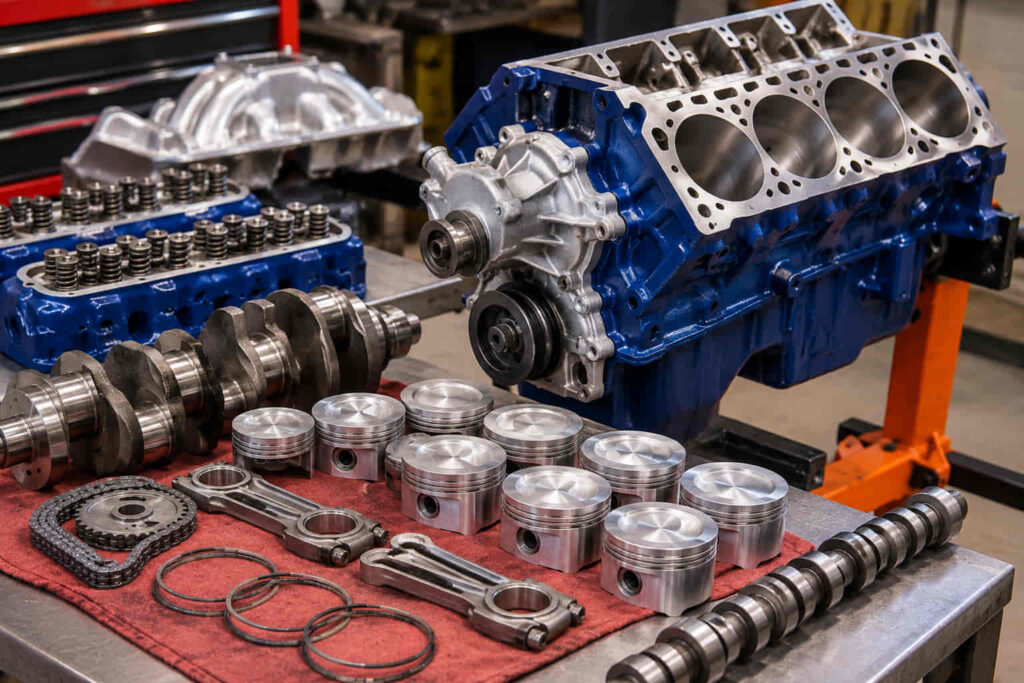
A Ford 302 engine rebuild involves disassembling the 5.0-liter Windsor V8, inspecting the block and rotating assembly, machining worn components, installing new bearings and piston rings, restoring the cylinder heads, and reassembling the engine to the correct specifications. A successful rebuild can restore compression, improve oil pressure, reduce oil consumption, and return an aging Ford small-block to reliable operation.
The Ford 302 is one of the most recognizable American V8 engines. Introduced in 1968, it became a popular powerplant in vehicles such as the Ford Mustang, F-150, Bronco, Thunderbird, and various Mercury and Lincoln models.
Its compact cast-iron block, overhead-valve design, and extensive parts availability make it a practical candidate for restoration and performance modifications.
The most important consideration during a Ford 302 engine rebuild is identifying the exact engine generation before ordering parts. Early 302 engines built from 1968 through 1980 use a 28 oz-in external imbalance specification, while production 302 engines from 1981 through 2001 use a 50 oz-in specification. Using the wrong harmonic balancer or flywheel can cause severe vibration and engine damage.
Camshaft design and firing order also vary. Many early standard 302 engines use the firing order 1-5-4-2-6-3-7-8, while the 5.0L High Output engines use 1-3-7-2-6-5-4-8.
Rebuild costs depend on the engine’s condition and the intended result. A basic rebuild can involve relatively affordable replacement components, while professional machining, cylinder head restoration, balancing, and performance upgrades can increase the total significantly.
This guide explains the essential Ford 302 rebuild procedures, machine shop operations, component compatibility, torque considerations, engine break-in, and whether rebuilding is more economical than purchasing a remanufactured or crate engine.
What Is the Ford 302 Engine?
The Ford 302 is a 302-cubic-inch, approximately 4.9-liter, naturally aspirated gasoline V8 belonging to Ford’s Windsor small-block engine family.
The engine uses a 90-degree V8 configuration with a camshaft located inside the engine block.
Its cylinders have a nominal bore of 4.000 inches and a crankshaft stroke of 3.000 inches.
These dimensions produce a displacement of approximately 302 cubic inches.
The engine uses pushrods and rocker arms to operate its overhead valves.
Unlike a modern dual-overhead-camshaft engine, the traditional 302 has a relatively compact cylinder head arrangement.
This helps explain its popularity in classic Mustangs, hot rods, and engine swaps.
Ford produced several versions of the 302.
Earlier engines commonly used hydraulic flat-tappet camshafts.
Later 5.0L applications introduced hydraulic roller camshaft designs.
Fuel delivery also evolved.
Older engines used carburetors, while later vehicles incorporated electronic fuel injection.
These changes influence which rebuild components are compatible.
For example, a hydraulic roller camshaft cannot automatically be installed in every early block using factory-style roller lifters.
Likewise, intake manifolds, cylinder heads, timing covers, and accessory arrangements can vary.
The Ford 302 should therefore be treated as an engine family rather than one completely interchangeable configuration.
Is the Ford 302 the Same as the Ford 5.0 Windsor?
The traditional Ford 302 and Ford 5.0 Windsor refer to the same basic small-block engine family, although different production versions have distinct components and specifications.
The 302 has a nominal displacement of 4.9 liters.
However, Ford marketed many later versions as the 5.0L V8.
This designation became especially recognizable through the Fox-body Mustang.
The 5.0L High Output engine introduced important performance and valvetrain changes.
Later configurations used hydraulic roller camshafts, revised cylinder heads, electronic fuel injection, and different engine management systems.
However, the basic pushrod Windsor architecture remained.
The modern Ford 5.0L Coyote V8 is different.
Although it shares the 5.0-liter marketing designation, the Coyote uses a dual-overhead-camshaft architecture with four valves per cylinder.
It does not share the same block, cylinder heads, camshaft arrangement, or rebuild procedures as the classic 302 Windsor.
Another important distinction involves the original 1969–1970 Boss 302.
That performance engine combined a specialized short-block arrangement with cylinder heads derived from Ford’s Cleveland-style architecture.
It has different valvetrain and performance components from an ordinary 302 Windsor.
A modern Ford Performance Boss 302 aftermarket block is also a separate component intended for performance builds.
The correct engine type must therefore be identified before purchasing a rebuild kit.
When Does a Ford 302 Need Rebuilding?
A Ford 302 may need rebuilding when internal wear causes persistent low compression, excessive oil consumption, abnormal bearing noise, low oil pressure, or other problems that cannot be corrected through ordinary repairs.
A high-mileage engine may gradually develop wear in its cylinders, piston rings, and bearings.
The resulting symptoms can appear in several ways.
Worn piston rings may allow engine oil to enter the combustion chamber.
This can produce blue exhaust smoke and increased oil consumption.
Excessive cylinder wear can also reduce compression.
The engine may become difficult to start or produce less power.
Worn crankshaft bearings can contribute to low oil pressure or abnormal knocking.
However, these symptoms do not always require a complete rebuild.
A leaking valve cover gasket can cause substantial oil loss while the engine’s internal components remain healthy.
A defective ignition system can create rough idle without any cylinder wear.
Likewise, a carburetor problem may produce poor acceleration even when compression is normal.
The correct diagnosis should include inspection of oil pressure, cylinder compression, leakage, and other relevant components.
A cylinder leakdown test can help distinguish piston ring leakage from valve sealing problems.
A full rebuild becomes more appropriate when testing confirms significant internal wear affecting multiple components.
The decision should also consider the engine’s historical value and the overall condition of the vehicle.
How Much Does a Ford 302 Engine Rebuild Cost?
A Ford 302 rebuild can cost approximately $3,000–$6,500 for parts and machine shop work in a typical owner-managed project, while a professionally completed restoration may cost approximately $5,500–$11,000 or more in the United States.
These are broad 2026 planning estimates rather than fixed repair prices.
The final cost depends on the starting condition of the engine and the amount of work required.
An engine with relatively healthy cylinders and crankshaft journals may need less machining.
A severely worn block may require boring, honing, and additional inspection.
Crankshaft grinding or replacement can add expense.
Cylinder head restoration is another major factor.
New valve guides, hardened valve seats, valve springs, and other components increase the cost.
Performance parts can make a rebuild more expensive.
Aluminum cylinder heads, forged pistons, performance camshafts, and specialized balancing work often cost more than stock-style components.
Labor also matters.
A vehicle with easy engine access may cost less to service than one requiring substantial removal and installation work.
An owner performing disassembly and assembly may reduce labor charges, but professional machining is still necessary when precision work is required.
A current remanufactured 302 long block may be available for less than the cost of a complete custom rebuild.
However, prices must be compared on an equivalent basis.
A long block may not include the intake, distributor, accessories, or installation labor.
The most reliable budget is based on a complete inspection and itemized quotation.
What Parts Are Needed for a Ford 302 Engine Rebuild?
A typical Ford 302 rebuild uses replacement piston rings, main and connecting rod bearings, gaskets, seals, timing components, and other parts determined by the engine’s condition.
However, a rebuild kit is not a substitute for measuring the engine.
The correct piston size cannot be selected until the cylinders have been inspected.
If the bores require machining, oversize pistons may be necessary.
The bearings must also match the crankshaft journal dimensions.
A crankshaft that has been ground undersize requires the appropriate bearings.
The valve train deserves similar attention.
Some rebuilds can reuse a serviceable camshaft.
Others require replacement of the camshaft and lifters.
Valve springs, guides, seals, and other cylinder head components must be inspected.
The oil pump should be evaluated carefully.
A worn or contaminated pump may require replacement.
The water pump, thermostat, hoses, and other cooling system components may also need service depending on their condition.
However, external accessories are not always included in a basic engine rebuild kit.
Compatibility is essential.
An early flat-tappet 302 may use different valvetrain components from a later hydraulic roller engine.
The crankshaft balance specification also affects flywheel and harmonic balancer selection.
The final parts selection should follow precise measurements and the intended build configuration.
How to Identify a Ford 302 Before Rebuilding
The first major step in rebuilding a Ford 302 is identifying the engine block, production configuration, crankshaft balance specification, and valvetrain design.
Many Ford small-block engines have been modified or exchanged between vehicles.
The engine installed in a classic Mustang may not be the engine originally supplied with that vehicle.
For this reason, vehicle model year alone may not establish the correct rebuild specifications.
The block casting number provides useful identification information.
The engine’s physical features and internal components should also be inspected.
Important details include the cylinder head design, camshaft arrangement, crankshaft, timing cover, and accessory drive system.
The 302 family includes different rear main seal arrangements and other production changes.
Later engines may have provisions for hydraulic roller lifters.
However, the actual installed camshaft must still be identified.
A replacement crankshaft may also have a different external balance requirement from the original production assembly.
The builder should document all significant components before disassembly.
This includes the harmonic balancer, flywheel or flexplate, distributor, cylinder heads, and engine accessories.
Photographs and measurements can help prevent reassembly mistakes.
Accurate identification is especially important when rebuilding an engine assembled from parts belonging to different production years.
Step 1: Remove and Disassemble the Ford 302 Engine
A Ford 302 rebuild begins with safe engine removal and organized disassembly so the condition and location of each component can be documented.
The vehicle must be secured before the engine is removed.
The battery should be disconnected.
Fuel, cooling, electrical, and exhaust connections must be handled according to the appropriate service procedure.
The engine should be supported using properly rated lifting equipment.
A suitable engine stand allows the block to be rotated during disassembly.
However, the stand and mounting hardware must be rated for the engine assembly.
Once the engine is accessible, external accessories can be removed.
The intake manifold, valve covers, rocker arms, pushrods, timing cover, and oil pan are then removed according to the service procedure.
The cylinder heads and rotating assembly can be disassembled.
Components should be marked so their original positions are known.
This is particularly important for main bearing caps and connecting rod caps.
These parts are machined as matched components.
Installing them in incorrect positions can cause serious mechanical problems.
The crankshaft, pistons, connecting rods, and camshaft are removed carefully.
All parts should be inspected for visible damage.
However, visual appearance alone is not sufficient to determine whether they can be reused.
Precision measurement is necessary before the rebuild plan is finalized.
Read more: How Long Do Engine Mounts Last
Step 2: Clean and Inspect the Ford 302 Engine Block
The Ford 302 block must be thoroughly cleaned and inspected for cracks, cylinder wear, damaged threads, and distortion before machining or reassembly.
An aging engine can contain sludge, corrosion, and accumulated deposits.
These contaminants must be removed.
A professional machine shop can clean the block using equipment and procedures suitable for cast iron.
Oil galleries deserve particular attention.
A blocked oil passage can restrict lubrication even after new bearings and pistons have been installed.
The block should be checked for cracks.
Potential problem areas include cylinder walls, main bearing webs, and other highly loaded regions.
The cylinder bores must be measured.
A dial bore gauge can identify wear, taper, and out-of-round conditions.
The main bearing bores must also be inspected.
The block deck surfaces should be evaluated for flatness and damage.
However, removing material from the deck changes the relationship between the piston and cylinder head.
Machining decisions should therefore consider piston position, head gasket thickness, and the intended compression ratio.
The condition of threaded holes and other mounting surfaces also matters.
Damaged threads may require an approved repair.
A block with severe cracking or insufficient material for machining may not be economical to rebuild.
The machine shop should determine whether the existing block is suitable for the intended use.
Step 3: Bore and Hone the Ford 302 Cylinders
Cylinder boring and honing restore suitable cylinder dimensions and surface finish when the original bores have developed excessive wear.
The standard Ford 302 cylinder bore is 4.000 inches.
However, an older engine may have worn or damaged cylinder walls.
If the wear exceeds the acceptable limits, simply installing new piston rings may not provide proper sealing.
The machine shop must measure each cylinder.
Boring removes material to establish a new diameter.
Honing then produces the final size, geometry, and surface finish required by the selected pistons and rings.
The piston manufacturer’s clearance specification is essential.
Different piston materials and designs may require different clearances.
A cast piston and a forged performance piston should not automatically be installed using the same measurements.
One common Ford 302 rebuild configuration uses a 0.030-inch overbore.
This increases the bore from 4.000 inches to 4.030 inches.
With the original 3.000-inch stroke, the engine’s displacement increases to approximately 306 cubic inches.
However, a 0.030-inch overbore is not automatically necessary or appropriate for every block.
The machine shop should remove only the material required to restore suitable cylinder condition.
Before substantial boring, the remaining cylinder wall thickness should be evaluated.
For high-performance applications, sonic testing may be advisable.
The final cylinder dimensions must match the actual piston manufacturer’s requirements.
Step 4: Inspect the Crankshaft and Connecting Rods
The crankshaft and connecting rods must be inspected for wear, distortion, cracking, and dimensional accuracy before they are reused in a Ford 302 rebuild.
The crankshaft converts piston movement into rotational output.
Its main journals rotate within bearings supported by the engine block.
The connecting rod journals support the connecting rods.
Over time, bearing wear or lubrication problems can damage the journals.
The machine shop should measure each journal for diameter, taper, and out-of-round conditions.
A damaged crankshaft may require polishing or grinding.
However, material removal must remain within acceptable limits.
A crankshaft that cannot be restored safely should be replaced.
The connecting rods require inspection as well.
Their big-end bores must remain round and correctly sized.
The small ends and piston pin arrangements must also be evaluated.
Worn rod bolts may require replacement according to the build specifications.
Aftermarket rod fasteners can introduce additional requirements.
For example, certain high-performance bolts must be installed using a specified lubricant and evaluated by bolt stretch rather than relying only on generic torque values.
The crankshaft and connecting rods should be selected according to the intended operating RPM and power output.
A stock restoration may be able to reuse properly inspected original components.
A high-output performance build may justify stronger replacement parts.
Step 5: Measure Main and Rod Bearing Clearances
Correct bearing clearance is essential for restoring oil pressure, controlling friction, and protecting the Ford 302 crankshaft and connecting rods.
The engine’s main bearings support the crankshaft.
Connecting rod bearings allow the rods to rotate around the crankshaft journals.
A thin film of engine oil separates the moving surfaces during normal operation.
If the bearing clearance is too small, oil flow and mechanical operation may be affected.
Excessive clearance can reduce oil pressure and allow abnormal movement.
Both conditions can lead to damage.
The builder must measure the crankshaft journal diameters and installed bearing bores.
Precision micrometers and bore gauges provide the most dependable measurements.
Plastic clearance gauge material may be used as a supplementary check, but it should not replace proper dimensional inspection when precision assembly is required.
The appropriate clearance depends on the specific engine and component combination.
A stock engine and a high-RPM performance engine may have different requirements.
The bearing manufacturer and engine builder should establish the correct targets.
Bearing shells must also be installed in their intended positions.
The oil passages must remain correctly aligned.
Main bearing caps should return to their original locations and orientations.
The crankshaft should rotate smoothly after the bearings and caps are installed.
Any unexpected resistance requires investigation before further assembly.
Step 6: Install Ford 302 Pistons and Piston Rings
Installing pistons and rings correctly is essential for restoring cylinder compression, controlling oil consumption, and achieving a durable Ford 302 rebuild.
The selected pistons must match the finished cylinder bores.
Their compression height, wrist pin arrangement, valve reliefs, and material must also suit the intended engine configuration.
A stock-style rebuild may use cast or hypereutectic pistons.
A more demanding performance build may use forged pistons.
However, forged pistons do not automatically provide better durability in every low-load street application.
The appropriate choice depends on operating temperature, power goals, and piston-to-wall clearance requirements.
Piston rings require careful attention.
The ring gaps must be measured inside the finished cylinder bore.
The correct gap depends on ring design, bore size, and expected operating conditions.
A boosted or high-performance engine may require different ring gap specifications from a naturally aspirated stock rebuild.
The piston and ring manufacturer’s instructions should determine the final values.
Rings should be installed in the correct orientation and position.
The pistons must also be oriented correctly in their cylinders.
During installation, the connecting rod bearings and crankshaft journals must be protected from damage.
The piston assembly should enter the cylinder without excessive force.
Unexpected resistance can indicate incorrect ring compression, orientation, or dimensional problems.
These conditions must be corrected before the engine is rotated further.
Step 7: Balance the Ford 302 Rotating Assembly
Correct crankshaft balancing is one of the most important Ford 302 rebuild requirements because production engines use different external imbalance specifications depending on the year.
Ford Performance confirms that production 302 engines built from 1968 through 1980 use a 28 oz-in external imbalance factor.
Production 302 engines from 1981 through 2001 use a 50 oz-in factor.
This distinction affects the harmonic balancer and flywheel or flexplate.
Both components must match the crankshaft’s balance specification.
A 28 oz-in flywheel should not be installed on a stock 50 oz-in rotating assembly.
Likewise, a 50 oz-in balancer should not be paired with an engine designed for 28 oz-in balance.
Ford warns that incorrect component matching can cause severe engine damage.
The issue becomes more complicated when rebuilding an engine with aftermarket parts.
Certain aftermarket crankshafts are configured for 28 oz-in external balance.
Other performance assemblies are internally balanced.
For example, Ford Performance’s modern Boss 302-based short-block uses a neutral-balanced rotating assembly.
That configuration requires the appropriate zero-balance external components.
The builder should therefore identify the actual crankshaft rather than rely solely on the engine’s casting year.
The rotating assembly should be balanced as a complete matched system.
Pistons, piston pins, connecting rods, bearings, crankshaft, damper, and flywheel or flexplate requirements must be considered.
This is not an area where visual similarity is sufficient for determining compatibility.
Step 8: Choose the Correct Ford 302 Camshaft and Lifters
Camshaft selection affects horsepower, torque, idle quality, valve timing, and the compatibility of the Ford 302 valvetrain.
The engine family uses different camshaft and lifter arrangements.
Many early Ford 302 engines have flat-tappet camshafts.
Later versions introduced hydraulic roller lifters.
The 1985–1995 Mustang 5.0L High Output is particularly associated with a hydraulic roller valvetrain.
However, not every engine block from the same period has identical internal provisions.
The camshaft must match the lifter configuration.
An early block may require specialized retrofit components when converting to a hydraulic roller camshaft.
The valve springs must also be compatible with the selected camshaft.
A performance camshaft with greater valve lift may require stronger springs.
However, excessive spring pressure can damage components when the camshaft and lifters are not designed for it.
Rocker arm geometry and pushrod length should also be checked.
A new camshaft can change the operating relationship between the lifters, pushrods, rocker arms, and valves.
The camshaft’s firing order is another important consideration.
The conventional early 302 order differs from that of the 5.0L High Output.
Ford Performance also specifies particular distributor gear materials for certain billet-steel roller camshaft applications.
Using an incompatible gear can cause premature wear.
The selected camshaft should match the engine block, intended power range, and complete valvetrain.
Step 9: Rebuild the Ford 302 Cylinder Heads
A Ford 302 cylinder head rebuild involves inspecting the valve seats, guides, valves, springs, sealing surfaces, and other components that control cylinder compression and airflow.
The cylinder heads must be cleaned and inspected.
Cracks, corrosion, and damaged sealing surfaces can make a head unsuitable for reuse.
Valve guides are particularly important.
Excessive clearance between the valve stem and guide can allow abnormal movement.
It may also contribute to oil consumption.
The valves should be inspected for wear and damage.
Burned valve faces can reduce compression.
Valve seats must provide reliable sealing.
A professional machine shop may perform a valve job when the seats require restoration.
The head surface should also be checked for flatness.
However, unnecessary machining can change combustion chamber volume and compression ratio.
Valve spring condition is another consideration.
Weak springs may not control valve movement correctly at the intended operating speed.
A performance camshaft may require a different spring package.
However, spring pressure, installed height, retainer clearance, and coil bind must be checked.
The piston-to-valve clearance must also be verified when camshaft lift, timing, piston design, or cylinder head geometry has changed.
A stock-style rebuild may use restored factory heads.
A performance build may benefit from modern aftermarket aluminum cylinder heads.
The correct choice depends on budget, intended use, and required compatibility.
Step 10: Assemble the Timing System, Oil Pump, and Engine
Final Ford 302 assembly requires correct camshaft timing, oil pump installation, gasket sealing, fastener tightening, and verification of all critical mechanical clearances.
The timing chain connects the crankshaft and camshaft.
It ensures that valve operation remains synchronized with piston movement.
The timing set must be installed according to the selected camshaft’s instructions.
A stock replacement cam may use the manufacturer’s intended timing marks.
A performance camshaft may require degreeing to confirm its installed position.
The timing cover and related components must also match the engine’s accessory arrangement.
Some Ford 302 applications use different water pump rotation directions.
A standard-rotation pump and reverse-rotation serpentine-belt pump are not automatically interchangeable.
The oil pump must be inspected or replaced as required.
The pickup must match the oil pan and maintain the correct clearance.
A front-sump oil pan may be required in some classic applications.
Later Mustang and truck configurations may use different sump arrangements.
The rear main seal and other gaskets should be installed correctly.
Fasteners must be tightened using the specifications for the actual components.
The builder should verify crankshaft rotation after major assembly operations.
Any unusual resistance should be investigated before the engine is installed.
Once assembly is complete, the lubrication system must be primed before the first startup.
What Are the Ford 302 Engine Torque Specs?
Ford 302 torque specifications depend on the engine generation, fastener type, component design, and whether original or aftermarket hardware is used.
A single universal torque chart is not sufficient for every Ford 302 rebuild.
For example, Ford’s M-6007-F50 5.0L High Output long-block instructions list main bearing bolt torque of 60–70 lb-ft for that particular assembly.
The same document identifies connecting rod bolt torque of 19–24 lb-ft.
However, these values should not be applied automatically to every early 302, aftermarket connecting rod, or performance crankshaft assembly.
Different fasteners may require different tightening methods.
Cylinder head bolts also deserve particular attention.
Certain Ford applications use torque-to-yield bolts with specific installation procedures.
Aftermarket head bolts or studs can use different lubricant and torque specifications.
The gasket manufacturer may also provide special instructions.
The correct procedure should account for thread condition, bolt length, lubricant, and tightening sequence.
Using generic figures without verifying the hardware can produce incorrect clamping force.
This may lead to gasket leakage, bearing distortion, or fastener damage.
For a reliable rebuild, the builder should obtain the factory service manual for the engine and the instructions supplied with any aftermarket fasteners.
Ford 302 Firing Order During Reassembly
The Ford 302 uses different firing orders depending on the camshaft configuration, making accurate identification essential during distributor and spark plug wire installation.
Many standard 302 engines use the firing order 1-5-4-2-6-3-7-8.
The Ford 5.0L High Output uses 1-3-7-2-6-5-4-8.
The latter is also commonly associated with the 351 Windsor.
The cylinders are numbered differently from some other V8 engine families.
On a typical Ford Windsor V8, cylinders 1 through 4 are on the passenger-side bank, from front to rear.
Cylinders 5 through 8 are on the driver-side bank, from front to rear.
The distributor rotates counterclockwise on the traditional Ford 302.
However, the correct spark plug wire routing must match the camshaft’s intended firing order.
This becomes especially important after installing an aftermarket camshaft.
A builder may install a camshaft using the High Output firing order into an earlier standard 302.
The ignition wiring must then match the camshaft configuration.
Some electronic fuel injection systems can also be affected by firing order and injector timing compatibility.
The correct calibration may therefore be necessary.
A rebuilt engine that misfires immediately after installation should have its firing order and distributor installation checked before expensive components are replaced.
Ford 302 Flat-Tappet vs Roller Cam Rebuild
Flat-tappet and hydraulic roller camshaft engines require different lifter components, lubrication considerations, and break-in procedures.
The flat-tappet camshaft uses lifters that operate through sliding contact with the camshaft lobes.
This arrangement relies heavily on correct lubrication and surface preparation during initial operation.
The lifters and camshaft must be matched correctly.
A new flat-tappet camshaft generally requires new compatible lifters.
Reusing worn lifters on a new camshaft can create abnormal contact and accelerate wear.
Hydraulic roller camshafts operate differently.
Their lifters use rolling contact to follow the camshaft lobes.
This reduces sliding friction.
However, roller lifters require the appropriate retention and alignment system.
The engine block must also be compatible with the selected installation method.
Certain early Ford 302 blocks need retrofit lifters and related components for a roller conversion.
A roller camshaft also requires the correct distributor gear material for its particular construction.
The fact that a camshaft is a roller design does not establish one universal distributor gear specification.
A hydraulic roller engine does not use the same traditional flat-tappet camshaft break-in procedure.
Nevertheless, all rebuilt engines require proper lubrication and initial operating checks.
The correct startup instructions should come from the camshaft manufacturer and engine builder.
How to Prime a Ford 302 Oil Pump Before Startup
Priming the Ford 302 lubrication system before the first startup helps ensure that oil reaches critical engine components before they operate under combustion loads.
Ford Performance provides a specific priming procedure for its 302-based crate engines.
The procedure involves removing the distributor and using an appropriate priming tool to drive the oil pump.
For the relevant Ford 302 configuration, the priming tool is rotated counterclockwise.
A mechanical oil pressure gauge should be used to confirm that pressure develops.
Ford’s instructions also describe checking for oil flow to the rocker arms.
This helps verify that lubricant is reaching the upper engine.
However, oil may not reach every rocker arm immediately without rotating the crankshaft to change the internal oil passage positions.
The exact procedure should follow the relevant Ford Performance installation instructions.
After priming, the engine should be inspected for external leaks.
The oil level must also be checked again.
Priming can fill the filter and internal passages, changing the amount of oil remaining in the sump.
The distributor must then be installed correctly.
The engine should be positioned at the appropriate top-dead-center compression condition for cylinder number one.
Distributor gear compatibility and engagement with the oil pump drive shaft are essential.
A rebuilt engine should not be started until the lubrication, ignition, and cooling systems have been prepared properly.
How to Break In a Rebuilt Ford 302 Engine
The correct Ford 302 break-in procedure depends on whether the rebuilt engine uses a flat-tappet or roller camshaft and on the piston ring and component manufacturers’ instructions.
A flat-tappet camshaft has special initial operating requirements.
COMP Cams recommends running certain new flat-tappet camshaft installations at approximately 2,000–2,500 RPM during an initial break-in period of about 30 minutes.
The procedure helps provide the oil splash needed to protect the new camshaft and lifters.
However, the exact recommendations depend on the camshaft and valve spring package.
COMP Cams also specifies appropriate assembly lubricant and spring load precautions for particular flat-tappet configurations.
The manufacturer recommends changing the oil and filter after the initial camshaft break-in.
A hydraulic roller camshaft does not require this same flat-tappet lobe break-in process.
However, the complete rebuilt engine still needs careful initial operation.
Oil pressure, coolant temperature, fuel delivery, and ignition timing should be monitored.
The engine should be checked for leaks.
Piston rings also require appropriate operating conditions to establish their intended contact with the cylinder walls.
The correct procedure depends on ring materials, cylinder finish, and engine builder instructions.
Excessive idling or aggressive operation immediately after rebuilding may be inappropriate for certain combinations.
The engine should be operated according to the instructions supplied with the installed components.
Ford 302 Rebuild vs Remanufactured Engine
Rebuilding an existing Ford 302 preserves the original engine assembly when feasible, while purchasing a remanufactured engine provides a replacement assembly restored by a specialized supplier.
A rebuild can be attractive when maintaining original engine identification is important.
Classic Mustang restorations are one example.
A vehicle owner may want to retain the original block because of historical value or documentation.
A custom rebuild also allows control over the internal components.
The builder can choose pistons, camshaft, cylinder heads, and other parts according to the intended application.
However, the final cost can increase if the original block requires extensive machining.
A remanufactured engine may offer more predictable pricing.
Suppliers commonly provide restored long-block assemblies with specified replacement components.
For example, some suppliers list remanufactured Ford 302 engines in the approximate $2,500–$3,000 range before installation and application-specific extras.
However, a quoted long-block price may not include shipping, taxes, accessories, or additional installation components.
Warranty terms also differ.
Some suppliers require returning a rebuildable core.
Others include a core charge or specify particular exclusions.
The best comparison should consider the complete installed cost, warranty coverage, engine compatibility, and whether original engine preservation is important.
Ford 302 Rebuild vs Crate Engine
A Ford 302 rebuild restores an existing engine, while a crate engine is purchased as a prepared assembly that may use new or remanufactured components.
Ford Performance offers several 302-based engine products intended for performance and restoration applications.
These include short blocks and more complete crate engines.
A modern Ford Performance Boss 302-based short block can use a four-bolt-main block, forged internal components, and neutral balance.
However, this is different from a stock production 302 Windsor.
Its engine architecture and installation requirements must be evaluated carefully.
Certain Ford Performance crate engines also use performance cylinder heads, roller camshafts, and different accessory arrangements.
A crate engine may offer advantages involving assembly quality and time required for installation.
However, it may not fit a particular vehicle without modification.
The oil pan, timing cover, water pump, exhaust system, flywheel, and engine management system must be compatible.
A crate engine also may not include every component required for operation.
For example, some packages exclude the intake manifold or distributor.
A stock restoration may therefore be better served by rebuilding the original engine.
A performance project may benefit from a modern crate engine if the cost and installation requirements are acceptable.
Can You Build a 306 Ford Engine From a 302?
Yes. A Ford 302 with a 4.030-inch finished bore and the original 3.000-inch crankshaft stroke has a displacement of approximately 306 cubic inches.
This is commonly called a Ford 306 rebuild.
The additional displacement comes from enlarging the cylinder bore.
The crankshaft stroke remains unchanged.
However, a 0.030-inch overbore should be selected based on cylinder condition and wall thickness rather than simply to increase displacement.
Boring removes material from the engine block.
If the cylinder walls become too thin, the block may lose strength or develop cooling and sealing problems.
The machine shop should evaluate the block before machining.
The selected pistons must match the finished 4.030-inch bore.
Piston-to-wall clearance and ring end gap must also follow the component manufacturer’s instructions.
The difference in displacement between 302 and 306 cubic inches is relatively small.
Therefore, an overbore alone is unlikely to produce a dramatic horsepower increase.
More substantial performance changes generally involve airflow, compression, camshaft selection, and overall engine tuning.
A 306 can be an effective choice when cylinder machining is already necessary.
However, maintaining proper cylinder wall integrity is more important than gaining four additional cubic inches.
Ford 302 Rebuild vs 331 or 347 Stroker
A standard Ford 302 rebuild retains the original 3.000-inch stroke, while a 331 or 347 stroker build increases displacement through a longer-stroke crankshaft and compatible internal components.
The 331 and 347 configurations are popular among small-block Ford enthusiasts.
A typical 331 combination uses a longer stroke and an appropriate overbore.
A common 347 combination uses a 3.400-inch stroke and a 4.030-inch bore.
Ford Performance’s published 347 crate engine specifications confirm this arrangement.
The additional displacement can provide greater torque potential.
However, a stroker build is more complicated than a stock rebuild.
The connecting rods, pistons, and crankshaft must be selected as a matched system.
Internal clearance also requires attention.
The rotating assembly may need additional clearance within the block.
Piston design, connecting rod geometry, and compression ratio must be evaluated.
Balancing is especially important.
Some aftermarket stroker assemblies are internally balanced.
Others use a specific external imbalance factor.
The correct harmonic balancer and flywheel must match the actual rotating assembly.
The cylinder heads and camshaft should also support the intended airflow and RPM range.
A stroker engine can be a worthwhile performance upgrade, but it generally increases parts and machining costs.
How Much Horsepower Can a Rebuilt Ford 302 Make?
Ford 302 horsepower depends on cylinder heads, camshaft design, compression ratio, fuel delivery, exhaust flow, and engine tuning rather than displacement alone.
A stock-style rebuild usually aims to restore the engine’s original performance.
Horsepower ratings varied significantly across the 302’s production history.
An early carbureted engine may have a different factory output from a later 5.0L High Output.
A rebuilt engine with stock components should not automatically be expected to produce the same horsepower as a modified performance build.
However, the Ford 302 responds well to carefully selected upgrades.
Cylinder heads with improved airflow can support higher output.
A compatible camshaft can increase valve lift and change the engine’s power characteristics.
An appropriate intake manifold and exhaust system may also improve airflow.
However, these modifications must work together.
An aggressive camshaft installed with unsuitable valve springs can cause mechanical problems.
A high compression ratio must also match the intended fuel.
Ford Performance offers a 302-based crate engine rated at approximately 340 horsepower in a specified configuration.
However, that rating applies to a particular package with its own cylinder heads, camshaft, intake, and testing conditions.
It is not a guaranteed output from every rebuilt 302.
For a reliable street engine, smooth torque delivery and component compatibility may be more valuable than the highest possible dyno number.
Common Ford 302 Engine Rebuild Mistakes
The most damaging Ford 302 rebuild mistakes include mismatched crankshaft balancing components, incorrect bearing clearance, improper camshaft selection, inadequate cleaning, and failure to prime the lubrication system.
The external balance specification is particularly important.
A production 302 from 1968–1980 generally uses 28 oz-in imbalance.
A production 302 from 1981–2001 generally uses 50 oz-in imbalance.
Certain aftermarket assemblies use different arrangements.
Using the wrong flywheel or harmonic balancer can cause severe vibration.
Incorrect bearing clearance is another serious problem.
A new engine can develop low oil pressure or bearing damage if the crankshaft journals and bearings are not measured correctly.
Cylinder machining errors can also affect durability.
Pistons must match the actual bore dimensions.
Ring end gaps must meet the manufacturer’s requirements.
Camshaft and lifter compatibility must be confirmed.
A flat-tappet camshaft requires the correct break-in procedure.
A billet-steel roller camshaft may require a particular distributor gear.
Another common mistake involves insufficient cleaning.
Metal particles left inside oil galleries can damage new bearings.
The timing system must also be installed correctly.
Finally, the oil pump should be primed before starting the engine.
A successful rebuild depends on precision and cleanliness, not simply replacing old components with new ones.
How Long Does a Ford 302 Rebuild Take?
A Ford 302 rebuild can take several weeks when professional machining and parts sourcing are required, although the actual duration varies substantially by project.
The engine must first be removed and disassembled.
The internal components then require inspection.
Machine shop work may include cleaning, boring, honing, crankshaft machining, cylinder head restoration, and balancing.
These operations can take time depending on shop workload.
The project may also be delayed if unexpected damage is discovered.
A cracked cylinder head or damaged crankshaft can require additional parts.
Performance builds often involve more planning.
Custom pistons, specialized camshafts, and aftermarket cylinder heads may have longer delivery times.
A stock-style rebuild using widely available parts may be easier to complete.
However, even a relatively simple engine requires accurate measurements and careful assembly.
The final stage includes installation, lubrication priming, ignition setup, initial startup, and break-in.
The builder must also verify oil pressure, cooling system operation, and the absence of leaks.
A professional rebuild estimate should identify whether the quoted time includes engine removal and installation.
Machine shop turnaround and complete vehicle repair time are not necessarily the same.
Is a Ford 302 Engine Rebuild Worth It?
A Ford 302 engine rebuild is often worthwhile when the block remains serviceable, the vehicle has restoration or personal value, and the owner wants to preserve the original engine or build a specific performance combination.
The 302 has several advantages.
Its compact small-block design is well understood by many engine builders.
Replacement parts remain widely available.
The aftermarket offers numerous cylinder heads, camshafts, pistons, and other components.
These factors can make rebuilding more practical than restoring certain rare engines.
A rebuild can also address multiple problems at once.
Worn piston rings, damaged bearings, leaking gaskets, and tired cylinder heads can be restored as part of a complete project.
However, rebuilding is not always the least expensive option.
A remanufactured long block may cost less than a fully customized rebuild.
A severely damaged block may also require replacement.
The cost of labor and machining can exceed the value of an ordinary vehicle.
For a classic Mustang or historically significant Ford, retaining the original block may justify additional expense.
For a daily-driven truck, a compatible remanufactured engine may be more economical.
The correct decision should compare total costs, available warranties, mechanical condition, and the owner’s goals.
A properly planned rebuild can provide years of service, but the result depends on component quality and assembly accuracy.
Final Verdict: How to Rebuild a Ford 302 Engine Successfully
A successful Ford 302 engine rebuild requires accurate identification, professional machining where necessary, correct component matching, precise assembly, and an appropriate initial startup procedure.
The Ford 302 Windsor is a 302-cubic-inch V8 with a nominal 4.000-inch bore and 3.000-inch stroke.
Its long production history makes it a popular restoration and performance engine.
However, not every 302 uses the same components.
Early production engines use a 28 oz-in external imbalance specification.
Later production engines generally use 50 oz-in.
Aftermarket performance assemblies may require neutral-balanced components.
Firing order also varies.
Many conventional 302 engines use 1-5-4-2-6-3-7-8.
The 5.0L High Output uses 1-3-7-2-6-5-4-8.
The installed camshaft must determine the correct ignition configuration.
A proper rebuild begins with disassembly and inspection.
The cylinders should be measured for wear.
The crankshaft, connecting rods, and bearings require precision evaluation.
If the cylinders are bored 0.030 inch over their original diameter, displacement increases to approximately 306 cubic inches.
However, machining should be based on block condition rather than displacement goals alone.
The camshaft and valvetrain must be compatible.
Cylinder heads should be inspected for valve sealing, guide wear, and proper surface condition.
All rotating components must be balanced correctly.
Final assembly requires accurate torque procedures, correct engine timing, and proper lubrication.
Before startup, the oil system should be primed.
A new flat-tappet camshaft requires its specific break-in procedure, while a roller camshaft follows different requirements.
The best Ford 302 rebuild is not necessarily the one with the most expensive performance parts. It is the one assembled with correct measurements, compatible components, reliable lubrication, and a clear operating purpose.
For classic Mustang restorations, a stock-style rebuild may preserve originality.
For performance projects, upgraded cylinder heads, camshafts, and rotating assemblies can provide additional power when selected correctly.
For everyday transportation, a quality remanufactured engine may offer better value.
Ultimately, a carefully rebuilt Ford 302 can restore the dependable operation and recognizable V8 character that made the Windsor small-block one of Ford’s most enduring engine designs.