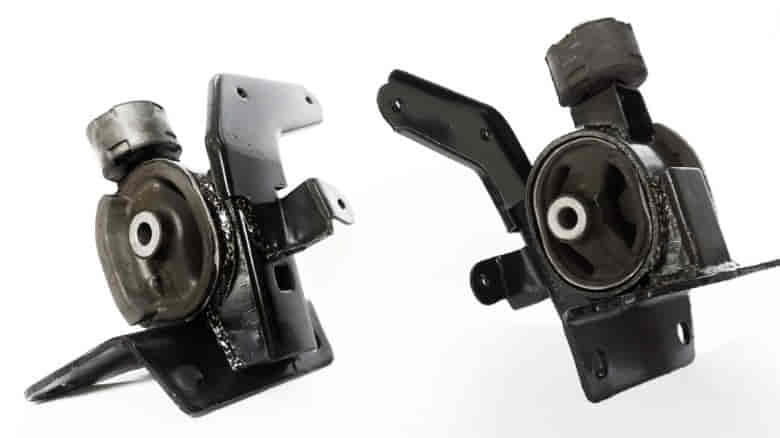
Engine mounts typically last between 60,000 and 100,000 miles (approximately 97,000–161,000 kilometers), although many can remain functional for 5–10 years or longer. Their actual lifespan depends on vehicle design, mount construction, engine vibration, driving habits, climate, and exposure to heat or leaking fluids.
Unlike engine oil, spark plugs, or certain timing belts, engine mounts generally do not have a universal replacement interval. Most manufacturers recommend replacing them when inspection confirms excessive wear, structural damage, hydraulic fluid leakage, or abnormal engine movement.
Engine mounts, also called motor mounts, secure the engine to the vehicle’s frame or subframe while absorbing vibration and controlling movement during acceleration, braking, and gear changes.
A typical vehicle uses several mounting points to support its engine and transmission. Depending on the design, the mounts may contain conventional rubber, hydraulic fluid, polyurethane, or electronically controlled components.
The most common signs of worn engine mounts include increased vibration at idle, clunking during gear changes, excessive engine movement, cracked rubber, and visible leakage from hydraulic mounts. However, these symptoms can also result from engine misfires, transmission problems, worn suspension components, or damaged exhaust connections.
Engine mount replacement is not always inexpensive. According to RepairPal’s September 2026 estimate, the average U.S. replacement cost is approximately $643–$798, although the actual price varies by vehicle and repair complexity.
Understanding how long different engine mounts last, what causes premature failure, and when replacement is necessary helps prevent unnecessary repairs and protects the surrounding drivetrain components.
What Are Engine Mounts?
Engine mounts are structural and vibration-isolating components that secure the engine to the vehicle while allowing a controlled amount of movement.
An internal combustion engine generates vibration whenever its pistons, connecting rods, and crankshaft operate.
The engine also experiences rotational forces during acceleration and deceleration.
Without an appropriate mounting system, these movements would transfer directly into the vehicle’s body and surrounding components.
Engine mounts help control these forces.
Most conventional mounts contain a metal bracket combined with a rubber or elastomeric isolator.
The bracket connects the powertrain to the vehicle structure.
The rubber absorbs vibration and allows limited movement.
More advanced mounting systems may contain hydraulic fluid or electronically controlled elements.
These designs can provide different damping characteristics under changing engine operating conditions.
Engine mounts also help maintain the correct position of the powertrain.
This is important because the engine connects to the transmission, exhaust system, cooling hoses, electrical wiring, and other vehicle components.
Excessive engine movement can place additional stress on these connections.
The mounting system is therefore responsible for both passenger comfort and mechanical stability.
A worn engine mount may not prevent the engine from running, but it can significantly change how the vehicle feels during normal operation.
How Long Do Engine Mounts Last in Miles?
Most engine mounts have an estimated service life of approximately 60,000–100,000 miles, but this is a general maintenance benchmark rather than a guaranteed replacement interval.
RepairPal identifies this mileage range as typical for many vehicles.
However, actual results vary considerably.
Some vehicles experience engine mount problems before reaching 60,000 miles.
Others continue using their original mounts beyond 100,000 or even 150,000 miles.
The difference depends on several factors.
Mount construction is one consideration.
A simple rubber mount may have different aging characteristics from a complex hydraulic or electronically controlled mount.
Engine design also matters.
A large engine that produces substantial torque may impose different loads on its mounts than a small, low-output engine.
Driving conditions influence wear as well.
Frequent hard acceleration and abrupt changes in drivetrain load increase movement through the mounting system.
Oil contamination, exposure to high temperatures, and environmental aging can also shorten service life.
Therefore, reaching 100,000 miles does not automatically mean every mount must be replaced.
Similarly, a vehicle with only 40,000 miles can have a defective mount if it has experienced fluid contamination, collision damage, or another abnormal condition.
The correct replacement decision depends on physical condition and operating symptoms.
How Many Years Do Engine Mounts Last?
Engine mounts often last approximately 5–10 years, although some remain serviceable for considerably longer under favorable conditions.
Mileage is not the only factor that affects their lifespan.
Rubber gradually ages even when a vehicle is driven relatively little.
Heat, oxygen, ozone, and environmental exposure can change the material’s elasticity.
As rubber becomes harder, it may lose some of its ability to absorb vibration.
Eventually, cracks or separation can develop.
A vehicle stored outdoors in a hot climate may experience different rubber aging from one kept in a sheltered environment.
However, storage conditions are only part of the picture.
The mount’s original material formulation and construction also influence durability.
Some vehicles are designed with substantial vibration isolation and robust mounting systems.
Others use more compact mounts because of limited engine bay space.
A hydraulic mount may develop leakage as its sealing components age.
An electronically controlled mount can also experience electrical or mechanical faults.
Consequently, a ten-year-old mount should be inspected rather than automatically condemned.
Visible cracks, collapse, hydraulic leakage, and excessive movement are more meaningful than age alone.
A vehicle with smooth operation and healthy mounts may not need replacement simply because it has reached a particular birthday.
Do Engine Mounts Have a Scheduled Replacement Interval?
Most engine mounts are replaced according to condition rather than a fixed mileage or age-based service interval.
This differs from maintenance items with predetermined replacement schedules.
Engine oil gradually degrades during operation and requires regular service.
Certain timing belts also have specified replacement intervals.
Engine mounts generally remain in use until inspection identifies deterioration or failure.
However, there are exceptions.
Some manufacturers specify periodic engine mount inspections.
A limited number of vehicle applications may also have maintenance recommendations or service programs involving mount replacement.
The appropriate schedule depends on the vehicle.
For this reason, the owner’s manual and official maintenance information should take precedence over a general mileage recommendation.
An inspection becomes particularly useful as a vehicle approaches higher mileage.
For example, a vehicle with 80,000 miles may benefit from checking the mounts during other engine or transmission service.
However, inspection does not mean replacement is automatically necessary.
A mount with intact rubber, proper alignment, no leakage, and normal vibration isolation may remain serviceable.
The most important distinction is between the expected lifespan of a component and a mandatory service interval.
An estimated lifespan is useful for anticipating repairs, but it should not replace actual mechanical inspection.
How Long Do Rubber Engine Mounts Last?
Conventional rubber engine mounts can last approximately 60,000–100,000 miles or longer, depending on their construction and operating environment.
Rubber mounts are widely used because they offer a practical balance of strength, flexibility, vibration isolation, and manufacturing cost.
Their rubber components absorb engine movement while metal brackets provide structural support.
However, rubber is subject to aging.
Repeated mechanical loading can gradually change its properties.
Exposure to engine heat may accelerate hardening.
Oil and other petroleum-based fluids can also affect certain rubber compounds.
As the material deteriorates, it may lose elasticity.
The mount may become less effective at absorbing engine vibration.
Cracks can develop around the rubber-to-metal connection.
In more severe cases, the rubber separates from the supporting bracket.
This may allow the engine to move farther than intended.
However, minor surface aging does not always indicate complete structural failure.
The mechanic must evaluate whether the mount can still support the engine and control movement correctly.
Some rubber mounts survive for many years without requiring replacement.
Others fail prematurely because of manufacturing defects, fluid contamination, collision damage, or excessive loading.
The correct decision should be based on the mount’s actual condition rather than mileage alone.
How Long Do Hydraulic Engine Mounts Last?
Hydraulic engine mounts often operate successfully for many years, but their lifespan depends on both the rubber structure and the integrity of the internal fluid-filled chambers.
A hydraulic engine mount combines an elastomeric structure with fluid-filled components.
The fluid changes how the mount responds to engine vibration.
This can improve vibration isolation across certain engine speeds and operating conditions.
Hydraulic mounts are commonly used in passenger cars and vehicles where cabin refinement is a major design objective.
However, their additional components introduce different failure possibilities.
The rubber structure can deteriorate with age.
Internal seals may also lose integrity.
If fluid leaks from the mount, its damping characteristics can change.
The engine may still remain physically supported, but substantially more vibration can reach the passenger compartment.
Ford documented this failure mechanism in its 2021 Explorer service program 21U06.
The manufacturer identified certain vehicles with left-side hydraulic mounts that could leak fluid.
Ford explained that sufficient fluid loss could prevent the mount from performing as intended and increase vibration or noise.
However, the program applied to a specific production population.
It does not establish that every hydraulic mount will fail prematurely.
Hydraulic mounts should be inspected for leakage, collapse, and abnormal vibration rather than replaced solely because of age.
How Long Do Electronic Engine Mounts Last?
Electronically controlled engine mounts do not have one universal service life because their durability depends on mechanical construction, electronic controls, and vehicle application.
Some modern vehicles use active engine mounts to improve noise and vibration control.
These mounts may adjust their damping characteristics according to engine speed or operating conditions.
Depending on the design, the system may involve electrical actuators, vacuum controls, or other mechanisms.
An active mount can therefore fail in more than one way.
The rubber element may deteriorate.
A fluid-filled chamber may leak.
An electrical or control component may also malfunction.
These conditions can produce different symptoms.
A leaking active mount may transmit excessive vibration during idle.
A control-related problem may affect the system’s response at particular engine speeds.
However, not every active engine mount fault produces a dashboard warning.
A vehicle may experience increased cabin vibration without storing an obvious diagnostic trouble code.
Bentley published technical information concerning active engine mount leakage in certain Continental GT, GTC, and Flying Spur W12 applications.
The document identifies vibration or humming at idle associated with hydraulic leakage.
This illustrates how advanced mounts can develop identifiable mechanical faults.
However, the bulletin is application-specific.
For other vehicles, the correct diagnostic procedure depends on their particular mount design and electronic control system.
How Long Do Polyurethane Engine Mounts Last?
Polyurethane engine mounts can provide durable engine control in certain performance applications, but their lifespan and comfort characteristics depend on material hardness, design, and operating conditions.
Polyurethane mounts are often used as aftermarket replacements.
They are especially popular in performance vehicles where controlling engine movement is important.
Compared with many conventional rubber mounts, polyurethane products may use a stiffer material formulation.
This can reduce powertrain movement during acceleration and gear changes.
However, additional stiffness also allows more engine vibration to reach the vehicle body.
Therefore, a polyurethane mount may make a healthy engine feel rougher at idle.
This should not automatically be interpreted as a defective replacement.
The amount of vibration depends on the specific mount design and vehicle.
Polyurethane durability also varies.
Material quality, manufacturing methods, temperature, chemical exposure, and loading all influence lifespan.
Some performance mounts are intended for demanding track use rather than maximum passenger comfort.
A stiffer mount can also transfer different loads into associated brackets and supporting components.
For a daily-driven passenger car, an original-equipment-style rubber or hydraulic mount may provide a more appropriate balance.
Polyurethane should be selected according to the intended application rather than assuming it will always last longer or perform better.
What Causes Engine Mounts to Wear Out?
Engine mounts wear out because of repeated loading, rubber aging, heat exposure, fluid contamination, impact damage, and excessive powertrain movement.
Every acceleration event places a reaction force on the engine mounting system.
The engine produces torque, and the mounts resist the resulting movement.
When the driver releases the accelerator or changes gears, the direction and amount of loading can change.
Over time, these repeated movements contribute to material fatigue.
Temperature is another factor.
Engine mounts operate near the engine and exhaust system.
Repeated heating and cooling cycles can influence rubber elasticity.
Certain environmental conditions also accelerate deterioration.
Exposure to ozone and other substances may contribute to aging.
Fluid contamination can be particularly damaging.
Engine oil or transmission fluid leaking onto rubber components may accelerate deterioration, depending on the rubber formulation.
Collision damage creates another risk.
A relatively minor impact may distort a mounting bracket or alter the powertrain’s alignment.
The mount may then experience abnormal loads.
Improper installation can also reduce service life.
If mounting bolts are tightened incorrectly or the engine is secured in an unintended position, vibration and premature wear may develop.
The correct repair therefore involves identifying both the failed mount and any conditions that caused the failure.
Can Engine Oil Leaks Damage Motor Mounts?
Yes. Engine oil leaks can contribute to premature deterioration of certain rubber engine mounts when the oil repeatedly contacts their elastomeric components.
Rubber engine mounts are designed to operate under specific environmental conditions.
However, prolonged exposure to incompatible fluids can change the rubber’s characteristics.
The material may swell, soften, harden, or otherwise deteriorate depending on its formulation.
An oil leak near an engine mount can therefore shorten its useful life.
Possible leakage sources include valve cover gaskets, oil filter housings, timing covers, or other engine seals.
Transmission fluid and power steering fluid can also contaminate nearby components.
However, not every wet engine mount is contaminated by an external fluid source.
A hydraulic mount may be leaking its own internal fluid.
The distinction matters because the repair is different.
If the engine mount has ruptured internally, the mount generally requires replacement.
If engine oil is dripping onto an otherwise serviceable rubber mount, the external leak should be repaired.
The contaminated mount must then be evaluated for deterioration.
Replacing a damaged mount without correcting an ongoing oil leak may contribute to another premature failure.
Cleaning the area and identifying the actual fluid source are important first steps.
What Are the Signs of Worn Engine Mounts?
The main signs of worn engine mounts are excessive vibration, clunking noises, abnormal engine movement, visible rubber damage, hydraulic fluid leakage, and unusual powertrain positioning.
These symptoms develop because the mounting system can no longer control engine forces as intended.
A worn mount may transmit more vibration into the body.
The driver can feel this through the steering wheel, seats, or floor.
Another common symptom is a clunk or thump during acceleration or gear changes.
This may happen when the engine shifts excessively and reaches the limit of the remaining mount movement.
Visible engine rocking can also indicate damage.
However, engines normally move slightly under changing torque.
The mechanic must distinguish intended movement from an abnormal condition.
Visual inspection may reveal torn rubber, collapsed mount geometry, or broken brackets.
Fluid leakage is another warning sign on hydraulic mounts.
However, these symptoms are not unique to engine mounts.
An engine misfire can produce severe vibration.
A worn transmission mount may create similar clunking.
Suspension or drivetrain faults can also produce vibration under particular driving conditions.
A correct diagnosis combines physical inspection with the vehicle’s operating symptoms.
Replacement should follow confirmation that the mount is actually defective.
Read more: Kohler 7000 Series Oil Capacity
Why Do Bad Engine Mounts Cause Vibration at Idle?
A worn engine mount can cause increased vibration at idle because it no longer isolates the normal vibration generated by the engine.
An internal combustion engine produces periodic forces as its cylinders fire.
Even a mechanically healthy engine has some vibration.
The mounting system is designed to reduce how much of that movement reaches the passenger compartment.
Rubber mounts absorb vibration through their flexible construction.
Hydraulic mounts provide additional damping through their internal fluid system.
When a mount deteriorates, its isolation characteristics may change.
A rubber mount that has hardened can transmit more vibration.
A hydraulic mount that has lost fluid may no longer provide the intended damping.
The driver may notice shaking through the steering wheel, dashboard, or seats.
The vibration may be especially noticeable while stopped in Drive with the brake applied.
However, the exact symptom depends on the vehicle and mounting arrangement.
An engine misfire can create similar shaking.
A dirty throttle body, incorrect idle control, or fuel delivery problem may also affect smoothness.
Therefore, vibration should not automatically be attributed to a failed mount.
The technician should confirm that the engine is running correctly before replacing expensive mounting components.
Why Do Bad Motor Mounts Make Clunking Noises?
A failed motor mount can produce clunking or thumping noises when the engine moves farther than its mounting system is designed to allow.
During acceleration, engine torque creates a reaction force.
The mounting system resists this movement.
When the driver releases the accelerator or shifts gears, the direction of the force changes.
Healthy mounts allow controlled movement while limiting vibration and mechanical contact.
A worn or broken mount may allow excessive displacement.
The engine or its supporting bracket can move abruptly.
This may produce a noticeable clunk.
The noise may occur during gear engagement, acceleration, deceleration, or changes between forward and reverse driving.
However, similar sounds can come from other components.
Worn transmission mounts can produce related symptoms.
Damaged suspension bushings, drivetrain joints, or loose brackets may also create clunks.
The technician should determine where the noise originates.
A vehicle with severe clunking and visible engine displacement should not continue normal operation.
Excessive engine movement may place additional stress on the exhaust, hoses, wiring, and drivetrain.
The source of the problem should be corrected before further damage occurs.
Can a Bad Engine Mount Cause the Engine to Shake?
Yes. A damaged engine mount can allow excessive engine movement and transmit more vibration into the vehicle body.
Some engine movement is normal.
The powertrain must respond to changing torque loads.
The mounts allow limited motion while keeping the engine in its intended position.
When a mount fails, movement can increase.
The engine may rock noticeably during changes in operating load.
However, the amount of acceptable movement varies by vehicle.
A transverse four-cylinder engine may have a different mounting arrangement from a longitudinal V8.
The mount design and the location of torque reaction components also influence movement.
Consequently, there is no universal amount of engine rocking that proves a mount has failed.
A technician should evaluate the movement according to the specific vehicle.
The engine should also be inspected for abnormal running conditions.
An engine with a misfire can shake even when its mounts remain healthy.
The difference is important.
A defective mount transmits or permits excessive mechanical movement.
A misfire creates uneven combustion forces that cause the engine itself to run roughly.
Replacing mounts will not correct a failed ignition coil or damaged fuel injector.
How Can You Tell if an Engine Mount Is Leaking?
A leaking hydraulic engine mount may show oily residue, fluid staining, or visible moisture around its body or lower mounting area.
Hydraulic mounts contain fluid within internal chambers.
The fluid is part of the damping mechanism.
If the mount’s sealing structure fails, fluid can escape.
This may leave dark or oily residue.
The mount may also lose height or collapse as its internal condition deteriorates.
However, visible oil near a mount does not automatically prove an internal leak.
Engine oil can drip from components located above the mount.
Transmission fluid may also reach nearby areas.
The mechanic should clean the area and determine where the fluid originates.
If a hydraulic mount is confirmed to be leaking internally, replacement is usually required.
Adding fluid to the mount is not normally a service procedure.
Ford’s 2021 Explorer program provides a documented example of this failure type.
The manufacturer identified certain hydraulic mounts that could leak and subsequently produce increased vibration and noise.
The affected population was narrowly defined.
The lesson is not that all hydraulic mounts will fail, but that fluid loss is a meaningful diagnostic finding.
A leaking mount should be evaluated promptly, especially when the vehicle also exhibits excessive movement or noise.
How Do You Inspect Engine Mounts?
Engine mounts are inspected by checking their physical condition, alignment, leakage, and ability to control powertrain movement under the manufacturer’s specified conditions.
The engine should be identified along with the number and location of its mounting points.
Access varies by vehicle.
Some mounts are visible from above the engine compartment.
Others are located beneath the powertrain or behind other components.
A visual inspection may reveal cracked rubber, separation from metal brackets, or damaged mounting hardware.
Hydraulic mounts should be checked for fluid leakage.
A collapsed mount may also cause the engine to sit lower or at an unusual angle.
However, the technician should compare the mount’s condition with the intended vehicle design.
Certain rubber mounts contain molded gaps or openings that are normal features.
These should not be mistaken for cracks.
A mechanic may also evaluate engine movement using an appropriate controlled procedure.
However, attempting to observe engine movement while another person applies throttle can be dangerous.
A moving vehicle, rotating belt, or shifting engine can cause serious injury.
Such tests should be performed only by qualified technicians using the proper safety precautions.
When the condition is uncertain, the manufacturer’s service information should guide further diagnosis.
Can Bad Engine Mounts Cause a Check Engine Light?
A worn engine mount does not ordinarily trigger the check engine light directly because most conventional mounts are mechanical components without an engine fault-monitoring sensor.
However, there are important exceptions and indirect effects.
Some modern active mounts are integrated with electronic control systems.
A problem involving their electrical components may generate a related diagnostic fault on certain vehicles.
However, this depends on the design.
Most ordinary rubber mounts do not communicate with the engine control module.
A driver may notice vibration and assume the mount has failed.
If the check engine light is illuminated, an engine operating fault must also be considered.
A misfire is a common example.
When one cylinder does not produce normal combustion, the engine may shake significantly.
The resulting vibration can resemble the symptoms of a failed mount.
Codes such as P0300 or cylinder-specific P0301 through P0308 may indicate combustion irregularities.
However, these codes do not independently establish the cause.
Ignition coils, spark plugs, fuel injectors, compression problems, or other mechanical conditions may be responsible.
A worn mount and an engine misfire can also occur simultaneously.
The correct approach is to scan the vehicle and verify engine operation before assuming that all vibration originates from the mounting system.
Bad Engine Mount vs Engine Misfire: What’s the Difference?
A bad engine mount primarily affects vibration isolation and powertrain movement, while an engine misfire disrupts combustion and can cause genuinely uneven engine operation.
The symptoms may overlap.
Both conditions can produce vibration at idle.
Both can make the vehicle feel rougher than normal.
However, the underlying causes are different.
An engine mount is responsible for controlling movement and isolating vibration.
When it deteriorates, the engine may continue firing normally while more vibration reaches the cabin.
A misfire occurs when a cylinder fails to contribute its expected combustion force.
The result can include rough running, reduced power, increased fuel consumption, and a check engine light.
The vibration may change with engine speed and load.
A technician can use diagnostic data to determine whether the engine is misfiring.
The mounting system can then be inspected separately.
This distinction matters because replacing all engine mounts may not improve a vehicle suffering from a mechanical or ignition-related misfire.
Likewise, replacing spark plugs will not repair a torn rubber mount.
A proper diagnosis should identify whether the vibration originates from abnormal combustion, failed vibration isolation, or both.
Engine Mount vs Transmission Mount: What Is the Difference?
Engine mounts support and stabilize the engine, while transmission mounts support the transmission and help control movement of the complete powertrain assembly.
The engine and transmission are mechanically connected.
Their mounting systems therefore work together.
A front-wheel-drive vehicle may use engine-side and transmission-side mounts along with torque control mounts.
A rear-wheel-drive vehicle may have separate engine mounts and a transmission mount near the transmission crossmember.
The exact arrangement varies.
A failed transmission mount can cause symptoms similar to a bad engine mount.
These include clunking during gear changes, vibration, and abnormal powertrain movement.
However, replacing an engine mount will not necessarily correct a defective transmission mount.
The technician should inspect the complete mounting system.
AutoZone’s transmission mount guidance identifies vibration, clunking, and shifting-related symptoms as common warning signs.
The important diagnostic distinction is determining which mounting point has failed.
A vehicle may also have multiple worn mounts.
Replacing only one may change the way forces are distributed through the remaining mounts.
However, this does not automatically justify replacing every mount.
Each component should be inspected for actual wear, damage, or abnormal operation.
How Many Engine Mounts Does a Car Have?
Many cars use approximately three or four powertrain mounting points, although the actual number and arrangement depend on the vehicle’s engine and transmission layout.
Front-wheel-drive vehicles often use a combination of side mounts and torque control mounts.
One mount may support the engine near the timing cover.
Another may support the transmission.
Additional mounts or torque struts help limit engine movement during acceleration.
Rear-wheel-drive vehicles commonly use separate engine mounts on either side of the engine and a mount supporting the transmission.
However, larger vehicles and specialized applications may have different arrangements.
Some manufacturers use additional torque control components or subframe-mounted supports.
The total number of mounts therefore cannot be established solely from engine displacement.
A four-cylinder vehicle does not necessarily have fewer mounts than a V6.
Likewise, a larger truck does not automatically use more mounting points than a compact passenger car.
The correct configuration can be identified through the vehicle’s service information or parts catalog.
This matters when estimating repair costs.
A quoted price for replacing one engine mount may not include the transmission mount or additional torque struts.
Owners should ask which exact mounting points are included in a repair estimate.
Should You Replace All Engine Mounts at Once?
Replacing all engine mounts is not always necessary, but the remaining mounts should be inspected when one has failed.
The correct decision depends on the mounting system and the condition of each component.
A single hydraulic mount may develop an internal leak while the other mounts remain healthy.
In that situation, replacing only the defective mount may be appropriate.
However, several mounts may have aged under similar conditions.
A vehicle with high mileage may have multiple hardened or cracked rubber components.
Replacing only the worst mount may improve vibration while leaving other worn mounts in service.
Some repair procedures also involve overlapping labor.
If several mounts are difficult to access, replacing additional confirmed worn mounts during the same service may reduce repeated disassembly.
However, parts replacement should remain condition-based unless the manufacturer specifies otherwise.
A healthy mount does not automatically become defective because another mount has failed.
The technician should evaluate physical damage, engine position, movement, and vibration performance.
The replacement decision should also account for the owner’s budget and expected remaining vehicle service life.
The goal is to restore proper powertrain support without replacing serviceable components unnecessarily.
Can You Drive With Bad Engine Mounts?
Driving with a mildly worn engine mount may be possible for a short distance, but continuing to operate a vehicle with a severely damaged or broken mount can increase the risk of additional mechanical damage.
The level of risk depends on the failure.
A mount that has hardened and transmits additional vibration is different from one that has completely separated.
A collapsed hydraulic mount may cause substantial discomfort without immediately releasing the engine from its supports.
However, a broken bracket or separated load-bearing mount is a serious condition.
Excessive engine movement can place strain on hoses, wiring, exhaust components, and other mounts.
A severely displaced engine may also interfere with nearby components.
RepairPal advises that gentle driving to a repair facility may be acceptable in some less severe cases.
However, it recommends against driving when very harsh clunks occur during acceleration, deceleration, or gear engagement.
In such cases, the mount requires immediate attention.
A vehicle that exhibits severe movement or loss of structural support should be towed rather than driven.
The safest decision depends on the specific failure and the technician’s assessment.
The absence of a check engine light does not mean a structurally damaged mount is safe.
Engine mounts are important mechanical support components even though they do not directly control combustion.
What Happens if You Do Not Replace Bad Engine Mounts?
Ignoring damaged engine mounts can increase vibration, reduce driving comfort, and place additional stress on the transmission, exhaust system, hoses, wiring, and remaining mounts.
The mounting system controls how engine forces are transferred into the vehicle structure.
When a mount fails, the forces may be redistributed unevenly.
A remaining mount may carry additional movement or loading.
This can accelerate wear.
Excessive engine movement can also affect flexible connections.
An exhaust flex pipe may experience greater bending.
Cooling hoses and wiring harnesses may be pulled beyond their intended range.
A transmission mount can also experience additional stress when the engine moves abnormally.
However, the exact damage depends on vehicle layout and failure severity.
A mildly hardened rubber mount may mainly create vibration.
A completely separated mount can create much more serious movement.
Over time, the extra motion can produce noises and additional mechanical problems.
Repairing the original failed mount early may prevent some of these secondary expenses.
However, the mechanic should inspect surrounding components before completing the repair.
A vehicle that has operated for a long period with a damaged mount may require more than a simple mount replacement.
Correct diagnosis should identify both the failed mount and any related damage.
How Much Does Engine Mount Replacement Cost?
The average U.S. engine mount replacement cost is approximately $643–$798 according to RepairPal’s estimate updated September 3, 2026.
The estimate includes both parts and labor.
RepairPal identifies labor costs of approximately $328–$481 and parts costs of approximately $316–$317 for its national reference estimate.
However, these figures are not a fixed quotation.
Actual costs vary by vehicle, engine configuration, location, and the mount being replaced.
A relatively accessible rubber mount may be less expensive.
A hydraulic or active mount can cost more because of its specialized construction.
Labor also varies.
Some mounts are accessible after removing a few surrounding components.
Others require extensive disassembly or specialized support equipment.
For example, a mount located beneath a crowded engine compartment may require additional labor.
Replacing multiple mounts can increase the total cost.
However, overlapping labor may reduce the amount charged for each additional component in certain repairs.
The type of replacement part also matters.
Original-equipment mounts may cost more than aftermarket alternatives.
However, an inexpensive replacement may not provide the same vibration isolation as the original component.
The most useful estimate identifies the exact mounting position, parts brand, labor time, and any additional hardware required.
Why Is Engine Mount Replacement Expensive?
Engine mount replacement can be expensive because the engine must often be supported safely while the damaged mount is removed and replaced.
An engine is a heavy mechanical assembly.
Its weight must remain properly supported throughout the procedure.
Depending on the vehicle, the technician may use an engine support bar or other manufacturer-approved support equipment.
Some mounts are located in difficult-to-reach areas.
Access may require removing air intake components, brackets, underbody panels, or other equipment.
In certain applications, additional components may need to be repositioned.
The mount must then be removed without allowing the engine to shift unexpectedly.
The replacement component must be correctly aligned.
Fasteners must be tightened to the manufacturer’s specified torque and installation sequence.
Some vehicles require the powertrain to be positioned at a particular height or alignment before final tightening.
Incorrect installation can create abnormal vibration or premature mount wear.
Certain fasteners may also require replacement rather than reuse.
The technician must follow the exact service procedure.
After installation, the vehicle should be checked for normal engine position and vibration.
A road test may also be necessary.
These procedures explain why labor can represent a substantial portion of the final repair bill.
How Long Does It Take to Replace Engine Mounts?
Engine mount replacement may take approximately one to several labor hours per mount, depending on accessibility and the vehicle’s construction.
However, there is no universal labor time.
An engine mount located near the top of the engine compartment may be relatively straightforward to access.
A lower mount positioned near the subframe may require significantly more work.
Some vehicles have limited clearance around the powertrain.
The technician may need to remove brackets or accessories before reaching the mount.
Hydraulic and active mounts may require additional connections or procedures.
The condition of the mounting hardware also affects labor.
Corroded bolts or damaged threads can increase repair complexity.
If more than one mount requires replacement, the total labor time may be longer.
However, some tasks overlap.
For example, the engine may need to be supported only once while replacing several related mounts.
The correct estimate should come from the vehicle-specific labor guide.
An advertised universal replacement time may not reflect the actual work required.
Owners should ask the repair shop whether the estimate includes all necessary fasteners, alignment procedures, and related inspections.
A complete repair should restore the powertrain to its intended position and eliminate the symptoms associated with the failed mount.
Can You Replace Engine Mounts Yourself?
Engine mount replacement can be a DIY repair for an experienced mechanic with the correct equipment, but it can be dangerous because the engine must be supported safely during disassembly.
The difficulty varies by vehicle.
Some mounts are relatively accessible.
Others require substantial engine support or component removal.
A properly rated engine support system is essential.
RepairPal warns against supporting the engine directly on the narrow head of an ordinary jack or jack stand.
The concentrated force can damage an oil pan or other engine component.
Improper support can also allow the engine to fall or shift unexpectedly.
This creates a serious crushing hazard.
A replacement procedure must follow the vehicle manufacturer’s instructions.
The correct mounting bolts and torque specifications are important.
Some modern vehicles use one-time-use fasteners or require specific tightening sequences.
The engine may also need to be positioned correctly before the mounts are secured.
If this step is performed incorrectly, the vehicle may experience vibration even after installing new components.
For owners without specialized tools or engine support experience, professional replacement is generally the safer choice.
An engine mount repair should not be treated as a simple cosmetic parts replacement.
It involves components that support a major portion of the powertrain’s weight.
OEM vs Aftermarket Engine Mounts: Which Last Longer?
Original-equipment and aftermarket engine mounts can differ in durability, vibration isolation, materials, and price, but no category guarantees longer life in every vehicle.
Original-equipment mounts are designed to meet the vehicle manufacturer’s specified operating characteristics.
Their rubber stiffness, fluid damping, and structural dimensions are selected for the particular powertrain.
This helps maintain the intended balance between engine control and passenger comfort.
Aftermarket mounts vary widely.
Some are designed as direct replacements matching the original specifications.
Others use different materials or damping characteristics.
A low-cost aftermarket mount may fit physically while transmitting more vibration than the original part.
However, some high-quality aftermarket products offer appropriate performance and durability.
The correct selection depends on the vehicle and intended use.
For an ordinary daily driver, a properly matched OE or OE-equivalent mount is generally the lower-risk option.
For a performance vehicle, a stiffer aftermarket mount may reduce engine movement.
However, that modification may also increase cabin vibration.
Active and hydraulic mounts deserve particular attention.
Replacing them with a simpler component that lacks the original damping characteristics may change the vehicle’s refinement.
The best replacement is one that matches the required mechanical and vibration-isolation specifications.
Price alone is not a reliable measure of quality.
How Can You Make Engine Mounts Last Longer?
Engine mount lifespan can be improved by reducing unnecessary mechanical stress, correcting fluid leaks, maintaining the powertrain, and replacing damaged mounts before they overload surrounding components.
Driving habits influence mount loading.
Hard launches and abrupt throttle changes place substantial forces on the powertrain.
Repeated aggressive acceleration can increase movement through the mounting system.
Smooth driving generally reduces unnecessary loading.
Fluid leaks should also be repaired promptly.
Oil or transmission fluid leaking onto certain rubber mounts can contribute to material deterioration.
The cause of contamination should be corrected rather than simply cleaning the mount repeatedly.
Engine running condition matters as well.
A severe misfire can produce abnormal vibration.
Although it may not directly destroy a healthy mount immediately, prolonged abnormal vibration increases mechanical demands on the vehicle.
Collision damage should also be inspected.
A distorted bracket or altered engine position can create uneven loading.
When replacing a mount, the correct installation procedure is essential.
Incorrect alignment can increase vibration and accelerate wear.
Regular inspection helps identify deterioration before it becomes severe.
However, rubber aging cannot be prevented completely.
Even well-maintained mounts may eventually lose elasticity or develop cracks.
The goal is to avoid unnecessary premature failure rather than guarantee an unlimited service life.
When Should You Inspect Engine Mounts?
Engine mounts should be inspected whenever a vehicle develops unexplained vibration, clunking, abnormal engine movement, or visible deterioration.
Inspection can also be useful during routine maintenance.
A high-mileage vehicle may benefit from checking the mounts when other engine or transmission work is being performed.
Some manufacturers include mount inspections in their maintenance schedules.
Others recommend condition-based service.
The appropriate procedure should follow the vehicle’s documentation.
A mount that has begun to leak hydraulic fluid deserves attention even if the vehicle remains drivable.
Likewise, a torn rubber isolator should be evaluated before it separates completely.
An inspection may also be justified after a collision.
The impact may damage a bracket or alter the powertrain’s alignment.
However, replacement is not automatically required after a particular mileage or accident.
The mechanic must determine whether the mount remains structurally sound and properly positioned.
For vehicles with more than 100,000 miles, a careful inspection may help identify developing wear.
The objective is to replace components based on confirmed condition rather than assumptions about age.
Can Engine Mounts Last 150,000 Miles?
Yes. Some original engine mounts can remain serviceable for 150,000 miles or longer, although this should not be treated as a guaranteed lifespan.
The durability of a mount depends on its construction and operating conditions.
A vehicle driven primarily on smooth roads under moderate loads may experience less abrupt powertrain movement than one used for repeated aggressive acceleration.
Environmental conditions also matter.
Rubber exposed to extreme heat, petroleum contamination, or other damaging conditions may deteriorate sooner.
A hydraulic mount may fail because of fluid leakage even when its external rubber appears relatively intact.
However, a conventional rubber mount can sometimes remain functional for many years without significant cracking or collapse.
The most important consideration is actual performance.
A mount that continues to hold the engine correctly and isolate vibration may not need replacement solely because the odometer has passed 150,000 miles.
Nevertheless, high-mileage mounts should be evaluated carefully.
Hardened rubber may transmit more vibration even when no complete separation is visible.
A professional inspection can identify whether the mount remains suitable for continued service.
Mileage is a useful risk indicator, but it is not a definitive diagnosis.
Will Replacing Engine Mounts Make a Car Smoother?
Replacing genuinely worn engine mounts can significantly reduce unwanted vibration, noise, and harshness, especially at idle and during gear engagement.
The improvement depends on the condition of the old mounts.
A collapsed hydraulic mount may no longer isolate engine vibration effectively.
A new correctly specified replacement can restore much of the intended damping.
A hardened rubber mount may also transmit more vibration than a fresh component.
Replacing it can improve passenger comfort.
Drivers may notice a smoother steering wheel, reduced dashboard vibration, or less movement when shifting into gear.
However, replacement does not automatically make every vehicle perfectly smooth.
Some engine configurations naturally produce more vibration than others.
A three-cylinder engine may have different vibration characteristics from a well-balanced six-cylinder engine.
A performance vehicle with stiff mounts may also transmit more engine vibration by design.
More importantly, vibration caused by an engine misfire will remain until the combustion problem is repaired.
Wheel imbalance, damaged tires, suspension faults, and other drivetrain problems can also produce vibration.
The correct diagnosis should therefore identify whether the mounts are responsible.
When the mount is genuinely defective, replacement can restore both engine stability and ride refinement.
Can New Engine Mounts Still Cause Vibration?
Yes. New engine mounts can produce vibration when they are incorrectly specified, installed improperly, excessively stiff, or combined with other worn powertrain mounts.
A new component is not automatically correct for every version of a vehicle.
Some models use different mounts depending on engine configuration, transmission, or performance package.
A physically similar aftermarket mount may have different rubber stiffness or hydraulic damping characteristics.
This can change how vibration reaches the cabin.
Installation also matters.
A mount tightened while the powertrain is incorrectly positioned may hold the engine under unintended stress.
The result can be vibration that was not present before the repair.
Other mounts may also be worn.
Replacing one mount can change the way forces are distributed through the remaining mounting points.
However, the underlying engine condition should not be overlooked.
A misfire, low idle quality, or other mechanical problem may continue to produce vibration after mount replacement.
A technician should inspect the new mount’s part number, alignment, and installation procedure.
The remaining mounts and transmission support should also be checked.
If the engine itself is running roughly, that problem must be diagnosed independently.
The best result comes from restoring the complete mounting system to its intended condition.
Are Engine Mounts Covered Under Warranty?
Engine mount warranty coverage depends on the vehicle manufacturer, warranty type, vehicle age, mileage, and reason for failure.
An engine mount may be covered by a new-vehicle limited warranty when a qualifying manufacturing defect occurs during the coverage period.
However, wear-related deterioration may be treated differently.
Extended warranties and vehicle service contracts also vary.
Some plans include certain mounting components.
Others exclude rubber parts or items considered normal wear.
A powertrain-only warranty may not cover every engine mount simply because the component supports the engine.
Therefore, the contract’s actual terms should be reviewed.
Manufacturer service programs are another consideration.
Ford issued program 21U06 for a narrowly defined group of 2021 Explorer vehicles equipped with the 2.3L engine.
The program addressed certain hydraulic mounts that could leak.
This example demonstrates that a mount defect can sometimes be covered by a manufacturer-specific service action.
However, the program did not apply to every Ford Explorer or every hydraulic mount.
Owners should identify their exact vehicle and check applicable service information.
The existence of a technical bulletin does not automatically guarantee a free repair.
Warranty eligibility must be confirmed for the individual vehicle.
Final Verdict: How Long Do Engine Mounts Last?
Engine mounts typically last approximately 60,000–100,000 miles or around 5–10 years, but many can remain serviceable considerably longer. Their actual lifespan depends on mount type, vehicle design, driving conditions, climate, maintenance, and exposure to damaging fluids.
Conventional rubber mounts may deteriorate through hardening, cracking, or separation.
Hydraulic mounts can fail when their internal fluid chambers leak.
Electronically controlled mounts introduce additional control and actuator components that require model-specific diagnosis.
Polyurethane mounts can offer greater stiffness for performance applications, but they may also increase vibration transmitted into the vehicle.
The most important warning signs are increased vibration at idle, clunking during gear changes, excessive engine movement, visible rubber damage, and leakage from hydraulic mounts.
However, these symptoms do not automatically prove that the mounts are defective.
Engine misfires, transmission mount failures, drivetrain problems, and other mechanical conditions can produce similar complaints.
Most vehicles do not require all engine mounts to be replaced at one fixed mileage.
Instead, mounts should be inspected and replaced when their physical condition or operating performance indicates failure.
According to RepairPal’s September 2026 estimate, the average U.S. engine mount replacement costs approximately $643–$798, with substantial variation depending on vehicle and labor requirements.
Replacement should be performed using the correct parts and safe engine support equipment.
A severely damaged mount should not be ignored because excessive powertrain movement can stress surrounding components.
The best rule is to inspect engine mounts as your vehicle ages, replace them when wear or damage is confirmed, and avoid using mileage alone as the reason for replacement.
A properly maintained vehicle with healthy mounts can continue operating smoothly beyond the typical lifespan estimates, while a vehicle with premature mount failure should be repaired before the problem causes additional damage.