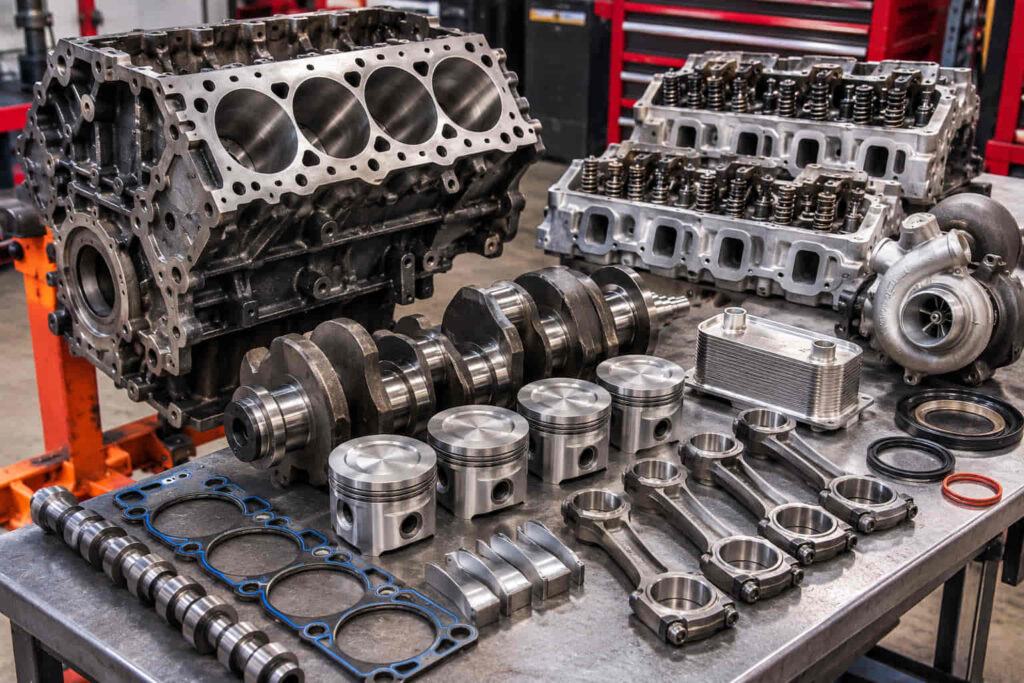
A 6.0 Powerstroke engine rebuild involves restoring the internal components of Ford’s 6.0-liter diesel V8, including the cylinder block, crankshaft, pistons, piston rings, bearings, cylinder heads, and valvetrain. A complete rebuild should also address the supporting systems that contribute to the engine’s known reliability concerns, particularly the EGR cooler, engine oil cooler, high-pressure oil injection system, and variable geometry turbocharger.
The 6.0L Power Stroke was introduced for the 2003 model year as the successor to the 7.3L Power Stroke. It was installed in Ford F-250, F-350, F-450, and F-550 Super Duty trucks, as well as the Excursion and selected E-Series commercial vans.
The engine was produced through Ford’s relationship with International Truck and Engine Corporation, now associated with Navistar’s historical engine operations. Its industrial counterpart belongs to the International VT365 engine family.
Although the 6.0 Power Stroke delivers strong performance and useful towing capability, it has several well-documented mechanical weaknesses. Cylinder head sealing problems, EGR cooler leakage, restricted engine oil coolers, high-pressure oil system faults, and injector-related problems can create expensive repairs.
However, not every 6.0 Power Stroke problem requires a complete engine rebuild.
A leaking EGR cooler, failed high-pressure oil connection, or defective fuel injection control module may be repaired without replacing the pistons, crankshaft, or engine block.
A full rebuild becomes appropriate when internal mechanical wear, overheating, lubrication failure, cylinder damage, or other severe conditions affect the engine’s major components.
Understanding the difference between repairing common supporting-system faults and rebuilding the complete engine is essential for controlling costs and achieving long-term reliability.
What Is the Ford 6.0 Powerstroke Engine?
The Ford 6.0 Power Stroke is a turbocharged, direct-injection diesel V8 with a displacement of approximately 365 cubic inches, or 6.0 liters.
It uses a cast-iron cylinder block and cast-iron cylinder heads.
The engine has a 90-degree V8 configuration with four valves per cylinder, providing a total of 32 valves.
Its nominal cylinder bore measures 3.74 inches, or 95 mm, while its crankshaft stroke measures approximately 4.134 inches, or 105 mm.
The factory compression ratio is approximately 18.0:1.
The engine uses a camshaft located inside the block and a pushrod valvetrain.
Its firing order is 1-2-7-3-4-5-6-8.
One of its distinguishing features is the Hydraulically Actuated Electronically Controlled Unit Injector system, commonly called HEUI.
This system uses high-pressure engine oil to operate the diesel fuel injectors.
The engine also features a variable geometry turbocharger that adjusts exhaust flow through the turbine.
Ford’s original technical documentation identifies a maximum output of approximately 325 horsepower at 3,300 RPM for certain Super Duty applications.
Torque ratings vary by production year and application.
The 6.0 Power Stroke introduced several technologies that improved performance compared with the older 7.3L.
However, these technologies also created additional maintenance and diagnostic requirements.
A reliable rebuild must account for the complete engine design rather than focusing only on the rotating assembly.
Read more: Ford 302 Engine Rebuild
Which Vehicles Use the 6.0 Powerstroke?
The 6.0 Power Stroke was primarily used in 2003–2007 Ford Super Duty trucks, but the engine also appeared in other Ford applications during different production periods.
The F-250 and F-350 are among its most recognizable applications.
The engine was also available in F-450 and F-550 commercial trucks.
Ford installed the 6.0L diesel in selected Excursion SUVs from the 2003 through 2005 model years.
The engine continued in certain E-Series commercial vans through 2010.
Related 6.0L applications also appeared in some medium-duty Ford trucks.
However, these installations are not completely identical.
Engine calibrations, supporting equipment, accessory arrangements, and service access may differ.
A Super Duty engine may have a different turbocharger or external component arrangement from a commercial van application.
The exact production date also matters.
Ford introduced significant changes to the high-pressure oil system during the engine’s production history.
Earlier engines use different pump and oil rail arrangements from many later engines.
Consequently, a rebuild kit advertised for a 2003 Power Stroke should not automatically be assumed compatible with a 2007 engine.
The engine serial number, vehicle identification number, and original equipment part numbers should be verified before ordering components.
When Does a 6.0 Powerstroke Need a Full Rebuild?
A full 6.0 Powerstroke rebuild is generally appropriate when the engine has confirmed internal wear or damage that cannot be corrected through a limited component repair.
The most important warning signs include severe bearing knocking, persistent low oil pressure, excessive crankcase blow-by, significant cylinder wear, and abnormal compression caused by internal mechanical damage.
An engine that has experienced prolonged overheating may also require extensive inspection.
Severe temperature exposure can affect cylinder head sealing, piston condition, and other components.
A lubrication failure can damage crankshaft bearings and connecting rod bearings.
A damaged piston or cylinder wall may require machining or component replacement.
However, common 6.0 Power Stroke complaints do not always indicate internal engine failure.
A hot no-start condition may result from a leaking high-pressure oil connection.
White exhaust smoke and coolant loss may indicate an EGR cooler leak.
A rough-running engine may have a defective injector or fuel injection control module.
These problems can sometimes be repaired without rebuilding the short block.
The correct decision begins with testing.
The technician should evaluate engine compression, cylinder leakage, oil pressure, cooling system condition, and the relevant electronic diagnostic data.
A rebuild should be recommended only when the findings justify the required disassembly and expense.
How Much Does a 6.0 Powerstroke Engine Rebuild Cost?
A professional 6.0 Powerstroke engine rebuild or long-block replacement may cost approximately $8,000–$20,000 or more in the United States, depending on the engine’s condition, replacement components, labor, and machining requirements.
This is a broad 2026 budgeting range rather than a guaranteed repair price.
The total cost varies significantly between rebuilding the existing engine and purchasing a remanufactured long block.
A lower-cost remanufactured long block may be advertised for approximately $4,000 before installation and additional expenses.
More comprehensive remanufactured engines can cost considerably more.
Premium performance-built long blocks may exceed $12,000 before installation.
However, the advertised engine price is not necessarily the complete repair price.
The engine must be removed and installed.
External components may need to be transferred or replaced.
The turbocharger, injectors, high-pressure oil pump, cooling components, and fuel system may require additional work.
Machine shop operations also affect cost.
Cylinder boring, crankshaft grinding, block inspection, and balancing are separate expenses.
A complete rebuild can become particularly expensive when both cylinder heads need replacement.
Shipping, core charges, fluids, taxes, and warranty requirements may further increase the total.
A customer should obtain an itemized estimate describing exactly which parts and services are included.
Comparing a basic long-block price with a fully installed, reliability-upgraded engine is not an equivalent comparison.
What Parts Are Needed for a 6.0 Powerstroke Rebuild?
A typical 6.0 Powerstroke rebuild requires replacement components selected according to the actual condition and measurements of the engine.
The main internal components include pistons, piston rings, crankshaft bearings, connecting rod bearings, gaskets, and seals.
However, not every rebuild requires replacement of every major component.
A crankshaft may be reused if it passes inspection.
Connecting rods may also remain serviceable when they meet the required specifications.
The cylinders must be measured before selecting pistons.
If the bores require machining, appropriately sized replacement pistons and rings must be used.
The cylinder heads require careful inspection.
Valves, guides, seats, springs, and other valvetrain components must meet the correct specifications.
Head gasket and fastener selection is particularly important on the 6.0L.
Many engine builders use upgraded head studs during a comprehensive rebuild.
However, the correct stud kit and installation procedure must be selected.
The supporting systems also deserve attention.
The oil cooler, EGR cooler, high-pressure oil pump, injector seals, standpipes, dummy plugs, and turbocharger should be evaluated.
A rebuild kit containing pistons and bearings does not necessarily include these components.
The complete parts list should be determined after the engine has been disassembled and inspected.
What Is the Difference Between Early and Late 6.0 Powerstroke Engines?
Early and late 6.0 Power Stroke engines have important differences in their high-pressure oil systems, turbocharger components, and other supporting equipment.
The earliest versions appeared during the 2003 model year.
These engines use a high-pressure oil pump configuration different from many later 2005–2007 applications.
Early 2003 and some 2004 engines commonly use a swash-plate-style high-pressure oil pump.
Later engines use a different pump arrangement.
High-pressure oil rail designs also changed.
Certain early engines use a more direct oil rail connection arrangement.
Later versions employ standpipes and dummy plugs with sealing O-rings.
These components can become leak points.
Another important change involves the pump-to-branch-tube connection.
Many 2005–2007 engines use a snap-to-connect fitting.
The fitting can deteriorate or separate and cause inadequate injection control pressure.
However, not all engines from one calendar year have identical components.
Production dates and service replacements matter.
A 2004 truck may have components that differ from those installed in another 2004 truck.
The engine may also have been repaired using updated parts.
The builder should identify the installed high-pressure oil system before purchasing replacement components.
A complete rebuild is an opportunity to evaluate compatibility and install applicable updated parts.
Step 1: Diagnose the Engine Before Disassembly
The first step in a 6.0 Powerstroke engine rebuild is determining whether the problem involves internal engine damage or a repairable external system.
This distinction can save thousands of dollars.
A diesel engine that cranks without starting may have adequate compression but insufficient high-pressure oil to operate its injectors.
A truck with white exhaust smoke may have an EGR cooler leak rather than damaged piston rings.
A misfire may result from an injector or FICM problem.
Therefore, diagnostic testing should precede engine removal.
A compatible scan tool can retrieve trouble codes and operating data.
Injection control pressure and high-pressure oil regulator operation should be evaluated when starting problems are present.
The fuel injection control module should also be checked.
Engine oil pressure is another important measurement.
Compression and cylinder leakage tests help evaluate mechanical condition.
Cooling system pressure testing may reveal internal or external leakage.
The technician should also inspect the crankcase for excessive blow-by.
However, blow-by must be interpreted using the correct engine-specific procedure.
No single test establishes the complete mechanical condition.
The rebuild decision should be based on combined findings rather than mileage, reputation, or one unusual symptom.
Step 2: Remove and Disassemble the 6.0 Powerstroke
Once a full rebuild is justified, the engine must be removed or accessed appropriately and disassembled using the correct Ford service procedures.
The 6.0 Power Stroke is a heavy diesel engine.
Ford’s original technical documentation identifies an approximate complete engine weight of 966 pounds, including oil, for the referenced configuration.
Proper lifting equipment and engine support are therefore essential.
Service access varies by vehicle.
Some Super Duty repairs may be performed with the cab lifted using suitable professional equipment.
However, cab removal is not a universal requirement for every 6.0 Power Stroke repair.
Engine removal procedures also differ between pickups, Excursions, and E-Series vans.
Before disassembly, the engine’s external connections should be documented.
The turbocharger, intake components, EGR equipment, fuel system, high-pressure oil system, and cooling components must be handled carefully.
Contamination should be prevented during removal.
The cylinder heads, valvetrain, oil pan, and rotating assembly can then be disassembled according to the service instructions.
Bearing caps, connecting rods, and other matched components should be identified and retained in their original positions when appropriate.
The engine should not be forced apart if an internal component binds.
The purpose of disassembly is to expose the components for inspection without creating additional damage.
Step 3: Inspect the Cylinder Block and Main Bearing Structure
The 6.0 Power Stroke block must be cleaned and inspected for cracks, cylinder damage, deck distortion, and problems affecting the main bearing structure.
The engine uses a cast-iron block with a rigid lower structure.
Ford describes the bedplate design as one of the engine’s major durability features.
However, a strong block design does not prevent damage caused by overheating or inadequate lubrication.
The block should be cleaned using a suitable professional process.
Oil passages must be inspected for contamination.
Any metal debris resulting from bearing failure must be removed.
The cylinder bores should be measured for taper and out-of-round conditions.
The main bearing bores must also be evaluated.
A professional machine shop can determine whether the block requires machining.
The cylinder deck surfaces are particularly important because head gasket sealing is a known concern on the engine.
The deck must meet the applicable flatness requirements.
However, machining should not be performed automatically.
Removing unnecessary material can alter piston position and other engine geometry.
The block must also be checked for cracks or corrosion that would make rebuilding uneconomical.
A damaged block should not be reused solely because new bearings and pistons are available.
The final machining plan should be based on precise measurements.
Step 4: Measure the Pistons and Cylinder Bores
Piston and cylinder measurements determine whether the original components can be reused or whether the 6.0 Power Stroke requires additional machining and replacement pistons.
The engine’s standard bore is approximately 95 mm.
During operation, the pistons move repeatedly against the lubricated cylinder walls.
The piston rings help seal combustion pressure and control oil movement.
Over time, cylinder wear can affect compression and oil consumption.
A damaged injector can also contribute to piston damage under certain conditions.
However, not every worn engine requires a substantial overbore.
The machine shop should measure each cylinder at several positions and directions.
This identifies taper, out-of-round conditions, and localized damage.
If the cylinders remain within acceptable limits, a less extensive restoration may be possible.
If machining is necessary, the correct piston oversize must be selected.
The piston manufacturer’s required clearance is essential.
Piston ring end gaps must also be measured within the finished bores.
Diesel combustion places substantial loads on the pistons.
Therefore, piston material, bowl geometry, compression height, and ring selection must match the intended application.
An aftermarket piston should not be selected solely according to bore diameter.
The engine’s compression ratio and injection characteristics must remain compatible.
Step 5: Inspect the Crankshaft and Connecting Rods
The crankshaft and connecting rods must be evaluated for dimensional wear, cracking, distortion, and damage caused by inadequate lubrication.
The crankshaft transfers combustion forces into rotational output.
Its main journals operate within the engine block bearings.
The connecting rods transfer piston forces to the crankshaft journals.
These components experience substantial loading in a turbocharged diesel engine.
A lubrication problem can damage their bearing surfaces.
The crankshaft should be measured using appropriate precision equipment.
Journal diameter, taper, and out-of-round conditions must be checked.
Scoring or surface damage may require polishing or grinding.
However, machining must remain within the manufacturer’s permitted limits.
The connecting rods should also be inspected.
Their big-end bores and small-end interfaces must meet the correct specifications.
Bent or damaged rods should not be reused.
The rod bolts and other fastening components require particular attention.
Certain fasteners may require replacement rather than reuse.
Aftermarket connecting rod bolts may have different installation specifications.
The selected rotating assembly should also match the intended engine output.
A stock towing engine may use a different component strategy from a high-performance competition engine.
However, reliable geometry and correct bearing clearance remain essential in both cases.
Step 6: Install Main Bearings, Rod Bearings, and Pistons
The installation of bearings and pistons is one of the most precision-sensitive stages of a 6.0 Powerstroke rebuild.
The crankshaft requires the correct oil film between its journals and bearings.
Excessively tight clearances can interfere with lubrication.
Excessively loose clearances can reduce oil pressure and allow abnormal movement.
The bearings should therefore be selected using actual measurements.
A crankshaft that has been machined undersize requires bearings matched to the finished journal dimensions.
The main bearing bores and connecting rod big-end dimensions should also be checked.
Bearing shells must be installed in the correct positions and orientations.
Oil passages must remain unobstructed.
The crankshaft should rotate smoothly after installation.
The pistons and rings must match the finished cylinder dimensions.
Ring end gaps should follow the piston and ring manufacturer’s specifications.
The piston assemblies must also be oriented correctly.
Incorrect piston orientation can interfere with combustion chamber geometry or mechanical clearance.
Connecting rod fasteners must be tightened using the correct procedure.
The applicable Ford service manual and aftermarket hardware instructions should determine torque values.
The builder should verify crankshaft rotation throughout assembly.
Unexpected binding must be investigated before additional components are installed.
Step 7: Rebuild or Replace the Cylinder Heads
Cylinder head condition is particularly important on the 6.0 Power Stroke because reliable head gasket sealing depends on the condition of the heads, block decks, and clamping hardware.
The engine uses cast-iron cylinder heads with four valves per cylinder.
The heads contain intake and exhaust valves, valve guides, seats, and other valvetrain components.
A rebuild should include inspection for cracks, distorted sealing surfaces, and valve damage.
The valves must seal properly.
The guides and seats should remain within the applicable specifications.
Valve springs must also be inspected.
However, cylinder head resurfacing requires special caution.
Ford’s service information for certain 2007 6.0L applications states that the cylinder heads are not to be resurfaced and directs replacement when a head is cracked or warped.
This is different from assuming every diesel cylinder head can be machined until it appears flat.
The correct service information should determine whether the head is reusable.
Some aftermarket rebuilders offer machined or modified replacement heads, but their specifications and procedures must be evaluated separately from Ford’s original service instructions.
A severely overheated cylinder head may not be suitable for reuse.
New gaskets cannot compensate for excessive distortion or cracking.
The engine builder should also verify the condition of the block deck before installing the heads.
Step 8: Install Head Gaskets and the Correct Fasteners
Cylinder head gasket installation is one of the most important stages of rebuilding a 6.0 Power Stroke because incorrect clamping or damaged sealing surfaces can cause recurring coolant loss and combustion leakage.
The original engine uses multilayer steel head gaskets.
These gaskets must seal high combustion pressures while maintaining separation between oil and coolant passages.
Ford used torque-to-yield cylinder head fasteners in the original engine.
A rebuild may use new factory-style fasteners or an appropriately engineered aftermarket stud system.
Many owners choose ARP head studs during a major rebuild.
However, head studs do not eliminate the need for correct machining, gasket selection, and installation.
The block deck and cylinder head sealing surfaces must meet the required condition.
The threaded holes in the block should be inspected and cleaned.
The gasket must be positioned correctly.
Studs or bolts should be installed according to their specific instructions.
For example, ARP kit 250-4202 uses a particular installation procedure and lubricant.
That procedure is not interchangeable with instructions for other stud kits.
The fastener manufacturer specifies the tightening sequence and clamping method.
A generic torque value can produce incorrect clamping force.
The final installation must preserve proper alignment and sealing throughout the cylinder head assembly.
Step 9: Inspect the HEUI System and High-Pressure Oil Pump
The 6.0 Power Stroke’s HEUI injection system should be inspected during a rebuild because high-pressure oil leakage and injector control problems can produce symptoms that resemble internal engine failure.
The engine uses ordinary lubricating oil for two functions.
Oil protects the engine’s bearings and moving components.
It also serves as the hydraulic medium that actuates the injectors.
The high-pressure oil pump increases oil pressure for injection control.
The injection pressure regulator controls the hydraulic system according to PCM commands.
The injection control pressure sensor provides feedback.
If the system leaks, the injectors may not receive sufficient hydraulic pressure.
The engine can develop long cranking, a hot no-start condition, or unexpected stalling.
However, the pump itself is not always defective.
The high-pressure oil rails, standpipes, dummy plugs, branch tube connection, and injector seals may be responsible.
Earlier and later 6.0L engines use different system configurations.
Therefore, replacement parts must match the actual engine.
Before replacing the HPOP, the technician should inspect the pressure control system and test for leakage.
A complete rebuild is an appropriate opportunity to install applicable updated seals and connections.
However, parts should be selected according to verified compatibility.
Step 10: Reassemble, Prime, and Test the Rebuilt Engine
Final assembly requires correct lubrication, timing, fastener installation, fluid filling, and verification that the rebuilt engine operates normally before it returns to service.
The camshaft and valvetrain must be installed according to the engine’s service specifications.
The 6.0 Power Stroke uses a geared camshaft drive rather than the conventional timing belt found on some other engines.
The gear timing relationship must be established correctly.
The lubrication system should be prepared using the applicable service procedure.
This includes the low-pressure oil system and the oil supply required by the HEUI components.
The oil filter and appropriate diesel engine oil must be installed.
Fuel system components should be assembled without introducing contamination.
The cooling system must also be prepared.
The correct coolant and filling procedure are important because trapped air or contamination can affect cooling performance.
Before startup, the technician should verify electrical connections and inspect for obvious leaks.
During initial operation, oil pressure and coolant temperature require attention.
Injection control pressure, fuel delivery, and FICM operation may also need verification.
The engine should be monitored for abnormal noise, exhaust smoke, or fluid leakage.
Initial operation and subsequent driving should follow the engine builder’s break-in recommendations.
A completed rebuild should not be considered successful until the major mechanical and supporting systems operate correctly.
Why Do 6.0 Powerstroke Head Gaskets Fail?
Head gasket failure on the 6.0 Power Stroke can involve excessive combustion pressure, inadequate sealing, damaged head or block surfaces, and abnormal cooling system conditions.
The engine operates with high cylinder pressures because of its diesel compression and turbocharging.
The cylinder head fasteners must maintain sufficient clamping force to preserve the head gasket seal.
The original engine uses torque-to-yield head bolts.
Under certain operating conditions, the sealing system can become compromised.
However, not every 6.0L coolant loss complaint is caused by a blown head gasket.
A leaking EGR cooler can produce similar symptoms.
A defective coolant reservoir cap can also allow coolant to escape.
Ford TSB 09-8-3 specifically instructs technicians to diagnose these possibilities in a defined sequence.
The bulletin also directs technicians to investigate turbocharger overboost when leaking head gaskets are confirmed.
This is important because replacing head gaskets without correcting an overboost condition may allow the problem to recur.
A complete rebuild should therefore address the root cause of gasket failure.
The head and block surfaces must be inspected.
The correct head gaskets and fasteners should then be installed.
A high-quality head gasket repair is more than simply replacing the old gasket.
Are ARP Head Studs Worth Installing During a Rebuild?
ARP head studs can be a worthwhile reliability upgrade during a 6.0 Powerstroke rebuild because they provide an alternative cylinder head clamping system designed for demanding diesel applications.
The decision depends on the intended engine use.
A completely stock engine may be rebuilt using appropriate factory-style components.
However, many builders prefer head studs when the cylinder heads are already removed.
A stud system allows the installer to control clamping force according to the fastener manufacturer’s specifications.
ARP offers several products for the 6.0L Power Stroke.
These include the widely used ARP2000 kit and a higher-strength Custom Age 625+ option.
However, the kits do not share identical installation instructions.
ARP kit 250-4202 specifies that the studs be installed into the block hand-tight.
Its instructions require ARP Ultra-Torque lubricant on the specified threaded components.
For this particular kit, ARP identifies a final torque of 210 lb-ft for the main M14 studs, applied in three stages according to the specified sequence.
The related smaller OEM-style fastener positions have their own requirements.
These values must not be copied to an unspecified stud kit.
A properly installed stud system can improve clamping consistency.
However, it cannot correct cracked cylinder heads, distorted block decks, or excessive turbocharger boost by itself.
The complete sealing system must be sound.
Do You Need to Rebuild the Engine to Install Head Studs?
A complete engine rebuild is not always necessary to install head studs or replace the head gaskets on a 6.0 Power Stroke.
A head gasket repair focuses primarily on the cylinder head sealing system.
It does not automatically involve replacing the pistons, crankshaft bearings, connecting rods, or other internal short-block components.
Therefore, a mechanically healthy engine with a confirmed head gasket problem may be repaired without a complete rebuild.
However, the actual repair can still require substantial disassembly.
The cylinder heads must be removed and inspected.
The block decks must be evaluated.
The selected gaskets and fasteners must then be installed correctly.
The vehicle configuration also affects service access.
Certain professional repair facilities lift the cab on Super Duty trucks to improve access.
Other procedures may be performed using different methods.
The correct approach depends on equipment and repair requirements.
If the engine has low compression caused by cylinder wear, severe blow-by, or damaged crankshaft bearings, a head gasket repair alone will not restore its mechanical condition.
The distinction should be explained clearly in the repair estimate.
A truck advertised as studded is not necessarily equipped with a fully rebuilt engine.
The actual work performed should be verified through receipts and component documentation.
Why Is the 6.0 Powerstroke Oil Cooler Important?
The engine oil cooler is an important part of 6.0 Powerstroke reliability because it helps control oil temperature and influences coolant flow through the engine’s cooling system.
The engine oil cooler transfers heat from the lubricating oil into the engine coolant.
However, the cooler contains relatively narrow coolant passages.
Contamination or deposits can restrict these passages.
When coolant flow becomes inadequate, oil temperature may rise.
The EGR cooler can also receive insufficient cooling under certain conditions.
This relationship explains why oil cooler and EGR cooler problems are often discussed together.
Ford TSB 09-8-3 provides a diagnostic procedure for evaluating coolant loss and overheating complaints.
The procedure uses engine oil temperature and engine coolant temperature data.
Ford specifies that the relevant temperature comparison must be performed under controlled conditions.
The coolant temperature must exceed 190°F during the specified test.
If oil temperature exceeds coolant temperature by 15°F or more under those conditions, the bulletin directs service of the oil cooler and further testing of the EGR cooler.
However, a 15°F difference should not be treated as a universal diagnostic threshold under every driving condition.
The prescribed test sequence matters.
During a full rebuild, the cooler’s condition should be evaluated before the engine returns to service.
Should You Replace the EGR Cooler During a Rebuild?
The EGR cooler should be inspected during a 6.0 Powerstroke rebuild and replaced when testing confirms leakage or another condition requiring repair.
The exhaust gas recirculation system directs a controlled amount of exhaust gas back into the intake.
Its purpose is to help reduce nitrogen oxide emissions.
The EGR cooler reduces the temperature of the recirculated exhaust gas.
However, internal leakage can allow coolant to enter the exhaust or intake system.
Possible symptoms include white smoke, coolant loss, rough operation, and overheating.
Severe leakage can create additional engine damage.
However, a leaking EGR cooler should not automatically be diagnosed as a failed head gasket.
Ford’s coolant loss bulletin specifically addresses this distinction.
The bulletin includes an off-vehicle pressure test for the EGR cooler.
For the specified procedure, the cooler is pressurized to 30 psi and inspected for leakage.
The test must be performed using the proper equipment and safety precautions.
If leakage is confirmed, the cooler requires replacement.
Updated or improved replacement coolers may be available for particular applications.
However, they must retain the required emissions functionality for road use.
The underlying cooling problem must also be corrected.
Installing a replacement EGR cooler without addressing a severely restricted oil cooler may allow additional cooling problems to develop.
Is an EGR Delete Necessary for a 6.0 Powerstroke Rebuild?
An EGR delete is not a required part of a proper 6.0 Powerstroke engine rebuild, and removing emissions equipment can violate laws governing road vehicles.
Some aftermarket discussions recommend eliminating the EGR cooler to prevent future leakage.
However, this is not equivalent to repairing the original emissions system.
The EGR system is part of the engine’s certified emissions control design.
Removing or disabling it changes how the engine operates and may increase emissions.
In the United States, the Environmental Protection Agency identifies EGR removal or defeat as a potential Clean Air Act violation.
The agency’s enforcement guidance specifically includes components that block or disable exhaust gas recirculation.
An engine rebuild for normal road use should therefore preserve the required emissions equipment.
A mechanically improved replacement EGR cooler may be an appropriate solution when it maintains the intended system function.
Cooling system maintenance is also essential.
A properly functioning oil cooler, correct coolant, and adequate system flow help protect the EGR cooler.
The complete repair should restore reliability without bypassing required emissions controls.
Competition-only applications may involve different regulatory considerations, but their legal status must be verified independently.
An EGR delete should never be presented as a universal requirement for rebuilding the engine.
How to Fix 6.0 Powerstroke HPOP Problems During Rebuild
High-pressure oil pump problems should be diagnosed and repaired according to the installed pump configuration rather than assuming every hard-starting 6.0 Power Stroke needs a new HPOP.
The HEUI system requires sufficient oil pressure to operate the injectors.
The high-pressure oil pump supplies this pressure.
However, the system contains several components that can leak.
A defective injector seal may reduce available pressure.
A leaking standpipe or dummy plug can create similar symptoms.
On many 2005–2007 engines, the snap-to-connect fitting is another recognized failure point.
A defective fitting can allow oil pressure to escape.
The engine may then crank for an extended period or fail to restart when hot.
Ford issued updated fitting components for affected applications.
However, replacing the complete pump is not always necessary when the problem is limited to the fitting.
Earlier 2003–2004 pump arrangements have different potential failure points.
The technician should use injection control pressure data and appropriate leak testing to identify the problem.
During a rebuild, the HPOP should be inspected for wear and contamination.
Applicable seals and connections should be renewed when necessary.
The correct pump and fittings must match the engine’s actual configuration.
Replacing expensive hydraulic components without testing can significantly increase rebuild costs.
Should You Replace the FICM During a 6.0 Powerstroke Rebuild?
The fuel injection control module should be tested during a 6.0 Powerstroke rebuild, but a properly functioning FICM does not automatically require replacement.
The FICM supplies electrical control to the HEUI injectors.
It works with the engine control system to manage injection operation.
A defective FICM can cause hard starting, rough idle, misfires, and other drivability complaints.
These symptoms may resemble injector or mechanical engine problems.
This makes accurate diagnosis particularly important.
Alliant Power’s technical bulletin APTB 06/12 describes a voltage test for the Ford 6.0L and related Navistar VT365 applications.
The bulletin identifies low FICM output voltage as a common source of cold-start and rough-running complaints.
A healthy FICM normally provides approximately 48 volts through the relevant output circuit.
However, the exact test procedure depends on module design and operating conditions.
The technician should verify voltage using the appropriate diagnostic tool.
The electrical supply, wiring, and connections should also be evaluated.
A malfunctioning module may require repair or replacement.
However, replacing all injectors will not correct insufficient FICM output.
Likewise, replacing the engine’s internal components will not solve an electronic injector control problem.
A full rebuild should include electrical system verification before final installation.
Should You Replace All 6.0 Powerstroke Injectors During Rebuild?
Replacing all eight injectors may be appropriate during a complete rebuild when the existing units are worn, contaminated, or have substantial operating history, but it is not an absolute requirement in every situation.
The 6.0 Power Stroke uses eight electronically controlled hydraulic unit injectors.
Their operation depends on fuel delivery, high-pressure engine oil, and electrical control.
Injector performance can deteriorate because of mechanical wear, contamination, internal leakage, or electrical problems.
A failing injector may cause rough idle, misfires, poor starting, or excessive smoke.
However, the same symptoms can result from low injection control pressure or FICM faults.
Therefore, injectors should be evaluated before replacement.
A professional diesel injection shop may be able to test the units.
The correct procedure can include evaluating electrical response and mechanical performance.
If several injectors show significant wear, replacing the complete set may provide a more consistent result.
However, installing new injectors increases rebuild cost.
The engine’s operating history and intended future use should influence the decision.
Replacement injectors must also match the engine’s calibration and application.
The fuel system should be clean before installation.
Contaminated fuel or inadequate oil pressure can damage new components or cause repeated performance problems.
The best rebuild balances component condition, reliability goals, and cost.
What Causes 6.0 Powerstroke Injector Stiction?
Injector stiction refers to sticking or delayed movement within the injector’s internal components, potentially causing rough running, hard starting, or misfires.
The 6.0 Power Stroke’s HEUI injectors use engine oil for hydraulic actuation.
Their internal mechanisms depend on precise movement.
Oil contamination, deposits, and internal wear can affect this operation.
The symptoms may be especially noticeable during cold starts.
The engine may run unevenly before reaching normal operating temperature.
However, injector stiction is not the only possible cause of a cold rough-running condition.
Low FICM voltage can produce similar symptoms.
A fuel supply restriction may also affect combustion.
Incorrect oil or lubrication problems can influence injector performance.
Therefore, an injector should not be condemned solely because the engine runs poorly when cold.
The technician should evaluate electronic control, hydraulic pressure, and fuel delivery.
If the injector is mechanically worn or unable to operate normally, replacement or qualified remanufacturing may be required.
Oil additives are sometimes marketed to address injector sticking.
However, chemical treatments cannot reliably restore damaged electrical or mechanical components.
During a rebuild, the injector system should be evaluated as part of the complete engine rather than treated as a separate, unrelated assembly.
Should You Rebuild the 6.0 Powerstroke Turbocharger?
The variable geometry turbocharger should be inspected during a 6.0 Powerstroke rebuild, particularly when the engine has experienced excessive soot accumulation, oil contamination, poor boost response, or lubrication problems.
The 6.0L uses a Garrett variable geometry turbocharger.
Its internal vanes change how exhaust gas flows through the turbine.
A unison ring coordinates the vane movement.
This design helps improve response across different engine speeds.
However, soot and corrosion can restrict vane movement.
The turbocharger may then produce abnormal boost behavior.
A truck may experience sluggish acceleration, poor low-speed response, or other drivability symptoms.
However, low boost does not automatically mean the turbocharger is defective.
Charge-air leaks, exhaust leaks, and control problems can produce similar complaints.
The turbocharger should be inspected for shaft damage, bearing wear, and excessive internal deposits.
The VGT control system should also be evaluated.
Some turbocharger assemblies can be restored through cleaning and replacement of suitable components.
However, damaged rotating components may require professional rebuilding or replacement.
A turbocharger rebuild involving compressor or turbine wheel replacement requires proper balancing.
The engine’s oil supply and return passages must also remain clean.
Installing a healthy turbocharger onto an engine with contaminated oil can cause another failure.
What Is a Bulletproofed 6.0 Powerstroke Rebuild?
A bulletproofed 6.0 Powerstroke generally refers to an engine that has received selected reliability-focused repairs or upgrades addressing common weaknesses, but the term does not have one universal technical definition.
Different builders use the term in different ways.
One truck may be described as bulletproofed because it has head studs and a replacement EGR cooler.
Another may have a rebuilt engine, updated oil cooler, improved high-pressure oil connections, fuel system repairs, and turbocharger service.
These are not equivalent levels of work.
The original engine’s mechanical condition remains important.
A truck with head studs can still have worn piston rings or damaged crankshaft bearings.
Likewise, a rebuilt short block can still suffer from a leaking high-pressure oil fitting if the supporting systems are neglected.
The most useful approach is to evaluate the actual components installed.
The head gasket repair should be documented.
The type and part number of head studs should be identified.
The oil cooler and EGR cooler should have known service histories.
The HPOP connections and injector system should also be inspected.
A complete rebuild with carefully selected reliability upgrades may provide a strong foundation for continued use.
However, no collection of aftermarket parts makes the engine immune to mechanical failure.
What Are the Best Reliability Upgrades During a 6.0 Rebuild?
The most useful reliability upgrades are those that correct documented weaknesses while preserving proper lubrication, cooling, combustion, and emissions operation.
Cylinder head sealing is a primary consideration.
Appropriate upgraded head studs may be selected when rebuilding an engine intended for demanding service.
However, the gasket surfaces and clamping procedure must be correct.
Cooling system condition is another priority.
A properly functioning oil cooler is important for maintaining oil temperature and coolant flow.
A reliable EGR cooler should be installed when the original unit is defective.
Some owners also install coolant filtration equipment to help control particulate contamination.
However, the filtration system must be compatible with the vehicle’s cooling arrangement.
High-pressure oil system updates are another practical consideration.
Applicable STC fitting, standpipe, and dummy plug improvements may reduce the risk of leakage in engines equipped with the relevant components.
The fuel system should also be maintained.
Adequate fuel pressure helps protect injector operation.
The FICM and turbocharger should be tested and repaired when necessary.
However, the most expensive upgrade is not always the most valuable.
A stock-power towing engine may benefit more from correct cooling and reliable injection than from a larger turbocharger.
The best component selection depends on the intended operating conditions.
What Is the Correct 6.0 Powerstroke Oil Capacity After Rebuild?
The 6.0 Power Stroke generally requires 15 US quarts (approximately 14.2 liters) of engine oil during a routine oil and filter change in the applicable Ford Super Duty and Excursion configurations.
Ford’s original technical documentation identifies this refill quantity.
However, an engine that has been completely disassembled and rebuilt may require additional attention because internal passages and components have been emptied.
The high-pressure oil system also contains oil that does not completely drain during an ordinary oil change.
Therefore, routine service capacity should not automatically be treated as the exact dry-fill requirement for every rebuilt configuration.
The engine builder should follow the correct initial filling and priming procedure.
The appropriate diesel engine oil must also be selected.
The 6.0L HEUI system depends on clean oil for injector operation.
Poor oil quality can affect both lubrication and injection performance.
Ford’s original service information includes heavy-duty diesel oils meeting the applicable performance standards of the engine’s production period.
Modern replacement oils should be selected according to current compatibility recommendations and the relevant Ford specification.
The oil filter must also be correct.
After filling and priming, the engine should be inspected for normal oil pressure and leaks.
The final oil level should be confirmed using the dipstick rather than relying only on the nominal refill quantity.
How Should You Break In a Rebuilt 6.0 Powerstroke?
A rebuilt 6.0 Powerstroke should be broken in according to the engine builder’s instructions, with particular attention to lubrication, coolant temperature, piston ring seating, and abnormal operating symptoms.
The initial startup is an important stage.
Oil must reach the engine’s bearings and other critical components.
The high-pressure oil injection system must also function correctly.
A lack of injection control pressure can cause extended cranking even when the engine is mechanically sound.
The technician should verify the required systems before starting the engine.
Once running, the engine should be monitored for adequate oil pressure.
Coolant temperature should remain within the expected operating range.
External oil, fuel, and coolant leaks must be checked.
The engine should not be subjected to uncontrolled high loads immediately after assembly.
However, excessive prolonged idling may also be inappropriate for seating piston rings in certain rebuilt diesel engines.
The correct procedure depends on piston rings, cylinder finish, and other component specifications.
The builder should establish the appropriate initial loading and operating schedule.
A remanufactured engine may have different instructions from a custom rebuild.
Some suppliers require an early oil and filter change after the initial operating period.
The engine’s actual warranty and break-in documentation should therefore take precedence over generic internet recommendations.
How Long Does a Rebuilt 6.0 Powerstroke Last?
A properly rebuilt 6.0 Powerstroke can provide substantial additional service life, but no fixed mileage guarantee applies to every engine or rebuild.
Durability depends on the quality of the original components and the rebuild.
Cylinder measurements must be accurate.
Bearing clearances must meet the required specifications.
The crankshaft and connecting rods must be suitable for reuse.
Cylinder head sealing must also be correct.
However, mechanical assembly is only part of the reliability equation.
The 6.0L relies on several supporting systems.
A restricted oil cooler can create temperature problems.
A defective EGR cooler can cause coolant loss.
High-pressure oil system leakage can prevent normal injector operation.
A poorly maintained fuel system can contribute to injector faults.
Therefore, a rebuilt engine with neglected external components may still experience reliability problems.
Maintenance also matters.
The engine oil and filters should be changed according to the appropriate schedule.
Fuel filtration and cooling system service are particularly important.
Towing demands and engine modifications can influence long-term durability.
A rebuilt engine producing significantly more than factory power may experience different stresses from a stock-calibrated engine.
The most useful assessment considers build documentation, component quality, maintenance, and actual operating conditions.
Is a 6.0 Powerstroke Rebuild Better Than a Remanufactured Engine?
Rebuilding the original 6.0 Powerstroke can be worthwhile when its major components remain serviceable, while a remanufactured long block may offer a more predictable replacement cost and standardized assembly process.
A custom rebuild provides control over the component selection.
The owner can choose pistons, bearings, cylinder heads, head studs, and supporting-system upgrades.
This can be attractive when the truck has a particular towing or performance requirement.
However, the existing block must be suitable for restoration.
A cracked block or severely damaged crankshaft can increase cost considerably.
A remanufactured long block is another option.
The supplier may provide a prepared engine block and cylinder head assembly.
However, not every long block includes the turbocharger, injectors, high-pressure oil pump, or other external components.
The exact package contents must be confirmed.
Ford continues to provide remanufactured Power Stroke engine support for relevant applications.
Ford’s published warranty information describes 24 months of unlimited-mileage coverage for qualifying remanufactured complete engines and long blocks, subject to the applicable terms.
Other suppliers may provide different warranties.
The comparison should include complete installed cost, component quality, warranty coverage, and compatibility.
A remanufactured engine is not automatically better than a high-quality custom rebuild.
Likewise, a custom rebuild is not always more economical than a suitable replacement long block.
Is It Worth Rebuilding a 6.0 Powerstroke in 2026?
Rebuilding a 6.0 Powerstroke can be worthwhile when the truck remains in good overall condition and the owner intends to keep it long enough to justify the repair expense.
A major engine rebuild is a significant investment.
However, replacing an older Super Duty with a newer diesel truck can also be expensive.
The existing vehicle may have useful towing capacity and equipment suited to the owner’s needs.
A properly rebuilt 6.0L can restore performance and reduce some of the problems associated with aging internal components.
However, the truck’s other systems must be considered.
The transmission, axles, suspension, brakes, cooling system, and electrical equipment may also require repairs.
A vehicle with severe corrosion or several major defects may not justify a costly engine rebuild.
The expected workload matters as well.
A commercial truck used regularly may benefit from predictable engine reliability and documented warranty coverage.
An occasionally driven recreational vehicle may have a different economic calculation.
Owners should compare the cost of rebuilding the current engine with the total expense of a remanufactured replacement.
The scope of reliability upgrades should also be included.
A rebuilt engine with an old failing oil cooler or damaged injectors may not provide the value expected.
The best decision considers the complete truck rather than the engine alone.
Common 6.0 Powerstroke Rebuild Mistakes
The most expensive 6.0 Powerstroke rebuild mistakes involve misdiagnosing the original problem, reusing damaged components, installing incorrect hardware, and ignoring the cooling or injection systems.
One major mistake is rebuilding an engine that only needs a high-pressure oil system repair.
A hot no-start condition may be caused by a leaking STC fitting or injector rail seal rather than worn pistons.
Another mistake is replacing head gaskets without evaluating the cylinder heads and block decks.
Damaged sealing surfaces can cause repeat failure.
The correct fastener procedure is also essential.
ARP studs and factory head bolts use different installation requirements.
Torque specifications should never be transferred between unrelated kits.
The oil cooler and EGR cooler deserve attention.
A blocked oil cooler can contribute to abnormal temperatures and cooling problems.
Ignoring the cooler may allow the original complaint to return.
Fuel system contamination is another concern.
New injectors can suffer damage when the fuel supply remains dirty.
Likewise, a defective FICM can continue causing rough running after mechanical repairs.
Internal cleanliness is equally important.
Metal particles left in oil passages can damage new bearings.
Finally, inadequate lubrication priming can compromise the rebuilt engine before normal operation begins.
A successful rebuild requires accurate diagnosis, precision assembly, and complete system testing.
Final Verdict: How to Rebuild a 6.0 Powerstroke Successfully
A successful 6.0 Powerstroke engine rebuild requires more than replacing pistons, bearings, and head gaskets. It must restore the engine’s internal mechanical condition while addressing the supporting systems that influence long-term reliability.
The 6.0L Power Stroke is a 365-cubic-inch turbocharged diesel V8 with a 95 mm bore, 105 mm stroke, 18.0:1 compression ratio, and firing order of 1-2-7-3-4-5-6-8.
It uses a 32-valve pushrod valvetrain, variable geometry turbocharger, and HEUI fuel injection.
These technologies provide strong performance but require careful maintenance and accurate diagnosis.
A full rebuild should begin with confirming internal engine damage.
The cylinder block must be inspected for cracks, bore wear, and deck distortion.
The crankshaft and connecting rods require dimensional testing.
New pistons, piston rings, and bearings must match the machined components.
Cylinder head condition is especially important.
Cracked or distorted heads may require replacement.
Head gaskets and fasteners must be installed according to the correct specifications.
ARP head studs can be a useful reliability upgrade, but only when installed with the appropriate procedures.
The engine oil cooler and EGR cooler should also be evaluated.
Ford’s TSB 09-8-3 provides a documented method for diagnosing cooling and head gasket-related problems.
The HEUI system requires inspection of the high-pressure oil pump, oil rail connections, injector seals, and pressure control components.
FICM operation should be verified.
The variable geometry turbocharger and fuel system must also be suitable for continued use.
After assembly, the lubrication system should be prepared correctly and the engine tested under controlled conditions.
For a professional rebuild or long-block replacement in 2026, a reasonable preliminary budget is approximately $8,000–$20,000 or more, depending on components, labor, and the level of restoration required.
A rebuild can be worthwhile when the truck remains mechanically sound and the owner wants to preserve its towing capability.
However, replacing a confirmed defective EGR cooler, FICM, injector, or high-pressure oil fitting does not automatically require a full engine rebuild.
The best approach is to diagnose the original problem, inspect every major component, install compatible parts, and correct the conditions that caused the failure.
A properly rebuilt 6.0 Powerstroke with verified head sealing, adequate cooling, reliable HEUI operation, and correct lubrication can remain a capable diesel engine for long-term use.