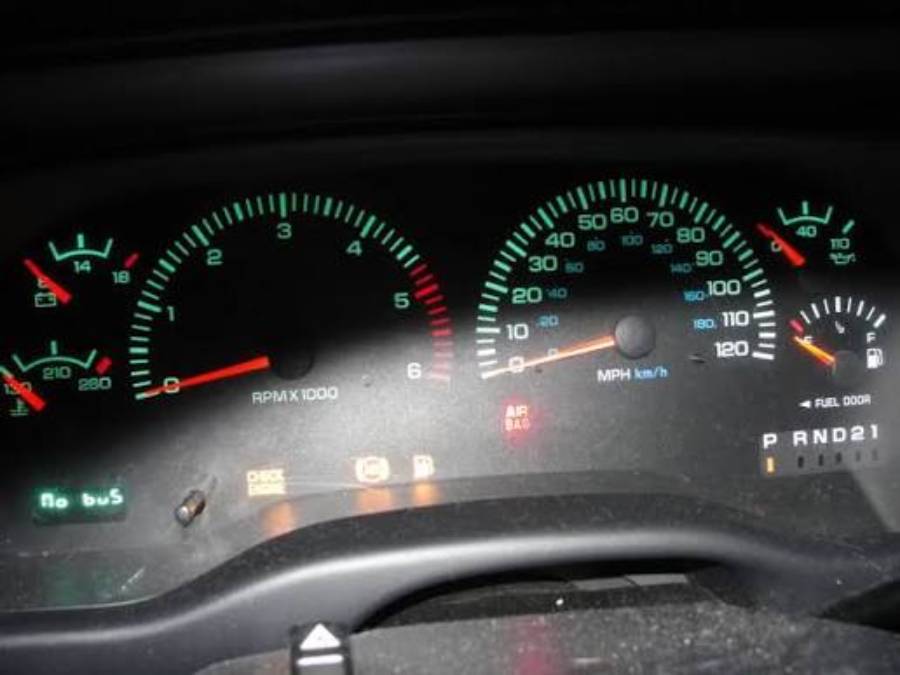
A Dodge No Bus problem means one or more electronic control modules cannot communicate correctly through the vehicle’s data network. The message may appear on the instrument cluster along with symptoms such as dead gauges, multiple warning lights, a no-start condition, intermittent stalling, or an inability to communicate with certain modules using a scan tool. The exact behavior depends on the Dodge model, model year, network design, and circuit affected.
A No Bus message does not automatically mean the Powertrain Control Module (PCM) has failed. The fault can originate from several parts of the communication system, including loss of module power, a blown fuse, a poor ground, corroded or loose connectors, damaged communication wiring, or a control module that disrupts network communication. Replacing the PCM before testing these circuits can therefore result in an unnecessary repair.
Diagnosing the Dodge No Bus problem requires a systematic process. Start with the vehicle’s power supply, fuses, grounds, connectors, and visible wiring before moving to scan-tool communication and network testing. This guide explains what the No Bus message means, which symptoms and faults are associated with it, how to isolate the cause, and which repairs can restore normal communication.
What Does “No Bus” Mean on a Dodge?
“No Bus” on a Dodge means the instrument cluster or another electronic control module has lost communication with the vehicle’s data network. The bus is the communication pathway that allows electronic modules to exchange information instead of operating as completely independent components. Depending on the Dodge model and model year, the vehicle may use different network architectures and communication protocols, so the exact circuit involved cannot be determined from the “No Bus” message alone.
Electronic modules use the communication network to exchange information needed by other systems. The Powertrain Control Module (PCM), Transmission Control Module (TCM), Body Control Module (BCM), ABS module, and instrument cluster are examples of components that may participate in these communications, depending on the vehicle. When the expected data stops reaching a module, the vehicle can display a No Bus message or develop symptoms associated with lost module communication.
A No Bus message identifies a communication problem rather than a specific failed component. For example, a module that loses its power supply cannot communicate even when the module itself is functional. The same result can occur because of a blown fuse, poor ground, damaged connector, open communication circuit, shorted wiring, or a module-related fault. This distinction is important because replacing a PCM based only on the No Bus message does not establish that the PCM caused the failure.
The diagnostic procedure must also match the specific Dodge model and model year. Older and newer Dodge vehicles do not necessarily use identical network layouts, modules, wiring arrangements, or diagnostic specifications. The vehicle’s wiring diagram and service information should therefore be used when circuit-level testing is required.
What Symptoms Can Occur With a Dodge No Bus Problem?
A Dodge No Bus problem can cause dead gauges, warning lights, scan-tool communication failures, starting problems, stalling, and other electrical symptoms. The symptoms depend on which module or section of the communication network has stopped exchanging data. A communication failure affecting information used by the instrument cluster, for example, can produce a different symptom set from a fault that interrupts communication required for engine operation.
Instrument-cluster problems are among the most visible symptoms because gauges and warning indicators depend on information received from other systems. A driver may see the No Bus message while one or more gauges stop displaying normal information. Multiple warning lights can also appear when modules stop receiving the data they expect from other controllers. These warning indicators do not necessarily mean that every system represented by the lights has independently failed.
A Dodge may also crank without starting, fail to crank normally, stall, or develop intermittent drivability problems when the communication fault affects modules required for vehicle operation. However, a No Bus message does not automatically mean the vehicle will not start. A partial network problem may allow the engine to continue running while other functions stop communicating correctly. The affected circuit and modules determine the severity of the symptoms.
Scan-tool behavior provides another diagnostic clue. A technician may find that the scanner communicates with some modules but cannot access another, or communication with the vehicle may be intermittent. This information can help narrow the diagnostic area, but it should be combined with power, ground, wiring, connector, and network tests before identifying a module as defective.
What Causes a Dodge No Bus Problem?
A Dodge No Bus problem occurs when a fault prevents one or more electronic control modules from communicating through the vehicle’s data network. The main fault areas include loss of electrical power, fuse failure, poor grounds, damaged wiring or connectors, and control-module faults. The exact cause varies by Dodge model, model year, and network architecture, so the No Bus message by itself cannot identify the failed component.
The location of the communication failure also matters. A module can stop communicating because it has failed internally, but a functional module will produce a similar communication loss if it does not receive the required voltage or ground. Network wiring can create broader problems when an open circuit or short prevents data from reaching other modules. Diagnosis should therefore establish whether the problem originates from the module, its electrical supply, or the communication circuit.
Can Power, Fuse, Ground, or Wiring Problems Cause a No Bus Message?
Yes. Power-supply, fuse, ground, connector, and wiring faults can cause a Dodge No Bus message by preventing a module from operating or communicating with the network. These electrical faults should be checked before assuming that an expensive electronic control module has failed.
Low or unstable system voltage can interfere with normal module operation. The battery and charging system supply the electrical power required by the vehicle’s control modules, while individual circuits may use separate fuses, relays, power feeds, and grounds. A module that loses one of its required power feeds may become unavailable on the network even though there is no internal failure inside the module.
A blown fuse can produce the same result when that fuse supplies a module involved in vehicle communication. Replacing the fuse alone is not always the complete repair because a fuse that blows repeatedly indicates an underlying electrical problem. A shorted wire, damaged component, or other excessive-current condition must be identified before the circuit can be considered repaired.
Poor grounds and connector problems can also interrupt communication. Corrosion, moisture intrusion, loose terminals, damaged connector pins, and high-resistance ground connections can prevent a module from receiving stable power or transmitting data correctly. Intermittent connections are particularly difficult to diagnose because the No Bus message may disappear when vibration, temperature, or connector movement temporarily restores electrical contact.
Communication wiring itself can fail through an open circuit, a short to ground, a short to voltage, or damage between communication circuits. The resulting symptoms depend on the network design and the location of the fault. For this reason, resistance and voltage specifications should come from service information for the specific Dodge model and model year rather than from a universal value applied to every Dodge vehicle.
Can a Failed Control Module Cause a Dodge No Bus Problem?
Yes. A faulty electronic control module can cause a No Bus problem when it stops communicating or interferes with communication elsewhere on the vehicle network. Potentially involved controllers include the PCM, TCM, BCM, ABS module, instrument cluster, and other network-connected modules, although the actual module set varies between Dodge vehicles.
There are two important diagnostic possibilities. First, one module may simply become unavailable while the rest of the network continues communicating. Second, an internal electrical fault in a module may affect the communication circuit itself and disrupt communication for additional controllers. These conditions can produce different scan-tool results even though the driver sees the same No Bus message.
The presence of an unresponsive module does not prove that the module has failed internally. Its power supply, ground circuits, connectors, and communication wiring must also function correctly. For example, a module with no battery feed can appear completely dead to a scan tool. Replacing that module would not correct the problem if the actual cause is a blown fuse or open power circuit.
Module isolation can help identify a controller that is interfering with network communication, but disconnecting modules should follow the wiring diagram and service procedure for the specific vehicle. Some modules require particular ignition conditions, configuration procedures, or relearn/programming after service. Randomly unplugging modules is therefore not an appropriate substitute for circuit diagnosis.
Can a Bad PCM Cause a Dodge No Bus Problem?
Yes, a faulty PCM can cause a Dodge No Bus problem, but a No Bus message alone does not prove that the PCM is bad. The PCM is one of several electronic controllers that may communicate through the vehicle network, and losing communication with it can result from either an internal PCM fault or an external electrical problem.
The PCM requires the correct power feeds, grounds, connectors, and communication circuits to operate normally. A blown PCM-related fuse, corroded connector, damaged ground, open wire, or network fault can make a functional PCM appear unresponsive. The diagnostic result may therefore resemble PCM failure even when replacing the PCM would not restore communication.
A PCM should be considered defective only after its supporting circuits have been tested against the specifications for the specific Dodge vehicle. The diagnostic process should verify required power and grounds, inspect relevant connectors and wiring, evaluate network communication, and determine whether other modules remain accessible. This sequence separates an actual PCM failure from a circuit fault that merely prevents the PCM from communicating.
Replacing a PCM without confirming the failure can also create additional cost because a replacement controller may require programming or vehicle-specific configuration. The correct repair is therefore to identify the communication fault first and replace the PCM only when diagnostic testing supports PCM failure.
How Do You Diagnose a Dodge No Bus Problem?
Diagnose a Dodge No Bus problem by checking the vehicle’s power supply and basic electrical circuits first, then testing module communication and the data network. A practical diagnostic sequence is battery and system voltage → fuses → grounds and connectors → scan-tool communication → network wiring → individual modules. Following this order helps distinguish a communication failure caused by an external circuit problem from an internally failed control module.
The diagnostic procedure should match the specific Dodge model and model year. Network architecture, module locations, connector pinouts, wiring colors, and electrical specifications can differ between vehicles. Use the appropriate wiring diagram and service information before performing circuit-level measurements or disconnecting network components.
What Should You Check Before Testing the Communication Network?
Check battery condition, system voltage, relevant fuses, module grounds, connectors, and visible wiring before testing the communication network. These components can make a functional module appear defective when they prevent it from receiving the electrical power or ground needed to operate.
Start by confirming that the battery has sufficient voltage for normal vehicle operation and that the electrical supply remains stable during the condition in which the No Bus message occurs. A weak battery, poor battery-terminal connection, or unstable supply voltage can affect multiple electronic modules at the same time. If the vehicle also has slow cranking, intermittent electrical operation, or other low-voltage symptoms, the power supply should be addressed before interpreting network behavior.
Inspect the fuses and power circuits associated with the modules that are not communicating. A visual fuse inspection can identify obvious failures, but electrical testing is more useful when a circuit must be confirmed under operating conditions. If a replacement fuse fails again, locate the short or excessive-current condition rather than repeatedly installing new fuses.
Check module grounds and connectors for loose terminals, corrosion, moisture, damaged pins, and wiring that has been stretched, crushed, rubbed through, or previously repaired. Pay particular attention to areas where symptoms change with vibration, temperature, or vehicle movement because an intermittent connection can repeatedly disconnect and reconnect a module from the network.
How Do You Find the Module or Circuit Causing the No Bus Problem?
Find the source of a Dodge No Bus problem by determining which modules still communicate, identifying which modules are unavailable, and then testing the affected module’s power, ground, and communication circuits. This approach narrows the fault area before a module is removed or replaced.
Connect a compatible diagnostic scan tool and check which control modules can be accessed. If several modules communicate normally while one controller does not respond, focus first on the unresponsive controller and its supporting circuits. Verify its power feeds, grounds, connectors, and communication wiring before declaring the module defective. Communication-related diagnostic trouble codes stored in other modules can also provide evidence about which controller or network segment has stopped responding.
A different diagnostic path is required when the scan tool cannot communicate with multiple modules or the entire vehicle network. In that situation, inspect shared power supplies, grounds, network circuits, and components capable of affecting communication across more than one controller. The location of the fault should be narrowed with the vehicle-specific wiring diagram rather than by replacing modules one at a time.
Use a digital multimeter when the diagnostic procedure requires voltage, continuity, resistance, or ground testing. Do not apply a single CAN bus resistance or voltage specification to every Dodge No Bus problem. Older and newer Dodge vehicles can use different communication architectures, and the correct test points and specifications depend on the network installed in that particular vehicle.
A suspected module can be isolated when the vehicle-specific diagnostic procedure calls for it. If network communication returns after the relevant circuit or module is safely isolated, that result provides useful evidence about the source of the fault. However, module disconnection should follow the appropriate service procedure because ignition state, retained power, network configuration, and programming requirements can affect both the test and the vehicle afterward.
The diagnosis is complete when testing identifies why communication was lost, not merely which module stopped responding. For example, finding that the PCM does not communicate is only an observation. Confirming that the PCM has correct power and ground but fails the specified communication tests provides substantially stronger evidence that the PCM itself is responsible.
How Do You Fix a Dodge No Bus Problem?
Fix a Dodge No Bus problem by repairing the electrical, wiring, network, or control-module fault identified during diagnosis. There is no single repair that applies to every No Bus message because the message describes a loss of communication rather than one specific failed component. The repair must address the confirmed cause instead of replacing parts based on the dashboard message alone.
Start with power-supply faults when diagnosis shows that a module is not receiving the electrical power it requires. This may involve correcting a poor battery connection, repairing a damaged power circuit, or replacing a failed fuse. A fuse that blows again after replacement requires further diagnosis because repeated fuse failure indicates that the underlying circuit problem has not been corrected.
Repair poor grounds and connector faults when testing identifies excessive resistance, corrosion, loose terminals, damaged pins, or moisture intrusion. A connector may require cleaning, terminal repair, or replacement depending on the damage. Wiring repairs should restore the electrical integrity of the original circuit and protect the repaired area against vibration, abrasion, heat, and moisture that could cause the problem to return.
Repair communication wiring when testing confirms an open circuit, short circuit, damaged conductor, or connector problem within the network. Follow the wiring diagram and repair procedure for the specific Dodge model and model year because network layouts and circuit requirements differ between vehicles. Avoid treating a generic communication-network specification as applicable to every Dodge vehicle.
Replace or repair a control module only after its supporting circuits have been verified. A module that does not communicate may still be functional if it has lost power, ground, or its connection to the network. If the module receives the required electrical inputs and its communication circuits test correctly but the controller remains unresponsive under the specified diagnostic procedure, an internal module fault becomes a stronger conclusion.
A replacement module may also require programming, configuration, initialization, or relearn procedures before it operates correctly with the vehicle. The exact requirements depend on the module, Dodge model, model year, and replacement procedure. Installing another module is therefore not always the final step of the repair.
After completing the repair, verify that normal communication has returned. Recheck module accessibility with the scan tool, address applicable diagnostic trouble codes, confirm that the No Bus message no longer appears, and verify that the original symptoms are gone. A repair should be considered successful only when it corrects both the communication failure and the condition that caused it.
What Should You Check Before Replacing the PCM on a Dodge?
Check PCM power, grounds, fuses, connectors, communication circuits, and the condition of the surrounding network before replacing a Dodge PCM for a No Bus problem. PCM replacement should come after circuit diagnosis because an external electrical fault can make a working PCM appear dead or unresponsive.
First, verify that all required PCM power feeds are present according to the wiring diagram for the specific vehicle. Do not assume that one good power circuit proves the PCM is receiving every required supply. A failed fuse, relay, connector terminal, or section of wiring can interrupt a required feed and prevent normal PCM operation.
Next, verify the PCM ground circuits. A poor ground can interfere with module operation even when battery voltage reaches the controller. Inspect the relevant ground points and connections for looseness, corrosion, physical damage, or other conditions that could increase electrical resistance. Testing should follow the specifications and procedures provided for the vehicle rather than relying only on visual inspection.
Inspect the PCM connectors and associated wiring before condemning the controller. Look for damaged pins, loose terminals, corrosion, moisture, rubbed-through wiring, previous repairs, and other physical defects. An intermittent terminal connection can be especially misleading because communication may return temporarily when the connector or harness moves.
The communication circuit must also be tested when PCM power and grounds are correct. Determine whether other modules communicate and whether the network reaches the PCM as designed. If multiple modules are unavailable, investigate shared network or electrical faults before treating the PCM as the primary failure.
Replace the PCM only when diagnostic evidence supports an internal PCM fault after its required external circuits have been verified. This prevents an unnecessary replacement that leaves the original No Bus problem unresolved. It also matters because a replacement PCM may require vehicle-specific programming or configuration before the Dodge can operate normally.
Which Dodge Models Can Develop a No Bus Problem?
A No Bus problem can occur on Dodge vehicles that depend on electronic control modules and a vehicle data network for communication. However, the meaning of the displayed message, network architecture, modules involved, and correct diagnostic procedure can differ by model and model year. A diagnostic method that applies to one Dodge should not automatically be applied to another.
The key distinction is the communication system installed in the specific vehicle. Dodge vehicles produced across different generations have used different module configurations and communication technologies. As vehicle electronics evolved, the number of network-connected controllers and the way those controllers exchanged information also changed. This is why the model year is diagnostically important rather than simply a vehicle-identification detail.
The same No Bus symptom can consequently originate from different circuits on different vehicles. One Dodge may have a communication failure caused by an instrument-cluster circuit, while another may have a power, wiring, or control-module problem elsewhere on the network. Even when two vehicles display the same message, the correct connector locations, wiring paths, test points, and electrical specifications may not be identical.
Identify the exact Dodge model, model year, engine configuration, and applicable network before performing detailed electrical tests. Vehicle-specific wiring diagrams and service information provide the correct module locations, connector pinouts, circuit paths, and diagnostic specifications. This approach is more reliable than using a repair procedure solely because another Dodge displayed the same No Bus message.
How Much Does It Cost to Fix a Dodge No Bus Problem?
The cost to fix a Dodge No Bus problem depends on whether the fault is caused by a basic electrical connection, damaged wiring, diagnostic labor, or a failed electronic control module. A single universal repair price is not reliable because No Bus describes a communication condition rather than a specific component failure.
Basic electrical faults generally require fewer parts than network or module failures. For example, correcting a loose connection or repairing a straightforward ground fault involves a different level of labor and material cost from tracing an intermittent communication circuit through a wiring harness. A blown fuse may be inexpensive to replace, but diagnosing the short circuit that repeatedly blows that fuse can require substantially more labor.
Wiring and connector faults vary further because accessibility affects repair time. A visible damaged wire near an accessible connector can be isolated relatively quickly, while an intermittent fault inside a harness may require extensive electrical testing. Corrosion or moisture damage can also extend the repair if multiple terminals, connectors, or sections of wiring have been affected.
Control-module replacement can add the cost of the component plus diagnosis and any required programming, configuration, initialization, or relearn procedure. PCM replacement can therefore cost considerably more than correcting a poor ground or damaged connector. However, the higher potential cost of a module is also why it should not be replaced until testing supports the diagnosis.
The most useful repair estimate is one based on the confirmed fault, vehicle identification, required parts, diagnostic time, labor rate, and programming requirements. An estimate given before the cause is identified should be treated as preliminary because two Dodge vehicles with the same No Bus message may require completely different repairs.
Can You Drive a Dodge With a No Bus Message?
Do not assume a Dodge is safe to drive simply because it still runs with a No Bus message. A communication fault can range from a limited loss of information to a failure that affects engine operation or communication with systems needed for safe vehicle operation. The symptoms accompanying the message determine how urgently the vehicle should be inspected.
A Dodge that continues running may have lost communication affecting gauges, warning information, or another electronic function without immediately stopping the engine. This does not establish that continued driving is safe. If the instrument cluster cannot display reliable vehicle information, the driver may lose information needed to recognize another developing problem.
Driving becomes more concerning when the No Bus condition occurs with engine stalling, starting problems, erratic electrical behavior, loss of critical instrumentation, or multiple system warnings. An intermittent network problem can also change while the vehicle is moving. A connection that temporarily restores itself can fail again because of vibration, temperature changes, moisture, or movement of damaged wiring.
Stop driving and arrange appropriate diagnosis when the vehicle stalls, loses functions required for safe operation, behaves unpredictably, or shows evidence of a significant electrical failure. A vehicle that will not start should be diagnosed rather than repeatedly attempting to operate it without identifying the communication fault.
A Dodge that displays No Bus but otherwise appears to operate normally still requires diagnosis because the message indicates that expected communication has been interrupted somewhere in the system. Whether the vehicle can physically move and whether it is safe to continue driving are two different questions.
Read more: Dodge Ram Ground Strap Locations That You Need To Know
How Can You Prevent Another Dodge No Bus Problem?
Reduce the risk of another Dodge No Bus problem by maintaining the battery and electrical connections, protecting wiring and connectors from damage, controlling corrosion and moisture, and correcting poor aftermarket electrical work. Not every communication failure is preventable because an electronic control module can eventually fail internally, but maintaining the circuits that support module communication can eliminate several avoidable causes.
Keep the battery, battery terminals, and charging system in good condition because control modules depend on stable electrical power. Loose or corroded battery connections can create voltage problems that affect electronic systems. If the vehicle develops slow cranking, intermittent electrical behavior, or repeated low-voltage conditions, diagnose the underlying power-supply problem rather than waiting for additional communication symptoms to appear.
Protect wiring harnesses and connectors from physical damage and moisture. Inspect wiring when repairs, collision damage, engine-bay work, or other conditions could have disturbed the harness. Abrasion against brackets or other components can damage insulation, while moisture and corrosion at connector terminals can increase resistance or interrupt an electrical connection. Repair damaged protective coverings and address water intrusion rather than treating corrosion as an isolated terminal problem.
Electrical modifications also require attention. Aftermarket accessories that are connected incorrectly can introduce power, ground, or wiring problems into existing vehicle circuits. If a No Bus condition begins after installation or modification of electrical equipment, include the altered circuits and connections in the diagnostic process.
Previous No Bus repairs should address the root cause rather than only restoring communication temporarily. For example, replacing a blown fuse may restore module operation, but the repair is incomplete if an unresolved short causes the fuse to fail again. Likewise, reconnecting a loose terminal without correcting terminal damage may allow the same intermittent communication problem to return.
When Should You Take a Dodge With a No Bus Problem to a Mechanic?
Take a Dodge with a No Bus problem to a qualified technician when the vehicle will not start, stalls, repeatedly loses communication, has multiple unavailable modules, or requires network testing or module programming beyond the available diagnostic equipment. Basic inspections can identify visible battery, fuse, connector, or wiring problems, but communication faults can require vehicle-specific wiring information and electrical testing.
Professional diagnosis is particularly appropriate when a scan tool cannot communicate with the expected modules. The technician must determine whether the failure comes from the diagnostic connection, module power or ground, communication wiring, or a controller affecting the network. Replacing the first module that fails to respond does not establish the cause because an external circuit fault can make a functional module appear unavailable.
Intermittent No Bus problems also justify deeper diagnosis when the fault repeatedly disappears before testing. Temperature changes, vibration, harness movement, moisture, and poor terminal contact can cause communication to fail only under particular conditions. Finding these faults may require reproducing the symptom while monitoring circuits or module communication rather than relying on a single static inspection.
Seek professional service promptly when the No Bus message occurs with stalling, unpredictable electrical behavior, loss of important instrumentation, or other symptoms that make continued operation unsafe. A tow may be more appropriate than driving the vehicle when the communication fault affects reliable vehicle operation.
Module replacement is another point at which professional equipment may be required. Depending on the Dodge model, model year, and controller being replaced, programming, configuration, initialization, or relearn procedures may be necessary. The objective is not simply to clear the No Bus message; it is to identify the failed circuit or component, complete the correct repair, and verify that normal module communication has been restored.