If you’ve ever shopped for a new car or compared models like the Subaru BRZ and Toyota GR86, you may have found yourself asking a common question: Does Toyota own Subaru? The close relationship between these two Japanese automakers has led many consumers to believe that Subaru is simply another brand within Toyota’s vast automotive empire.
The confusion is understandable. Toyota and Subaru collaborate on vehicle development, share technologies, and have jointly produced several popular models. Their partnership has become even more visible in recent years as both companies work together on electric vehicles and next generation automotive innovations. As a result, many drivers assume Toyota has full ownership and control over Subaru.
However, the reality is more nuanced. While Toyota is the largest shareholder in Subaru Corporation, Subaru remains an independent company with its own management, engineering teams, and brand identity. Understanding the distinction between ownership, investment, and corporate control is essential for anyone researching either brand.
In this article, we’ll break down the exact relationship between Toyota and Subaru, explain how Toyota became Subaru’s largest shareholder, explore the vehicles they develop together, and reveal what this partnership means for consumers today and in the future.
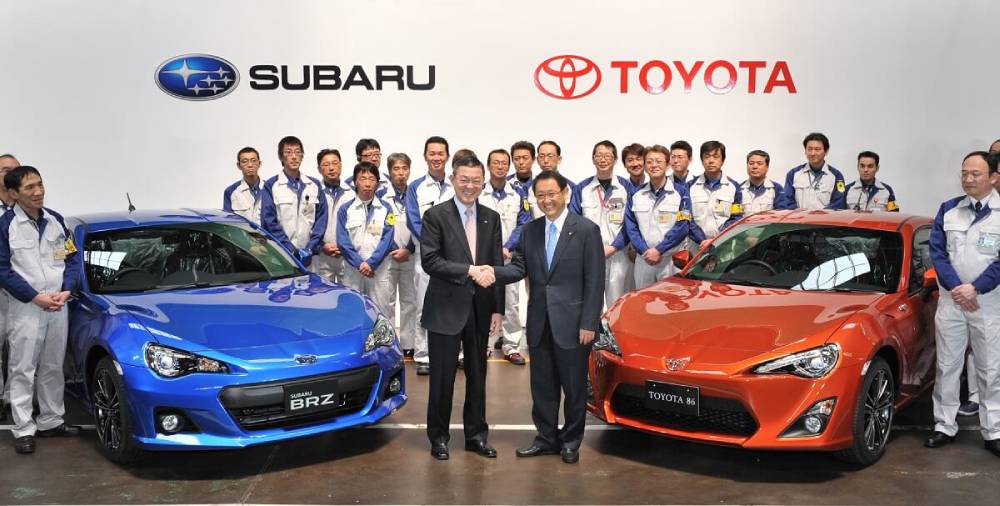
The Short Answer: Does Toyota Own Subaru?
The simple answer is no. Toyota does not fully own Subaru, nor is Subaru a subsidiary of Toyota. While the two companies maintain a close business relationship and collaborate on several vehicle projects, Subaru continues to operate as an independent automaker.
The confusion largely stems from Toyota’s significant ownership stake in Subaru Corporation. Toyota is currently the largest shareholder of Subaru, holding approximately 20 percent of the company’s shares. This ownership position gives Toyota influence as a major investor, but it does not provide complete control over Subaru’s operations, management, or strategic direction.
Many consumers assume that a large shareholding automatically means one company owns another. In reality, corporate ownership structures are often more complex. A company can be the largest shareholder without having full authority over day to day business decisions. Subaru maintains its own executive leadership team, develops its own vehicle lineup, and continues to make independent decisions regarding its future products and technologies.
As a result, the most accurate way to describe the relationship is that Toyota is a major investor and strategic partner rather than the owner of Subaru. The partnership allows both companies to share resources and expertise while preserving their individual identities in the global automotive market.
Who Actually Owns Subaru?
To understand Subaru’s ownership structure, it is important to look at the company behind the brand. Subaru vehicles are produced by Subaru Corporation, a Japanese automotive and aerospace manufacturer. The company was previously known as Fuji Heavy Industries before officially changing its name to Subaru Corporation in 2017 to better reflect the strength and recognition of the Subaru brand worldwide.
Subaru Corporation is a publicly traded company listed on the Tokyo Stock Exchange. This means ownership is distributed among a variety of shareholders, including institutional investors, investment funds, financial organizations, and individual shareholders. No single entity owns 100 percent of the company.
Toyota stands as the largest shareholder, but numerous other investors also hold significant stakes. Because ownership is spread across multiple shareholders, Subaru remains an independent corporation with its own governance structure and decision making processes.
The company’s board of directors and executive management team oversee business operations, product development, manufacturing strategies, and long term planning. While Toyota’s investment gives it a voice in certain strategic matters, Subaru retains the ability to chart its own course and maintain the unique characteristics that have made the brand popular among drivers around the world.
This independence is one reason why Subaru has successfully preserved its reputation for all wheel drive capability, safety innovation, and practical vehicle design despite its close relationship with Toyota.
The relationship between Toyota and Subaru did not develop overnight. It emerged through a series of strategic business decisions aimed at strengthening both companies in an increasingly competitive automotive industry.
The partnership began in 2005 when Toyota acquired a portion of Subaru’s shares following changes in Subaru’s ownership structure. At the time, automakers around the world were facing rising research and development costs, stricter environmental regulations, and growing pressure to invest in advanced technologies. Forming strategic alliances became an effective way to remain competitive without shouldering all development costs alone.
Toyota recognized several valuable strengths within Subaru. The company had built an excellent reputation for engineering durable all wheel drive systems and developing efficient boxer engines. These technologies complemented Toyota’s existing capabilities and created opportunities for future collaboration.
Over the years, Toyota gradually increased its ownership stake in Subaru. As the partnership expanded, the two automakers began working together on vehicle platforms, sports cars, manufacturing projects, and more recently, electric vehicle development.
One of the most famous outcomes of this collaboration is the Toyota GR86 and Subaru BRZ. These sports cars demonstrate how both companies can share engineering resources while still delivering products that appeal to their respective customer bases.
Today, Toyota’s investment reflects a long term strategic partnership rather than an attempt to absorb Subaru into its corporate structure. Both companies benefit from shared innovation while continuing to compete and operate as separate brands.
Why Did Toyota Invest in Subaru?
Toyota’s investment in Subaru was driven by more than a desire to expand its influence within the automotive industry. The partnership was built on strategic advantages that could help both companies remain competitive in a rapidly evolving market.
One of the primary reasons Toyota invested in Subaru was the company’s expertise in all wheel drive technology. Subaru has spent decades refining its symmetrical all wheel drive system, earning a strong reputation among drivers who prioritize traction, stability, and performance in challenging weather conditions. By working closely with Subaru, Toyota gained access to valuable engineering knowledge that could support future vehicle development.
Another major factor was the rising cost of research and development. Modern vehicles require significant investment in safety systems, emissions reduction technologies, connectivity features, hybrid powertrains, and electric vehicle platforms. By sharing development expenses, both companies can bring new products to market more efficiently while reducing financial risk.
The partnership also allows Toyota and Subaru to leverage each other’s strengths. Toyota contributes its vast manufacturing resources, global scale, and expertise in hybrid technology. Subaru contributes specialized engineering capabilities and a loyal customer base that values reliability and practicality. Together, they can develop vehicles that might be more difficult or expensive to create independently.
As the automotive industry moves toward electrification and advanced mobility solutions, strategic partnerships have become increasingly important. Toyota’s investment in Subaru reflects a long term vision focused on innovation, efficiency, and sustained competitiveness rather than outright ownership.
Vehicles Developed Through the Toyota Subaru Partnership
The collaboration between Toyota and Subaru has produced several notable vehicles that showcase the strengths of both companies. These projects demonstrate how two independent automakers can successfully work together while maintaining distinct brand identities.
Perhaps the best known example is the Toyota GR86 and Subaru BRZ. Both sports cars were developed using a shared platform and engineering resources. They feature similar dimensions, chassis architecture, and powertrains, yet each model has been tuned to deliver a unique driving experience. Toyota emphasizes a slightly different performance character, while Subaru focuses on its own interpretation of sports car dynamics.
Another significant project is the Toyota bZ4X and Subaru Solterra. As the global automotive market shifts toward electric mobility, both companies recognized the benefits of combining resources to develop a competitive electric vehicle platform. The result is a pair of electric crossovers that share many core components while retaining brand specific styling and features.
Beyond these headline models, Toyota and Subaru collaborate in various areas of manufacturing, technology development, and future product planning. Their partnership continues to evolve as both companies invest in electric vehicles, battery technology, advanced driver assistance systems, and next generation mobility solutions.
For consumers, these collaborations often result in higher quality vehicles, improved technology, and more efficient product development. Rather than creating identical vehicles, Toyota and Subaru seek to balance shared innovation with brand differentiation.
Does Toyota Control Subaru’s Operations?
Despite being Subaru’s largest shareholder, Toyota does not control Subaru’s day to day operations. This distinction is crucial because ownership and control are not always the same thing in the corporate world.
Toyota’s ownership stake gives it influence as a major investor, but Subaru remains governed by its own leadership team and board of directors. Decisions regarding vehicle design, product strategy, marketing initiatives, manufacturing priorities, and brand positioning are ultimately made by Subaru’s management.
Subaru continues to operate independently and maintains a unique identity within the automotive industry. The company remains committed to the characteristics that have defined the brand for decades, including standard all wheel drive on many models, strong safety performance, practical utility, and a focus on outdoor oriented lifestyles.
At the same time, Toyota and Subaru cooperate in areas where mutual benefits exist. This includes sharing development costs, exchanging engineering expertise, and collaborating on future technologies. Such cooperation allows both companies to remain competitive without sacrificing their individual brand values.
The relationship can best be described as a strategic alliance rather than a parent company and subsidiary arrangement. Toyota provides investment, support, and collaboration opportunities, while Subaru preserves its autonomy and continues to build vehicles according to its own vision.
For consumers, this means Subaru vehicles remain distinctly Subaru, even as the company benefits from one of the strongest partnerships in the automotive industry.
Benefits of the Toyota Subaru Relationship for Consumers
While corporate partnerships often focus on business objectives, the relationship between Toyota and Subaru also delivers meaningful benefits to consumers. By combining resources and expertise, both automakers can create vehicles that offer improved technology, enhanced reliability, and greater overall value.
One of the most significant advantages is access to shared engineering knowledge. Toyota is widely recognized for its manufacturing efficiency, quality control systems, and leadership in hybrid technology. Subaru, meanwhile, has earned praise for its all wheel drive systems, safety innovations, and durable vehicle platforms. When these strengths are combined, customers often benefit from vehicles that incorporate the best aspects of both companies.
The partnership also helps reduce development costs. Designing entirely new vehicle platforms requires billions of dollars in investment. By sharing certain technologies and components, Toyota and Subaru can allocate resources more efficiently while continuing to innovate. These efficiencies may ultimately contribute to more competitive pricing and better-equipped vehicles.
Another important benefit is faster technological advancement. The automotive industry is undergoing major changes driven by electrification, connectivity, and advanced driver assistance systems. Through collaboration, Toyota and Subaru can accelerate the development of new technologies and bring them to market more quickly than they might independently.
For consumers, the result is a broader selection of vehicles that combine reliability, performance, safety, and modern features. Whether purchasing a sports car, crossover, or future electric vehicle, buyers gain access to products shaped by the expertise of two respected automotive manufacturers.
Common Myths About Toyota and Subaru
The close relationship between Toyota and Subaru has led to several misconceptions. Understanding the facts can help consumers make more informed decisions when researching either brand.
One of the most common myths is that Toyota completely bought Subaru. While Toyota is the largest shareholder, it does not own Subaru outright. Subaru remains an independent company with its own leadership, business strategy, and product development processes.
Another widespread misconception is that all Subaru vehicles are simply rebadged Toyotas. This is far from the truth. Most Subaru models are designed, engineered, and manufactured specifically by Subaru. Vehicles such as the Outback, Forester, Crosstrek, and WRX maintain unique characteristics that reflect Subaru’s engineering philosophy and brand identity.
Some consumers also believe Subaru has lost its independence because of Toyota’s investment. In reality, Subaru continues to operate autonomously and has retained the qualities that attract its loyal customer base. The company’s focus on safety, all wheel drive performance, and practical versatility remains central to its product lineup.
A final myth is that Toyota makes all major decisions for Subaru. While Toyota may have influence as a significant shareholder, Subaru’s management team remains responsible for guiding the company’s direction. Strategic collaboration does not equate to corporate control.
These misconceptions often arise because partnerships in the automotive industry can appear similar to acquisitions. However, the Toyota Subaru relationship is fundamentally a collaborative alliance rather than a traditional ownership structure.
What Does the Future Hold for Toyota and Subaru?
The partnership between Toyota and Subaru is expected to grow even stronger in the coming years as both companies navigate a rapidly changing automotive landscape. Industry trends such as electrification, sustainability, autonomous driving technology, and digital connectivity are creating new opportunities for collaboration.
Electric vehicles will likely play a major role in the future of the partnership. Both companies have already demonstrated their commitment through the development of the Toyota bZ4X and Subaru Solterra. As consumer demand for electric vehicles continues to increase, additional jointly developed models may emerge across multiple vehicle segments.
Advanced safety technologies are another area where collaboration is expected to expand. Subaru’s EyeSight driver assistance system and Toyota’s extensive experience in vehicle safety research provide a strong foundation for future innovations. By sharing expertise, both automakers can continue improving accident prevention technologies and driver support systems.
The partnership may also extend into battery development, software integration, and next generation mobility solutions. As vehicles become increasingly connected and technology driven, cooperation can help both companies remain competitive while managing development costs.
Despite these growing collaborations, Subaru is expected to maintain its independent identity. The company has built a loyal global following based on its unique approach to vehicle design and engineering. Toyota’s investment appears focused on strengthening strategic cooperation rather than pursuing full ownership.
Looking ahead, consumers can expect Toyota and Subaru to continue working together where it makes sense while preserving the characteristics that make each brand distinct. This balance of collaboration and independence is likely to remain one of the defining features of their relationship for years to come.
Conclusion
So, does Toyota own Subaru? The answer is no. Toyota does not fully own Subaru, nor does it operate the company as a subsidiary. Instead, Toyota is Subaru Corporation’s largest shareholder, holding a significant ownership stake while allowing Subaru to remain an independent automaker.
The partnership between the two companies has proven highly beneficial for both sides. Toyota gains access to Subaru’s expertise in all wheel drive systems and specialized engineering, while Subaru benefits from Toyota’s vast resources, manufacturing experience, and technological leadership. Together, they have successfully developed vehicles such as the Toyota GR86, Subaru BRZ, Toyota bZ4X, and Subaru Solterra.
For consumers, this relationship delivers tangible advantages through improved vehicle development, shared innovation, and accelerated progress in emerging technologies. At the same time, Subaru continues to preserve the qualities that have made it a trusted brand among drivers worldwide.
As the automotive industry enters a new era defined by electric vehicles and advanced mobility solutions, the Toyota Subaru partnership is likely to become even more important. However, one thing remains clear: Subaru continues to chart its own path, supported by a strategic alliance that strengthens both companies without sacrificing independence.