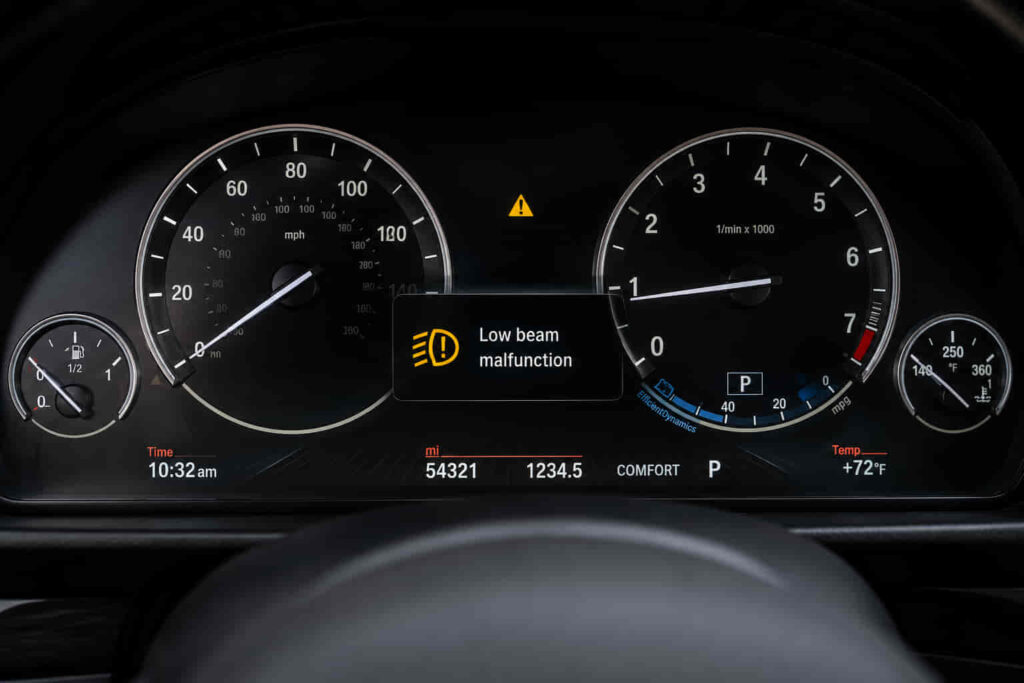
A BMW Low Beam Malfunction warning means the vehicle has detected a problem affecting the low-beam lighting system, but the warning alone does not identify which component has failed. The fault can originate from the low-beam light source, xenon ballast or related electronics, LED driver or headlight module, wiring and connectors, moisture intrusion, power or control circuitry, or a deeper software and module-communication problem. The correct diagnosis depends heavily on the headlight technology installed on the specific BMW.
This distinction matters because BMW models use different halogen, xenon/HID, and LED headlight architectures. A replaceable bulb may be the logical failure point on one system, while another BMW may depend on an LED module or electronic driver for the same low-beam function. A low beam that fails on only one side also creates a different diagnostic context from both headlights failing simultaneously, while a warning that remains after bulb replacement suggests that the complete electrical path has not yet been confirmed as functional.
The correct way to fix a BMW Low Beam Malfunction is therefore to identify the headlight type, confirm the affected side and lighting function, and trace the fault through the relevant light source, power electronics, connectors, wiring, and control system. The warning identifies the affected lighting function; diagnosis identifies the component or circuit that actually requires repair.
What Are the 7 Common Causes of a BMW Low Beam Malfunction?
The 7 common causes of a BMW Low Beam Malfunction are a failed low-beam bulb or light source, a faulty xenon ballast or ignition component, an LED driver or headlight module failure, damaged wiring or connectors, moisture intrusion, a power or lighting-control problem, and a software, coding, or module-communication fault. The relevant cause depends on the headlight technology fitted to the vehicle, so a component used in one BMW lighting system should not automatically be treated as part of another.
A failed low-beam bulb or light source is one of the most direct causes on BMW headlights that use a replaceable bulb. As the light source fails, the affected low beam stops producing the expected illumination and the vehicle can detect an abnormal lighting condition. A completely dark lamp on one side makes the light source a relevant starting point, but it does not prove that the bulb itself has failed because the same symptom can occur when power is not reaching a functional bulb. The bulb should therefore be confirmed as the failed component rather than replaced solely because the warning mentions the low beam.
A xenon ballast or related ignition component becomes relevant on BMWs equipped with xenon/HID headlights. A xenon system requires power electronics to create and regulate the electrical conditions needed for the lamp to start and operate. If that electronics layer fails, a functional xenon bulb may not illuminate correctly, may fail to start, or may operate intermittently. Replacing the bulb in this situation does not correct the fault because the component responsible for supplying and controlling the lamp remains defective.
BMWs equipped with LED headlights create a different diagnostic path. An LED low-beam system should not automatically be approached as though it contains a conventional replaceable low-beam bulb. The light output can depend on LED elements, drivers, control electronics, and modules integrated with the headlight system. A failure in the driver or associated electronics can therefore produce a low-beam malfunction even though there is no conventional bulb to replace. The specific headlight architecture must be identified before parts are selected.
Damaged wiring or an electrical connector can produce the same visible symptom as a failed light source because the low beam still depends on a reliable electrical path. A loose connection, damaged wire, poor terminal contact, or corrosion can interrupt power or communication to the affected headlight component. These faults can also produce intermittent behavior in which the low beam works at one moment and fails at another. When the malfunction changes with vehicle conditions or repeatedly returns after component replacement, the electrical path deserves closer inspection.
Moisture intrusion creates another failure mechanism because headlight assemblies contain electrical connections and electronic components that can be affected by water exposure. Significant or persistent moisture can contribute to corrosion, poor electrical contact, or damage to headlight electronics. However, visible condensation should not automatically be treated as proof that the headlight electronics have failed. The diagnostic question is whether moisture is excessive or persistent and whether there is evidence that it has affected the electrical system.
A power-supply or lighting-control problem can also prevent the low beam from operating even when the lamp-side components remain functional. The exact circuit architecture varies between BMW models and generations, so a fuse or one particular control unit should not be presented as a universal cause. Diagnosis needs to establish whether the affected headlight is receiving the electrical supply and control required by that specific lighting system. If both low beams or several exterior-lighting functions fail together, a shared power or control condition becomes more relevant than when only one lamp is affected.
The final cause is a software, coding, module-communication, or deeper electrical fault. Modern BMW lighting systems can depend on control modules and vehicle communication in addition to the physical light source. If the required components are functional but the vehicle still detects a lighting fault, diagnostic information from the relevant modules can help determine whether the system has a communication, configuration, or electronic-control problem. This becomes especially relevant when the warning persists after an obvious failed component has already been repaired.
These seven causes demonstrate why BMW Low Beam Malfunction is a description of the affected lighting function rather than a diagnosis of a specific failed part. The same warning can result from different failure mechanisms depending on whether the BMW uses halogen, xenon/HID, or LED headlights. The permanent repair begins by matching the symptom to the vehicle’s actual headlight architecture and then confirming which component or electrical path has failed.
Why Is Only One BMW Low Beam Not Working?
When only one BMW low beam is not working, diagnosis should initially focus on components and electrical paths specific to the affected headlight rather than assuming the entire lighting system has failed. The working low beam on the opposite side provides useful comparative evidence because at least part of the vehicle’s lighting system remains capable of operating.
On a replaceable-bulb system, a failed light source on the affected side is one possible explanation. On a xenon-equipped BMW, the diagnostic scope can also include the bulb, ballast, ignition electronics, local wiring, and connectors associated with that headlight. On an LED-equipped vehicle, the relevant failure points can instead involve LED electronics, a driver, a headlight module, or the electrical path serving the affected assembly. The headlight type therefore determines which components should actually be investigated.
A one-sided failure also makes local wiring and connector conditions more relevant. If a connection at the affected headlight has poor contact, corrosion, damage, or another electrical interruption, the opposite low beam can continue working because its local electrical path remains intact. Moisture confined to one headlight assembly can create a similar pattern by affecting electronics or connections on only that side.
The working side can sometimes provide diagnostic comparison, but it should not be used to justify random component swapping. A technician can compare system behavior and electrical evidence between the affected and functioning sides when the vehicle architecture permits it. The purpose is to isolate the fault, not simply to move parts until the warning changes.
Shared-system problems become more significant when both headlights or several related lighting functions fail together, but a one-sided failure does not completely eliminate vehicle-level control faults. Modern lighting systems can control left and right functions independently through electronics and communication paths. Fault information and electrical testing are therefore still necessary when local components do not explain the malfunction.
The correct distinction is one-side failure = diagnostic evidence, not component diagnosis. It narrows the likely failure area but does not establish whether the bulb, ballast, LED electronics, connector, wiring, or another component is responsible. Confirming the actual failed part prevents a simple Low Beam Malfunction warning from turning into unnecessary headlight-component replacement.
Read more:BMW ConnectedDrive Not Working
Why Does BMW Still Say Low Beam Malfunction After Replacing the Bulb?
If a BMW still displays Low Beam Malfunction after the bulb has been replaced, the original fault may involve another component in the lighting circuit, the replacement bulb may not be operating correctly, or the vehicle may still detect an electrical abnormality. Replacing the bulb addresses only the light source. It does not confirm that the ballast, driver, connector, wiring, power supply, or headlight electronics required to operate that light source are functioning correctly.
The first diagnostic question is whether the replacement bulb actually illuminates. If the new bulb remains completely off, the failure should no longer be treated automatically as a bulb problem. On a xenon/HID system, for example, the ballast and associated electronics must provide the electrical conditions required to start and operate the lamp. A functional replacement bulb cannot illuminate normally if the electronics supplying it have failed.
The same principle applies differently to BMWs with LED headlights. An LED-equipped system can rely on drivers, modules, and integrated headlight electronics rather than a conventional replaceable low-beam bulb. If the vehicle’s headlight architecture does not use a traditional bulb for the affected function, replacing or focusing on an unrelated light source cannot correct a driver or module fault. Identifying the actual lighting architecture therefore remains necessary even after previous repair attempts.
The bulb connection itself also matters. A replacement light source still depends on reliable electrical contact. A damaged connector, poor terminal contact, corrosion, or wiring fault can interrupt the circuit and produce the same Low Beam Malfunction warning that existed before replacement. Intermittent operation after the bulb has been changed makes the electrical connection particularly relevant because the light source may be functional while its supply is unstable.
A warning that remains after the low beam begins working requires a different diagnostic approach from a lamp that remains dark. The vehicle may still be detecting an abnormal electrical or control condition, or another part of the lighting system may remain faulty. Reading relevant fault information and confirming actual system operation provides more diagnostic value than assuming that every persistent warning simply needs to be manually cleared.
Randomly replacing additional parts is not the correct next step. A xenon ballast should be investigated when the xenon system provides evidence pointing toward its power electronics, while an LED module should be considered only when the vehicle actually uses that architecture and testing supports the diagnosis. This prevents a relatively specific lighting warning from becoming an expensive sequence of unnecessary component replacements.
The important distinction is replacing a bulb ≠ confirming the complete low-beam circuit is functional. A successful repair requires the light source to operate correctly, the relevant electronics and electrical path to function as designed, and the vehicle to stop detecting the condition that produced the warning.
Can Moisture Cause a BMW Low Beam Malfunction?
Yes. Significant moisture or water intrusion can contribute to a BMW Low Beam Malfunction when it reaches electrical connectors, wiring, modules, drivers, or other electronics associated with the headlight. Moisture becomes a diagnostic concern when it persists, accumulates, or produces evidence of electrical deterioration rather than simply appearing briefly as light condensation.
The failure mechanism is electrical. Water reaching a connector or electronic component can interfere with electrical contact and contribute to corrosion over time. A compromised connection can then create intermittent or complete loss of low-beam operation. If electronic modules or drivers are exposed, the resulting problem can extend beyond the light source itself, which explains why replacing a bulb may not resolve a moisture-related malfunction.
Moisture can also help explain a one-sided problem. If water enters only the left or right headlight assembly, the opposite low beam can continue functioning normally while connections or electronics on the affected side deteriorate. Visible moisture inside the same assembly that repeatedly produces the malfunction therefore has greater diagnostic relevance than unrelated condensation elsewhere on the vehicle.
However, condensation inside a headlight should not automatically be diagnosed as damaging water intrusion. The important evidence is the severity and persistence of the moisture, whether liquid accumulates, whether corrosion or electrical damage is present, and whether the condition corresponds with the lighting malfunction. This distinction prevents every trace of temporary condensation from being treated as proof that the headlight assembly or module needs replacement.
Repair also needs to address why damaging moisture reached the electronics. Replacing a corroded connector, ballast, driver, or module without correcting the underlying water-entry condition can expose the replacement component to the same environment. The malfunction may disappear temporarily and then return as moisture again reaches the electrical system.
A permanent moisture-related repair therefore follows the causal chain water entry → electrical exposure → connection or electronics damage → low-beam malfunction. The failed electrical component needs to be diagnosed and repaired, while the condition allowing significant water intrusion also needs to be corrected. Treating only the final failed component does not fully address the mechanism that caused the problem.
How Do You Diagnose a BMW Low Beam Malfunction?
Diagnosing a BMW Low Beam Malfunction starts by identifying the headlight technology, confirming which low-beam function has failed, and then testing the light source, electronics, wiring, and control path specific to that system. The warning itself identifies an abnormal condition in the low-beam system, but it does not establish whether the failed component is a bulb, xenon ballast, LED driver, connector, wiring circuit, or control module.
Headlight technology should be established before replacing parts because halogen, xenon/HID, and LED systems use different components to produce low-beam illumination. A replaceable bulb is directly relevant to a conventional bulb-based system, while a xenon headlight adds power and ignition electronics such as a ballast. An LED-equipped BMW can instead depend on drivers, modules, and integrated electronics. Diagnosing all three architectures as though they use the same low-beam bulb creates an incorrect repair path from the beginning.
The next diagnostic clue is the scope of the failure. If only one low beam is not working, components and electrical paths specific to that side deserve early attention. If both low beams or several exterior-lighting functions fail together, a shared power, control, or communication condition becomes more relevant. Flickering or intermittent operation provides different evidence from a lamp that remains completely dark because an unstable connection or electronic component can repeatedly interrupt an otherwise functional lighting circuit.
Physical evidence should then be connected to the electrical symptom. A damaged connector, loose terminal, deteriorated wiring, corrosion, or significant moisture inside the affected headlight can explain why a functional light source does not operate reliably. The objective is to determine where the electrical path stops functioning rather than replacing the component nearest to the visible symptom. This is particularly important when a new bulb has already been installed and the malfunction remains.
Diagnostic fault information can further narrow the problem because BMW lighting systems can monitor electrical and electronic conditions associated with exterior lighting. A relevant fault can identify the circuit or system in which an abnormality was detected, but a fault code is diagnostic evidence rather than automatic proof that a particular component must be replaced. The electrical condition still needs to correspond with testing and the actual headlight architecture.
Confirmation completes the diagnosis. If a bulb, ballast, LED driver, connector, wiring section, or module is identified as faulty, repairing that component should restore normal low-beam operation and eliminate the condition responsible for the warning. If the lamp works but the warning remains, diagnosis should continue instead of assuming that illumination alone proves the complete system is operating correctly.
The correct diagnostic sequence is therefore identify the headlight architecture → define the affected function and side → inspect physical and electrical evidence → evaluate relevant fault information → test the suspected circuit or component → verify the repair. This approach turns BMW Low Beam Malfunction from a generic warning into a component-specific diagnosis without relying on random parts replacement.
Can You Drive With a BMW Low Beam Malfunction?
Driving with a BMW Low Beam Malfunction can reduce forward visibility and create a safety problem, particularly at night or in low-visibility conditions, so the fault should be repaired rather than treated as a warning that can be ignored indefinitely. The practical severity depends on whether one low beam or both have failed and on the conditions in which the vehicle is being driven.
A single failed low beam reduces the vehicle’s intended road illumination and creates an uneven lighting pattern. The functioning headlight does not restore the complete beam pattern designed to illuminate the road ahead. The problem becomes more significant at night, in rain, fog, tunnels, or other environments where low-beam illumination is necessary for the driver to see and for the vehicle to remain visible to other road users.
Loss of both low beams creates a substantially greater visibility problem because the vehicle no longer has its normal low-beam road illumination. This condition should not be treated as equivalent to a minor dashboard message. If adequate required lighting is unavailable for the current driving conditions, continuing the trip can create an avoidable safety risk.
High beams are not a permanent substitute for failed low beams. The two lighting functions produce different beam patterns and are intended for different operating conditions. Using high beams around other traffic can create glare for other drivers, so the presence of functioning high beams does not eliminate the need to repair a low-beam malfunction.
Legal requirements also vary by jurisdiction, so one universal statement about whether a BMW with one failed low beam is legally permissible to drive would be inaccurate. The relevant lighting requirements depend on where the vehicle is operated. Regardless of jurisdiction, a malfunction that materially reduces required nighttime illumination should be corrected promptly.
The urgency also increases when the lighting problem is associated with electrical damage or significant water intrusion. A dark bulb caused by normal light-source failure represents a different failure mechanism from a headlight containing water, corroded electrical connections, or malfunctioning electronics. Those conditions justify diagnosing the underlying electrical problem rather than simply finding a temporary way to produce light.
The practical distinction is warning severity versus driving condition. A BMW Low Beam Malfunction does not describe the same level of immediate risk in every situation, but a vehicle with inadequate low-beam illumination should not be treated as fully functional for nighttime or poor-visibility driving. The correct resolution is to identify the failed lighting component or circuit and restore normal low-beam operation.
How Much Does It Cost to Fix a BMW Low Beam Malfunction?
The cost to fix a BMW Low Beam Malfunction depends primarily on the headlight technology and the component that has actually failed, because replacing a conventional bulb has a very different repair scope from replacing a xenon ballast, LED driver, control module, damaged wiring, or complete headlight assembly. The warning message alone therefore cannot provide an accurate repair estimate. Diagnosis must identify the failure point before cost can be evaluated meaningfully.
A replaceable low-beam bulb generally represents a narrower repair scope when the bulb itself is confirmed as the only failed component. The work involves accessing the light source, installing the correct replacement, and verifying normal operation. However, replacing a bulb becomes unnecessary expense when the actual problem is a connector, power supply, ballast, or another part of the electrical path. This is why a dark low beam should not automatically be converted into a bulb-replacement estimate.
Xenon/HID systems create a different cost structure because the bulb is only one part of the lighting system. A malfunctioning ballast or related power electronics can prevent a functional xenon lamp from starting or remaining illuminated. Access requirements also vary by BMW model and headlight assembly. The final repair cost therefore depends on whether diagnosis identifies the light source, ballast, wiring, connector, or another component rather than simply whether the vehicle displays a Low Beam Malfunction warning.
LED-equipped BMWs can involve a broader electronic repair scope. Depending on the headlight architecture, the low-beam function can depend on LED elements, drivers, modules, and integrated headlight electronics. If the failed component is serviceable separately, the repair can differ substantially from a condition requiring replacement of a larger headlight assembly. Programming, initialization, or coding requirements associated with the applicable vehicle configuration can also affect the complete repair process.
Wiring and connector faults are similarly difficult to price from the warning alone. A poor connection that is accessible and repairable has a different labor requirement from damaged wiring that must be traced through the vehicle. Moisture-related problems can increase the repair scope further because replacing an electrically damaged component without correcting the water-entry condition can allow the same failure to return.
Complete headlight replacement should therefore not be treated as the default response to a low-beam malfunction. A headlight assembly can contain multiple lighting and electronic functions, while the actual fault may be limited to a serviceable component or electrical connection. Replacing the entire assembly before confirming the failure can substantially increase repair cost without adding diagnostic certainty.
For this reason, diagnosis should come before cost estimation. The most useful repair estimate is based on the specific BMW model, headlight technology, confirmed failed component, required labor, and any programming or additional damage involved. BMW Low Beam Malfunction identifies the affected function; it does not define a universal repair price.
How Do You Permanently Fix a BMW Low Beam Malfunction?
To permanently fix a BMW Low Beam Malfunction, identify the failed light source, electronic component, wiring circuit, connector, or control system, correct the underlying fault, address any condition that caused the failure, and verify that the low beam operates normally without the warning returning. Permanent repair therefore depends on the failure mechanism rather than on clearing the dashboard message.
If diagnosis confirms a failed replaceable bulb, installing the correct light source can restore the low beam when the rest of the electrical circuit remains functional. If a replacement bulb does not illuminate or the malfunction returns, diagnosis must continue through the relevant power and control path. Repeatedly replacing bulbs cannot repair a ballast, connector, wiring, or control problem.
On a xenon-equipped BMW, the permanent repair may instead involve the ballast or related electronics when testing confirms that the bulb is functional but the required electrical conditions are not being supplied correctly. On an LED-equipped BMW, diagnosis can lead toward an LED driver, module, integrated electronics, or another system-specific component. The headlight architecture determines which repair is technically relevant.
Electrical faults require restoration of the circuit itself. A loose or corroded connector, damaged terminal, or compromised wiring can create intermittent low-beam operation even when the lamp and electronics remain functional. Repairing that electrical path restores the connection responsible for normal operation rather than masking the symptom with another light source.
Moisture-related failures require an additional step. If significant water intrusion damages a connector, ballast, driver, or module, replacing the damaged electronics addresses only the consequence. The condition allowing damaging moisture to reach the headlight also needs to be corrected. Otherwise, the replacement component can be exposed to the same failure mechanism and the malfunction can return.
Software, coding, initialization, or module-related work should likewise be performed only when it is relevant to the diagnosed system and vehicle configuration. Clearing a fault message without correcting the underlying electrical condition is not a permanent repair. Conversely, replacing physical components cannot solve a confirmed configuration or communication problem simply because the visible symptom involves the headlight.
Verification completes the repair. The affected low beam should operate consistently, the relevant electrical and electronic system should function correctly, and the vehicle should no longer detect the condition responsible for the malfunction warning. If the warning returns, the original failure mechanism has either not been fully corrected or another fault remains in the lighting system.
The permanent repair therefore follows the causal sequence identify the headlight architecture → locate the failed component or circuit → correct the failure → eliminate contributing conditions → verify normal operation. The permanent fix for a BMW Low Beam Malfunction is determined by the failed lighting component or electrical path, not by the warning message alone.