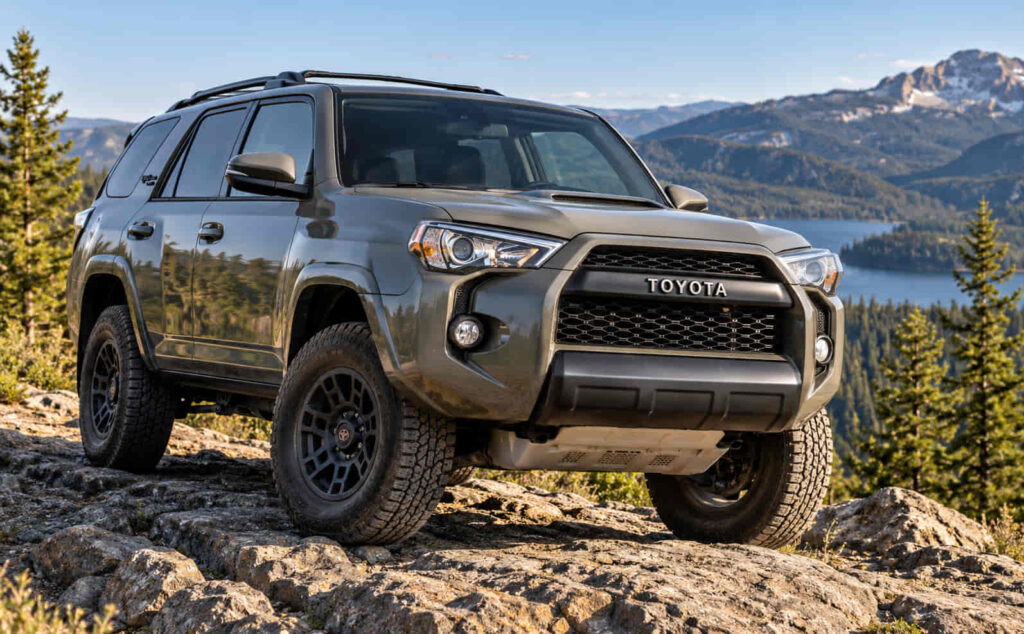
Toyota 4Runners are generally considered reliable SUVs, particularly when long-term durability and high-mileage use are the main criteria. Current iSeeCars data gives the 4Runner an 8.1/10 reliability score and estimates an average lifespan of about 217,000 miles, while a separate longevity study found the model had a 32.9% predicted chance of reaching 250,000 miles. These figures support the 4Runner’s durability reputation, but they do not mean every model year or used example will provide the same ownership experience.
A Toyota 4Runner’s actual reliability depends on the condition of its engine, transmission, four-wheel-drive system, frame, suspension, and maintenance history. Age, corrosion, previous off-road use, towing, and neglected servicing can turn an otherwise durable 4Runner into an expensive vehicle to own. Generation also matters because established models such as the fifth-generation 4Runner have years of real-world service history, while the sixth generation is still too new for an equivalent long-term durability record. Toyota confirms that the 2026 4Runner is only the second model year of the sixth generation.
The most useful reliability assessment therefore goes beyond Toyota’s reputation. It requires examining how long 4Runners last, which mechanical problems occur, how mileage affects ownership risk, and what buyers should inspect before purchasing a used example.
Are Toyota 4Runners Reliable?
Toyota 4Runners are reliable by long-term durability standards, but the strength of that conclusion is much greater for established generations than for the new sixth-generation model. Current iSeeCars research gives the Toyota 4Runner an 8.1 out of 10 reliability rating and ranks it first among midsize SUVs in its 2026 reliability analysis. The same dataset estimates an average usable lifespan of approximately 217,000 miles and a 58.8% probability of reaching at least 200,000 miles. These figures are based on a statistical model analyzing hundreds of millions of vehicles, so they provide stronger evidence for long-term durability than reputation alone.
Reliability should still be separated from the idea that every 4Runner is mechanically trouble-free. A reliable vehicle can require suspension components, wheel bearings, cooling-system parts, brakes, seals, sensors, or other age-related repairs as mileage accumulates. What matters for long-term reliability is whether the vehicle can continue providing useful service without repeated major failures that make continued ownership impractical. A 4Runner that reaches 200,000 miles may therefore qualify as durable even though maintenance and component replacement were required along the way.
Generation is one of the most important constraints on the reliability claim. The fifth-generation 4Runner remained in production from 2010 through 2024, giving owners and the used-car market more than a decade of experience with the same broad vehicle generation. Its final 2024 model retained a 4.0-liter naturally aspirated V6 producing 270 horsepower and 278 lb-ft of torque, paired with a five-speed automatic transmission. Toyota also retained body-on-frame construction and a solid rear axle for this generation. The long production period does not prove that every fifth-generation vehicle is equally reliable, but it creates substantially more long-term ownership evidence than exists for a newly introduced design.
The sixth-generation 4Runner requires a different level of certainty. Toyota introduced this generation for the 2025 model year and confirms that the 2026 model is only its second year in production. It also represents a major mechanical change: standard versions use a turbocharged 2.4-liter four-cylinder i-FORCE engine with an eight-speed automatic transmission, while i-FORCE MAX versions add a hybrid system. These powertrains cannot inherit the long-term reliability record of the previous 4.0-liter V6 simply because they carry the same 4Runner name. There has not yet been enough elapsed ownership time to establish whether a 2025 or 2026 4Runner will routinely reach the same high-mileage thresholds as older generations.
Mileage alone also does not determine whether an individual Toyota 4Runner is reliable. Two vehicles showing 150,000 miles can represent very different ownership risks if one received regular servicing and remained corrosion-free while the other experienced neglected fluid changes, heavy towing, repeated off-road impacts, or prolonged exposure to road salt. Engine condition, transmission behavior, four-wheel-drive operation, frame corrosion, service records, previous modifications, and evidence of hard use become increasingly important as a 4Runner ages.
The evidence therefore supports a clear but qualified verdict: Toyota 4Runners have strong long-term reliability and longevity records as a model line, especially among generations with extensive real-world history, but the condition and generation of the individual vehicle remain more important than the nameplate alone. This distinction is particularly important for used-car buyers because reliability statistics describe a population of vehicles, while the purchase decision concerns one specific 4Runner.
Why Are Toyota 4Runners Considered Reliable?
Toyota 4Runners are considered reliable because established generations combine demonstrated high-mileage survival with a truck-based chassis and powertrains that remained in production for extended periods. The strongest evidence is not simply Toyota’s reputation. It is the number of 4Runners that continue operating at high mileage, combined with vehicle architectures that were retained long enough to accumulate substantial real-world ownership history. iSeeCars currently estimates that a 4Runner has a 58.8% chance of reaching 200,000 miles and an average lifespan exceeding 217,000 miles, placing the model above the average midsize SUV in its durability analysis.
The fifth-generation 4Runner illustrates why the model developed this reputation. Toyota produced the generation from 2010 through 2024 while retaining its body-on-frame construction and, in its final model year, the 4.0-liter V6 and five-speed automatic transmission. A 15-model-year generation gives the same broad mechanical platform a much longer period to accumulate mileage than a vehicle architecture replaced after only a few years. This does not make a long production run a guarantee of reliability, but it allows recurring weaknesses and long-term durability characteristics to become easier to identify through service and ownership history.
Body-on-frame construction also contributes to the 4Runner’s reputation for durability, although it should not be confused with proof of reliability. In the fifth generation, the body sits on a separate frame and the rear suspension uses a solid axle with a four-link coil arrangement. Toyota designed this architecture around the loads associated with towing, rough surfaces, and off-road driving. A robust chassis can tolerate operating conditions that place greater stress on suspension and structural components, which helps explain why 4Runners are frequently kept in service for demanding applications. However, a strong frame does not prevent problems in the engine, transmission, electrical system, suspension, or the frame itself when corrosion becomes severe.
The relationship between ruggedness and reliability is therefore important. Ruggedness describes how well a vehicle is engineered to tolerate physical loads, while reliability describes its ability to continue functioning without unacceptable failure over time. A body-on-frame SUV may be structurally robust but still become unreliable if maintenance is neglected. Conversely, replacing wear components such as brakes, shocks, bushings, or wheel bearings does not automatically indicate poor vehicle reliability because those parts have finite service lives.
The 4Runner’s high-mileage reputation also benefits from the continued use of familiar mechanical configurations in earlier generations. The 2024 model still paired its naturally aspirated 4.0-liter V6 with a five-speed automatic transmission, rather than introducing an entirely new powertrain late in the generation. That consistency created a large installed population of vehicles sharing closely related components and operating characteristics. It also means the reliability evidence surrounding fifth-generation vehicles is more mature than the evidence surrounding the sixth generation.
Toyota retained the body-on-frame concept for the sixth-generation 4Runner, but the underlying architecture and powertrain changed substantially. The 2025 model moved to Toyota’s TNGA-F truck platform with a high-strength steel ladder frame, while its standard engine became a turbocharged 2.4-liter four-cylinder paired with an eight-speed automatic. The available i-FORCE MAX version adds hybrid assistance. These changes may deliver advantages in torque, efficiency, refinement, and capability, but they also mean that the historical durability of the fifth-generation V6 cannot be used as direct evidence for the long-term reliability of the new powertrain.
The Toyota 4Runner’s reliability reputation is therefore strongest when it is tied to measurable longevity and specific generations rather than to the Toyota badge alone. Older 4Runners have demonstrated the ability to accumulate substantial mileage, while long-running generations such as the fifth provide extensive ownership history. That record explains why the model is considered reliable, but maintenance quality, corrosion, previous use, and generation-specific mechanical design still determine whether an individual 4Runner deserves the same description.
Read more: VTEC vs VVT-i
How Reliable Is the Toyota 4Runner Engine?
Toyota 4Runner engines have a strong long-term durability record at the model level, but reliability should be evaluated by generation because the 4Runner has used substantially different engines over its production history. The strongest evidence currently applies to older and fifth-generation vehicles that have accumulated enough years and mileage to demonstrate longevity. iSeeCars estimates the 4Runner’s average lifespan at approximately 217,484 miles and gives it a 58.8% probability of reaching at least 200,000 miles. Those figures measure the complete vehicle rather than engine failures specifically, but a vehicle cannot consistently reach high mileage without its powertrain remaining economically serviceable for a significant portion of that lifespan.
The fifth-generation 4Runner provides the clearest case because Toyota used the generation from 2010 through 2024 and retained the 4.0-liter V6 throughout most of that period. The 2011 model used a 4.0-liter V6 producing 270 horsepower and 278 lb-ft of torque, and Toyota was still using a 270-horsepower 4.0-liter V6 in the 2024 model. The engine also used Dual Independent VVT-i to control valve timing. This long production period matters for reliability analysis because the powertrain had more than a decade to accumulate real-world mileage rather than being replaced after only a few model years.
That production consistency does not mean every 4.0-liter 4Runner engine will reach 200,000 miles without repairs. Engine reliability depends on lubrication, cooling-system condition, operating temperature, service history, previous towing load, and whether emerging leaks or abnormal noises were repaired before causing secondary damage. At high mileage, the correct question is not simply whether the internal engine can continue running. A buyer also needs to consider the condition of supporting components such as the cooling system, sensors, ignition components, seals, and accessory systems because failures around the engine can still make ownership expensive even when the basic engine remains mechanically sound.
Fourth-generation 4Runners require separate evaluation. Toyota produced that generation from 2003 through 2009 and offered both V6 and V8 configurations during its life. Toyota’s historical documentation confirms that the 2003 redesign introduced a V8 option while retaining the model’s truck-based architecture. These vehicles have now had substantially more time to demonstrate long-term durability than current models, but their age introduces a different reliability problem: a mechanically durable engine can still be attached to a vehicle with deteriorated rubber components, cooling-system parts, electrical connections, oil seals, suspension parts, or structural corrosion.
This distinction becomes especially important when comparing a 15- or 20-year-old 4Runner with a newer fifth-generation example. Age-related deterioration and engine durability are not the same thing. An engine may remain capable of high mileage while the total cost of keeping the vehicle reliable increases because surrounding components have exceeded their normal service lives. For this reason, a maintenance record showing regular fluid service and documented repairs provides more useful evidence than an assumption that a particular Toyota engine is “bulletproof.”
The sixth-generation 4Runner changes the reliability question substantially. Toyota replaced the previous naturally aspirated V6 with a 2.4-liter turbocharged four-cylinder i-FORCE engine producing up to 278 horsepower and 317 lb-ft of torque. The available i-FORCE MAX combines the 2.4-liter turbo engine with a 48-horsepower electric motor and a 1.87-kWh nickel-metal hydride battery for up to 326 horsepower and 465 lb-ft of torque. These are fundamentally different powertrains from the fifth-generation V6, so the older engine’s longevity record cannot simply be transferred to the new design.
As of 2026, there is also not enough elapsed ownership time to determine how frequently these sixth-generation engines will reach 150,000, 200,000, or 250,000 miles. RepairPal states that it does not yet have enough data to calculate an accurate annual maintenance cost specifically for the 2026 4Runner. The absence of extensive failure data should not be interpreted as proof of exceptional reliability; it primarily reflects the vehicle’s short time on the road.
The most defensible engine-reliability conclusion is therefore that established Toyota 4Runner generations have demonstrated strong high-mileage durability, with the fifth-generation 4.0-liter V6 benefiting from an unusually long production history. The 2025–2026 turbocharged and hybrid engines may ultimately establish a similar record, but there is not yet enough long-term evidence to make that conclusion with the same certainty.
How Reliable Is the Toyota 4Runner Transmission?
Toyota 4Runner automatic transmissions have generally supported the model’s high-mileage longevity, but transmission condition becomes increasingly important as mileage, towing load, heat exposure, and previous maintenance accumulate. The strongest reliability evidence again applies to established generations. The fifth-generation 4Runner paired its 4.0-liter V6 with a five-speed ECT-i automatic transmission for most of its long production run, while the sixth generation replaces that transmission with an eight-speed automatic.
The five-speed automatic is important to the fifth-generation reliability discussion because Toyota retained the same basic engine-and-transmission arrangement for an extended period. The 2010 4Runner launched with the 4.0-liter V6 and five-speed ECT-i automatic on V6 models, and Toyota was still pairing the 4.0-liter V6 with a five-speed ECT-i automatic more than a decade later. In the 2022 model, for example, Toyota continued to specify the same broad configuration while rating the 4Runner to tow as much as 5,000 pounds.
A long production history provides useful evidence, but it does not mean automatic transmission problems never occur. RepairPal identifies improper shifting at high mileage as the most commonly reported 4Runner problem in its owner-reported database. The issue has been reported across multiple model years, and RepairPal states that symptoms may appear around 125,000 to 150,000 miles in affected vehicles. Possible causes include a throttle-position sensor that requires adjustment or a shift solenoid fault, and RepairPal notes that a complete transmission overhaul is not always necessary.
That distinction is important because a shifting complaint does not automatically indicate internal transmission failure. An automatic transmission relies on hydraulic pressure, electronically controlled solenoids, sensor inputs, fluid condition, valve-body operation, and internal friction components. A fault in one control component can produce delayed, harsh, or incorrect shifting even when the main gearset remains serviceable. Diagnosing the mechanism therefore provides more useful information than simply labeling a high-mileage 4Runner as having a “bad transmission.”
Operating conditions also affect transmission durability. Towing places greater thermal and mechanical load on an automatic transmission because more torque must be transmitted while the vehicle accelerates or climbs grades. Repeated off-road driving can add low-speed load, heat, and drivetrain stress, particularly when the vehicle operates on steep or high-resistance terrain. A used 4Runner that has spent much of its life towing or off-road therefore deserves closer inspection than an otherwise comparable vehicle used mainly for highway travel, even when both show the same odometer mileage.
Transmission maintenance history becomes more important as mileage rises because fluid performs several jobs simultaneously. It transmits hydraulic pressure, lubricates internal components, removes heat, and provides the friction characteristics required by clutches and control systems. For a used 4Runner, documented service history and current shift quality provide stronger evidence than mileage alone. Hesitation when selecting drive or reverse, abnormal slipping, repeated harsh shifts, warning lights, or inconsistent shifting under load should be investigated before purchase rather than dismissed because the model has a strong general reliability reputation.
The sixth-generation 4Runner again requires a separate conclusion. Toyota pairs both the standard 2.4-liter turbo i-FORCE engine and the available i-FORCE MAX hybrid powertrain with an eight-speed automatic transmission. The hybrid version also integrates a 48-horsepower electric motor into the transmission assembly, creating a different powertrain architecture from the previous five-speed automatic.
The eight-speed transmission provides more gear ratios and works with substantially greater available torque; the i-FORCE MAX system produces up to 465 lb-ft compared with 278 lb-ft from the previous 4.0-liter V6. These design differences do not demonstrate lower reliability. They simply mean that the fifth-generation five-speed transmission’s durability record cannot serve as direct evidence for the new unit. The correct reliability judgment will require enough vehicles to accumulate significant mileage under commuting, towing, off-road, and mixed-use conditions.
The fifth-generation 4Runner’s five-speed automatic has the advantage of a long real-world service history, while the sixth-generation eight-speed transmission remains too new for an equivalent longevity assessment. On a used 4Runner, current shift behavior, maintenance records, towing history, fluid condition, and diagnostic findings should therefore carry more weight than the assumption that every Toyota 4Runner transmission is equally reliable.
How Reliable Is the Toyota 4Runner 4WD System?
The Toyota 4Runner 4WD system has a generally strong durability record, but its reliability depends heavily on transfer-case operation, differential condition, actuator function, fluid maintenance, and how the vehicle was used off-road. The 4Runner has used several four-wheel-drive configurations rather than one identical system across every generation and trim. For example, the 2024 4Runner Limited uses a full-time 4WD system with a Torsen center differential and locking function, while off-road-oriented versions use features such as a two-speed transfer case, electronic locking rear differential, A-TRAC, Multi-Terrain Select, and Crawl Control. Toyota retained this emphasis on selectable and full-time 4WD configurations in the sixth-generation model.
The core mechanical advantage of the 4Runner’s system is that low-range gearing and differential control allow drivetrain torque to be managed for difficult terrain instead of relying only on brake-based traction control. In a traditional part-time 4WD configuration, the transfer case sends power to both axles when four-wheel drive is engaged, while low range multiplies torque for slow-speed operation on steep, loose, or uneven terrain. Toyota supplements this mechanical system with electronic controls such as A-TRAC, which can use braking intervention to reduce wheelspin, and an available locking rear differential that can divide rear-axle torque more evenly when traction becomes limited.
A durable design does not make the 4WD system maintenance-free. Transfer cases, differentials, driveshafts, CV joints, seals, bearings, and electronically controlled actuators remain mechanical wear points. Their operating conditions can also be harsher than those of the same components in a road-only vehicle because off-road driving introduces greater suspension articulation, sudden traction changes, water or mud exposure, underbody impacts, and sustained low-speed torque. A 4Runner that has spent years on difficult trails therefore deserves closer drivetrain inspection than one used primarily for commuting, even when both vehicles show similar mileage.
Actuator problems are particularly important on older 4Runners because electronically controlled transfer-case or differential components can become expensive when they fail. Owner-complaint databases contain reports of failed transfer-case and differential actuators on fourth-generation vehicles, although the number of reported drivetrain complaints is too small to establish a broad failure rate for the entire generation. CarComplaints, for example, identifies actuator failure on a 2007 4Runner and transfer-case complaints on several other model years, but these reports should be interpreted as evidence that the failure can occur rather than proof that it is common across all 4Runners.
This distinction is essential when evaluating 4WD reliability. A failure database can identify components worth inspecting, but the number of submitted complaints is not the same as the percentage of vehicles that fail. The available data does not support describing transfer-case actuator failure as a universal 4Runner weakness. It does support checking that the four-wheel-drive system engages and disengages correctly, that low range operates normally where equipped, and that no warning indicators or abnormal noises appear during operation.
The fifth-generation system benefits from a long period of real-world use, while the sixth-generation setup again requires more cautious language. The 2025 redesign continues to offer two-speed transfer cases, electronically locking rear differentials on selected grades, and full-time 4WD on certain configurations, but these systems are installed on a new TNGA-F platform with new powertrains and updated electronic controls. Toyota’s specification confirms their mechanical capability, not their eventual 150,000- or 200,000-mile failure rates.
The Toyota 4Runner 4WD system should therefore be considered a durable drivetrain design rather than an indestructible one. On an older or high-mileage vehicle, actual transfer-case operation, differential condition, leaks, driveshaft behavior, service history, modifications, and evidence of heavy off-road use provide more useful reliability information than the presence of a 4WD badge alone.
What Are the Most Common Toyota 4Runner Problems?
The most commonly reported Toyota 4Runner problems involve high-mileage transmission shifting, EVAP-system faults, starter components, brake wear, and other age-related mechanical systems, but the problems vary significantly by model year and generation. RepairPal currently lists 80 reported 4Runner problems in its database, with incorrect automatic-transmission shifting at higher mileage receiving the largest number of owner reports. Other frequently reported issues include failure of the EVAP charcoal canister, worn or corroded starter-solenoid contacts, front brake rotor pulsation, brake master-cylinder problems, mass-air-flow sensor faults, front brake caliper seizure, and power-steering pump leakage. These figures identify recurring complaint themes, not failure rates for all 4Runners.
High-mileage shifting problems deserve attention because they can create the impression of complete transmission failure even when the underlying fault is related to a control component. RepairPal reports that affected vehicles may begin shifting incorrectly around 125,000 to 150,000 miles and identifies throttle-position adjustment or shift-solenoid problems among possible causes. A driver may experience delayed, harsh, or abnormal gear changes, but diagnosis is required before determining whether the transmission itself needs major internal repair. This is why a road test and diagnostic scan provide more useful purchasing information than simply assuming that any shift irregularity means the gearbox has reached the end of its life.
The EVAP system is another recurring complaint category. RepairPal lists intermittent charcoal-canister failure as the second-most-reported 4Runner problem in its database. The evaporative-emissions system stores and controls fuel vapors rather than allowing them to escape directly into the atmosphere, so a malfunction can illuminate the check-engine light even when the engine continues to run normally. This distinction matters to reliability analysis because an emissions-system warning can create repair expense without representing catastrophic engine failure. The appropriate response is to diagnose the fault code and affected component rather than classify the entire powertrain as unreliable.
Starting-system faults appear repeatedly as vehicles age. RepairPal records owner reports of worn or corroded solenoid contacts preventing the starter from operating, as well as a separate category of vehicles that fail to crank because of starter problems. Starter motors operate every time the engine is started, and their electrical contacts experience repeated mechanical and electrical cycling over the vehicle’s life. Failure at high mileage therefore represents wear of a serviceable component rather than evidence that the engine itself has failed.
Brake-related problems also appear in the reported data. Front brake rotor wear can create pulsation during braking, while some owners have reported master-cylinder replacement and front-caliper seizure. A seized caliper can create drag and excess heat, accelerating rotor and pad wear if the condition is not corrected. These faults deserve attention because brakes are both a reliability and safety system, but they should again be separated from the engine and drivetrain longevity for which the 4Runner is commonly known.
The pattern across these complaints reveals an important characteristic of high-mileage 4Runner ownership. Many recurring problems involve peripheral systems and wear components rather than immediate failure of the complete engine or drivetrain. RepairPal rates the 4Runner at 4.0 out of 5.0 for reliability and reports an average annual repair and maintenance cost of $514, with approximately 0.4 unscheduled repair visits per year. Its reported probability of a repair being classified as severe is 13%, equal to its midsize-SUV comparison average. These figures support an above-average overall reliability assessment while also showing that ownership still includes repairs.
Model year remains critical when interpreting any “common problem.” A fault reported repeatedly on an older third- or fourth-generation vehicle should not automatically be attributed to a fifth- or sixth-generation 4Runner that uses different components. Likewise, a failure reported by dozens of owners cannot be converted into a percentage risk without knowing how many vehicles were exposed to the same conditions. Complaint databases are most useful for identifying what to inspect, while model-specific recall records, service history, diagnostic findings, and a physical inspection are more useful for determining whether a particular 4Runner actually has that problem.
The practical reliability picture is therefore more favorable than a simple list of faults suggests. Toyota 4Runners can develop transmission-control, emissions, starter, brake, steering, suspension, and drivetrain problems as mileage increases, but the available repair data does not indicate that all of these failures occur broadly across every generation. A prospective buyer should use these recurring issues as inspection priorities rather than assume that they are inevitable failures.
Is Frame Rust a Serious Toyota 4Runner Reliability Problem?
Frame rust can become a serious Toyota 4Runner reliability and safety problem, particularly on older vehicles exposed to road salt, moisture, and years of underbody corrosion. The risk should not be interpreted as evidence that every 4Runner develops structural rust, but corrosion deserves separate attention because the 4Runner uses body-on-frame construction. Once corrosion progresses from surface oxidation to significant metal loss around structural rails, suspension mounting points, or crossmembers, an otherwise mechanically healthy vehicle can become unsafe or uneconomical to repair.
Owner-complaint data shows that corrosion concerns are concentrated most visibly among some older 4Runners. CarComplaints identifies body and paint problems as the largest complaint category for the model and lists excessive rust or undercarriage corrosion among the most reported problems for early fourth-generation model years. Its database records 37 body and paint complaints for the 2003 model, 28 for 2004, and 27 for 2005, although these figures represent voluntarily submitted complaints rather than failure rates across all vehicles sold. The same database identifies undercarriage rust on the 2005 model and excessive corrosion on the 2003 model among its highest-rated 4Runner problems.
The severity of frame corrosion matters more than the presence of visible rust alone. Light surface corrosion can form on exposed steel without substantially reducing structural strength. Structural corrosion occurs when oxidation removes enough material to thin, perforate, crack, or weaken load-bearing sections of the frame. Owner reports for older 4Runners include cases in which frame deterioration affected suspension mounting areas or caused vehicles to fail safety inspections. For example, reports involving the 2006 4Runner describe severe frame deterioration at mileages ranging from roughly 90,000 to 178,000 miles, while a separate group of 2006 owner complaints places reported frame-rust cases around an average of 112,950 miles. These cases demonstrate that severe corrosion can occur, but they do not establish how frequently it occurs in the entire 4Runner population.
Environment is a major part of the mechanism. Road salt and chloride-containing moisture accelerate electrochemical corrosion when they remain on exposed steel, particularly in seams, boxed frame sections, welds, mounting points, and areas where dirt retains moisture. A 4Runner operated for years in a region that heavily salts winter roads can therefore have substantially more underbody deterioration than an identical vehicle of the same mileage from a dry climate. Mileage alone does not reveal this difference.
This is why frame condition can become more important than engine mileage when buying an older 4Runner. A 180,000-mile vehicle with a solid frame and documented maintenance may remain serviceable, while a lower-mileage example with advanced structural corrosion can require repairs whose cost or safety implications outweigh the value of its otherwise healthy powertrain. An inspection should therefore distinguish cosmetic surface rust from thinning metal, perforation, compromised welds, and deterioration around suspension or drivetrain mounting points.
Frame rust is a real inspection priority for older Toyota 4Runners, but the available complaint data does not justify describing every generation as having an inevitable frame failure. Climate, storage, road-salt exposure, previous underbody care, age, and the condition of the individual frame determine the practical risk. For an older used 4Runner, structural condition should be verified physically rather than inferred from Toyota’s broader reliability reputation.
How Many Miles Can a Toyota 4Runner Last?
A Toyota 4Runner can realistically exceed 200,000 miles, and current large-scale vehicle data indicates that reaching this mileage is substantially more common for the 4Runner than for many vehicles. iSeeCars estimates the model’s average lifespan at approximately 217,484 miles, equivalent to about 16.1 years of use, and calculates a 58.8% probability of a 4Runner reaching at least 200,000 miles during its usable life. These estimates are based on analysis of more than 300 million vehicles and provide a better basis for discussing lifespan than isolated owner examples of exceptionally high-mileage vehicles.
The 217,000-mile figure should not be interpreted as a mechanical expiration point. Average lifespan describes what happens across a population of vehicles, not the exact mileage at which an individual engine or transmission fails. Some 4Runners leave service earlier because of accidents, corrosion, neglected maintenance, or repair costs unrelated to catastrophic powertrain failure. Others continue significantly beyond the average when the engine, transmission, cooling system, drivetrain, chassis, and supporting components remain economical to maintain.
A useful distinction is therefore required between engine lifespan and vehicle lifespan. An engine can remain mechanically healthy beyond 200,000 miles while suspension bushings, wheel bearings, seals, cooling components, steering parts, brakes, driveline components, electrical systems, and the body or frame accumulate age-related wear. Vehicle longevity ends when the complete vehicle becomes unsafe, unreliable, or uneconomical to keep in service, not necessarily when the engine stops running.
Maintenance history changes the probability of reaching high mileage because lubrication, cooling, and drivetrain systems depend on fluids and serviceable components remaining within acceptable operating conditions. Repeated overheating, inadequate lubrication, delayed repairs, neglected drivetrain fluids, or unresolved leaks can shorten component life even in an engine family with a strong durability record. Conversely, repairing wear items before they create secondary damage can keep the larger powertrain serviceable much longer.
Usage also changes the meaning of mileage. Two 4Runners with 180,000 miles may have experienced radically different stress histories. Long-distance highway mileage generally creates a different pattern of wear from repeated short trips, heavy towing, severe off-road operation, prolonged idling, or extensive driving in corrosive winter environments. The odometer records distance but does not record thermal cycles, drivetrain load, impact exposure, maintenance quality, or corrosion.
The model’s statistical longevity nonetheless supports its reputation. A predicted average lifespan above 217,000 miles and a 58.8% probability of reaching 200,000 miles indicate that 200,000 miles is a realistic operating range for the Toyota 4Runner rather than an exceptional theoretical maximum.
The correct high-mileage question is therefore not simply whether a Toyota 4Runner can reach 200,000 miles. The more useful question is whether the particular vehicle can reach and remain beyond that mileage without repair costs exceeding its practical value. Frame condition, engine and transmission health, drivetrain operation, maintenance records, previous use, and accumulated age-related repairs determine that outcome more accurately than odometer mileage alone.
Is 200,000 Miles Too Much for a Toyota 4Runner?
200,000 miles is not automatically too much for a Toyota 4Runner, but maintenance history and mechanical condition become more important than the odometer reading at this mileage. Current iSeeCars data estimates that the 4Runner has a 58.8% probability of reaching at least 200,000 miles and an average lifespan of approximately 217,484 miles. This means 200,000 miles falls within a realistic service range for the model rather than representing an exceptional mileage that only a small number of vehicles can achieve.
The significance of 200,000 miles changes because vehicle reliability at this point depends on more than whether the engine still runs. A high-mileage 4Runner has accumulated hundreds of thousands of suspension movements, engine heat cycles, transmission shifts, braking events, steering inputs, and drivetrain loads. Rubber seals, bushings, bearings, cooling-system components, electrical connections, suspension parts, and hydraulic systems can therefore require attention even when the engine and transmission remain serviceable. This is why a 200,000-mile 4Runner can be mechanically sound without being maintenance-free.
The condition of the powertrain remains one of the strongest indicators of whether a high-mileage example is worth buying. The engine should operate without abnormal knocking, persistent smoke, overheating, significant fluid loss, or warning lights. The transmission should engage drive and reverse normally and shift consistently under both light and heavier acceleration. This deserves particular attention because RepairPal identifies incorrect automatic-transmission shifting at high mileage as the most frequently reported 4Runner problem in its owner database, with affected vehicles commonly reported in the 125,000-to-150,000-mile range. The possible causes include control-related components such as shift solenoids rather than complete transmission failure, so abnormal shifting requires diagnosis rather than an assumption that the gearbox is finished.
Frame condition can be even more important than engine mileage on an older 4Runner. A properly maintained engine or transmission can be repaired or replaced, but advanced structural corrosion can affect the economic and physical viability of the entire vehicle. A 200,000-mile 4Runner from a dry environment with a solid frame may therefore represent a lower ownership risk than a 130,000-mile example that has spent years exposed to road salt and has significant corrosion around structural or suspension mounting areas. Odometer mileage does not record environmental exposure.
Maintenance records provide another way to distinguish between two vehicles with the same mileage. A documented service history shows whether the owner addressed routine lubrication, cooling, brakes, driveline maintenance, and emerging mechanical faults rather than allowing small problems to create secondary damage. RepairPal currently estimates average 4Runner repair and maintenance costs at approximately $514 per year across model years, below its reported midsize-SUV average of $573. This model-level average does not predict the annual cost of a specific 200,000-mile vehicle, because several age-related repairs can occur close together once components have accumulated substantial wear.
Previous use also changes the meaning of high mileage. A 4Runner that accumulated most of its mileage on long highway trips has experienced a different mechanical history from one used repeatedly for towing, rock crawling, deep-water crossings, short urban trips, or heavy winter driving. Off-road use can increase loads on wheel bearings, suspension joints, skid plates, differentials, transfer-case components, and underbody structures. Aftermarket lifts, oversized tires, or other modifications can also change suspension and driveline loads, making modification quality part of the reliability assessment.
The purchase price should therefore account for the vehicle’s remaining systems rather than the engine’s reputation alone. A high-mileage 4Runner may still have many years of usable life, but a buyer who immediately needs tires, brakes, suspension repairs, cooling-system work, drivetrain servicing, and corrosion remediation can spend a substantial amount even if no catastrophic powertrain failure occurs. Reliability and ownership cost are related but not identical concepts.
A 200,000-mile Toyota 4Runner can still be a reasonable purchase when its frame is structurally sound, its engine and transmission operate correctly, its 4WD system functions normally, and its maintenance history supports continued use. The mileage itself is not a reason to reject the vehicle. At this stage, however, a professional pre-purchase inspection becomes more valuable because the condition of the individual 4Runner determines its remaining useful life more accurately than the model’s overall reputation.
Which Toyota 4Runner Generation Is the Most Reliable?
The third-generation Toyota 4Runner currently has the strongest published generation-specific reliability score from iSeeCars, but the fifth generation can be a more practical reliability choice for many used-car buyers because it combines a long production history with substantially less vehicle age. iSeeCars gives the 1996–2002 third-generation 4Runner a 9.5 out of 10 reliability rating based on its longevity methodology, while generation-specific reliability scores for the 2003–2009 fourth generation, 2010–2024 fifth generation, and 2025-present sixth generation are currently listed as unavailable or “coming soon.” A precise ranking of every generation would therefore go beyond the data currently published by that source.
The third generation has an important durability advantage in the evidence itself: surviving examples have now had more than two decades in which to accumulate mileage. Toyota identifies this generation as running from 1996 through 2002, with available 2.7-liter four-cylinder and 3.4-liter V6 engines during the period. The high iSeeCars reliability score indicates strong longevity among vehicles represented in its dataset.
Age creates a major constraint, however. A 1996–2002 4Runner is now approximately 24 to 30 years old in 2026. Even when the original engine and transmission remain durable, corrosion, seals, hoses, suspension bushings, wiring, steering components, cooling parts, and other age-sensitive systems can materially affect reliability. A generation can therefore have excellent historical longevity while an individual surviving example still represents a significant repair risk. This is why the generation with the strongest durability record is not automatically the best used vehicle for every buyer.
The fourth generation, produced from 2003 through 2009, introduced a different mechanical package that included both V6 and V8 engines. Toyota describes the generation as retaining the 4Runner’s truck-based roots while introducing a V8 option and more sophisticated drivetrain technology. These vehicles have also accumulated enough age to demonstrate substantial long-term durability, but corrosion and age-related component deterioration become increasingly important when evaluating examples that are now approaching or exceeding two decades of service.
The fifth generation occupies a particularly strong position for buyers prioritizing long-term reliability because Toyota produced it from 2010 through 2024. iSeeCars identifies the generation as using the 4.0-liter V6 rated at 270 horsepower across the majority of its production run, creating an unusually long period in which the same broad powertrain architecture remained in service. Toyota likewise confirms the fifth generation covered 2010–2024 before the complete redesign for 2025.
A 15-model-year production span has two practical benefits for reliability evaluation. First, large numbers of vehicles have accumulated real-world mileage, making the generation less dependent on theoretical engineering predictions. Second, later examples can provide the benefits of an established powertrain without the additional 10 or 20 years of age carried by many third- and fourth-generation vehicles. A well-maintained late fifth-generation 4Runner can therefore provide a useful balance between demonstrated mechanical history and remaining vehicle age.
This does not prove that the fifth generation is statistically more reliable than the third generation. The currently published iSeeCars generation data does not provide a fifth-generation reliability score that would support that conclusion. The more accurate statement is that the third generation has the strongest published generation-specific longevity rating, while the fifth generation offers one of the strongest combinations of proven design, long production history, and comparatively younger used vehicles.
The sixth generation cannot yet compete on long-term evidence. Toyota completely redesigned the 4Runner for the 2025 model year, replacing the previous 4.0-liter naturally aspirated V6 with a 2.4-liter turbocharged four-cylinder and introducing an available i-FORCE MAX hybrid powertrain. iSeeCars currently lists reliability for both the conventional and hybrid 2025-generation 4Runner as “coming soon,” which is consistent with the limited amount of high-mileage data available for such a new vehicle.
The absence of a long-term score does not mean the sixth generation is unreliable. It means that a vehicle introduced in 2025 cannot yet demonstrate the same 150,000-, 200,000-, or 250,000-mile survival history as designs that have been on the road for one or two decades. Predicting equivalent longevity from Toyota’s brand history would substitute reputation for evidence.
For buyers who define “most reliable” strictly by published long-term longevity data, the 1996–2002 third-generation 4Runner currently has the clearest supporting score. For buyers who want demonstrated durability without purchasing a vehicle that is already several decades old, a well-maintained fifth-generation 2010–2024 4Runner is often the more practical reliability target. In either case, frame condition, maintenance history, mileage, modifications, and actual mechanical condition should override a generation-level ranking when choosing a specific vehicle.
Are Fifth-Generation Toyota 4Runners Reliable?
Fifth-generation Toyota 4Runners are generally strong candidates for long-term reliability because the 2010–2024 generation combines a long production history, an established naturally aspirated 4.0-liter V6, and a five-speed automatic transmission with extensive real-world use. This does not mean every fifth-generation 4Runner is equally reliable, but the generation has a major advantage over a newly introduced vehicle: owners have had up to 15 model years to accumulate mileage, expose recurring weaknesses, and demonstrate how the underlying mechanical package behaves as it ages. Toyota confirms that the fifth generation ran from 2010 through 2024 before the complete sixth-generation redesign arrived for 2025.
Powertrain consistency is one reason this generation is particularly useful for reliability-focused buyers. The fifth-generation 4Runner retained a 4.0-liter V6 producing 270 horsepower for most of its life, and Toyota continued using that broad engine architecture through the final 2024 model year. Rather than replacing the core powertrain every few years, Toyota kept the same general naturally aspirated V6 and five-speed automatic combination while updating technology, safety equipment, styling, and trim content around it. A long-running powertrain does not automatically prove low failure rates, but it gives buyers far more accumulated ownership evidence than a design that has only been on the road for one or two years.
The simplicity of the powertrain relative to the new generation also affects the reliability discussion. The fifth-generation V6 does not use turbocharging or an electrified hybrid system, and its five-speed automatic uses fewer ratios than the new eight-speed unit. Fewer components do not guarantee higher reliability, because component quality, lubrication, cooling, manufacturing, and maintenance matter more than simple parts count. However, a naturally aspirated engine and established automatic transmission create a mechanical configuration whose long-term service behavior is already much easier to evaluate.
The generation’s broader vehicle architecture is equally important. Toyota retained body-on-frame construction throughout the fifth generation, and the model continued using a rear solid axle and truck-oriented suspension layout. This structure was designed to support towing, rough-road use, and off-road operation, which helps explain the model’s durability reputation. Rugged construction should still be separated from reliability: suspension parts can wear, wheel bearings can deteriorate, four-wheel-drive components can require repair, and frame corrosion can undermine an otherwise healthy vehicle. The correct conclusion is that the fifth generation provides a robust foundation, not that its components are immune to aging.
High-mileage condition therefore remains more important than the generation name alone. A fifth-generation 4Runner that has covered 170,000 miles with consistent maintenance, a corrosion-free frame, normal transmission operation, and a properly functioning four-wheel-drive system can present a lower ownership risk than a 90,000-mile example with incomplete service history, off-road damage, severe underbody corrosion, or neglected fluids. The odometer measures distance but cannot show how the vehicle was maintained or what loads it experienced.
RepairPal’s model-wide data supports the broader reliability reputation without suggesting that repairs disappear entirely. The 4Runner currently receives a 4.0 out of 5.0 reliability score, compared with 3.5 for the average midsize SUV in its methodology. RepairPal reports approximately $514 in average annual repair and maintenance costs across the 4Runner population, compared with $573 for midsize SUVs. These figures cover multiple model years rather than the fifth generation alone, so they should support the overall context rather than be treated as a generation-specific failure rate.
The most important limitation is that published generation-specific statistical ratings remain incomplete. iSeeCars currently lists a reliability rating for the 1996–2002 generation but marks its 2010–2024 generation rating as unavailable because it does not yet provide a sufficient generation-specific score under that methodology. It would therefore be inaccurate to assign the fifth generation a numerical reliability rating or claim that data proves it is the single most reliable 4Runner generation. What can be established is that the generation combines 15 model years of production with an established powertrain and a large population of vehicles that have accumulated significant real-world mileage.
For most buyers seeking a used 4Runner primarily for long-term reliability, the fifth generation offers one of the strongest balances between proven mechanical history and vehicle age. It avoids much of the age-related deterioration found on many third- and fourth-generation examples while providing far more long-term evidence than the sixth generation. The safest purchase is still determined by maintenance records, frame condition, engine and transmission behavior, four-wheel-drive operation, modifications, and a professional inspection rather than by choosing a 2010–2024 model automatically.
Are 2025 and 2026 Toyota 4Runners Reliable?
It is too early to establish the long-term reliability of the 2025 and 2026 Toyota 4Runner because the sixth generation has not been on the road long enough to produce meaningful 150,000-, 200,000-, or 250,000-mile durability data. Toyota introduced the completely redesigned sixth generation for the 2025 model year, and Toyota describes the 2026 4Runner as only the second year of that generation. Any statement that these models have already proven the same long-term reliability as a fifth-generation 4Runner would therefore exceed the available evidence.
The distinction matters because the 2025 redesign changed far more than exterior styling. Toyota moved the 4Runner to its TNGA-F truck platform with a high-strength steel ladder frame and introduced a new powertrain family. Standard models use a turbocharged 2.4-liter four-cylinder i-FORCE engine producing up to 278 horsepower and 317 lb-ft of torque, paired with an eight-speed automatic transmission. Available i-FORCE MAX versions combine the same basic turbocharged engine architecture with an electric motor for up to 326 horsepower and 465 lb-ft.
These changes break the direct reliability continuity with the fifth-generation 4.0-liter V6 and five-speed automatic. Turbocharging introduces components and operating conditions that the previous naturally aspirated engine did not use in the same way, including forced-induction hardware and higher specific output from a smaller displacement. The i-FORCE MAX configuration additionally incorporates an electric motor and hybrid battery system. An eight-speed automatic also replaces the previous five-speed transmission. None of these changes proves that the new 4Runner is less reliable; they simply mean that the longevity history of the outgoing powertrain cannot be used as direct evidence for the new one.
The correct distinction is between engineering capability and demonstrated longevity. Toyota can document what the new engine, hybrid system, transmission, frame, and four-wheel-drive hardware are designed to do. For example, the i-FORCE MAX powertrain provides 465 lb-ft of torque, and the TNGA-F platform uses a boxed steel ladder frame shared with other Toyota truck products. Those specifications establish the design and performance characteristics of the sixth generation, but they cannot show how often its components will require major repairs after 10 or 15 years.
Independent longevity data reflects this limitation. iSeeCars currently lists reliability for the 2025 conventional 4Runner as unavailable because of insufficient data, while the generation page likewise does not provide a demonstrated long-term reliability rating for the new generation. This absence should not be interpreted negatively. A vehicle introduced in 2025 simply cannot yet have a population of ordinary owners who have accumulated two decades or several hundred thousand miles of service.
Early ownership data can still identify manufacturing defects, recalls, software issues, drivability complaints, or component problems, but those indicators answer a different question from long-term reliability. A first- or second-year vehicle can perform well during its initial ownership period and still lack evidence about durability at 200,000 miles. Conversely, early problems can be corrected through updated components, software, production changes, or service campaigns and may not define the complete generation. Long-term reliability requires both sufficient mileage and sufficient time.
The sixth generation also requires buyers to consider whether they prioritize proven durability or newer engineering. A fifth-generation 4Runner offers an older platform and powertrain with substantially more ownership history. A 2025 or 2026 model offers newer technology, more torque, an eight-speed transmission, updated safety systems, and an available hybrid powertrain, but buyers accepting those benefits are also choosing a vehicle whose full longevity record has not yet been established.
This does not mean a reliability-focused buyer should automatically avoid the 2025 or 2026 model. Toyota continues to use body-on-frame construction and positions the 4Runner as a vehicle engineered for demanding on- and off-road use. The new TNGA-F platform is also shared across several Toyota truck-based products. These facts provide relevant engineering context, but they remain different from statistical evidence showing how long sixth-generation 4Runners actually last.
The most accurate verdict in 2026 is that the 2025 and 2026 Toyota 4Runners are too new to receive a proven long-term reliability rating comparable with older generations. There is no sound evidence at this stage that they are inherently unreliable, but there is also not enough high-mileage history to assume they will match the longevity of the fifth-generation V6. Buyers who place maximum value on demonstrated reliability have more evidence available with an established fifth-generation example, while buyers choosing the sixth generation should evaluate current recalls, service information, warranty coverage, and early ownership data separately from long-term durability.
Does Off-Road Driving Reduce Toyota 4Runner Reliability?
Off-road driving can increase wear on a Toyota 4Runner, but it does not automatically make the vehicle unreliable because the 4Runner is specifically engineered to operate on rough terrain. The reliability effect depends on terrain severity, driving technique, vehicle modifications, impact damage, water and mud exposure, and the maintenance performed afterward. A 4Runner used occasionally on maintained dirt roads experiences a very different mechanical load from one repeatedly driven over rocks, deep mud, water crossings, steep grades, and high-speed desert terrain.
Toyota equips the 4Runner with hardware intended to manage these conditions. On the 2026 model, four-wheel-drive versions use an electronically controlled two-speed transfer case with high and low ranges, while TRD Off-Road, TRD Pro, and Trailhunter grades receive an electronic locking rear differential. Toyota also offers Multi-Terrain Select, CRAWL Control, underbody protection, and specialized suspension systems depending on trim. These components demonstrate that off-road operation is an intended use of the vehicle rather than an operating condition automatically outside its design envelope.
The mechanical loads created by off-road driving are nevertheless different from normal paved-road use. Uneven surfaces require greater suspension articulation and repeatedly load shocks, springs, control-arm bushings, ball joints, wheel bearings, steering components, and axle assemblies. Large impacts can damage wheels, alignment components, skid plates, exhaust parts, or the frame. When one wheel suddenly gains traction after spinning on a loose surface, torque can also be transferred rapidly through axles, differentials, driveshafts, and the transfer case. The 4Runner is designed to tolerate substantial drivetrain loads, but repeated severe loading still contributes to wear over time.
Low-range operation presents another important reliability relationship. A two-speed transfer case multiplies torque at low vehicle speeds so the 4Runner can climb, descend, or move through difficult terrain without requiring excessive speed. Toyota’s CRAWL Control similarly regulates throttle and braking at low speeds to help the vehicle negotiate challenging surfaces. These systems can reduce some driver-induced stress by controlling wheelspin and vehicle speed, but they cannot prevent mechanical damage caused by striking rocks, exceeding available traction, or subjecting the drivetrain to repeated shock loads.
Mud and water create different reliability risks because they can contaminate or accelerate deterioration around components that normally remain relatively protected on paved roads. Mud can accumulate around suspension, brakes, skid plates, and cooling areas, while water exposure can affect bearings, connectors, breather systems, and lubricated drivetrain components when seals or venting systems are compromised. Road salt and moisture retained in accumulated dirt can also contribute to corrosion. A vehicle that is cleaned and inspected after demanding trail use can therefore have a different long-term condition from one on which mud and debris remain trapped against the underbody.
Modifications add another variable. Larger tires increase rotating mass and can alter loads on wheel bearings, steering components, gearing, brakes, and driveline parts. Suspension lifts change suspension geometry and can increase operating angles at CV joints and related components depending on the design. Aftermarket skid plates, bumpers, winches, roof loads, and recovery equipment also add vehicle weight. None of these modifications automatically causes poor reliability, but installation quality and the resulting mechanical loads should be considered when evaluating a modified used 4Runner.
Toyota’s own design illustrates why the vehicle should be assessed according to the severity of its use rather than whether it has ever left pavement. The 2026 TRD Pro uses adjustable FOX shocks with remote reservoirs, while the Trailhunter uses Old Man Emu forged monotube shocks designed around off-road control and load capacity. Toyota also reinforces the platform with frame crossmembers and provides dedicated underbody protection on off-road-focused trims. These components are intended to increase capability and durability under demanding use, but wear still accumulates as the vehicle absorbs repeated loads.
For a used-car buyer, evidence of off-road use should therefore trigger a more detailed inspection rather than an automatic rejection. Underbody impacts, leaking shocks, uneven tire wear, damaged skid plates, torn CV boots, wheel-bearing noise, steering play, fluid leaks, and incorrect 4WD operation provide more meaningful information than scratches or dirt alone. A carefully maintained off-road 4Runner can remain highly reliable, while a vehicle that appears cosmetically clean can have mechanical problems caused by neglected use.
Off-road driving can reduce Toyota 4Runner reliability when it repeatedly subjects the suspension, drivetrain, frame, and underbody to severe loads without corresponding inspection and maintenance. Normal trail use within the vehicle’s intended capability does not make a 4Runner inherently unreliable. The decisive factors are how hard the vehicle was used, whether damage occurred, and whether maintenance followed that use.
Are Toyota 4Runners Expensive to Maintain?
Toyota 4Runners are not unusually expensive to maintain when compared with other midsize SUVs, although an older or high-mileage example can become costly when several wear items require replacement at the same time. RepairPal currently estimates average annual repair and maintenance costs for the Toyota 4Runner at $514, compared with $573 for the average midsize SUV and $652 across all vehicle models in its database. RepairPal also gives the 4Runner a 4.0 out of 5.0 reliability rating.
The $514 figure should not be interpreted as a fixed yearly budget for every owner. RepairPal calculates the number across multiple model years and ownership situations, while the actual cost for one 4Runner changes according to mileage, age, location, labor rates, drivetrain configuration, previous maintenance, and current mechanical condition. A relatively new 4Runner requiring only scheduled servicing can cost substantially less in a given year, while a 200,000-mile vehicle that needs suspension, brakes, wheel bearings, cooling-system work, and seals can cost several times the model-wide average.
The difference between maintenance and reliability is particularly important. A vehicle can be reliable while still requiring routine maintenance and age-related component replacement. Engine oil, filters, tires, brakes, fluids, belts where applicable, spark plugs, and other service items are expected operating expenses rather than evidence of a defective vehicle. Reliability becomes a different concern when unexpected failures occur frequently or when major components repeatedly require expensive repair.
RepairPal’s frequency data helps make this distinction. The platform reports that 4Runner owners average approximately 0.4 unscheduled repair-shop visits per year, which is equal to the midsize-SUV average. It also estimates a 13% probability that a repair will be classified as severe, again equal to the midsize-SUV comparison figure in its methodology. The 4Runner’s relatively favorable overall rating therefore comes mainly from the combined relationship between repair cost, frequency, and severity rather than from an absence of repairs.
High mileage changes the cost structure because multiple components can approach the end of their service lives during the same ownership period. A vehicle may need brake components one year, suspension work the next, and a cooling-system or drivetrain repair later. RepairPal’s current 4Runner cost database illustrates the possible range: a transfer-case output-shaft seal is estimated at roughly $350–$504, while certain less common repairs such as a knock sensor can exceed $2,000 depending on the repair required. These examples show why average annual cost and the cost of an individual repair are different measurements.
Maintenance requirements also extend beyond engine oil. RepairPal’s 4Runner maintenance schedule database identifies 40 types of services across the first 150,000 miles. The exact schedule depends on model year, engine, drivetrain, mileage, and operating conditions, so a universal interval should not be applied to every 4Runner. The practical reliability principle is that fluids and wear components should be serviced according to the applicable Toyota schedule rather than waiting for a failure symptom to appear.
Four-wheel-drive models introduce additional serviceable systems because they contain transfer-case, differential, axle, and associated drivetrain components that two-wheel-drive vehicles do not use in the same configuration. This does not mean a 4WD 4Runner is inherently expensive to own. It means there are additional lubricated and mechanically loaded components whose condition should be monitored, particularly after towing, water crossings, or extensive off-road use.
Tires can also affect ownership cost more than a reliability score suggests. A body-on-frame SUV uses comparatively large tires, and off-road-oriented models may use all-terrain designs whose replacement cost is greater than that of smaller passenger-car tires. Incorrect alignment, worn suspension components, or aggressive off-road use can accelerate tread wear. Tires are not normally classified as mechanical failures, but they still influence the real cost of keeping a 4Runner roadworthy.
The new sixth-generation 4Runner requires a separate cost caveat. RepairPal states that it does not yet have enough data to calculate an accurate annual maintenance cost specifically for the 2026 Toyota 4Runner. This is consistent with the vehicle’s short production history and reinforces why the model-wide $514 figure should not be treated as a proven cost estimate for the new turbocharged and hybrid generation.
Long-term ownership cost therefore depends heavily on the condition at purchase. A cheaper high-mileage 4Runner can become expensive if the previous owner deferred major maintenance, while a more expensive example with documented servicing and recently replaced wear components may require less immediate spending. This relationship becomes particularly important above 150,000 or 200,000 miles because purchase price alone does not reveal accumulated maintenance liability.
Toyota 4Runners are not exceptionally expensive to maintain as a model line, but high-mileage ownership can produce substantial individual repair bills even when the vehicle remains fundamentally reliable. A realistic ownership assessment should therefore consider routine maintenance, wear components, age-related repairs, tire and brake costs, four-wheel-drive servicing, and the condition of the specific vehicle rather than relying only on an average annual figure.
What Should You Check Before Buying a Used Toyota 4Runner?
Before buying a used Toyota 4Runner, inspect its maintenance history, frame condition, engine, transmission, four-wheel-drive system, suspension, modifications, and evidence of previous hard use rather than relying on mileage or Toyota’s reliability reputation alone. A 4Runner can remain serviceable beyond 200,000 miles, but high model-level durability does not establish the condition of an individual vehicle. iSeeCars currently estimates that the 4Runner has a 58.8% probability of reaching at least 200,000 miles and an average lifespan of approximately 217,484 miles, making condition and maintenance history particularly important when deciding whether a high-mileage example still has useful life remaining.
Maintenance records should be evaluated first because they show how the vehicle accumulated its mileage. Evidence of regular oil service, cooling-system maintenance, brake work, drivetrain servicing, and repairs provides more useful information than an odometer reading by itself. A 4Runner that accumulated 180,000 miles with documented maintenance can present a lower risk than a vehicle showing 100,000 miles with long service gaps, unresolved warning lights, fluid leaks, or no verifiable maintenance history. The objective is not to find a vehicle that has never required repairs; it is to determine whether required maintenance was performed before wear or minor faults created larger mechanical problems.
Frame condition deserves equal priority on older 4Runners. Surface oxidation should be distinguished from structural corrosion affecting frame rails, crossmembers, welds, or suspension mounting points. Because the 4Runner uses body-on-frame construction, serious deterioration in these areas can affect the viability of the entire vehicle even when the engine and transmission operate correctly. Inspection becomes particularly important for vehicles that spent years in areas where road salt is used because mileage does not indicate corrosion exposure. A mechanically strong powertrain cannot compensate for a frame that has lost significant structural material.
The engine should be evaluated both cold and at normal operating temperature. Starting behavior, oil or coolant leaks, abnormal mechanical noise, exhaust smoke, warning lights, operating temperature, and overall running quality can reveal problems that a short warm-engine test drive may miss. A clean engine bay should not be treated as evidence of proper maintenance because cleaning can remove visible signs of recent leaks. Service documentation and a physical inspection provide stronger evidence of engine condition.
Transmission behavior should be tested under several operating conditions because high-mileage shifting faults appear in 4Runner repair data. The transmission should engage drive and reverse without abnormal hesitation and should shift consistently during light and stronger acceleration. RepairPal identifies incorrect automatic-transmission shifting at higher mileage among the most frequently reported 4Runner issues, while also noting that faults such as shift-solenoid or control problems do not necessarily require complete transmission replacement. Abnormal shifting should therefore be diagnosed rather than dismissed or automatically classified as catastrophic transmission failure.
The four-wheel-drive system should also be operated before purchase rather than assumed functional because the dashboard contains a 4WD indicator. Where the vehicle is equipped with selectable four-wheel drive, low range, a locking differential, or other drivetrain functions, those systems should engage and disengage normally under the conditions specified by Toyota. Unusual noises, warning lights, fluid leakage, delayed engagement, or actuators that fail to complete a mode change deserve further diagnosis. This inspection becomes more important on vehicles that have spent significant time off-road because their transfer case, differentials, axle components, driveshafts, bearings, and underbody may have experienced greater mechanical loads.
Suspension and steering condition provide additional evidence about previous use. Uneven tire wear can indicate alignment problems, worn components, or altered suspension geometry. Excessive play, knocking over bumps, wheel-bearing noise, leaking shock absorbers, damaged control components, or inconsistent steering behavior can indicate accumulated wear. These faults do not necessarily make the 4Runner itself unreliable, but repairing several suspension and steering components immediately after purchase can materially change the economics of buying an older vehicle.
Aftermarket modifications require closer examination rather than automatic rejection. Suspension lifts, oversized tires, aftermarket wheels, bumpers, winches, skid plates, and other off-road equipment can increase capability when properly engineered, but they can also alter driveline angles, steering geometry, wheel-bearing load, braking demand, vehicle weight, and suspension travel. Installation quality therefore matters as much as the presence of the modification. Evidence of poorly routed wiring, improvised fabrication, tire contact, damaged CV boots, or severe underbody impacts should increase the level of inspection.
The final evaluation should combine these systems instead of judging them independently. A low purchase price becomes less attractive when the vehicle simultaneously needs tires, brakes, suspension repairs, corrosion work, fluid servicing, and drivetrain diagnosis. RepairPal’s model-wide data reports average annual Toyota 4Runner repair and maintenance costs of $514, but this is a fleet-level average across model years and cannot predict the first-year repair bill for a neglected used example.
A professional pre-purchase inspection is therefore one of the most useful steps before buying a used Toyota 4Runner, especially when the vehicle is older, modified, heavily used, or above 150,000–200,000 miles. The inspection should establish whether the specific vehicle’s remaining mechanical and structural condition supports the longevity suggested by the 4Runner’s overall reliability record. Model reputation can identify a promising vehicle; inspection determines whether the individual example deserves that reputation.
Is a Toyota 4Runner Worth Buying for Long-Term Reliability?
A Toyota 4Runner is a strong choice for long-term reliability when the buyer selects a well-maintained example with a sound frame and healthy powertrain, particularly from a generation with an established high-mileage history. Current longevity data supports this conclusion at the model level. iSeeCars gives the 4Runner an 8.1 out of 10 reliability score, ranks it first among midsize SUVs in its 2026 reliability study, and estimates a 58.8% probability of reaching 200,000 miles. A separate iSeeCars longevity study gives the 4Runner a 32.9% predicted chance of reaching 250,000 miles, compared with a 4.3% average across SUVs in that analysis.
These figures provide stronger support for the 4Runner’s reputation than statements that it is simply “bulletproof.” Reliability is probabilistic rather than absolute. A high proportion of vehicles surviving to high mileage indicates durable design and ownership potential, but it does not guarantee that one particular vehicle will reach 250,000 miles without significant repair. Maintenance history, climate, corrosion, towing, off-road use, accidents, modifications, and previous repairs can move an individual 4Runner far above or below the model-level expectation.
Repair-cost data also supports the 4Runner as a reasonable long-term ownership choice. RepairPal rates the model 4.0 out of 5.0 and reports an average annual repair and maintenance cost of $514, below its midsize-SUV average of $573. Owners average approximately 0.4 unscheduled repair visits per year, and RepairPal classifies 13% of repairs as severe, equal to its midsize-SUV average. The 4Runner therefore combines favorable overall dependability with ownership costs that are not unusually high for its class, although these averages cannot predict expenses on an individual high-mileage vehicle.
The fifth-generation 2010–2024 4Runner presents a particularly compelling long-term reliability case for used buyers because it combines an established mechanical design with vehicles that are generally younger than third- and fourth-generation examples. Its long production period also means the generation has had substantial time to accumulate real-world mileage. A later fifth-generation vehicle can therefore offer a balance between proven powertrain history and lower age-related deterioration than a 20- or 25-year-old 4Runner.
Older third- and fourth-generation 4Runners can still be excellent long-term vehicles, but age increasingly competes with original engineering quality. A durable engine and transmission do not prevent deterioration of frame steel, seals, bushings, cooling components, wiring, suspension parts, or other systems after two or three decades. Buyers seeking long-term reliability should therefore evaluate older vehicles according to present condition rather than assume that an older generation is automatically preferable because it has demonstrated high mileage.
The sixth-generation 2025–2026 4Runner requires the opposite consideration. It is substantially newer but lacks equivalent long-term mileage evidence. Toyota confirms that the 2026 model is only the second year of the sixth generation, which uses new 2.4-liter turbocharged i-FORCE and available i-FORCE MAX hybrid powertrains rather than the previous 4.0-liter naturally aspirated V6. The new generation may eventually develop a strong longevity record, but two model years cannot provide the same durability evidence as powertrains that have operated for more than a decade.
This difference makes the purchase decision dependent on the buyer’s definition of reliability. Someone who prioritizes proven long-term durability has stronger evidence available from established generations, particularly well-maintained fifth-generation vehicles. Someone purchasing a sixth-generation 4Runner receives newer engineering, technology, safety systems, higher available torque, and warranty coverage, but accepts greater uncertainty about performance at very high mileage because sufficient time has not yet passed.
High resale demand can also change the economics of the decision. Reliability does not automatically make a vehicle good value if the purchase price substantially exceeds alternatives. A buyer paying a premium for a used 4Runner should therefore consider how much of that premium is supported by actual vehicle condition. A poorly maintained 4Runner does not become a better long-term investment merely because the model has strong longevity statistics.
The strongest buying decision combines four variables: powertrain condition, structural condition, maintenance history, and previous use. Mileage becomes meaningful only when interpreted through those variables. A 170,000-mile 4Runner with extensive service documentation, clean fluids, normal drivetrain operation, and a structurally solid frame can present a stronger long-term ownership case than an 80,000-mile vehicle with corrosion, questionable modifications, neglected servicing, or evidence of severe off-road abuse.
Toyota 4Runners are worth considering for long-term reliability because large-scale data shows that the model has an above-average ability to remain in service at high mileage. The strongest purchase is not automatically the newest 4Runner, the lowest-mileage example, or the generation with the best reputation. It is the individual vehicle whose condition demonstrates that its engine, transmission, drivetrain, frame, and maintenance history can continue supporting the long service life for which the 4Runner is known.